
Kids and teens · Bullying prevention for ages 6 to 13 · Updated 2026-11-04
Bullying worksheets for kids: what bullying is (and is not), upstander activities, and a free printable
Ready-made printable: Bullying Small Group Curriculum Holiday 20% off: about $11.04, was $14 (EUR 12) · instant digital download
Buy on EtsyTry it free first: download session 1 free (group at a glance, lesson plan and student page, PDF, 74 KB). Run it with your group, then get all 8 sessions. No email needed.

Almost every adult who works with children has heard some version of it: "She said I can't sit with them again." "They keep taking my stuff on the bus." "Everyone in the group chat is laughing at me." Some of these moments are bullying. Some are a one time mean comment, and some are ordinary friction between kids who are still learning how to get along. Children need help telling the difference, and they need a plan for what to do in each case.
This guide is for school counselors, teachers, social workers, therapists and parents of children about 6 to 13. It explains how bullying is defined in research and policy, what the most recent US numbers show, what the evidence says actually reduces bullying, and how to teach kids to sort, respond to and report it. At the end there is a free three page printable with an Is It Bullying? sorting activity, an Upstander Plan and a Report and Support Plan.
Jump to the free bullying worksheets for kids
What is bullying? The definition kids and adults can share
In 2014 the CDC and the US Department of Education published a uniform definition so that schools, researchers and states would mean the same thing when they say "bullying". StopBullying.gov uses the same core idea: bullying is unwanted aggressive behavior among school aged children that involves a real or perceived power imbalance and is repeated, or has the potential to be repeated.
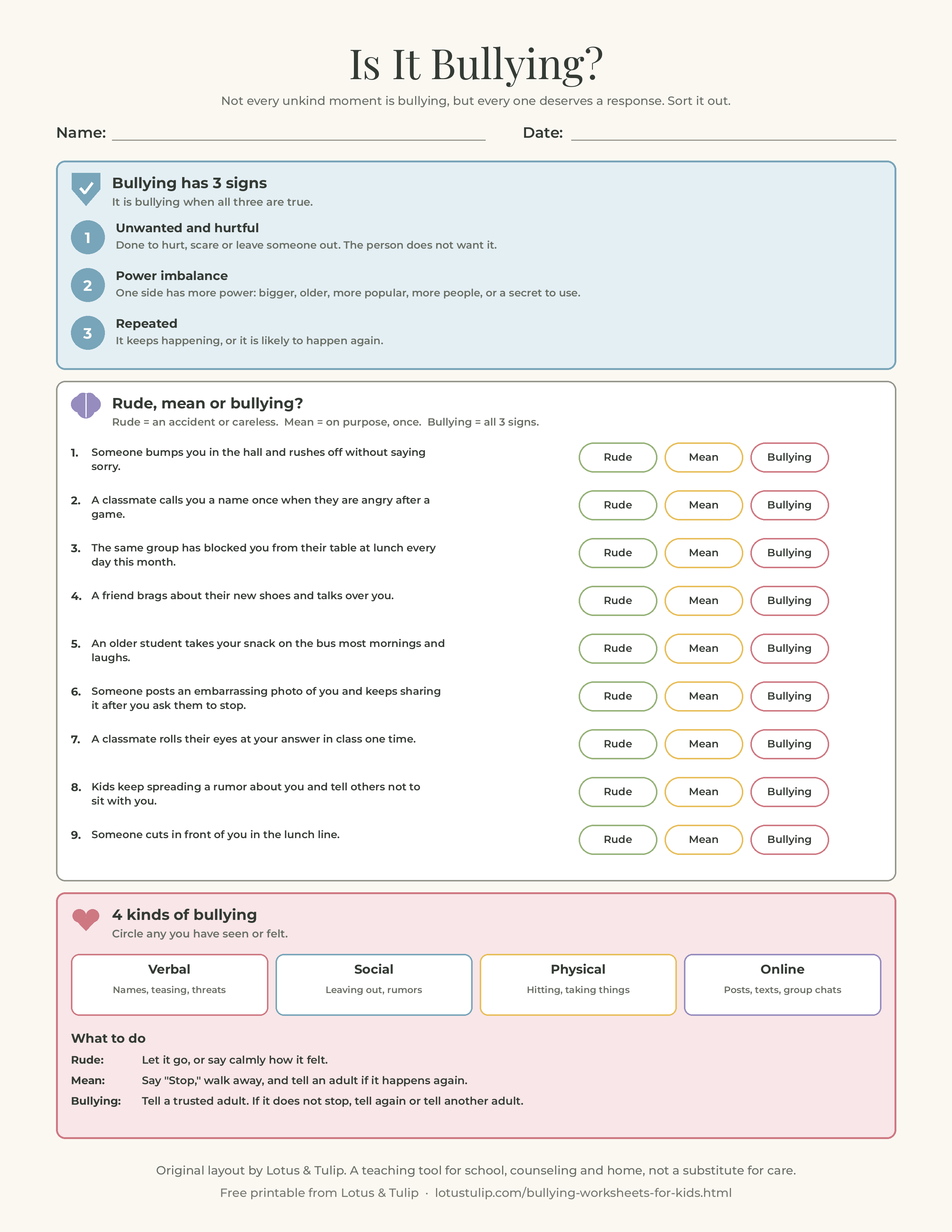
For children, that becomes three plain signs, the same three on page 1 of the printable:
- Unwanted and hurtful. It is done to hurt, scare, embarrass or leave someone out, and the child on the receiving end does not want it.
- Power imbalance. One side has more power. That can be size or age, popularity, more people on their side, or private information they can use, such as a photo or a secret.
- Repeated. It keeps happening, or it is likely to happen again.
StopBullying.gov describes three main types: verbal (name calling, teasing, taunting, threats), social or relational (leaving someone out on purpose, spreading rumors, telling others not to be friends with someone, embarrassing someone in public) and physical (hitting, tripping, pushing, taking or breaking belongings). Cyberbullying is the same behavior through phones, games, social media and group chats. It can follow a child home, reach a wide audience fast and be hard to delete.
One detail in the uniform definition is worth copying in your own language: it describes behaviors and roles in a situation, not types of children. StopBullying.gov advises against labeling a child as "a bully" or "a victim". Labels suggest a fixed identity, while behavior can change. In this guide and the printable we say "the child who was targeted" and "the kids who did the bullying" for that reason.
Rude, mean or bullying? Why the difference matters
Children often call every unkind moment bullying, and adults sometimes call real bullying "just kids being kids". Both get in the way. A simple three level sort, popularized by social worker and author Signe Whitson, helps everyone use the same words:
- Rude is careless or thoughtless: bumping into someone and not saying sorry, bragging, cutting in line. It is not usually meant to hurt.
- Mean is hurtful on purpose, but once or twice: an insult in the heat of an argument, an eye roll aimed at a classmate. It still deserves a response.
- Bullying is hurtful on purpose, repeated, and involves a power imbalance.
The sort matters because the right response is different. StopBullying.gov points out that bullying is not ordinary peer conflict, so peer mediation is not recommended for bullying. Mediation assumes two sides with equal power who share responsibility. Putting a targeted child in a room to "work it out" with the kids who have been bullying them can send the message that they are partly to blame, and it can make the situation worse. Conflict between equals is a good fit for a conflict resolution worksheet. Bullying needs adults to step in.
What the research says about bullying in US schools (with honest caveats)
There are two main national sources, and they ask slightly different questions, so the numbers are close but not identical.
- NCES School Crime Supplement, 2022 (school year 2021 to 22). About 19% of students ages 12 to 18 said they were bullied at school during the school year. That is down from 28% in 2010 to 11 and 22% in 2018 to 19. Girls reported bullying more often than boys (about 22% vs 17%), and middle school students more often than high school students (about 26% vs 16%). By grade, rates were highest in grades 6 to 8 (about 25 to 27%) and lowest in grade 11 (about 10%). Among students who were bullied, about 22% said it happened online or by text.
- CDC Youth Risk Behavior Survey, 2023 (high school students). About 19% of US high school students said they had been bullied on school property in the past year and about 16% had been electronically bullied. Bullying at school rose from about 15% in 2021 to 19% in 2023, after many students returned to in person learning. Female students and LGBTQ+ students were more likely to report being bullied.
Two caveats. First, these are self reports from students ages 12 and up, so they do not tell us how common bullying is in early elementary grades. Second, the surveys ask whether students were bullied, not who did it or for how long, so a single percentage hides a wide range of experiences.
Two more findings are directly useful for practice:
- Most bullying is never reported. StopBullying.gov estimates that only about 25 to 50% of children who are bullied talk to an adult about it. The reasons kids give include fear of making it worse, shame, worry about being seen as a "tattletale", and doubt that adults will help. That is why the printable includes a written report page: writing it down first makes telling easier.
- Connection is protective. In the 2023 YRBS, high school students who felt close to people at school were less likely to report being electronically bullied (about 13% vs 25% for students who did not). This is a correlation, not proof of cause, but it fits a large body of work showing that belonging and supportive adults matter.
What actually reduces bullying
The best evidence comes from meta-analyses that pool many program evaluations. A 2019 review by Hannah Gaffney, Maria Ttofi and David Farrington looked at 100 evaluations of school anti-bullying programs. On average, programs reduced bullying perpetration by about 19 to 20% and victimization by about 15 to 16%. A companion review of cyberbullying programs found reductions of roughly 10 to 15% in perpetration and about 14% in victimization. These are meaningful but modest effects. No worksheet or single assembly makes bullying disappear.
When the same research team looked at which program parts were linked to larger effects, the list was practical rather than flashy: a whole school approach, a clear anti-bullying policy, classroom rules about bullying, information for parents, informal peer involvement such as class discussion and role play, and direct work with children who were targeted. Worksheets fit into the classroom rules, peer discussion and support pieces. They work best as part of a school's wider plan, not on their own.
Peers matter more than many adults expect. In a classic playground observation study of children in grades 1 to 6, Hawkins, Pepler and Craig (2001) found that peers were present in 88% of bullying episodes but stepped in during only 19% of them. When peers did intervene, the bullying stopped within 10 seconds in more than half of those cases (57%). That is the case for teaching safe upstander skills: most children are already in the room when it happens.
Signs a child may be being bullied
Because so few children tell, adults often have to notice first. Possible signs include:
- Not wanting to go to school, ride the bus or go to a club they used to enjoy
- Frequent headaches or stomachaches, especially on school mornings
- Lost or damaged belongings, clothes or books, or "lost" lunch money
- Unexplained bruises or scrapes
- Changes in sleep or eating, or coming home very hungry
- Falling grades or loss of interest in schoolwork
- Fewer friends, avoiding social situations, or seeming upset after time online
- Lower self esteem, more sadness, anxiety or irritability
None of these signs proves bullying. They are a reason to ask, calmly and privately. A good opener is specific and low pressure: "I noticed you have not wanted to take the bus this week. What is it like on the bus right now?"
Get more help right away if a child talks about hurting themselves, seems hopeless, or if there are threats of serious harm, weapons, sexual harassment or harassment based on race, disability, religion, sex or other protected characteristics. These may need school administration, law enforcement or civil rights processes, not only a counseling response. In the US, the 988 Suicide and Crisis Lifeline is available by call or text 24 hours a day.
Bullying prevention activities for kids
These activities work in classrooms, small groups, counseling sessions and at home. Each one connects to a page of the free printable.
- Rude, mean or bullying sort. Read short situations aloud and have children hold up a card or move to a corner of the room for Rude, Mean or Bullying. Ask them to name which of the three signs they see. Page 1 has nine situations ready to use.
- Four kinds of bullying. Brainstorm examples of verbal, social, physical and online bullying. Children are often surprised that leaving someone out on purpose or spreading a rumor counts.
- Telling vs tattling. Tattling is to get someone in trouble. Telling is to get someone help or keep someone safe. Practice deciding which is which, then make it clear that telling about bullying is always telling.
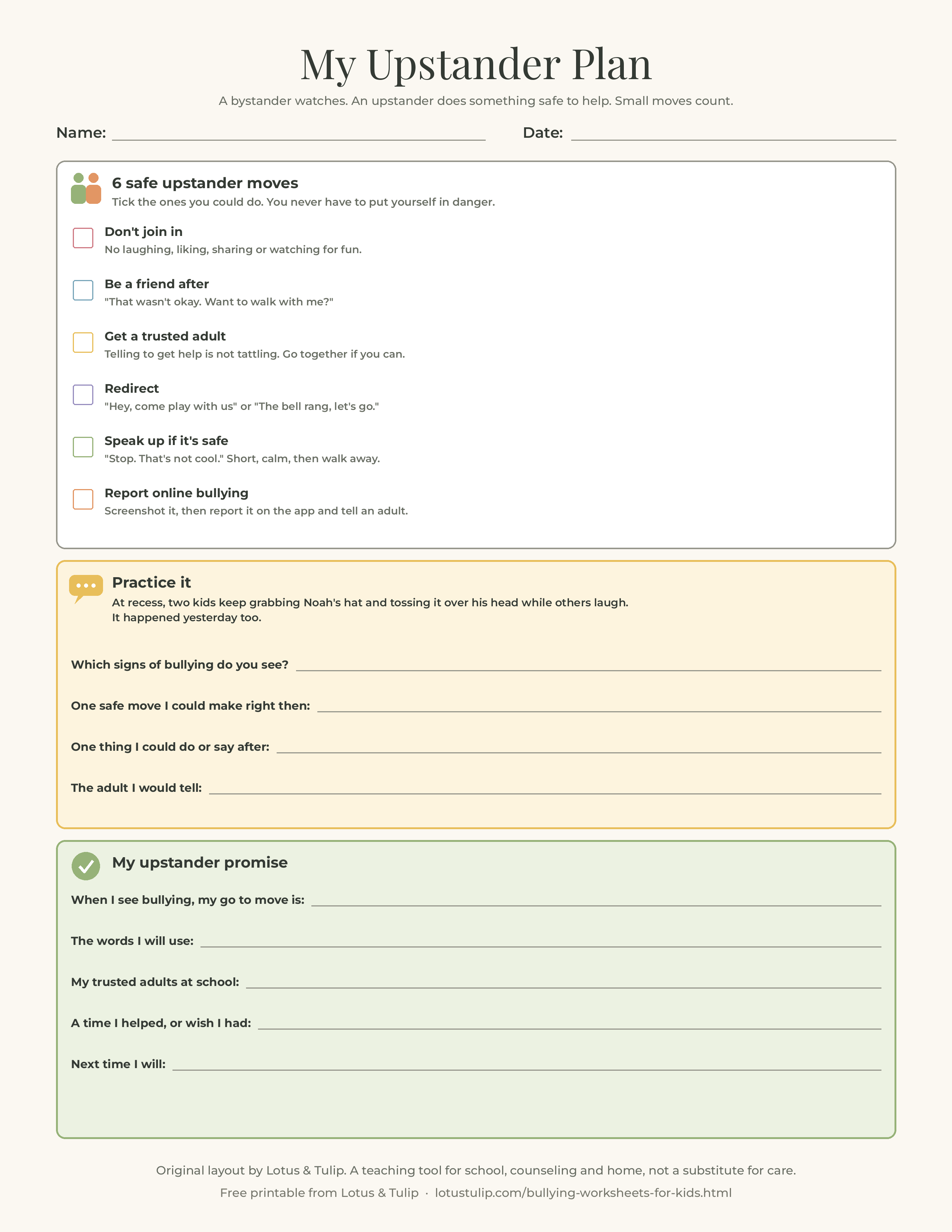
- Upstander role plays. Act out short scenes and practice one safe move each: not joining in, redirecting ("Come play with us"), saying a short calm "Stop, that's not cool" when it is safe, getting an adult, and checking in with the targeted child afterward. Page 2 has a practice scenario.
- Online safety steps. Teach a simple routine for cyberbullying: do not reply, take a screenshot, block or report on the app, and tell a trusted adult. Practice where the report button is on games and apps children actually use.
- Trusted adult map. Have each child name at least two adults at school and one at home they could tell. Children who cannot name anyone are a signal for adults to reach out.
- Class agreement. Write three or four class rules about bullying together, such as "We do not leave people out on purpose" and "If we see bullying, we help or we tell." Post them and refer back to them.
- Kindness and inclusion practice. Prevention is also about building the opposite skill. Pair this work with kindness activities, empathy worksheets and friendship worksheets.
How to teach kids about bullying, step by step
- Set safety first. Tell the group that you will talk about bullying in general and that no one should name classmates during the lesson. Explain how they can talk to you privately afterward.
- Teach the three signs. Unwanted and hurtful, power imbalance, repeated. Use simple examples and check understanding.
- Sort rude, mean and bullying. Use page 1. Discuss the borderline cases. Some children will disagree, and that discussion is the point.
- Name the four kinds. Verbal, social, physical and online. Make sure social and online bullying are taken seriously.
- Teach telling vs tattling. Make reporting normal and expected.
- Practice upstander moves. Use page 2 and short role plays. Stress that no one has to put themselves in danger. Getting an adult is always a strong choice.
- Make a support plan. Use page 3 with children who are being targeted, or as a "just in case" plan for everyone. Help each child name two trusted adults and safe places.
- Close the loop. When a child reports, thank them, write down what they tell you, act according to your school's policy, and check back with them within a few days. Children stop telling when nothing seems to happen.
What to do when a child tells you they are being bullied
- Stay calm and listen. Thank them for telling you. Avoid promising to keep it a secret, because you may need to act.
- Make it clear it is not their fault. Avoid questions such as "What did you do to make them act that way?"
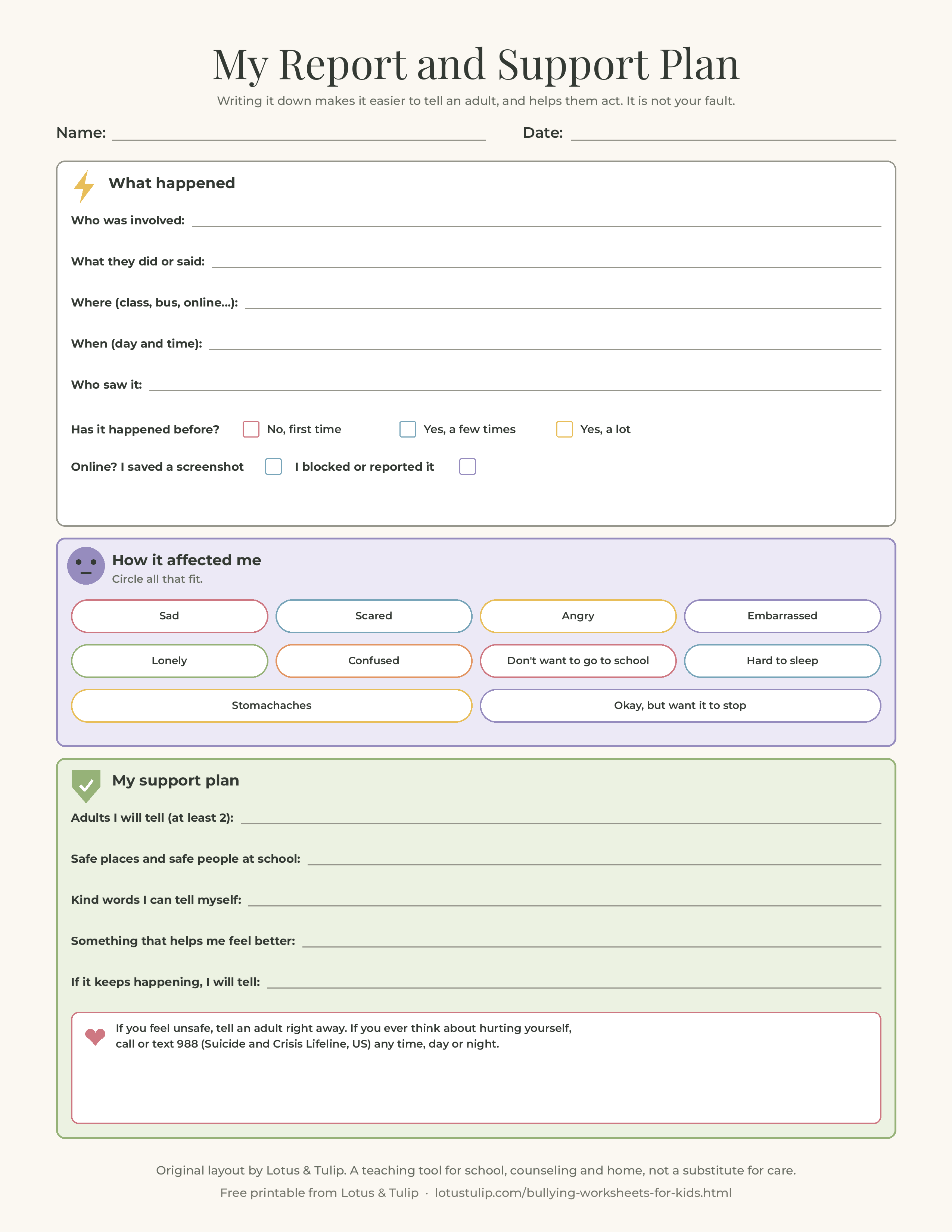
- Get the facts. Who, what, where, when, who saw it and whether it has happened before. Page 3 of the printable follows that order.
- Do not ask the child to fix it alone. Advice such as "just ignore it" or "hit back" puts the responsibility on the child with less power.
- Do not use mediation for bullying. Speak with the children involved separately.
- Follow your school or district policy and document what you did.
- Follow up. Check in again within a few days and keep checking until the child feels safe.
Common mistakes when teaching kids about bullying
- Calling everything bullying. It weakens the word and sends adults into a bullying response for ordinary conflict.
- Calling nothing bullying. "Kids will be kids" teaches children that adults will not help.
- Labeling children. Talk about behavior. Children who bully others often need support too.
- A single assembly. The research points to steady, whole school work: rules, supervision, parent information and peer involvement.
- Ignoring online bullying. Ask about it directly. It often connects to what is happening at school.
Free bullying worksheets for kids (PDF)
This free printable is an original Lotus & Tulip design, sized for US Letter paper and written for about ages 6 to 13 (upper elementary and middle school, with adult support for younger children) in classrooms, counseling sessions, small groups and at home. It has three pages:
- Page 1: Is It Bullying? The three signs of bullying in plain words, nine situations to sort as Rude, Mean or Bullying, four kinds of bullying to circle (verbal, social, physical and online), and a short What to Do guide for each level.
- Page 2: My Upstander Plan. Six safe upstander moves to tick, from not joining in to reporting online bullying, a practice scenario with four questions, and an upstander promise with a go to move, the words to use, trusted adults at school, a time the child helped or wished they had, and a next time plan.
- Page 3: My Report and Support Plan. A What Happened log (who, what, where, when, who saw it, how often, and online steps such as saving a screenshot and blocking), a How It Affected Me section with ten feelings and effects to circle, and a support plan with trusted adults, safe places, kind self talk and who to tell if it keeps happening, plus a help box with the 988 Lifeline.
Download the free bullying worksheets for kids (PDF, 3 pages, US Letter)
Prefer single images? Page 1: Is It Bullying? (PNG) · Page 2: My Upstander Plan (PNG) · Page 3: Report and Support Plan (PNG)
Free to print for your own use and for use with your own students, clients or children. Please link to this page rather than re-uploading the file.
Related resources
- Food allergy worksheets for kids: when teasing involves food threats, with a free food allergy brave plan
- Tic worksheets for kids: supporting children with tics, who are bullied far more often
- Tattling vs telling worksheet (free printable): when to tell an adult, with a 12 scenario sort and a telling plan
- Kindness activities for kids (free printable)
- Empathy worksheets for kids (free printable)
- Friendship worksheets for kids (free printable)
- Social skills worksheets for kids (free printable)
- Conflict resolution worksheet (free printable)
- I statements worksheet (free printable)
- Self esteem worksheets for kids (free printable)
- Positive self talk worksheet (free printable)
- Coping skills list for kids (free printable)
- Problem solving worksheet for kids (free printable)
- Body image worksheets for kids: when teasing is about weight or looks, a free body talk plan
Sources
- Centers for Disease Control and Prevention (2024). Youth Risk Behavior Surveillance: United States, 2023. MMWR Supplements, 73(4). Also CDC, YRBS Data Summary and Trends Report, 2013 to 2023.
- Gaffney, H., Ttofi, M. M., and Farrington, D. P. (2019). Evaluating the effectiveness of school-bullying prevention programs: an updated meta-analytical review. Aggression and Violent Behavior, 45, 111 to 133.
- Gaffney, H., Farrington, D. P., Espelage, D. L., and Ttofi, M. M. (2019). Are cyberbullying intervention and prevention programs effective? A systematic and meta-analytical review. Aggression and Violent Behavior, 45, 134 to 153.
- Gaffney, H., Ttofi, M. M., and Farrington, D. P. (2021). What works in anti-bullying programs? Analysis of effective intervention components. Journal of School Psychology, 85, 37 to 56.
- Gladden, R. M., Vivolo-Kantor, A. M., Hamburger, M. E., and Lumpkin, C. D. (2014). Bullying Surveillance Among Youths: Uniform Definitions for Public Health and Recommended Data Elements, Version 1.0. CDC and US Department of Education.
- Hawkins, D. L., Pepler, D. J., and Craig, W. M. (2001). Naturalistic observations of peer interventions in bullying. Social Development, 10(4), 512 to 527.
- National Center for Education Statistics. Student Reports of Bullying: Results From the 2022 School Crime Supplement to the National Crime Victimization Survey. Web tables. nces.ed.gov.
- StopBullying.gov (US Department of Health and Human Services). What Is Bullying; Facts About Bullying; Warning Signs; Respond to Bullying.
- Whitson, S. (2014). 8 Keys to End Bullying: Strategies for Parents and Schools. W. W. Norton.
- 988 Suicide and Crisis Lifeline. 988lifeline.org.
Bullying worksheets for kids: FAQ
What are bullying worksheets for kids?
They are printable pages that help children understand what bullying is, tell it apart from rude or mean behavior, practice safe ways to help as a bystander, and plan how to report bullying and get support. They are used in classrooms, school counseling, small groups and at home.
How do you explain bullying to a child?
Use three signs: it is unwanted and hurtful, one side has more power, and it happens again and again or is likely to. If all three are true, it is bullying and an adult needs to know. If something is mean once, it still deserves a response, but it may be a conflict or a mean moment rather than bullying.
What is the difference between rude, mean and bullying?
Rude is careless or thoughtless, such as not saying sorry after bumping into someone. Mean is hurtful on purpose but once or twice. Bullying is hurtful on purpose, repeated, and involves a power imbalance. The difference matters because bullying needs adults to step in.
How common is bullying in US schools?
In the 2022 NCES School Crime Supplement, about 19% of students ages 12 to 18 said they were bullied at school, with the highest rates in grades 6 to 8. In the CDC's 2023 Youth Risk Behavior Survey, about 19% of high school students said they were bullied on school property and about 16% were bullied electronically.
What is an upstander?
An upstander is someone who sees bullying and does something safe to help, such as not joining in, inviting the targeted child to join them, getting a trusted adult, or checking on the child afterward. In playground observations, bullying often stopped within seconds when a peer stepped in.
Should schools use peer mediation for bullying?
No. StopBullying.gov advises against peer mediation for bullying because bullying is not a conflict between equals. Adults should speak with the children involved separately and follow the school's anti-bullying policy.
Are these bullying worksheets free?
Yes. The three page bullying worksheets for kids are free to print for your own use and for use with your own students, clients or children. Please link to this page rather than re-uploading the file.