
Kids and teens · Picky eating for kids 3 to 12 · Updated 2026-11-15
Picky eating activities for kids: what is normal, what research shows and a free food explorer plan

Ages 5 to 11: Kids Feelings and Social Skills Worksheets, incl. feelings detective, body clues, a feelings thermometer, a coping skills menu and a calm down plan Holiday 20% off: about $11.04, was $14 (EUR 12) · fillable PDF, instant digital download
Buy on EtsyTry it free first: download a fillable sample (feelings thermometer and calm-down plan, PDF, 240 KB). Type into it on screen, then get the full pack. No email needed.
Calmer meal routines: Visual Schedule and Behavior Supports, 23 pages with token boards, a reward menu, first then boards and 136 picture cards Holiday 20% off: about $6.44, was $8 (EUR 7) · instant digital download
Buy on EtsyKids and teens bundle: Kids and Teens Worksheets Bundle (feelings, anger, self esteem, social anxiety) Holiday 20% off: about $22.08, was $28 (EUR 24) · 80 pages, instant digital download
Buy on EtsyOne child eats only beige foods. Another will not let peas touch the pasta. A third used to love strawberries and now pushes them away, and dinner has turned into a nightly standoff. Picky eating is one of the most common worries parents bring to pediatricians, and one of the most tiring to live with.
This guide is for parents, caregivers, teachers, school counselors and therapists supporting children about 3 to 12. It explains what picky eating usually looks like, when it is more than a phase, what research shows about pressure, rewards and repeated tasting, eight kinds of picky eating activities that build food curiosity without a fight, nine steps to a calmer plan, age and need adaptations, notes for school, common mistakes and three short examples. It ends with a free 2 page printable: My Food Explorer Map and My Try a Bite Plan.
When to talk with your child's doctor first: if your child is losing weight or not growing as expected; if the list of foods they accept keeps getting shorter; if they gag, choke, cough or vomit with eating, have pain, reflux or constipation, or take a very long time to eat; if they avoid whole food groups or need nutrition drinks to get by; if eating started to change after a choking or vomiting scare; or if meals cause panic, or worries about weight and body shape. A pediatrician can check growth and nutrition and refer to a feeding therapist, dietitian or psychologist. For children under 4, follow your pediatrician's choking safety advice (for example, cut grapes and avoid whole nuts). If a child talks about wanting to die or hurting themselves, call or text 988 (the 988 Suicide and Crisis Lifeline). If anyone is in immediate danger, call 911.
Download the free picky eating worksheets for kids (PDF, 2 pages, US Letter)
Direct download, no email or sign up. See the pages first. Food textures a big part of it? See sensory processing activities for kids. Worries running the show? See anxiety worksheets for kids.
What picky eating usually looks like
There is no single agreed definition of picky eating, which is one reason estimates of how common it is vary so widely between studies (Taylor and colleagues, 2015). Most definitions include some mix of these:
- Refusing new foods (food neophobia). "I don't like it" before the food has touched their lips.
- A short list of accepted foods. Often plain, predictable, crunchy or soft foods that look and taste the same every time.
- Strong rules about how food is served. No sauce, no touching, only one brand, cut a certain way.
- Dropping foods they used to eat. Especially in toddlers, a favorite one week can be refused the next.
- Small or unpredictable appetites. After the fast growth of infancy, toddlers' growth and appetite slow down, which the American Academy of Pediatrics notes is one reason picky eating is so common at this age.
The CDC describes favoring a couple of foods or not wanting foods to touch on the plate as normal behaviors that often fade by about age 5. For many children it does fade. For some it lasts longer, and that is where a plan helps.
Picky eating or something more?
A newer diagnosis, avoidant/restrictive food intake disorder (ARFID), was added to the DSM-5 for eating problems that go well beyond ordinary picky eating. The avoidance can come from low interest in food, from the look, smell or texture of foods, or from fear of what might happen (such as choking or vomiting). ARFID is only diagnosed when the eating problem leads to at least one serious consequence: significant weight loss or faltering growth, a significant nutritional deficiency, dependence on tube feeding or nutrition supplements, or marked interference with daily life, such as being unable to eat with friends or at school. Unlike anorexia, it is not driven by worry about body weight or shape. The National Institute of Mental Health lists picky eating that gets progressively worse among its signs.
The worksheets on this page are for everyday picky eating and for the home side of a plan a professional has made. They are not a screening tool, and they are not a treatment for ARFID or any medical feeding problem.
What the research shows, honestly
Picky eating is very common in the early years. In a national random sample of 3,022 US infants and toddlers, the share whose caregivers called them picky eaters rose from 19% at 4 months to 50% at 24 months. Picky eaters were found across all incomes and ethnicities, and on the day studied both picky and non picky eaters met or exceeded energy recommendations. Caregivers usually offered a new food only three to five times before deciding the child disliked it, and the authors advised far more repeated exposures, about 8 to 15 (Carruth and colleagues, 2004).
For some children it is a lasting eating style, usually without harm to growth. A Stanford study that followed 120 children from age 2 to 11 found that at any age 13% to 22% were described as picky eaters, and for 40% of picky eaters it lasted more than two years. Parents of picky eaters more often reported mealtime struggles, cooking special meals and commenting on their child's eating. No significant effects on growth were found (Mascola, Bryson and Agras, 2010).
Picky eating that comes and goes looks like normal development. In 3,748 Dutch children assessed at 1.5, 3 and 6 years, picky eating that stopped before age 6 was not linked to later emotional or behavioral problems. Picky eating at all three ages was linked to teacher reported pervasive developmental problems at age 7 (odds ratio 2.00), but not to emotional or behavioral problems, so persistent, severe picky eating is worth mentioning to a pediatrician as part of a broader developmental check (Cardona Cano and colleagues, 2016).
More severe selective eating deserves attention. In a sample of 917 children aged 2 to 5 recruited through primary care, both moderate and severe selective eating were linked to symptoms of anxiety, depression and ADHD, at the time and about two years later, along with family stress and sensory sensitivity outside of food. The authors suggested that health care providers should step in even at moderate levels (Zucker and colleagues, 2015). In a Swiss school survey of 1,444 children aged 8 to 13, avoidant or restrictive eating patterns were commonly self reported, including food avoidance based on a specific fear in 5.0%, though the authors stressed that these screening results need confirming with interviews (Kurz and colleagues, 2016).
Pressure backfires. In an experiment with preschoolers, children ate significantly more of a soup when they were not asked to finish it, and made far fewer negative comments about it (Galloway and colleagues, 2006). Restriction backfires too: when an appealing snack was restricted, children wanted it more and ate more of it once it was available (Fisher and Birch, 1999).
Repeated tasting works, and it takes more tries than most parents expect. In a randomized trial with 156 families of children aged 2 to 6, parents who offered a small taste of a disliked vegetable every day for 14 days saw bigger gains in liking and eating than families given nutrition advice or no help (Wardle and colleagues, 2003). A meta-analysis of 30 studies with 4,017 preschool children found that programs using repeated taste exposure did better than those that did not, that intake rose with the number of exposures, and that disliked or unfamiliar vegetables gained the most. The authors suggested a minimum of 8 to 10 exposures (Nekitsing and colleagues, 2018). The AAP tells parents a child may need to try a new food 10 to 15 times over several months.
Small non-food rewards for tasting can help; food rewards do not. In a home study of 115 children aged 2 to 4, daily offers of a disliked vegetable for 14 days increased how much children ate when paired with a small non-food reward for tasting, with or without parent modeling. Liking afterward was highest in the two reward groups (over 60%), compared with 10% in the control group (Holley, Haycraft and Farrow, 2015). A review concluded that using food as a reward appears to be universally negative, while stickers or praise can encourage children to taste a food often enough for familiarity to do its work (Cooke and colleagues, 2011). The AAP also advises never using food as a reward or punishment.
Food play counts as exposure. In a nursery study of 92 children aged 12 to 36 months, four weeks of daily looking, listening, feeling and smelling activities with unusual fruits and vegetables led children to touch and taste more of those foods at mealtime than matched foods they had not played with (Dazeley and Houston-Price, 2015).
What this means for you. No study has tested worksheets like the ones on this page. Most trials involved preschoolers and one target vegetable, not older children with long food lists. Still, the pattern is consistent: calm, frequent, low pressure contact with a food, starting with looking, touching and smelling, works better than battles, bribes with dessert or hiding foods forever.
What picky eating activities can and cannot do
Picky eating activities can lower the temperature at the table. They give a child a sense of control ("I choose how I explore it"), turn a power struggle into a game, and give adults a way to count small wins, like a lick or a sniff, that would otherwise go unnoticed. They also help adults stop doing the things that research says make picky eating worse.
They cannot fix a medical problem such as reflux, constipation, allergies, oral motor difficulties or dental pain, treat ARFID, or replace a feeding evaluation. If eating is getting harder, not easier, after a few weeks, bring your notes to your pediatrician.
8 kinds of picky eating activities for kids
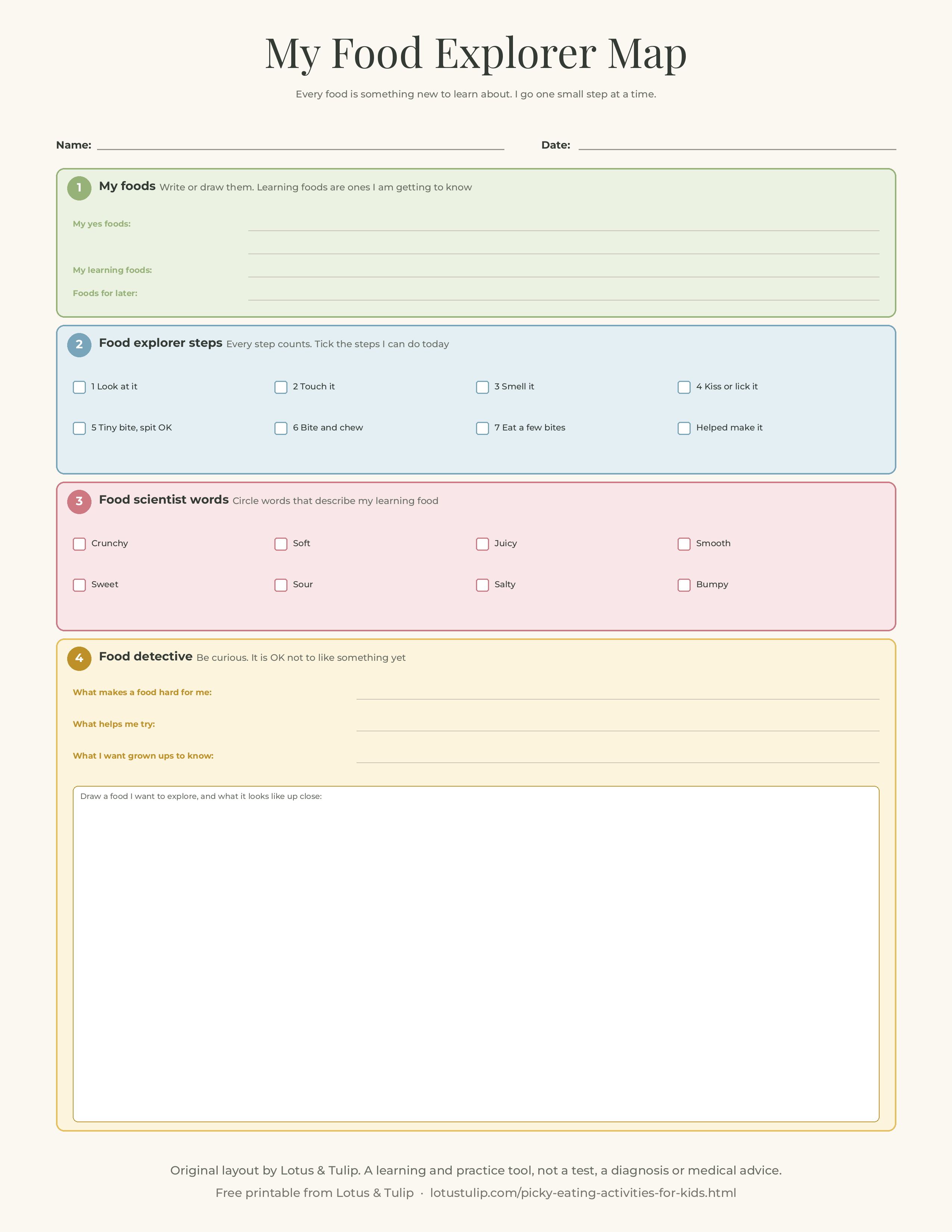
- Food explorer steps. Turn tasting into small steps: look at it, touch it, smell it, kiss or lick it, take a tiny bite and spit it out if needed, take a bite and chew, eat a few bites. Each step counts. The free Food Explorer Map uses these steps.
- Food play away from meals. Wash vegetables, stamp prints with cut peppers, build faces from fruit, sort foods by color, guess foods by smell with eyes closed. There is no expectation to eat, which is exactly why it helps.
- Cooking and shopping jobs. Let children pick one new fruit or vegetable at the store, wash, tear lettuce, stir, measure or sprinkle. The AAP suggests letting preschoolers choose a new food and help prepare it.
- Food scientist talk. Swap "yummy" and "yucky" for describing words: crunchy, juicy, sour, smooth, cold. Children who can describe a food can say what bothers them about it ("too slimy") instead of just "no."
- Food bridges. Move in small changes from a food the child already likes: one brand of crackers to another, plain pasta to pasta with a little butter, apple slices to pear slices. Change one thing at a time: shape, color, brand, flavor or texture.
- A learning plate. Put one pea sized piece of a learning food on a small side plate next to a full meal that includes at least one safe food. The child may leave it, touch it or try it. No comments needed.
- Taste tests and ratings. Offer two versions of one food (raw and roasted carrot, red and green apple) and let the child rate each with a thumbs up, sideways or down. Ratings change over time, and noticing that is part of the lesson.
- Calm body before meals. A few minutes of quiet play, a short walk or slow breathing before dinner can help a child who arrives at the table already wound up or worried. See breathing exercises for kids for scripts.
How to make a picky eating plan for kids, step by step
- Write down what they eat now. For a week, list every food your child eats, even if it is only a few. This is the safe food list. It often turns out longer than you feared, and it shows your pediatrician what is really going on.
- Check for red flags. Use the doctor first box at the top of this page. Growth, pain, gagging or a shrinking food list are reasons to see your pediatrician before starting a home plan.
- Split the jobs. A widely used approach called the division of responsibility (developed by dietitian Ellyn Satter) gives adults the job of deciding what is served, when and where, and gives children the job of deciding whether to eat and how much. The AAP gives similar advice: offer healthy food and let the child decide what and how much to eat.
- Set a meal and snack rhythm. Regular meals and planned snacks, with no grazing in between, help a child come to the table hungry. The AAP notes that scheduled meals and limited snacks can help a child be ready to try new foods.
- Always include a safe food. Serve one family meal with at least one food your child usually eats. Avoid cooking a separate meal on request, but do not leave a child with nothing they can eat.
- Pick one learning food at a time. Let the child choose from two or three options. Offer a tiny amount often, ideally several times a week, in the same form at first.
- Use the food explorer steps. Celebrate any step (looking, touching, smelling, licking) with praise or a sticker on the plan, never with dessert. Model eating the food yourself and keep the talk about other things.
- Drop the pressure. No "one more bite," no hiding foods as a trick that breaks trust, no comparing with siblings and no comments about the child being picky. Let them spit a bite into a napkin. Feeling safe makes the next try more likely.
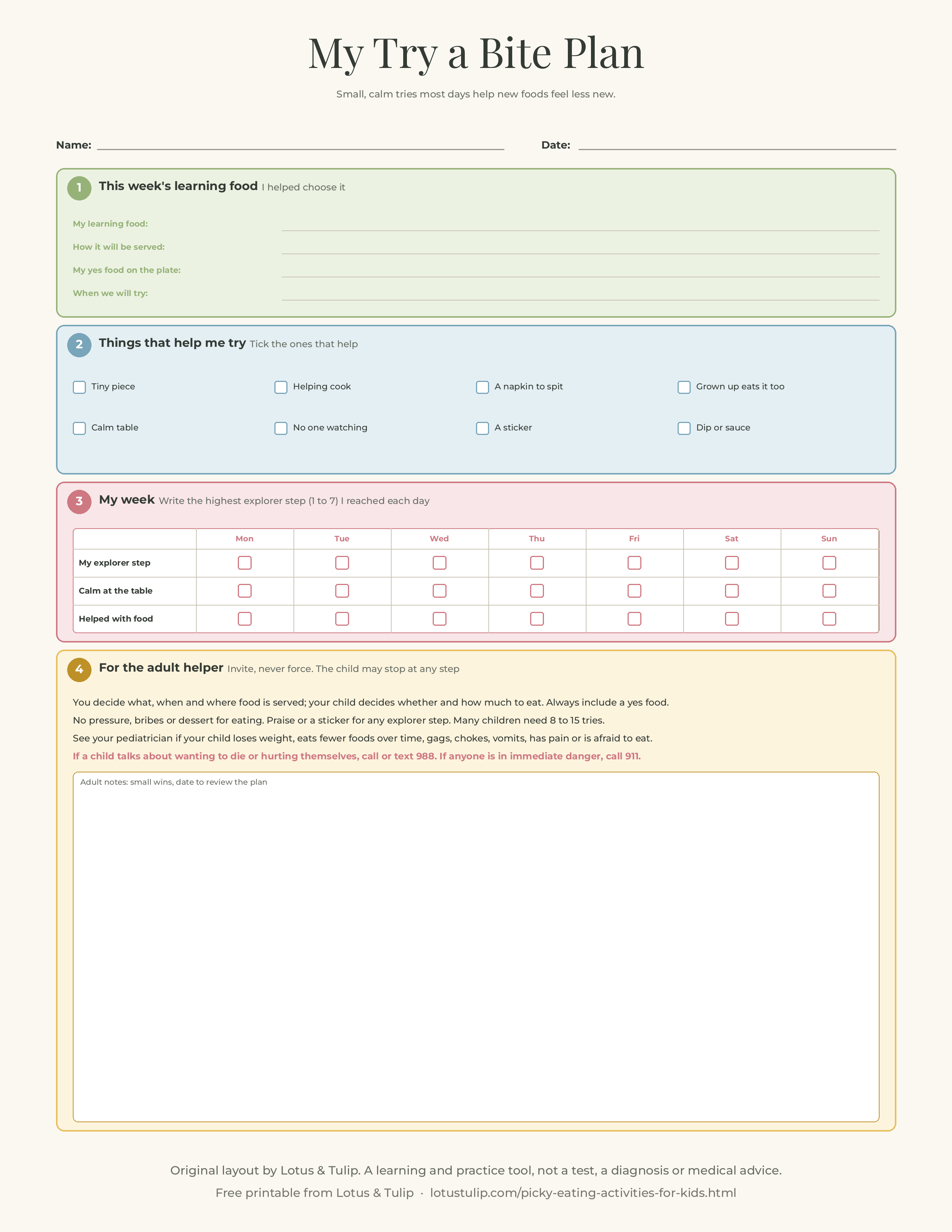
- Track for four weeks and review. Use the weekly tracker on page 2. Notice progress in steps, not plates cleaned. If nothing has changed after a month, or things are getting worse, share your notes with your pediatrician.
How to adapt it by age and need
- Ages 3 to 5: keep it playful. Food play, picture books about food, helping in the kitchen and a parent reading the explorer steps aloud. Expect many no's. Offer tiny portions and keep choking safety in mind.
- Ages 6 to 9: children enjoy being food scientists. Taste tests, ratings, food describing words and a sticker for each explorer step work well. Let them choose the learning food.
- Ages 10 to 12: respect privacy and pride. Older children often do better with cooking projects, a say in the menu and quiet practice at home, not attention at the table or in front of friends. Watch for worries about weight or body shape, which point toward a different kind of help. See body image worksheets for kids.
- Autistic children: strong food preferences are common and often linked to texture, smell and routine. Go slower, change one small thing at a time and work with a feeding therapist or occupational therapist when the food list is very short.
- Children with sensory sensitivities: start with looking and smelling before touching, offer utensils for messy foods and respect textures they find hard. See sensory processing activities for kids.
- Anxious children or after a choking scare: fear of choking or vomiting needs gentle, gradual steps and often professional help. Do not push a child back to feared textures quickly. See anxiety worksheets for kids.
Picky eating at school: notes for teachers and counselors
- Keep lunch low pressure. Avoid rules like "eat your sandwich before your snack" or holding children back from recess until they finish. Comments about lunch boxes can shame children and families.
- Use food activities outside of meals. Classroom gardens, science lessons with fruits and vegetables, and tasting events where trying is optional give children exposure without the pressure of a meal.
- Notice and share concerns kindly. A child who eats almost nothing all day, seems tired or unwell, gags often or seems frightened of eating should be mentioned to the family and the school nurse.
- Plan accommodations when needed. When a diagnosed feeding or medical condition affects school, a 504 plan or health plan can cover things like extra time to eat, a quieter lunch space or access to safe foods.
- Be careful with food rewards. Candy for good behavior and taking away snacks as a consequence both make food more emotional. Use non-food rewards in class.
- Notice the whole child. Sudden changes in eating, hunger at school or hoarding food can signal stress or food insecurity at home. If you suspect abuse or neglect, follow your district's mandated reporting procedures.
Buy the Kids Feelings Worksheets on Etsy
Common mistakes
- Giving up after a few tries. Caregivers in one large US study usually stopped after three to five offers. Research suggests 8 to 15 calm exposures before deciding a food is truly disliked.
- Pressure, bribes and threats. "Two more bites or no dessert" teaches that the vegetable is something to get through and dessert is the prize. Studies show pressure lowers intake and enjoyment.
- Making the plate too big. A heap of a new food is overwhelming. A pea sized piece next to safe foods is enough.
- Only hiding foods. Blending vegetables into sauces can add nutrition, but if it is the only plan, children never learn to accept the food they can see. Offer visible versions too.
- Labeling the child. "She's just picky" said in front of a child can become part of how they see themselves. Try "He's still learning about broccoli."
- Waiting too long to ask for help. Weight loss, a shrinking food list, gagging, pain or real fear around food are reasons to see the pediatrician now, not after another month of trying harder.
Examples
- Mia, 4: ate about twelve foods and cried when anything new appeared on her plate. Her parents moved new foods to a tiny learning plate, stopped asking her to taste and let her wash and sort vegetables before dinner. After six weeks she licked a cucumber slice on her own and asked for "the crunchy water one" again.
- Jayden, 7: refused all vegetables and dinners ended in tears. With his mom he picked one learning food, sweet potato fries, and moved through the explorer steps with a sticker for each one. Breakfast and lunch stayed relaxed. By the end of the month he was eating a few fries most nights and rated them sideways instead of down.
- Sofia, 10: had eaten fewer and fewer foods since a choking scare and had started skipping lunch at school. Her parents talked with her pediatrician, who checked her growth and referred her to a psychologist experienced with feeding problems. The worksheets helped the family track her small steps at home between sessions.
Free printable: picky eating worksheets for kids
This printable is an original Lotus & Tulip layout. It is not a feeding assessment or screening tool and gives no score. Page 1, My Food Explorer Map, has space to list my yes foods, my learning foods and foods for later, the seven food explorer steps from looking to eating plus helping make it, food scientist describing words to circle, and a box to draw a food I want to explore. Page 2, My Try a Bite Plan, has lines for this week's learning food and how it will be served, helpers that make trying easier, a 7 day tracker for the highest explorer step reached each day, and adult helper notes on pressure free tasting and when to call the pediatrician.
Download the free picky eating worksheets for kids (PDF, 2 pages, US Letter)
Prefer single images? Page 1: My Food Explorer Map (PNG) · Page 2: My Try a Bite Plan (PNG)
Related resources
- Food allergy worksheets for kids: when a child must avoid foods for medical reasons, with a free food allergy brave plan
- Sensory processing activities for kids: when textures, smells and sounds feel like too much
- Interoception activities for kids: teaching hunger, fullness and other body clues
- Anxiety worksheets for kids: for worries that show up at the table and beyond
- Body image worksheets for kids: how to talk about food and bodies without weight talk
- Visual schedule and behavior supports: first then boards and token boards for predictable routines
- All counseling resources for kids and teens
FAQ
Is picky eating normal for kids?
Yes, especially for toddlers and preschoolers. In a large US survey, half of 2 year olds were described as picky eaters by their caregivers, and the CDC notes that favoring a few foods or not wanting foods to touch often fades by about age 5. For some children picky eating lasts longer as an eating style, usually without affecting growth.
How many times should I offer a new food?
More than most parents expect. The AAP says it can take 10 to 15 tries over several months, and research reviews suggest at least 8 to 10 calm exposures. Offer a tiny amount alongside foods your child already likes, and count looking, touching and smelling as progress too.
Should I make my child take one bite?
Research suggests pressure tends to backfire. In one experiment, preschoolers ate more and complained less when they were not asked to finish their food. Invite, model and praise any step, and let your child decide whether and how much to eat from what you serve.
Is it okay to reward my child for trying new foods?
Small non-food rewards such as stickers or praise for tasting can help, and in one home study they increased how much young children ate of a disliked vegetable. Avoid food rewards like dessert for finishing vegetables, which the AAP advises against and research links to poorer outcomes.
When is picky eating a problem?
Talk with your pediatrician if your child is losing weight or not growing as expected, eats fewer and fewer foods, gags, chokes or vomits with eating, has pain or constipation, needs nutrition drinks, or is very anxious about eating. These can point to a medical or feeding problem, or to avoidant/restrictive food intake disorder (ARFID).
What is the difference between picky eating and ARFID?
Picky eating is common and usually does not harm growth or daily life. ARFID is a DSM-5 eating disorder in which food avoidance, based on low interest in eating, sensory features of food or fear of consequences like choking, leads to weight loss or faltering growth, a nutritional deficiency, dependence on supplements or marked interference with daily life. It needs professional assessment and treatment.
What age are these picky eating worksheets for?
They are designed for children about 3 to 12. Younger children can point, color and use stickers with an adult reading aloud. Children 7 to 12 can fill in most of the food explorer map and try a bite plan themselves. Parents, teachers, school counselors and therapists can use them at home, in sessions or to share a plan with the team.
Sources
- American Academy of Pediatrics. Toddler food and feeding (Healthy Active Living for Families); 10 tips for parents of picky eaters (HealthyChildren.org); Healthy habits start early: tips for feeding picky eaters (fact sheet).
- American Psychiatric Association (2013, updated 2020). Avoidant/restrictive food intake disorder diagnostic criteria. Diagnostic and Statistical Manual of Mental Disorders, 5th ed.
- Cardona Cano, S., Hoek, H. W., van Hoeken, D., de Barse, L. M., and colleagues (2016). Behavioral outcomes of picky eating in childhood: a prospective study in the general population. Journal of Child Psychology and Psychiatry, 57(11), 1239 to 1246.
- Carruth, B. R., Ziegler, P. J., Gordon, A., and Barr, S. I. (2004). Prevalence of picky eaters among infants and toddlers and their caregivers' decisions about offering a new food. Journal of the American Dietetic Association, 104(1 Suppl 1), s57 to s64.
- Centers for Disease Control and Prevention. Picky eaters and what to do (Infant and Toddler Nutrition).
- Cooke, L. J., Chambers, L. C., Añez, E. V., and Wardle, J. (2011). Facilitating or undermining? The effect of reward on food acceptance. A narrative review. Appetite, 57(2), 493 to 497.
- Dazeley, P., and Houston-Price, C. (2015). Exposure to foods' non-taste sensory properties. A nursery intervention to increase children's willingness to try fruit and vegetables. Appetite, 84, 1 to 6.
- Fisher, J. O., and Birch, L. L. (1999). Restricting access to palatable foods affects children's behavioral response, food selection, and intake. American Journal of Clinical Nutrition, 69(6), 1264 to 1272.
- Galloway, A. T., Fiorito, L. M., Francis, L. A., and Birch, L. L. (2006). 'Finish your soup': counterproductive effects of pressuring children to eat on intake and affect. Appetite, 46(3), 318 to 323.
- Holley, C. E., Haycraft, E., and Farrow, C. (2015). 'Why don't you try it again?' A comparison of parent led, home based interventions aimed at increasing children's consumption of a disliked vegetable. Appetite, 87, 215 to 222.
- Kurz, S., van Dyck, Z., Dremmel, D., Munsch, S., and Hilbert, A. (2016). Variants of early-onset restrictive eating disturbances in middle childhood. International Journal of Eating Disorders, 49(1), 102 to 106.
- Mascola, A. J., Bryson, S. W., and Agras, W. S. (2010). Picky eating during childhood: a longitudinal study to age 11 years. Eating Behaviors, 11(4), 253 to 257.
- National Institute of Mental Health. Eating disorders: what you need to know.
- Nekitsing, C., Blundell-Birtill, P., Cockroft, J. E., and Hetherington, M. M. (2018). Systematic review and meta-analysis of strategies to increase vegetable consumption in preschool children aged 2 to 5 years. Appetite, 127, 138 to 154.
- Taylor, C. M., Wernimont, S. M., Northstone, K., and Emmett, P. M. (2015). Picky/fussy eating in children: review of definitions, assessment, prevalence and dietary intakes. Appetite, 95, 349 to 359.
- Wardle, J., Cooke, L. J., Gibson, E. L., Sapochnik, M., Sheiham, A., and Lawson, M. (2003). Increasing children's acceptance of vegetables; a randomized trial of parent-led exposure. Appetite, 40(2), 155 to 162.
- Zucker, N., Copeland, W., Franz, L., Carpenter, K., and colleagues (2015). Psychological and psychosocial impairment in preschoolers with selective eating. Pediatrics, 136(3), e582 to e590.
Lotus & Tulip is not affiliated with the researchers, programs, agencies or organizations named on this page. Names in the examples are invented. This page is educational and does not replace professional advice, diagnosis or treatment.