
Therapist worksheets · Forgiveness · Updated 2026-11-13
Forgiveness worksheet for adults: what forgiveness is (and is not), what research shows, and a step by step plan (free printable)
When the replayed thoughts are the hard part: CBT Worksheets for Therapists, 20 pages including thought records and core beliefs Holiday 20% off: about $11.04, was $14 (EUR 12) · fillable PDF, instant digital download
Buy on EtsyTry it free first: download a fillable sample (thought record and evidence for and against, PDF, 105 KB). Type into it on screen, then get the full pack. No email needed.
Values, acceptance and letting go of the struggle: ACT Worksheets for Therapists, incl. values, defusion and committed action pages Holiday 20% off: about $9.20, was $12 (EUR 10) · fillable PDF, instant digital download
Buy on EtsyTry it free first: download a fillable sample (values compass and unhooking from thoughts, PDF, 259 KB). Type into it on screen, then get the full pack. No email needed.
A full caseload: Therapist Worksheets Mega Bundle (8 packs incl. DBT, CBT, ACT, anxiety, grief and ADHD) Holiday 20% off: about $35.88, was $45 (EUR 39) · fillable PDFs for all 8 packs plus 160 printable pages, instant digital download
Buy on EtsySomeone hurt you. Maybe it was a parent, a former partner, a friend who disappeared when you needed them, or a colleague who took credit and never said sorry. Months or years later, the scene still replays, and a reminder can bring the anger back as if it happened yesterday. People around you may say "just forgive and move on," which makes it sound simple and, often, a little insulting.
This guide is for adults working through a real hurt, and for the therapists, counselors and coaches who help them. It explains what forgiveness actually means in the research (and the things it does not require, such as reconciling or excusing), what studies of forgiveness interventions show, nine practical steps, common mistakes and three short examples. It ends with a free 2 page printable: My Forgiveness Map, for naming the hurt, its cost and where you stand, and My Forgiveness Plan, for working through it while keeping your boundaries.
Download the free forgiveness worksheet (PDF, 2 pages, US Letter)
Direct download, no email or sign up. See the pages first.
What forgiveness is, and what it is not
In the research most forgiveness therapy is built on, forgiveness means willingly giving up resentment toward someone who treated you unfairly, and responding with some goodwill even though they have no right to it. That definition, from Robert Enright and colleagues and summarized by Baskin and Enright (2004), stresses two things: the hurt was genuinely unfair, and forgiving is a choice the hurt person makes freely.
Forgiveness is not condoning or excusing. If you excuse something, you decide it was not really unfair after all. Forgiving starts from the opposite place: it was wrong, and you are choosing what to do with your resentment anyway.
Forgiveness is not reconciliation. Reconciling means two people coming back together in mutual trust. Forgiving is one person's inner change. As Baskin and Enright put it, one can forgive without reconciling. You can forgive a parent and keep contact limited, or forgive a former partner you never plan to see again.
Forgiveness is not forgetting. People who forgive rarely forget. What tends to change is how the memory feels: you can remember it without the same charge of anger.
Forgiveness is not required. Nobody owes anyone forgiveness on a timetable, and healing does not depend on it. This page is a tool for people who want to explore forgiving, not a test of whether you are a good enough person. If you mainly want to forgive yourself, the shame vs guilt worksheet and the self-compassion worksheet are better starting points; this page focuses on forgiving someone else.
What the research says
- Two kinds of forgiveness: decisional and emotional. Everett Worthington and colleagues distinguish decisional forgiveness, an intention to give up an unforgiving stance and treat the other person differently (for example, not seeking revenge), from emotional forgiveness, where resentful feelings are gradually replaced by more positive, other-oriented feelings such as empathy or compassion. In their 2007 review in the Journal of Behavioral Medicine, they argue that emotional forgiveness is the part more directly tied to health and well-being. In practice this explains a common experience: "I decided to forgive, so why am I still angry?" The decision can come first; the feelings often follow slowly.
- Forgiveness interventions work, on average, and more time helps. Wade, Hoyt, Kidwell and Worthington (2014) pooled 54 published and unpublished reports of interventions designed explicitly to help people forgive a specific hurt (53 posttreatment effect sizes, 2,323 participants). People who received a forgiveness intervention reported more forgiveness than people who received no treatment (effect size 0.56) and than people who received a different treatment (0.45). They also showed greater improvements in depression, anxiety and hope than no-treatment groups. Longer interventions and individual (rather than group) formats predicted larger gains in forgiveness.
- A quick decision on its own did little; working through the process did more. In an earlier meta-analysis of 9 published studies (330 participants), Baskin and Enright (2004) found that brief decision-based interventions showed no effect on forgiveness compared with controls (4 interventions, effect size about 0). Process-based group interventions showed a significant effect (3 interventions, 0.82), and process-based individual interventions a large one (2 interventions, 22 participants, 1.66). The individual result rests on very few people, so treat the size with caution, but the pattern fits Wade and colleagues: forgiveness is something people work through, not a switch they flip.
- Two well-known models: Enright's process model and Worthington's REACH. Enright's process model, used in many of these studies, moves through four phases: Uncovering (facing the hurt and the anger), Decision (considering forgiveness as an option), Work (understanding the offender more fully and bearing the pain) and Deepening (finding meaning and relief). In Freedman and Enright's 1996 study, 12 women who had survived incest worked through the model individually in weekly sessions averaging 14.3 months. Compared with a waiting-list group, they gained more in forgiveness and hope and dropped more in anxiety and depression, and the waiting-list group showed similar changes once they had the program. Worthington's REACH model has five steps: Recall the hurt, Empathize, give forgiveness as an Altruistic gift, Commit, and Hold on to forgiveness when doubts return.
- Self-guided work can help. Harper and colleagues (2014) randomly assigned 41 university students to a 6 hour self-directed workbook adapted from REACH or to a waitlist. The workbook increased forgiveness, and a benchmarking analysis suggested it was at least as effective as REACH delivered in groups. That is one small study with students, but it supports careful written work like the printable below as a useful adjunct to therapy.
- Forgiveness tracks with lower stress, but it is not a cure-all, and it is not for ongoing harm. Toussaint, Shields and Slavich (2016) followed 332 adults aged 16 to 79 weekly for five weeks. When forgiveness rose, perceived stress tended to fall, and lower stress was linked to fewer mental health symptoms (not physical ones). That is an association, not proof that forgiving causes better health. On the other side, McNulty (2011) followed newlywed couples and found that spouses who were more forgiving experienced psychological and physical aggression from their partners that stayed stable over the first four years of marriage, while less forgiving spouses saw that aggression decline. Forgiving someone who keeps harming you can remove the consequences that might make them stop. Safety and boundaries come first.
How to use a forgiveness worksheet, step by step
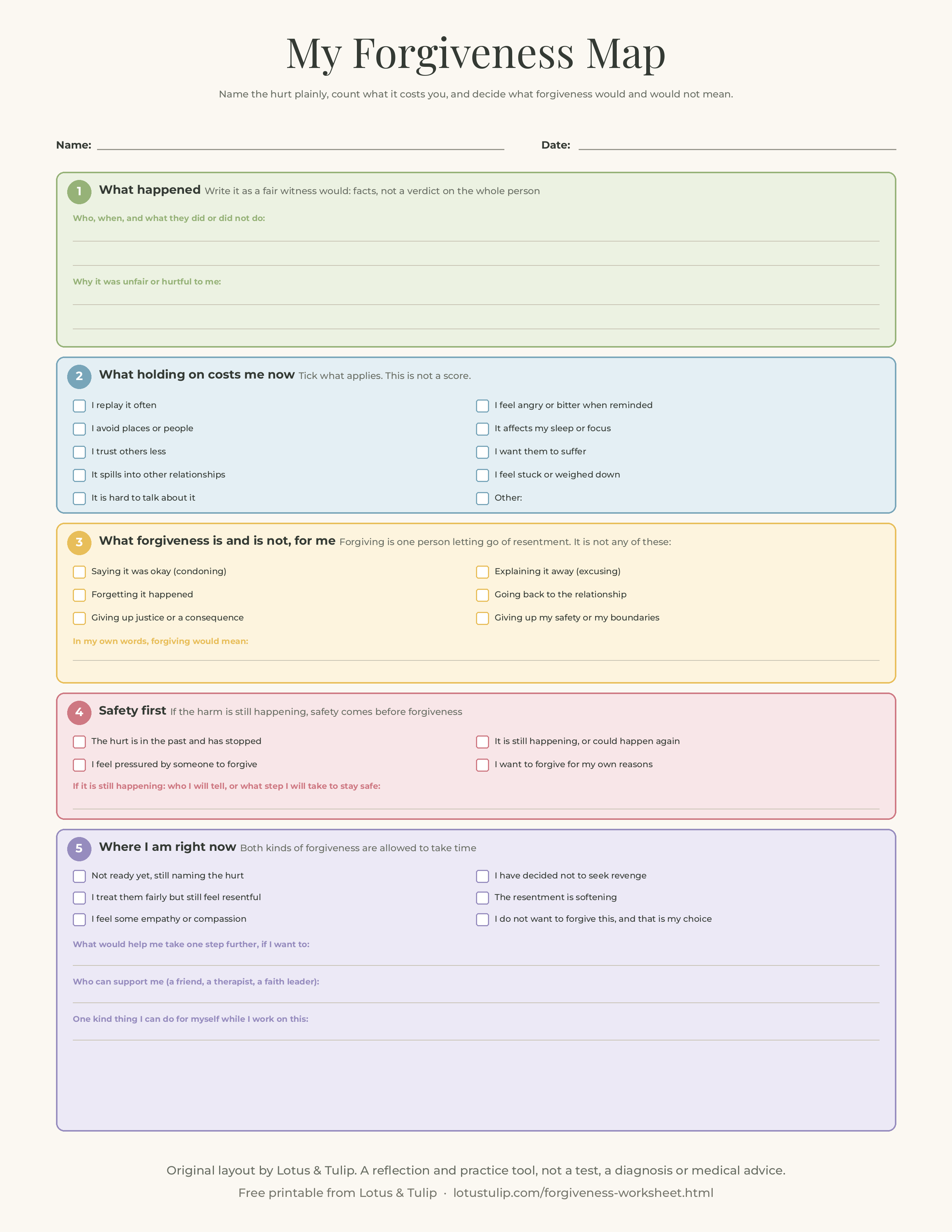
- Check safety before anything else. On page 1, tick whether the hurt is in the past or still happening. If someone is still hurting you, the first task is protection (telling someone, making a safety plan, legal or practical steps), not forgiveness. Forgiveness work is for hurts that have stopped, or for relationships where you can keep yourself safe.
- Name what happened, plainly. Write who did what, and when, as a fair witness would. Then write why it was unfair or hurtful to you. This is Enright's Uncovering and the R in REACH: you cannot forgive something you are still minimizing.
- Count what holding on costs you now. Tick what applies: replaying it, bitterness when reminded, avoiding places, poor sleep, trusting others less, wanting them to suffer. This is not a score. It helps you see what you are carrying and whether you want to put some of it down.
- Decide what forgiveness would and would not mean for you. Tick the things forgiving does not require (condoning, excusing, forgetting, reconciling, giving up justice, giving up safety). Then write, in your own words, what forgiving would mean. Many people find they are more willing to forgive once they see that it does not mean saying it was fine.
- Notice where you are, without forcing it. On page 1, mark where you stand today: not ready, decided not to seek revenge, fair but still resentful, softening, or feeling some empathy. "I do not want to forgive this" is also an honest option. Decisional and emotional forgiveness often move at different speeds.
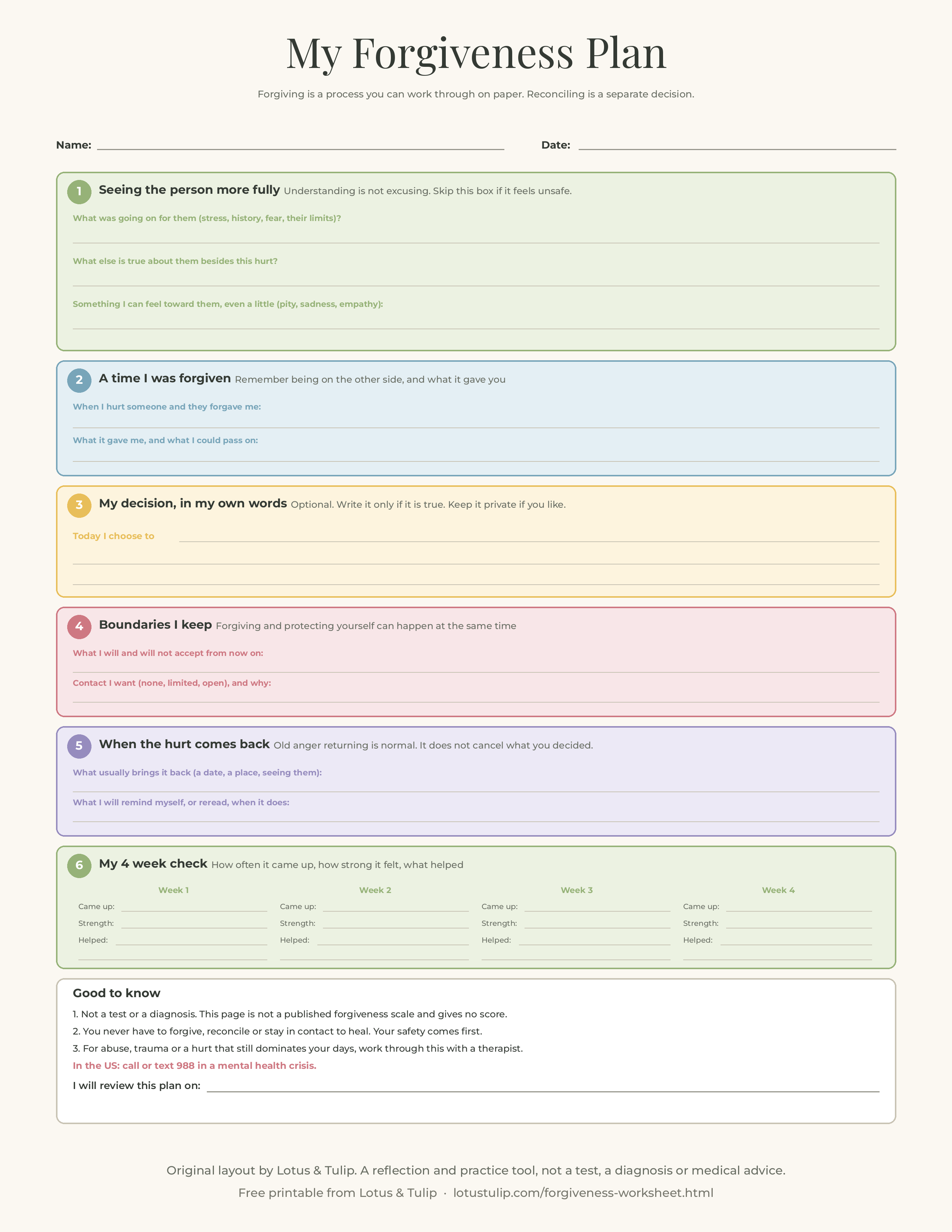
- Try to see the person more fully, if it feels safe. On page 2, write what may have been going on for them (stress, history, fear, their limits) and what else is true about them besides this hurt. Understanding is not excusing. If thinking about the person in this way feels unsafe or retraumatizing, skip this box and work on it with a therapist.
- Remember a time you were forgiven. Write about a time you hurt someone and they forgave you, and what it gave you. This is the Altruistic gift step in REACH: it shifts forgiveness from something taken from you to something you choose to offer.
- Write your decision and your boundaries side by side. If it is true, write "Today I choose to..." in your own words. Right next to it, write what you will and will not accept from now on, and the contact you want (none, limited or open). Forgiving and protecting yourself can happen at the same time.
- Plan for the hurt coming back, and review after four weeks. Anger returning on an anniversary or after seeing the person does not cancel your decision. Write what usually brings it back and what you will reread when it does (the H in REACH). Fill in the 4 week check: how often it came up, how strong it felt, what helped. If the hurt involves abuse or trauma, or still dominates your days, work through it with a therapist. In the US, call or text 988 in a mental health crisis.
Common mistakes
- Pressuring someone to forgive. Forgiveness is, by definition, freely chosen. Telling a client, a friend or yourself that you "have to" forgive tends to produce shame, not forgiveness.
- Treating forgiveness as reconciliation. Many people refuse to forgive because they believe it means letting the person back in. It does not. Keep the two decisions separate on paper.
- Forgiving while the harm continues. McNulty's findings in newlywed couples are a warning: forgiving a partner who keeps being aggressive may remove the consequences that would discourage it. Safety first.
- Skipping the anger. Rushing to "I forgive them" without naming what happened and how it hurt often leaves resentment underneath. Both main models start with facing the hurt.
- Expecting the feelings to follow the decision overnight. Decisional forgiveness can be made in a moment; emotional forgiveness usually takes longer. The research favors longer, process-based work over a single decision.
- Reading returning anger as failure. A flash of anger when you see the person again is normal. Reread your decision and your boundaries; you have not undone the work.
Examples
- The adult child and the absent father: He had not spoken to his father in years and felt bitter every Father's Day. On page 1 he wrote the facts (missed visits, broken promises) and ticked that forgiving would not mean resuming contact. On page 2 he wrote what he knew of his father's own childhood, then his boundary: no contact for now. Over two months the bitterness softened. He did not reconcile, and he did not need to.
- The colleague who took credit: She replayed a meeting where a coworker presented her project as his own. Before forgiveness, she used the CBT thought record to separate facts from "everyone thinks I am a pushover," then raised the attribution with her manager. With the practical problem handled, she worked through the plan page and found she could be civil at work without the daily replay.
- The client not ready to forgive: A therapist used the map page with a client hurt by a former partner. The client ticked "I do not want to forgive this." Rather than push, they used the cost box to agree on a goal the client did want (fewer nights lost to replaying it), worked on rumination and boundaries, and left forgiveness as an option for later. Respecting the "no" kept the work moving.
Free printable: forgiveness worksheet for adults
This free printable is an original Lotus & Tulip layout on US Letter, in our own wording. It is not a published forgiveness scale, and it does not give a score. Page 1, My Forgiveness Map, covers what happened, what holding on costs you now, what forgiveness is and is not for you, a safety check and where you are right now. Page 2, My Forgiveness Plan, covers seeing the person more fully, a time you were forgiven, your decision in your own words, the boundaries you keep, what to do when the hurt comes back, a 4 week check and a review date.
Download the free forgiveness worksheet (PDF, 2 pages, US Letter)
Prefer single images? Page 1: my forgiveness map (PNG) · Page 2: my forgiveness plan (PNG)
Free to print for yourself or for use with your own clients or groups. Please link to this page rather than re-uploading the file. A reflection and practice tool, not a test, a diagnosis or a substitute for therapy. In the US, call or text 988 in a mental health crisis.
Related resources
- Radical acceptance worksheet: accepting what happened without approving of it
- Shame vs guilt worksheet: when the person you are struggling to forgive is you
- Self-compassion worksheet: kindness toward yourself while you work through a hurt
- Anger management worksheets for adults: when the anger itself needs cooling first
- Rumination worksheet: for the scene that keeps replaying
- Healthy boundaries worksheet: forgiving and protecting yourself at the same time
- All therapist worksheets: CBT, DBT, ACT and more
FAQ
What is a forgiveness worksheet?
A forgiveness worksheet is a structured page that helps you work through a hurt on paper: naming what happened, noticing what holding on costs you, deciding what forgiveness would and would not mean, and planning boundaries and next steps. The free 2 page printable on this page is an original reflection tool, not a test or a published forgiveness scale.
Does forgiving someone mean I have to reconcile with them?
No. In the research definition used by forgiveness therapists, forgiveness is one person's choice to let go of resentment, while reconciliation means two people restoring trust. You can forgive and still keep no contact or limited contact. The plan page puts your decision and your boundaries side by side for that reason.
Do forgiveness interventions actually work?
On average, yes. A 2014 meta-analysis by Wade and colleagues of 54 reports found that people in forgiveness interventions reported more forgiveness than people with no treatment or a different treatment, along with greater improvements in depression, anxiety and hope than no treatment. Longer and individual interventions tended to help more. A brief decision on its own showed little effect in an earlier meta-analysis.
What is the REACH model of forgiveness?
REACH is Everett Worthington's five step approach: Recall the hurt, Empathize with the person who hurt you, give forgiveness as an Altruistic gift, Commit to the forgiveness you experienced, and Hold on to it when doubts return. A 6 hour self-directed REACH workbook increased forgiveness in a small randomized trial with university students.
Should I forgive someone who is still hurting me?
Safety comes first. Research with newlywed couples found that more forgiving spouses saw their partner's aggression stay stable over four years, while less forgiving spouses saw it decline. If harm is ongoing, focus on protection and support. If you are in danger in the US, call 911; for a mental health crisis, call or text 988.
Can therapists use these worksheets with clients?
Yes. They are free to print for use with your own clients or groups. Please link to this page rather than re-uploading the file. For abuse or trauma, use them within therapy rather than as homework alone, and never as pressure to forgive.
Sources
- Baskin, T. W., and Enright, R. D. (2004). Intervention studies on forgiveness: A meta-analysis. Journal of Counseling and Development, 82(1), 79 to 90.
- Freedman, S. R., and Enright, R. D. (1996). Forgiveness as an intervention goal with incest survivors. Journal of Consulting and Clinical Psychology, 64(5), 983 to 992.
- Harper, Q., Worthington, E. L., Jr., Griffin, B. J., Lavelock, C. R., Hook, J. N., Vrana, S. R., and Greer, C. L. (2014). Efficacy of a workbook to promote forgiveness: A randomized controlled trial with university students. Journal of Clinical Psychology, 70(12), 1158 to 1169.
- McNulty, J. K. (2011). The dark side of forgiveness: The tendency to forgive predicts continued psychological and physical aggression in marriage. Personality and Social Psychology Bulletin, 37(6), 770 to 783.
- Toussaint, L. L., Shields, G. S., and Slavich, G. M. (2016). Forgiveness, stress, and health: A 5-week dynamic parallel process study. Annals of Behavioral Medicine, 50(5), 727 to 735.
- Wade, N. G., Hoyt, W. T., Kidwell, J. E. M., and Worthington, E. L., Jr. (2014). Efficacy of psychotherapeutic interventions to promote forgiveness: A meta-analysis. Journal of Consulting and Clinical Psychology, 82(1), 154 to 170.
- Worthington, E. L., Jr., Witvliet, C. V. O., Pietrini, P., and Miller, A. J. (2007). Forgiveness, health, and well-being: A review of evidence for emotional versus decisional forgiveness, dispositional forgivingness, and reduced unforgiveness. Journal of Behavioral Medicine, 30(4), 291 to 302.