
Therapist worksheets · DBT distress tolerance · Updated 2026-11-05
Radical acceptance worksheet: the DBT skill explained, with steps, examples and a free printable
Ready-made printable: DBT Worksheets for Therapists Fillable PDF, 20 pages: weekly diary card, chain analysis, pros and cons, crisis survival plan and 0 to 10 suffering scales
Holiday 20% off: about $11.04, was $14 (EUR 12) · instant digital download
Try it free first: download a fillable sample (weekly diary card and checking the facts, PDF, 234 KB). Type into it on screen, then get the full pack. No email needed.

Some things cannot be changed. A diagnosis has been given. A relationship has ended. A parent has moved out. The job offer went to someone else. A loss has happened and nothing will undo it. Most people respond to facts like these by fighting them in their heads: replaying what should have happened, asking "why me?" over and over, refusing to believe it. That fight is understandable, and it is exhausting. It also tends to add a second layer of pain on top of the first. Radical acceptance is the DBT skill for exactly these moments: you stop fighting the facts that cannot be changed, so that you can feel what you need to feel and put your energy into what you can still do.
This guide is for therapists, counselors, DBT skills group leaders and clients who are practicing on their own. It explains what radical acceptance is in dialectical behavior therapy, what it is not (it is not approval, giving up or pretending to be fine), the related skills Marsha Linehan teaches alongside it (turning the mind, willingness, half smiling and willing hands), a step by step practice, examples from everyday life, how to adapt it for teens, common mistakes and what the research does and does not show. At the end there is a free three page radical acceptance worksheet: a Reality Acceptance Skills card, a Radical Acceptance Worksheet and a Turning the Mind Practice Log.
Jump to the free radical acceptance worksheet · Jump to radical acceptance examples
What radical acceptance means in DBT
Radical acceptance is one of the distress tolerance skills in dialectical behavior therapy (DBT), the treatment developed by psychologist Marsha Linehan. In the current skills materials it sits in a group called the reality acceptance skills, which Linehan describes as skills for living a life that is not the life you want. The other distress tolerance group, the crisis survival skills such as STOP, pros and cons and TIPP, helps a person get through a short, intense crisis without making it worse. Reality acceptance skills are for the longer haul: painful facts that are not going away.
The word "radical" means all the way, complete and total. Radical acceptance is acceptance with your mind, your heart and your body, not just a sentence you say while still raging inside. It means you stop fighting reality, stop insisting that it should be different from how it is, and let go of bitterness about it. In Linehan's framing, the things to be accepted include that the facts of the past and present are what they are, that everyone has some limits on their future (only realistic ones need to be accepted), that everything that happens has causes, and that life can be worth living even with painful events in it.
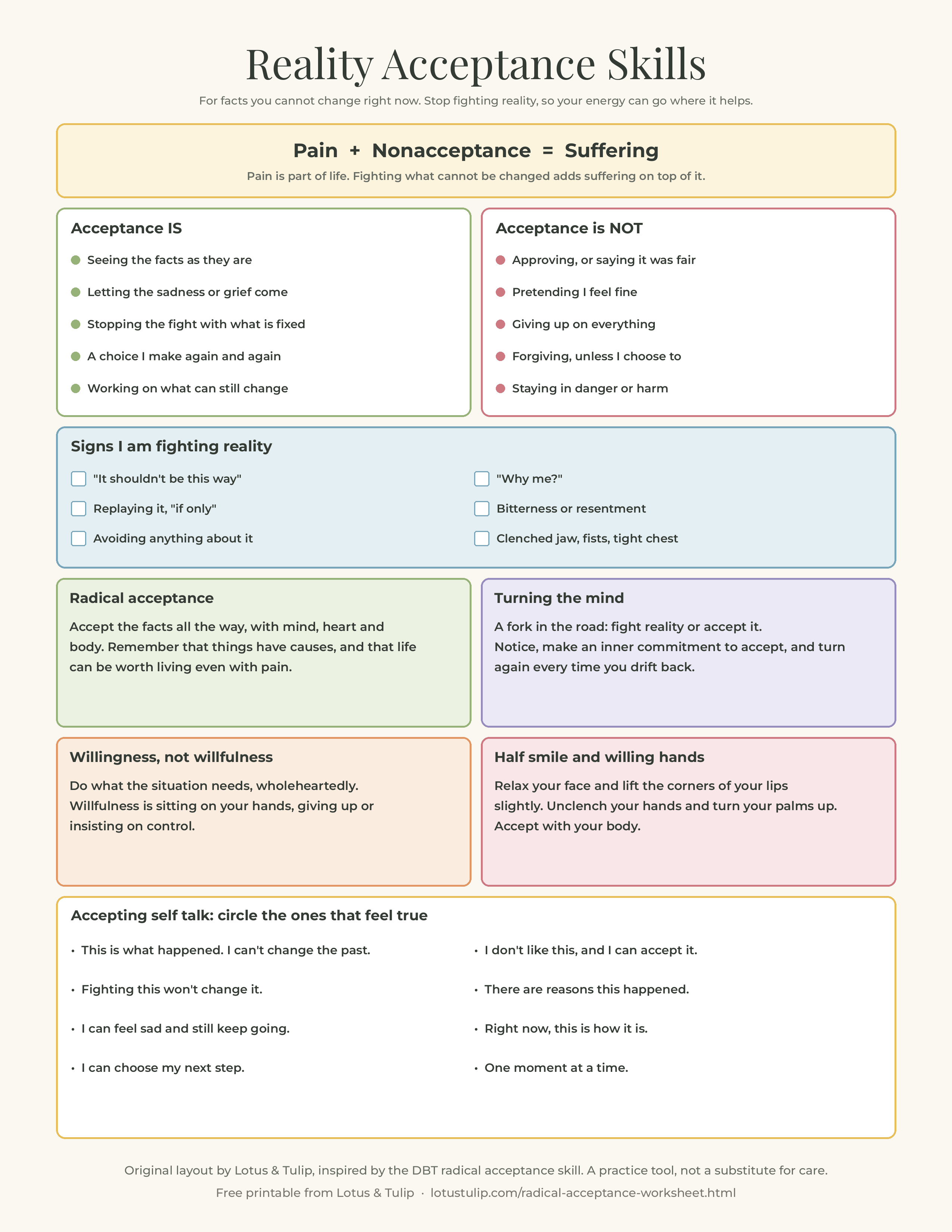
DBT teachers often sum up the core idea with a short formula: pain plus nonacceptance equals suffering. Pain is part of life and cannot always be avoided. Suffering is what grows when we refuse to accept the pain: the rumination, the bitterness, the "this can't be happening," the energy spent pushing against a wall that will not move. Radical acceptance does not remove the pain. It aims to remove the extra suffering, which often turns out to be the larger part.
Where radical acceptance comes from
Linehan first published DBT in her 1993 treatment manual and skills training manual for borderline personality disorder. The current version of the skills, including the reality acceptance handouts, is in the second edition DBT Skills Training Manual and the companion DBT Skills Training Handouts and Worksheets (Guilford Press, 2015), where radical acceptance, turning the mind, willingness and half smiling and willing hands appear as Distress Tolerance Handouts 11 to 14.
The "dialectic" in DBT is the balance between acceptance and change. Linehan found that therapy focused only on change (fix your thoughts, fix your behavior) could feel invalidating to clients in deep pain, while therapy focused only on acceptance left them stuck. DBT holds both at once. Radical acceptance is one of the clearest expressions of the acceptance side, and Linehan has written about how her own Zen practice shaped it. Outside DBT, the meditation teacher and psychologist Tara Brach used the same phrase as the title of her 2003 book Radical Acceptance, which focuses on self acceptance in a Buddhist framework. The two overlap in spirit but are not the same thing; this guide follows the DBT skill.
Radical acceptance also has close cousins in other therapies. Acceptance and commitment therapy (ACT) treats acceptance as one of six core processes of psychological flexibility, and many ACT exercises, such as values work, pair acceptance with committed action in the same way DBT pairs acceptance with change.
What radical acceptance is, and what it is not
The most common reason people resist this skill is that they hear "accept" as "approve" or "give up." Clearing that up early is often half the work.
| Radical acceptance is | Radical acceptance is not |
|---|---|
| Acknowledging the facts as they are | Approving of what happened or saying it was fair |
| Letting yourself feel the grief or disappointment underneath | Pretending you feel fine |
| Stopping the mental fight with what cannot be changed | Giving up on what can still be changed |
| A choice you make again and again | A one time decision or a feeling you must already have |
| Compatible with working hard for change, justice or repair | Passivity, resignation or staying in a harmful situation |
| Something you do for yourself | Forgiving someone, unless you choose to |
A useful line for clients: "Accepting that it happened is not the same as agreeing that it was okay." A person can radically accept that they were treated unfairly and still report it, set a boundary or leave. In fact, acceptance often makes that action easier, because energy that was spent on "this should not have happened" becomes available for "this happened, so what do I do now?"
Signs you are fighting reality
Nonacceptance is not always obvious. It often shows up as a pattern of thoughts, feelings and behaviors that keep circling the same fact. Common signs:
- Thoughts like "It shouldn't be this way," "Why me?", "I can't stand this," "This isn't fair," "If only," and replaying the event looking for a different ending.
- Feelings like bitterness, resentment, chronic irritation or a numb refusal to feel anything about it at all.
- Behaviors like avoiding everything connected to the situation, refusing to make decisions that depend on it (for example not filling in the insurance forms after a diagnosis), or repeatedly trying to undo something that is done.
- Body signs like a clenched jaw, tight fists, shallow breathing or tension that spikes whenever the topic comes up.
Noticing these signs is the first step of the practice. It is not a reason for self criticism. Fighting reality is a normal human reaction; the skill is learning to notice it and turn away from it.
The reality acceptance skills
Linehan teaches radical acceptance as part of a small family of skills that support each other. You do not need all of them every time, but knowing them gives a client more ways in.
Radical acceptance
Complete acceptance, with mind, heart and body, of facts that cannot be changed right now. This is the core skill. It applies to big facts (a death, a disability, a past trauma) and small ones (the train is cancelled, the exam result is in).
Turning the mind
Linehan compares this to standing at a fork in the road. One road is rejecting reality; the other is accepting it. Turning the mind is the act of choosing the acceptance road. The choice itself is not acceptance yet; it just puts you on the path. The steps are simple: notice that you are not accepting, make an inner commitment to accept, and do it again, over and over, every time you find yourself back at the fork. Most people need to turn the mind many times a day when the fact is painful. That is not failure. It is the skill.
Willingness vs willfulness
Willingness means doing what the situation needs, wholeheartedly, without dragging your feet. Willfulness is the opposite: refusing to tolerate the moment, sitting on your hands when action is needed, insisting on being in control, or trying to fix everything instead of doing what works. Linehan's examples of willfulness include giving up, refusing to make changes that are needed and trying to make the situation into what you want it to be. When a client notices willfulness, the next step is not to fight the willfulness (which just adds another struggle) but to acknowledge it, turn the mind and ask, "What does this situation actually need from me right now?"
Half smiling and willing hands
These are two ways to accept with the body. A half smile is a slight upturn of the lips with a relaxed face, not a forced grin, the kind of expression you might have when you are calm and content. Willing hands means unclenching the hands and turning the palms up, either resting on the thighs or loosely at your sides. The idea is that the body and mind influence each other: a relaxed, open posture can make acceptance a little easier, while clenched fists and a tight jaw keep the fight going. Clients can practice both while thinking about something hard to accept, or when they first wake up, or when they notice irritation building.
Allowing the mind: mindfulness of current thoughts
The last reality acceptance skill is observing thoughts as thoughts, letting them come and go without pushing them away or holding on to them. For radical acceptance this means noticing "it shouldn't have happened" as a thought passing through, rather than as an order to keep fighting. Our Wise Mind worksheet covers related DBT mindfulness skills.
How to practice radical acceptance: 10 steps
Linehan's handout lists a series of steps for practicing radical acceptance. Here they are in our own words, with what each looks like in practice.
- Notice that you are fighting reality. Catch the "it shouldn't be this way" thoughts, the bitterness or the clenched body.
- Remind yourself that this is the reality. Say it plainly, in the present or past tense: "This is what happened." "This is where things are."
- Remind yourself that there are causes. Things happen because of a long chain of earlier events. Given all of those causes, this is how it unfolded. This is not about blame; it is about seeing that reality is not random or personally aimed at you.
- Accept with your whole self. Use accepting self talk, slow breathing, a half smile and willing hands, prayer if that fits your values, or a place that helps you feel grounded.
- Act as if you have already accepted. List what you would do if you truly accepted this fact, then do those things. This is opposite action applied to nonacceptance. The opposite action worksheet guide explains the skill in depth.
- Cope ahead. Picture situations where the fact will be hard to accept (an anniversary, seeing the ex at school, a medical appointment) and rehearse in your mind how you will respond with acceptance.
- Notice your body sensations as you think about what you need to accept. Breathe into them rather than bracing.
- Let the feelings come. Allow disappointment, sadness or grief to rise. Acceptance often brings sadness first, and a deeper calm later.
- Acknowledge that life can be worth living even when there is pain in it.
- If you are stuck, do pros and cons of accepting versus continuing to fight. Write both sides honestly.
Clients rarely need every step every time. For a small daily frustration, steps 1, 2 and 4 might be enough. For a major loss, the whole list may be practiced over weeks or months.
Accepting self talk: phrases that help
Many clients find it easier to start with words. Encourage them to choose one or two phrases that feel true to them, not ones that feel like slogans. Some options:
- "This is what happened. I can't change the past."
- "It is what it is, and I can still choose my next step."
- "I don't like this, and I can accept it."
- "Fighting this won't change it. It will only make me more tired."
- "There are reasons this happened, even if I don't know them all."
- "I can feel sad about this and still keep going."
- "Right now, this is how it is."
- "I can accept this moment, and then the next one."
Notice that none of these say "this is fine" or "this is good." Accepting statements describe reality without judging it as acceptable.
Radical acceptance examples
The examples below are written fresh to show the skill across very different situations. In each one, notice what is accepted and what is still open to change.
A chronic illness diagnosis
A 34 year old is diagnosed with type 1 diabetes. For months she skips glucose checks and tells herself the test was probably wrong. Fighting reality: "This can't be happening to me." Radical acceptance: "I have type 1 diabetes. That is a fact. There are reasons it happened, and none of them are my fault." What changes: she starts the checks, books the dietitian appointment and joins a support group. The sadness about the diagnosis is still there, but the exhausting denial is not.
The end of a relationship
A man's partner of six years has left and is not coming back. He keeps sending long messages explaining why she was wrong to leave. Radical acceptance: "The relationship is over. She has decided, and I cannot decide for her." What changes: he stops sending messages, lets himself grieve and slowly rebuilds his weekends around friends and his own interests.
A teen whose parents are divorcing
A 14 year old believes that if he behaves perfectly, his parents will get back together. Radical acceptance: "My parents are divorcing. It is their decision, not something I caused or can fix." What changes: he can be honest about feeling sad and angry, tell each parent what he needs at their houses, and stop carrying the job of fixing their marriage.
Not getting in
A high school senior is rejected by her first choice college. Radical acceptance: "I did not get in. That is the result this year." What changes: after a few days of real disappointment she looks seriously at the schools that did accept her, and decides whether a transfer later is worth planning for.
Grief after a death
Grief is not something to "accept away." But radical acceptance can help with the part of grief that keeps arguing with the fact of death: "if only we had gone to the doctor sooner," "it shouldn't have been him." Radical acceptance: "She died. I miss her terribly, and I cannot bring her back." What changes: the person can grieve the loss itself instead of fighting it, which many people describe as painful but less exhausting. For children, see our grief activities for kids.
A small, everyday one
You are stuck in traffic and will be twenty minutes late. You cannot make the cars move. Fighting reality: gripping the wheel, swearing, replaying the decision to take this route. Radical acceptance: "I'm going to be late. This is the traffic today." What changes: you send one message to say you will be late, put on a podcast, unclench your hands. Practicing on small things like this builds the skill for the big ones.
A body or ability that has changed
After an injury, a former runner can no longer run long distances. Radical acceptance: "My knee will not handle marathons any more. That is a real limit." What changes: she grieves the old identity, then explores swimming and cycling, and keeps the parts of running she loved (being outside, training with friends) in a new form.
What to accept and what to change
Radical acceptance is for facts that cannot be changed, at least right now. Many real situations are a mix. The skill is to separate the parts, accept the fixed ones and act on the rest. A simple way to sort them is to write two lists:
- Cannot change (accept): what already happened, other people's choices, a diagnosis, a decision that has been made, the weather, the past.
- Can change or influence (act): my next step, how I treat myself, who I ask for help, the boundaries I set, how I care for my body, what I say next.
This is close to the circle of control idea that many counselors use with children; see our circle of control worksheet. In DBT terms, once the fixed facts are accepted, problem solving, DEAR MAN requests and opposite action are all available for the parts that can change.
One important case: if someone is being hurt right now, radical acceptance means accepting that the harm is happening and is real, not accepting that it must continue. Accepting the facts is often what makes it possible to leave, report or ask for help.
A worked example, start to finish
Here is how one completed radical acceptance worksheet might read, for a 17 year old client who was cut from the varsity team.
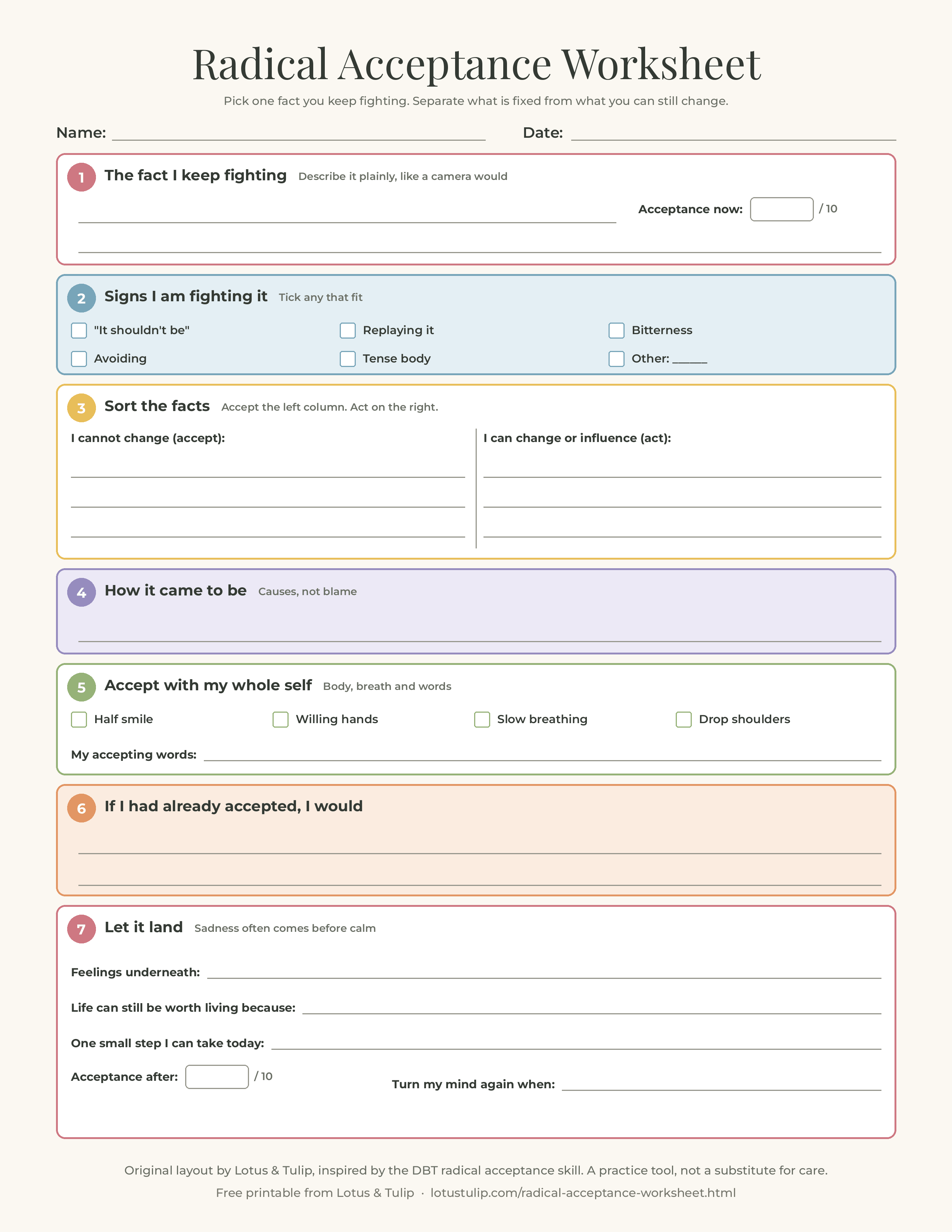
- The fact I keep fighting: I was cut from the varsity soccer team this season.
- Signs I am fighting it: I keep replaying the tryout. I think "the coach is an idiot" every time I see him. I skip lunch so I don't have to sit with the team. Acceptance right now: 2 out of 10.
- What I cannot change: The roster is posted. The coach decided. This season is set.
- What I can change: How I train, asking the coach what to work on, playing club, trying out next year.
- How it came to be: There were 31 players for 22 spots. I missed two weeks with a sprained ankle. Some seniors had played together for years.
- Accepting with my body: Half smile and willing hands on the bus, slow breaths when I see the team.
- Accepting self talk: "I was cut. I hate it, and it's the fact. I can still get better."
- If I had already accepted, I would: Eat lunch with my friends again. Ask the coach for two things to work on. Sign up for the club team.
- Feelings underneath: Embarrassed and really sad. I cried a bit after writing this.
- After: Acceptance 5 out of 10. I'll need to turn my mind again tomorrow.
The acceptance rating is not a grade. It moved from 2 to 5, and that is real progress. The fact that he will need to turn his mind again tomorrow is exactly how the skill is supposed to work.
How to teach radical acceptance, step by step
- Start with the client's own experience of fighting reality. Ask about a time they kept arguing with something that had already happened, and what that cost them in energy, sleep or relationships.
- Introduce pain versus suffering. Explain that pain is part of life, and that suffering grows when pain is not accepted. Draw it as pain plus nonacceptance equals suffering.
- Clear up what acceptance is not. Go through the "is and is not" list: not approval, not giving up, not pretending, not forgiveness unless chosen. Invite the client's objections; they are usually good ones.
- Practice on something small first. Pick a low intensity fact, such as the rain, a long line or a cancelled plan, and walk through noticing, naming the fact and accepting with the body.
- Teach turning the mind. Use the fork in the road image. Ask the client to predict how often they will need to turn the mind about their bigger issue, and normalize that it may be many times a day.
- Add the body. Practice half smiling and willing hands in session for a minute or two while the client holds a mildly hard thought, and ask what they notice.
- Fill in the Radical Acceptance Worksheet together. Use a real but manageable fact. Separate what cannot change from what can, look at the causes, and write the "if I had already accepted, I would" list.
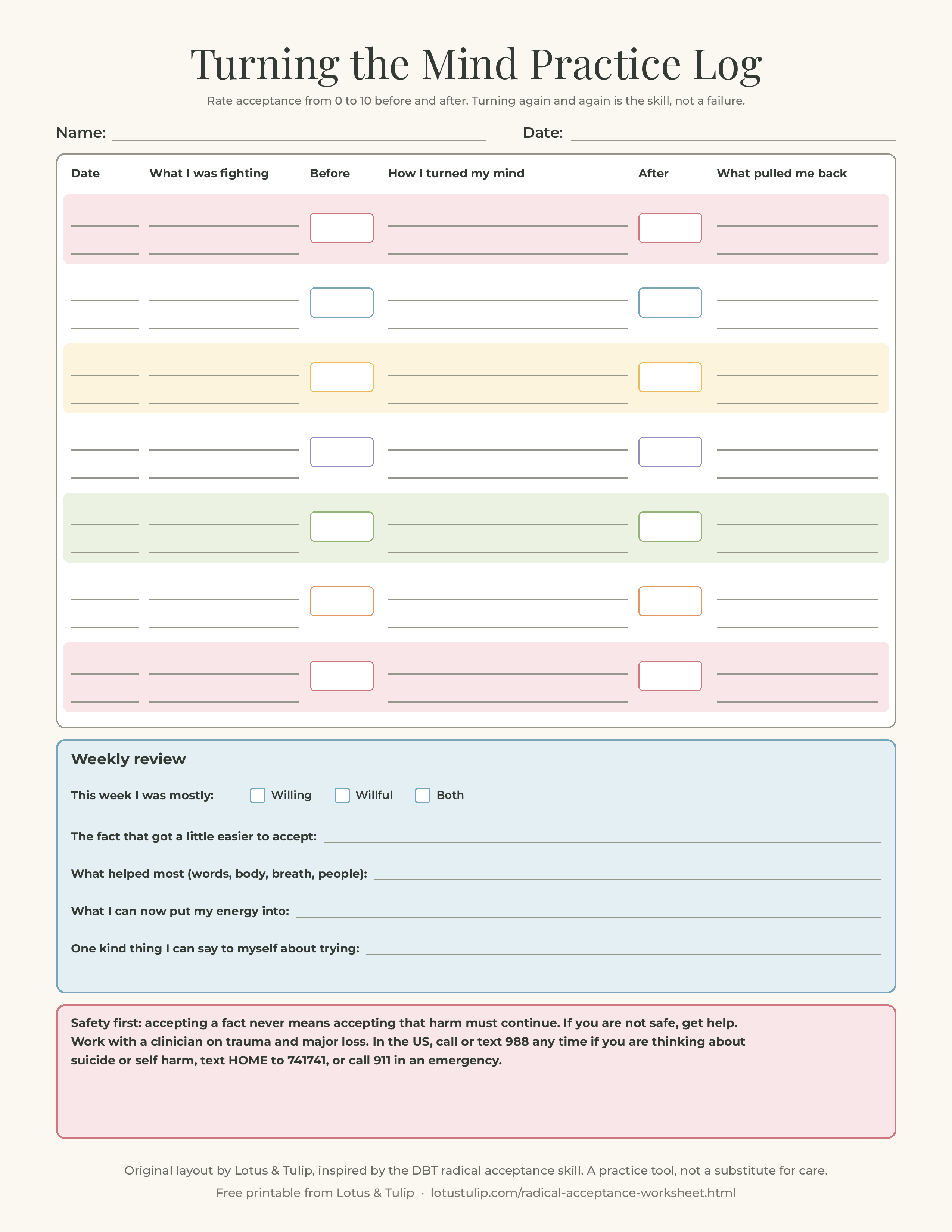
- Assign practice with the Turning the Mind Log. Ask the client to log each time they notice nonacceptance, what they did to turn the mind, and their acceptance rating before and after.
- Review, validate and repeat. In the next session, review the log first, validate how hard the practice is, praise turning the mind rather than "succeeding," and choose the next fact to practice with.
Using radical acceptance with teens
DBT for adolescents (DBT-A) teaches the same distress tolerance skills, including the reality acceptance skills, in a format adapted for teens and their families. Jill Rathus and Alec Miller's DBT Skills Manual for Adolescents (Guilford, 2015) is the standard reference. The evidence for DBT-A as a whole package is promising: in a randomized trial by Mehlum and colleagues (2014) with 77 adolescents in Norway who had repeated self harm, 19 weeks of DBT-A reduced self harm, suicidal ideation and depressive symptoms more than enhanced usual care.
Teens often push back hardest on this skill, usually because they hear it as adults telling them to be quiet about unfair things. Some adaptations that help:
- Lead with fairness. Say early and clearly that accepting something does not mean it was fair or okay. Many teens relax once they hear that.
- Use their situations. Divorce, a breakup, a friend group that changed, a rule they hate, a diagnosis like ADHD or diabetes, not making a team, a move.
- Keep the language plain. "Stop arguing with what already happened, so you can deal with what's next" lands better than the formal definition.
- Make it physical. Willing hands is easy to do discreetly in class or on the bus. Teens often like that it is invisible.
- Involve caregivers carefully. Parents can model acceptance of their own frustrations, but "just radically accept it" said in an argument usually feels dismissive. Share the "is and is not" list with parents too.
- Respect real problems. If a teen is being bullied or mistreated, radical acceptance is about accepting that it is happening so they can get help, never about putting up with it. The coping skills worksheets for teens guide covers other tools for hard days.
For broader DBT practice with this age group, see our DBT worksheets for teens.
Common mistakes with radical acceptance
- Treating it as approval. This is the biggest one. If a client thinks acceptance means saying it was okay, they will understandably refuse. Repeat the difference as often as needed.
- Using it on things that can change. Radical acceptance is not the right skill for a problem you could solve today. Accept the facts, then act on what is open.
- Expecting it to happen once. Acceptance of a big loss is a process, not a moment. Turning the mind over and over is normal.
- Skipping the grief. Acceptance often brings sadness before it brings calm. If a client feels worse at first, that may be a sign the skill is working, not failing.
- Starting with the hardest fact. Practice first on small daily frustrations so the skill is familiar before it is used on trauma or major loss.
- Using it in a crisis. At very high distress, start with crisis survival skills such as TIPP, then move to acceptance once the intensity has come down a little.
- Telling someone else to "just accept it." Radical acceptance is a skill a person chooses for themselves. Prescribing it to someone who is upset with you usually feels invalidating, and often is.
What the research says (honestly)
Radical acceptance is widely taught and fits well with what is known about emotion regulation, but most of the evidence for it comes from studies of DBT as a package. Direct tests of the skill on its own are recent and still small. Here is a fair summary.
- DBT skills training as a whole helps. In a component analysis, Linehan and colleagues (2015) randomized 99 women with borderline personality disorder at high risk for suicide to standard DBT, DBT skills training plus case management, or DBT individual therapy without skills training. All three reduced suicide attempts similarly, but the conditions that included skills training did better on several outcomes, including the frequency of self harm and depression. That study tested the whole skills curriculum, not radical acceptance alone.
- Two week training studies. Segal, Sher, Aderka and Weinbach (2023) randomized 120 healthy adults to two weeks of online practice in Radical Acceptance, practice in the DBT skill Check the Facts, or a control condition. Only the Radical Acceptance group improved in using both emotional acceptance and cognitive reappraisal on a laboratory emotion regulation task. Check the Facts improved reappraisal only.
- A single session comparison. In a later study by Segal, Bronshtein and Weinbach (2025), 92 healthy young adults used either radical acceptance or Check the Facts to cope with a personally distressing event. Negative affect returned to baseline in the radical acceptance group but only partly in the Check the Facts group.
- A brief online trial under real stress. Segal and colleagues (2025) ran a randomized trial with 149 women in Israel whose close relatives or spouses had been deployed during the Israel and Hamas war. In this brief online intervention, only the radical acceptance condition (compared with DBT relaxation skills and a monitoring control) produced significant reductions in stress, depression and emotion regulation difficulties, and the benefits held at a three week follow up.
The fair summary: these are encouraging, well designed studies, but they come mostly from one research group, use short follow ups, and were done with healthy adults or a specific stressed population rather than clinical samples. They suggest radical acceptance is a useful emotion regulation skill, not that it is a stand alone treatment. Use it as one tool inside a broader plan, and judge it by what changes for each client, which the practice log helps you see.
Safety notes and when to get more help
- Acceptance is not staying in danger. Radical acceptance never means accepting that abuse or harm must continue. Accept the facts, then get safe and get support.
- Trauma needs care and pacing. Accepting that a traumatic event happened can be a powerful part of recovery, but it is best done with a trained clinician, at a pace the person can handle.
- Grief can become complicated. If grief stays intense and disabling for a long time, a licensed professional can assess whether more specific help is needed.
- Persistent hopelessness is a warning sign. Radical acceptance includes the idea that life can be worth living with pain in it. If a person cannot see that at all, or is thinking of ending their life, they need more support than a worksheet.
In the US, if you or someone you are supporting is thinking about suicide or self harm, call or text 988 (the 988 Suicide and Crisis Lifeline) any time, day or night. You can also text HOME to 741741 to reach the Crisis Text Line. If someone is in immediate danger, call 911.
Tips for therapists and group leaders
- Teach radical acceptance after clients have some crisis survival skills, so they have something to fall back on if acceptance brings up strong feelings.
- Model it with your own small examples: "I was annoyed the printer jammed before group. I said to myself, 'It's jammed, this is how it is,' and fixed it."
- Expect and welcome objections. "So I'm supposed to be okay with this?" is the perfect opening to explain the difference between acceptance and approval.
- Pair the skill with problem solving and opposite action so clients see acceptance as the start of change, not the end.
- Track practice with the log and review practice before new content each session.
- Link it to the rest of DBT: Wise Mind for seeing clearly, TIPP for crisis intensity, opposite action for acting as if you have accepted, and the window of tolerance for explaining when a person is too dysregulated to practice.
Free radical acceptance worksheet (PDF)
The free radical acceptance worksheet has three pages in US Letter size, written for teens and adults:
- Page 1: Reality Acceptance Skills. A one page reference card: pain plus nonacceptance equals suffering, what acceptance is and is not, signs you are fighting reality, the four reality acceptance skills (radical acceptance, turning the mind, willingness, half smile and willing hands) and a set of accepting self talk phrases.
- Page 2: Radical Acceptance Worksheet. A fill in page: the fact I keep fighting, signs I am fighting it, an acceptance rating from 0 to 10, a two column "cannot change / can change" box, how it came to be, accepting with my body, my accepting words, "if I had already accepted, I would," feelings underneath and an after rating.
- Page 3: Turning the Mind Practice Log. A table for seven practices with acceptance ratings before and after, what pulled you back to fighting and what you did to turn the mind, a willingness check, a weekly review and a safety note with 988.
Download the free radical acceptance worksheet (PDF, 3 pages, US Letter)
Prefer single images? Page 1: Reality Acceptance Skills (PNG) · Page 2: Radical Acceptance Worksheet (PNG) · Page 3: Turning the Mind Practice Log (PNG)
Free to print for your own use and for use with your own clients or groups. This is an original layout by Lotus & Tulip, not a copy of the DBT manual handouts. Please link to this page rather than re-uploading the file.
Related resources
- Forgiveness worksheet for adults: when acceptance turns toward letting go of resentment, with a free map and plan
- Opposite action worksheet (free printable)
- Wise Mind worksheet (free printable)
- DBT TIPP skills worksheet (free printable)
- DEAR MAN worksheet (free printable)
- ACT values worksheet (free printable)
- Circle of control worksheet (free printable)
- Core beliefs worksheet (free printable)
- All therapist worksheets: CBT, DBT, ACT and more
Sources
- Linehan, M. M. (2015). DBT Skills Training Manual, second edition. Guilford Press.
- Linehan, M. M. (2015). DBT Skills Training Handouts and Worksheets, second edition. Guilford Press. Distress Tolerance Handouts 10 to 15.
- Rathus, J. H., and Miller, A. L. (2015). DBT Skills Manual for Adolescents. Guilford Press.
- Brach, T. (2003). Radical Acceptance: Embracing Your Life with the Heart of a Buddha. Bantam.
- Linehan, M. M., Korslund, K. E., Harned, M. S., and colleagues (2015). Dialectical behavior therapy for high suicide risk in individuals with borderline personality disorder: a randomized clinical trial and component analysis. JAMA Psychiatry, 72(5), 475 to 482.
- Segal, O., Sher, H., Aderka, I. M., and Weinbach, N. (2023). Does acceptance lead to change? Training in radical acceptance improves implementation of cognitive reappraisal. Behaviour Research and Therapy, 164, 104303.
- Segal, O., Bronshtein, K., and Weinbach, N. (2025). The benefits of radical acceptance of reality as a standalone strategy for emotion regulation. Current Psychology.
- Segal, O., Hevron, H., Sher, H., Aderka, I. M., and Weinbach, N. (2025). A randomized controlled trial of an online dialectical behavior therapy skills intervention for war-related distress. Journal of Consulting and Clinical Psychology, 93(7), 500 to 510.
- Mehlum, L., Tormoen, A. J., Ramberg, M., and colleagues (2014). Dialectical behavior therapy for adolescents with repeated suicidal and self-harming behavior: a randomized trial. Journal of the American Academy of Child and Adolescent Psychiatry, 53(10), 1082 to 1091.
- 988 Suicide and Crisis Lifeline, 988lifeline.org. Crisis Text Line, crisistextline.org.
Radical acceptance worksheet: FAQ
What is radical acceptance in DBT?
Radical acceptance is a DBT distress tolerance skill developed by Marsha Linehan. It means completely accepting, with your mind, heart and body, facts that cannot be changed right now, and letting go of the fight against them. It is one of the reality acceptance skills, alongside turning the mind, willingness and half smiling and willing hands.
Does radical acceptance mean approving of what happened?
No. Radical acceptance means acknowledging that something happened, not agreeing that it was fair, good or okay. You can radically accept that you were treated badly and still set a boundary, report it or leave. Acceptance is also not forgiveness, unless you choose to forgive.
What are the steps of radical acceptance?
Notice that you are fighting reality, remind yourself that this is the reality, remember that it has causes, accept with your whole self (accepting self talk, breathing, half smile and willing hands), act as if you have already accepted, cope ahead for hard moments, notice body sensations, allow the sadness or grief underneath, acknowledge that life can be worth living with pain, and use pros and cons if you are stuck.
What is turning the mind in DBT?
Turning the mind is the choice to accept reality, made again and again. Linehan compares it to a fork in the road, with one path toward rejecting reality and one toward accepting it. Each time you notice you are back on the rejecting path, you turn your mind toward acceptance. The choice itself is not full acceptance, but it puts you on the path.
What is the difference between willingness and willfulness?
Willingness is doing what a situation needs, wholeheartedly and without resistance. Willfulness is refusing to tolerate the moment, giving up, insisting on control or trying to force things to be the way you want. In DBT, when you notice willfulness you acknowledge it, turn the mind and ask what the situation actually needs.
Is there research on radical acceptance?
DBT skills training as a whole has good evidence. Studies of radical acceptance on its own are newer and smaller: a 2023 two week online training study with 120 adults, a 2025 single session study with 92 adults and a 2025 randomized trial with 149 women under war related stress all found benefits for emotion regulation or distress, mostly from one research group. The results are encouraging but still early.
Is this radical acceptance worksheet free?
Yes. The three page radical acceptance worksheet (reality acceptance skills card, fill in worksheet and turning the mind practice log) is free to print for your own use and for use with your own clients or groups. It is an original Lotus & Tulip layout. Please link to this page rather than re-uploading the file.