
Kids and teens · Goal setting and motivation · Updated 2026-11-04
Goal setting worksheet for students: how to teach SMART goals, if-then plans and progress tracking (free printable)
Ready-made printable: Executive Function Group Curriculum Holiday 20% off: about $11.04, was $14 (EUR 12) · instant digital download
Buy on EtsyTry it free first: download session 1 free (group at a glance, lesson plan and student page, PDF, 69 KB). Run it with your group, then get all 8 sessions. No email needed.

Ask a student what their goal is and you will often hear "do better in school" or "get good grades." Those are wishes, not goals. They do not say what to do on Tuesday night, how to know it is working, or what to do when the phone lights up. Teaching goal setting well is less about a poster with five letters and more about three skills: writing a goal that is clear enough to act on, planning for the moment it gets hard, and keeping track so progress is visible. This guide is for US school counselors, teachers, parents and child and teen therapists who want a practical, honest way to teach those skills, whether it is a new semester, a report card conference or New Year goals in January. It covers what a SMART goal is (and where the idea came from), what the research actually shows, including a large study that should keep us humble, SMART goal examples for elementary, middle and high school, a nine step plan for teaching goal setting, how to use if-then plans and a tracker, and the most common mistakes. It ends with a free three page printable: a "My SMART Goal" builder, a "My Goal Plan" page with if-then plans, and a four week "My Goal Tracker."
Jump to the free goal setting worksheet printable
What a SMART goal is
SMART is a memory aid for checking whether a goal is clear enough to act on. The version used in most schools today is:
- Specific: it names exactly what the student will do. "Read 20 minutes before bed" instead of "read more."
- Measurable: there is a number, a count or a check mark, so the student can tell whether it happened.
- Achievable: it is a stretch but possible with the time, skills and help the student actually has.
- Relevant: it matters to the student, connected to something they care about, not only to what an adult wants.
- Time-bound: it has an end date and, ideally, check in dates along the way.
The acronym is usually traced to a short 1981 article by George T. Doran in Management Review, written for managers, not students. His original letters stood for specific, measurable, assignable, realistic and time-related. Schools later adapted the words, which is why you will see several versions (attainable, achievable, realistic; relevant, results focused). The exact words matter much less than the questions they prompt.
It also helps to know what SMART is not. It is a checklist for writing a goal. It is not, by itself, a plan for reaching it. A perfectly SMART goal can still fall apart the first evening a student is tired. That is why the free printable has two more pages: one for planning around obstacles and one for tracking progress.
What the research says about goal setting for students
Goal setting is one of the most studied topics in psychology, and the findings are more useful (and more nuanced) than the usual "write your goals down" advice.
- Specific, challenging goals beat "do your best." Edwin Locke and Gary Latham summarized decades of research in a 2002 American Psychologist article: across many studies, specific and difficult goals led to better performance than vague goals such as "do your best," as long as people were committed, had the ability and got feedback. That is the core idea behind the S and the A in SMART: clear, and a stretch, but possible.
- If-then plans help people follow through. Peter Gollwitzer's "implementation intentions" are plans in the form "If situation X happens, then I will do Y." A 2006 meta-analysis by Gollwitzer and Paschal Sheeran pooled 94 independent tests and found a medium to large effect on goal attainment (d = .65) compared with goal intentions alone. The plan works because it decides the response in advance, so the student does not have to rely on willpower in the moment.
- Tracking progress helps, especially when it is written down. A 2016 meta-analysis in Psychological Bulletin by Benjamin Harkin and colleagues looked at 138 studies with 19,951 participants. Interventions that increased how often people monitored their progress also improved goal attainment (d+ = 0.40), and the effect was larger when progress was physically recorded or shared with others. This is the reason for page 3 of the printable.
- Picturing the obstacle, not only the win, helps teens. Gabriele Oettingen's research on mental contrasting asks people to imagine the outcome they want and then the obstacle inside them that is most likely to get in the way. Combined with if-then plans, this approach is often taught as WOOP (Wish, Outcome, Obstacle, Plan). In a small 2011 study by Angela Duckworth and colleagues, 66 high school students preparing for the PSAT who did a 30 minute exercise combining mental contrasting with implementation intentions completed more than 60 percent more practice questions than students in a control exercise. It was a small study, but the method is simple, free and fits a single counseling session. (WOOP is Oettingen's work; this page is not affiliated with it.)
- A one-off goal exercise is not magic. This one matters. In a large field experiment published in 2019, Christopher Dobronyi, Philip Oreopoulos and Uros Petronijevic tested an online goal setting exercise with about 1,400 first year students at a Canadian university, with and without a mindset message and follow up reminders. It had no detectable effect on grades, credits or persistence. Earlier, a smaller 2010 study by Dominique Morisano and colleagues had found that struggling university students who did a detailed goal setting program improved their grades compared with a control group. The honest takeaway: writing a goal once, on its own, rarely changes much. What seems to matter is a specific goal, a plan for obstacles, regular check ins and an adult who follows up.
In short, treat the worksheet as the start of a process, not a one-time activity. The goal page gets the student clear, the plan page prepares them for the hard moment, and the tracker plus a weekly check in keeps it alive.
SMART goal examples for students
Students learn the format fastest from examples at their own level. Notice that each one names an action, a number and a date. Most also focus on what the student will do (a process goal) rather than only the result, because a student controls their effort more than their grade.
Elementary school (about grades 2 to 5)
- "I will read for 15 minutes every night before bed and color my tracker, for four weeks."
- "I will practice my 7 times tables for 5 minutes each school day, so I can answer all 12 facts in under a minute by December 15."
- "I will raise my hand and wait instead of calling out, at least 4 out of 5 days this week, and check with my teacher on Friday."
- "I will pack my backpack the night before, every school night for two weeks, so I don't forget my folder."
- "I will ask one new kid to play at recess each week this month."
Middle school (about grades 6 to 8)
- "I will write every assignment in my planner before I leave each class, and check it at home, for the next four weeks."
- "I will turn in all my math homework on time for the rest of the quarter, and look at my grade portal every Friday."
- "I will study for my science test by doing a 20 minute quiz-myself session on three days before the test, not just the night before."
- "I will put my phone in the kitchen until my homework is done, at least 5 school nights a week, for three weeks."
- "I will go to my teacher's help session once a week until my ELA grade is at a C or higher."
High school (about grades 9 to 12)
- "I will raise my chemistry grade from a D to a C by the end of the semester by doing every practice set and going to tutoring every Tuesday."
- "I will complete two full practice SAT sections each weekend until my test date on March 14, and log my scores."
- "I will finish one college application essay draft by November 20 and get feedback from my counselor by December 1."
- "I will be in bed by 11 pm on school nights at least 4 nights a week for the next month."
- "I will apply to three part time jobs by the end of the month and practice an interview with a friend."
Social and emotional goals count too. "Use my calm down plan instead of yelling when I get frustrated, and tally it each day" is a perfectly good SMART goal, and often the one that makes the biggest difference.
How to teach goal setting to students, step by step
- Start with a wish, not a rule. Ask "If this month went really well, what would be different?" Let the student name something they actually want. A goal an adult assigns rarely survives the first hard evening, so begin with their reason, then shape it.
- Turn the wish into one SMART goal. Use page 1 to work letter by letter. Push gently on vague words: "What does better mean? What would I see you doing?" Keep it to one goal at a time; several goals at once usually means none get done.
- Check that it is a stretch, not a leap. Ask the two rating questions on the page: how much do you want this, and how sure are you that you can do it, from 0 to 10. If either is below about 6, adjust the size of the goal or the reason until both feel right.
- Favor process goals over outcome goals. "Get an A" depends on many things a student cannot control. "Study 20 minutes a day using practice questions" is fully in their hands and tends to lead to the grade anyway. Use both if you like, but make sure there is an action they can do today.
- Picture the best outcome, then the main obstacle. On page 2, have the student imagine the win in detail, then ask: "What inside you is most likely to get in the way?" Look for internal obstacles such as being tired, the phone, forgetting or feeling nervous, rather than blaming a teacher or a sibling, because those are the ones a plan can address.
- Write if-then plans for that obstacle. Turn each obstacle into a sentence: "If I get home and want to grab my phone, then I will put it in the kitchen and start my first problem." Make the "if" a real moment and the "then" a small, concrete action. Two or three plans are enough.
- Choose a first step and a start time. The very first step should be almost too easy: open the planner, put the book on the pillow, set a reminder. Write the day and time it will happen, and who can help.
- Track it where the student can see it. Use page 3 every day: color a circle when the step is done and use a dot for "tried, not finished." A visible record is motivating on its own, and the research on progress monitoring suggests it helps more when it is written down and shared.
- Check in weekly and adjust. Once a week, ask the three questions on the tracker: what went well, what got in the way, and what will you change. Keep, tweak or swap the plan. A missed week is information, not failure. When the goal is met, celebrate, then pick the next one.
If-then plan examples
If-then plans are the part of goal setting that most worksheets leave out, and they are where many students get stuck. Here are examples you can adapt:
- "If it is 4 pm on a school day, then I will sit at the kitchen table and open my planner."
- "If I feel like quitting a hard problem, then I will mark it, skip it and come back after two more."
- "If my friends ask me to play a game before my homework is done, then I will say 'after 5' and finish my reading first."
- "If I forget to do my step one day, then I will do it first thing the next morning and not skip two days in a row."
- "If I start thinking 'I'm just bad at this,' then I will say 'not yet' and ask one question in class tomorrow."
- "If I get into bed with my phone, then I will plug it in across the room before I lie down."
Good if-then plans share three features: the "if" is a specific moment or feeling the student will recognize, the "then" is one small action, and it is written in the student's own words.
How to use the goal tracker and weekly check in
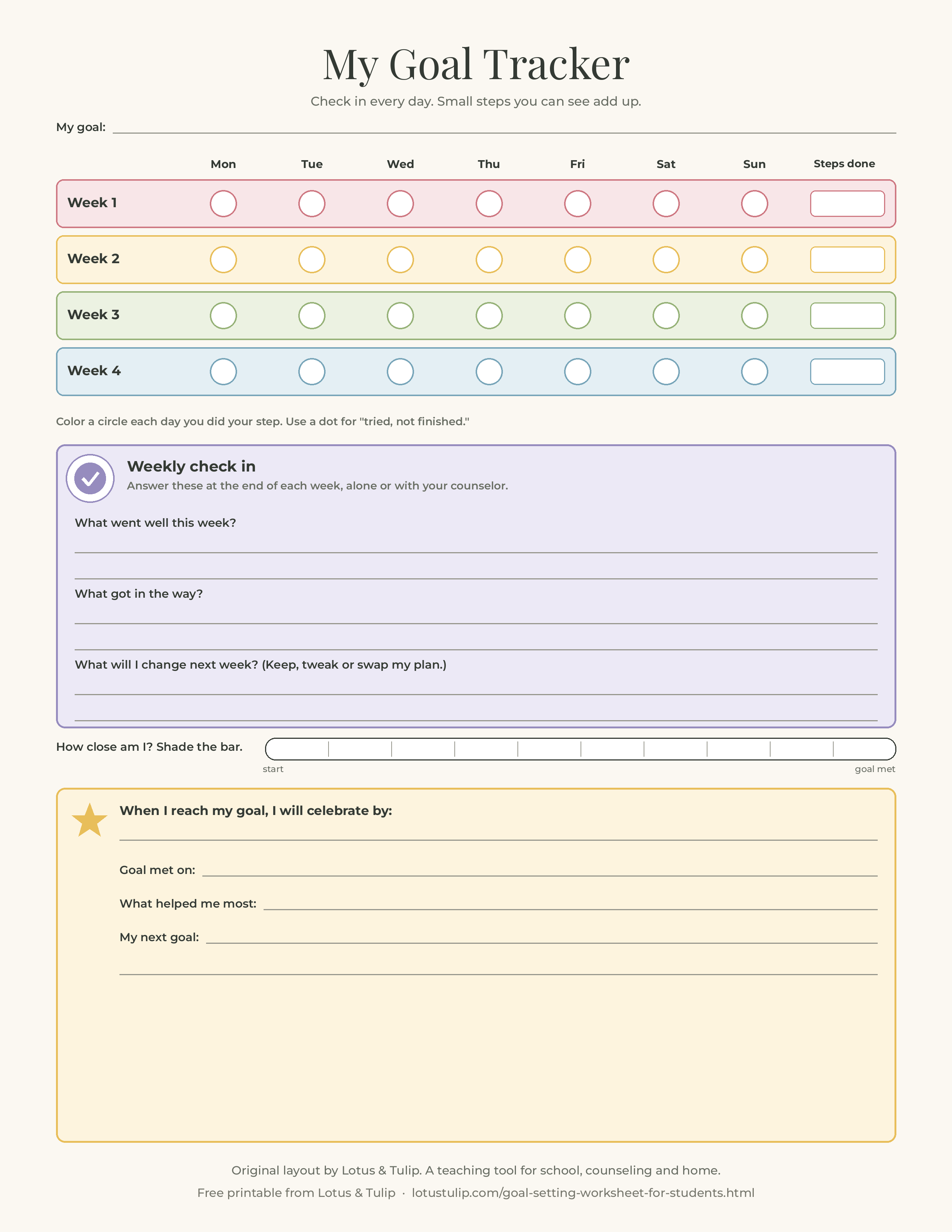
The four week tracker on page 3 turns a goal into something the student can see. Each row is one week and each circle is one day. Students color the circle when they did their step and add a dot if they tried but did not finish, which keeps partial effort from feeling like zero. The "steps done" box at the end of each row gives a simple weekly count.
The weekly check in is where the learning happens. Keep it short, about five minutes, and curious rather than judging. If a student did their step two days out of seven, the useful question is not "why didn't you do it?" but "what got in the way on the other five days, and what could the plan say instead?" Often the fix is to make the step smaller or to move it to a different time of day. The shaded progress bar lets students see how close they are to the final goal, and the celebration box at the bottom gives them something to look forward to and a place to record what helped and what their next goal will be.
Ideas for school counselors and teachers
- Individual planning meetings. Use page 1 and page 2 in a 20 to 30 minute meeting, then a short weekly check in with page 3. This fits academic planning, attendance plans and student success meetings.
- Small groups. Goal setting works well as one session inside a study skills, executive functioning, growth mindset or transition group, with check ins at the start of every following session.
- Whole class lessons. Teach SMART with examples, have each student write one goal and one if-then plan, and revisit it at the start of each week. Goal setting also fits the learning strategies area of the ASCA Student Standards that many US school counseling programs use.
- Report card and conference time. After grades come out, students can set one academic and one habit goal, and share them with a parent or advisor so someone else knows to ask.
- New semester and New Year. January is a natural reset. A short goal setting lesson in the first week back gives students a fresh, concrete plan instead of a vague resolution.
Tips for parents
- Let your child choose the goal, even if it is not the one you would pick. You can help shape it, but ownership is what keeps it going.
- Ask about the plan, not only the result: "What is your if-then plan for after school?" lands better than "Did you study?"
- Put the tracker somewhere visible, like the fridge, and notice effort out loud: "You colored in four days this week."
- Model it. Share a small goal of your own and your own if-then plan. Kids learn more from watching than from lectures.
- Keep celebrations simple and connected to the effort: a favorite dinner, a trip to the library, extra time for a hobby.
Common goal setting mistakes
- Too many goals at once. One goal, done well, builds the skill and the confidence for the next.
- Only outcome goals. "Get straight A's" with no daily action leaves the student with nothing to do today.
- Goals that are too big. A goal that requires a huge change on day one usually ends in a few days. Start smaller than feels necessary.
- No plan for the obstacle. Most goals fail at a predictable moment. If-then plans prepare for it.
- Write it and forget it. As the large 2019 field experiment suggests, a single goal exercise without follow up rarely changes results. Schedule the check ins.
- Treating a missed day as failure. Progress is rarely a straight line. The rule "never skip two days in a row" is kinder and more effective than demanding perfection.
When a student needs more support
Sometimes a student cannot set or keep any goal, no matter how small, and it is not a motivation problem. Ongoing trouble starting tasks, planning or remembering can be a sign of attention or executive function difficulties. A student who says nothing matters, has lost interest in things they used to enjoy, or seems hopeless may be dealing with low mood or depression. Big changes at home, anxiety or learning differences can also get in the way. In those cases, talk with the school counselor, school psychologist or the student's doctor, and consider whether a 504 plan, an IEP or counseling would help. A goal worksheet is a teaching tool, not a replacement for that support.
Free goal setting worksheet printable (PDF)
This free printable is an original Lotus & Tulip design, sized for US Letter paper and suited to about ages 8 to 18 (elementary, middle and high school), classrooms, counseling sessions, small groups and home. Younger students can use it with an adult writing for them. It has three pages:
- Page 1: My SMART Goal. A space for the goal idea, a box for each letter (specific, measurable, achievable, relevant, time-bound) with a prompt, a "my SMART goal in one sentence" box, two 0 to 10 scales (how much do I want this, how sure am I), and lines for a check in date and a grown up who knows the goal.
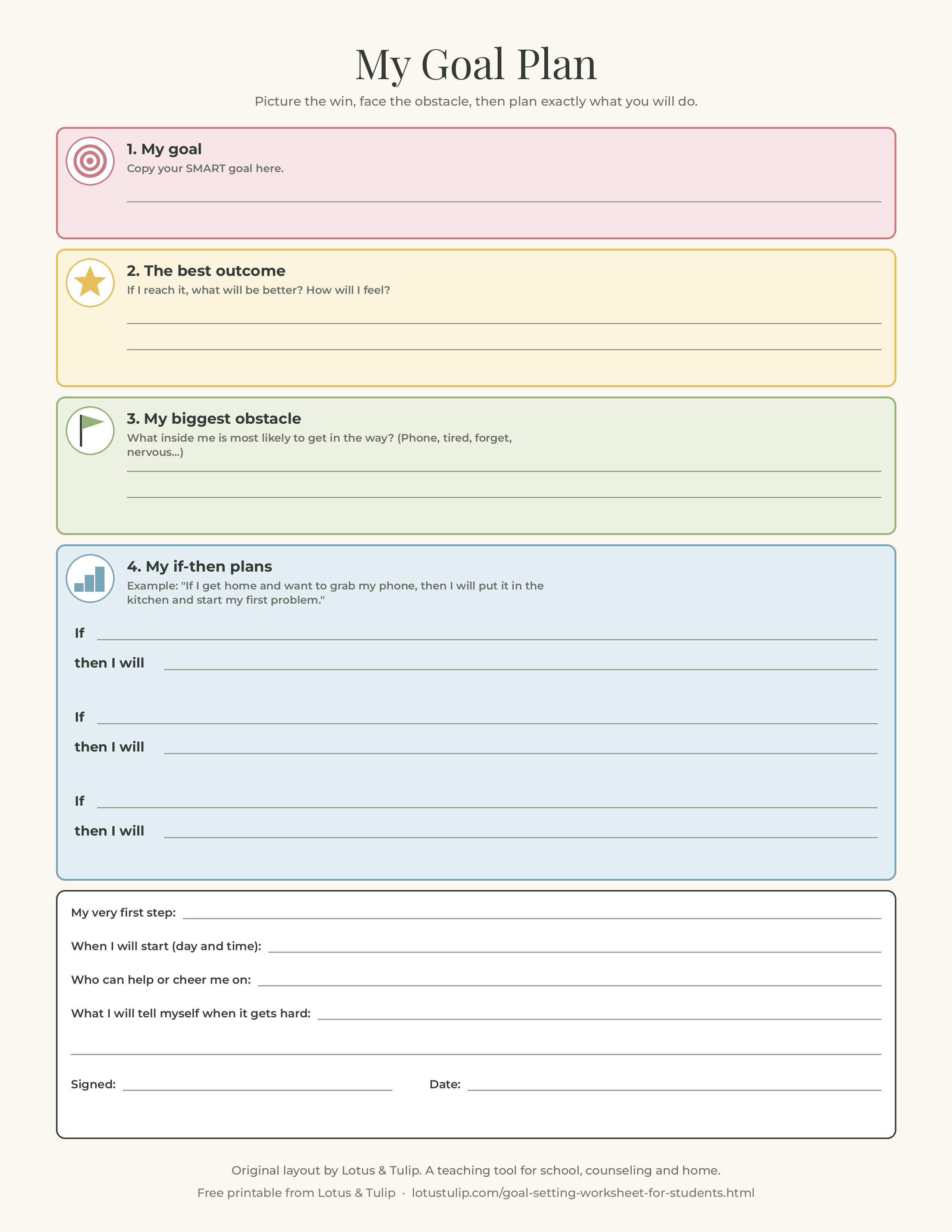
- Page 2: My Goal Plan. My goal, the best outcome, my biggest obstacle, three if-then plans with an example, my very first step, when I will start, who can help, what I will tell myself when it gets hard, and a place to sign and date.
- Page 3: My Goal Tracker. A four week, seven day tracker with a weekly steps count, a weekly check in (what went well, what got in the way, what I will change), a progress bar and a celebration box with goal met on, what helped most and my next goal.
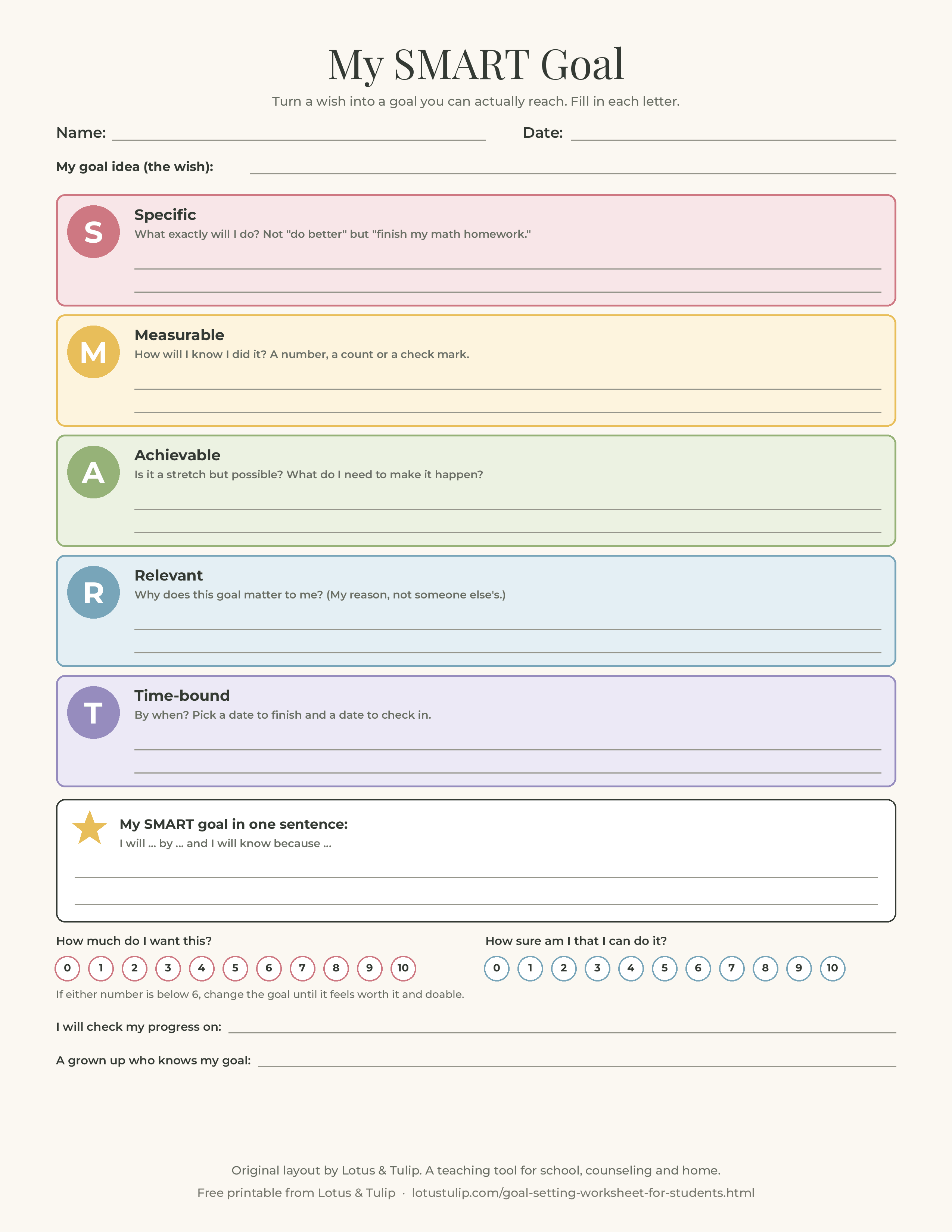
Download the free goal setting worksheets printable (PDF, 3 pages, US Letter)
Prefer single images? Page 1: My SMART Goal (PNG) · Page 2: My Goal Plan with if-then plans (PNG) · Page 3: My Goal Tracker, 4 weeks (PNG)
Free to print for your own use and for use with your own students, clients or children. Please link to this page rather than re-uploading the file.
Related resources
- Goal setting worksheet for adults (free printable): the adult version, with if-then plans and an eight week tracker
- Growth mindset worksheet (free printable)
- Test anxiety worksheet for students (free printable)
- Daily check in for students (free printable)
- Positive self talk worksheet for kids and teens (free printable)
- Self care plan template (free printable)
Sources
- Doran, G. T. (1981). There's a S.M.A.R.T. way to write management's goals and objectives. Management Review, 70(11), 35 to 36.
- Locke, E. A., and Latham, G. P. (2002). Building a practically useful theory of goal setting and task motivation: a 35-year odyssey. American Psychologist, 57(9), 705 to 717.
- Gollwitzer, P. M., and Sheeran, P. (2006). Implementation intentions and goal achievement: a meta-analysis of effects and processes. Advances in Experimental Social Psychology, 38, 69 to 119.
- Harkin, B., Webb, T. L., Chang, B. P. I., Prestwich, A., Conner, M., Kellar, I., Benn, Y., and Sheeran, P. (2016). Does monitoring goal progress promote goal attainment? A meta-analysis of the experimental evidence. Psychological Bulletin, 142(2), 198 to 229.
- Duckworth, A. L., Grant, H., Loew, B., Oettingen, G., and Gollwitzer, P. M. (2011). Self-regulation strategies improve self-discipline in adolescents: benefits of mental contrasting and implementation intentions. Educational Psychology, 31(1), 17 to 26.
- Morisano, D., Hirsh, J. B., Peterson, J. B., Pihl, R. O., and Shore, B. M. (2010). Setting, elaborating, and reflecting on personal goals improves academic performance. Journal of Applied Psychology, 95(2), 255 to 264.
- Dobronyi, C. R., Oreopoulos, P., and Petronijevic, U. (2019). Goal setting, academic reminders, and college success: a large-scale field experiment. Journal of Research on Educational Effectiveness, 12(1), 38 to 66.
- WOOP and mental contrasting with implementation intentions are the work of Gabriele Oettingen and colleagues. Lotus & Tulip is not affiliated with WOOP.
Goal setting worksheet FAQ
What is a SMART goal for students?
A SMART goal is specific, measurable, achievable, relevant and time-bound. For a student, that means naming exactly what they will do, how they will count it, making sure it is a stretch but possible, connecting it to something they care about and setting a date. "Read 20 minutes every night for four weeks" is a SMART goal; "read more" is not.
What is a good SMART goal example for a middle school student?
"I will write every assignment in my planner before I leave each class and check it at home, for the next four weeks." It names an action, can be checked every day, is realistic and has an end date. Pair it with an if-then plan such as "If I forget to write it down, then I will check the class website before dinner."
Does goal setting actually improve grades?
It can help, but a one-time goal exercise on its own usually does not. A large 2019 field experiment with about 1,400 university students found no effect from an online goal setting exercise by itself. Research on if-then plans and on tracking progress suggests the parts that make a difference are a specific plan for obstacles, regular monitoring and follow up from an adult.
What is an if-then plan?
An if-then plan, called an implementation intention by researchers, links a specific situation to a specific action: "If it is 4 pm on a school day, then I will open my planner at the kitchen table." A 2006 meta-analysis of 94 tests found these plans had a medium to large effect on reaching goals, because the decision is made ahead of time.
What is the WOOP goal setting method?
WOOP stands for Wish, Outcome, Obstacle, Plan. It was developed by psychologist Gabriele Oettingen and combines picturing the outcome you want with picturing the obstacle inside you, then making an if-then plan. Page 2 of the free printable follows a similar wish, outcome, obstacle and if-then plan structure.
How many goals should a student set at once?
Usually one, or at most two (for example one academic and one habit goal). One goal with a clear plan and daily tracking teaches the skill far better than a list of five that are forgotten by the second week.
What age is this goal setting worksheet for?
It suits about ages 8 to 18, from upper elementary through high school. Younger children can do it with an adult writing their words, and the examples in this guide are grouped by elementary, middle and high school so you can match the level.