
Kids and teens · Test anxiety and school stress · Updated 2026-11-04
Test anxiety worksheet for students: how to help kids and teens calm test nerves, study smarter and reset during the test (free printable)
Ready-made printable: Test Anxiety Group Curriculum Holiday 20% off: about $11.04, was $14 (EUR 12) · instant digital download
Buy on EtsyTry it free first: download session 1 free (group at a glance, lesson plan and student page, PDF, 74 KB). Run it with your group, then get all 8 sessions. No email needed.

A student who knows the material sits down, reads the first question and goes blank. Their heart pounds, their hands sweat, and a voice in their head says "you are going to fail." Afterward they remember everything. That is test anxiety, and it is one of the most common reasons capable students underperform. The good news is that it is also one of the most treatable school worries. This guide is for US parents, teachers, school counselors and child and teen therapists who want practical, honest tools before unit tests, finals and state assessments. It explains what test anxiety is (and is not), what the research actually shows, including a popular trick that has not held up, how to tell normal nerves from a problem, a nine step plan for helping a student, study habits that lower anxiety, what to do the night before and during the test, how parents and teachers can help, and when to get more support. It ends with a free three page printable: a "My Test Worry Check" thought worksheet, a five day "Test Ready Plan," and a "Test Time Reset" page with 12 helpful thought cards.
Jump to the free test anxiety worksheet printable
What test anxiety is
Test anxiety is worry, tension and physical stress that show up before or during a test or any situation where a student feels they are being judged on their performance. A little nervousness is normal and can even help: it sharpens attention. Test anxiety becomes a problem when it is strong enough to get in the way of showing what you know, or when a student starts avoiding tests, school or studying because of it.
Researchers have described two parts of test anxiety for more than half a century. In 1967, Robert Liebert and Larry Morris separated worry (the thinking part: "I'll fail," "everyone will see," "I always mess up") from emotionality (the body part: racing heart, upset stomach, shaky hands). Later work has kept this split, and it matters in practice. The worry part is the one most strongly linked to lower scores, because worried thoughts take up the working memory a student needs to solve problems. The body part feels awful, but on its own it is less tied to performance. That is why the printable has a section for each: body clues and worried thoughts.
Common signs of test anxiety in kids and teens include:
- Body: stomachaches, headaches, nausea, a racing heart, sweating, shaking, trouble sleeping the night before, feeling faint.
- Thoughts: "I'm going to fail," "I'm stupid," "I can't do this," catastrophic chains ("if I fail this I'll fail the class and never get into college"), and going blank on material they knew.
- Feelings: dread, panic, irritability, tearfulness, frustration, shame after the test.
- Behavior: procrastinating on studying, cramming all night, asking to stay home on test days, rushing through a test to get it over with, or checking answers again and again and running out of time.
What the research says
Test anxiety is one of the most studied topics in educational psychology. Here is what the evidence supports, stated as carefully as the studies allow.
- It is linked to lower scores, but modestly. Ray Hembree's 1988 meta-analysis in the Review of Educational Research pulled together 562 studies. Test anxiety was linked to poorer performance and to lower self esteem and more fear of negative evaluation. A 30 year update by Nathaniel von der Embse and colleagues (2018, Journal of Affective Disorders, 238 studies) found test anxiety was negatively related to standardized test scores, entrance exams and grade point average, with the relationship in the small to moderate range and strongest in the middle grades. The thinking part (worry) was more strongly related to scores than the body part.
- It is common. Estimates vary with the measure and the age group. In one large study of 2,435 secondary school students in England, David Putwain and Anthony Daly (2014) found that about 16 percent scored in the highly test anxious range. Treat any single number with caution, but test anxiety in a meaningful minority of students is a consistent finding.
- Treatment works. Hembree also found that a variety of treatments reduce test anxiety and that reductions go along with better test performance and grades. Tuncay Ergene's 2003 meta-analysis in School Psychology International (56 studies, 2,482 participants) found an average effect size of 0.65, a moderate to large effect, and the strongest programs combined study skills training with behavioral or cognitive approaches such as relaxation and changing anxious thinking. In other words: teach how to study and how to handle the worry, not one or the other.
- Practice testing lowers nerves. In a 2014 study in the Journal of Applied Research in Memory and Cognition, Pooja Agarwal and colleagues surveyed 1,408 middle and high school students who had done frequent low stakes quizzes in class. 72 percent said this retrieval practice made them less nervous about unit tests and exams, 22 percent said it made no difference, and 6 percent said it made them more nervous. Retrieval practice also has strong evidence as a learning tool in its own right (Roediger and Karpicke, 2006).
- Reframing the body's alarm can help. Jeremy Jamieson, Wendy Berry Mendes and colleagues (2010, Journal of Experimental Social Psychology) told some students preparing for the GRE that the physical arousal they felt during a test could help them perform. Those students scored higher on the math section, both on a practice test and on their real GRE, than students not told this. It was a small study of college graduates, so it is a promising idea rather than proof, but it fits a simple message kids can use: "my racing heart is my body getting ready."
- The honest caution: "write your worries away" has not held up well. A famous 2011 study in Science by Gerardo Ramirez and Sian Beilock found that ten minutes of writing about test worries right before an exam improved scores for anxious students. It is still widely repeated. However, a large replication project (Camerer and colleagues, 2018, Nature Human Behaviour) did not reproduce the effect, and a 2025 meta-analysis of single session expressive writing in Anxiety, Stress, and Coping (21 studies, 1,457 participants) found no reliable effect on anxiety and at most a negligible effect on scores. Writing worries down can still feel good to some students, and it is harmless, but it should not be sold as a proven fix.
Put together: test anxiety is real, common and linked to lower scores; the thinking part matters most; and the approaches with the best support combine good study habits (especially practice testing), coping skills for the body, and checking anxious thoughts. That is the structure of this guide and the printable.
Normal nerves or a problem? A quick guide
| Usually normal | Worth more attention |
|---|---|
| Butterflies before a big test that fade once the student starts | Panic, crying or feeling sick that lasts through the test or starts days before |
| Some extra studying and a bit of worry the night before | Cannot sleep before most tests, or stays up all night cramming again and again |
| Disappointment after a bad grade, then moving on | Shame, "I'm stupid" talk, or refusing to look at results |
| Nerves mostly before high stakes tests | Stomachaches or asking to stay home on most test days, or avoiding school |
| Scores roughly match what the student knows | A clear, repeated gap: knows it at home, goes blank in the test |
If test worry is spreading into worry about many other things (friends, health, family, the future), or a student has panic attacks outside tests too, it may be part of a broader anxiety problem. That is a reason to talk to a professional, not just to use a worksheet.
How to help a student with test anxiety, step by step
- Name it and normalize it. Say plainly that test anxiety is common, that it is not a sign of being stupid or weak, and that it can be learned out of. "Lots of smart kids feel this. It is your body's alarm going off at the wrong time, and we can turn it down."
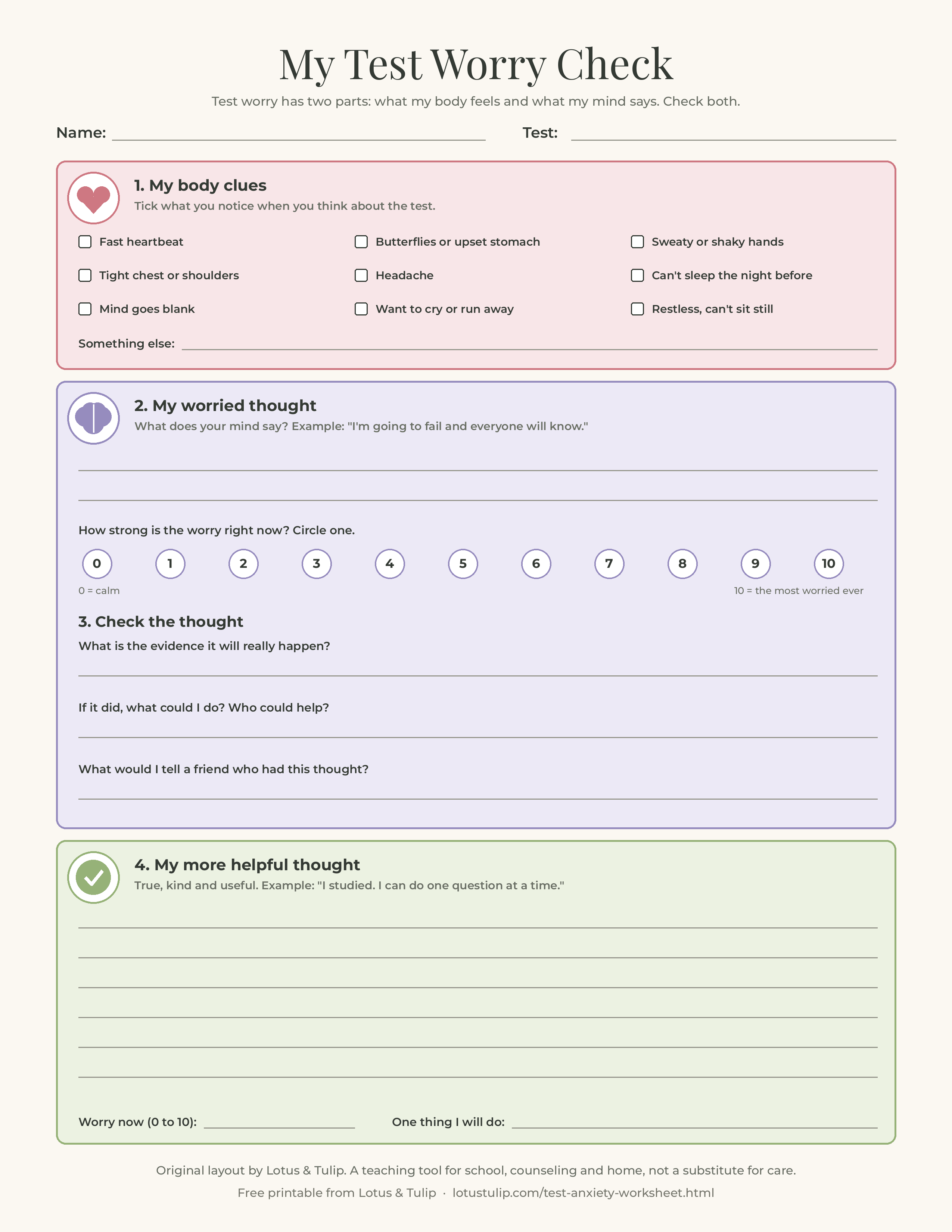
- Explain the two parts. Teach that test worry has a body part and a thinking part. Draw two columns, or use page 1 of the printable: body clues on one side, worried thoughts on the other. Students feel less out of control once they can spot both.
- Find the student's body clues. Ask them to tick what they notice when they think about a test. Knowing their own early signs (tight shoulders, stomach flips) helps them use a calming skill before the feeling gets big.
- Catch the worried thought. Ask, "What does your mind say right before or during a test?" Write it down in the student's own words, and rate how strong it feels from 0 to 10.
- Check the thought, kindly. Use three questions: What is the evidence it will really happen? If it did, what could I do and who could help? What would I tell a friend who had this thought? This is a simple version of the thought checking used in cognitive behavioral therapy (CBT). The goal is not fake positivity; it is a thought that is true, kind and useful.
- Write a more helpful thought. Help the student build one sentence they can actually believe: "I studied. I can do one question at a time." Rate the worry again. Even a drop from 8 to 6 is progress worth noticing.
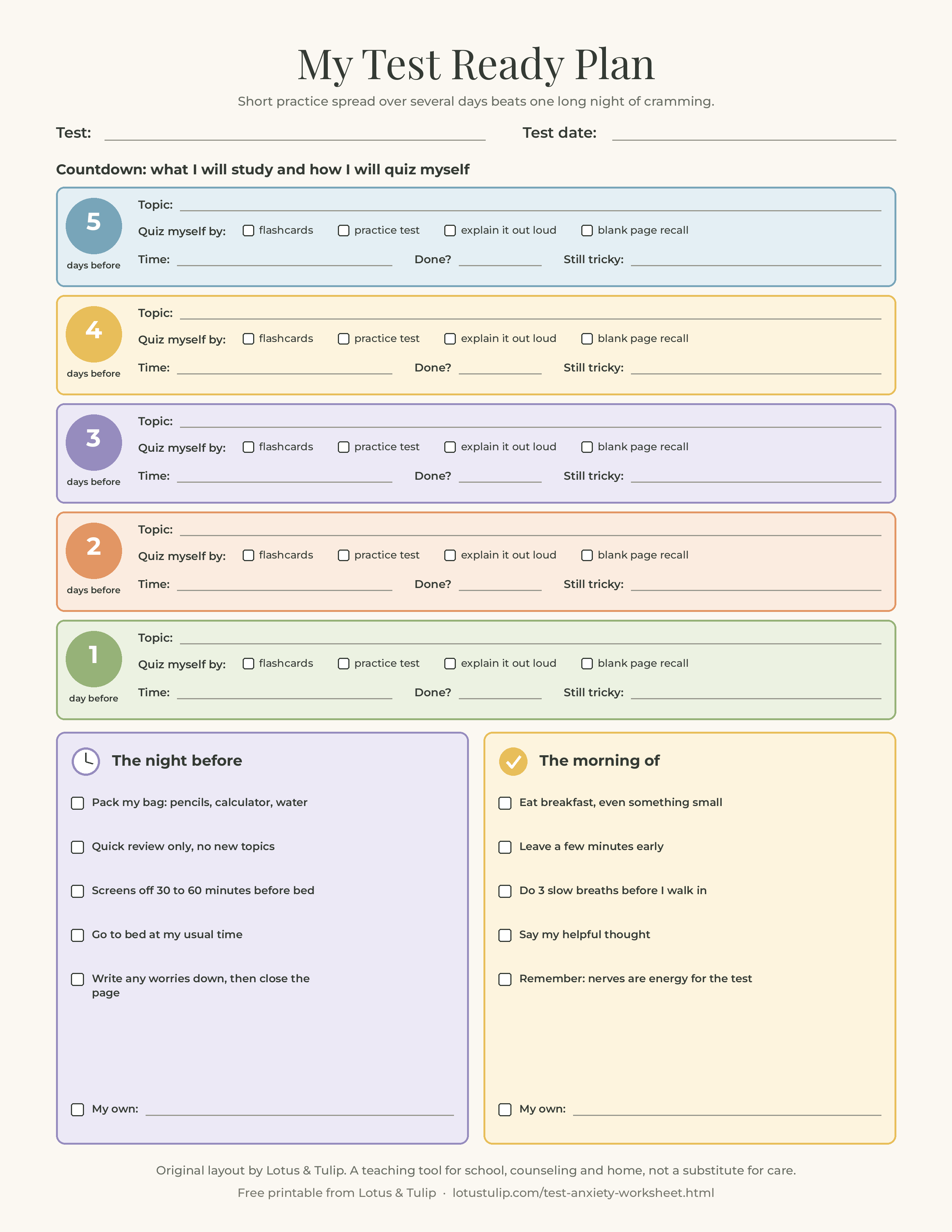
- Make a study plan with practice testing. Use page 2 to spread study over several short sessions and to quiz rather than reread: flashcards, practice questions, explaining it out loud, or writing everything they remember on a blank page. Being prepared is one of the most reliable anxiety reducers there is.
- Practice a reset before test day. Rehearse the six step Test Time Reset on page 3 when the student is calm: pause, slow breathing with a longer exhale, grounding, renaming the body's alarm as energy, skipping and returning, and one question at a time. A skill practiced only in the middle of panic rarely works.
- Review after the test. Afterward, look at what helped and what did not, without focusing only on the grade. "Which step did you use? What would you try next time?" Each test becomes practice for the next one.
Study habits that lower test anxiety
Many anxious students study in ways that feel productive but leave them feeling unprepared, which feeds the worry. These habits help on both fronts.
- Quiz, don't just reread. Rereading notes and highlighting feel comfortable but give a false sense of knowing. Practice testing (retrieval practice) shows students what they really know, strengthens memory, and makes the real test feel familiar.
- Space it out. Four or five short sessions over several days beat one long session the night before. The five day countdown on page 2 is built for this.
- Start with what is tricky. Anxious students often avoid the hardest topic. Put it early in the plan, when there is time to ask for help.
- Practice under test like conditions once. One timed practice set, in a quiet room, lets a student rehearse both the content and the reset steps.
- Ask early. Encourage students to bring "still tricky" topics (there is a space for them on the plan) to the teacher before the test, not after.
- Protect sleep. The American Academy of Sleep Medicine recommends 9 to 12 hours of sleep a night for children 6 to 12 and 8 to 10 hours for teens 13 to 18. An all nighter trades the sleep that consolidates memory for a few extra hours of tired rereading.
The night before and the morning of the test
The last 24 hours are about lowering the alarm, not cramming. Page 2 of the printable has two short checklists for these.
- The night before: pack the bag (pencils, calculator, water, anything allowed), do a quick review only, no new topics, turn screens off 30 to 60 minutes before bed, go to bed at the usual time, and if worries keep spinning, write them down and close the page.
- The morning of: eat breakfast, even something small, leave a few minutes early so rushing does not add stress, do three slow breaths before walking in, say the helpful thought, and remember that nerves are energy for the test.
- Avoid last minute crowd panic. Standing in a hallway where everyone is asking "did you study chapter 6?" can spike anxiety. It is fine to walk in a little early and sit quietly.
During the test: the Test Time Reset
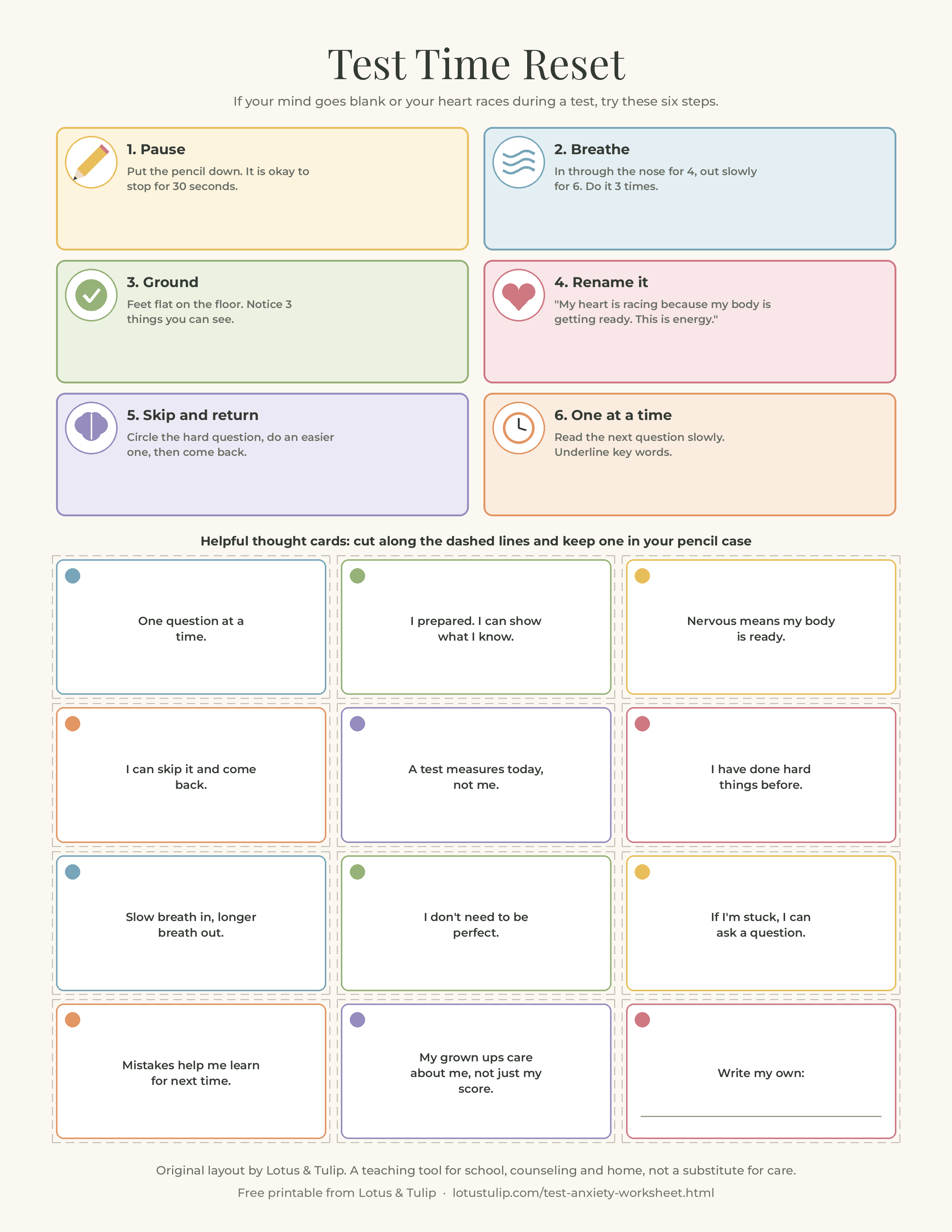
When a student goes blank or panics in the middle of a test, they need a short routine they have already practiced. Page 3 of the printable lays out six steps:
- Pause. Put the pencil down. Thirty seconds of stopping costs less time than ten minutes of panic.
- Breathe. In through the nose for 4, out slowly for 6, three times. A longer out breath is a simple way to help the body settle. Our breathing exercises for kids guide has more options.
- Ground. Feet flat on the floor, notice three things you can see. This pulls attention out of the worry loop and back into the room.
- Rename it. "My heart is racing because my body is getting ready. This is energy." This is the reappraisal idea from the Jamieson study, in kid language.
- Skip and return. Circle the hard question, do an easier one, then come back. Getting a few right rebuilds confidence and often unlocks the stuck memory.
- One at a time. Read the next question slowly and underline key words. Anxiety makes students rush and misread.
The 12 helpful thought cards on page 3 are small enough to keep in a pencil case. Students can pick the one or two that feel most true to them, or write their own on the blank card.
What parents can do
- Watch the message about grades. Kids notice how adults react to scores. Praise effort and strategies ("you quizzed yourself every night") more than the number. Avoid "this test decides your future" talk, which raises the stakes the anxiety feeds on.
- Help with planning, not panicking. Sit down with the five day plan a week before a big test. Offer to quiz them, which is more useful than asking "did you study?"
- Don't rescue too fast. Letting a child stay home on every test day can make the fear grow, because avoidance teaches the brain that tests really are dangerous. Be warm, acknowledge the feeling, and help them go anyway with a plan. If a child is truly unwell, that is different; if school avoidance is becoming a pattern, talk to the school.
- Model calm. Share how you handle your own nerves before a presentation or appointment. Children learn coping by watching it.
- Keep the basics steady. Regular sleep, food and some movement during exam weeks matter more than an extra hour of study.
What teachers and school counselors can do
- Use frequent low stakes quizzes. Short, ungraded or lightly graded retrieval practice makes tests feel routine. In the Agarwal study, most students said it made them less nervous.
- Be clear about the test. Tell students the format, topics and timing ahead of time, and give a practice version. Uncertainty feeds worry.
- Teach the reset to the whole class. A two minute breathing and grounding routine before a test helps anxious students without singling them out.
- Watch your framing. "This is a chance to show what you have learned" lands better than "this counts for a lot of your grade."
- Run a small group. School counselors can run a short test anxiety group in the weeks before finals or state testing, combining study skills, body calming and thought checking, which is the combination Ergene's meta-analysis found strongest.
- Know about formal supports. For students whose anxiety is part of a diagnosed condition, a Section 504 plan or an IEP can include testing accommodations such as extended time, breaks or a separate, quieter room. These are decided by the school team with the family.
Common mistakes
- "Just relax" or "don't worry." Students would if they could. Teach a specific skill instead.
- Only working on calm, never on study skills. A student who is calm but unprepared still has good reason to worry. Do both.
- Only working on study skills, never on worry. Some anxious students over prepare and still freeze. They need the thinking and body tools too.
- Practicing coping only during panic. Rehearse the reset when the student is calm, several times, so it is available under stress.
- Forced positive thinking. "I'll get 100 percent" is not believable and collapses at the first hard question. Aim for true and helpful: "I can do one question at a time."
- Letting avoidance win. Skipping tests, retakes or school brings short relief and long term growth of the fear.
When to get more help
Talk to the school counselor, your pediatrician or a licensed child or teen therapist if test anxiety causes panic attacks, physical symptoms that keep a student out of school, a clear and repeated drop in grades, or school avoidance, or if worry is spreading beyond tests. Cognitive behavioral therapy has good evidence for anxiety in children and teens, and a therapist can tailor it to the student. Sudden changes in mood, sleep, eating or friendships, or talk of hopelessness, can be signs of depression and deserve attention too. If a child or teen talks about hurting themselves or not wanting to be alive, take it seriously and get help right away. In the US you can call or text 988 to reach the 988 Suicide and Crisis Lifeline, which is free, confidential and available 24 hours a day. If someone is in immediate danger, call 911. This guide and printable are educational and are not a substitute for medical or mental health care.
Free test anxiety worksheet printable (PDF)
This free printable is an original Lotus & Tulip design, sized for US Letter paper and suited to about ages 9 to 18 (upper elementary, middle and high school), classrooms, counseling groups and home. Younger students can use it with an adult. It has three pages:
- Page 1: My Test Worry Check. Nine body clues to tick, a space for the worried thought with a 0 to 10 worry scale, three thought checking questions, and a "more helpful thought" box with a second rating and one thing I will do.
- Page 2: My Test Ready Plan. A five day countdown with a topic, four ways to quiz yourself (flashcards, practice test, explain it out loud, blank page recall), time, done and still tricky for each day, plus night before and morning of checklists.
- Page 3: Test Time Reset and Helpful Thought Cards. The six step reset for use during a test (pause, breathe, ground, rename it, skip and return, one at a time) and 12 cut out helpful thought cards, including one to write your own.
Download the free test anxiety worksheets printable (PDF, 3 pages, US Letter)
Prefer single images? Page 1: My Test Worry Check (PNG) · Page 2: My Test Ready Plan (PNG) · Page 3: Test Time Reset and helpful thought cards (PNG)
Free to print for your own use and for use with your own students, clients or children. Please link to this page rather than re-uploading the file.
Related resources
- Worry worksheet for kids (free printable)
- Breathing exercises for kids (free printable)
- Positive self talk worksheet for kids and teens (free printable)
- CBT thought record worksheet (free printable)
- Growth mindset worksheet (free printable)
- Sleep hygiene worksheet (free printable)
Sources
- Liebert, R. M., and Morris, L. W. (1967). Cognitive and emotional components of test anxiety: a distinction and some initial data. Psychological Reports, 20(3), 975 to 978.
- Hembree, R. (1988). Correlates, causes, effects, and treatment of test anxiety. Review of Educational Research, 58(1), 47 to 77.
- von der Embse, N., Jester, D., Roy, D., and Post, J. (2018). Test anxiety effects, predictors, and correlates: a 30-year meta-analytic review. Journal of Affective Disorders, 227, 483 to 493.
- Putwain, D., and Daly, A. L. (2014). Test anxiety prevalence and gender differences in a sample of English secondary school students. Educational Studies, 40(5), 554 to 570.
- Ergene, T. (2003). Effective interventions on test anxiety reduction: a meta-analysis. School Psychology International, 24(3), 313 to 328.
- Agarwal, P. K., D'Antonio, L., Roediger, H. L., McDermott, K. B., and McDaniel, M. A. (2014). Classroom-based programs of retrieval practice reduce middle school and high school students' test anxiety. Journal of Applied Research in Memory and Cognition, 3(3), 131 to 139.
- Roediger, H. L., and Karpicke, J. D. (2006). Test-enhanced learning: taking memory tests improves long-term retention. Psychological Science, 17(3), 249 to 255.
- Jamieson, J. P., Mendes, W. B., Blackstock, E., and Schmader, T. (2010). Turning the knots in your stomach into bows: reappraising arousal improves performance on the GRE. Journal of Experimental Social Psychology, 46(1), 208 to 212.
- Ramirez, G., and Beilock, S. L. (2011). Writing about testing worries boosts exam performance in the classroom. Science, 331(6014), 211 to 213.
- Camerer, C. F., and colleagues (2018). Evaluating the replicability of social science experiments in Nature and Science between 2010 and 2015. Nature Human Behaviour, 2, 637 to 644.
- Single-session expressive writing interventions for test anxiety: a meta-analysis (2025). Anxiety, Stress, and Coping, 39(1).
- Paruthi, S., and colleagues (2016). Recommended amount of sleep for pediatric populations: a consensus statement of the American Academy of Sleep Medicine. Journal of Clinical Sleep Medicine, 12(6), 785 to 786.
- 988 Suicide and Crisis Lifeline, 988lifeline.org.
FAQ
What is a test anxiety worksheet?
A test anxiety worksheet is a printable page that helps a student notice the body clues and worried thoughts that come with tests, check those thoughts, and plan what to do before and during a test. It works best when an adult goes through it with the student well before test day, not five minutes before.
What causes test anxiety in kids and teens?
Usually a mix of things: high stakes or a test that feels hard, past bad experiences, pressure (from others or from themselves), perfectionism, feeling unprepared, and a general tendency to worry. Research links test anxiety to lower self esteem and to fear of being judged. Feeling unprepared is one of the most fixable causes, which is why study habits are part of the plan.
How can I help my child with test anxiety?
Name it as common and fixable, help them notice their body clues and worried thoughts, practice a calming routine when they are calm, and help them study with short practice quizzes over several days instead of cramming. Praise effort and strategies more than grades, and avoid letting them skip tests, which tends to make the fear grow.
What should a student do if their mind goes blank during a test?
Pause and put the pencil down, take three slow breaths with a longer out breath, put both feet on the floor and notice three things they can see, remind themselves the racing heart is their body getting ready, then skip to an easier question and come back later. Practicing these steps beforehand makes them much easier to use in the moment.
Does writing about your worries before a test help?
A well known 2011 study suggested it did, but larger replication attempts and a 2025 meta-analysis found no reliable benefit on anxiety and at most a tiny effect on scores. It is harmless and some students find it helpful, but it should not replace study skills, practice testing and calming and thinking tools, which have stronger support.
Can a student get testing accommodations for anxiety?
Sometimes. In US public schools, a student whose anxiety is part of a diagnosed condition that affects learning may qualify for a Section 504 plan or an IEP, which can include accommodations such as extended time, breaks or a quieter room. The school team decides with the family, so start by talking to the school counselor.
Is this test anxiety worksheet printable free?
Yes. It is free to print for your own use and for use with your own students, clients or children. Please link to this page rather than re-uploading the file.