
Kids and teens · Growth mindset · Updated 2026-11-04
Growth mindset worksheet for kids and teens: how to teach it honestly, with examples and a free printable
Ready-made printable: Growth Mindset Group Curriculum Holiday 20% off: about $11.04, was $14 (EUR 12) · instant digital download
Buy on EtsyTry it free first: download session 1 free (group at a glance, lesson plan and student page, PDF, 71 KB). Run it with your group, then get all 8 sessions. No email needed.

"I'm just not a math person." "I give up, I'm bad at this." Every teacher, school counselor and parent has heard some version of it. Growth mindset is the idea that abilities can be developed through work, good strategies and help from others, and it has become one of the most taught ideas in American schools. It has also become one of the most misunderstood. Posters that say "Mistakes are proof you are trying" do not change much on their own, and the research is more modest than many workshops suggest. This guide is for US teachers, school counselors, therapists who work with children and teens, and parents who want to teach growth mindset in a way that actually helps. It covers what a growth mindset is and is not, what the research really shows, Carol Dweck's warning about "false growth mindset", fixed to growth examples that stay honest, a step by step way to teach it, activities for classrooms and small groups, praise that helps and praise that backfires, and common mistakes. It ends with a free three page growth mindset worksheet: a Change Your Words page, a Not Yet Plan with a mistake reflection, and a weekly challenge log.
Jump to the free growth mindset worksheet
What is a growth mindset?
The term comes from Stanford psychologist Carol Dweck, who popularized it in her 2006 book Mindset: The New Psychology of Success, based on decades of research on how people explain success and failure. In her own words from a 2015 Education Week essay, students "who believed their intelligence could be developed (a growth mindset) outperformed those who believed their intelligence was fixed (a fixed mindset)."
- Fixed mindset: the belief that ability is something you either have or do not have. Under this belief, a hard task is a threat, because struggling seems to prove you lack the ability. Mistakes feel like a verdict.
- Growth mindset: the belief that ability can be developed. Under this belief, a hard task is a chance to learn, and a mistake is information about what to do differently.
Two points get lost in many classroom versions. First, nobody has a pure growth or pure fixed mindset. Most people hold a mix, and the same student can be growth minded about soccer and fixed minded about writing. Second, a growth mindset is not a promise that anyone can become anything. It is a more accurate belief: that with practice, better strategies and support, most people can get better than they are now.
What growth mindset is not
Dweck herself has spent years correcting how the idea is used. In her 2015 Education Week essay "Carol Dweck Revisits the 'Growth Mindset'", she described an outbreak of what her Australian colleague Susan Mackie called "false growth mindset": adults who claim the label while their words and actions do not match it. Her main corrections are worth knowing before you hand out any worksheet.
- It is not just effort. Dweck calls equating growth mindset with effort "perhaps the most common misconception." She writes that students also "need to try new strategies and seek input from others when they're stuck." Trying the same thing harder is not a growth mindset.
- It is not praising effort when nothing is being learned. Dweck warns against saying "Great effort! You tried your best!" to a student who is not learning, just to make them feel good. Instead, when a child is stuck, she suggests appreciating the work so far and adding: "Let's talk about what you've tried, and what you can try next."
- It is not a way to hide gaps. In her words, "the growth mindset was intended to help close achievement gaps, not hide them." It means telling the truth about where a student is now, then working on it together.
- It is not a label for kids. Dweck also cautions against explaining away a student's struggles with "Oh, he has a fixed mindset." The job is to find a way to help them learn, not a new reason why they cannot.
- It is not toxic positivity. A growth thought is honest. "I'm amazing at fractions!" is not a growth thought when a student is failing fractions. "I don't understand fractions yet, and I know what to practice" is.
The worksheet below is built around these corrections. Every growth thought is paired with a concrete next strategy, so the page cannot be filled in with effort slogans alone.
What does the research say?
Growth mindset research is genuinely debated, and you will teach it better if you know the honest picture.
- The early studies. In a 2007 study published in Child Development, Lisa Blackwell, Kali Trzesniewski and Carol Dweck followed 373 seventh graders through junior high. Students who believed intelligence could grow had rising math grades over two years, while those with a fixed view had flat grades. In a second, small experiment, students who took part in an eight session workshop that included teaching that the brain can grow with learning stopped the decline in math grades seen in a control group that got a study skills workshop.
- The praise studies. A 1998 paper by Claudia Mueller and Carol Dweck in the Journal of Personality and Social Psychology reported that children praised for being smart showed less persistence and enjoyment after a failure than children praised for their effort. A 2019 replication by Yue Li and Timothy Bates with 624 children in China found mostly null results; Dweck's colleagues argued that pooling the replication's three studies supports the original finding. The question is not fully settled.
- The big national experiment. In 2019, David Yeager and colleagues published a pre-registered, nationally representative study in Nature with more than 12,000 ninth graders in 65 US public high schools. A short online growth mindset program, under an hour in total, raised core course GPA among lower achieving students by 0.10 grade points and reduced the share of those students with a D or F average by more than 5 percentage points. The effect was larger in schools where peer norms supported taking on challenging work, and there was no significant effect on grades for higher achieving students.
- The meta-analyses. A 2018 meta-analysis in Psychological Science by Victoria Sisk, Brooke Macnamara and colleagues found that the overall link between mindset and achievement was weak, and that mindset interventions had a small average effect on achievement (d = 0.08), with larger effects for students from low income families and academically at risk students. In 2023, two meta-analyses in Psychological Bulletin reached different conclusions from the same literature. Macnamara and Burgoyne (63 studies) found a very small effect that was not significant after correcting for possible publication bias and pointed to weaknesses in study design. Burnette and colleagues found meaningful effects in the groups expected to benefit most when programs were delivered as intended (d = 0.14 for academic achievement, d = 0.32 for mental health), with wide variation from study to study.
The practical takeaway for a classroom or counseling office: growth mindset is not a magic switch, and a single poster or assembly will not raise grades. The evidence is strongest for students who are struggling, and effects depend on context, especially whether the adults and peers around a student actually reward taking on challenges. That is why the worksheet focuses on strategies, specific next steps and adult feedback, not just beliefs.
Fixed mindset vs growth mindset examples
These examples work well on a board or in a counseling session. Notice that each growth version stays truthful, and the best ones point toward an action.
| Fixed mindset thought | Growth mindset thought | Next strategy |
|---|---|---|
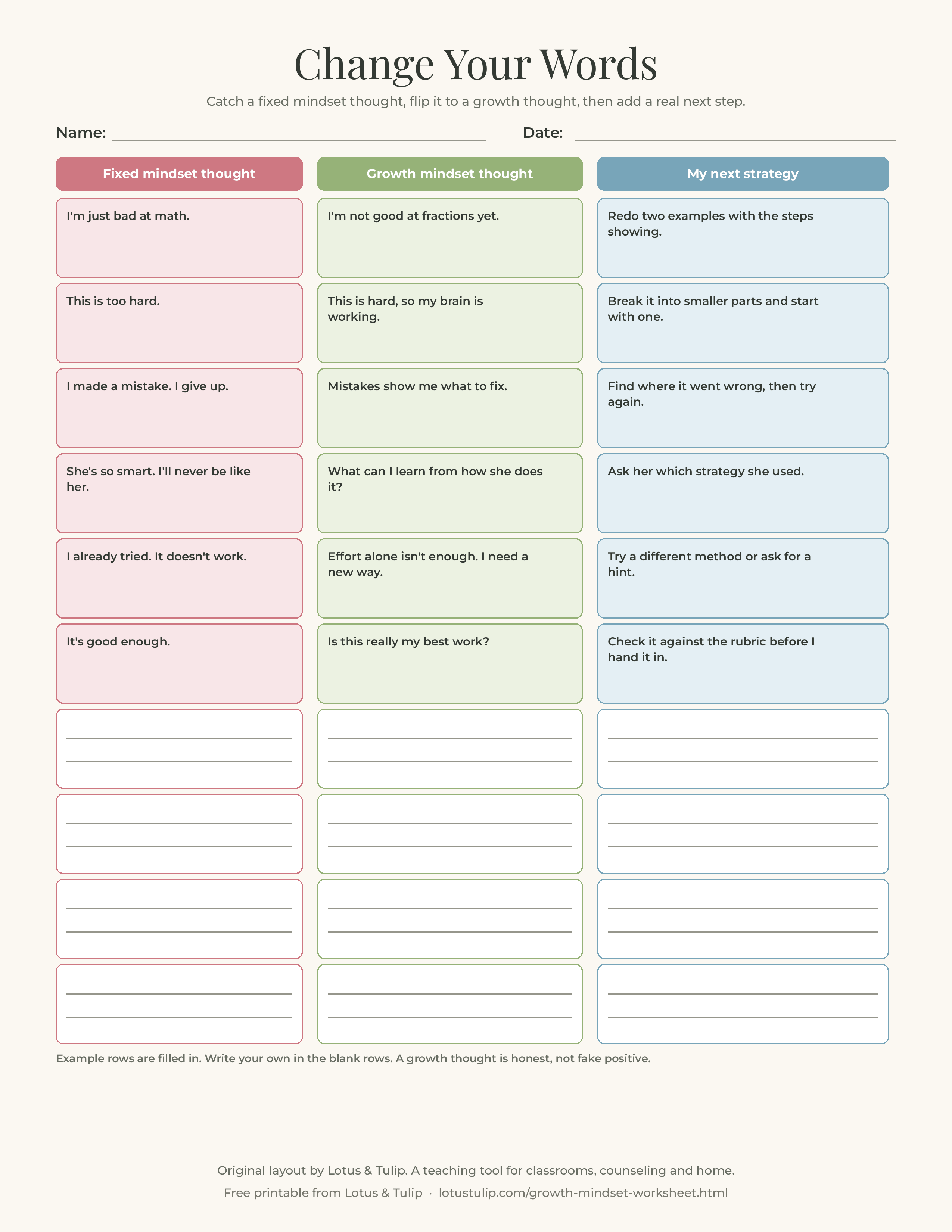
| I'm just bad at math. | I'm not good at fractions yet. | Redo two examples with every step shown. |
| This is too hard. | This is hard, so it will take some time. | Break it into parts and start with the first one. |
| I made a mistake. I give up. | Mistakes show me what to fix. | Find the exact step where it went wrong. |
| She's so smart. I'll never be like her. | What can I learn from how she does it? | Ask her which strategy she used. |
| I already tried. It doesn't work. | Trying harder isn't enough. I need a new way. | Try a different method or ask for a hint. |
| It's good enough. | Is this really my best work? | Check it against the rubric before handing it in. |
| I'm not a reader. | Reading gets easier with practice. | Read 15 minutes a day of something I enjoy. |
| I'll never be good at this. | I can't do this yet. | Ask the teacher what to practice first. |
| I'm not creative. | Ideas come from trying lots of options. | Sketch five rough ideas before picking one. |
| The coach hates me. | The coach's feedback tells me what to work on. | Write down one thing to practice this week. |
| Everyone will laugh if I get it wrong. | Most people are focused on their own work. | Ask my question privately after class. |
| I'm dumb. | I don't understand this part yet. | Say exactly which part is confusing. |
The word "yet" deserves a special mention. In her 2014 TEDx talk "The power of believing that you can improve", Dweck described a Chicago high school where students who had not passed a course received the grade "Not Yet" instead of a failing grade, framing it as a point on a learning curve. Adding "yet" to the end of "I can't do this" is one of the simplest growth mindset moves a child can learn, and page 2 of the free worksheet is built around it.
How to teach growth mindset, step by step
- Start with a real experience. Ask students to remember something they could not do at first and can do now: riding a bike, a video game level, a dance, tying shoes. Let them notice that they got better through practice, new strategies and help.
- Teach the two mindsets in plain words. Explain that a fixed mindset says "I'm either good at it or I'm not" and a growth mindset says "I can get better with practice, good strategies and help." Keep it short; the point is the practice, not the vocabulary.
- Explain why practice changes us. For older students, explain simply that practicing a skill strengthens connections in the brain, which is why hard things get easier with repetition. Keep it accurate: practice helps, but it does not make anyone limitless.
- Practice catching fixed thoughts. Use the examples above. Students sort statements into fixed or growth, then share a fixed thought they have had themselves, in a safe and low pressure way.
- Flip the thought and add a strategy. On the Change Your Words page, students write the fixed thought, an honest growth version, and one concrete next strategy. Insist on the third column; it is what separates a growth mindset from a slogan.
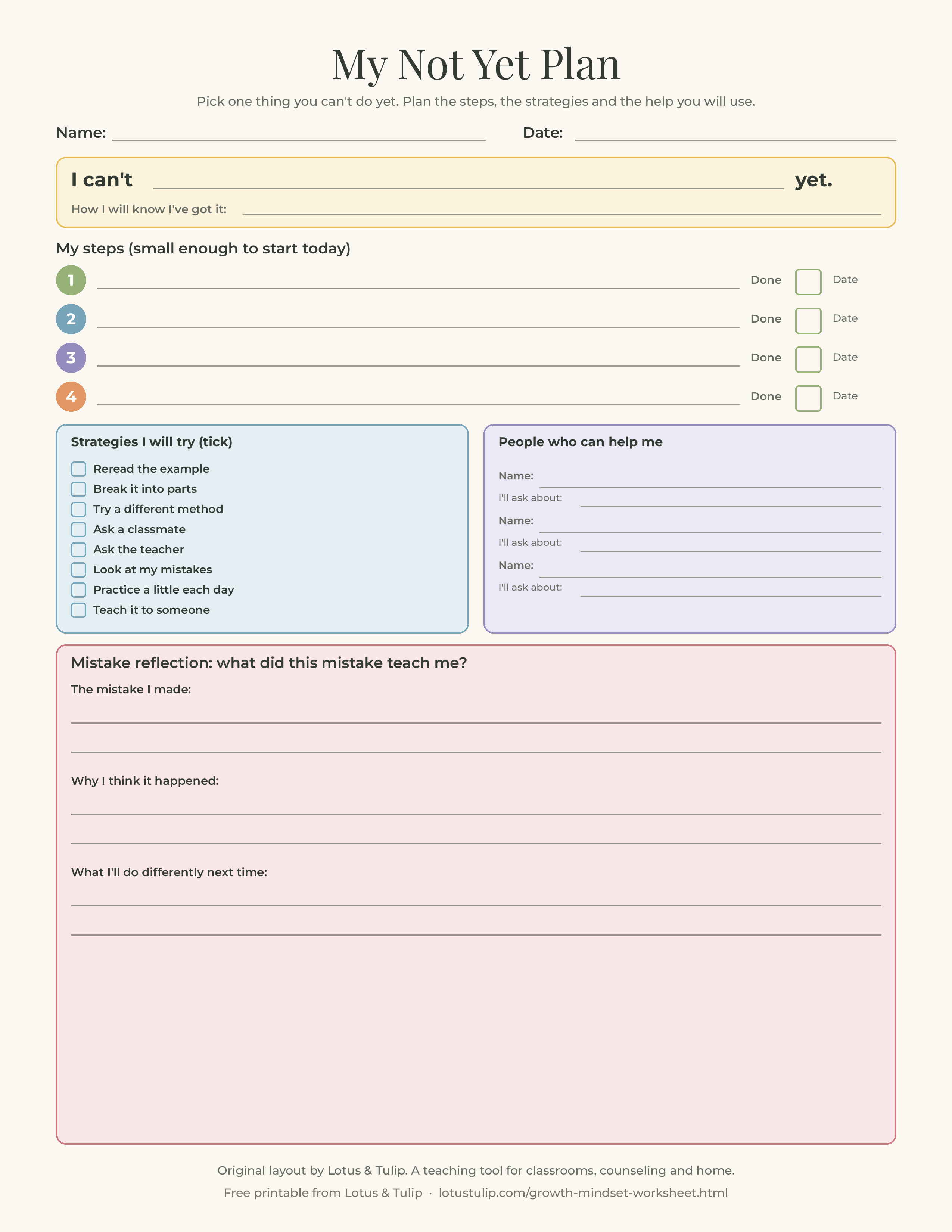
- Add the word "yet". Have each student complete "I can't ___ yet" on the Not Yet Plan, then break the goal into four small steps they could start today.
- Make mistakes useful. Model a mistake of your own, out loud, and how you fixed it. Then have students use the mistake reflection: what was the mistake, why do I think it happened, what will I do differently.
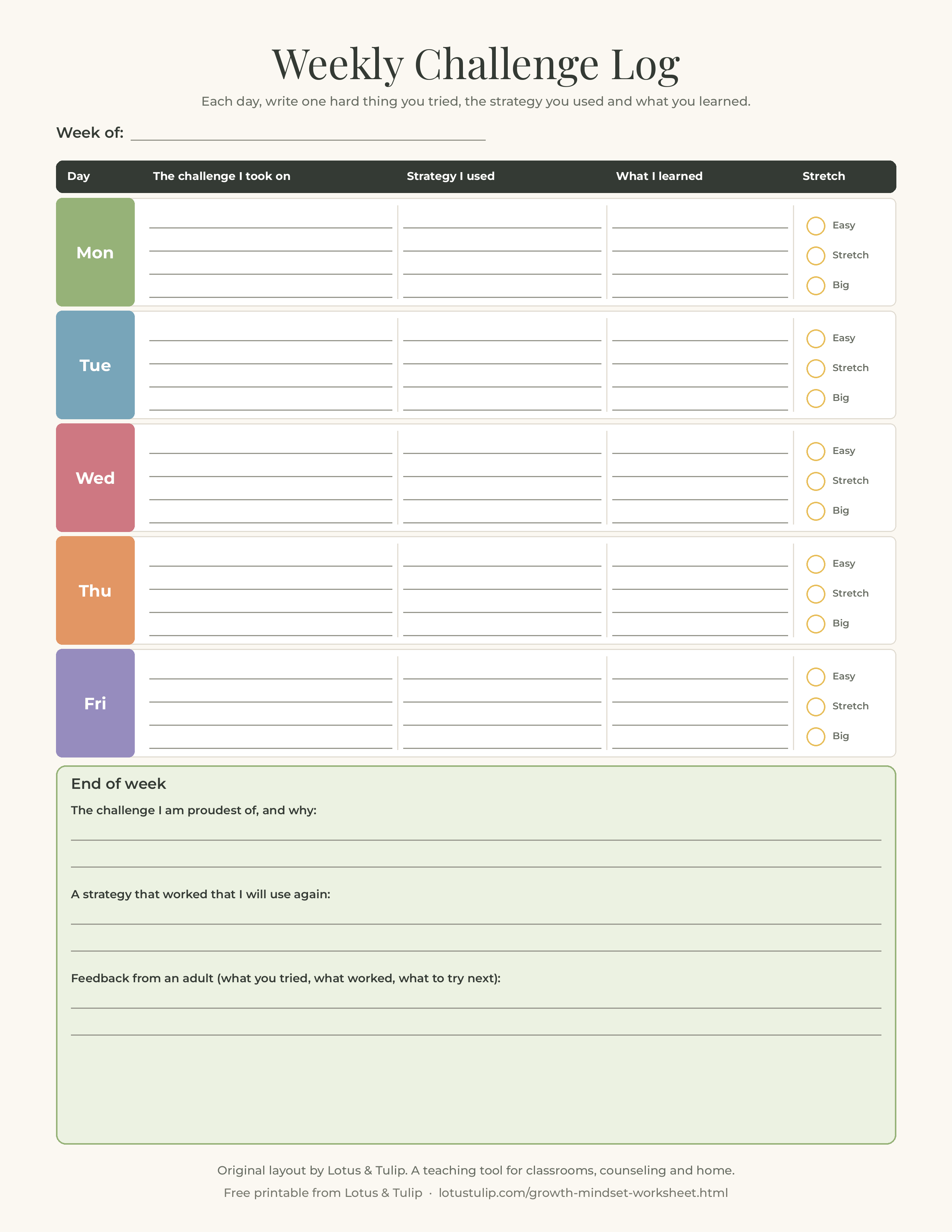
- Practice for a week with real challenges. Students log one challenge a day on the weekly challenge log, the strategy they used and what they learned, and rate how much of a stretch it was.
- Give process feedback and review. At the end of the week, an adult writes specific feedback on what the student tried, what worked and what to try next. Ask the class or group which strategies they will keep using.
Growth mindset activities for the classroom and small groups
- Fixed or growth sort. Print statements on strips and have pairs sort them into two piles, then rewrite the fixed ones together.
- Favorite mistake of the week. Each Friday, students share one mistake that taught them something. The teacher goes first. This works best when the mistake is real and the lesson is specific.
- Strategy wall. Instead of a slogan poster, keep a running list of strategies students actually used when stuck: reread the example, draw it, ask a partner, work backwards, take a break and return.
- The learning curve graph. Students graph their scores on a repeated task, like a weekly spelling or math fact quiz, to see progress over time rather than a single result.
- Interview a grown up. Students ask a family member or school staff member about something that was hard for them to learn and how they got better at it.
- Stretch goal Friday. Students choose one task slightly beyond their comfort zone and use the challenge log to plan and reflect.
- Small group version. School counselors running a Tier 2 group can use the three pages across several sessions: Change Your Words in an early session, the Not Yet Plan midway, and the challenge log between sessions with a check in at the start of each meeting.
Praise and feedback that build a growth mindset
How adults respond to success and failure shapes how children interpret them. The research on praise is still debated, as noted above, but Dweck's own guidance is clear: praise the process that led to learning, such as strategies, focus, practice and asking for help, and be honest when the learning has not happened yet.
| Instead of | Try |
|---|---|
| You're so smart! | You kept trying different ways until one worked. |
| You're a natural. | Your practice this week really shows. |
| Great effort! (when nothing worked) | Let's look at what you tried and what you could try next. |
| Don't worry, not everyone is good at math. | This part is hard right now. What's one thing we could practice? |
| That was easy for you! | That was too easy. Let's find something that will stretch you. |
| Perfect score, you're a genius. | You checked every step. What helped you most? |
Parents can use the same approach at home. Ask "What did you try today that was hard?" at dinner, share your own struggles and how you worked through them, and treat a bad grade as information to plan with, not a judgment of the child.
Growth mindset for teens
Teenagers are quick to spot a gimmick, and a growth mindset lesson that feels like a poster slogan will lose them. The 2019 national study is a useful guide here: its program was short, framed teens as able to help others, and avoided lecturing. A few adjustments help:
- Use real stakes: a class they are failing, a sport, a job skill, learning to drive.
- Talk about strategies and help seeking more than effort. Many struggling teens are already working hard with a strategy that is not working.
- Be honest about limits. A growth mindset does not mean grades are entirely within their control; teachers, sleep, stress and life outside school matter too.
- Invite them to teach the idea to younger students or write advice to a future ninth grader. Explaining an idea to someone else is often more persuasive than being told it.
- Connect it to self talk. Our positive self talk worksheet pairs well with this one for students whose inner voice is harsh.
Using growth mindset in counseling and therapy
School counselors and child and adolescent therapists often use growth mindset work alongside other approaches. It fits naturally with cognitive behavioral work on unhelpful thoughts, since "I'm stupid" is both a fixed mindset belief and an all or nothing thinking trap. It can support students with test anxiety, perfectionism and low self esteem, and it gives students with learning differences a vocabulary that separates "this is hard for me" from "I am not capable." A few cautions:
- Do not use growth mindset to dismiss real barriers. A student with an undiagnosed learning disability, ADHD, vision problems, hunger, or a chaotic home needs those addressed, not a pep talk.
- Watch for perfectionism. Some anxious students turn "I can always improve" into "I am never good enough." For them, emphasize learning and progress, not constant striving.
- Pair the worksheet with a cognitive distortions worksheet for teens who need more structured thought work.
Common mistakes
- Posters instead of practice. A wall of slogans without daily routines and feedback rarely changes anything. The context around the student matters more than the decor.
- Praising effort that is not working. If a student is trying hard with the wrong strategy, more praise for effort keeps them stuck. Help them change the strategy.
- Turning it into a character judgment. Telling a child "you have a fixed mindset" can become a new fixed label. Talk about thoughts and moments, not personalities.
- Fake positive flips. "I'm the best at reading!" is not a growth thought for a struggling reader. Keep flips honest and specific.
- Ignoring the adults. Students notice whether teachers and parents themselves treat mistakes as useful. Model it out loud.
- Expecting big results fast. The research suggests modest effects that depend on context. Measure small changes: more questions asked, more revisions, fewer "I give up" moments.
When a student needs more than a growth mindset
Sometimes "I'm stupid" or "I'll never be good at anything" is not a mindset issue but a sign of something deeper, such as depression, anxiety, bullying or a hard situation at home. Signs to watch for include a lasting low mood, withdrawing from friends, sharp changes in sleep or appetite, talking about being a burden or about not wanting to be alive, or self harm. If you see these, involve the school counselor, the family and, where needed, a mental health professional rather than continuing with worksheets.
Safety note: If a child, teen or adult is struggling or having thoughts of suicide, call or text the 988 Suicide and Crisis Lifeline at 988 or chat at 988lifeline.org. It is free, confidential and available 24 hours a day. In a life threatening emergency, call 911. This guide and worksheet are educational and are not a substitute for professional care.
Free growth mindset worksheet (printable PDF)
This free printable is an original Lotus & Tulip design, sized for US Letter paper and suited to grades 3 to 12, small groups and home. It has three pages:
- Page 1: Change Your Words. Three columns: fixed mindset thought, growth mindset thought and my next strategy, with six filled examples and four blank rows.
- Page 2: My Not Yet Plan. "I can't ___ yet", how I will know I've got it, four small steps with done boxes, eight strategies to tick, people who can help, and a mistake reflection.
- Page 3: Weekly Challenge Log. Monday to Friday: the challenge I took on, the strategy I used, what I learned and how big a stretch it was, plus an end of week review with space for adult feedback.
Download the free growth mindset worksheet (PDF, 3 pages, US Letter)
Prefer single images? Page 1: Change Your Words (PNG) · Page 2: My Not Yet Plan (PNG) · Page 3: Weekly Challenge Log (PNG)
Free to print for your own use and for use with your own students, clients or children. Please link to this page rather than re-uploading the file.
Related resources
- Resilience activities for kids (free printable)
- Positive self talk worksheet (free printable)
- Cognitive distortions worksheet (free printable)
- Size of the problem worksheet (free printable)
- Circle of control worksheet (free printable)
- Daily check in sheet for students (free printable)
- Self care plan template (free printable)
Sources
- Dweck, C. S. (2006). Mindset: The New Psychology of Success. Random House.
- Dweck, C. S. (2015, September 22). Carol Dweck Revisits the 'Growth Mindset'. Education Week.
- Dweck, C. S. (2014). The power of believing that you can improve. TEDxNorrköping talk.
- Blackwell, L. S., Trzesniewski, K. H., and Dweck, C. S. (2007). Implicit theories of intelligence predict achievement across an adolescent transition: a longitudinal study and an intervention. Child Development, 78(1), 246 to 263.
- Mueller, C. M., and Dweck, C. S. (1998). Praise for intelligence can undermine children's motivation and performance. Journal of Personality and Social Psychology, 75(1), 33 to 52.
- Li, Y., and Bates, T. C. (2019). You can't change your basic ability, but you work at things, and that's how we get hard things done. Journal of Experimental Psychology: General.
- Yeager, D. S., et al. (2019). A national experiment reveals where a growth mindset improves achievement. Nature, 573, 364 to 369.
- Sisk, V. F., Burgoyne, A. P., Sun, J., Butler, J. L., and Macnamara, B. N. (2018). To what extent and under which circumstances are growth mind-sets important to academic achievement? Two meta-analyses. Psychological Science, 29(4), 549 to 571.
- Macnamara, B. N., and Burgoyne, A. P. (2023). Do growth mindset interventions impact students' academic achievement? Psychological Bulletin, 149(3-4), 133 to 173.
- Burnette, J. L., et al. (2023). A systematic review and meta-analysis of growth mindset interventions: for whom, how, and why might such interventions work? Psychological Bulletin, 149(3-4), 174 to 205.
FAQ
What is a growth mindset worksheet?
A growth mindset worksheet is a printable activity that helps students notice fixed mindset thoughts like "I'm bad at this", replace them with honest growth thoughts like "I can't do this yet", and plan a concrete next strategy. Good worksheets also include a plan for a skill the student cannot do yet and a way to reflect on mistakes.
What is the difference between a fixed and a growth mindset?
A fixed mindset is the belief that ability is set: you are either good at something or you are not. A growth mindset is the belief that ability can be developed through practice, good strategies and help from others. Most people have a mix of both, depending on the subject or situation.
How do you teach growth mindset to kids?
Start with something they learned to do through practice, explain the two mindsets in plain words, practice catching and flipping fixed thoughts, add the word "yet", model your own mistakes, and give feedback on strategies and progress rather than on being smart. Short daily routines work better than a single lesson.
Does growth mindset actually work?
The evidence is mixed. Large studies show small average effects on grades, with the clearest benefits for lower achieving and at risk students, and effects depend on whether the school environment supports taking on challenges. Meta-analyses published in 2023 disagree about how meaningful those effects are. It is best seen as one helpful tool, not a fix on its own.
What are some growth mindset phrases for kids?
Useful phrases include "I can't do this yet", "Mistakes show me what to fix", "This is hard, so it will take time", "What strategy can I try next?", "Who can I ask for help?" and "What can I learn from how they did it?". Pair each phrase with a specific action.
Is praising effort a growth mindset?
Not by itself. Carol Dweck has warned that praising effort when a student is not learning is a common misunderstanding. Praise the process that leads to learning, such as trying new strategies, practicing and asking for help, and when a student is stuck, talk about what they have tried and what they could try next.
Is this growth mindset worksheet free?
Yes. It is free to print for your own use and for use with your own students, clients or children. Please link to this page rather than re-uploading the file.