
Kids and teens · School counseling · Updated 2026-11-03
Positive self talk worksheet for kids and teens: how to teach it, with examples and a free printable
Ready-made printable: Self Esteem Worksheets for Kids and Teens Holiday 20% off: about $9.20, was $12 (EUR 10) · instant digital download
Buy on Etsy
Every child talks to themselves. Sometimes it is out loud ("Come on, come on, where's the blue one?"), and by the upper elementary years it is mostly silent. That inner voice can coach ("Slow down, read it again") or it can tear down ("I'm so stupid, I always mess up"). Positive self talk is the skill of noticing that voice and steering it toward words that are kind, true and useful. This guide is for school counselors, teachers, child and adolescent therapists and parents in the US. It explains what self talk is, what the research actually shows, the difference between helpful and unhelpful self talk, a table of negative to positive examples that stay realistic, how to teach it step by step, classroom and group activities, how to adapt it by age, common mistakes and when a child needs more than a worksheet. It ends with a free three page printable: a thought flip worksheet, 18 self talk cards with 6 blanks, and a weekly self talk tracker.
Jump to the free positive self talk worksheet
What is self talk?
Self talk is the running commentary people have with themselves: the words we use to plan, encourage, criticize, warn and explain what just happened. Young children often do it out loud while they play or work through a puzzle. Psychologists call that private speech, and it gradually moves inside as children grow, becoming the quiet inner voice older kids and adults know well.
Self talk is not good or bad on its own. "I need to check my work" is self talk, and so is "I'm going to fail anyway, why bother." What matters is whether the words help the child cope, learn and keep going, or whether they pile on shame and make a hard moment harder.
Positive self talk, in the sense this guide uses, does not mean pretending everything is great. It means talking to yourself the way a good coach or a trusted friend would: honest about the problem, kind about the person, and focused on what to do next.
Why self talk matters: what the research shows
The idea that thoughts shape feelings and actions sits at the center of the cognitive therapies. Albert Ellis developed rational emotive therapy in the mid 1950s, later called rational emotive behavior therapy (REBT), around an ABC model: an Activating event does not cause the emotional Consequence directly; the Beliefs we hold about it do much of the work. In the 1960s Aaron Beck, working with depressed patients, described "automatic thoughts", quick negative interpretations that pop up and color mood. His cognitive therapy teaches people to notice those thoughts and test them against the evidence. Both approaches are about self talk, and both shaped the CBT that school counselors and child therapists use today.
With children specifically, one of the classic studies is Donald Meichenbaum and Joseph Goodman's 1971 paper in the Journal of Abnormal Psychology, "Training impulsive children to talk to themselves". Impulsive second graders learned to guide their work with self instructions, first out loud and then silently, and improved on several measures of self control compared with control groups, with gains still visible a month later. That self instructional approach ("What do I have to do? Go slowly. Check it.") is still a backbone of many classroom strategies.
Coping self talk is also built into well known anxiety programs for children. The Coping Cat program by Philip Kendall and colleagues uses a FEAR plan in which the E step ("Expecting bad things to happen?") helps children notice anxious thoughts and the A step ("Attitudes and actions that can help") includes coping thoughts, alongside problem solving and relaxation.
Sport psychology offers the clearest numbers. A 2011 meta-analysis by Hatzigeorgiadis and colleagues in Perspectives on Psychological Science pooled 32 studies (62 effect sizes) and found a moderate positive effect of self talk interventions on sport performance (effect size .48). Self talk helped more on fine, precise tasks and on new skills, instructional cues ("eyes on the ball") worked especially well for fine tasks, and interventions that included practice with the self talk worked better than those that did not. Two practical lessons for teachers: short instructional cues are powerful, and self talk needs rehearsal, not a single lesson.
How you talk to yourself matters as well. In a set of seven studies published in 2014 in the Journal of Personality and Social Psychology, Ethan Kross and colleagues found that adults who reflected on a stressful task using their own name or "you" ("You can do this, Maya") instead of "I" performed better on a speech task, felt less distress afterwards and saw future stressors more as a challenge than a threat. Speaking to yourself like a coach speaks to a player seems to give a little helpful distance.
Finally, an important warning from the research: positive self talk is not the same as repeating big affirmations. Joanne Wood, Elaine Perunovic and John Lee (2009, Psychological Science) asked adults to repeat "I'm a lovable person". People with high self esteem felt slightly better, but people with low self esteem felt worse than those who did not repeat it. Statements that feel far from what a person believes can backfire, which is exactly why this guide and the printable focus on realistic, believable self talk.
A fair summary: self talk is a learnable skill with solid support in sport and education research and a central place in CBT. It is not a cure, and none of these studies promise that a worksheet will change how a particular child feels. It is one useful tool among many.
Helpful vs unhelpful self talk
Children understand this best through a simple contrast between the inner critic and the inner coach.
- The inner critic uses always and never, calls names ("I'm so dumb"), predicts disaster ("Everyone will laugh"), compares ("Everyone else gets it"), and focuses on the person instead of the problem.
- The inner coach names the problem honestly, stays kind about the person, looks for evidence, and points to a next step ("This is hard. I got the first two right. Let me ask about number three").
Helpful self talk usually comes in a few flavors, and it is worth teaching all of them:
- Instructional: tells you what to do. "Slow down. Read the question again. Show your work."
- Coping: helps you get through a feeling. "I feel nervous, and I can still try. Breathe out slowly."
- Encouraging: supports effort. "Keep going. I've done hard things before."
- Self compassionate: treats mistakes kindly. "Everyone messes up sometimes. What can I learn from this one?"
Unhelpful self talk often follows the same patterns that CBT calls thinking traps or cognitive distortions: all or nothing thinking, fortune telling, mind reading, labeling and discounting the positive. If your students are ready for more, the cognitive distortions worksheet names these patterns in plain words.
Negative to positive self talk examples (realistic, not fake)
The goal is not to swap a harsh thought for a cheerful slogan. A good replacement is kind and still true, so the child can actually believe it. Notice how the examples below keep the problem in view.
| Unhelpful self talk | Too positive (hard to believe) | Realistic, helpful self talk |
|---|---|---|
| "I'm so bad at math." | "I'm amazing at math!" | "Fractions are hard for me right now, and practice is helping." |
| "I'll never make any friends." | "Everyone loves me." | "Making friends takes time. I can say hi to one person at lunch." |
| "I ruined everything." | "That was perfect." | "I made a mistake. I can fix part of it and do better next time." |
| "Everyone will laugh at me." | "Nobody will notice anything." | "Some kids might notice. Most are thinking about their own turn." |
| "I can't do this." | "This is easy!" | "I can't do it yet. What is the first step?" |
| "I'm stupid." | "I'm the smartest kid in class." | "I don't understand this part. Asking is how I'll learn it." |
| "I always mess up." | "I never mess up." | "I messed up this time. Yesterday I got it right." |
| "She didn't say hi, she hates me." | "She definitely likes me." | "I don't know why she didn't say hi. Maybe she didn't see me." |
| "I'm going to fail this test." | "I'll get 100 for sure." | "I studied two chapters. I'll do my best and check my answers." |
| "I'm the worst on the team." | "I'm the best player here." | "I'm still learning to dribble. I'm faster than I was in September." |
| "Nothing ever goes right for me." | "Everything is great." | "Today was rough. Some things went OK, like art and recess." |
| "I look so weird in this photo." | "I look perfect." | "I don't love this photo. It's one picture, not who I am." |
The middle column is there on purpose. Showing students what toxic positivity looks like helps them understand why the right hand column works: it is something they could say and mean.
How to teach positive self talk, step by step
- Notice that self talk exists. Start with a curiosity question: "Do you ever hear a voice in your head when something goes wrong? What does it say?" Share a small example of your own so it feels normal, such as "When I spilled coffee this morning, my brain said, 'Great, you ruin everything.'"
- Introduce the inner critic and the inner coach. Give the two voices names or even characters. Ask students how a mean coach and a good coach would talk to a player who just missed a shot. Most students instantly know the difference.
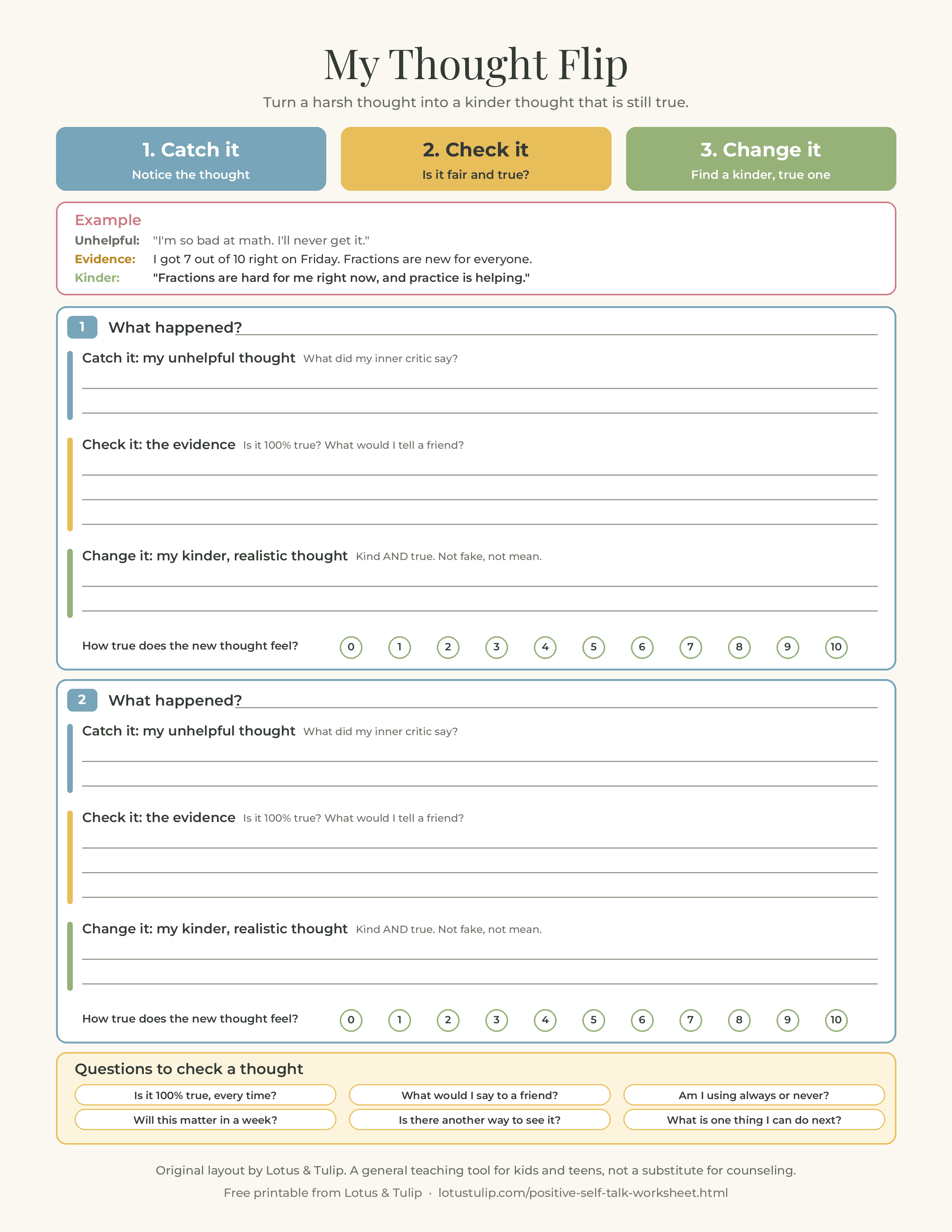
- Catch it. Help students notice and write down one unhelpful thought from a real moment. On page 1 of the printable this goes in the "Catch it" box. Keep it safe: a test, a game, a friendship moment, not a deep personal wound in a group setting.
- Check it. Teach a few checking questions: Is it 100% true, every time? What would I say to a friend? Am I using always or never? Will this matter in a week? Students write the evidence for and against the thought.
- Change it to something kind and true. Students write a replacement that they actually believe. Use the "too positive" column from the table above to show what to avoid, and ask them to rate how true the new thought feels from 0 to 10. If it is below about 5, help them make it more realistic.
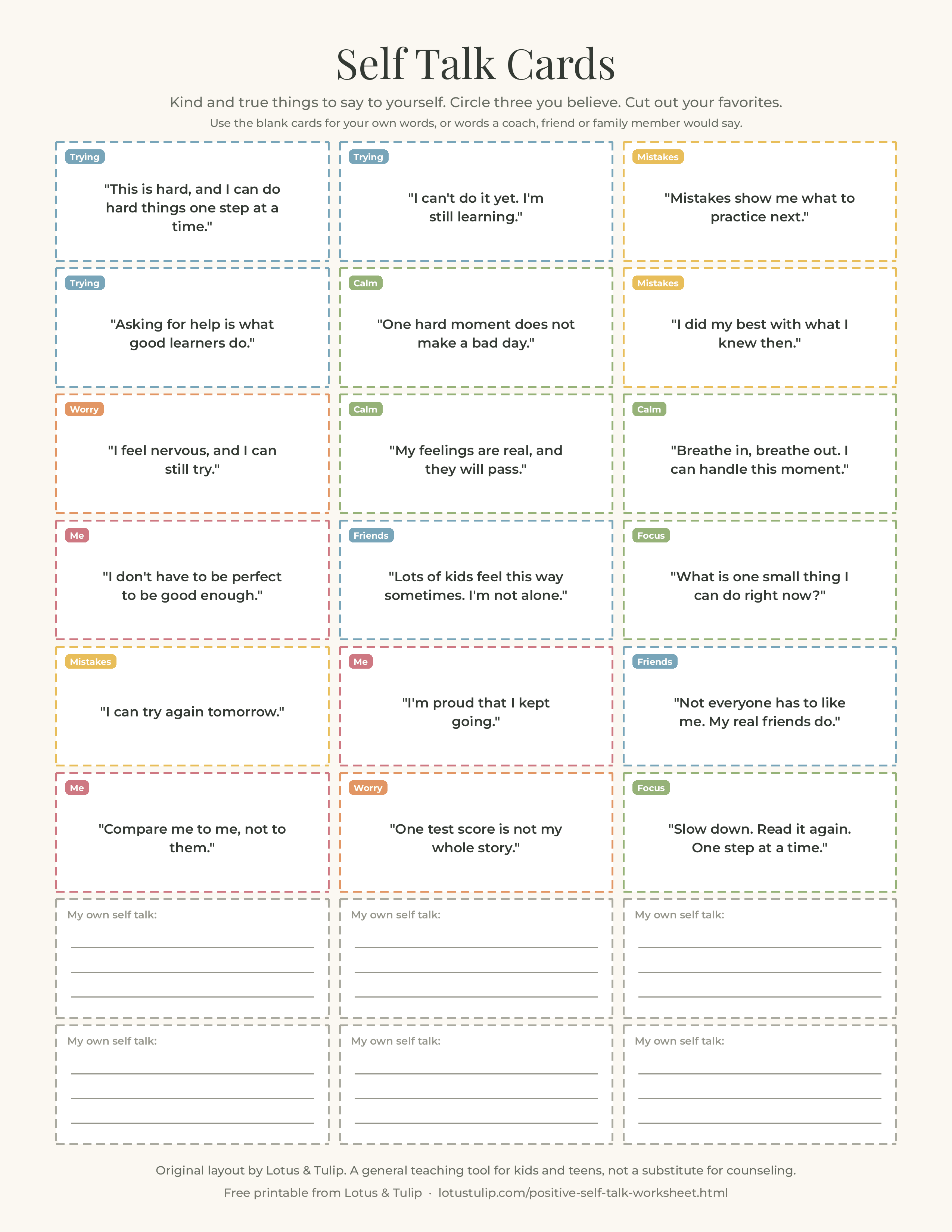
- Collect short coach phrases. Give students the self talk cards on page 2. They circle three they believe and keep them somewhere visible: a pencil case, a locker, the back of a phone case, a desk name plate.
- Practice out loud, then quietly. Following the self instruction model, rehearse a phrase out loud during a low stakes task (a puzzle, a tricky worksheet, a shooting drill), then whisper it, then say it silently. Older students can try speaking to themselves by name or as "you".
- Use it during real moments. When you see a student stuck or frustrated, prompt gently: "What would your coach say right now?" Do this after the big feeling has settled a little, not in the middle of a meltdown.
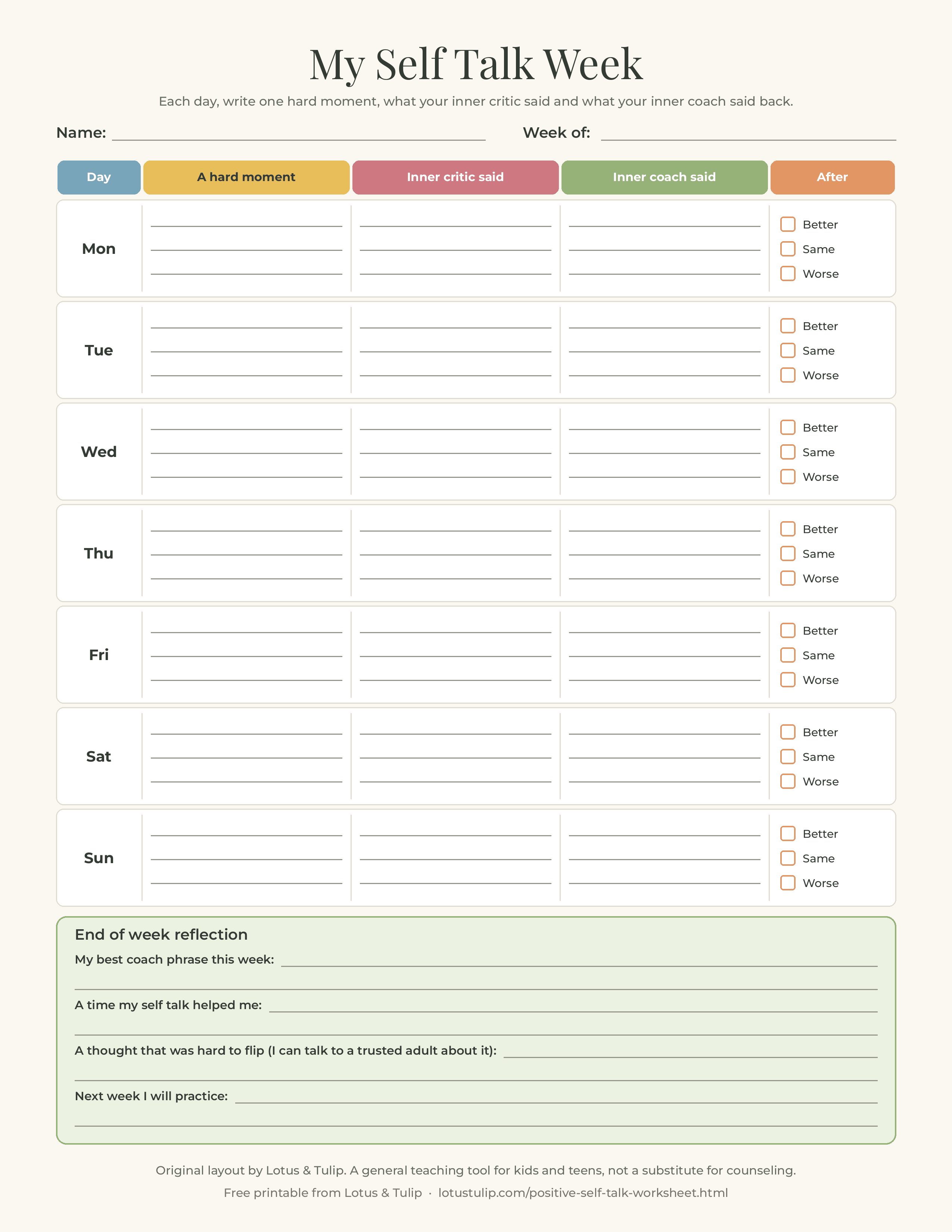
- Track and reflect for a week. Students use the weekly tracker on page 3 to write one hard moment each day, what the critic said and what the coach said back, then reflect at the end of the week. Celebrate attempts, not perfect results.
Classroom and small group activities
- Critic or coach sort. Write 12 to 16 self talk statements on slips. Students sort them into two piles, then rewrite three critic statements as coach statements.
- Coach the character. Read a short story or show a picture book scene where a character makes a mistake. Students write what the character's inner coach could say. Fictional characters make it easier to practice without exposing anyone.
- Thought flip relay. In teams, one student reads an unhelpful thought, the next writes the evidence, the next writes a realistic replacement. Rotate roles.
- Too much, too little, just right. Read three responses to the same situation (critical, toxic positive and realistic). Students vote for the "just right" one and explain why.
- Sport cue cards. Before PE or a team practice, each student picks one short instructional cue ("Eyes up", "Follow through", "Breathe and go") and one encouraging phrase. Debrief afterwards: did the words help?
- Self talk bookmarks. Students copy their favorite card onto a bookmark for silent reading or test days.
- Before and after a test. Before: one coping phrase. After: one honest, kind sentence about how it went. This builds the habit of reflection without catastrophizing.
- Exit ticket. "One thing my inner critic said today, and what my coach could say back."
Self talk fits naturally into a small group on confidence. Our elementary self esteem group includes an inner critic and inner coach swap page, and the middle school Real Me group has a critic to coach rewrite chart (links below). Pair it with the size of the problem worksheet for students whose self talk turns small setbacks into disasters, and with the coping skills list for kids for calming strategies.
Adapting self talk by age
- Pre K to grade 2. Keep it short and concrete. Teach two or three phrases ("I can try", "Mistakes help me learn", "Big breath") and practice them out loud during play. Puppets work well: the puppet says something mean to itself and the children coach it. Skip the written evidence step and talk it through instead.
- Grades 3 to 5. Introduce the inner critic and inner coach, use the thought flip worksheet with support, and add the idea of "yet". This is the sweet spot for the self talk cards and a classroom chart of coach phrases.
- Middle school. Connect self talk to comparison, social media and friendships. Students this age are quick to spot fake positivity, so lean hard on realistic statements and evidence. Talking to yourself by name or as "you" can feel less awkward than affirmations.
- High school. Link self talk to CBT thought records, test anxiety, sports and performance. Teens can use a full CBT thought record and track patterns over a few weeks. Respect their skepticism; invite them to run the tracker as an experiment.
- Students with language or learning differences. Use pictures or symbols on the cards, offer sentence starters, and let students say or record their coach phrase instead of writing it.
Using positive self talk at home
Children learn a lot of their inner voice from the voices around them. Parents can help by narrating their own coping out loud ("I'm frustrated that I burned dinner. OK, plan B, sandwiches") and by describing a child's effort rather than labeling them ("You kept going on that puzzle even when it was tricky"). When a child says "I'm so stupid", resist the urge to argue ("No you're not!"). Try: "That sounds like your inner critic talking. What would your coach say?" Post two or three family coach phrases on the fridge, and use the weekly tracker together at the end of a hard week.
Common mistakes
- Forcing big affirmations. "I am amazing and everyone loves me" can make a struggling child feel worse, as Wood and colleagues found with adults. Aim for believable.
- Dismissing feelings. "Just think positive" tells a child their worry or sadness is wrong. Validate the feeling first, then work on the words.
- Arguing with the child. Telling a child their thought is silly rarely changes it. Asking questions that help them find the evidence works better.
- Teaching it once. The sport research suggests that rehearsal matters. Revisit self talk regularly and practice in calm moments.
- Making it a performance. Do not ask students to share painful self talk in front of a class. Use fictional examples or anonymous slips in groups.
- Ignoring the real problem. If a child says "Nobody likes me" because they are being excluded, kind self talk is not the fix. The situation needs adult attention.
When to refer and a safety note
Positive self talk is an everyday skill, not a treatment for depression, anxiety disorders or trauma. Talk with the school counselor, school psychologist or the family's pediatrician or therapist if a child's negative self talk is constant, lasts for weeks, comes with changes in sleep, eating, grades or friendships, or includes statements like "I wish I wasn't here", "Everyone would be better off without me" or any mention of hurting themselves. Take those statements seriously every time and follow your school's safety protocol; do not try to "flip" them on a worksheet. In the US, anyone can call or text 988 to reach the 988 Suicide and Crisis Lifeline, and in an emergency call 911.
If a child's harsh self talk is linked to bullying, abuse or problems at home, the priority is adult action and safety, not a change in the child's thinking.
Free positive self talk worksheet (printable PDF)
This free printable is an original Lotus & Tulip design, sized for US Letter paper. It has three pages:
- Page 1: my thought flip. The three steps (catch it, check it, change it), a worked math example, two thought flip boxes for what happened, the unhelpful thought, the evidence and a kinder realistic thought, a 0 to 10 "how true does it feel" scale, and six questions to check a thought.
- Page 2: self talk cards. 18 realistic coach phrases sorted by theme (trying, mistakes, worry, calm, friends, me and focus), plus 6 blank cards for students to write their own.
- Page 3: my self talk week. A seven day tracker with a hard moment, what the inner critic said, what the inner coach said and how the student felt after, plus an end of week reflection.
Download the free positive self talk worksheet (PDF, 3 pages, US Letter)
Prefer single images? Page 1: thought flip worksheet (PNG) · Page 2: 18 self talk cards and 6 blanks (PNG) · Page 3: weekly self talk tracker (PNG)
Free self esteem starter pack: The free self esteem worksheets starter pack includes an inner critic, inner coach talk back page and believable affirmations from our paid self esteem set, plus a strengths finder, thinking traps, a brave steps ladder and a support and safety page.
Free to print for use with your own students, clients or children. Please link to this page rather than re-uploading the file. A general teaching tool, not a substitute for individual counseling or a safety plan.
Related resources
- CBT worksheets for kids (free printable): catch the thought, spot the thinking trap, take a brave step
- CBT thought record worksheet (free printable)
- Cognitive distortions worksheet (free printable)
- I statements worksheet (free printable)
- Size of the problem worksheet (free printable)
- Circle of control worksheet (free printable)
- Feelings thermometer printable
FAQ
What is positive self talk for kids?
Positive self talk is the way a child speaks to themselves in their head or out loud, steered toward words that are kind, true and useful, like a good coach would use. It does not mean pretending everything is fine. "This is hard, and I can try one step at a time" is positive self talk; "This is easy!" when it clearly is not is not.
What are examples of negative to positive self talk?
"I'm so bad at math" can become "Fractions are hard for me right now, and practice is helping." "I can't do this" can become "I can't do it yet. What is the first step?" "Everyone will laugh at me" can become "Some kids might notice, and most are thinking about their own turn." The best replacements are realistic enough to believe.
Does positive self talk really work?
There is good evidence that self talk can be trained and can help. A 2011 meta-analysis of 32 sport studies found a moderate positive effect of self talk interventions on performance, and self instruction training has helped impulsive children work more carefully since the 1970s. It is not a cure for anxiety or depression, and very positive affirmations can backfire for people with low self esteem, so keep it realistic.
What is the difference between positive self talk and toxic positivity?
Toxic positivity denies or rushes past real feelings ("Just be happy!"). Healthy positive self talk accepts the feeling and the problem, then adds kindness and a next step: "I'm disappointed about the game, and I can practice my free throws this week."
What age can children learn positive self talk?
Preschoolers can learn two or three short phrases practiced out loud during play. From about third grade, children can use a thought flip worksheet to catch, check and change a thought with support. Middle and high school students can use full CBT style thought records and track their self talk over a week.
What are some self talk activities for the classroom?
Try a critic or coach card sort, coaching a character from a picture book, a thought flip relay in teams, choosing a "just right" response between a harsh and a fake positive one, sport cue cards before PE, and a quick exit ticket where students write one critic statement and a coach reply.
Is this positive self talk worksheet free?
Yes. It is free to print for use with your own students, clients or children. Please link to this page rather than re-uploading the file.