
Kids and teens · Gratitude and wellbeing · Updated 2026-11-04
Gratitude worksheet for kids: a gratitude journal, activities and Thanksgiving ideas that feel real (free printable)
Ready-made printable: Self Esteem Worksheets for Kids and Teens Holiday 20% off: about $9.20, was $12 (EUR 10) · instant digital download
Buy on Etsy
Most adults want grateful kids, and most have tried the obvious things: "Say thank you," "Think of the children who have nothing," a gratitude jar that is full for a week and then forgotten. The results are often a polite but empty "thanks" and an eye roll. Gratitude can be taught, but not by demanding it. It grows when a child learns to notice the good things that come their way, to think about the people behind them, to feel what that means, and then to do something about it. This guide is for US parents, teachers, school counselors and child therapists who want to teach gratitude in a way that holds up. It covers what gratitude is and is not, what the research honestly shows (including its limits), the four part Notice, Think, Feel, Do model, what to expect at each age, a nine step teaching plan, how to run a gratitude journal kids will keep, 15 activities, Thanksgiving ideas for the classroom and the dinner table, and when gratitude practice backfires. It ends with a free three page printable: a "My Thank You Moment" worksheet, a kids gratitude journal page, and a thank you note with 12 gratitude talk cards.
Jump to the free gratitude worksheet printable
What gratitude is, and what it is not
Gratitude is the warm feeling of recognizing that something good has come into your life, often because someone else chose to give it. Psychologists usually separate two layers. State gratitude is the feeling in a single moment, such as when a friend shares their snack. Trait gratitude is a general tendency to notice and appreciate good things over time. Worksheets and journals aim at the first, in the hope that repeated moments build the second.
It helps to be clear about what gratitude is not:
- It is not just good manners. Saying "thank you" is a social habit, and it is worth teaching. But a child can say it on cue without feeling anything.
- It is not comparison. "Be grateful, other kids have it worse" asks a child to feel better by thinking about someone else's suffering. It tends to produce guilt and shame rather than gratitude, and it teaches that their own feelings do not count.
- It is not forced positivity. Gratitude can sit alongside sadness, anger or disappointment. A child can be grateful for a grandparent and heartbroken that the grandparent is ill. Gratitude practice should never be used to shut down a hard feeling.
- It is not debt. Feeling grateful is different from feeling indebted ("now I owe them"). Research on adults suggests that when thanks feels like an obligation, it is less pleasant and less likely to help.
What the research says
Gratitude is one of the most studied topics in positive psychology, and also one of the most oversold. Here is what the evidence supports, stated as carefully as the studies allow.
- The classic adult study. Robert Emmons and Michael McCullough (2003) asked college students to write, once a week for ten weeks, either five things they were grateful for, five hassles, or five neutral events. The gratitude group felt better about their lives as a whole and more optimistic about the coming week, and reported fewer physical complaints and more time exercising than the hassles group. This is the study most "gratitude journal" advice traces back to.
- Counting blessings in middle school. Jeffrey Froh, William Sefick and Robert Emmons (2008) ran a version with 221 sixth and seventh graders in 11 classrooms. Students in the gratitude condition listed up to five things they were grateful for each day for two weeks. They reported more gratitude, more optimism, more life satisfaction and less negative mood, and they were more satisfied with school, including at a three week follow up. An important caveat, which the authors themselves later pointed out: most of the differences were against a "hassles" group, not against students who did nothing special.
- Gratitude letters help some kids more than others. In a 2009 study in The Journal of Positive Psychology, Froh, Todd Kashdan, Kathleen Ozimkowski and Norman Miller asked 89 children and teens to write a letter to someone they were grateful to and deliver it in person. The benefit showed up mainly in youth who started with low positive emotion: they reported more gratitude and positive mood afterward and more positive mood two months later. Kids who were already doing well had less room to gain.
- Gratitude can be taught as thinking, not just listing. In "Nice Thinking!" (Froh and colleagues, 2014, School Psychology Review), elementary classrooms of 8 to 11 year olds were randomly assigned to lessons about three ideas: someone helped me on purpose, it cost them something, and it benefited me. Children in the daily version became more grateful within two days and wrote 80 percent more thank you cards to their Parent Teacher Association when given the chance. A weekly version raised gratitude for up to five months and also lifted positive mood. That is the strongest child study, and it is why the "Think" step in this guide asks who helped and what it cost them.
- The honest caution. A 2016 systematic review and meta-analysis by Tyler Renshaw and Rachel Olinger Steeves in Psychology in the Schools looked at 20 youth studies. Gratitude was linked to wellbeing, but the six intervention studies they could pool were, as a group, generally ineffective, and they called for much more research before schools treat gratitude programs as proven. In adults, a 2021 meta-analysis by David Cregg and Jennifer Cheavens (27 studies, 3,675 people) found that gratitude exercises had only a small effect on symptoms of depression and anxiety, and the effect was smaller still when compared with a believable alternative activity.
Put together: gratitude practice is cheap, safe and pleasant for most children, it can raise grateful thinking and positive mood, and it seems to matter most for kids who are low on good feelings to begin with. It is not a treatment for depression or anxiety, and it works better as a skill you teach (why did someone help me?) than as a list you demand.
The four parts of gratitude: Notice, Think, Feel, Do
Andrea Hussong and colleagues at the University of North Carolina at Chapel Hill, in their Raising Grateful Children project, describe a gratitude moment as having four parts. The printable in this guide is built around them. (Lotus & Tulip is not affiliated with the project; we simply find the model the clearest way to explain gratitude to a child.)
- Notice what you have or what has come into your life, no matter how small. A seat saved at lunch counts. So does a warm coat.
- Think about why you received it: who played a part, whether they had to, and what it cost them in time, effort or money. This is the step most kids skip, and it is where gratitude deepens.
- Feel the emotions that come with receiving: happy, warm, cared for, lucky, loved. Naming the feeling makes the moment stick.
- Do something to show it: say it, write it, draw it, or do something kind back.
The model also explains why many gratitude habits fall flat. A forced "thank you" is only the Do step, with nothing behind it. A gratitude list that says "my house, my family, my dog" every night is only the Notice step, on repeat. When a child gets stuck, ask which part is missing.
Gratitude by age: what to expect
Gratitude develops slowly. Understanding that another person chose to help you, and that it cost them something, takes perspective taking that grows across childhood. Adjust your expectations and your tools to the child in front of you.
| Age | What gratitude often looks like | What helps |
|---|---|---|
| 3 to 5 | "Thank you" mostly as a prompted habit. Gratitude is concrete and about things and treats. | Model it out loud ("Grandma drove a long way to see you, that was kind"). Draw one good thing at bedtime. Keep it short and playful. |
| 6 to 8 | Starting to connect good things to people. Lists can become repetitive. | The Notice and Think questions with an adult. Drawing counts as an answer. Thank you notes with a sentence starter. |
| 9 to 12 | Can think about effort and intention, and can feel embarrassed by "mushy" thanks. | The full Notice, Think, Feel, Do worksheet, gratitude journals two or three times a week, a gratitude letter to a teacher or coach. |
| Teens | Gratitude is private and real but rarely said out loud. Very sensitive to being lectured. | Invite, never demand. Private journals or notes on a phone, gratitude texts, savoring a good memory, and adults who model gratitude without preaching. |
How to teach gratitude, step by step
- Model it out loud first. Say what you notice, think and feel: "My neighbor shoveled our walk. She didn't have to, and it saved me half an hour. I feel really looked after." Children learn the inside of gratitude by hearing yours.
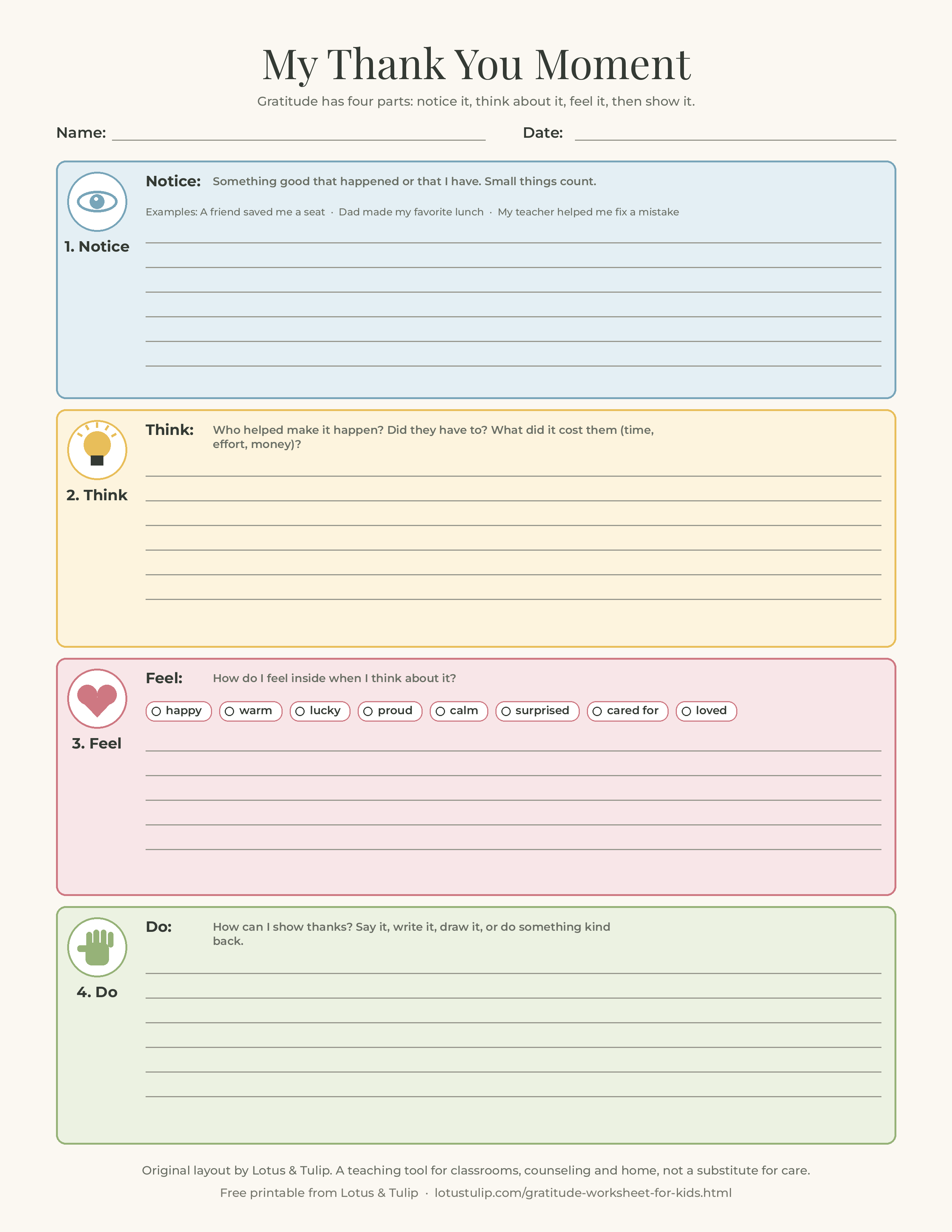
- Introduce the four parts. Teach Notice, Think, Feel, Do with a real example from the child's day, not an abstract one. Page 1 of the printable walks through all four.
- Start small and concrete. Ask for one good thing, not five. Small, specific moments ("Sam let me go first on the slide") work better than big general ones ("my life").
- Ask the Think questions. "Who made that happen? Did they have to? What did it take?" This turns a list into grateful thinking, the part the "Nice Thinking!" study taught.
- Name the feeling. Offer words if the child is stuck: warm, happy, lucky, safe, proud, cared for. Accept "I don't know" and come back later.
- Pick one way to show it. A spoken thank you, a note, a drawing, or a kind act in return. Let the child choose. Choice keeps it real.
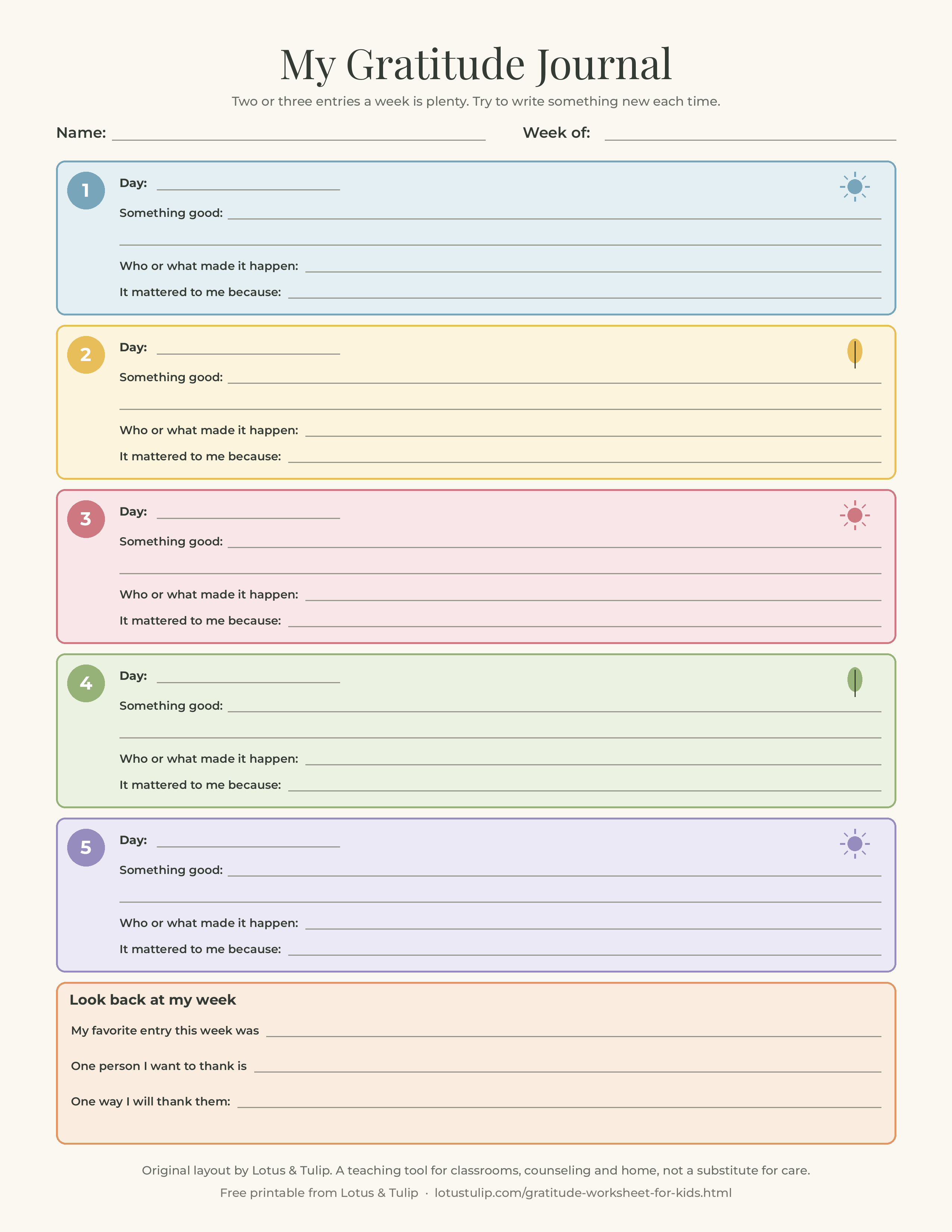
- Keep a light journal. Two or three entries a week, each one new and specific, using page 2 of the printable. Do not grade it or check spelling.
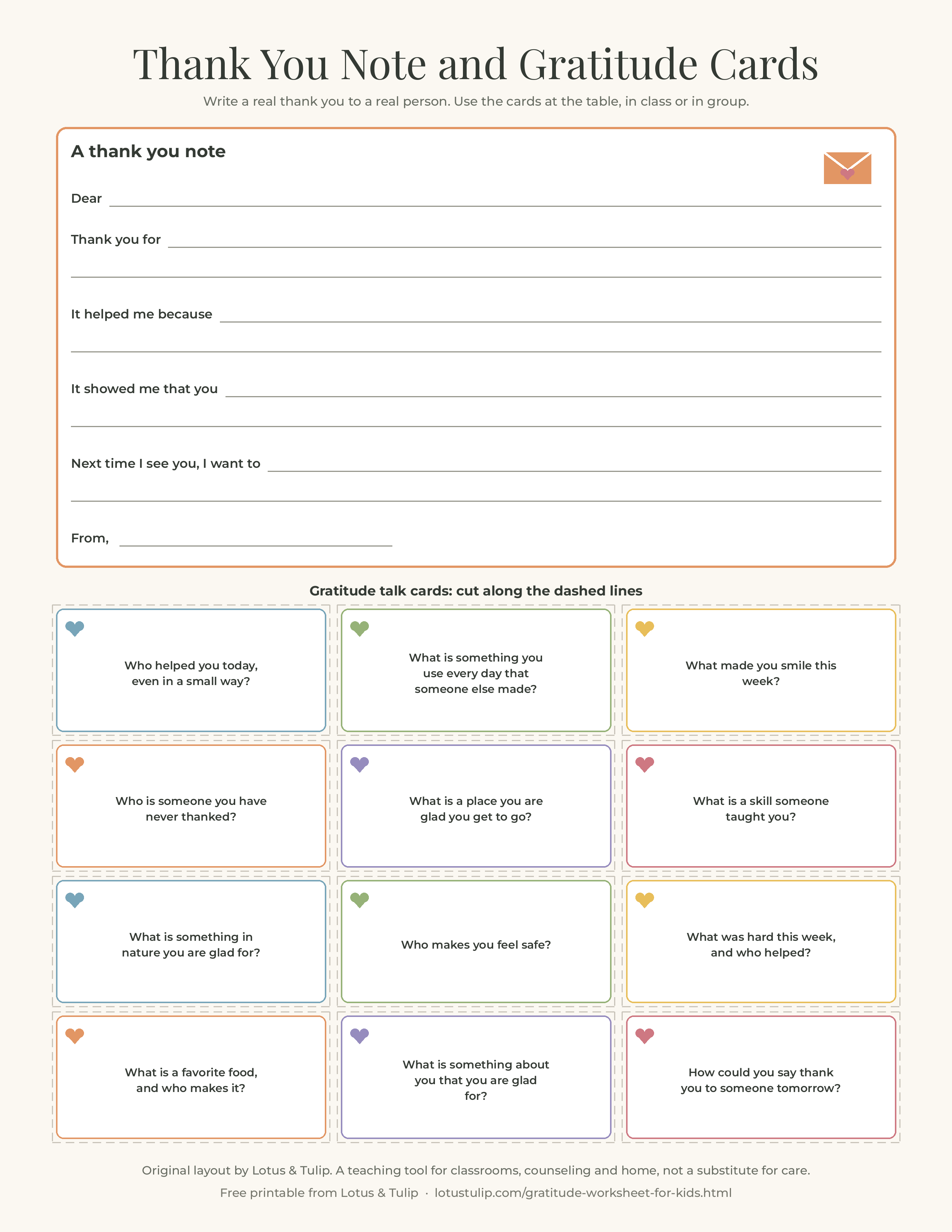
- Make it social. Share good things at dinner, in morning meeting or at the start of a counseling group, using the gratitude talk cards on page 3.
- Review and keep it fresh. Every few weeks, look back at the journal together, notice patterns ("a lot of yours are about your coach"), and change the format before it gets stale.
How to use a gratitude journal with kids (so they keep it)
A gratitude journal is the most popular gratitude activity and the easiest one to kill. A few rules make the difference:
- Less often is fine. In an early adult study described by Sonja Lyubomirsky, Kennon Sheldon and David Schkade (2005), people who counted their blessings once a week became happier, while people who did it three times a week did not, possibly because it became a chore. Evidence in children is limited, so treat two or three times a week as a sensible starting point and let the child's interest guide you.
- New and specific beats long. One fresh entry ("Mom stayed up late to fix my costume") is worth more than "family, friends, food" for the hundredth time. If entries repeat, ask the Think question about one of them.
- Add the "who." Each entry on the printable journal page asks who or what made the good thing happen, and why it mattered. That small line moves a child from a list of stuff to a picture of people.
- Drawing counts. Younger children and reluctant writers can draw the good thing and tell you about it.
- Keep it private if they want. Especially for older kids and teens. You can ask if they want to share one entry, but do not read it without permission.
- Never use it as punishment. "Go write in your gratitude journal" after a tantrum turns a good tool into a consequence.
15 gratitude activities for kids
At home
- Rose, thorn and thank you. At dinner, each person shares a good part of the day, a hard part, and one person they are grateful to. It honors hard feelings and gratitude together.
- The gift behind the gift. When a gift arrives, talk about the thought behind it: "Aunt Rosa remembered blue is your favorite color."
- Gratitude jar, with a twist. Each slip names a person and what they did. Read a few aloud once a week, not every day.
- Thank you photo. The child takes a photo of something good and sends it, with one sentence, to the person who made it possible.
- Savor a memory. Look at an old photo together and ask what made that day good and who was part of it.
In the classroom
- Gratitude circle. In morning meeting, each student names one specific good thing from yesterday. Passing is always allowed.
- Hidden helpers hunt. Students list everyone who helped get them to school today: bus driver, crossing guard, cafeteria staff, custodian. Then they write a class card to one group.
- "Who made my lunch" chain. Trace one item, like an apple, back through the store, the truck driver and the farmer. It builds the Think step.
- Thank you notes to school staff. Use the note template on page 3. Deliver them in person if you can, since delivering a letter was part of the 2009 study.
- Gratitude wall. A bulletin board of sticky notes that each name a person and an action. Refresh it monthly so it does not become wallpaper.
In counseling and small groups
- Opening check in. Start each session with one gratitude talk card. It warms up the room without forcing deep sharing.
- Gratitude and strengths. Pair gratitude with a strength: "What did someone do for you, and what did you do for someone?" This links naturally to self esteem work.
- Gratitude letter. For older children and teens, a letter to someone they never properly thanked. Plan the delivery together and prepare for any reaction.
- Grateful for me. Gratitude for one's own body, effort or skills ("my legs carried me through the race"), for kids who find it hard to say anything kind about themselves.
- Thank you moment worksheet. Walk through page 1 of the printable with one real moment from the week, all four steps.
Thanksgiving gratitude activities
US Thanksgiving falls on Thursday, November 26, 2026, and November is when most teachers and families reach for gratitude activities. A few ideas that go beyond the paper turkey:
- Gratitude tree. Draw or build a bare branch and add paper leaves through November. Each leaf names a person and what they did, not just a thing. By Thanksgiving week you have a full tree of people.
- Table talk cards. Cut out the 12 gratitude talk cards from page 3 and put one at each place setting. Each person answers their card during the meal. Questions like "What is something you use every day that someone else made?" get better answers than "What are you thankful for?"
- Thank the cooks and the hidden helpers. Before the meal, children write a short note to whoever cooked, drove or hosted, using the note template.
- One gratitude letter in November. Pick one teacher, coach, neighbor or relative and write a real letter to them over the holiday break.
- A Thanksgiving week journal. Use the journal page for the week: one new, specific entry on three days, with the "look back at my week" box on Friday.
Be thoughtful about who is in the room. For some families, Thanksgiving is complicated: Native American families may see the holiday very differently, some children are grieving or living through a divorce, in foster care, or facing food insecurity, and some will not have a big meal at all. Keep classroom activities about everyday gratitude and the people around the child, not about how much they have, and always let children pass.
When gratitude practice backfires
- When it is forced. Demanding a thank you, or making a child list three good things before they can leave the table, teaches compliance, not gratitude.
- When it is used to dismiss feelings. "You should be grateful" in response to a child's frustration tells them their feeling is wrong. Validate the feeling first. Gratitude can come later.
- When it becomes comparison. "Think of kids who have nothing" usually brings guilt, not gratitude, and can shame children who are themselves struggling.
- When the child is in real hardship. A child who is grieving, being bullied, unsafe at home, depressed or going without basics does not need a gratitude list. They need adults who notice and help. Gratitude practice is not a fix for real problems.
- When it feels like debt. Some children, and some cultures, experience thanks as obligation. Research on adults by Kristin Layous and colleagues (2013) found that a gratitude letter boosted wellbeing less for South Korean participants than for US participants, possibly because of feelings of indebtedness. Offer gratitude for nature, places and their own strengths as well as for people, and let a child choose how to express it.
Common mistakes adults make
- Lecturing instead of modeling. Children copy what we do. Saying your own gratitude out loud does more than any speech.
- Going too big, too often. Five things every night quickly becomes a chore. Fewer, fresher entries work better.
- Accepting only "deep" answers. A child who is grateful for pizza is noticing something good. Follow up with "who made it?" rather than correcting them.
- Grading or correcting the journal. Spelling corrections and red pens turn gratitude into homework.
- Making it only about things. Steer gently toward people, actions and experiences. That is where the Think step lives.
- Expecting it to fix behavior or mood. Gratitude is a good habit, not a behavior plan or a treatment.
For school counselors and therapists
Gratitude work fits naturally into social emotional learning lessons, self esteem and friendship groups, and individual sessions with children who struggle to see anything good in their week. The 2009 Froh study suggests a gratitude letter may be especially worth trying with kids low in positive emotion, but screen first: for a child with depression, gratitude is a small add on to real treatment, not a substitute. Watch for children whose "nothing good happened" is a sign of something more serious at home or at school, and follow your school's or practice's procedures if it is.
When to get more help
Talk to the school counselor, your pediatrician or a licensed child therapist if a child seems persistently sad, flat or irritable, says nothing good ever happens, loses interest in things they used to enjoy, or if their mood comes with big changes in sleep, eating, school or friendships. These can be signs of depression, which is common and treatable. If a child or teen talks about hurting themselves or not wanting to be alive, take it seriously and get help right away. In the US you can call or text 988 to reach the 988 Suicide and Crisis Lifeline, which is free, confidential and available 24 hours a day. If someone is in immediate danger, call 911. This guide and printable are educational and are not a substitute for medical or mental health care.
Free gratitude worksheet printable (PDF)
This free printable is an original Lotus & Tulip design, sized for US Letter paper and suited to about ages 6 to 12, classrooms, counseling groups and home. Teens can use the journal and note pages too. It has three pages:
- Page 1: My Thank You Moment. One real gratitude moment, worked through the four parts: Notice (with examples), Think (who helped, did they have to, what did it cost them), Feel (with eight feeling words to circle) and Do (how I will show thanks).
- Page 2: My Gratitude Journal. Five entries for the week, each with "something good," "who or what made it happen" and "it mattered to me because," plus a "look back at my week" box with one person to thank.
- Page 3: Thank You Note and Gratitude Cards. A guided thank you note (thank you for, it helped me because, it showed me that you) and 12 cut out gratitude talk cards for the dinner table, morning meeting or a counseling group.
Download the free gratitude worksheets printable (PDF, 3 pages, US Letter)
Prefer single images? Page 1: My Thank You Moment (PNG) · Page 2: My Gratitude Journal (PNG) · Page 3: Thank you note and gratitude cards (PNG)
Free to print for your own use and for use with your own students, clients or children. Please link to this page rather than re-uploading the file.
Related resources
- Gratitude worksheets for adults: a weekly journal, savoring and a gratitude letter, with a free printable
- Positive self talk worksheet for kids and teens (free printable)
- Growth mindset worksheet (free printable)
- Friendship worksheets for kids (free printable)
- Feelings wheel for kids (free printable)
- Coping skills list for kids
- Self care plan template (free printable)
Sources
- Emmons, R. A., and McCullough, M. E. (2003). Counting blessings versus burdens: an experimental investigation of gratitude and subjective well-being in daily life. Journal of Personality and Social Psychology, 84(2), 377 to 389.
- Froh, J. J., Sefick, W. J., and Emmons, R. A. (2008). Counting blessings in early adolescents: an experimental study of gratitude and subjective well-being. Journal of School Psychology, 46(2), 213 to 233.
- Froh, J. J., Kashdan, T. B., Ozimkowski, K. M., and Miller, N. (2009). Who benefits the most from a gratitude intervention in children and adolescents? Examining positive affect as a moderator. The Journal of Positive Psychology, 4(5), 408 to 422.
- Froh, J. J., Bono, G., Fan, J., Emmons, R. A., Henderson, K., Harris, C., Leggio, H., and Wood, A. M. (2014). Nice thinking! An educational intervention that teaches children to think gratefully. School Psychology Review, 43(2), 132 to 152.
- Renshaw, T. L., and Olinger Steeves, R. M. (2016). What good is gratitude in youth and schools? A systematic review and meta-analysis of correlates and intervention outcomes. Psychology in the Schools, 53(3), 286 to 305.
- Cregg, D. R., and Cheavens, J. S. (2021). Gratitude interventions: effective self-help? A meta-analysis of the impact on symptoms of depression and anxiety. Journal of Happiness Studies, 22(1), 413 to 445.
- Lyubomirsky, S., Sheldon, K. M., and Schkade, D. (2005). Pursuing happiness: the architecture of sustainable change. Review of General Psychology, 9(2), 111 to 131.
- Layous, K., Lee, H., Choi, I., and Lyubomirsky, S. (2013). Culture matters when designing a successful happiness-increasing activity: a comparison of the United States and South Korea. Journal of Cross-Cultural Psychology, 44(8), 1294 to 1303.
- Hussong, A. M. How to practice gratitude? Notice. Think. Feel. Do. University of North Carolina at Chapel Hill, unc.edu. Raising Grateful Children project. (Not affiliated.)
- American Psychological Association. Speaking of Psychology: How to raise grateful kids, with Andrea Hussong. apa.org.
- 988 Suicide and Crisis Lifeline, 988lifeline.org.
FAQ
What is a gratitude worksheet for kids?
A gratitude worksheet is a printable page that helps a child notice something good, think about who made it possible, name how it feels and choose a way to say thank you. It works best as a short, guided conversation with an adult, not as a page to fill in alone.
How do you teach gratitude to a child?
Model it out loud, then teach the four parts: notice something good, think about who helped and what it cost them, feel the emotion, and do something to show thanks. Start with one small, specific moment, ask the "who made it happen?" question, let the child choose how to say thank you, and keep it light rather than forced.
How often should kids write in a gratitude journal?
Two or three times a week is a sensible starting point. In one adult study, counting blessings once a week worked better than three times a week, possibly because it stayed fresh. What matters most is that each entry is new and specific and that the journal never feels like a chore or a punishment.
What are good gratitude activities for Thanksgiving?
A gratitude tree where each leaf names a person and what they did, gratitude talk cards at each place setting, short thank you notes to whoever cooked, drove or hosted, and one real gratitude letter to a teacher, coach or relative. Keep the focus on people and everyday kindness, not on how much a family has, and let children pass.
Do gratitude activities really work for kids?
They can help, but the effects are modest. Studies with children and teens show more grateful thinking and better mood, especially for kids who start out low on positive feelings, and a 2014 classroom study found children wrote 80 percent more thank you cards after gratitude lessons. A 2016 review found youth gratitude interventions were, as a group, not reliably effective, so treat gratitude as a healthy habit, not a treatment.
What should I do if my child says they are not grateful for anything?
Do not argue or lecture. Ask about something very small and concrete ("What was the best part of lunch?") or about a happy memory. If a child keeps saying nothing good happens, or seems sad, flat or withdrawn for weeks, talk to the school counselor, your pediatrician or a licensed child therapist, since this can be a sign of depression.
Is this gratitude worksheet printable free?
Yes. It is free to print for your own use and for use with your own students, clients or children. Please link to this page rather than re-uploading the file.