
Therapist worksheets · Gratitude for adults · Updated 2026-11-13
Gratitude worksheets for adults: what a gratitude practice can and cannot do, what research shows, and how to keep a journal that does not go stale (free printable)
Low mood, step by step: Depression and Behavioral Activation Worksheets for Therapists, mood cycle, activity log, activity menu and weekly plan Holiday 20% off: about $9.20, was $12 (EUR 10) · instant digital download
Buy on EtsyValues and meaningful action: ACT Worksheets for Therapists, incl. values, defusion and committed action pages Holiday 20% off: about $9.20, was $12 (EUR 10) · fillable PDF, instant digital download
Buy on EtsyTry it free first: download a fillable sample (values compass and unhooking from thoughts, PDF, 259 KB). Type into it on screen, then get the full pack. No email needed.
A full caseload: Therapist Worksheets Mega Bundle (8 packs incl. CBT, anxiety, DBT, ACT, grief and ADHD) Holiday 20% off: about $35.88, was $45 (EUR 39) · fillable PDFs for all 8 packs plus 160 printable pages, instant digital download
Buy on EtsyYou start a gratitude journal in January. For a week it feels good. By week three you are writing "my family, my health, coffee" every night without feeling anything, and by February the notebook is in a drawer. That is not a personal failing. It is one of the most predictable things about gratitude practice, and the research explains why.
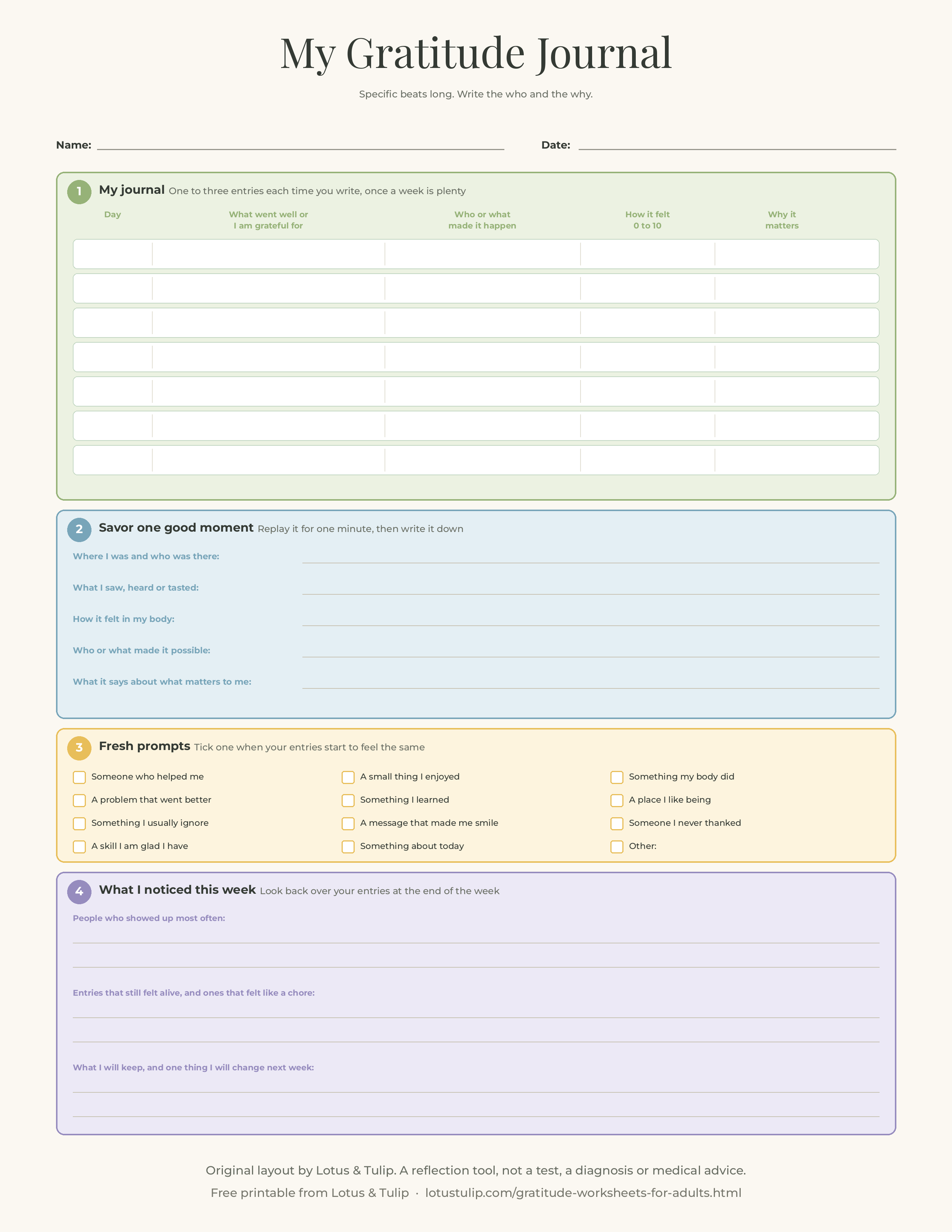
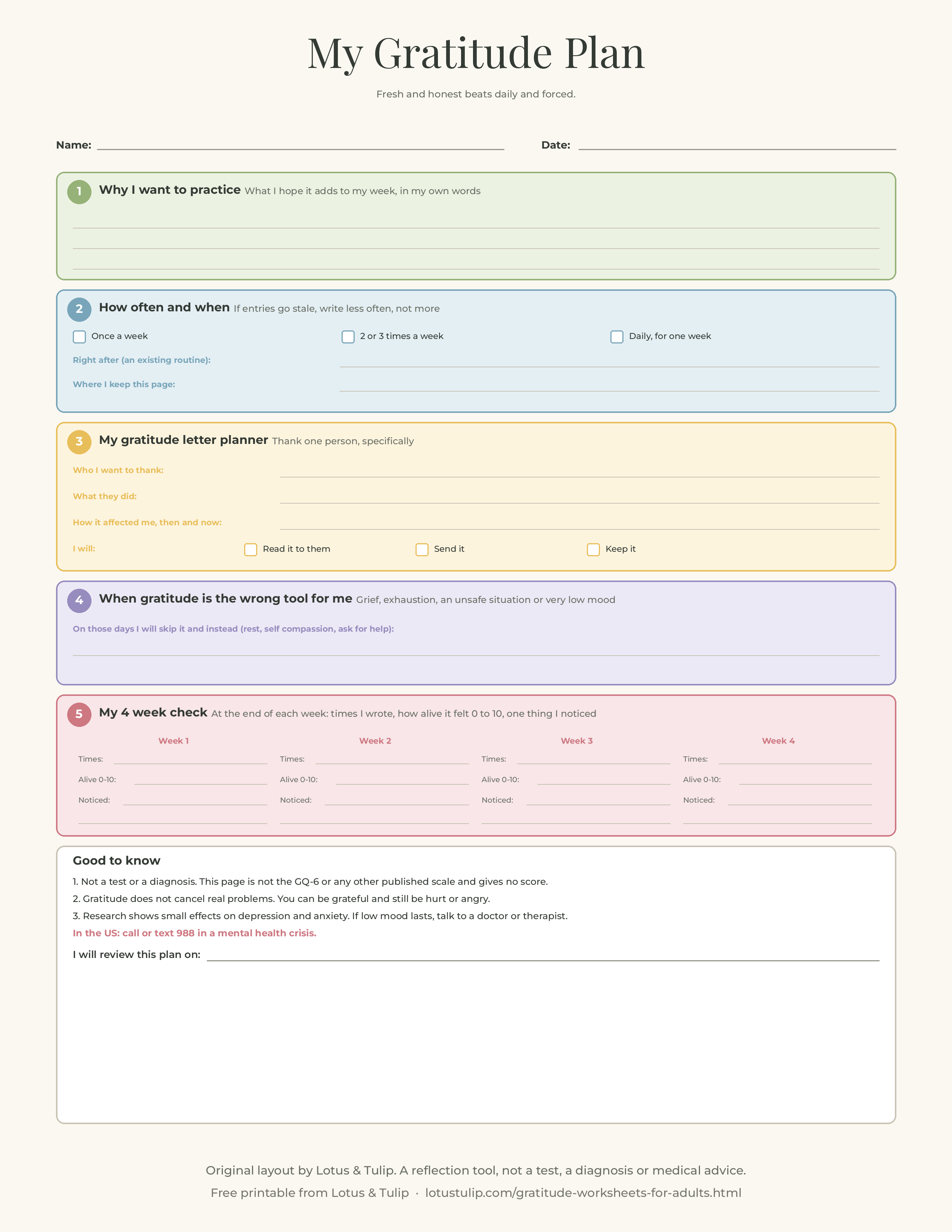
This guide is for adults who want a gratitude practice that stays fresh, and for the therapists, counselors and coaches who suggest one. It explains what gratitude practice is and is not, what research honestly shows (smaller effects than the internet suggests), nine practical steps, common mistakes and examples. It ends with a free 2 page printable: My Gratitude Journal, a weekly page with a savoring box and fresh prompts, and My Gratitude Plan, which covers why you practice, how often, a gratitude letter planner, when gratitude is the wrong tool and a 4 week check.
Download the free gratitude worksheets (PDF, 2 pages, US Letter)
Direct download, no email or sign up. See the pages first.
What gratitude practice is
Gratitude practice means deliberately noticing good things in your life and where they came from, especially the people behind them. The most studied exercises are simple: listing things you are grateful for (often called counting blessings), writing down three things that went well and why, and writing a letter of thanks to someone you never properly thanked.
It is not forced positivity. A gratitude practice does not ask you to pretend that problems are not there, to feel lucky about something painful, or to stop being angry about something that was genuinely wrong. Both can be true at once: a hard week and a friend who brought soup. Good practice makes room for both.
The "why" matters more than the list. Writing "my sister" helps less than writing "my sister called on Tuesday because she remembered my interview, and I felt less alone". Specific details, and the person or cause behind a good thing, are what keep the practice from turning into a chore.
What the research says
- The classic study: weekly lists helped. In the first of three studies by Emmons and McCullough (2003), students wrote once a week for 10 weeks about things they were grateful for, about hassles, or about neutral events. The gratitude group rated their lives more favorably, felt more optimistic about the coming week, reported fewer physical symptoms and exercised nearly 1.5 hours more per week than the hassles group. Not every result held up across the three studies; the most consistent finding was more positive mood.
- Three good things lasted, a thank you visit faded. In an online randomized trial with 577 adults, Seligman and colleagues (2005) tested five exercises against a placebo exercise (writing about early memories). Writing down three good things each day for a week, and why they happened, increased happiness and reduced depressive symptoms for six months. Writing and delivering a gratitude letter gave the largest boost at one month, but the effect had faded by six months.
- More often is not always better. In a six week study reported by Lyubomirsky, Sheldon and Schkade (2005), people who counted their blessings once a week became happier than a control group, while people who did it three times a week did not. A likely reason is that frequent repetition made the exercise routine and less meaningful.
- Against fair comparisons, effects are small. After a review by Wood, Froh and Geraghty (2010) warned that many gratitude studies used weak comparison groups, Davis and colleagues (2016) pooled the research in a series of meta-analyses. Gratitude interventions beat a similar but neutral activity on psychological well-being, but the effect was small (d = .17), they did not reduce anxiety (d = .11, not significant), and they did no better than other psychologically active exercises (d = -.03).
- For depression and anxiety, use something stronger first. Cregg and Cheavens (2021) analyzed 27 studies with 3,675 participants. Gratitude interventions had a small effect on symptoms of depression and anxiety (g = -0.29 at post-test, -0.23 at follow-up), and effects were larger against waitlists than against active control conditions. The authors recommended that people looking to reduce depression or anxiety use interventions with stronger evidence. In plain words: gratitude is a pleasant, low risk extra, not a treatment.
How to use gratitude worksheets, step by step
- Write down why you want to practice. On page 2, note what you hope to get from it: noticing more of the good in an ordinary week, feeling closer to people, ending the day on something other than your inbox. A reason you wrote yourself carries you through the evenings when you do not feel like it.
- Pick a pace that keeps it fresh. Choose one: once a week, two or three times a week, or a one week burst of daily "three good things" a few times a year. If you notice entries getting repetitive, write less often, not more. Once a week is a reasonable default.
- Attach it to an existing routine. Write right after something you already do: Sunday breakfast, the commute home, brushing your teeth. Keep the worksheet where that happens.
- Be specific, and write the why. For each entry on page 1, note what happened, who or what made it possible and how it felt. "The bus driver waited for me when I was running" beats "kind strangers". One detailed entry is worth more than five vague ones.
- Look for people, not only things. Gratitude has a social side: it points to someone who did something for you. When you can, name the person. That also gives you ideas for step 7.
- Savor one entry. Pick one good moment from the week and replay it for a minute in the savoring box: where you were, what you saw, heard and felt, and what it says about what matters to you. Savoring stretches a brief good moment into a longer one.
- Write one gratitude letter. Use the letter planner on page 2 to thank someone specifically: what they did, how it affected you, and where you are now partly because of it. You can read it to them, send it, or simply keep it. All three are fine.
- Know when gratitude is the wrong tool. If you are grieving, burned out, in an unsafe situation or very low, being told to be grateful can feel invalidating and add guilt. On those days, skip it or swap it for something kinder, such as self compassion or asking for help. Gratitude should never be used to excuse harm.
- Review after four weeks. Fill in the 4 week check: how often you wrote, whether entries still felt alive and what changed. Keep it, change the pace or prompts, or set it aside. If low mood is the real problem, behavioral activation or therapy will help more.
Common mistakes
- Writing the same list every night. Repeating "family, health, coffee" quickly goes stale. Use the prompts, change the pace, or write about one moment in detail instead.
- Using gratitude to argue yourself out of real feelings. "Other people have it worse" is not gratitude; it is a way of dismissing your own pain. You can feel grateful and still be upset.
- Turning it into a performance. The journal is private. You do not need to post it, share it or write in a cheerful voice.
- Expecting it to fix depression. Research shows small effects on depression and anxiety. Use it alongside effective care, not instead of it.
- Pushing it on someone in pain. If you are a therapist, partner or parent, suggesting gratitude to someone in crisis can feel like being told their pain does not count. Validate first.
- Giving up after one flat week. Some entries will feel like nothing. Look at four weeks together before deciding whether it helps.
Examples
- The nightly lister: He had kept a nightly list for two months and felt nothing. He switched to one entry, twice a week, always with a person and a "why". By week three he noticed he was looking out for small kindnesses during the day so he would have something to write, which he said was the most useful part.
- The letter writer: A client in therapy for loneliness wrote a gratitude letter to a former teacher who had encouraged her to apply to college. She decided to send it by email. The reply led to a coffee and a renewed contact, which she and her therapist used as a step in her plan to rebuild connections. The loneliness worksheet covered the rest.
- The burned out nurse: After long shifts, a gratitude journal felt like one more task and made her feel guilty for being exhausted. She paused it, worked on rest and boundaries first, and later returned to a once a week "three good things" entry on her day off, which felt manageable. The burnout worksheet helped her plan the recovery part.
Free gratitude worksheets for adults
This free printable is an original Lotus & Tulip layout on US Letter, in our own wording. It is not the Gratitude Questionnaire (GQ-6) or any other published questionnaire, and it does not give a score. Page 1, My Gratitude Journal, has a 7 line journal (day, what went well, who or what made it happen, how it felt 0 to 10), a savoring box for one good moment, a checklist of fresh prompts and space for what you noticed over the week. Page 2, My Gratitude Plan, covers why I practice, how often and when, a gratitude letter planner, when gratitude is the wrong tool for me, a 4 week check and a review date.
Download the free gratitude worksheets (PDF, 2 pages, US Letter)
Prefer single images? Page 1: my gratitude journal (PNG) · Page 2: my gratitude plan (PNG)
Free to print for yourself or for use with your own clients or groups. Please link to this page rather than re-uploading the file. A reflection and practice tool, not a test, a diagnosis or a substitute for therapy. In the US, call or text 988 in a mental health crisis.
Related resources
- Character strengths worksheet: gratitude is one of 24 strengths; find your top five and use one in a new way
- Behavioral activation worksheet: the stronger tool when low mood is the main problem
- ACT values worksheet: what matters to you, and one step toward it
- Self compassion worksheet: for the days when gratitude feels like too much
- Mindfulness worksheets for adults: noticing the present moment, including the good parts
- Loneliness worksheet: rebuilding connection, step by step
- Depression worksheets: activity scheduling, thoughts and a free printable
- All therapist worksheets: CBT, DBT, ACT and more
FAQ
What are gratitude worksheets?
Gratitude worksheets are structured pages that help you notice and record good things in your life, where they came from and how they felt, and plan ways to express thanks. This set has two pages: a weekly gratitude journal with a savoring box and fresh prompts, and a gratitude plan with a letter planner.
How often should I write in a gratitude journal?
Often enough that it stays meaningful. In one six week study, counting blessings once a week raised happiness while three times a week did not (Lyubomirsky, Sheldon and Schkade, 2005). Once a week is a good default; a one week burst of daily "three good things" is another option.
What should I write in a gratitude journal?
One to three specific good things, who or what made them happen, and how they felt. Small things count: a kind message, a good meal, a problem that turned out smaller than feared. Detail and the "why" matter more than the number of entries.
Does gratitude help with depression or anxiety?
Only a little. A meta-analysis of 27 studies found small effects on depression and anxiety symptoms, and the authors recommended treatments with stronger evidence for those problems (Cregg and Cheavens, 2021). Gratitude can be a pleasant extra alongside behavioral activation, CBT or other care.
Can I use these worksheets with clients?
Yes. Therapists, counselors and coaches can print them for their own clients or groups. Introduce gratitude as an option, not a rule, and validate difficult feelings first. Please link to this page rather than re-uploading the file.
When is it a reason to see a professional?
If low mood, hopelessness or anxiety lasts for weeks or affects your work, relationships or sleep, talk to a doctor or therapist. If you are thinking about suicide, in the US call or text 988.
Sources
- Cregg, D. R., and Cheavens, J. S. (2021). Gratitude interventions: Effective self-help? A meta-analysis of the impact on symptoms of depression and anxiety. Journal of Happiness Studies, 22(1), 413 to 445.
- Davis, D. E., Choe, E., Meyers, J., Wade, N., Varjas, K., Gifford, A., Quinn, A., Hook, J. N., Van Tongeren, D. R., Griffin, B. J., and Worthington, E. L. (2016). Thankful for the little things: A meta-analysis of gratitude interventions. Journal of Counseling Psychology, 63(1), 20 to 31.
- Emmons, R. A., and McCullough, M. E. (2003). Counting blessings versus burdens: An experimental investigation of gratitude and subjective well-being in daily life. Journal of Personality and Social Psychology, 84(2), 377 to 389.
- Lyubomirsky, S., Sheldon, K. M., and Schkade, D. (2005). Pursuing happiness: The architecture of sustainable change. Review of General Psychology, 9(2), 111 to 131.
- Seligman, M. E. P., Steen, T. A., Park, N., and Peterson, C. (2005). Positive psychology progress: Empirical validation of interventions. American Psychologist, 60(5), 410 to 421.
- Wood, A. M., Froh, J. J., and Geraghty, A. W. A. (2010). Gratitude and well-being: A review and theoretical integration. Clinical Psychology Review, 30(7), 890 to 905.