
Kids and teens · Social skills and friendship · Updated 2026-11-04
Friendship worksheets for kids: how to teach friendship skills, with activities (free printable)
Ready-made printable: Social Skills Small Group Curriculum for School Counselors, Grades 2 to 5 Holiday 20% off: about $11.04, was $14 (EUR 12) · instant digital download
Buy on Etsy
Some children seem to make friends without trying. Others stand at the edge of the playground, say the wrong thing at the wrong moment, or have one close friend and fall apart when that friend plays with someone else. Friendship is not a personality trait a child either has or lacks. It is a set of skills, and skills can be taught, practiced and improved. This guide is for US school counselors, teachers, child therapists and parents who want a practical way to do that. It covers why friendships matter so much in childhood, what the research says, how friendship changes with age, the nine core friendship skills, how to join a group without getting brushed off, healthy versus unhealthy friendships, teasing versus bullying, a nine step teaching plan, classroom and counseling activities, and the mistakes adults make most often. It ends with a free three page printable: a "What Makes a Good Friend?" worksheet, a joining in plan with 12 conversation starter cards, and a Friendship Check-Up with a friendship traffic light and a repair plan.
Jump to the free friendship worksheets printable
Why friendship skills matter
A friend is more than someone to play with at recess. For a child, a good friend is a practice partner for almost every social skill they will need as an adult: sharing, compromise, loyalty, apologizing, forgiving and standing up for someone. Friends also buffer the hard parts of childhood. A child who walks into a new classroom, a lunchroom or a bad day with one reliable friend is in a very different position from a child who walks in alone.
It helps to separate two ideas that adults often mix up. Popularity (or peer acceptance) is how much the group as a whole likes a child. Friendship is a two way relationship with a specific person. A child can be well liked and still have no close friend, or be on the edge of the class and still have one loyal buddy. Both matter, but in different ways, and a friendship worksheet is mostly about the second one.
Friendship skills also sit squarely inside social emotional learning. The Collaborative for Academic, Social, and Emotional Learning (CASEL) groups social and emotional skills into five areas: self-awareness, self-management, social awareness, relationship skills and responsible decision-making. Making and keeping friends draws on all five, but especially relationship skills (communicating clearly, cooperating, resolving conflict, seeking and offering help) and social awareness (noticing how others feel and taking their perspective).
What the research says
Here is what the evidence supports, stated as carefully as the studies allow.
- Having a friend, and the quality of that friendship, is linked to loneliness. In a well known study in Developmental Psychology, Jeffrey Parker and Steven Asher (1993) studied 881 third, fourth and fifth graders. Children without a best friend reported more loneliness, and friendship quality (how much validation, help and conflict a friendship had) was related to loneliness beyond how accepted a child was by the class as a whole. In short: one good friend matters, and the kind of friendship matters too.
- A best friend can protect against bullying. Ernest Hodges, Michel Boivin, Frank Vitaro and William Bukowski (1999) followed 393 fourth and fifth graders for a year. Children with quiet, withdrawn or anxious behavior were more likely to become targets of peer victimization, but that link was weaker for children with a protective friendship. Being victimized predicted more emotional and behavior problems a year later only for children without a mutual best friend. That is one of the clearest reasons to help isolated children build at least one friendship.
- Friendship in late elementary school is linked to adult wellbeing. Catherine Bagwell, Andrew Newcomb and William Bukowski (1998) followed up 60 young adults 12 years after fifth grade. Those who had a stable, mutual best friend in fifth grade had higher general self-worth as adults, even after accounting for how competent they had felt as children. The study was small, so treat it as an encouraging signal rather than a guarantee.
- Friendship quality matters from kindergarten. Gary Ladd, Becky Kochenderfer and Cynthia Coleman (1996) found that features of kindergartners' friendships, such as how much a friend helped and validated them, were related to how children felt about and adjusted to school, while conflict in a friendship was linked to poorer adjustment.
- How a child joins a group matters. In a classic study in Child Development, Martha Putallaz and John Gottman (1981) watched second and third graders try to join two classmates who were already playing. Less popular children were more likely to be ignored or rejected. They tended to disagree, talk about themselves, state their own feelings and opinions, or ask questions that pulled attention away from what the pair was doing. More accepted children tended to fit in with what the group was already doing. That finding is the basis for the "watch, get close, fit in, then ask" joining steps in this guide and the printable.
- Social and emotional skills can be taught in schools. A 2011 meta-analysis in Child Development by Joseph Durlak and colleagues pooled 213 school based social and emotional learning programs with more than 270,000 students from kindergarten through high school. Compared with controls, students in these programs showed better social and emotional skills, attitudes and behavior, and an 11 percentile point gain in academic achievement. These were whole programs taught over time, not a single worksheet, which is a useful reminder that friendship skills grow with repeated practice.
- Connection is a public health issue. In 2023 the US Surgeon General issued an advisory, Our Epidemic of Loneliness and Isolation, describing social connection as important for health at every age and calling on schools and families to help children build relationships.
None of this means every quiet child is at risk or that a worksheet makes friends for a child. It does mean that time spent teaching friendship skills is not "soft" time. It is some of the most protective work a counselor or parent can do.
How friendship changes with age
What a child thinks a friend is changes a lot between kindergarten and middle school. Psychologist Robert Selman described these changes in his work on how children understand relationships (Selman, 1980). The table below is a simplified, practical version. Ages are rough, and children move at their own pace.
| Age (approx.) | What a friend means | What to teach first |
|---|---|---|
| 3 to 6 | Whoever I am playing with right now. Friendships are based on shared toys and activities and can change in minutes. | Taking turns, sharing, using gentle hands, using a friend's name, simple words to join ("Can I play?"). |
| 6 to 8 | Someone who does nice things for me and likes what I like. Fairness and rules matter a lot. "You're not my friend anymore" is common and usually short lived. | Joining in, being a good sport, noticing feelings, saying sorry, handling "no" when someone does not want to play. |
| 8 to 11 | Someone who helps me and I help back. Trust and keeping promises start to matter. Best friends and small groups form. | Conversation skills, compromise, keeping secrets that are safe to keep, handling jealousy, including others, repairing after a fight. |
| 11 to 14 | Someone I can trust, who understands me and is loyal. Friendships become more intimate, and group chats and social standing matter more. | Healthy versus unhealthy friendships, peer pressure, online friendship, gossip, drifting apart, finding "your people." |
This explains a lot of everyday friction. A six year old who announces "you're not my friend" is not being cruel in the way a twelve year old would be. A ten year old devastated that a best friend told a secret is reacting to a real breach of what friendship means at that age. Match the skill to the stage.
The nine core friendship skills
Most friendship lessons and social skills curricula teach some version of these skills. They work best taught one at a time, practiced in role play and then noticed and praised in real life. The free printable covers the first three directly and supports the rest.
1. Knowing what a good friend is
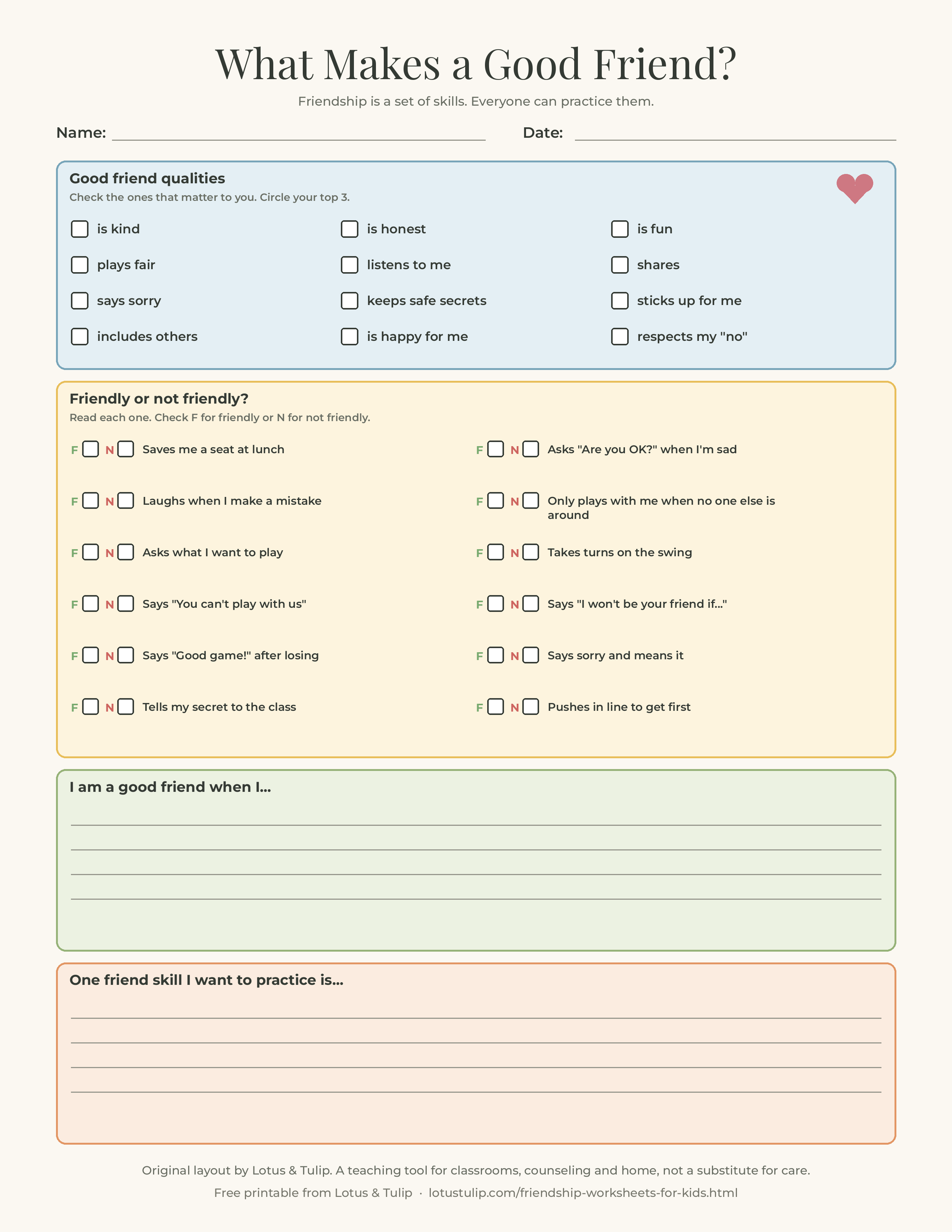
Start with values before techniques. Ask children what makes someone a good friend, and they will usually name the big ones themselves: kind, fun, fair, honest, a good listener, someone who sticks up for you, someone who says sorry. Writing these down turns a vague idea into a checklist a child can use to look at their own behavior ("Am I being a good friend?") and at others ("Is this person being a good friend to me?"). Page 1 of the printable has a "Good friend qualities" checklist and a "Friendly or not friendly?" sort.
2. Joining in
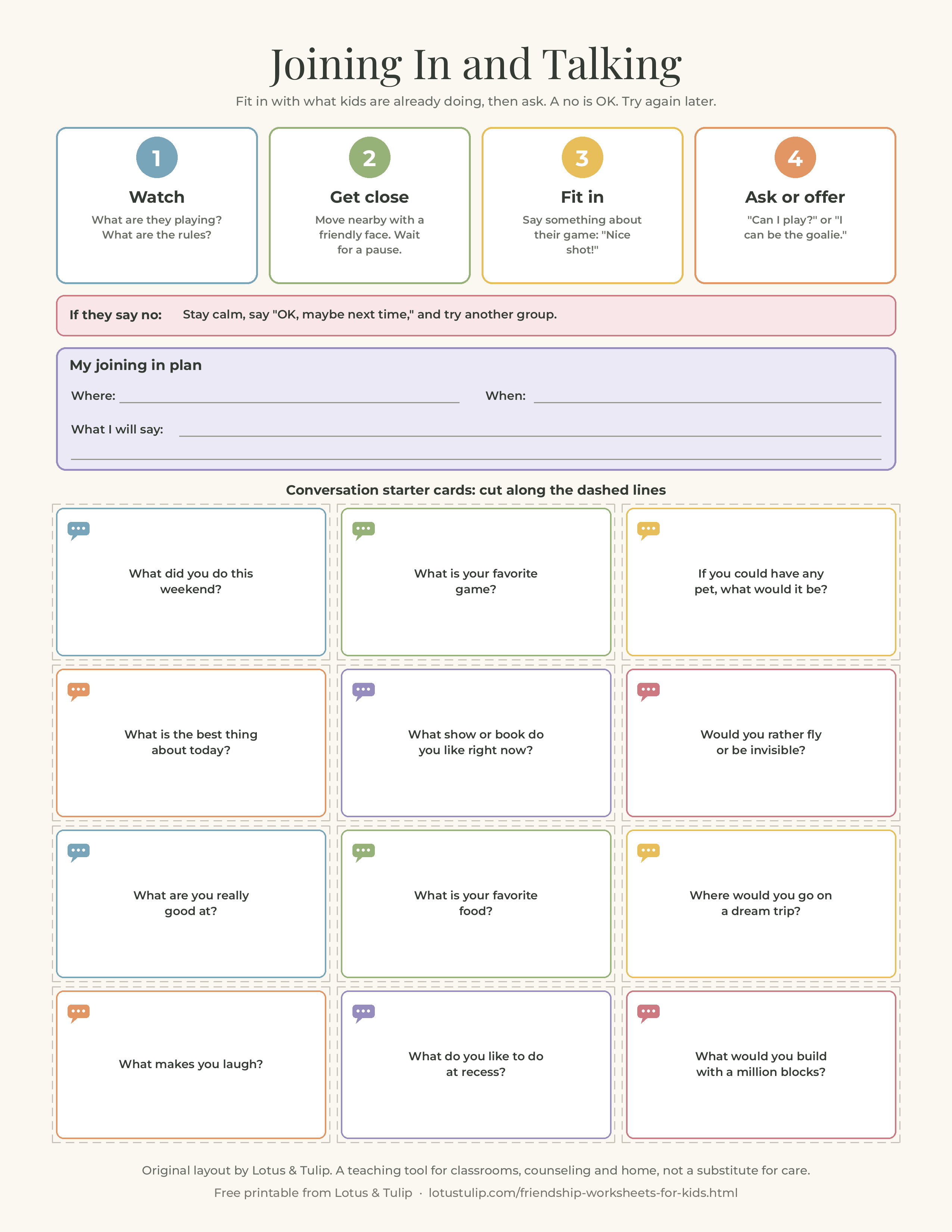
Joining a game or conversation that is already going is one of the hardest moments for many children, and it is where the Putallaz and Gottman findings are most useful. Teach four steps:
- Watch. Stand nearby and figure out what they are playing or talking about and what the rules are.
- Get close. Move near the group with a friendly face. Wait for a pause.
- Fit in. Say something about what they are already doing: "Nice shot!" or "Are you building a fort?" This shows interest in them, not just in yourself.
- Ask or offer. "Can I be on a team?" or "I can be the goalie." If the answer is no, say "OK, maybe next time" and try another group. A no is not a disaster.
The common mistakes are the ones the research picked up: barging in, changing the game, announcing what you want, or talking only about yourself. Practicing the steps in role play first makes them much easier to use on a busy playground.
3. Starting and keeping a conversation
Conversation is a back and forth, like passing a ball. Teach children to (a) start with a greeting and the person's name, (b) ask a question about the other person, (c) listen to the answer, (d) say something connected ("I like that too!" or "What happened next?"), and (e) take turns, not lecture. Many children with big interests (dinosaurs, a video game, trains) need help noticing when a friend has stopped listening: eyes wandering, short answers, turning away. Page 2 of the printable has 12 cut out conversation starter cards to practice with.
4. Listening and showing interest
Good listening is visible. Children can learn "whole body listening": facing the person, looking toward them (not necessarily direct eye contact, which is uncomfortable for some children, including many autistic kids), keeping their body calm and responding to what was said. A simple rule: ask one follow up question before switching to your own topic.
5. Sharing, taking turns and being a good sport
For younger children this is the core of friendship. Practice with board games, card games and sports: wait your turn, follow the rules everyone agreed on, and use good sport words. Winners say "Good game." Losers say "Good game" too, and maybe "Can we play again?" Losing is hard, so teach a calming step first (a slow breath, a squeeze of the hands) and then the words. Our breathing exercises for kids guide has 12 options.
6. Reading social cues and personal space
Friends notice how each other feel. Children can learn to check three things: the face (smiling, frowning, rolling eyes), the body (leaning in, turning away, arms crossed) and the voice (excited, flat, upset). Pair this with personal space, about an arm's length for most conversations. Feelings tools like our feelings wheel for kids help children name what they see.
7. Handling disagreements and compromise
Every friendship has conflict. Children who keep friends are not the ones who never argue. They are the ones who can cool down, say what they want without blaming, listen to the other side and find a middle path ("You pick the game first, I pick next," or "Let's do both"). For a full process with scenario cards, use our conflict resolution worksheet, and for the words themselves, our I statements worksheet.
8. Repairing after a mistake
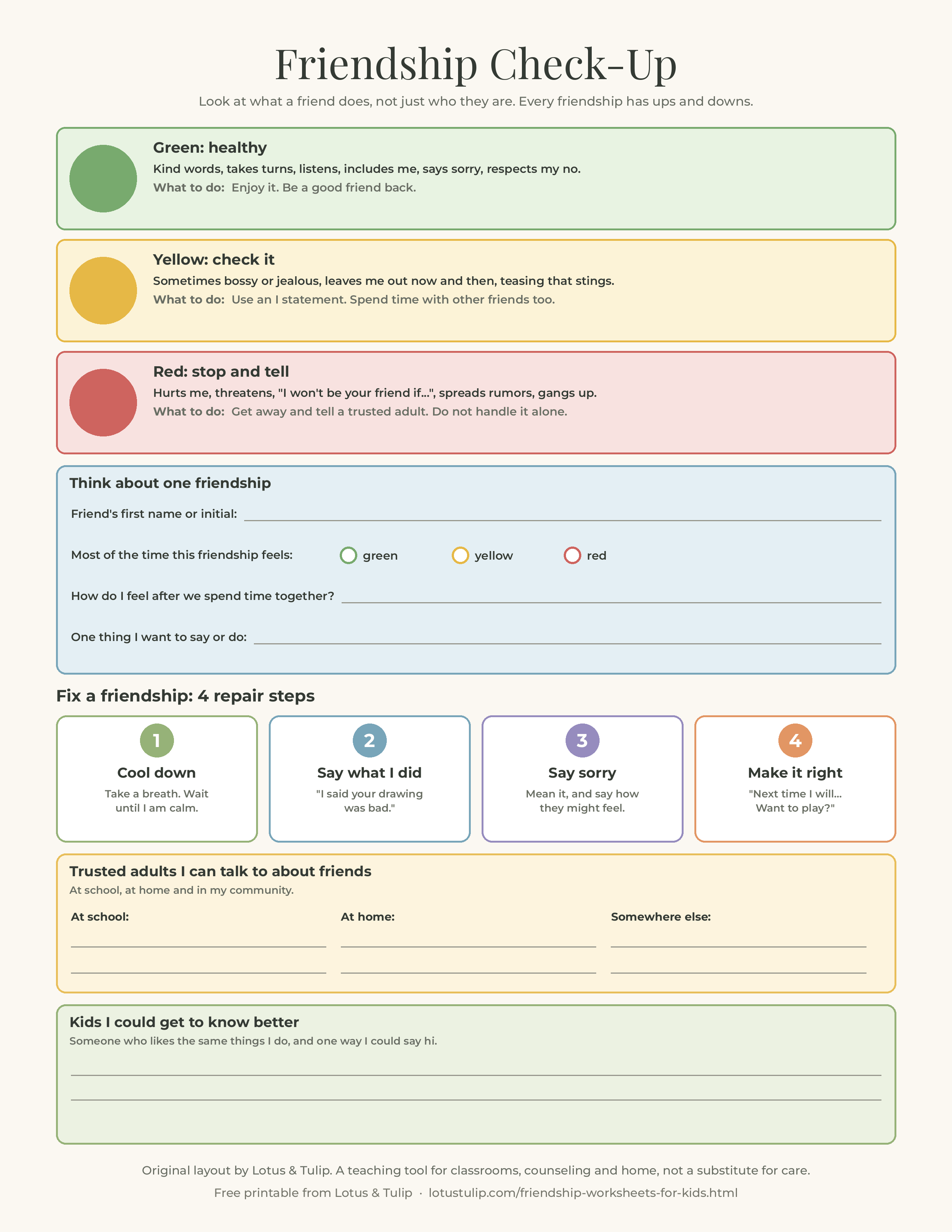
Children will hurt friends: say something mean, leave someone out, break a promise. What matters is the repair. A real apology has four parts: say what you did ("I said your drawing was bad"), say sorry and mean it, show you understand how it felt ("That probably made you feel embarrassed"), and make it right ("Next time I'll say something kind. Do you want to draw together?"). A muttered "Sorry" forced by an adult teaches little. A planned repair teaches a lot. Page 3 of the printable has a four step repair plan.
9. Telling healthy from unhealthy friendships
Older elementary and middle school students need to know that not every friendship is a good one. A friend who is kind most of the time and sometimes makes mistakes is very different from a "friend" who regularly makes you feel bad, threatens to stop being your friend unless you do what they say, or shares your secrets to embarrass you. The friendship traffic light on page 3 helps children sort this out (see below).
Healthy vs unhealthy friendships: the friendship traffic light
A traffic light is an easy frame for children of most ages. It does not label a friend as "good" or "bad." It sorts behaviors, so a child can think about what is happening and what to do.
| Light | What it looks like | What to do |
|---|---|---|
| Green: healthy | Kind words, taking turns, listening, keeping safe secrets, saying sorry, including you, being happy for you, respecting "no." | Enjoy it and keep being a good friend back. |
| Yellow: check it | Sometimes bossy, gets jealous, leaves you out now and then, teases in a way that stings, only plays when no one else is around. | Talk about it with an I statement. Notice if it changes. Spend time with other friends too. Tell an adult if it keeps happening. |
| Red: stop and tell | Hurting your body, threatening, "I won't be your friend unless...", spreading rumors, sharing private photos or messages, getting others to gang up on you, pressuring you to do unsafe things. | Get away if you can and tell a trusted adult. This is not a friendship problem to solve alone. |
Teasing, conflict or bullying?
Adults and children both use "bullying" loosely, and that makes it harder to respond well. The CDC's uniform definition (Gladden and colleagues, 2014) describes bullying as unwanted aggressive behavior by another youth or group of youths, who are not siblings or current dating partners, that involves an observed or perceived power imbalance and is repeated multiple times or is highly likely to be repeated. StopBullying.gov uses the same core ideas.
- Friendly teasing is playful, both kids are laughing, and it stops when someone says "stop."
- Conflict is a disagreement between children with roughly equal power. Both want something, and both can be taught to solve it.
- Bullying is one sided, usually repeated, and involves a power imbalance (size, age, popularity, numbers, or having something to hold over the other child). It is not a "friendship skills" problem for the targeted child to fix. Adults need to step in.
This distinction matters because the advice is different. Telling a bullied child to "use your I statements" or "just be nicer" can feel like blame. Teach friendship skills to build connection and resilience, and handle bullying through your school's reporting and safety procedures.
How to teach friendship skills, step by step
- Start with what the child already knows. Ask "What makes someone a good friend?" and write their answers down. Children invest more in rules they helped write.
- Pick one skill at a time. Choose the skill that would make the biggest difference right now, such as joining in or being a good sport, rather than teaching everything at once.
- Explain why it matters. Connect the skill to something the child wants: "When you ask about their game first, kids are more likely to say yes."
- Model it, including a wrong way. Act out the skill done well and done badly. Children love spotting the mistakes, and it makes the steps concrete.
- Role play with low stakes. Practice with an adult, a puppet or a trusted peer before trying it with classmates. Use the conversation cards and the joining in steps from the printable.
- Plan a real try. Agree on one specific situation this week: "At recess on Tuesday, I will watch the four square game and then ask to join."
- Coach in the moment, lightly. A quiet reminder ("Remember: watch first") works better than stepping in and fixing it for the child.
- Debrief and praise effort. Afterward, ask what happened, what went well and what to try next time. Praise the try, even if the other kids said no.
- Review and add the next skill. Revisit the worksheet every week or two. When one skill becomes easy, add another, and check friendships with the traffic light from time to time.
Friendship activities for the classroom and counseling groups
These activities need little or no prep and pair well with the free printable.
- Friendship recipe. Students write a "recipe" for a good friend: "2 cups of kindness, a spoonful of listening, a pinch of silly." Display the recipes and refer back to them.
- Friendly or not friendly sort. Read short behaviors aloud ("She saved me a seat," "He only talks to me when nobody else is around") and have students hold up green or red cards. Discuss the tricky ones.
- Conversation ball. Pass a soft ball. Whoever holds it answers a conversation card, then asks someone else a follow up question before passing. It makes the back and forth of conversation visible.
- Joining in role play. Two students play a simple game. A third practices the watch, get close, fit in, ask steps. Rotate. Then try a "barging in" version so students can feel the difference.
- Same and different. Pairs find three things they have in common and one thing that is different. Common ground is where many friendships start.
- Compliment chain. Each student writes a specific compliment for the person beside them on a paper strip ("You are great at explaining math"). Link the strips into a chain.
- Repair practice. Give pairs a short scenario ("You laughed when your friend tripped") and have them practice the four step apology from page 3.
- Good sport games. Play a quick game with a clear winner and loser, then practice good sport words on purpose. Repeat until losing calmly becomes a habit.
- Buddy bench or lunch bunch. Many schools set up a buddy bench at recess or a counselor lunch group to give isolated children a structured way to connect. Pair it with joining in practice so children know what to do when someone sits down next to them.
- Friendship check-in. In a small group, students color a friendship traffic light for the week and share one green moment.
For parents: helping your child make and keep friends
Parents cannot make friends for a child, but they can make friendship easier. A few things that tend to help:
- Host short, structured playdates. One friend at a time, about one to two hours, with an activity both children enjoy. Children's friendship programs such as Fred Frankel's Children's Friendship Training recommend one on one get togethers at home as a key way to turn a school acquaintance into a friend (we are not affiliated). Stay nearby, keep screens to a minimum, and end while things are still going well.
- Find your child's people. Friendships grow from shared interests. A chess club, art class, scouts, a sports team or a library program puts your child in a room with kids who like the same things.
- Coach, do not lecture. After a hard day, listen first. Then ask "What could you try next time?" rather than giving a list of rules.
- Avoid labeling. "She's just shy" can become a story a child believes. Try "She likes to watch first, and then she joins in."
- Model friendship. Children notice how you talk about your own friends, how you apologize and how you include others.
- Stay calm about friendship drama. Fallings out are normal and usually short lived in elementary school. Help your child repair what they can, and keep perspective.
The Calm and Connected parenting worksheets include pages on coaching big feelings, which carry over to friendship upsets.
Children who find friendship harder
Some children need more than a worksheet. Children with ADHD may know the friendship rules but struggle to use them in the moment (waiting, not interrupting, losing calmly). Autistic children may prefer different kinds of friendships and conversation, and the goal is not to make them act neurotypical, but to help them find connection in ways that work for them and with peers who share their interests. Children with social anxiety may know exactly what to say but freeze. For these children:
- Keep the skills concrete and visual, like the step cards in the printable.
- Practice more, in smaller steps, with more support.
- Focus on one good friendship rather than popularity.
- Work with the school team. A counselor led social skills group or a structured lunch bunch often helps.
For autistic teens, the UCLA PEERS program developed by Elizabeth Laugeson and colleagues has been tested in randomized trials (for example, Laugeson and colleagues, 2012, Journal of Autism and Developmental Disorders). We mention it as a resource; Lotus & Tulip is not affiliated.
Common mistakes adults make
- Forcing friendships. "Go play with her, she's nice" rarely works. Create chances to connect instead.
- Making everyone be friends. "Everyone has to be friends" is not realistic. "Everyone has to be kind" is. Children can choose their friends and still include others in games.
- Forced, empty apologies. A mumbled sorry teaches children that sorry is a password to end adult attention. Teach the full repair instead.
- Teaching skills only when things go wrong. A child in the middle of a falling out cannot learn a new skill. Teach calm, practice calm, then coach in the moment.
- Treating bullying as a friendship problem. If there is a power imbalance and repetition, adults need to act, not just teach the target better skills.
- Talking only about friends, never practicing. Worksheets start the conversation. Role play and real tries make the change.
- Ignoring the online world. For many middle schoolers, a lot of friendship happens in group chats and games. Talk about online kindness, screenshots, leaving people out of chats and what to do when something goes wrong.
When to get more help
Talk to the school counselor, your pediatrician or a licensed child therapist if a child has no friends at all over a long period, is regularly excluded or bullied, refuses to go to school because of peers, seems persistently sad, anxious or withdrawn, or if friendship problems come with big changes in sleep, eating or mood. If a child or teen talks about hurting themselves or not wanting to be alive, take it seriously and get help right away. In the US you can call or text 988 to reach the 988 Suicide and Crisis Lifeline, which is free, confidential and available 24 hours a day. If someone is in immediate danger, call 911. This guide and printable are educational and are not a substitute for medical or mental health care.
Free friendship worksheets printable (PDF)
This free printable is an original Lotus & Tulip design, sized for US Letter paper and suited to about ages 6 to 12, classrooms, small groups and home. It has three pages:
- Page 1: What Makes a Good Friend? Check the good friend qualities that matter most, sort 12 behaviors into friendly or not friendly, and finish the sentences "I am a good friend when I..." and "One friend skill I want to practice is..."
- Page 2: Joining In and Talking. The four joining in steps (watch, get close, fit in, ask or offer), what to do if the answer is no, a "my joining in plan" box, and 12 cut out conversation starter cards.
- Page 3: Friendship Check-Up. A friendship traffic light (green, yellow, red) with examples, reflection questions about a friendship, a four step "Fix a friendship" repair plan, and a box for trusted adults to talk to.
Download the free friendship worksheets printable (PDF, 3 pages, US Letter)
Prefer single images? Page 1: What Makes a Good Friend? (PNG) · Page 2: Joining In and conversation cards (PNG) · Page 3: Friendship Check-Up (PNG)
Free to print for your own use and for use with your own students, clients or children. Please link to this page rather than re-uploading the file.
Related resources
- Moving worksheets for kids: helping children cope with moving to a new home, with a free moving plan
- Conflict resolution worksheet for kids (free printable)
- I statements worksheet (free printable)
- Size of the problem worksheet (free printable)
- Feelings wheel for kids (free printable)
- Free social story template
- Worry worksheet for kids (free printable)
Sources
- Parker, J. G., and Asher, S. R. (1993). Friendship and friendship quality in middle childhood: links with peer group acceptance and feelings of loneliness and social dissatisfaction. Developmental Psychology, 29(4), 611 to 621.
- Hodges, E. V. E., Boivin, M., Vitaro, F., and Bukowski, W. M. (1999). The power of friendship: protection against an escalating cycle of peer victimization. Developmental Psychology, 35(1), 94 to 101.
- Bagwell, C. L., Newcomb, A. F., and Bukowski, W. M. (1998). Preadolescent friendship and peer rejection as predictors of adult adjustment. Child Development, 69(1), 140 to 153.
- Ladd, G. W., Kochenderfer, B. J., and Coleman, C. C. (1996). Friendship quality as a predictor of young children's early school adjustment. Child Development, 67(3), 1103 to 1118.
- Putallaz, M., and Gottman, J. M. (1981). An interactional model of children's entry into peer groups. Child Development, 52(3), 986 to 994.
- Durlak, J. A., Weissberg, R. P., Dymnicki, A. B., Taylor, R. D., and Schellinger, K. B. (2011). The impact of enhancing students' social and emotional learning: a meta-analysis of school-based universal interventions. Child Development, 82(1), 405 to 432.
- Selman, R. L. (1980). The Growth of Interpersonal Understanding: Developmental and Clinical Analyses. Academic Press.
- Gladden, R. M., Vivolo-Kantor, A. M., Hamburger, M. E., and Lumpkin, C. D. (2014). Bullying Surveillance Among Youths: Uniform Definitions for Public Health and Recommended Data Elements, Version 1.0. Centers for Disease Control and Prevention and US Department of Education.
- Office of the US Surgeon General (2023). Our Epidemic of Loneliness and Isolation: The US Surgeon General's Advisory on the Healing Effects of Social Connection and Community. hhs.gov.
- CASEL. What is the CASEL framework? casel.org.
- Frankel, F., and Myatt, R. (2003). Children's Friendship Training. Brunner-Routledge. (Not affiliated.)
- Laugeson, E. A., Frankel, F., Gantman, A., Dillon, A. R., and Mogil, C. (2012). Evidence-based social skills training for adolescents with autism spectrum disorders: the UCLA PEERS program. Journal of Autism and Developmental Disorders, 42(6), 1025 to 1036. (Not affiliated.)
- StopBullying.gov, US Department of Health and Human Services.
- 988 Suicide and Crisis Lifeline, 988lifeline.org.
FAQ
What are friendship worksheets for kids?
Friendship worksheets are printable pages that help children think about and practice the skills behind friendships: what makes a good friend, how to join in, how to start a conversation, how to handle disagreements and how to repair after a mistake. They work best as a starting point for discussion and role play, not as a stand alone lesson.
What friendship skills should kids learn?
The core friendship skills are knowing what a good friend is, joining in, starting and keeping a conversation, listening and showing interest, sharing and being a good sport, reading social cues and personal space, handling disagreements and compromise, repairing after a mistake with a real apology, and telling healthy from unhealthy friendships.
How do I teach my child to join in with other kids?
Teach four steps: watch to see what the group is doing, get close with a friendly face, fit in by saying something about what they are already doing, then ask or offer to join. If the answer is no, say "OK, maybe next time" and try another group. Practice the steps in role play at home before trying them at recess.
What is the friendship traffic light?
The friendship traffic light sorts friend behaviors into green (healthy, such as kind words and listening), yellow (check it, such as bossiness or teasing that stings) and red (stop and tell an adult, such as threats, hurting or spreading rumors). It helps children think about what is happening in a friendship without labeling a friend as good or bad.
What is the difference between conflict and bullying?
Conflict is a disagreement between children with roughly equal power, and both can learn to solve it. Bullying, as defined by the CDC, is unwanted aggressive behavior that involves a real or perceived power imbalance and is repeated or highly likely to be repeated. Bullying needs adult action, not just better friendship skills from the child who is targeted.
My child has no friends at school. What should I do?
Start by talking with your child and their teacher or school counselor to understand what is happening. Help your child find activities with kids who share their interests, host short one on one playdates, and practice one friendship skill at a time. If your child seems persistently sad, anxious or excluded, or is being bullied, ask the school counselor, your pediatrician or a licensed child therapist for help.
Is this friendship worksheet printable free?
Yes. It is free to print for your own use and for use with your own students, clients or children. Please link to this page rather than re-uploading the file.