
Therapist worksheets · Schema therapy, trauma and self-compassion work · Updated 2026-11-12
Inner child worksheet: what inner child work really is, what the research supports, and how to use it safely (free printable)
Trauma informed pacing: Trauma Worksheets for Therapists, stabilization, grounding and safety pages Holiday 20% off: about $9.20, was $12 (EUR 10) · fillable PDF, instant digital download
Buy on EtsyTry it free first: download a fillable sample (window of tolerance and grounding toolkit, PDF, 189 KB). Type into it on screen, then get the full pack. No email needed.
Big emotions in the moment: DBT Worksheets for Therapists, diary card, check the facts, opposite action and validation Holiday 20% off: about $11.04, was $14 (EUR 12) · fillable PDF, instant digital download
Buy on EtsyTry it free first: download a fillable sample (weekly diary card and checking the facts, PDF, 234 KB). Type into it on screen, then get the full pack. No email needed.
A full caseload: Therapist Worksheets Mega Bundle (8 packs incl. DBT, CBT, ACT, anxiety, grief and ADHD) Holiday 20% off: about $35.88, was $45 (EUR 39) · fillable PDFs for all 8 packs plus 160 printable pages, instant digital download
Buy on EtsyMost people know the moment: a partner sounds a little cold, a boss sends a short email, and suddenly you feel eight years old, in trouble and alone. "Inner child" is the popular name for that experience. It is a metaphor, not a second person living inside you: a way of talking about old feelings, beliefs and unmet needs that still shape how an adult reacts today.
This guide is for therapists, counselors and anyone curious about inner child work. It covers where the idea comes from, what the research does and does not support, the one safety rule that matters most, step by step use in session, and common mistakes. It ends with a free 2 page printable: Meeting My Younger Self, which traces a recent moment back to an old feeling and need, and My Reparenting Plan, with a practice log.
Download the free inner child worksheet (PDF, 2 pages, US Letter)
Direct download, no email or sign up. See the pages first.
Where the inner child idea comes from
The idea has several roots rather than one inventor.
- Carl Jung wrote about the child as an archetype in his essay "The Psychology of the Child Archetype" (1940). His child was a symbol of new beginnings and potential, not the wounded child of later self-help books.
- Eric Berne described three ego states, Parent, Adult and Child, in Transactional Analysis in Psychotherapy (1961) and the bestseller Games People Play (1964). In his model the Child state holds feelings and strategies from early life, and anyone can slip into it.
- Popular books brought the phrase to a mass audience: W. Hugh Missildine's Your Inner Child of the Past (1963), Charles Whitfield's Healing the Child Within (1987), written for adult children of dysfunctional families, and John Bradshaw's Homecoming (1990). Bradshaw's work was hugely popular and also criticized as oversimplified pop psychology.
Two structured therapies later gave related ideas a clearer, testable form. Schema therapy (Young, Klosko and Weishaar, 2003) describes "modes", including a Vulnerable Child mode, critical or punitive modes, and a Healthy Adult who learns to meet the child's needs; the therapist offers "limited reparenting" within professional limits. Internal Family Systems (Schwartz, 1995) describes young, hurt parts called exiles, protective parts that keep them hidden, and a calm core Self that can relate to both.
What the research shows, and what it does not
There is no trial of "inner child work" as such. The popular version has not been tested as a defined treatment. What has been tested are full therapies that use related ideas.
Schema therapy has the strongest evidence. In a Dutch trial of 86 people with borderline personality disorder who received three years of twice weekly therapy, Giesen-Bloo and colleagues (2006) found that both schema therapy and transference focused psychotherapy helped, but schema therapy did better: after three years, 45% of schema therapy patients had recovered compared with 24%, and fewer dropped out (27% vs 50%). A larger trial by Bamelis and colleagues (2014) randomized 323 people with avoidant, dependent, obsessive compulsive, paranoid, histrionic or narcissistic personality disorder to 50 sessions of schema therapy, treatment as usual or clarification oriented psychotherapy. More schema therapy patients recovered than with treatment as usual, though the differences showed up on interview measures and not on self-report scales.
IFS evidence is early. In a proof of concept trial, Shadick and colleagues (2013) randomized 79 adults with rheumatoid arthritis to a 9 month IFS program or mailed education. A year after treatment the IFS group still had better self-rated joint pain, self-compassion and depressive symptoms, but not anxiety or disease activity. That is promising, not proof.
The honest caveat. These trials test whole treatments delivered by trained therapists over months or years. They do not show that an inner child exercise on its own, or a worksheet, causes change. Use a worksheet as a structured way to talk about old feelings and present needs, inside an approach you are trained in.
The one safety rule: work with what is remembered
In the late 1980s and 1990s some inner child and "recovered memory" practices encouraged people to go looking for forgotten childhood events through guided imagery and suggestion. Memory researchers, most visibly Elizabeth Loftus (1993), showed how suggestion and imagination can create vivid memories that feel true and are not. Good inner child work does not dig. It starts from what the person already remembers and, above all, from what they feel today.
That is why the free worksheet starts with "Use something that happened this week" and asks "How old this feeling seems (a guess is fine)", not "What happened to you as a child?". The goal is to notice an old pattern in a present reaction and respond to the need, not to reconstruct the past.
How to use an inner child worksheet, step by step
- Explain the metaphor. Say plainly that "inner child" is a way of talking about old feelings and needs, not a separate person. Offer other words if the client prefers, such as "younger part" or "the scared part of me".
- Check stability first. Make sure the client has grounding skills and is inside their window of tolerance. With significant trauma, stabilization comes before any work on the past.
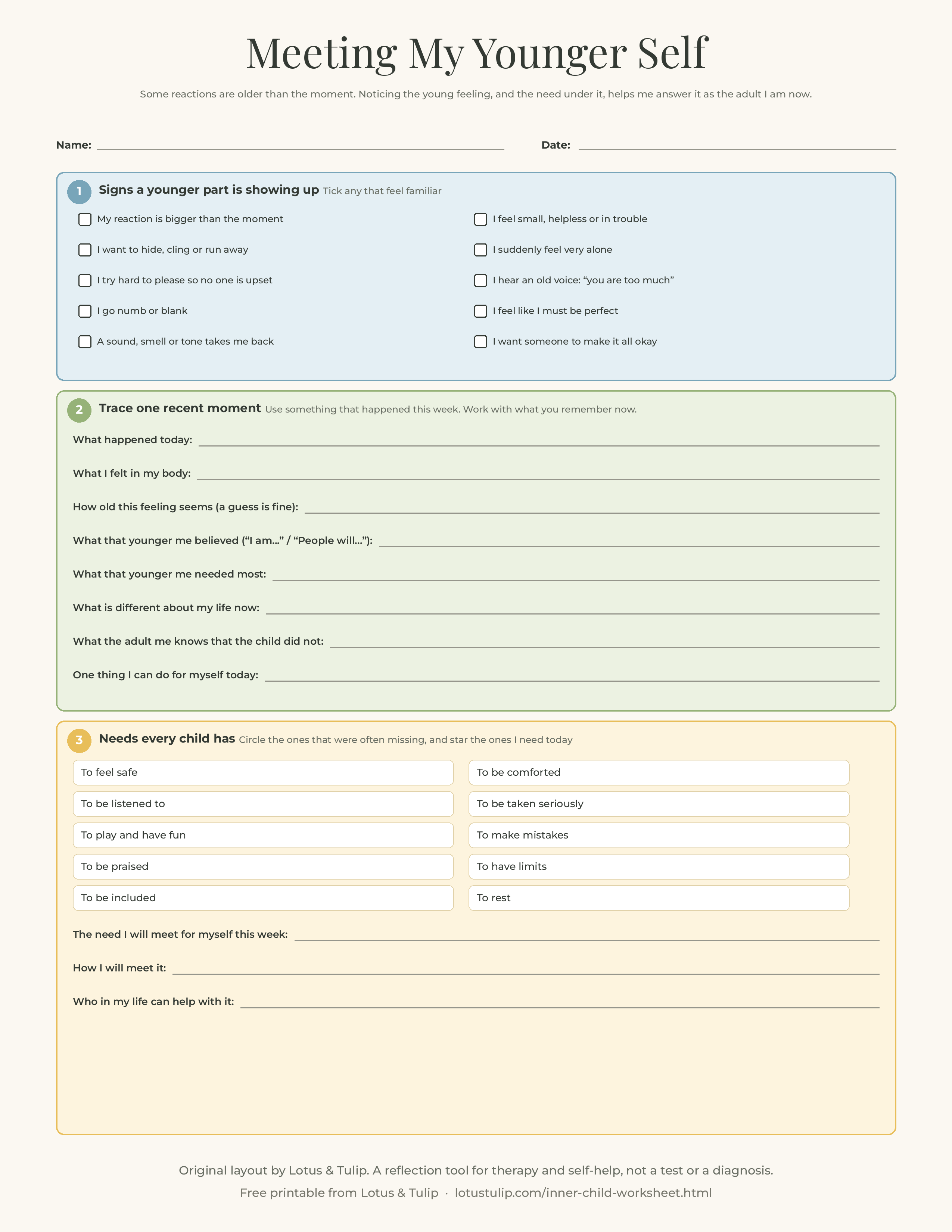
- Spot the signs. Use the checklist on page 1 to name how a younger part tends to show up: reactions bigger than the moment, feeling small, people pleasing, going numb.
- Trace one recent moment. Pick something from this week. Write what happened, what the body felt and how old the feeling seems, without searching for a specific childhood event.
- Name the old belief and the need. Ask what that younger self believed ("I am too much", "People leave") and what they needed most, using the needs list for words.
- Bring in the adult. Ask what is different about life now and what the adult knows that the child did not. This is the Healthy Adult or Self stepping forward.
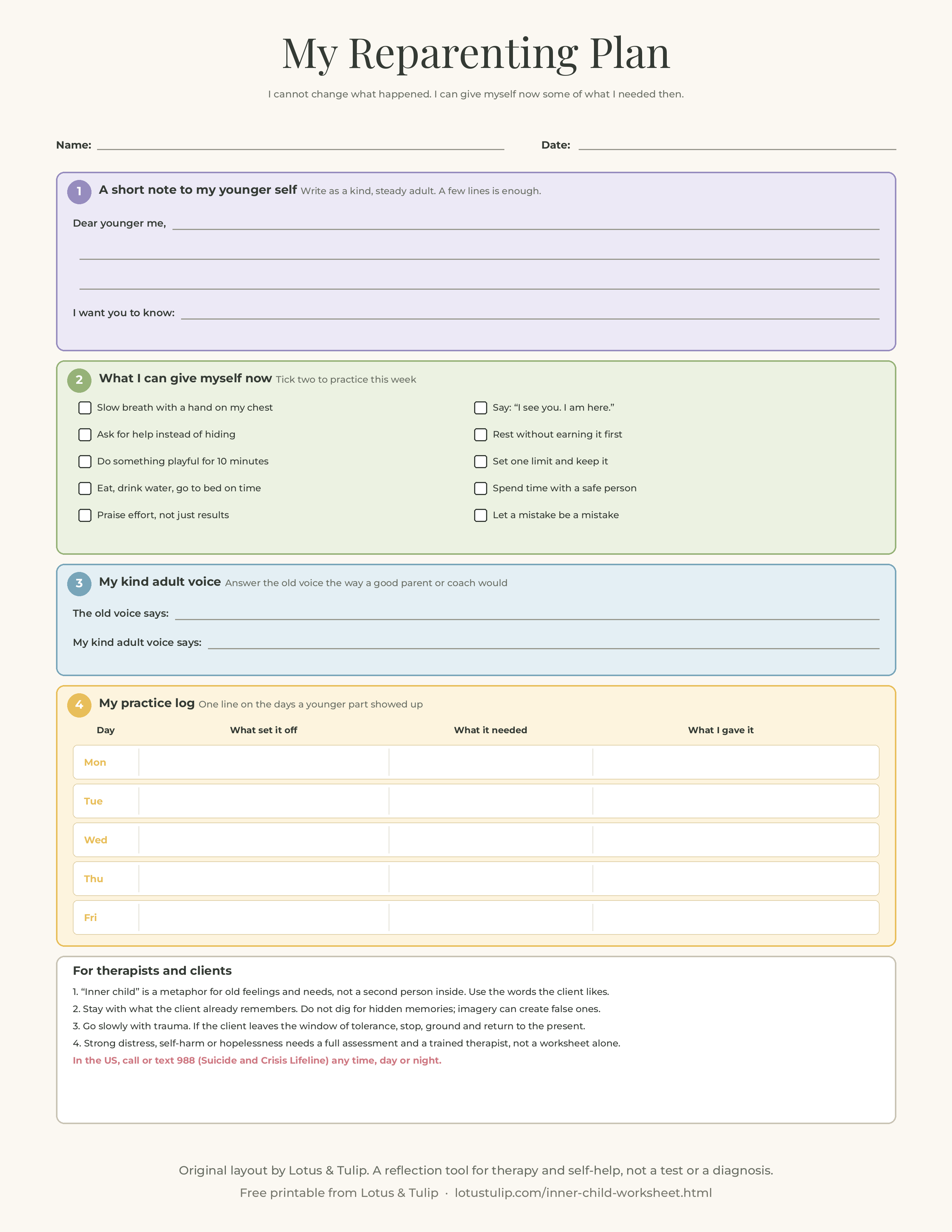
- Write a short note. On page 2, write a few lines to the younger self in a kind, steady adult voice. Keep it brief and present focused.
- Choose two ways to meet the need now. Tick two moves, such as resting without earning it or asking for help instead of hiding, and rehearse one in session.
- Track for a week. Use the practice log to note what set off the young feeling, what it needed and what the client gave it. Review it together next session.
Common mistakes
- Digging for memories. Prompts like "what are you not remembering?" can plant false memories. Stay with what is known and felt.
- Going too fast with trauma. If a client floods or goes numb, stop, ground and return to the present. Regulation first, insight second.
- Making it all about blame. Naming unmet needs can help, but the aim is to meet needs now, not to build a case against parents.
- Treating the child as fragile forever. Children also need play, limits and the chance to make mistakes. A good plan includes fun and structure, not just comfort.
- Replacing therapy with a worksheet. Strong distress, self-harm or hopelessness needs a full assessment and a trained therapist.
Examples
- Adult client: A partner is quiet at dinner and the client panics. Signs: reaction bigger than the moment, suddenly very alone. Feeling seems about 7. Old belief: "If someone is upset, I did something wrong." Need: to be reassured. Adult knows: quiet is not anger, and I can ask. Move: ask "Long day?" instead of over apologizing.
- Perfectionist: A small error at work leads to hours of rereading emails. Old voice: "You must never get it wrong." Need: to be allowed mistakes. Kind adult voice: "One typo does not change your worth. Fix it and move on."
- Burned out parent: Feels guilty for resting. Old belief: "Rest is lazy." Need: to rest. Move: 20 minutes of rest before chores, logged for a week.
Free inner child worksheet
This free printable is an original Lotus & Tulip layout on US Letter, in our own wording. Page 1, Meeting My Younger Self, has ten signs that a younger part is showing up, eight prompts to trace one recent moment back to an old feeling, belief and need, and a list of ten needs every child has, with lines to plan how to meet one this week. Page 2, My Reparenting Plan, has a short note to my younger self, ten ways to give myself what I need now, a kind adult voice section, a 5 day practice log and notes for therapists and clients, including the US 988 crisis line.
Download the free inner child worksheet (PDF, 2 pages, US Letter)
Prefer single images? Page 1: meeting my younger self (PNG) · Page 2: my reparenting plan (PNG)
Free to print for use with your own clients or for yourself. Please link to this page rather than re-uploading the file. A reflection tool, not a test, a diagnosis or a substitute for therapy. In the US, call or text 988 in a crisis.
Related resources
- Emotional neglect worksheet: when what was missing was attention to feelings, with a free feelings and needs plan
- People pleasing worksheet: noticing the automatic yes, with a free kind no practice plan
- Self compassion worksheet: talking to yourself like a good friend
- Shame vs guilt worksheet: when the old voice says "I am bad"
- Attachment styles worksheet: early bonds and adult relationships
- Core beliefs worksheet: working with "I'm not enough" and other deep beliefs
- Window of tolerance worksheet: staying regulated while you do this work
FAQ
What is inner child work?
Inner child work is a way of noticing old feelings, beliefs and unmet needs from childhood that still show up in adult reactions, and learning to respond to them as a caring adult. "Inner child" is a metaphor, not a literal second person inside you.
Is inner child work evidence based?
Not as a stand-alone method. Related approaches have research behind them: schema therapy, which works with a Vulnerable Child mode, did better than comparison treatments in randomized trials for personality disorders, and Internal Family Systems has early, promising trials. A worksheet alone has not been tested.
What is reparenting?
Reparenting means giving yourself now some of what you needed as a child, such as comfort, limits, rest, play and kind words. In schema therapy, the therapist offers "limited reparenting" within professional limits while the client builds their own Healthy Adult.
Can inner child work be harmful?
It can be if it pushes people to search for forgotten memories, which can create false ones, or if it moves too fast with trauma. Work with what you already remember, stay grounded, and do deeper trauma work with a trained therapist.
Can I do inner child work on my own?
Many people use gentle exercises like this worksheet on their own. If it brings up strong distress, flashbacks or thoughts of self-harm, stop and reach out to a therapist. In the US, call or text 988 in a crisis.
Is this inner child worksheet free?
Yes. It is free to print for use with your own clients or for yourself. Please link to this page rather than re-uploading the file.
Sources
- Bamelis, L. L. M., Evers, S. M. A. A., Spinhoven, P., and Arntz, A. (2014). Results of a multicenter randomized controlled trial of the clinical effectiveness of schema therapy for personality disorders. American Journal of Psychiatry, 171(3), 305 to 322. doi:10.1176/appi.ajp.2013.12040518
- Berne, E. (1961). Transactional Analysis in Psychotherapy. Grove Press.
- Bradshaw, J. (1990). Homecoming: Reclaiming and Championing Your Inner Child. Bantam.
- Giesen-Bloo, J., van Dyck, R., Spinhoven, P., et al. (2006). Outpatient psychotherapy for borderline personality disorder: randomized trial of schema-focused therapy vs transference-focused psychotherapy. Archives of General Psychiatry, 63(6), 649 to 658.
- Jung, C. G. (1940). The psychology of the child archetype. In The Archetypes and the Collective Unconscious, Collected Works vol. 9, part 1. Princeton University Press.
- Loftus, E. F. (1993). The reality of repressed memories. American Psychologist, 48(5), 518 to 537.
- Schwartz, R. C. (1995). Internal Family Systems Therapy. Guilford Press.
- Shadick, N. A., Sowell, N. F., Frits, M. L., et al. (2013). A randomized controlled trial of an Internal Family Systems-based psychotherapeutic intervention on outcomes in rheumatoid arthritis: a proof-of-concept study. Journal of Rheumatology, 40(11), 1831 to 1841.
- Whitfield, C. L. (1987). Healing the Child Within. Health Communications.
- Young, J. E., Klosko, J. S., and Weishaar, M. E. (2003). Schema Therapy: A Practitioner's Guide. Guilford Press.