
Therapist worksheets · Childhood emotional neglect, feelings and needs · Updated 2026-11-13
Emotional neglect worksheet for adults: what childhood emotional neglect is, what the research shows, and how to start naming feelings and needs (free printable)
Trauma informed pacing: Trauma Worksheets for Therapists, stabilization, grounding and safety pages Holiday 20% off: about $9.20, was $12 (EUR 10) · fillable PDF, instant digital download
Buy on EtsyTry it free first: download a fillable sample (window of tolerance and grounding toolkit, PDF, 189 KB). Type into it on screen, then get the full pack. No email needed.
Naming and handling emotions: DBT Worksheets for Therapists, diary card, check the facts, opposite action and validation Holiday 20% off: about $11.04, was $14 (EUR 12) · fillable PDF, instant digital download
Buy on EtsyTry it free first: download a fillable sample (weekly diary card and checking the facts, PDF, 234 KB). Type into it on screen, then get the full pack. No email needed.
A full caseload: Therapist Worksheets Mega Bundle (8 packs incl. DBT, CBT, ACT, anxiety, grief and ADHD) Holiday 20% off: about $35.88, was $45 (EUR 39) · fillable PDFs for all 8 packs plus 160 printable pages, instant digital download
Buy on EtsyNothing terrible happened. There was food on the table, nobody hit you, and your parents came to the school play. And yet, as an adult, you find it hard to say what you feel, you would rather do everything yourself than ask for help, and somewhere inside there is a flat, empty spot you cannot explain. Many clients describe their childhood this way, and many feel they have no right to complain about it.
Childhood emotional neglect is about what was missing rather than what was done. This guide is for adults and the therapists who work with them. It explains what the term means and where it comes from, what the research does and does not show, nine practical steps, common mistakes and examples. It ends with a free 2 page printable: My Emotional Neglect Map, which looks at what was often missing, how it may show up now and the feelings you rarely name, and My Feelings and Needs Practice Plan, with a 7 day feelings and needs log, one small ask and a self-care plan.
Download the free emotional neglect worksheet (PDF, 2 pages, US Letter)
Direct download, no email or sign up. See the pages first.
What childhood emotional neglect is, and what it is not
It is an absence. Emotional neglect means a child's emotional needs were not responded to enough: feelings went unnoticed, comfort did not come, and nobody helped the child understand what was going on inside. Psychologist Jonice Webb popularized the phrase "childhood emotional neglect" in her 2012 book Running on Empty and describes it as parents failing to respond enough to a child's emotional needs. Because it is a non-event, people often cannot point to a memory of it.
It is not a diagnosis. Childhood emotional neglect is not a disorder in the DSM-5-TR, and Webb's widely shared framework is a popular, clinically useful description rather than a formal category with diagnostic criteria. Researchers study emotional neglect as one type of childhood maltreatment, usually with questionnaires.
It is not the same as having imperfect parents. Every parent misses things. Emotional neglect describes a pattern that went on over time, not the occasional distracted evening. It also often happens in loving families, for example when a parent was depressed, ill, overwhelmed, grieving or never learned to talk about feelings themselves. Naming it is about understanding, not blame.
How researchers measure emotional neglect
The most widely used research measure is the Childhood Trauma Questionnaire. Its short form (Bernstein et al., 2003) has 28 items: 25 clinical items across five subscales of five items each (emotional, physical and sexual abuse, and emotional and physical neglect) plus 3 items that check for minimizing. The emotional neglect items ask, in reverse, whether you felt loved, felt important or special to someone in your family, and whether your family felt close and supportive.
The CDC and Kaiser Permanente ACE Study used that subscale. Among the 8,629 adults in its second survey wave, 14.8% reported moderate to extreme emotional neglect (16.7% of women and 12.4% of men). The participants were insured health plan members in Southern California surveyed in 1995 to 1997, so the figure is a rough guide, not a national rate.
Our free worksheet is not the CTQ and not a screening test. It uses our own wording to help you reflect, and it does not produce a score.
What the research shows
Emotional neglect is closely linked with depression. Humphreys and colleagues (2020) meta-analyzed 192 samples with 68,830 people who completed the CTQ. Every type of maltreatment was linked with depression, and emotional abuse and emotional neglect showed the strongest associations. An earlier meta-analysis of 12 studies using a detailed interview rather than a questionnaire (Infurna et al., 2016, 4,372 participants) also found psychological abuse and neglect most strongly associated with major depression. These are associations, not proof that neglect causes depression on its own.
It is linked with difficulty naming feelings. Alexithymia means trouble identifying and describing your own emotions. In a meta-analysis of 99 samples and 36,141 participants, Ditzer and colleagues (2023) found childhood maltreatment correlated with adult alexithymia (r = .23), with emotional neglect (r = .21), emotional abuse and physical neglect among the strongest predictors. A separate meta-analysis of 88 studies (Khan and Jaffee, 2022) also found alexithymia more strongly tied to neglect than to physical or sexual abuse. The effects are small, and studies varied a lot, but they fit what clients often report: feelings were never named, so the words never formed.
Naming feelings can help. In a brain imaging study, Lieberman and colleagues (2007) found that putting a word to an emotional image reduced activity in the amygdala, a region involved in emotional alarm, compared with other ways of processing the same image. It was a lab study with pictures, not a treatment trial, but it supports a simple idea behind the worksheet: practicing feeling words is worth the effort.
Memory is an important limitation. Almost all adult research on emotional neglect relies on looking back. Baldwin, Reuben, Newbury and Danese (2019) pooled 16 studies with 25,471 people that measured maltreatment both during childhood and later in adult reports. Agreement was poor (kappa = .19): on average 52% of people identified during childhood did not report maltreatment as adults, and 56% of adults who reported it had not been identified during childhood. Adult recall is shaped by current mood and by what was recorded at the time, and both kinds of measure miss things. Your account still matters in therapy. It just means a worksheet like this is a tool for reflection, not a way to establish what happened.
The honest caveat. We found no randomized trial of a program built specifically around the popular childhood emotional neglect framework, and there is no trial of this worksheet. The steps below borrow from approaches with broader support for adults with difficult childhoods and emotion difficulties, such as emotion awareness and regulation skills (for example in DBT), self-compassion work and trauma informed pacing, and work best with a therapist.
How to use an emotional neglect worksheet, step by step
- Start with safety and pace. Check that you or your client can stay grounded when thinking about childhood. If reflecting brings intense distress, flashbacks or numbness, slow down and build stabilization skills first.
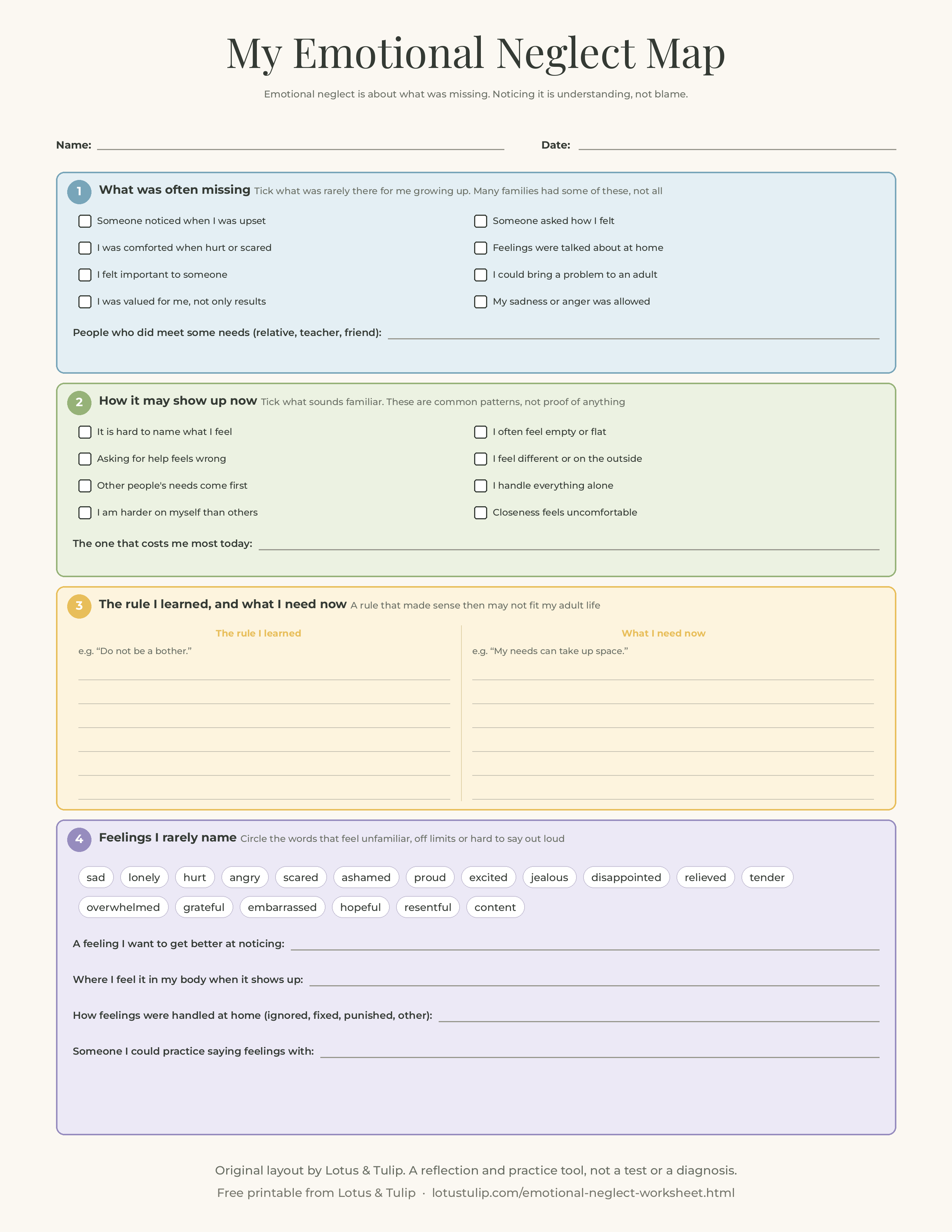
- Tick what was often missing. On page 1, mark the experiences that were rarely there, such as being comforted or asked how you felt. Go by the overall pattern, not single memories.
- Name who did help. Write down anyone who met some needs: a grandparent, a teacher, a friend's parent. This is often forgotten and gives a fuller picture.
- Notice how it may show up now. Tick the adult patterns that sound familiar, such as finding it hard to ask for help or feeling empty. Circle the one that costs you most today.
- Write the rule you learned and what you need now. For example, "Do not be a bother" next to "My needs can take up space". A rule that protected a child may not fit an adult life.
- Circle the feelings you rarely name. Use the word bank to spot emotions that feel unfamiliar or off limits, and note where you feel them in your body and how feelings were handled at home.
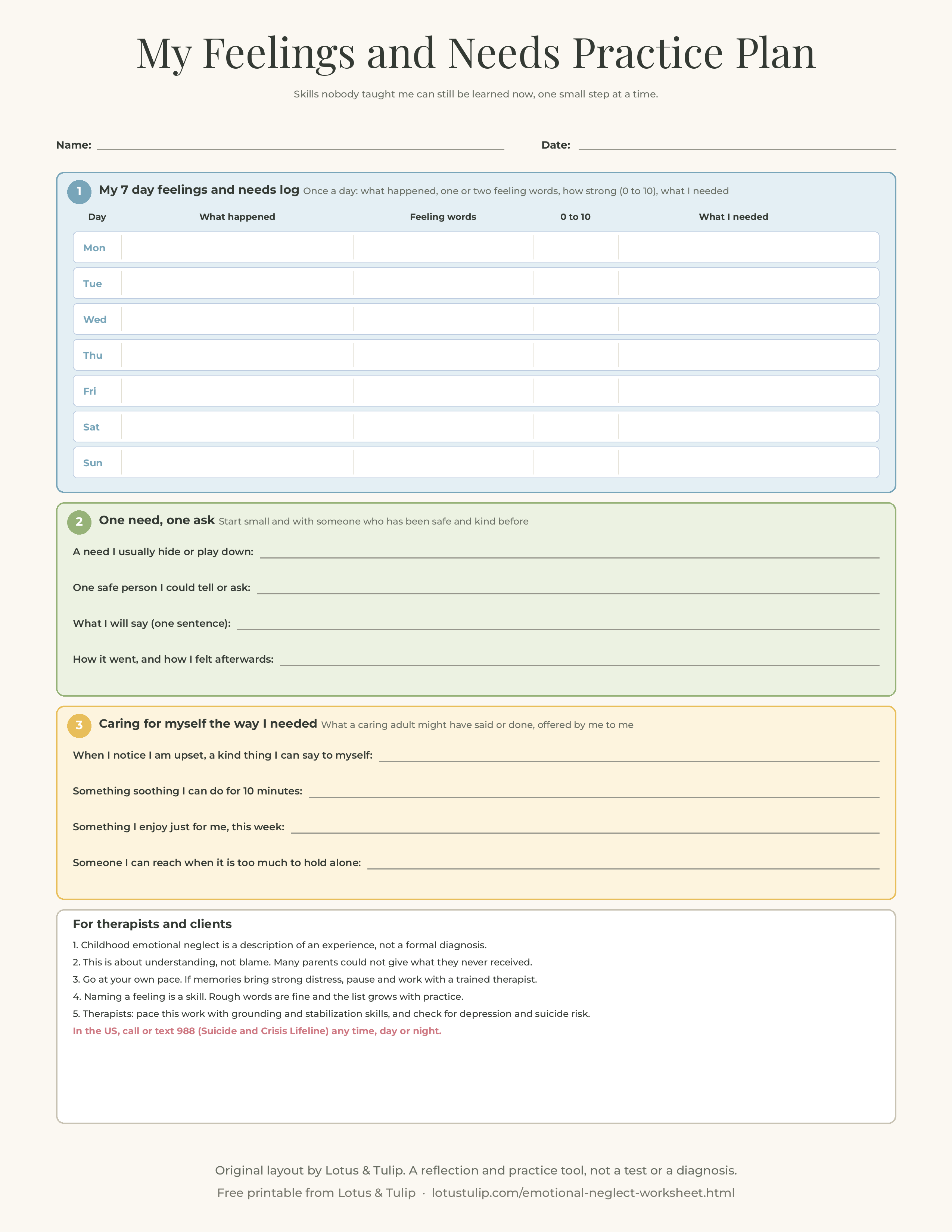
- Keep a 7 day feelings and needs log. On page 2, once a day, write what happened, one or two feeling words, how strong (0 to 10) and what you needed. Rough words are fine.
- Make one small ask. Choose a need you usually hide and one person who has been safe and kind before. Plan one sentence, say it, then note how it went and how you felt.
- Offer yourself what was missing. Plan a kind thing to say when you are upset, something soothing for 10 minutes, something just for you this week and someone to reach when it is too much to hold alone.
For more on naming emotions, see the feelings wheel printable, and for staying regulated during this work, the window of tolerance worksheet.
Common mistakes
- Treating the checklist as a diagnosis. Ticking boxes does not prove emotional neglect, and the adult patterns have many possible causes. Use it to open a conversation, not to close one.
- Digging for memories. Pushing to recover details is not needed and can distort memory and raise distress. The pattern and its effects today are enough to work with.
- Turning it into blame. Anger can be part of the process, but the goal is not to put parents on trial. Many could not give what they never received, and both things can be true: it was not your fault, and they may have done their best.
- Skipping the present. Understanding the past helps, but change comes from practicing new skills now: naming feelings, noticing needs and asking for support.
- Missing depression or risk. Emotional neglect is strongly linked with depression. If low mood, hopelessness or thoughts of suicide are present, address them directly and get appropriate care.
Examples
- The capable one: Ticked "I handle everything alone" and "Asking for help feels wrong". Rule learned: "Do not be a bother." Need now: "I can let people help." Ask: told a friend she was overwhelmed with a move and accepted an offer to help pack. Log: "relieved, a bit exposed, 6".
- The empty spot: Ticked "It is hard to name what I feel" and "I often feel empty or flat". Circled "lonely" and "disappointed" in the word bank. After a week of logging, noticed the flat feeling often followed weekends alone. Linked page: the self compassion worksheet.
- In a relationship: Partner says "You never tell me what you need." Rule learned: "Feelings are a burden." Practice: one sentence a day starting with "I feel ... and I would like ...". Linked page: the I statements worksheet.
Free emotional neglect worksheet for adults
This free printable is an original Lotus & Tulip layout on US Letter, in our own wording. Page 1, My Emotional Neglect Map, has a checklist of what was often missing with space for people who did help, a checklist of how it may show up now, a two column space for the rule you learned and what you need now, and a word bank of feelings you rarely name with prompts about your body and home. Page 2, My Feelings and Needs Practice Plan, has a 7 day feelings and needs log, a one need, one ask plan, a caring for myself plan and notes for therapists and clients, including the US 988 crisis line.
Download the free emotional neglect worksheet (PDF, 2 pages, US Letter)
Prefer single images? Page 1: my emotional neglect map (PNG) · Page 2: my feelings and needs practice plan (PNG)
Free to print for use with your own clients or for yourself. Please link to this page rather than re-uploading the file. A reflection tool, not a test, a diagnosis or a substitute for therapy. In the US, call or text 988 in a crisis.
Related resources
- Inner child worksheet: old feelings and unmet needs, with a free reparenting plan
- Self-esteem worksheets for adults: the harsh bottom line belief and a free fairer view practice plan
- Attachment styles worksheet: early bonds and adult relationships
- DBT validation worksheet: learning to validate feelings, including your own
- Feelings wheel printable: more words for what you feel
- Window of tolerance worksheet: staying regulated while you do this work
FAQ
What is childhood emotional neglect?
It is a pattern in which a child's emotional needs were not responded to enough: feelings were not noticed, named or comforted. It is about what was missing rather than what was done, which is why many adults struggle to recognize it.
Is childhood emotional neglect a diagnosis?
No. It is not a disorder in the DSM-5-TR. The popular framework from Jonice Webb's book Running on Empty is a useful description, and researchers study emotional neglect as a type of childhood maltreatment, but there are no formal diagnostic criteria.
What are signs of emotional neglect in adults?
Commonly described patterns include difficulty naming feelings, feeling empty or flat, finding it hard to ask for help, putting others' needs first and feeling different from others. Research links emotional neglect with depression and with alexithymia, but these signs have many causes and do not prove neglect.
Can I test myself for childhood emotional neglect?
Online quizzes cannot diagnose it. Researchers use the Childhood Trauma Questionnaire, which includes an emotional neglect subscale, but even that relies on memory, and studies show adult recall and childhood records often disagree. A therapist can help you make sense of your history.
Can emotional neglect be healed?
Many of the skills that were not taught, such as naming feelings, noticing needs and asking for support, can be learned in adulthood. There are no trials of programs built specifically on the popular framework, but therapy for depression, emotion regulation and trauma related difficulties has evidence and is commonly used for this work.
Is this emotional neglect worksheet free?
Yes. It is free to print for use with your own clients or for yourself. Please link to this page rather than re-uploading the file.
Sources
- Baldwin, J. R., Reuben, A., Newbury, J. B., and Danese, A. (2019). Agreement between prospective and retrospective measures of childhood maltreatment: A systematic review and meta-analysis. JAMA Psychiatry, 76(6), 584 to 593.
- Bernstein, D. P., Stein, J. A., Newcomb, M. D., Walker, E., Pogge, D., Ahluvalia, T., Stokes, J., Handelsman, L., Medrano, M., Desmond, D., and Zule, W. (2003). Development and validation of a brief screening version of the Childhood Trauma Questionnaire. Child Abuse and Neglect, 27(2), 169 to 190.
- Centers for Disease Control and Prevention. About the CDC-Kaiser ACE Study: prevalence of ACEs by category, Waves 1 and 2.
- Ditzer, J., Wong, E. Y., Modi, R. N., Behnke, M., Gross, J. J., and Talmon, A. (2023). Child maltreatment and alexithymia: A meta-analytic review. Psychological Bulletin, 149(5 to 6), 311 to 329.
- Humphreys, K. L., LeMoult, J., Wear, J. G., Piersiak, H. A., Lee, A., and Gotlib, I. H. (2020). Child maltreatment and depression: A meta-analysis of studies using the Childhood Trauma Questionnaire. Child Abuse and Neglect, 102, 104361.
- Infurna, M. R., Reichl, C., Parzer, P., Schimmenti, A., Bifulco, A., and Kaess, M. (2016). Associations between depression and specific childhood experiences of abuse and neglect: A meta-analysis. Journal of Affective Disorders, 190, 47 to 55.
- Khan, A. N., and Jaffee, S. R. (2022). Alexithymia in individuals maltreated as children and adolescents: A meta-analysis. Journal of Child Psychology and Psychiatry, 63(9), 963 to 972.
- Lieberman, M. D., Eisenberger, N. I., Crockett, M. J., Tom, S. M., Pfeifer, J. H., and Way, B. M. (2007). Putting feelings into words: Affect labeling disrupts amygdala activity in response to affective stimuli. Psychological Science, 18(5), 421 to 428.
- Webb, J., with Musello, C. (2012). Running on Empty: Overcome Your Childhood Emotional Neglect. Morgan James Publishing.