
Therapist worksheets · Jealousy and envy · Updated 2026-11-14
Jealousy worksheet for adults: jealousy vs envy, what research shows, and a step by step plan (free printable)
Check the facts, opposite action and calm asking: DBT Worksheets for Therapists, skills handouts for adult clients across all four DBT skill areas Holiday 20% off: about $11.04, was $14 (EUR 12) · fillable PDF, instant digital download
Buy on EtsyTry it free first: download a fillable sample (weekly diary card and checking the facts, PDF, 234 KB). Type into it on screen, then get the full pack. No email needed.
When suspicious thoughts run the show: CBT Worksheets for Therapists, 20 pages including thought records and core beliefs Holiday 20% off: about $11.04, was $14 (EUR 12) · fillable PDF, instant digital download
Buy on EtsyTry it free first: download a fillable sample (thought record and evidence for and against, PDF, 105 KB). Type into it on screen, then get the full pack. No email needed.
A full caseload: Therapist Worksheets Mega Bundle (8 packs incl. DBT, CBT, ACT, anxiety, grief and ADHD) Holiday 20% off: about $35.88, was $45 (EUR 39) · fillable PDFs for all 8 packs plus 160 printable pages, instant digital download
Buy on EtsyYour partner laughs a little too long at a coworker's joke, and your chest tightens. A friend announces a promotion you wanted, and you smile while something sour turns over inside. Later you find yourself rereading their messages, or scrolling their photos at midnight, and then feeling ashamed that you did.
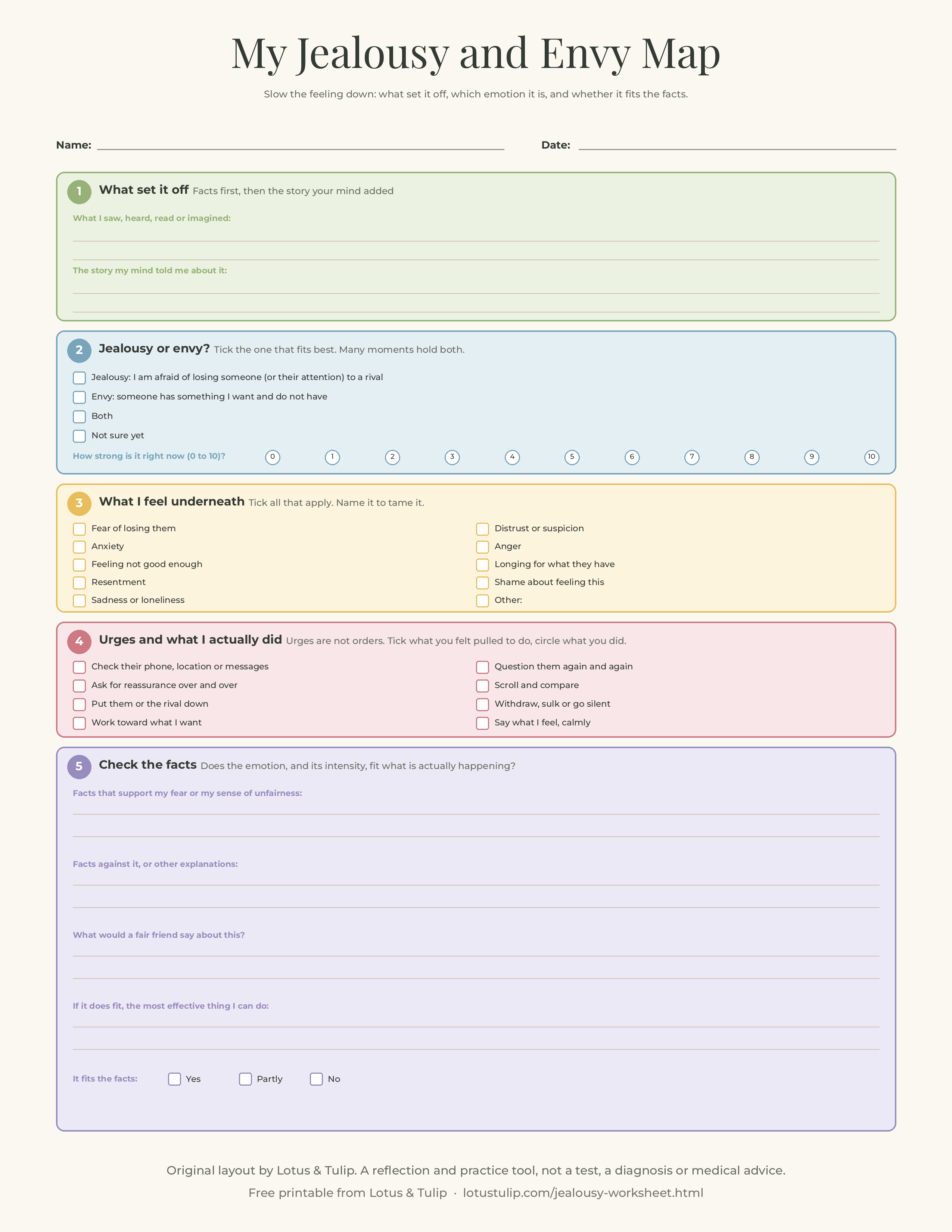
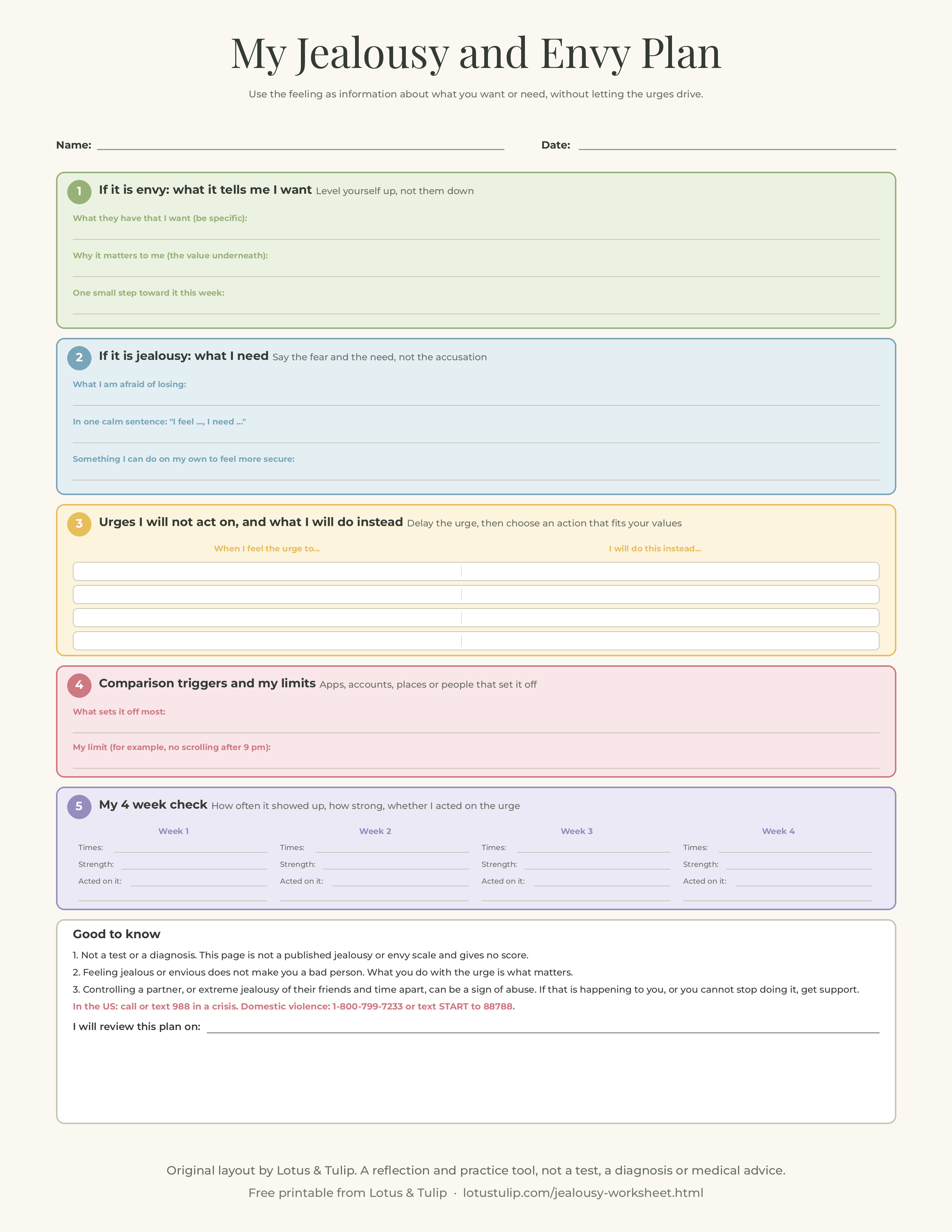
This guide is for adults who want to handle jealousy and envy better, and for the therapists, counselors and coaches who help them. It explains the difference between the two emotions, what research shows about how they work, nine practical steps, common mistakes and three short examples. It ends with a free 2 page printable: My Jealousy and Envy Map, for slowing the feeling down and checking it against the facts, and My Jealousy and Envy Plan, for turning it into a clear want or need and a better response than the urge.
Download the free jealousy worksheet (PDF, 2 pages, US Letter)
Direct download, no email or sign up. See the pages first.
Jealousy vs envy: two different emotions
Jealousy is about losing something you have. Envy is about wanting something someone else has. In everyday English people often say "jealous" for both, which is part of why the two get confused. Psychologists separate them by the situation and by how they feel.
- Jealousy involves three people (or more): you, someone you value, and a rival who might take their attention, affection or loyalty. In Parrott and Smith's 1993 experiments, jealousy was marked by fear of loss, distrust, anxiety and anger.
- Envy involves two: you, and someone who has an advantage you want, such as a job, a relationship, money, looks or an easier life. In the same experiments, envy was marked by feelings of inferiority, longing, resentment, and disapproval of the emotion itself. People tend to feel bad about feeling envious, which makes it harder to admit.
Telling them apart matters because they point to different needs. Jealousy usually asks "am I safe in this relationship?" Envy usually asks "what do I want for my own life?" The map page starts with that question for this reason.
What the research says
- Jealousy and envy feel different, even when people use one word. Parrott and Smith (1993) asked people to recall a personal episode of envy or jealousy, and in a second experiment had them read stories in which envy and jealousy situations were varied independently. Both experiments found qualitative differences: fear of loss, distrust, anxiety and anger for jealousy; inferiority, longing, resentment and self disapproval for envy.
- Envy can pull you up or push you to pull others down. Van de Ven, Zeelenberg and Pieters (2009) distinguished benign envy, which drives a "moving up" motivation to improve your own position, from malicious envy, which drives a "pulling down" motivation aimed at the person who has more. They found the two experiences in the Netherlands, where Dutch has separate words for them, and also in samples from the United States and Spain, where one word covers both. Smith and Kim's 2007 review in Psychological Bulletin describes envy proper as painful and mixed with hostility and resentment, and discusses how people cope with it.
- Which kind you lean toward predicts what you do next. Lange and Crusius (2015) developed the Benign and Malicious Envy Scale in four studies with 1,094 participants and found the two tendencies were independent. Among marathon runners, benign envy predicted faster race times, through setting higher goals, while malicious envy predicted giving up on race goals. In plain terms: envy used as information about what you want can help; envy used as a reason to resent tends not to.
- Jealousy has thoughts, feelings and behaviors. Pfeiffer and Wong (1989) built a multidimensional jealousy scale that measures cognitive jealousy (suspicious thoughts), emotional jealousy (upset reactions to threatening situations) and behavioral jealousy (checking and questioning). Emotional jealousy was positively related to love, while cognitive jealousy was negatively related, and emotional and behavioral jealousy were linked to lower happiness. Some jealous feeling is a normal part of caring about someone; persistent suspicion and checking are where the cost shows up.
- Passive scrolling feeds envy. Verduyn and colleagues (2015) randomly assigned 84 students to use Facebook passively or actively for 10 minutes; the passive group felt worse by the end of the day. In a second study, 89 adults answered text message surveys five times a day for 6 days. Passive use predicted more envy, and envy predicted drops in how good people felt. That is why the plan page includes comparison triggers and limits.
A note on safety: the National Domestic Violence Hotline lists extreme jealousy of a partner's friends or time apart, and preventing or discouraging a partner from seeing friends and family, among the warning signs of abuse. If someone's jealousy is controlling you, this page is not the right first step. Reach out to the Hotline (see the end of this guide). If you are the one checking and controlling and cannot stop, that is a reason to work with a therapist, not a reason for shame.
How to use a jealousy worksheet, step by step
- Write down what set it off, facts first. On page 1, write what you actually saw, heard or read, the way a camera would record it. Then, separately, write the story your mind added ("she is losing interest," "he always gets everything"). Keeping the two apart is the foundation for everything else.
- Decide whether it is jealousy, envy or both. Are you afraid of losing someone or their attention to a rival (jealousy)? Or does someone have something you want (envy)? Many moments hold both, for example envy of a friend's new relationship mixed with jealousy that she will have less time for you. Rate how strong it is from 0 to 10.
- Name what is underneath. Tick the feelings that apply: fear of loss, distrust, anxiety, anger, feeling not good enough, longing, resentment, shame about feeling this, sadness. Naming them precisely gives you more options than "I am jealous."
- Notice the urges and what you actually did. Tick what you felt pulled to do (check their phone, question them, ask for reassurance again, scroll and compare, put someone down, withdraw) and circle what you did. Urges are not orders. Seeing the pattern on paper is the first step to changing it.
- Check the facts. On page 1, list the facts that support your fear or sense of unfairness and the facts against it or other explanations. Then write what a fair friend would say, and mark whether the emotion fits the facts: yes, partly or no. This mirrors the DBT check the facts skill.
- If it is envy, turn it into a want. On page 2, write specifically what the other person has that you want, why it matters to you, and one small step toward it this week. This is the benign envy route: level yourself up, not them down. If the thing is out of reach, the value underneath it (connection, recognition, security) usually is not.
- If it is jealousy, turn it into a need. Write what you are afraid of losing, then one calm sentence: "I feel ..., I need ...". Say the fear and the need, not the accusation. Also write something you can do on your own to feel more secure, so your peace does not depend entirely on the other person's reassurance.
- Plan for the urges. In the urges box, list up to four urges you do not want to act on and what you will do instead (for example: "check her location" becomes "wait 20 minutes, text a friend, then ask once if I still need to"). Then list your comparison triggers, such as certain accounts or apps, and a realistic limit.
- Review after four weeks. Fill in the 4 week check: how often it showed up, how strong it was, and whether you acted on the urge. Fewer acted-on urges is real progress even if the feeling still visits. If jealousy or envy dominates your days, damages your relationships or comes with thoughts of harming yourself or someone else, work with a therapist. In the US, call or text 988 in a mental health crisis.
Common mistakes
- Treating the feeling as proof. Feeling jealous does not mean you are being betrayed, and feeling envious does not mean life is unfair to you. The feeling is a signal to check, not a verdict.
- Reassurance on repeat. Asking "do you still love me?" for the fifth time tonight brings brief relief and then more doubt. Ask once, clearly, and use the plan page for the rest.
- Checking and investigating. Looking through phones, tracking locations and questioning someone about their whereabouts are the behavioral side of jealousy. They rarely bring peace, and they erode trust on both sides.
- Hiding envy until it turns bitter. Because envy comes with self disapproval, people often deny it, and it leaks out as criticism or gossip. Naming it privately, on paper, is safer and more useful.
- Feeding the comparison. Passive scrolling through the lives you envy keeps the emotion going. Muting, limiting or using social media actively (messaging, posting, commenting) changes the input.
- Mistaking control for love. Some jealousy is part of caring. Monitoring, isolating or threatening someone is not, whichever side of it you are on.
Examples
- The partner and the coworker: She felt sick every time her husband mentioned a colleague. On page 1 she wrote the facts (they work on one project, he mentions her in passing) apart from the story ("he would rather be with her"), ticked fear of losing him and feeling not good enough, and admitted she had checked his phone twice. The facts only partly fit. On page 2 she wrote, "I feel insecure when you talk about her a lot; I need us to have more time together," said it once, and planned a weekly date night. The checking stopped within two weeks.
- The friend's promotion: He congratulated his friend and then avoided him for a month. The map page showed envy, not jealousy: longing and feeling behind. On the plan page he wrote what he wanted (a team lead role), why (being trusted with bigger work) and one step: ask his manager what the next level requires. The resentment eased once the envy had somewhere to go.
- The therapist and the client who scrolls: A client spent evenings comparing herself with former classmates online and felt worse each night. Her therapist used page 1 to name envy, inferiority and shame, then the comparison box to set a limit (no scrolling after 9 pm, three accounts muted). The 4 week check showed the evening slumps cut roughly in half, and they moved on to values work for what she actually wanted.
Free printable: jealousy worksheet for adults
This free printable is an original Lotus & Tulip layout on US Letter, in our own wording. It is not a published jealousy or envy scale, and it does not give a score. Page 1, My Jealousy and Envy Map, covers what set it off, whether it is jealousy or envy and how strong it is, the feelings underneath, the urges and what you did, and a check the facts box. Page 2, My Jealousy and Envy Plan, covers what envy tells you that you want, what jealousy tells you that you need, urges and what you will do instead, comparison triggers and limits, a 4 week check and a review date.
Download the free jealousy worksheet (PDF, 2 pages, US Letter)
Prefer single images? Page 1: my jealousy and envy map (PNG) · Page 2: my jealousy and envy plan (PNG)
Free to print for yourself or for use with your own clients or groups. Please link to this page rather than re-uploading the file. A reflection and practice tool, not a test, a diagnosis or a substitute for therapy. In the US, call or text 988 in a mental health crisis. If a partner's jealousy is controlling or frightening you, contact the National Domestic Violence Hotline at 1-800-799-7233 or text START to 88788. In immediate danger, call 911.
Related resources
- Opposite action worksheet: the DBT skill for acting against an urge that does not fit, with envy and jealousy examples
- Check the facts worksheet: does the emotion and its intensity fit what is happening?
- Attachment styles worksheet: when fear of losing people runs deep
- Self esteem worksheets for adults: for the "not good enough" feeling under envy
- I statements worksheet: saying the fear and the need without accusing
- Rumination worksheet: for the suspicious story that keeps replaying
- All therapist worksheets: CBT, DBT, ACT and more
FAQ
What is the difference between jealousy and envy?
Jealousy is the fear of losing someone or something you have, usually to a rival, and tends to involve fear of loss, distrust, anxiety and anger. Envy is wanting something another person has, and tends to involve longing, feeling inferior and resentment. Research by Parrott and Smith (1993) found the two feel qualitatively different, even though people often say "jealous" for both.
What is a jealousy worksheet?
A jealousy worksheet is a structured page that helps you slow the feeling down: separate facts from the story, decide whether it is jealousy or envy, name the feelings and urges underneath, check whether it fits the facts and plan a better response. The free 2 page printable on this page is an original reflection tool, not a test or a published scale.
Is it normal to feel jealous in a relationship?
Some jealous feeling is common when you care about someone. In research on the Multidimensional Jealousy Scale, emotional jealousy was positively related to love, while suspicious thoughts were negatively related to love and jealous checking was linked to lower happiness. The feeling itself is not the problem; persistent suspicion, checking and control are.
Can envy ever be useful?
Yes. Researchers distinguish benign envy, which motivates people to improve their own position, from malicious envy, which motivates pulling the other person down. In one study of marathon runners, benign envy predicted faster race times through higher goals. Using envy as information about what you want is the useful route.
When is jealousy a warning sign?
When it turns into control. The National Domestic Violence Hotline lists extreme jealousy of your friends or time apart, and preventing you from seeing friends and family, among the warning signs of abuse. If that describes your relationship, contact the Hotline at 1-800-799-7233 or text START to 88788. In immediate danger, call 911.
Can therapists use these worksheets with clients?
Yes. They are free to print for use with your own clients or groups. Please link to this page rather than re-uploading the file. With couples where there is any sign of coercive control or violence, screen for safety first rather than treating jealousy as a communication problem.
Sources
- Lange, J., and Crusius, J. (2015). Dispositional envy revisited: Unraveling the motivational dynamics of benign and malicious envy. Personality and Social Psychology Bulletin, 41(2), 284 to 294.
- National Domestic Violence Hotline. Warning signs of abuse. thehotline.org.
- Parrott, W. G., and Smith, R. H. (1993). Distinguishing the experiences of envy and jealousy. Journal of Personality and Social Psychology, 64(6), 906 to 920.
- Pfeiffer, S. M., and Wong, P. T. P. (1989). Multidimensional jealousy. Journal of Social and Personal Relationships, 6(2), 181 to 196.
- Smith, R. H., and Kim, S. H. (2007). Comprehending envy. Psychological Bulletin, 133(1), 46 to 64.
- van de Ven, N., Zeelenberg, M., and Pieters, R. (2009). Leveling up and down: The experiences of benign and malicious envy. Emotion, 9(3), 419 to 429.
- Verduyn, P., Lee, D. S., Park, J., Shablack, H., Orvell, A., Bayer, J., Ybarra, O., Jonides, J., and Kross, E. (2015). Passive Facebook usage undermines affective well-being: Experimental and longitudinal evidence. Journal of Experimental Psychology: General, 144(2), 480 to 488.