
Therapist worksheets · Self-worth, self-criticism and CBT · Updated 2026-11-13
Self-esteem worksheets for adults: what low self-esteem is, what the research shows, and how to build a fairer view of yourself (free printable)
The beliefs underneath: CBT Worksheets for Therapists, 20 pages including thought records and core beliefs Holiday 20% off: about $11.04, was $14 (EUR 12) · fillable PDF, instant digital download
Buy on EtsyTry it free first: download a fillable sample (thought record and evidence for and against, PDF, 105 KB). Type into it on screen, then get the full pack. No email needed.
Low mood and withdrawal: Depression and Behavioral Activation Worksheets for Therapists Holiday 20% off: about $9.20, was $12 (EUR 10) · instant digital download
Buy on EtsyA full caseload: Therapist Worksheets Mega Bundle (8 packs incl. DBT, CBT, ACT, anxiety, grief and ADHD) Holiday 20% off: about $35.88, was $45 (EUR 39) · fillable PDFs for all 8 packs plus 160 printable pages, instant digital download
Buy on EtsyYou finish a presentation that went fine, and all you can replay is the one question you fumbled. A friend compliments your work and you explain why it was nothing. You do not apply for the job because "they would never pick me". Low self-esteem in adults rarely looks dramatic. It looks like a steady, quiet verdict about yourself that colors how you read almost everything.
Most self-esteem worksheets online are made for kids. This guide is for adults and for the therapists who work with them. It explains what self-esteem is and is not, what the research actually supports (including where the popular advice goes wrong), nine practical steps, common mistakes and examples. It ends with a free 2 page printable: My Self-Esteem Map, which maps the harsh belief, the rules that protect you from it and what your worth hangs on, and My Fairer View Practice Plan, which builds a balanced view through a 7 day evidence log and one small experiment.
Download the free self-esteem worksheets for adults (PDF, 2 pages, US Letter)
Direct download, no email or sign up. See the pages first.
What self-esteem is, and what it is not
It is your overall judgment of your own worth. Sociologist Morris Rosenberg (1965) defined it as a positive or negative attitude toward the self, and his 10 item Rosenberg Self-Esteem Scale is still the most widely used measure in research. Items ask how far you agree with statements such as feeling that you have a number of good qualities.
It is not a diagnosis. Low self-esteem is not a disorder in the DSM-5-TR. It is a pattern that shows up across many problems, especially depression, social anxiety and eating disorders, and it is also common in people with no diagnosis at all.
Higher is not always better. Inflated or fragile self-esteem that needs constant defending is not the goal. Healthy self-esteem is a fair, fairly stable view of yourself that can hold both strengths and flaws, and that does not collapse after one bad day.
A useful model: the bottom line and the rules for living
Oxford clinical psychologist Melanie Fennell (1997) described a cognitive model of low self-esteem that most CBT work in this area still draws on. In plain terms:
- The bottom line. Early and later experiences (criticism, bullying, neglect, loss, being the odd one out) can leave a global belief about the self, such as "I am not good enough", "I am unlovable" or "I am stupid".
- Rules for living. To stay safe from that belief, people develop rules: "If I make a mistake, people will see I am useless", "I must always put others first or they will leave", "If I do not do everything perfectly, I am a failure". As long as the rules are met, life can feel fine.
- Activation. When a rule is broken or seems about to be, the bottom line switches on. That brings anxious predictions and protective behaviors such as avoiding, overpreparing or apologizing, which also stop the person from learning the belief may be wrong. If the belief seems confirmed, self-criticism and low mood follow, and the cycle feeds itself.
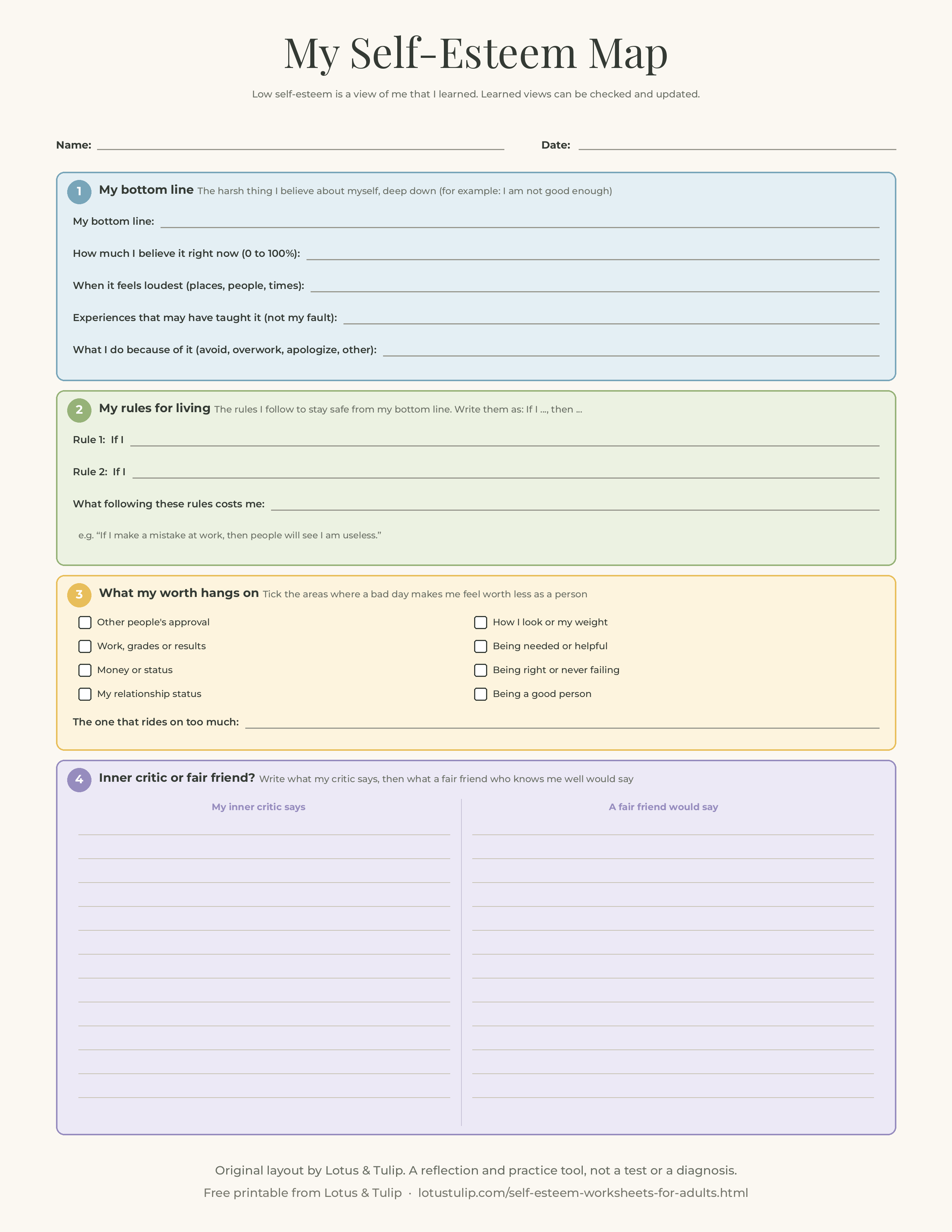
The free worksheet follows this structure: map the bottom line and the rules on page 1, then build and test a fairer view on page 2.
What the research shows
Low self-esteem is a risk factor for depression, not only a symptom. Sowislo and Orth (2013) meta-analyzed longitudinal studies, 77 on depression and 18 on anxiety. Low self-esteem predicted later depression (beta = -.16) more strongly than depression predicted later self-esteem (beta = -.08). For anxiety, the effects in each direction were about equal (-.10 and -.08). These are modest, correlational effects, but they support taking self-esteem seriously in therapy.
Self-esteem tends to grow through adulthood. In a meta-analysis of 331 longitudinal samples with 164,868 participants, Orth, Erol and Luciano (2018) found that average self-esteem rose strongly from adolescence to age 30, kept rising until about 60, stayed level until about 70 and then declined. Feeling worse about yourself in your twenties than you will later is common, not a personal failing.
CBT for low self-esteem has the best support. Kolubinski and colleagues (2018) reviewed CBT programs based on Fennell's model. Across five studies of weekly individual or group sessions, self-esteem improved with a large effect (Hedges' g = 1.12), and depression fell by a similar amount. One day workshops showed a smaller effect (g = 0.34). The studies were few, all from the UK, with high dropout, little follow-up data and weak controls, so the true effect is likely smaller. A broader meta-analysis of 119 studies of self-esteem interventions for adults (Niveau, New and Beaudoin, 2021) found a small to moderate overall effect (d = 0.38), with CBT among the most effective approaches, while repeated self-statements had too little evidence to support them.
Positive affirmations can backfire. In experiments by Wood, Perunovic and Lee (2009), people with low self-esteem who repeated "I'm a lovable person" felt worse afterwards, while people with high self-esteem felt only slightly better. A statement that clashes with what you believe tends to remind you of all the reasons it is not true. This is why the worksheet asks for a fairer view and real evidence, not a slogan.
The fair criticism. Baumeister, Campbell, Krueger and Vohs (2003) reviewed the self-esteem movement and found that high self-esteem is strongly linked with happiness and with persistence after failure, but does not reliably cause better school or job performance or better relationships, and they found no evidence that programs to boost self-esteem caused those benefits. Crocker and Park (2004) argued that chasing self-esteem can itself be costly when your worth hangs on approval, looks or success (Crocker and Wolfe, 2001, called these contingencies of self-worth). Neff and Vonk (2009), in a study of 2,187 people, found self-compassion predicted more stable feelings of self-worth than self-esteem did. The practical lesson: aim for a fair and steady view of yourself, not a high score.
The honest caveat. There is no trial of this worksheet. It is a structure for work that has support (CBT on core beliefs and rules, behavioral experiments and self-compassion practice), and it works best alongside a therapist or a structured self help program.
How to use self-esteem worksheets for adults, step by step
- Name the bottom line. On page 1, write the harsh sentence you believe about yourself in your own words, and rate how much you believe it from 0 to 100%. Rating it makes change visible later.
- Look at where it came from, without blame. Note experiences that may have taught the belief. The point is understanding, not finding fault with you or anyone else: a belief that made sense then may not fit now.
- Spell out your rules for living. Write two rules as "If I ..., then ...". Then write what following them costs you: time, rest, honesty, opportunities.
- Find what your worth hangs on. Tick the areas where a bad day makes you feel worth less as a person, such as approval, looks, work results or being needed. Circle the one that carries too much weight.
- Answer the inner critic fairly. Write what the critic says, then what a fair friend who knows you well would say. Fair means honest about mistakes too, not only kind.
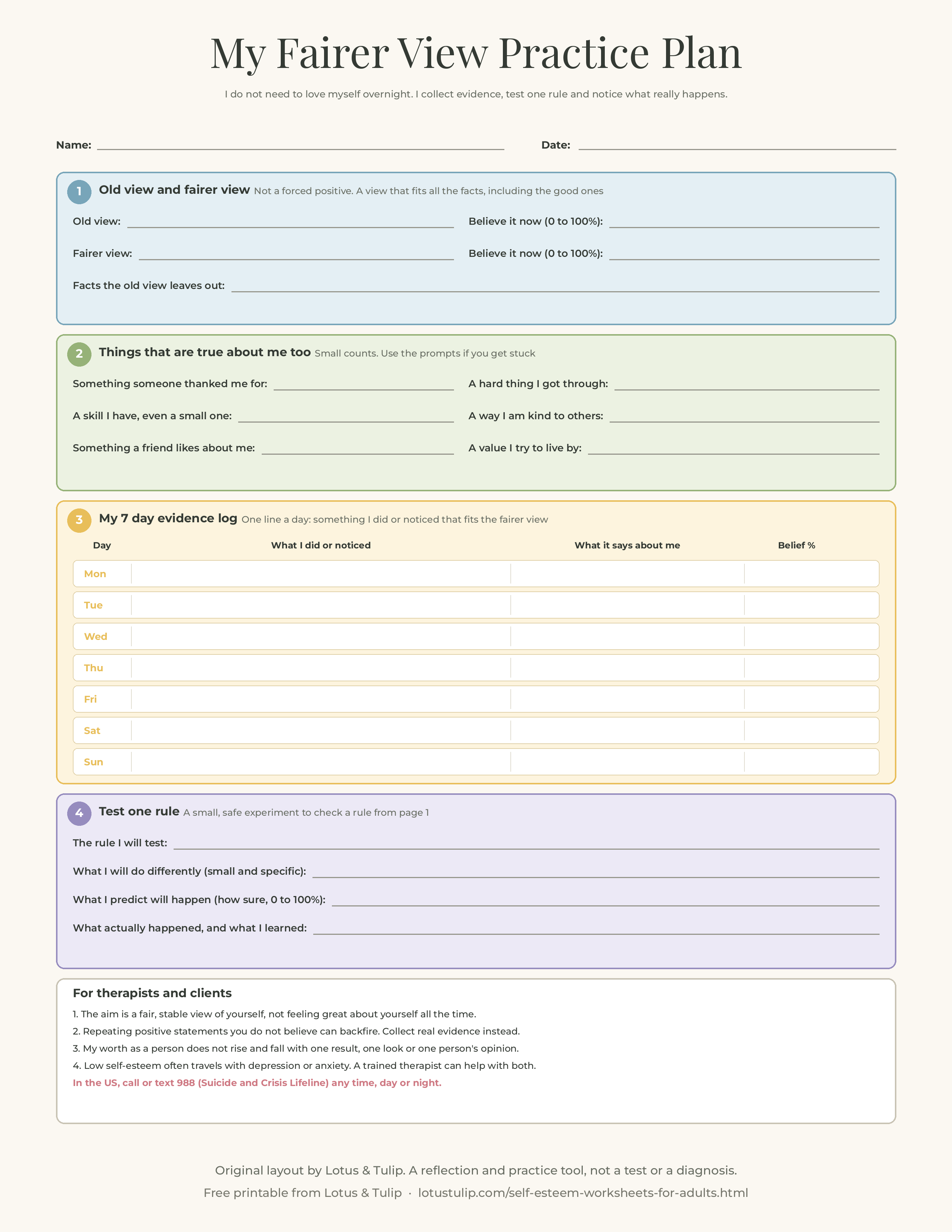
- Write a fairer view. On page 2, write an alternative view that fits all the facts, for example "I am a capable person who sometimes makes mistakes", and rate how much you believe it. A low number at first is normal.
- List things that are also true. Use the prompts: something someone thanked you for, a hard thing you got through, a value you live by. Small and ordinary counts.
- Keep a 7 day evidence log. Each day, write one thing you did or noticed that fits the fairer view, what it says about you, and your belief rating. Low self-esteem filters out this evidence; the log catches it.
- Test one rule. Plan a small, safe experiment that bends a rule, for example sending an email without checking it four times. Write your prediction, do it, then record what actually happened and what you learned.
For more on deep beliefs, see the core beliefs worksheet, and for testing predictions, the behavioral experiment worksheet.
Common mistakes
- Reaching for affirmations. Repeating statements you do not believe can make low self-esteem feel worse. Build belief through evidence and action instead.
- Arguing the critic down with praise. "You are amazing" will not stick. A fair, specific answer ("I missed one deadline this month and met eleven") is easier to believe.
- Making worth depend on a new achievement. "I will like myself once I get promoted" just swaps one contingency for another. The goal is worth that does not ride on any single result.
- Skipping the behavior change. Insight alone rarely shifts a bottom line. Small experiments that break the rules are where belief ratings usually move.
- Missing depression. If low self-esteem comes with persistent low mood, loss of interest or hopelessness, treat the depression too, and ask directly about thoughts of suicide.
Examples
- Work: Bottom line: "I am not good enough." Rule: "If I ask a question, people will think I am incompetent." Experiment: asked one question in the team meeting. Predicted 80% that someone would look annoyed; actually a colleague said she had the same question. Belief in the fairer view: 20% to 35%.
- Relationships: Bottom line: "I am unlovable." Rule: "I must always agree or they will leave." Evidence log: told my partner I preferred a different restaurant; we went there and had a good evening. Linked page: the people pleasing worksheet.
- Appearance: Worth hanging on: looks and weight. Critic: "Everyone noticed how I looked." Fair friend: "Most people were focused on themselves. My friends invited me because they like my company." Experiment: went to the dinner without changing outfits three times.
Free self-esteem worksheets for adults
This free printable is an original Lotus & Tulip layout on US Letter, in our own wording. Page 1, My Self-Esteem Map, has space for the bottom line with a belief rating, where it feels loudest and where it may have come from, two rules for living with their costs, a checklist of what your worth hangs on, and an inner critic or fair friend column. Page 2, My Fairer View Practice Plan, has the old view and a fairer view with belief ratings, six prompts for things that are also true about you, a 7 day evidence log, a one rule experiment and notes for therapists and clients, including the US 988 crisis line.
Download the free self-esteem worksheets for adults (PDF, 2 pages, US Letter)
Prefer single images? Page 1: my self-esteem map (PNG) · Page 2: my fairer view practice plan (PNG)
Free to print for use with your own clients or for yourself. Please link to this page rather than re-uploading the file. A reflection tool, not a test, a diagnosis or a substitute for therapy. In the US, call or text 988 in a crisis.
Related resources
- Character strengths worksheet for adults: a fairer view starts with real strengths, with a free strengths map and plan
- Body image worksheet for adults: when the "not good enough" feeling centers on your body, with a free body image map and plan
- Jealousy worksheet for adults: when comparison turns into envy, with a free jealousy and envy plan
- Perfectionism worksheet for adults: when worth rides on flawless results, with a free good enough practice plan
- Impostor syndrome worksheet: when success still feels like luck, with a free evidence file and practice plan
- Emotional neglect worksheet: when feelings went unnoticed growing up, with a free feelings and needs log
- Core beliefs worksheet: identifying and changing "I am not good enough" with the downward arrow
- Self compassion worksheet: a kinder and steadier way to relate to yourself
- Shame vs guilt worksheet: when a mistake turns into "I am bad"
- People pleasing worksheet: when your worth hangs on approval
- Self-esteem worksheets for kids: the version for younger clients
FAQ
What are self-esteem worksheets for adults?
They are structured pages that help adults look at how they judge themselves, find the beliefs and rules behind low self-esteem and practice a fairer view. Good ones are based on CBT: they ask for evidence and small experiments rather than repeating affirmations.
What causes low self-esteem in adults?
Usually a mix of temperament and experience: criticism, bullying, neglect, loss, discrimination or long periods of stress can leave a harsh belief about the self. Depression and anxiety can also lower it. It is learned, which means it can change.
Do positive affirmations help self-esteem?
Not reliably. In experiments, people with low self-esteem who repeated "I'm a lovable person" felt worse, not better. Writing a fairer, believable view and collecting real evidence for it tends to work better.
What therapy works best for low self-esteem?
Cognitive behavioral therapy has the strongest evidence. Programs based on Fennell's model showed large improvements in small studies, and a 2021 meta-analysis of 119 studies found CBT among the most effective approaches. Self-compassion work is a promising addition.
How long does it take to improve self-esteem?
There is no fixed timeline. Belief ratings often move a little with regular practice, but a long held bottom line usually changes gradually, which is why CBT programs for low self-esteem run over a series of weekly sessions rather than a single workshop.
Are these self-esteem worksheets free?
Yes. They are free to print for use with your own clients or for yourself. Please link to this page rather than re-uploading the file.
Sources
- Baumeister, R. F., Campbell, J. D., Krueger, J. I., and Vohs, K. D. (2003). Does high self-esteem cause better performance, interpersonal success, happiness, or healthier lifestyles? Psychological Science in the Public Interest, 4(1), 1 to 44.
- Crocker, J., and Park, L. E. (2004). The costly pursuit of self-esteem. Psychological Bulletin, 130(3), 392 to 414.
- Crocker, J., and Wolfe, C. T. (2001). Contingencies of self-worth. Psychological Review, 108(3), 593 to 623.
- Fennell, M. J. V. (1997). Low self-esteem: A cognitive perspective. Behavioural and Cognitive Psychotherapy, 25(1), 1 to 26.
- Kolubinski, D. C., Frings, D., Nikčević, A. V., Lawrence, J. A., and Spada, M. M. (2018). A systematic review and meta-analysis of CBT interventions based on the Fennell model of low self-esteem. Psychiatry Research, 267, 296 to 305.
- Neff, K. D., and Vonk, R. (2009). Self-compassion versus global self-esteem: Two different ways of relating to oneself. Journal of Personality, 77(1), 23 to 50.
- Niveau, N., New, B., and Beaudoin, M. (2021). Self-esteem interventions in adults: A systematic review and meta-analysis. Journal of Research in Personality, 94, 104131.
- Orth, U., Erol, R. Y., and Luciano, E. C. (2018). Development of self-esteem from age 4 to 94 years: A meta-analysis of longitudinal studies. Psychological Bulletin, 144(10), 1045 to 1080.
- Rosenberg, M. (1965). Society and the Adolescent Self-Image. Princeton University Press.
- Sowislo, J. F., and Orth, U. (2013). Does low self-esteem predict depression and anxiety? A meta-analysis of longitudinal studies. Psychological Bulletin, 139(1), 213 to 240.
- Wood, J. V., Perunovic, W. Q. E., and Lee, J. W. (2009). Positive self-statements: Power for some, peril for others. Psychological Science, 20(7), 860 to 866.