
Kids and teens · School counseling · Updated 2026-11-03
I statements worksheet: how to teach I statements to kids and teens, with examples and a free printable
Ready-made printable: Anger Management Small Group Curriculum for School Counselors Holiday 20% off: about $11.04, was $14 (EUR 12) · instant digital download
Buy on Etsy
"You never listen!" and "I feel frustrated when I get interrupted, because I lose my idea" can describe the same moment. The first one usually starts an argument. The second one gives the other person something they can actually respond to. That second sentence is an I statement, and it is one of the most useful communication skills a child, a teenager or an adult can learn. This guide is for school counselors, teachers, child and family therapists and parents. It covers what an I statement is and where the idea comes from, what the research says, a simple four part formula, dozens of examples for kids, teens and adults, how to teach I statements step by step, activities for classrooms and small groups, and the mistakes that turn an I statement back into blame. It ends with a free three page printable: an I statement builder, 12 practice cards that turn you statements into I statements, and a planner for a real conversation.
Jump to the free I statements worksheet
What is an I statement?
An I statement is a way to say how you feel and what you need from your own point of view, without blaming the other person. It usually starts with "I" and describes three things: your feeling, the specific thing that happened, and why it matters to you. Many versions add a fourth part: what you would like to happen next.
A you statement does the opposite. It focuses on the other person and often carries a judgment: "You're so rude", "You always take my stuff", "You made me mad". Even when the complaint is fair, the listener tends to hear an attack and defend themselves, so the real problem never gets solved.
Notice that starting a sentence with "I" is not enough. "I feel like you are being selfish" is still a you statement in disguise, because the part after "I feel like" is a judgment of the other person, not a feeling. A true I statement names a feeling word (frustrated, hurt, worried) and describes behavior the way a video camera would record it.
Where I statements come from
The term is usually credited to psychologist Thomas Gordon, who described "I-messages" in the 1960s and made them widely known in his book P.E.T.: Parent Effectiveness Training (1970). Gordon contrasted I-messages with "you-messages" that blame, and described a confrontive I-message with three parts: a non-blameful description of the behavior, its tangible effect on the speaker, and the speaker's feeling. Gordon Training International still teaches it with the memory aid "behavior, effect, feeling", and notes that the order of the parts matters less than including all three.
Since then I statements have become a standard part of social and emotional learning, conflict resolution programs, assertiveness training, DBT style interpersonal skills and couples therapy. In the CASEL framework that many US schools use for SEL, they fit under relationship skills: communicating clearly, resolving conflict constructively and seeking or offering help.
Do I statements actually work?
There is useful, if modest, research. Psychologist Edward Kubany and colleagues ran two studies published in 1992. In one, published in the journal Aggressive Behavior, 40 undergraduate women imagined discussing an important problem with a close partner and rated their likely reactions to different statements. In the other, high school boys and girls did the same. In both studies, accusatory you statements were rated as more aversive and drew more negative reactions than assertive I statements. In the study with undergraduates, statements that named anger also drew more negative reactions than statements that named distress, such as feeling hurt or worried.
That second finding is practical: "I feel hurt when..." tends to land more softly than "I feel angry when...", even though both are honest. It does not mean children should hide anger. It means it often helps to look under the anger for the feeling beneath it, the same idea the anger iceberg worksheet teaches.
Be honest with students about the limits too. These studies measured how people expected to react, not real conflicts, and an I statement does not guarantee the other person will agree. What it does is make a calm conversation more likely and give the speaker a script for a moment when words are hard to find.
The I statement formula
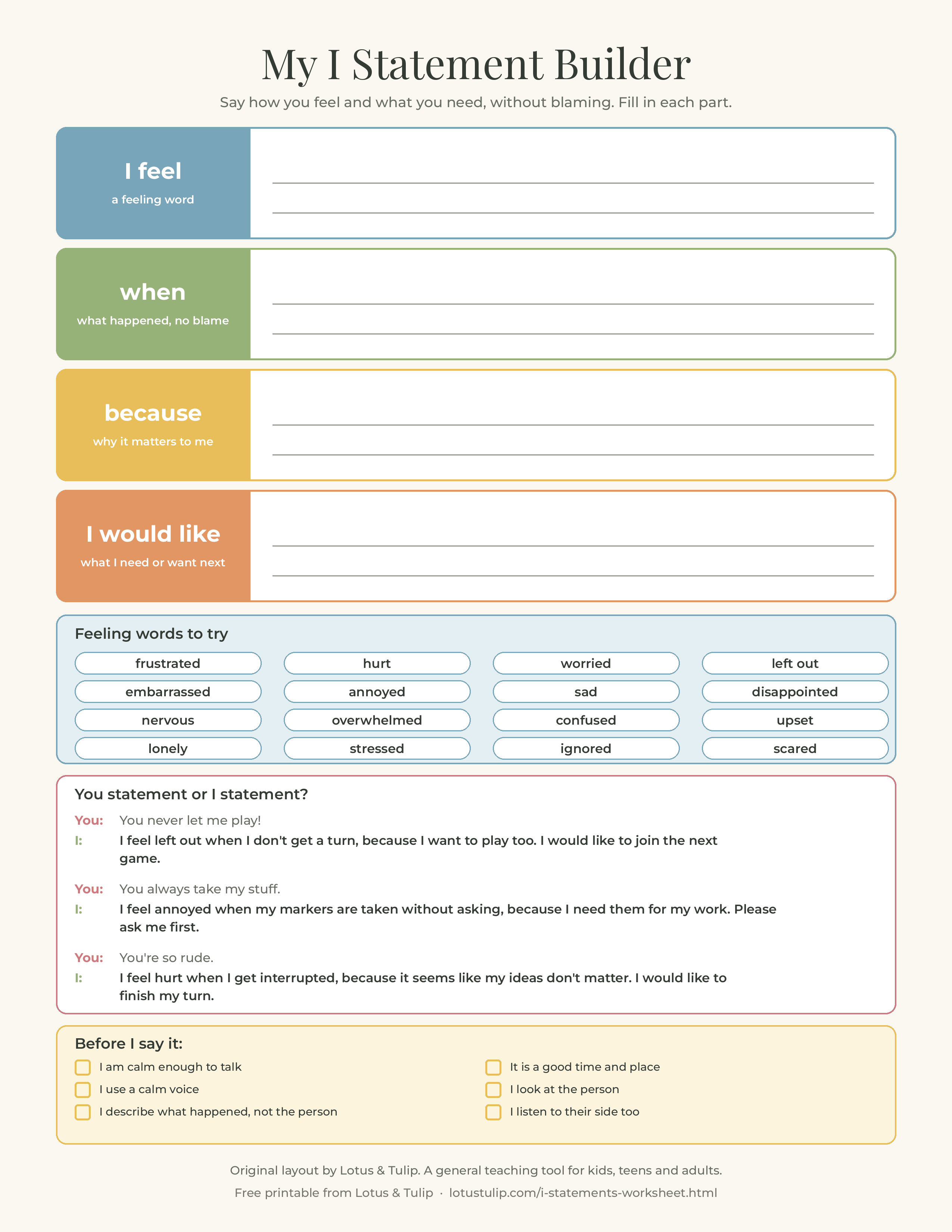
The simplest frame to teach, and the one on the free printable, has four parts:
- I feel (a feeling word: frustrated, hurt, worried, left out)
- when (what happened, described without blame)
- because (why it matters to me, the effect on me)
- I would like (what I need or want next)
Put together: "I feel left out when I don't get a turn, because I want to play too. I would like to join the next game."
For kindergarten and first grade, start with just two parts, "I feel ___ when ___", and add "because" and "I would like" once that is easy. For couples and adults, the Gottman Institute teaches a closely related "gentle start-up": "I feel (emotion) about (a specific situation), and I need (a positive need)." The positive need is the key: ask for what you want, not for what you want the other person to stop.
I statement examples for kids
- You statement: "You cheated!" I statement: "I feel upset when the rules change in the middle of the game, because then it doesn't feel fair. I would like us to agree on the rules first."
- You statement: "You took my seat!" I statement: "I feel frustrated when someone sits in my seat, because I need to be near the board. Could you move to the empty chair?"
- You statement: "You never let me play!" I statement: "I feel left out when I don't get a turn, because I want to play too. I would like to join the next round."
- You statement: "You ruined my drawing." I statement: "I feel sad when my picture gets torn, because I worked hard on it. Please ask before you touch my things."
- You statement: "You're bugging me!" I statement: "I feel distracted when my chair gets kicked, because I can't finish my work. Please stop kicking my chair."
- You statement: "You told on me!" I statement: "I feel embarrassed when you tell the class about my mistake, because I wanted to fix it myself. I would like you to talk to me first next time."
I statement examples for teens
- "I feel hurt when I see photos from a hangout I wasn't invited to, because I thought we were close. I would like to be included next time, or at least to talk about it."
- "I feel ignored when my texts go unanswered for days, because I start to worry something is wrong. Can you let me know if you're busy?"
- "I feel stressed when we're assigned the whole project the night before it's due, because I don't have time to do my part well. I would like us to split the work this weekend."
- "I feel embarrassed when my private messages are shared in the group chat, because I trusted you with them. I need you to delete it and keep our chats between us."
- To a parent: "I feel frustrated when my curfew changes at the last minute, because I've already made plans. I would like us to agree on the curfew before the weekend."
I statement examples for adults and couples
- "I feel overwhelmed when the dishes are left until morning, because I start the day behind. I would like us to take turns each night."
- "I feel worried when you get home late without a text, because I don't know if you're safe. I need a quick message if plans change."
- "I feel discouraged when my ideas are interrupted in meetings, because I lose my point. I would like to finish before we discuss it."
- "I feel lonely when our evenings are spent on our phones, because I miss talking with you. I would love one phone free dinner a week."
In couples work these scripts pair well with active listening: the partner repeats back what they heard before responding. The couples therapy worksheets include a page on saying it with I statements.
How to teach I statements, step by step
- Start with feeling words. Children cannot say "I feel frustrated" if they only know mad, sad and happy. Build a feelings vocabulary first with a feelings wheel or the feeling word bank on page 1 of the printable.
- Show the difference between you and I statements. Say the same complaint both ways in two voices and ask students how each one would make them feel if they heard it. Most can tell the difference immediately.
- Teach the four part frame. Write I feel, when, because and I would like on the board or use the builder on page 1. Point out that the "when" part describes what happened, not what kind of person someone is.
- Model it with your own small problems. Use real, low stakes examples: "I feel frustrated when the markers are left without caps, because they dry out. I would like everyone to click the caps on." Hearing adults use the frame makes it normal.
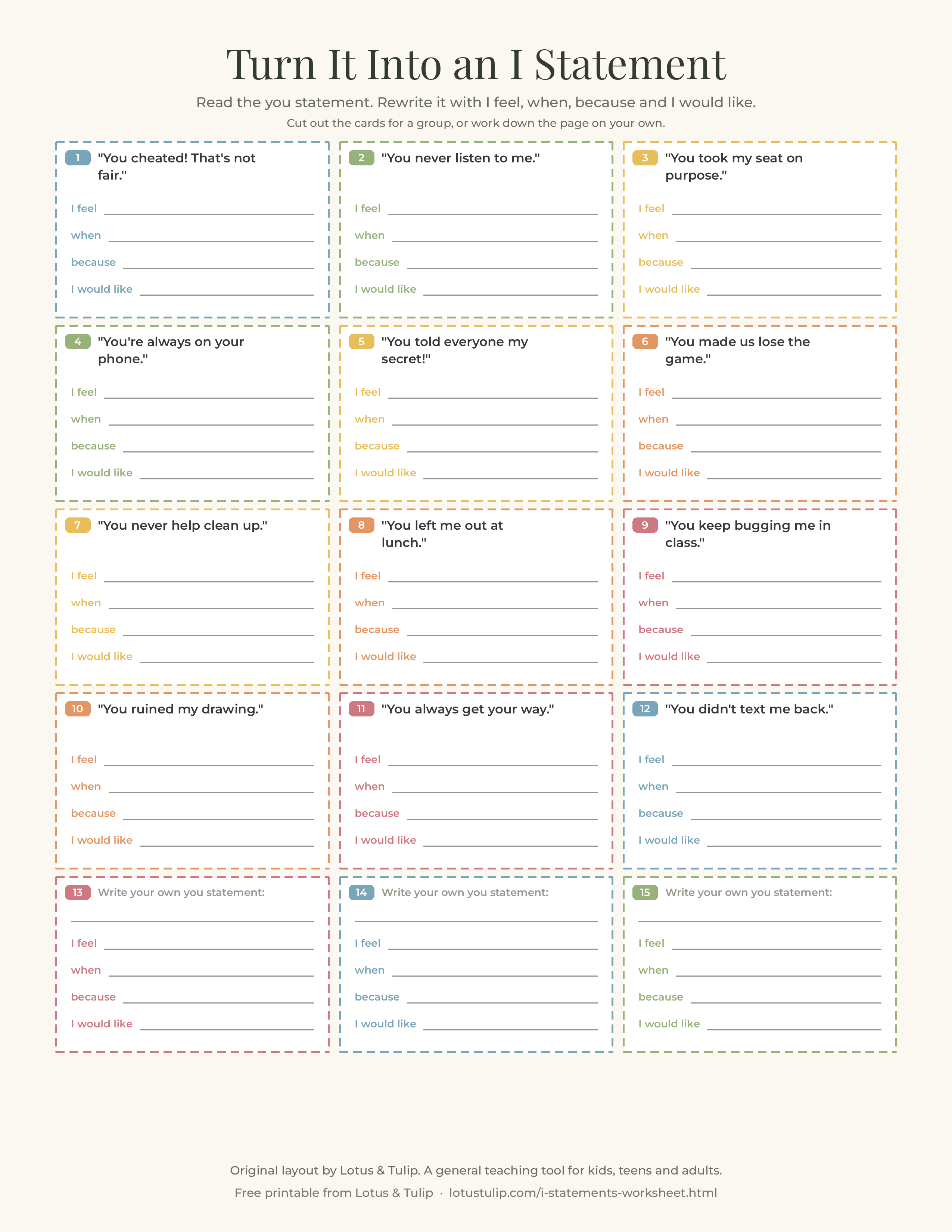
- Practice turning you statements into I statements. Use the 12 practice cards on page 2. Students rewrite each one alone or in pairs, then read their versions aloud.
- Role play with a partner. One student reads an I statement and the other practices listening and responding calmly. Swap roles. Add tone of voice and body language, since a calm sentence said in a sneer is not an I statement.
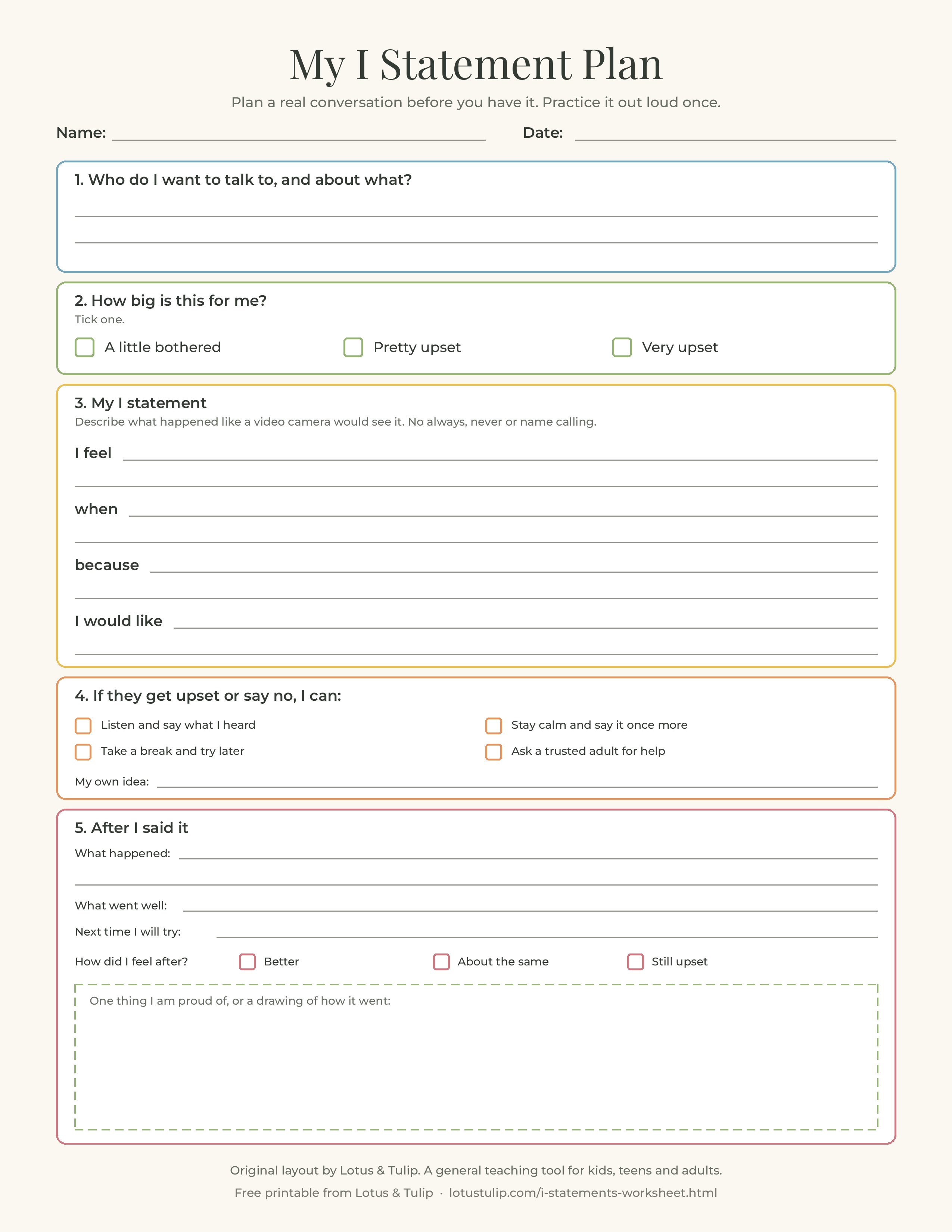
- Plan a real conversation. When a student has a real conflict, use the planner on page 3 to prepare. Check first that they are calm enough to talk and that the problem is safe to handle with a peer.
- Practice in the moment, briefly. When a you statement slips out, prompt quietly: "Can you try that as an I statement?" Do it after the student has calmed down, not in the middle of a meltdown.
- Reflect and praise effort. Afterwards, talk about what happened and notice the attempt, even if the other person did not respond well. The skill is saying it clearly, not controlling the reply.
When I statements are not the right tool
- Bullying, harm or danger. A child who is being bullied, threatened or hurt should not be told to solve it with an I statement. They should tell a trusted adult, and adults need to act. I statements are for everyday conflicts between people with roughly equal power.
- When someone is too upset. Big feelings come first. Use a calm down strategy before any talk; the calm down corner steps and the coping skills list for kids can help.
- As a forced apology script. Making a child recite an I statement on command teaches the words without the meaning. Offer it as a tool, not a punishment.
- As a guarantee. The other person may still say no. Teach students what to do next: listen to their side, say it once more calmly, take a break or ask an adult for help.
I statement activities for the classroom and small groups
- Two voices. Read a you statement in a harsh voice and an I statement in a calm voice. Students hold up a thumbs up or down for which one they would want to hear.
- Card sort and rewrite. Cut out the practice cards. Groups sort them by how often the situation happens at school, then rewrite three each.
- Fill the frame. Give only the "when" part ("when someone cuts in line") and have students add the feeling, the because and the request.
- Spot the disguise. Mix true I statements with fakes like "I feel like you're mean". Students find the fakes and fix them.
- Puppet or picture book practice. For younger children, puppets act out a conflict and students coach the puppet to use an I statement.
- Exit ticket. Each student writes one I statement they could use this week.
In a small group, I statements fit naturally into a unit on friendships, anger or conflict. They are session 7 of our anger management group, session 6 of the girls friendship group and session 4 of the middle school friendship group (links below).
Using I statements at home
Parents can use the same frame with their children, which is exactly how Gordon first taught it: "I feel worried when the bike is left in the driveway, because a car could hit it. I would like it in the garage." Post the four parts on the fridge, model them during small frustrations, and invite children to use them with siblings. When a sibling fight starts, ask each child for one I statement before anyone decides who is right.
Common mistakes
- "I feel like you..." This is a judgment, not a feeling. Ask: what is the one feeling word?
- Always and never. "When you always..." is blame again. Describe one specific time.
- Name calling in the "when" part. "When you're a jerk" describes a person, not a behavior.
- No request. Without "I would like", the listener knows you are upset but not what would help.
- Wrong tone. Sarcasm or a raised voice cancels the words.
- Teaching it only during conflict. Practice on calm days so the words are ready when they are needed.
Free I statements worksheet (printable PDF)
This free printable is an original Lotus & Tulip design, sized for US Letter paper. It has three pages:
- Page 1: I statement builder. The four part frame (I feel, when, because, I would like) with space to write, 16 feeling words, three you statement and I statement examples, and a six point checklist for before you say it.
- Page 2: practice cards. 12 numbered you statements from everyday school and friendship situations to rewrite as I statements, plus 3 blank cards to write your own.
- Page 3: my I statement plan. Who and what, how big it feels, my I statement, what I can do if they get upset or say no, and a reflection on how it went.
Download the free I statements worksheet (PDF, 3 pages, US Letter)
Prefer single images? Page 1: I statement builder (PNG) · Page 2: 12 practice cards and 3 blanks (PNG) · Page 3: I statement plan (PNG)
Free to print for use with your own students, clients or children. Please link to this page rather than re-uploading the file. A general teaching tool, not a substitute for individual counseling or a safety plan.
Related resources
- Size of the problem worksheet (free printable)
- DEAR MAN worksheet, DBT scripts for asking and saying no (free printable)
- Healthy boundaries worksheet (free printable)
- Anger iceberg worksheet (free printable)
- Feelings wheel printable for kids
- Daily check in for students (free weekly sheet)
FAQ
What is an I statement?
An I statement is a way to express a feeling and a need from your own point of view without blaming the other person, for example "I feel frustrated when I get interrupted, because I lose my idea. I would like to finish my turn." It names a feeling, the specific behavior, why it matters and, often, a request.
What is the I statement formula?
A common four part formula is: I feel (feeling word) when (what happened, without blame) because (why it matters to me), and I would like (what I need next). Younger children can start with just "I feel ___ when ___".
Who invented I statements?
The idea is usually credited to psychologist Thomas Gordon, who described "I-messages" in the 1960s and popularized them in his 1970 book P.E.T.: Parent Effectiveness Training.
What is the difference between an I statement and a you statement?
A you statement focuses on the other person and often blames or labels them, such as "You never listen." An I statement focuses on your own feeling and need, such as "I feel ignored when I'm talking and you look at your phone, because I want to share something important." In studies by Kubany and colleagues (1992), people rated accusatory you statements as more aversive than assertive I statements.
What age can kids learn I statements?
Many kindergarten and first grade students can use a simple "I feel ___ when ___" frame with adult support. The full four part frame works well from about second or third grade through high school and for adults.
Is "I feel like you are ignoring me" an I statement?
Not really. "I feel like you..." introduces a judgment about the other person, not a feeling. A true I statement would be "I feel hurt when my question isn't answered, because I need help with it."
Is this I statements worksheet free?
Yes. It is free to print for use with your own students, clients or children. Please link to this page rather than re-uploading the file.