
Therapist worksheets · DBT emotion regulation · Updated 2026-11-05
Check the Facts Worksheet: The DBT Skill Explained, with Steps, Examples and a Free Printable
Ready-made printable: DBT Worksheets for Therapists Fillable PDF, 20 pages: weekly diary card, chain analysis, pros and cons, crisis survival plan and 0 to 10 suffering scales
Holiday 20% off: about $11.04, was $14 (EUR 12) · instant digital download
Try it free first: download a fillable sample (weekly diary card and checking the facts, PDF, 234 KB). Type into it on screen, then get the full pack. No email needed.

An emotion rises fast. Your chest tightens, your mind fills in a story, and before you have checked what actually happened, you are already answering a text you have not received, cancelling a plan, or rehearsing a fight. In Dialectical Behavior Therapy (DBT), that jump from event to story is one of the main reasons emotions get bigger than the situation. The skill for slowing that jump down is called Check the Facts.
This guide is for therapists, counselors, DBT skills group leaders, and teens or adults learning emotion regulation. It explains what Check the Facts is in Linehan's Emotion Regulation materials, when to use it and when not to, the steps in plain language, adult and teen worked examples, how it differs from a CBT thought record and from opposite action, common mistakes, an honest look at the research, safety notes, and a free three page printable: a Check the Facts Worksheet, a Steps Card, and a Practice Log.
Jump to the free Check the Facts worksheets (PDF) · See worked examples
What Check the Facts is in DBT
Check the Facts is an emotion regulation skill in DBT, the treatment developed by psychologist Marsha Linehan. In the second edition of DBT Skills Training Handouts and Worksheets (Guilford Press, 2015), it appears as Emotion Regulation Handout 8, with the matching practice page as Emotion Regulation Worksheet 5. A companion handout, Emotion Regulation Handout 8a, gives examples of emotions that fit the facts. The skill sits in the section on changing emotional responses, right next to opposite action and problem solving.
The core idea is simple and easy to miss when feelings are loud: many emotions and actions are set off by our thoughts and interpretations of events, not by the events themselves. An email that says "Can we talk?" is a fact. "I'm about to get fired" is an interpretation. Fear that fits the interpretation may not fit the facts. Checking the facts means separating what you observed through your senses from what your mind added, weighing the evidence, trying other interpretations, and then asking whether the emotion and its intensity match what is really going on.
Check the Facts is not about talking yourself out of every feeling. It is about making sure the feeling you are about to act on is keyed to reality. When the emotion fits, you may still need problem solving, opposite action for effectiveness, or mindfulness of current emotion. When it does not fit, changing the interpretation (or acting opposite to the urge) is often the path that brings the intensity down.
When to use Check the Facts (and when not to)
Use Check the Facts when:
- An emotion feels intense and you suspect your mind has filled in gaps.
- You notice absolute language, mind reading, fortune telling, or catastrophe stories ("they hate me," "this always happens," "it will be a disaster").
- You are about to act on an urge (send the message, cancel, withdraw, attack) and want a pause.
- You are teaching clients how to decide between opposite action and problem solving. Checking the facts is the first fork in that decision path.
Do not use Check the Facts as a way to invalidate real pain:
- Valid grief. After a real loss, sadness fits. Checking the facts does not mean arguing someone out of mourning. It can still help when the mind adds secondary stories ("I will never feel anything again," "this means I am broken").
- Anger at real injustice. If someone was harmed, mistreated, or blocked from an important goal, anger can fit. The skill then asks whether the intensity and the action urge are effective, not whether the person should feel nothing.
- Useful fear. Fear of a real threat calls for safety planning and action, not reinterpretation.
- Trauma reminders. Gently check interpretations, but do not push clients to "prove" that a trauma response is wrong. Pair the skill with grounding, pacing, and a solid therapeutic relationship.
A practical rule: Check the Facts clarifies the map. It does not erase the weather. If the map shows a real problem, use problem solving or an effective action. If the map shows a misread, use opposite action or change the thought to fit the facts. Our opposite action worksheet and distress tolerance worksheets cover the next moves.
The Check the Facts steps in plain language
Linehan's Handout 8 lays out a questioning sequence. Here is the same sequence in everyday clinical language, close to how most skills groups teach it.
- Ask: what emotion do I want to change, and how strong is it? Name it specifically (anxious, ashamed, furious, jealous) and rate intensity from 0 to 100. Vague labels like "bad" or "upset" make the rest of the skill harder. Emotion Regulation Handout 6 (Ways of Describing Emotions) helps here.
- Ask: what is the prompting event? Describe only what you observed through your senses. What did you see, hear, or read? Challenge judgments, absolutes, and black and white wording. "She glared at me" may need to become "She looked toward me and her eyebrows were down." Mindfulness "what" skills (observe and describe) support this step.
- Ask: what are my interpretations, thoughts, and assumptions about the event? Write the story your mind told. Include assumptions about other people's motives. Then generate other possible interpretations. Practice looking at more than one side.
- Ask: am I assuming a threat? Label the threat clearly. How likely is it, really? List other possible outcomes. Anxious minds often treat a low probability catastrophe as if it were already happening.
- Ask: what is the catastrophe I am fearing? Imagine the worst case briefly, then imagine coping with it (problem solving, cope ahead, or radical acceptance). Catastrophe thinking often shrinks when you rehearse a coping response instead of only the disaster.
- Ask: what is the evidence for and against my interpretation? List facts that support it and facts that challenge it. Prefer observations over feelings-as-evidence ("I feel rejected, so I must be rejected" is circular).
- Ask: what are other possible interpretations? Force at least two alternatives, even if they feel less sticky than the first story.
- Ask: does my emotion, and its intensity, fit the actual facts? Check Emotion Regulation Handout 8a style prompts for each emotion (fear fits threat, anger fits blocked goals or attack, sadness fits loss, and so on). Ask Wise Mind. Intensity matters: mild annoyance may fit a late reply; rage usually does not.
- Choose the next skill. If the emotion fits and acting on it helps, problem solve or act effectively. If it fits but acting on the urge would make things worse, consider opposite action for effectiveness. If it does not fit, change the thought to fit the facts and/or use opposite action. If you need to ride the wave without changing anything yet, use mindfulness of current emotion.
Our free printable compresses this into a fill in worksheet, a one page steps card, and a practice log so clients can rehearse the sequence between sessions.
Worked examples
Adult example: the vague work message
Jordan is 38 and works in project management. At 4:40 p.m. their manager sends: "Can we talk tomorrow morning?" Jordan's chest tightens. Intensity of anxiety: 85. The mind story: "I'm being put on a performance plan. They've been disappointed. I'll lose this job."
- Prompting event (facts): One Slack message with seven words. No other information yet.
- Interpretations: Job threat, hidden criticism, imminent failure.
- Threat assumed: Being fired or put on a plan. Probability if they check past patterns: the manager often sends short scheduling messages. Last three "can we talk" notes were about a client deliverable, a birthday coverage swap, and praise for a launch.
- Evidence for: The message is short. Jordan made one small error last week.
- Evidence against: Recent positive feedback in writing. No prior performance conversations. Manager's style is always brief. Error last week was corrected and acknowledged.
- Other interpretations: Scheduling a routine check in. Asking for help on a deadline. Sharing news that is neutral or good.
- Does anxiety at 85 fit? Mild alertness fits uncertainty. Panic level intensity does not fit the known facts.
- Next skill: Change the thought to "I do not know yet; I will ask a clarifying question." Opposite action for the urge to spiral: stop refreshing Slack, prepare two calm questions for tomorrow, and finish the current task. Intensity after: 40.
Jordan still felt uneasy. Checking the facts did not create fake calm. It stopped an 85 from driving a resignation fantasy and a sleepless night.
Teen example: the group chat silence
Maya is 16. She sends a photo to a group chat of three friends. Twenty minutes pass with no reply. Emotion: shame and fear of rejection. Intensity: 80. Story: "They are laughing at me. They never really liked me. I should leave the chat."
- Prompting event: Photo sent. No replies yet. Phone shows they were online earlier today.
- Interpretations: Rejection, mockery, confirmation that she does not belong.
- Threat: Social exclusion. Likelihood based on history: these friends replied slowly many times before when they were in class or at practice.
- Evidence for: Delay feels long. One friend left her on read last month once.
- Evidence against: They invited her to sit together at lunch yesterday. They replied warmly to her last three messages, just not instantly. School is in session.
- Other interpretations: Phones in lockers. Someone typing a longer reply. The photo is fine and they are busy.
- Fit: A little worry about silence can fit teenage social life. Shame at 80, and the urge to leave the chat, do not fit the facts she has.
- Next skill: Opposite action for shame (stay visible, do not hide): keep the chat open, put the phone face down for 30 minutes, text one friend later if needed with a light follow up, not an accusation. Intensity after practice: 45.
Teens often need help separating "I feel rejected" from "I have evidence of rejection." Check the Facts gives them a shared language for that without demanding toxic positivity.
How Check the Facts differs from related skills
- CBT thought records. A classic thought record asks for the situation, automatic thought, emotion, evidence for and against, and a balanced alternative thought. Check the Facts overlaps on evidence and alternative interpretations, but it is explicitly tied to DBT emotion theory: does this emotion and this intensity fit the facts for this emotion's prompting event? It also feeds a clear next skill choice (problem solving vs opposite action). See our CBT thought record worksheet and cognitive distortions worksheet when you want the CBT frame.
- Opposite action. Opposite action changes what you do when the emotion does not fit, or when acting on it would not help. Check the Facts is often the step that tells you whether opposite action is the right tool. Link: opposite action worksheet.
- Wise Mind. Wise Mind is the DBT stance that integrates emotion mind and reasonable mind. Clients often "ask Wise Mind" at the fit question. Link: wise mind worksheet.
- Cognitive defusion (ACT). Defusion changes your relationship to a thought ("I'm having the thought that...") without requiring a new interpretation. Check the Facts evaluates content and fit. Many clients use both: defuse enough to get space, then check the facts. Link: cognitive defusion worksheet.
- PLEASE skills. PLEASE reduces vulnerability so fewer false alarms fire. A sleep deprived, hungry client will check the facts less accurately. Link: DBT PLEASE skills worksheet.
- Distress tolerance. When intensity is too high to think clearly, TIPP, STOP, or self soothe first, then Check the Facts. Link: distress tolerance worksheets.
- Core beliefs. Recurring Check the Facts themes ("I am unlovable," "I always fail") may point to deeper beliefs that need longer CBT or schema work. Link: core beliefs worksheet.
How to teach Check the Facts, step by step
- Validate first. Before any fact checking, name that the emotion makes sense given the story the client is living inside. Checking the facts after invalidation feels like an argument.
- Teach the event to thought to emotion chain. Draw Event → Thoughts → Emotions (and the reverse Emotion → Thoughts loop). Clients need to see why thoughts matter without being told their feelings are fake.
- Practice on a low stakes example first. Use a neutral classroom or work vignette before a trauma memory or a fight with a partner.
- Separate observe from describe from interpret. Spend real time on the prompting event line. Most failures of the skill happen here, when judgments sneak in as "facts."
- Rate intensity before and after. Without ratings, clients cannot see change. Use 0 to 100.
- Generate at least two alternative interpretations. One alternative is easy to dismiss. Two forces flexibility.
- Teach the fit question with Handout 8a style cues. Fear fits threat, anger fits blocked goals or attack, sadness fits loss, shame fits rejection risk or values violation, and so on.
- Map the next skill explicitly. End every practice with: problem solving, opposite action, mindfulness of emotion, or cope ahead. Do not leave clients in analysis.
- Assign between session practice with the log. Review logs in the next session. Look for repeated themes, skipped intensity ratings, and moments where fact checking became rumination.
What "fits the facts" means for common emotions
Handout 8a style cues are one of the most useful teaching aids in the emotion regulation module. Clients do better when they know what each emotion is for, not only how it feels. Use these as starting points, then customize.
- Fear / anxiety fits when there is a real threat to life, health, safety, or wellbeing (yours or someone you care about). Intensity should match the size and nearness of the threat.
- Anger fits when an important goal is blocked, or you or someone you care about is attacked, insulted, or treated unfairly. Proportional anger fits a real slight; rage at a tiny slight usually does not.
- Sadness fits after loss, disappointment, or when things are not as you hoped. Secondary hopeless stories ("nothing will ever be good again") often do not fit even when the sadness does.
- Shame fits when a personal characteristic or behavior would lead to rejection by a valued group if known, or when you have violated your own values. Shame about being human, having needs, or making a repaired mistake often does not fit.
- Guilt fits when you have done something that violates your values or harms someone and repair is owed. Guilt for having feelings, for saying no, or for things outside your control usually does not.
- Envy / jealousy can fit when someone has something you want or when a valued relationship feels threatened. The stories that follow ("I am worthless because they have more," "they are definitely cheating") often need fact checking even when a flicker of the emotion fits.
- Love / caring fits when someone or something is valuable to you. Even warm emotions can be checked when intensity or urges (for example, abandoning your own limits) stop being effective.
Teaching "fits the facts" this way prevents two common errors: treating every strong feeling as a distortion, and treating every strong feeling as a command.
Check the Facts in session: a short script
Here is a condensed script many clinicians adapt. Keep your tone curious, not cross examining.
"Let's slow this down for a minute. What emotion is loudest right now, and from 0 to 100, how strong? What exactly happened, just what you saw or heard? What did your mind say it meant? If we put that interpretation on trial, what evidence supports it, and what evidence challenges it? What are two other ways a fair observer might see the same event? Looking at all of that, does this emotion, at this intensity, fit the facts? If yes, what problem needs solving? If no, what emotion would fit better, and what is the opposite of the urge you have right now?"
Leave silence after each question. Clients often rush to defend the first story. Your job is to hold the structure, not to win the argument. If intensity is above about 80 and thinking is fragmented, pause for TIPP or paced breathing, then return.
For school counselors and skills groups
Check the Facts works well in groups of teens and young adults when you:
- Use a shared vignette first (group chat silence, a coach's short email, a friend canceling plans).
- Write the prompting event on a whiteboard in observe and describe language only, and let the group catch judgments as they appear.
- Have pairs generate alternative interpretations on sticky notes, then sort them into "more likely," "possible," and "unlikely."
- End every round with a next skill vote: problem solving, opposite action, or mindfulness of emotion.
- Send the practice log home with a 10 minute cap so homework does not become late night rumination.
School settings need an extra boundary: this skill is for everyday social and academic stress. Suicidal talk, abuse disclosures, or trauma content should move out of the skills exercise and into the school's risk and referral pathway.
Common mistakes
- Using it to invalidate real pain. "Check the facts" said sharply can sound like "your feelings are wrong." Lead with validation. Distinguish primary emotions that fit from secondary emotions and added stories that do not.
- Checking forever as rumination. Endless evidence lists that never end in a next skill are worry with a worksheet. Set a time limit (10 to 15 minutes) and finish with a decision.
- Skipping intensity. An emotion can fit while its intensity does not. Mild disappointment may fit; despair may not.
- Treating feelings as evidence. "I feel sure they are mad" is not evidence they are mad. Feelings are data about your state, not proof about the other person.
- Only looking for confirming evidence. Require a for column and an against column.
- Jumping to opposite action before checking. Sometimes the emotion fits and problem solving is the better move.
- Using it in a full crisis. When someone is at peak arousal, start with TIPP or STOP, then return to facts.
What the research says (honestly)
DBT as a package has substantial support. Check the Facts is one component skill inside that package. Be precise about what trials show.
- DBT for high suicide risk. Linehan, Korslund, Harned and colleagues (2015, JAMA Psychiatry) randomized 99 women with borderline personality disorder at high risk for suicide to standard DBT, DBT skills training plus case management, or DBT individual therapy without skills training. All three reduced suicide attempts similarly. Conditions that included skills training did better on several other outcomes, including frequency of self harm and depression. That trial supports skills training as part of DBT. It does not isolate Check the Facts.
- Skills use mediates outcomes. Neacsiu, Rizvi and Linehan (2010) found that increases in DBT skills use mediated improvements in suicide attempts, depression, and anger control across pooled trial data. Emotion regulation skills are part of that skills use measure.
- Emotion regulation skills for broader dysregulation. Neacsiu, Eberle, Kramer, Wiesmann and Linehan (2014) found that a DBT skills training group reduced emotion dysregulation and anxiety more than an activities based support group in adults with high emotion dysregulation. Again, this is the skills package, not one handout.
- Related cognitive techniques. Cognitive reappraisal and evidence testing are well studied outside DBT. Check the Facts shares DNA with those methods, but that is not the same as a trial of Handout 8 alone.
What we cannot honestly claim: that a randomized trial has tested Check the Facts by itself as a standalone treatment for any diagnosis. Teach it as a practical, theory grounded skill inside DBT emotion regulation, and measure whether this client gets clearer decisions and more fitting emotional intensity when they use it.
Safety notes and when to get more help
Check the Facts is a thinking and clarifying skill. It is not a crisis intervention and it is not a substitute for therapy.
- In the US, call or text 988 (988 Suicide and Crisis Lifeline), any time.
- Text HOME to 741741 to reach the Crisis Text Line.
- Call 911 if there is immediate danger.
If thoughts of suicide or self harm are present, complete a proper risk assessment and safety plan first. If trauma memories flood the session when you ask about prompting events, slow down, ground, and consider whether exposure based or stage based trauma work needs to come first. For in the moment crisis skills, see our distress tolerance worksheets.
Tips for therapists and group leaders
- Model the skill live: "My mind's first story is X. Other stories are Y and Z. Intensity was 70, now 45."
- Keep Handout 8a style "emotions that fit" cues on the wall or in a binder.
- In groups, practice one shared vignette, then one personal example with privacy boundaries.
- Watch for clients who intellectualize. If they never rate intensity or never pick a next action, the skill has become a debate club.
- Pair with PLEASE homework so clients are less vulnerable to false alarms.
- For teens, shorten the language, use phone and social examples, and keep the practice under 10 minutes.
Free Check the Facts worksheets (PDF)
The free Check the Facts worksheets have three pages in US Letter size, written for teens and adults:
- Page 1: Check the Facts Worksheet. Emotion and intensity, prompting event, interpretations, evidence for and against, other interpretations, does the emotion fit, a fitting emotion if not, and the next skill.
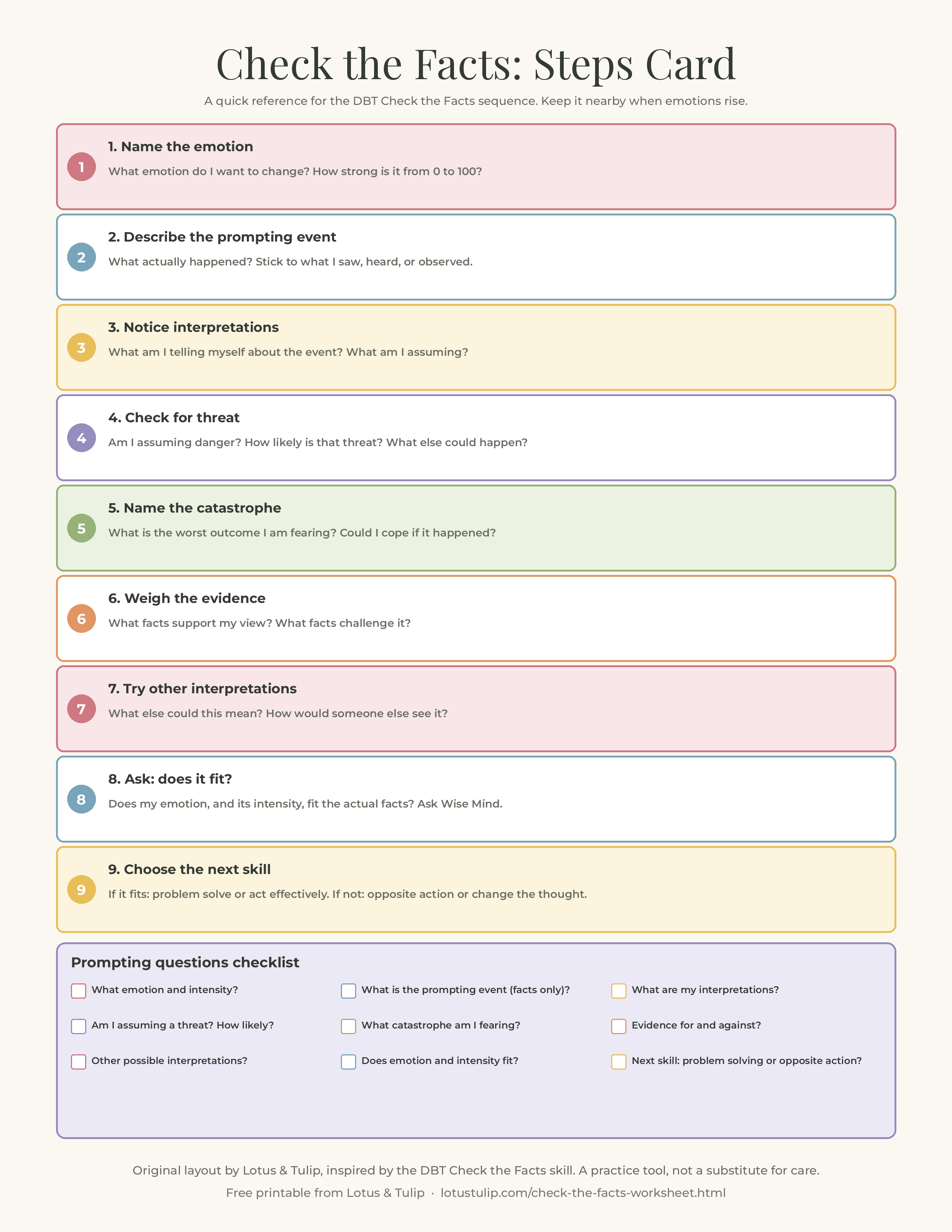
- Page 2: Check the Facts Steps Card. Nine step quick reference plus a prompting questions checklist you can keep on a clipboard or fridge.
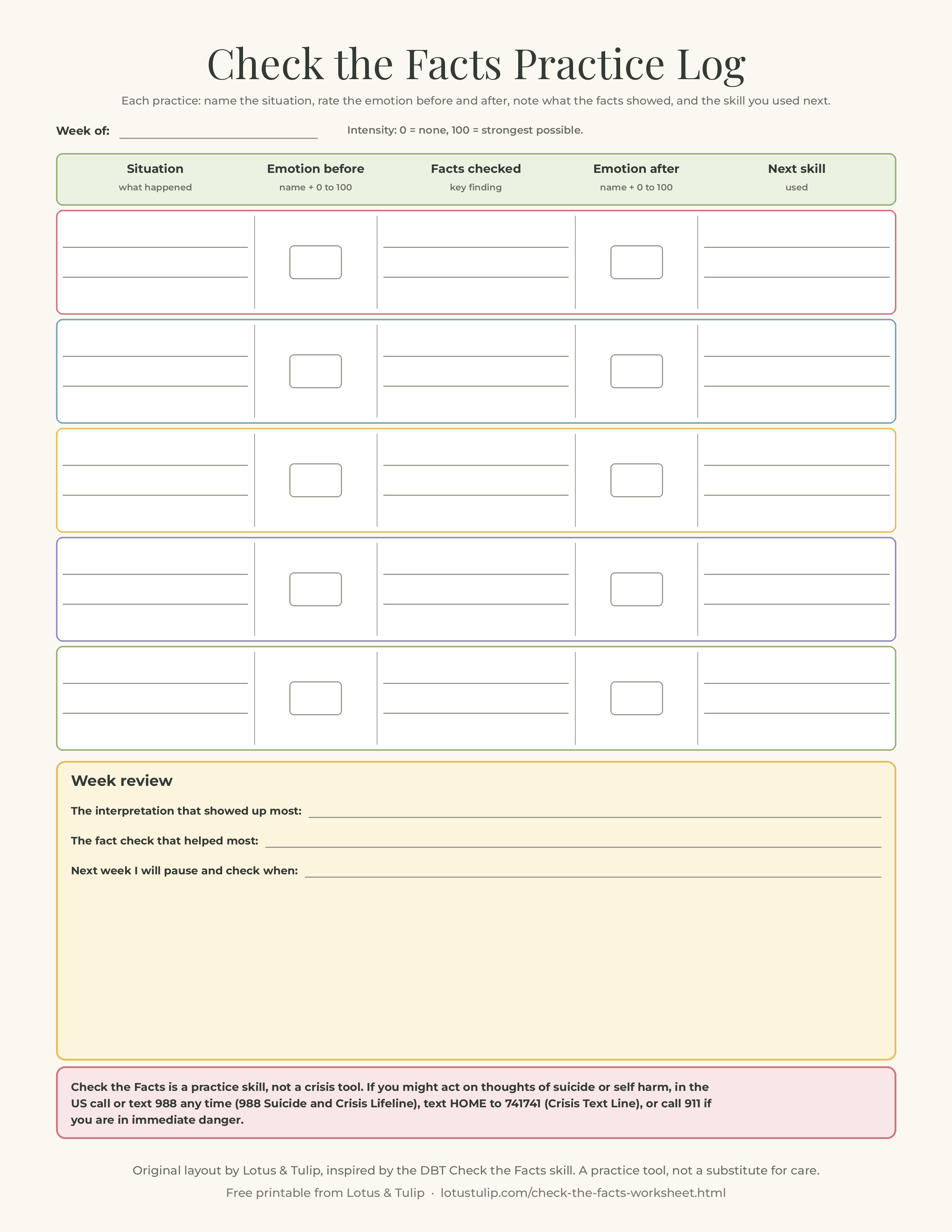
- Page 3: Check the Facts Practice Log. Five practice rows (situation, emotion before, facts checked, emotion after, next skill), a week review, and a crisis line box with 988, the Crisis Text Line, and 911.
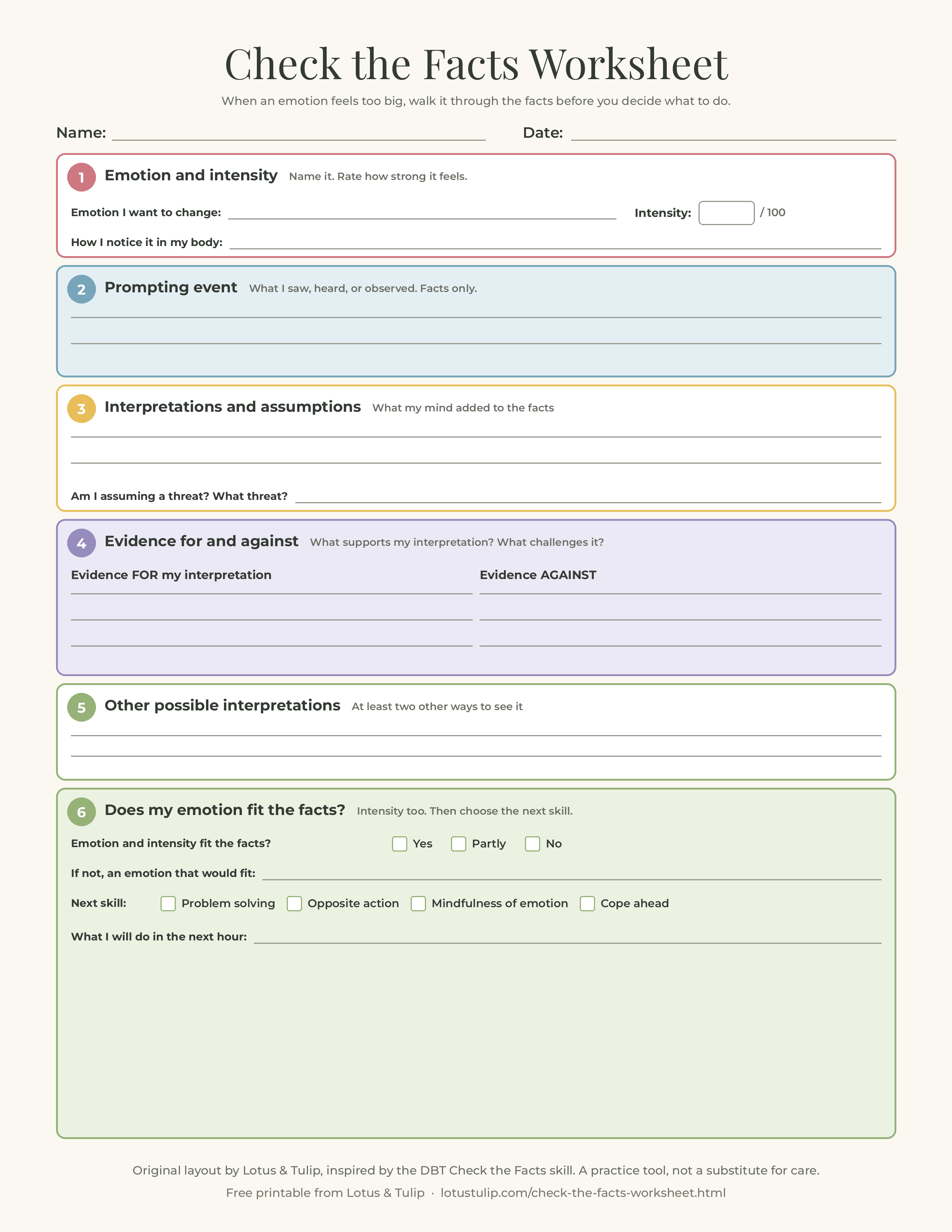
Download the free Check the Facts worksheets (PDF, 3 pages, US Letter)
Prefer single images? Page 1: Check the Facts Worksheet (PNG) · Page 2: Steps Card (PNG) · Page 3: Practice Log (PNG)
Free DBT starter pack for teens: Working with a teen? The free DBT worksheets for teens starter pack adds the teen version of check the facts from our paid DBT set for teens, plus finding my wise mind, ride the emotion wave, a distress tolerance toolkit, a weekly diary card and a safety and care page (8 pages, ages about 13 to 18, client use license, no email).
Free to print for your own use and for use with your own clients or groups. This is an original layout by Lotus & Tulip, inspired by the DBT Check the Facts skill, not a copy of any Linehan handout or worksheet. Please link to this page rather than re-uploading the file.
Related resources
- Jealousy worksheet for adults: checking the facts when jealousy or envy shows up, with a free map and plan.
- Cope ahead worksheet: plan and rehearse a hard situation once the facts are checked.
- Opposite action worksheet: the usual next skill when the emotion does not fit.
- Wise mind worksheet: the stance clients use at the fit question.
- CBT thought record: the CBT cousin of evidence testing.
- Cognitive distortions worksheet: naming the thinking traps that show up in interpretations.
- Cognitive defusion worksheet: ACT tools for sticky thoughts when arguing with content is not helping.
- DBT PLEASE skills worksheet: reducing vulnerability so fact checks stay clearer.
- Distress tolerance worksheets: crisis skills when intensity is too high to think.
- Radical acceptance worksheet: when the facts are painful and cannot be changed right now.
Sources
- Linehan, M. M. (2015). DBT Skills Training Manual, second edition. Guilford Press.
- Linehan, M. M. (2015). DBT Skills Training Handouts and Worksheets, second edition. Guilford Press. Emotion Regulation Handout 8 (Check the Facts), Handout 8a, and Emotion Regulation Worksheet 5.
- Linehan, M. M., Korslund, K. E., Harned, M. S., and colleagues (2015). Dialectical behavior therapy for high suicide risk in individuals with borderline personality disorder: a randomized clinical trial and component analysis. JAMA Psychiatry, 72(5), 475 to 482.
- Neacsiu, A. D., Rizvi, S. L., and Linehan, M. M. (2010). Dialectical behavior therapy skills use as a mediator and outcome of treatment for borderline personality disorder. Behaviour Research and Therapy, 48(9), 832 to 839.
- Neacsiu, A. D., Eberle, J. W., Kramer, R., Wiesmann, T., and Linehan, M. M. (2014). Dialectical behavior therapy skills for transdiagnostic emotion dysregulation: a pilot randomized controlled trial. Behaviour Research and Therapy, 59, 40 to 51.
- 988 Suicide and Crisis Lifeline, 988lifeline.org. Crisis Text Line, crisistextline.org.
Check the Facts: FAQ
What is Check the Facts in DBT?
Check the Facts is a DBT emotion regulation skill (Emotion Regulation Handout 8 in Linehan's 2015 handouts) that helps you separate observed events from interpretations, weigh evidence, try other views, and ask whether your emotion and its intensity fit the actual facts before you choose what to do next.
When should I use Check the Facts?
Use it when an emotion feels intense and may be based on a misread of the situation, or when you need to decide between problem solving and opposite action. Do not use it to talk yourself out of valid grief, justified anger at real injustice, or useful fear of real danger.
What are the steps of Check the Facts?
Name the emotion and intensity, describe the prompting event with facts only, notice interpretations and assumptions, check for assumed threats and feared catastrophes, weigh evidence for and against, generate other interpretations, ask whether the emotion and intensity fit, then choose problem solving, opposite action, or another fitting skill.
How is Check the Facts different from a CBT thought record?
Both use evidence and alternative thoughts. Check the Facts is tied to DBT emotion theory: it asks whether this specific emotion and intensity fit the facts for that emotion, and it points to a next DBT skill (often opposite action or problem solving). Thought records stay inside the CBT restructuring frame.
Does Check the Facts work?
DBT skills training as a package has randomized trial support, and greater skills use has been shown to mediate better outcomes. Check the Facts has not been tested alone as a standalone treatment. Treat it as a well specified component skill inside DBT emotion regulation.
Can teens use Check the Facts?
Yes. Shorten the language, use social and school examples, keep practice brief, and always end with a next action. Shame and rejection fears are common teen targets for this skill.
Can I print the free Check the Facts worksheets for clients?
Yes. The free PDF is an original Lotus & Tulip layout you can print for your own use and for your own clients, students, or groups. Please link to this page instead of re-uploading the file.