
Therapist worksheets · DBT emotion regulation · Updated 2026-11-05
Opposite action worksheet: the DBT skill explained, with examples for every emotion and a free printable
Ready-made printable: DBT Worksheets for Therapists Fillable PDF, 20 pages: weekly diary card, chain analysis, pros and cons, crisis survival plan and 0 to 10 suffering scales
Holiday 20% off: about $11.04, was $14 (EUR 12) · instant digital download
Try it free first: download a fillable sample (weekly diary card and checking the facts, PDF, 234 KB). Type into it on screen, then get the full pack. No email needed.

Every emotion comes with a push. Fear pushes us to get away. Anger pushes us to attack. Sadness pushes us to pull the covers over our head. Most of the time that push is useful, which is why we have it. But when the emotion does not match what is really happening, or when acting on it would make things worse, following the push keeps the feeling alive and often makes it grow. Opposite action is the DBT skill for those moments: you notice the urge, check whether it fits, and then deliberately do the opposite, fully, until the emotion starts to change.
This guide is for therapists, counselors, DBT skills group leaders and clients who are practicing on their own. It explains what opposite action is and where it comes from, the seven steps as Marsha Linehan teaches them, how to decide between opposite action and problem solving, examples for fear, anger, sadness, shame, guilt, disgust, envy, jealousy and love, how to adapt the skill for teens, common mistakes, and what the research does and does not show. At the end there is a free three page opposite action worksheet: an Urge to Opposite Action Chart, an Opposite Action Planner and a Practice Log.
Jump to the free opposite action worksheet · Jump to opposite action examples
What opposite action means in DBT
Opposite action (sometimes written "opposite action to emotion") is one of the emotion regulation skills in dialectical behavior therapy (DBT), the treatment developed by psychologist Marsha Linehan. It rests on a simple observation: emotions and actions feed each other. Every emotion has an action urge attached to it, and acting on that urge tends to send a signal back to the brain that the emotion was right. Run from the thing you fear and the fear is confirmed. Withdraw when you feel low and the low mood deepens. Act the other way, and over time the emotion usually loses strength.
In Linehan's skills materials, opposite action is meant for a specific situation: when an emotion does not fit the facts of the situation, or when acting on it would not be effective for your goals. It is not a tool for pretending to feel fine or for ignoring emotions that are telling you something true. If your fear fits the facts because you are walking alone toward a dangerous situation, the wise move is to listen to the fear, not to march toward the danger. Opposite action is for the fear of a harmless elevator, the shame about something that was not wrong, the anger that has grown far bigger than the event that started it.
Two phrases matter in DBT language:
- Fits the facts. An emotion fits the facts when the situation really contains what that emotion is designed to respond to. Fear fits when there is a real threat to your life, health or wellbeing. Anger fits when an important goal is blocked or you or someone you care about is attacked or treated unfairly. Sadness fits when you have lost something or someone, or things are not what you hoped for. Checking the facts also includes intensity and duration: some irritation may fit a slow driver, while road rage usually does not.
- Effective. Even when an emotion fits, acting on its urge might not help. Anger at a manager may be justified, but shouting in the meeting may cost you the job you need. In that case, acting opposite to the urge in the moment (and solving the problem later) can be the effective choice.
Where opposite action comes from
Linehan first described DBT in her 1993 treatment manual and skills training manual for borderline personality disorder. The current version of the skills, including the opposite action handouts, is in the second edition, DBT Skills Training Manual and the companion DBT Skills Training Handouts and Worksheets (Guilford Press, 2015). In those handouts opposite action sits in the emotion regulation module, in the section on changing emotional responses, next to Check the Facts and Problem Solving.
The idea is not unique to DBT. Opposite action shares its core logic with two of the best supported techniques in behavioral therapy:
- Exposure. In exposure therapy for anxiety, a person repeatedly approaches what they fear, without escaping, until the fear response weakens. Approaching instead of avoiding is exactly the opposite action for fear that does not fit the facts.
- Behavioral activation. In behavioral activation for depression, a person schedules and does valued, active things even when they do not feel like it, instead of withdrawing. Getting active is the opposite action for sadness that has become depression.
Linehan's contribution was to turn that shared principle into one portable skill that works across many emotions, not only fear and sadness, and to pair it with a clear decision process for when to use it. A similar skill appears in the Unified Protocol for transdiagnostic treatment of emotional disorders (Barlow and colleagues), where a module called Countering Emotional Behaviors asks clients to identify emotion driven behaviors and practice alternative actions.
Opposite action vs problem solving: which one to use
Linehan pairs opposite action with problem solving and gives a short decision path for choosing between them. In plain terms:
- Name the emotion and check the facts. Does the emotion, and its intensity, fit the situation?
- If it does not fit the facts, opposite action is usually the skill. Acting on the urge would only feed an emotion that the situation does not call for.
- If it does fit the facts, ask whether acting on the urge would be effective. If yes, act on it, or use problem solving to change the situation that is causing it. If acting on the urge would not be effective, opposite action can still help you get through the moment while you work on the problem.
- Check in with Wise Mind before you act. The Wise Mind worksheet guide explains how to do that.
A simple way to say it to a client: "If the feeling is not matching the facts, change the feeling by changing what you do. If the feeling is matching the facts, change the situation." Many real moments are mixed. A client may be right that a friend let them down (disappointment fits) but wrong that this means nobody will ever care about them (the despair does not fit). They might problem solve the first part and use opposite action for the second.
The 7 steps of opposite action
Linehan's handout lays the skill out in seven steps. Here they are in our own words, with what each one looks like in practice.
- Identify and name the emotion you want to change. Be as precise as you can. "Bad" is hard to work with. "Ashamed," "jealous" or "scared of being judged" gives you something specific to act opposite to. An emotion word list helps, and many clients start with the feelings vocabulary used in emotional regulation work.
- Check the facts. Ask whether the emotion, and its strength, fits the situation. What happened, exactly? What am I assuming? Is there a real threat, a real loss, a real injustice? Is the intensity proportional? If the emotion fits, go to problem solving instead.
- Identify and describe the action urge. What does the emotion want you to do or say? Hide, run, yell, quit, text twenty times, stay in bed, snap at someone, avoid eye contact. Write it down. Urges are easier to resist once they are named.
- Ask Wise Mind: is acting on this urge effective? Would it move you toward what you want? Would you be glad tomorrow that you did it?
- Identify the opposite action. Work out what the urge is pushing you toward, then choose the opposite: approach instead of avoid, be gentle instead of attacking, get active instead of withdrawing, show up instead of hiding.
- Act opposite all the way. This is the step most people skip. Opposite action includes your body, face, voice and thoughts, not just your feet. Approaching a feared situation while clenching, staring at the floor and telling yourself it will be a disaster is only half the skill.
- Repeat until the emotion changes. One try rarely changes an emotion that has been fed for months. The skill works through repetition. Keep going, and track how intense the emotion is before and after.
What "all the way" means
Linehan is clear that a half hearted opposite action does not work well. If you go to the party you were afraid of but stand by the door with your phone out, you are still avoiding. If you "do something nice" for the person you are angry at while sighing and rehearsing your grievances, the anger is still being fed. Acting all the way usually includes several channels at once:
- Behavior. The main action itself: approach, stay, go out, speak up, be kind, step back.
- Body posture. Upright and open for fear and shame, relaxed and unclenched for anger, energized and moving for sadness.
- Face and voice. Eye contact and a steady voice instead of looking away and mumbling. A softer tone instead of a sharp one. DBT also teaches a "half smile" and "willing hands" (palms turned up and relaxed) as ways to soften anger.
- Thoughts. Letting go of the thoughts that keep the emotion going, such as replaying an insult or predicting catastrophe, and turning attention to the present task.
- Breathing. Slow, paced breathing helps the body match the opposite action, especially for fear and anger. The DBT TIPP skills worksheet covers paced breathing in more detail.
"All the way" does not mean faking a feeling. You do not have to feel brave to act brave, and you do not have to feel warm to act gently. You act, and let the feeling catch up.
Opposite action examples for each emotion
Linehan's materials include a detailed handout for each major emotion: when it fits the facts, what its typical urges are, and what opposite action looks like. The examples below follow the same structure and are written fresh. They are a starting point. The best opposite action is always specific to the person and the situation.
Fear and anxiety
Fits the facts when there is a real threat to your life, health, safety or wellbeing, or to someone you care about.
Typical urges: run, avoid, freeze, escape early, ask for reassurance again and again, use safety behaviors.
Opposite action: approach what you fear, again and again. Stay in the situation instead of leaving early. Keep eyes and ears open and take in what is actually happening. Stand or sit in a confident posture, and use slow breathing. Do the thing that makes you feel more in control, such as preparing well.
Example: A client is afraid to speak in team meetings because she expects to be laughed at. The facts: no one has ever laughed at her and her colleagues ask for her input. Opposite action is to say one sentence in the first ten minutes of each meeting, shoulders back, looking at the people she is speaking to, and to stay in the room afterward instead of rushing out. For a full set of approach steps, see the brave steps in our anxiety worksheets guide.
Anger
Fits the facts when an important goal is blocked, you or someone you care about is attacked, hurt, insulted or threatened, or the integrity of your group is under threat.
Typical urges: attack, yell, criticize, slam doors, send the sharp text, ruminate on the injustice.
Opposite action: gently avoid the person you are angry with for a while instead of attacking. Take a time out and breathe slowly. Do something kind, or at least a little nice, instead of something mean. Try to imagine their point of view and what might make their behavior understandable. Unclench your hands and jaw, use willing hands and a half smile, and speak softly. Stop rehearsing the grievance in your head.
Example: A teen is furious because his younger sister borrowed his headphones. Some irritation fits, but the rage he feels, and his urge to break her things, does not. Opposite action is to leave the room, unclench, breathe for a minute, and then ask for the headphones back in a calm voice. If the borrowing keeps happening, that is a problem to solve, for example with a DEAR MAN request or a family rule.
Sadness and depression
Fits the facts when you have lost someone or something important, or things are not the way you wanted or expected them to be.
Typical urges: withdraw, isolate, stay in bed, stop doing things you used to enjoy, give up, dwell on the loss.
Opposite action: get active. Approach rather than avoid. Do things that build a sense of mastery and competence. Schedule pleasant events. Pay attention to the present moment instead of the loss. Use an upright, energized posture and move your body, for example with a walk or other exercise.
Example: A client has been in a low mood for weeks after a move. The urge is to stay home every weekend. Opposite action is a small, scheduled plan: Saturday morning walk to a café, one phone call to a friend, one task finished from the to do list. This is the same principle as behavioral activation, explained in our behavioral activation worksheet guide. Note that grief after a real loss fits the facts; opposite action is not about making a grieving person stop feeling sad, but about not letting withdrawal take over their whole life.
Shame
Fits the facts when you would be rejected by a group you care about if a personal characteristic or behavior were known, or when your behavior goes against your own values.
Typical urges: hide, avoid people, look down, cover up, keep secrets, attack yourself.
Opposite action when shame does not fit: stop hiding. Share the thing you feel ashamed of with people who will not reject you for it. Keep your head up, make eye contact, keep a steady voice. If the behavior does not go against your values, do it openly and repeatedly, for example eating in public or asking a question in class.
When shame does fit: because you really did act against your values, the guilt and shame skills below (repair and commit to change) are the better path. If it fits because a particular group really would reject you, opposite action is not the answer with that group; instead, think carefully about who you share with and look for communities that accept you.
Example: A client feels deep shame about having been in a psychiatric hospital and hides it from everyone. The facts: the close friends she has hinted to have been supportive. Opposite action is to tell one trusted friend in plain words, looking at her, and to notice what happens.
Guilt
Fits the facts when your own behavior went against your values or moral code.
Typical urges: over apologize, punish yourself, avoid the person, try to make up for it again and again.
Opposite action when guilt does not fit: do not apologize or try to make up for something that was not wrong. Change your body posture so you look guilt free (head up, steady voice). If the behavior fits your values, keep doing it.
When guilt does fit: this is a problem solving moment. Own what you did, make a sincere apology, repair the harm where you can, commit to doing differently, and accept the consequences. Then let it go instead of continuing to punish yourself.
Example: A parent feels guilty every time she leaves her toddler with a babysitter to go to work. Her values include providing for her family and her child is safe and well cared for. The guilt does not fit. Opposite action: a warm, short goodbye without lingering or repeated apologies, and a calm walk to the car.
Disgust
Fits the facts when something could contaminate or poison you, or a person's behavior is deeply harmful or offensive in a way that could hurt you or your community.
Typical urges: pull away, push away, avoid contact, look away.
Opposite action when it does not fit: move closer. Eat the food, touch the harmless object, sit near the person. Be kind to the people you feel disgust toward and try to understand them. Breathe in deeply instead of holding your breath.
Example: After one bad stomach bug, a client feels disgust at a whole category of food that is safe and that his family eats every week. Opposite action is to take small, repeated bites at meals, sitting with the family, instead of leaving the table.
Envy
Fits the facts when someone has something you strongly want or need and do not have.
Typical urges: criticize them, take away what they have, compare constantly, scroll their posts over and over.
Opposite action when it does not fit, or when acting on it is not effective: do not try to spoil what the other person has. Count your own blessings and list what you do have. Stop inflating the other person's good fortune and minimizing your own. Avoid the comparison triggers, for example by muting accounts that feed the envy.
Example: A newly qualified therapist feels envy every time a colleague posts about a full caseload. Opposite action is to congratulate the colleague sincerely, mute the feed for a month, and write down three things that went well in her own week.
Jealousy
Fits the facts when a relationship or something very important to you is really at risk of being taken away.
Typical urges: control the other person, check their phone, accuse, follow, demand reassurance.
Opposite action when it does not fit: let go of controlling the other person. Stop spying and checking. Linehan's memorable phrase for this is to "fire your private detective." Relax your body, share your thoughts openly and calmly instead of accusing, and give the other person room.
Example: A teen checks who her boyfriend follows several times an hour. There is no evidence he is losing interest. Opposite action: delete the app from her home screen for the evening, plan something fun with friends, and if worry remains, say it once, kindly, in person.
Love that does not fit
This one surprises people. Love fits the facts when the person or thing enhances your life or the life of people you care about. But sometimes we keep loving someone who harms us, or who is not available.
Typical urges: stay close, contact them, think about them all the time, express love.
Opposite action when it does not fit: stop expressing love to that person, avoid contact and reminders, distract yourself when thoughts arise, and remind yourself of the reasons the love does not fit the facts.
Example: After a breakup from a controlling partner, a client keeps rereading old messages. Opposite action is to archive the messages, block the number for now, and spend the evenings with people who are good for him.
A quick reference: emotion, urge and opposite action
| Emotion | Common urge | Opposite action (when it does not fit the facts) |
|---|---|---|
| Fear | Run, avoid, escape | Approach, stay, eyes open, confident posture |
| Anger | Attack, yell, ruminate | Gently step back, be kind, unclench, soft voice |
| Sadness | Withdraw, stay in bed | Get active, do mastery and pleasant activities |
| Shame | Hide, look down | Share with safe people, head up, eye contact |
| Guilt | Over apologize, self punish | Stop apologizing for what was not wrong |
| Disgust | Push away, avoid | Move closer, breathe in, be kind |
| Envy | Spoil, compare | Count your blessings, stop comparing |
| Jealousy | Control, check, spy | Let go of control, stop checking |
| Love (that harms) | Contact, stay close | Avoid contact and reminders, distract |
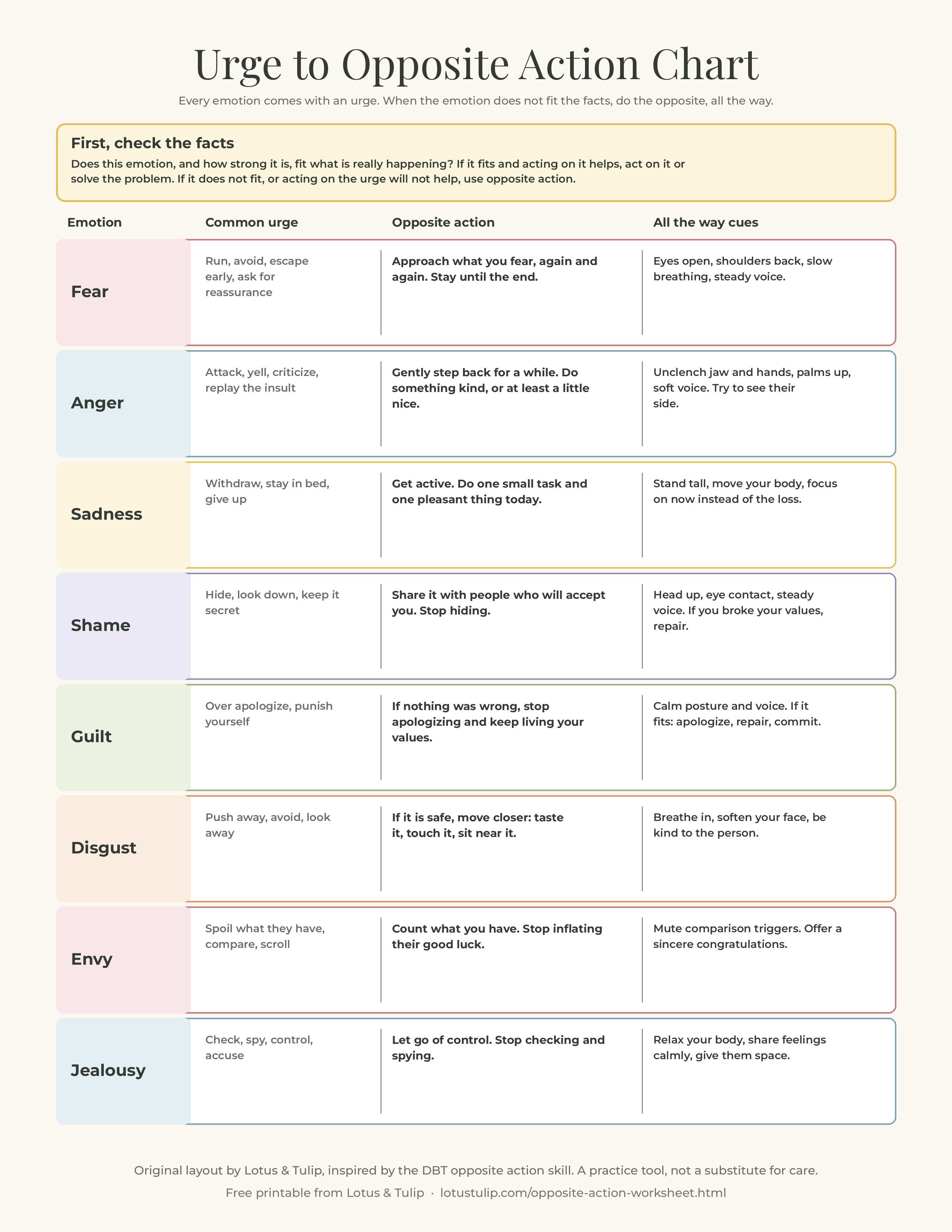
The free printable below includes a fuller version of this chart, with "all the way" body and thought cues for each emotion.
A worked example, start to finish
Here is how one completed opposite action worksheet might read, for a 16 year old client.
- Prompting event: My friend group made weekend plans in a group chat and I saw it after they had decided.
- Emotion and intensity: Hurt and ashamed, 80 out of 100. A bit of anger, 30.
- Check the facts: They made plans at 11 pm when I was asleep. They tagged me in the chat. One friend said "you coming?" I assumed they did not want me there. The shame does not fit the facts. The intensity does not fit either.
- Action urge: Leave the group chat, stay home all weekend, not answer anyone.
- Wise Mind: If I leave the chat, I lose my friends for real. Not effective.
- Opposite action: Reply "yes I'm in!" and go. At the meetup, stand with the group, make eye contact, ask a question, stay for the whole thing.
- All the way: Shoulders back, phone in pocket, remind myself "they tagged me, I am invited."
- After: Hurt and ashamed 25 out of 100. I had fun for most of it.
The before and after rating is not a test of success. Sometimes the emotion drops a lot after one practice, sometimes very little. What matters is the trend across repeated practice, which is why the printable includes a log.
How to teach opposite action, step by step
- Start with the link between emotions and urges. Ask clients to name three strong feelings from the past week and what each one made them want to do. Point out that every emotion came with an urge.
- Explain why acting on the urge keeps the emotion going. Use a simple example, such as avoiding a feared dog making the fear of dogs stronger, and approaching friendly dogs making it weaker.
- Teach Check the Facts first. Opposite action depends on knowing whether the emotion fits. Practice separating facts from interpretations and checking whether the intensity matches the situation.
- Introduce the seven steps. Walk through them with one low intensity example from the client's life, filling in the Opposite Action Planner together.
- Build the opposite action list. Use the Urge to Opposite Action Chart to find the opposite for each emotion the client struggles with most, and personalize the actions.
- Practice "all the way" in session. Role play the opposite action, including posture, face, voice and breathing. Have the client try willing hands or an upright posture and notice any shift.
- Assign real world practice. Agree on one or two specific situations in the coming week where the client will use opposite action, starting with moderate emotions rather than the hardest ones.
- Track intensity before and after. Ask the client to rate the emotion from 0 to 100 before and after each practice on the Practice Log.
- Review and repeat. In the next session, look at the log together, troubleshoot what got in the way, praise effort rather than results, and plan the next round of practice.
Using opposite action with teens
DBT for adolescents (DBT-A) teaches the same emotion regulation skills, including opposite action, in a format adapted for teens and their families. Jill Rathus and Alec Miller's DBT Skills Manual for Adolescents (Guilford, 2015) is the standard reference, with teen friendly handouts and parent involvement built in. The evidence for DBT-A as a whole package is promising: in a randomized trial by Mehlum and colleagues (2014) with 77 adolescents in Norway who had repeated self harm, 19 weeks of DBT-A reduced self harm, suicidal ideation and depressive symptoms more than enhanced usual care.
Some practical adaptations for teens:
- Use their language. "Do the opposite of what the feeling is yelling at you to do" lands better than "act opposite to the action urge."
- Pick relevant situations. Group chats, sports tryouts, sibling fights, speaking in class, a parent's rule that feels unfair.
- Keep the steps short. Many teens do well with a three step version: What am I feeling? Does it fit? What is the opposite? Use the full seven steps once the idea is clear.
- Practice in the room. Teens often respond to a playful role play where they act out the urge and then the opposite, with exaggerated body language.
- Involve caregivers. Parents can coach opposite action at home, but only if they understand it is not about forcing a teen to "just be happy." Share the chart and the reasons behind it.
- Respect the facts. If a teen's anger fits the facts, for example because they are being bullied, the job is problem solving and adult support, not asking them to be nice to the bully. The bullying worksheets guide covers that side.
For broader DBT practice with this age group, see our guide to DBT worksheets for teens.
Common mistakes with opposite action
- Skipping Check the Facts. Opposite action applied to an emotion that fits the facts can be harmful. Approaching real danger, or being "a little nice" to someone who is abusing you, is not the skill. Always check first.
- Doing it halfway. Going to the event but hiding in the bathroom, or being polite through gritted teeth. Include body, face, voice and thoughts.
- Treating it as suppression. Opposite action is not stuffing the feeling down or pretending it is not there. You can name the feeling honestly ("I am scared") while acting opposite to its urge.
- Starting with the hardest emotion. Practice first with moderate emotions, around 30 to 60 out of 100, so the client can build confidence before facing their biggest triggers.
- Expecting one try to fix it. Step 7 is "repeat." Emotions that have been fed by avoidance for a long time need repeated opposite actions.
- Using it in a crisis. At very high intensity, when thinking is hard, start with crisis survival skills such as TIPP, then use opposite action once the emotion has come down a little.
- Using it to dismiss someone else. Opposite action is a skill a person chooses for themselves. Telling a partner or child to "just do opposite action" when they are upset tends to feel invalidating.
What the research says (honestly)
Opposite action is widely taught and makes strong theoretical sense, but it is worth being clear about what has and has not been tested.
- The principle has deep roots. Approaching rather than avoiding feared situations is the core of exposure therapy, and getting active is the core of behavioral activation. Both are among the best supported behavioral treatments for anxiety and depression, and opposite action applies the same logic.
- Direct studies of opposite action alone are small. Rizvi and Linehan (2005) tested opposite action as a stand alone treatment for shame in a pilot study with five women with borderline personality disorder, using a single case multiple baseline design. Shame about a specific event went down over a short course of treatment. This is encouraging, but it is a very small sample.
- A related skill has been tested in a similar way. Sauer-Zavala and colleagues (2020) gave eight adults with borderline personality disorder four sessions of the Unified Protocol's Countering Emotional Behaviors module, which closely resembles opposite action. Most participants meaningfully reduced emotionally avoidant behaviors by follow up, with preliminary signs of improvement in borderline, depression and anxiety symptoms.
- DBT skills training as a package helps. In a component analysis, Linehan and colleagues (2015) randomized 99 women with borderline personality disorder at high risk for suicide to standard DBT, DBT skills training plus case management, or DBT individual therapy without skills training. All three reduced suicide attempts similarly, but the conditions that included skills training did better on several outcomes, including the frequency of self harm and depression. That study tested the whole skills curriculum, not opposite action on its own.
The fair summary: opposite action is a well reasoned skill built on strongly supported behavioral principles, taught inside a treatment with good evidence, but there are only small studies of the skill by itself. Use it as one tool inside a broader plan, and judge it by what happens for each client, which the practice log helps you see.
Safety notes and when to get more help
- Opposite action is not for real danger. If a situation is truly unsafe, the fear fits. Do not use opposite action to stay with or return to someone who is hurting you.
- Trauma related fear needs care. Approaching trauma reminders can be powerful but is best planned with a trained clinician, at a pace the person can handle.
- Self harm urges are not a place to start alone. If urges to harm yourself are part of the picture, work with a DBT trained clinician on a safety plan and crisis skills first.
- Persistent low mood, anxiety or shame that gets in the way of work, school or relationships deserves an assessment from a licensed mental health professional.
In the US, if you or someone you are supporting is thinking about suicide or self harm, call or text 988 (the 988 Suicide and Crisis Lifeline) any time, day or night. You can also text HOME to 741741 to reach the Crisis Text Line. If someone is in immediate danger, call 911.
Tips for therapists and group leaders
- Teach opposite action right after Check the Facts so clients always do the two together.
- Ask each client to build a personal "top three" list of emotions they most want to change and the opposite action for each, and keep it on their phone.
- In groups, model your own small opposite actions: "I felt like skipping my walk this morning because I was tired and flat. I went anyway, and my mood was better after."
- Use diary cards or the printable log to track practice. Review practice before content each session.
- Watch for the "yes, but it fits the facts" debate. Sometimes it does. Validate, then decide together whether problem solving or opposite action is the better tool.
- Link opposite action to the rest of DBT: Wise Mind for deciding, TIPP for very high intensity, DEAR MAN for the interpersonal problem solving that often follows, and the window of tolerance for explaining when a person is too dysregulated to practice.
Free opposite action worksheet (PDF)
The free opposite action worksheet has three pages in US Letter size, written for teens and adults:
- Page 1: Urge to Opposite Action Chart. Eight emotions (fear, anger, sadness, shame, guilt, disgust, envy, jealousy) with the common urge, the opposite action and an "all the way" cue for body, face and thoughts, plus a reminder to check the facts first.
- Page 2: Opposite Action Planner. The seven steps as a fill in page: prompting event, emotion and 0 to 100 intensity, a Check the Facts box, the urge, a Wise Mind effectiveness check, the opposite action plan, an "all the way" checklist and an after rating.
- Page 3: Opposite Action Practice Log. A table for seven practices with before and after ratings, what you did and what you noticed, a weekly review, and a safety note with 988.
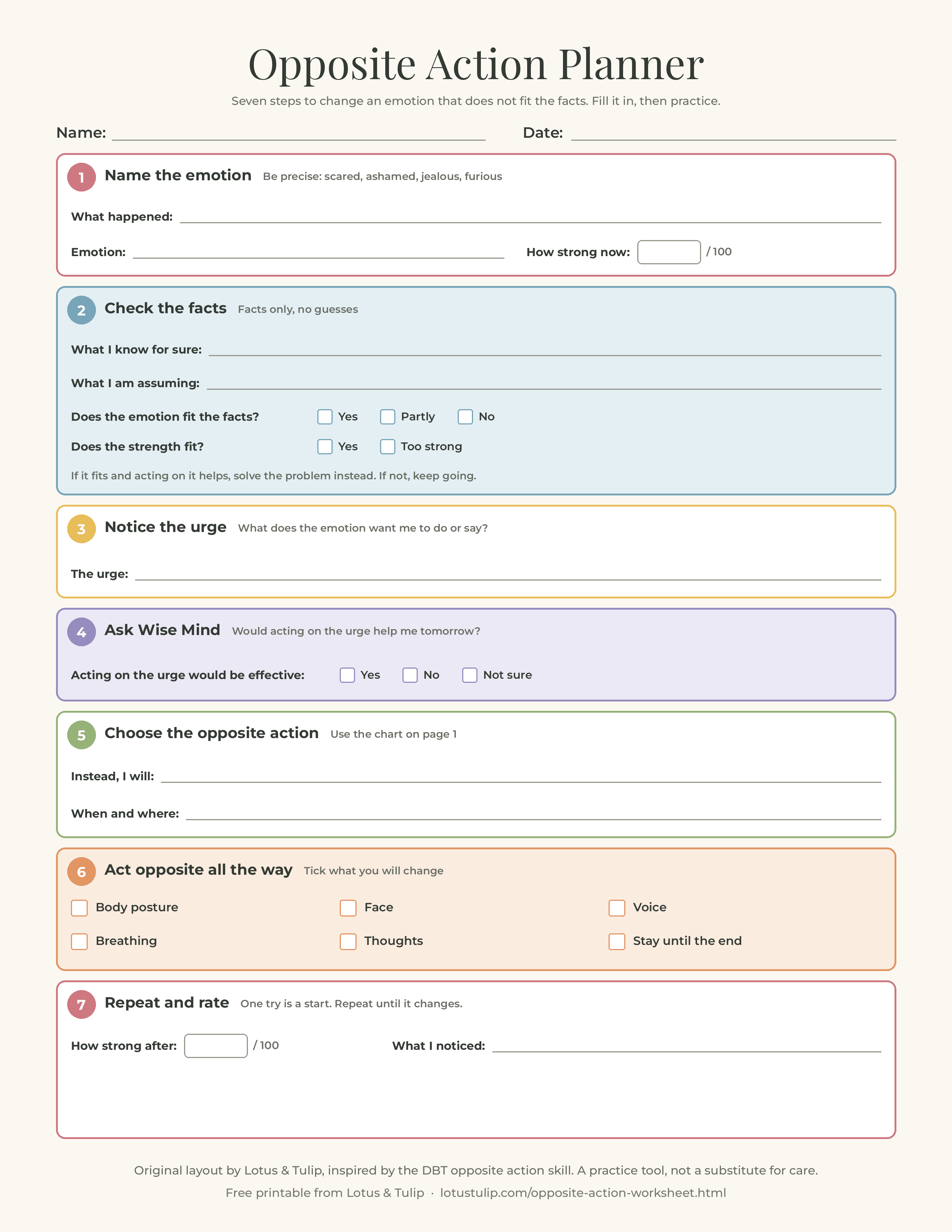
Download the free opposite action worksheet (PDF, 3 pages, US Letter)
Prefer single images? Page 1: Urge to Opposite Action Chart (PNG) · Page 2: Opposite Action Planner (PNG) · Page 3: Practice Log (PNG)
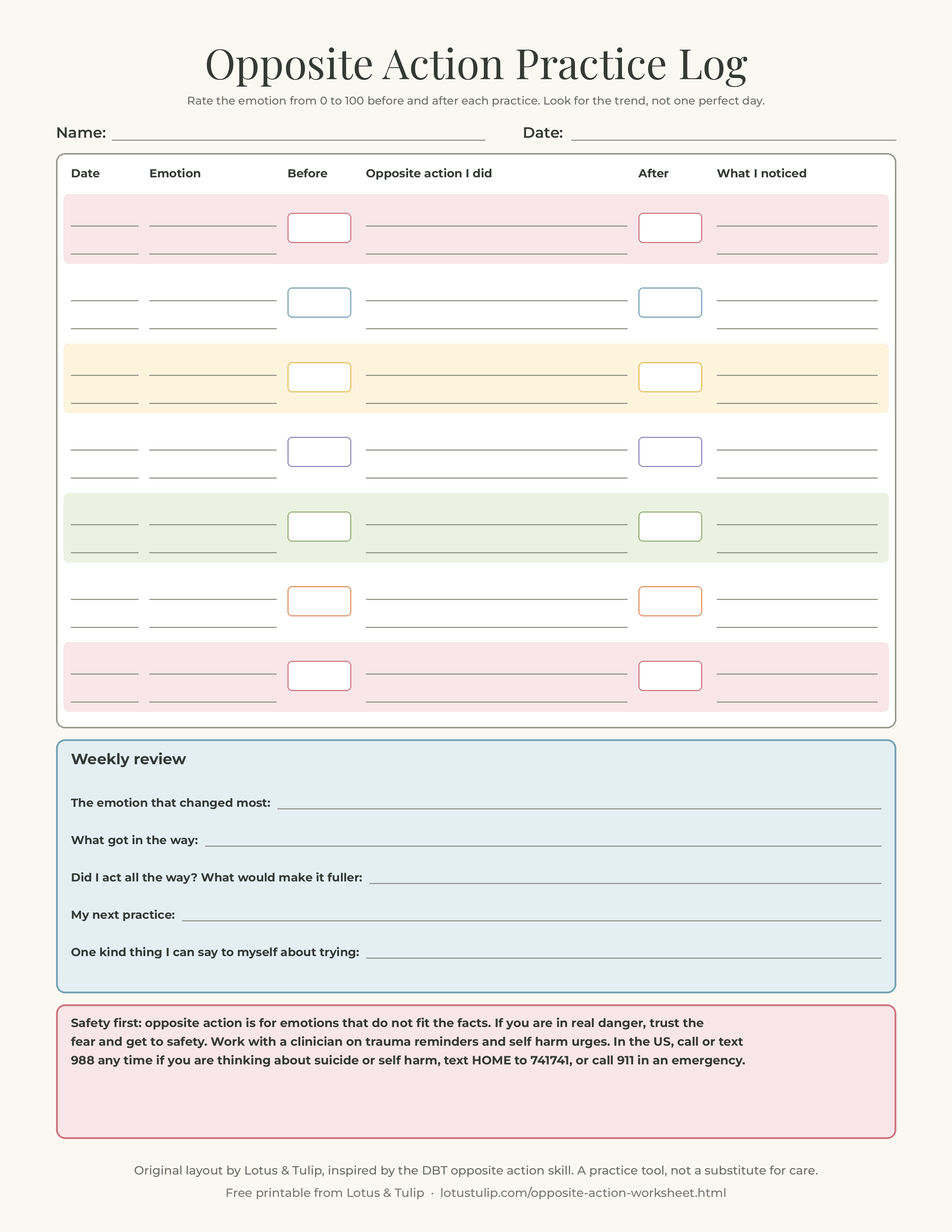
Free to print for your own use and for use with your own clients or groups. This is an original layout by Lotus & Tulip, not a copy of the DBT manual handouts. Please link to this page rather than re-uploading the file.
Related resources
- Jealousy worksheet for adults: jealousy vs envy, check the facts and a free jealousy and envy plan
- Cope ahead worksheet (free printable)
- Wise Mind worksheet (free printable)
- DBT TIPP skills worksheet (free printable)
- DEAR MAN worksheet (free printable)
- Window of tolerance worksheet (free printable)
- Behavioral activation worksheet (free printable)
- Coping skills worksheets for teens (free printable)
- All therapist worksheets: CBT, DBT, ACT and more
Sources
- Linehan, M. M. (2015). DBT Skills Training Manual, second edition. Guilford Press.
- Linehan, M. M. (2015). DBT Skills Training Handouts and Worksheets, second edition. Guilford Press. Emotion Regulation Handouts 9 to 13 and Worksheets 6 and 7.
- Rathus, J. H., and Miller, A. L. (2015). DBT Skills Manual for Adolescents. Guilford Press.
- Rizvi, S. L., and Linehan, M. M. (2005). The treatment of maladaptive shame in borderline personality disorder: a pilot study of "opposite action." Cognitive and Behavioral Practice, 12(4), 437 to 447.
- Linehan, M. M., Korslund, K. E., Harned, M. S., and colleagues (2015). Dialectical behavior therapy for high suicide risk in individuals with borderline personality disorder: a randomized clinical trial and component analysis. JAMA Psychiatry, 72(5), 475 to 482.
- Sauer-Zavala, S., Cassiello-Robbins, C., Woods, B. K., and colleagues (2020). Countering emotional behaviors in the treatment of borderline personality disorder. Personality Disorders: Theory, Research, and Treatment, 11(5), 328 to 338.
- Barlow, D. H., Farchione, T. J., Sauer-Zavala, S., and colleagues (2018). Unified Protocol for Transdiagnostic Treatment of Emotional Disorders: Therapist Guide, second edition. Oxford University Press.
- Mehlum, L., Tormoen, A. J., Ramberg, M., and colleagues (2014). Dialectical behavior therapy for adolescents with repeated suicidal and self-harming behavior: a randomized trial. Journal of the American Academy of Child and Adolescent Psychiatry, 53(10), 1082 to 1091.
- 988 Suicide and Crisis Lifeline, 988lifeline.org. Crisis Text Line, crisistextline.org.
Opposite action worksheet: FAQ
What is opposite action in DBT?
Opposite action is a DBT emotion regulation skill developed by Marsha Linehan. When an emotion does not fit the facts of a situation, or acting on it would not be effective, you identify the action urge that comes with the emotion and deliberately act the opposite way, fully and repeatedly, so the emotion loses strength. For example, approaching instead of avoiding when fear does not fit the facts.
What are the steps of opposite action?
Linehan's version has seven steps: name the emotion, check the facts, identify the action urge, ask Wise Mind whether acting on the urge is effective, identify the opposite action, act opposite all the way (including body, face, voice and thoughts), and repeat until the emotion changes.
What are some examples of opposite action?
For fear that does not fit the facts, approach the feared situation and stay. For anger, gently step back, unclench and do something kind. For sadness, get active and schedule pleasant and mastery activities. For shame that does not fit, share with people who will accept you and keep your head up. For jealousy, stop checking and let go of control.
When should you not use opposite action?
Do not use opposite action when the emotion fits the facts and acting on it is effective, for example fear in a truly dangerous situation. In that case, use problem solving or act on the emotion. Opposite action is also not the first step at crisis level intensity; use crisis survival skills such as TIPP first.
What is the difference between opposite action and problem solving?
Opposite action changes the emotion by changing your behavior, and is mainly used when the emotion does not fit the facts. Problem solving changes the situation causing the emotion, and is used when the emotion does fit the facts. Linehan teaches them together with a short decision process for choosing between them.
Does opposite action work?
Opposite action is based on the same principle as exposure therapy and behavioral activation, which are well supported treatments. Studies of the skill on its own are small, such as a pilot study by Rizvi and Linehan (2005) on shame, while DBT skills training as a whole has stronger evidence. It works best as part of a broader plan, practiced repeatedly.
Is this opposite action worksheet free?
Yes. The three page opposite action worksheet (chart, planner and practice log) is free to print for your own use and for use with your own clients or groups. It is an original Lotus & Tulip layout. Please link to this page rather than re-uploading the file.