
Therapist worksheets · Motivational interviewing · Updated 2026-11-14
Motivational interviewing worksheet: OARS, change talk and how to work with ambivalence step by step (free printable)
Thought records and structured CBT pages for the change plan: CBT Worksheets for Therapists, 20 pages including thought records and core beliefs Holiday 20% off: about $11.04, was $14 (EUR 12) · fillable PDF, instant digital download
Buy on EtsyTry it free first: download a fillable sample (thought record and evidence for and against, PDF, 105 KB). Type into it on screen, then get the full pack. No email needed.
Values and committed action once motivation is there: ACT Worksheets for Therapists, values, defusion and committed action pages Holiday 20% off: about $9.20, was $12 (EUR 10) · fillable PDF, instant digital download
Buy on EtsyTry it free first: download a fillable sample (values compass and unhooking from thoughts, PDF, 259 KB). Type into it on screen, then get the full pack. No email needed.
A full caseload: Therapist Worksheets Mega Bundle (8 packs incl. DBT, CBT, ACT, anxiety, grief and ADHD) Holiday 20% off: about $35.88, was $45 (EUR 39) · fillable PDFs for all 8 packs plus 160 printable pages, instant digital download
Buy on EtsyA client says "I know I should cut back, but..." and you feel the pull to explain, persuade or list the reasons. Most of us have been there. Motivational interviewing (MI) starts from a different place: the person already holds both sides of the argument, and your job is to help them hear their own reasons for change out loud.
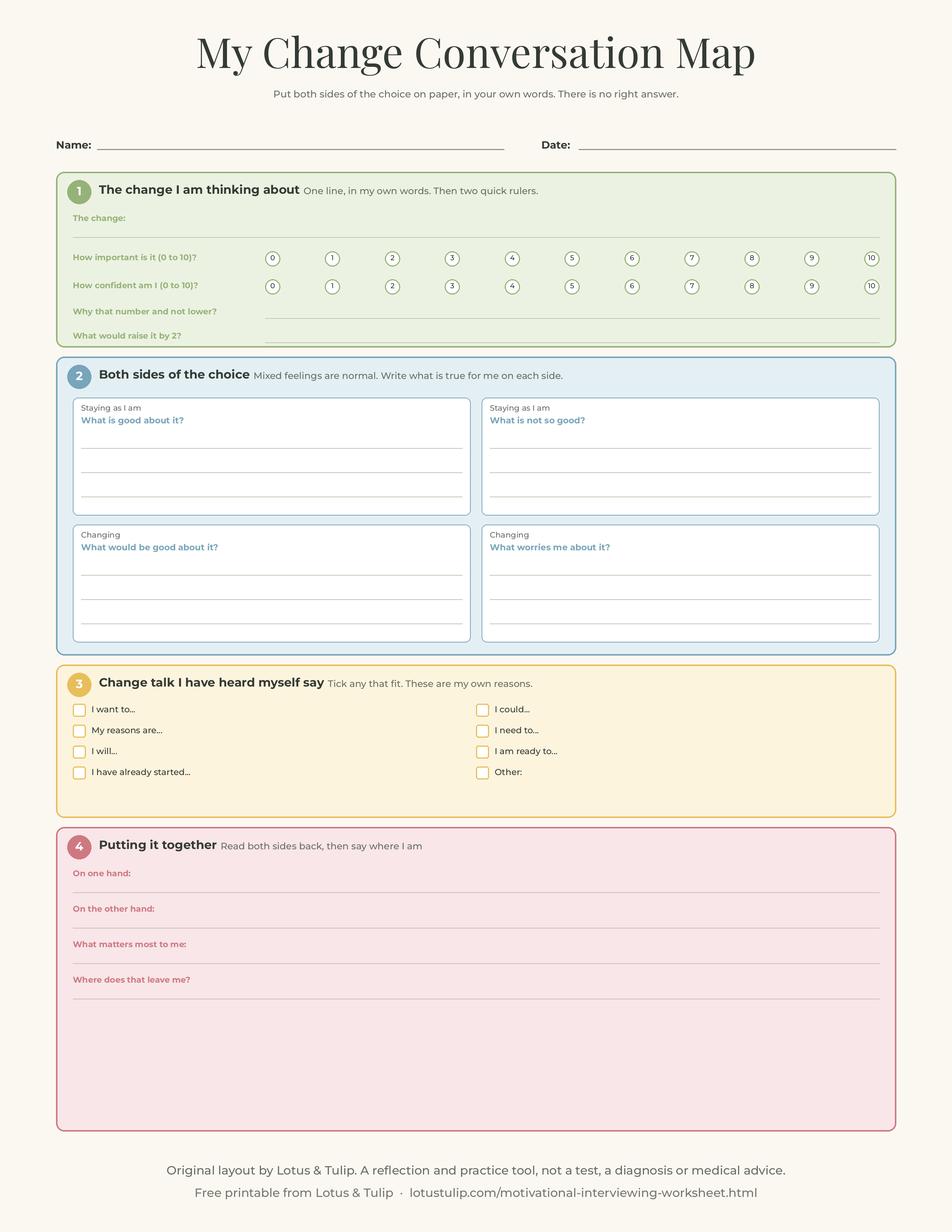
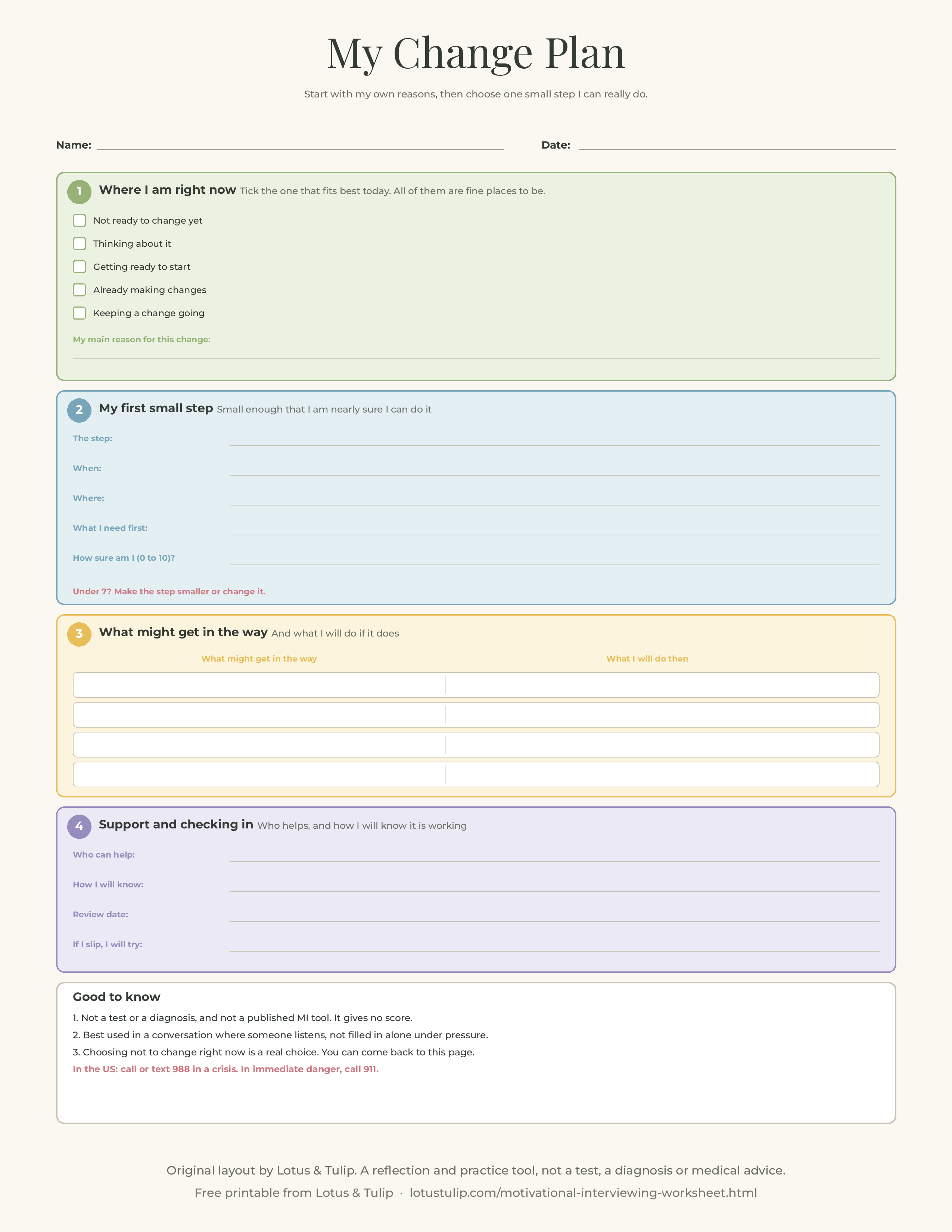
This guide is for therapists, counselors, coaches, nurses and anyone else who helps people change, and for adults who want to understand their own mixed feelings about a change. It explains what MI is and is not, the four tasks and the spirit behind it, the OARS skills, how to recognize change talk, what the research honestly shows, nine practical steps to use a worksheet in a conversation, common mistakes and three short examples. It ends with a free 2 page printable: My Change Conversation Map, for naming the change and both sides of ambivalence, and My Change Plan, for turning your own reasons into a small, specific step.
Download the free motivational interviewing worksheet (PDF, 2 pages, US Letter)
Direct download, no email or sign up. See the pages first.
What motivational interviewing is
Motivational interviewing is a collaborative, person-centered way of talking with people about change, designed to strengthen their own motivation and commitment. William Miller and Stephen Rollnick, who developed it, described it in 2009 as "a collaborative, person-centered form of guiding to elicit and strengthen motivation for change." In the fourth edition of their book (2023) they define it as a particular way of talking with people about change and growth to strengthen their own motivation and commitment.
The core idea is ambivalence. Wanting to change and wanting to stay the same can sit side by side, and arguing for change tends to make people argue for staying put. MI therefore invites the person to do the arguing for change.
| Telling and fixing | Motivational interviewing | |
|---|---|---|
| Who gives the reasons | You do | The person does, in their own words |
| Typical question | "Don't you think you should...?" | "What would make this change worth it to you?" |
| What it tends to bring out | "Yes, but..." and pushback | Reasons, hopes and ideas for a first step |
| Your role | Expert with the answer | Partner and guide |
The spirit and the four tasks
In the fourth edition, Miller and Rollnick describe the spirit of MI as four parts: partnership (working with the person, not on them), acceptance (respecting their worth, autonomy and perspective), compassion (actively putting their welfare first) and empowerment (building on their strengths and resourcefulness). In earlier editions the fourth part was called evocation.
They describe four tasks, called processes in earlier editions, that you move between during a conversation:
- Engaging: building a working relationship so the person feels heard.
- Focusing: agreeing which change you are talking about.
- Evoking: drawing out the person's own reasons, desire and confidence for that change.
- Planning: agreeing on a next step once the person is ready.
OARS: the four core skills
OARS has stayed the same through every edition. It is the everyday toolkit for engaging and evoking:
- Open questions invite more than yes or no. "What worries you about how things are now?" "What would you like to be different?"
- Affirmations name a real strength or effort. "You came in even though you were unsure." They are specific and true, which makes them different from general praise.
- Reflections say back what you heard, and sometimes the meaning underneath it. "You are tired of the arguments, and you also do not want to feel judged." Reflections are the workhorse of MI.
- Summaries gather the person's own words into one picture, often ending with a gentle "What else?" or "Where does that leave you?"
Change talk and sustain talk
People talk about change in two directions. Change talk is language that points toward the change. Sustain talk is language that points toward staying as things are. Both are normal, and ambivalence means you will hear both.
The MI literature groups change talk into two kinds, remembered with the letters DARN and CAT:
| Preparatory (DARN) | Example | Mobilizing (CAT) | Example |
|---|---|---|---|
| Desire | "I want to feel better." | Commitment | "I will start on Monday." |
| Ability | "I could try walking after work." | Activation | "I am ready to do something about it." |
| Reasons | "My sleep would improve." | Taking steps | "I told my sister and booked the visit." |
| Need | "I have to do something." |
When you hear change talk, reflect it, ask for more ("What else?", "How would you go about it?") and affirm it. When you hear sustain talk, you do not argue. You can reflect both sides ("Part of you wants this, and part of you is not sure it is worth the effort"), ask what matters most, or acknowledge their autonomy.
What the research says
- Confrontation backfired in an early trial. In 1993, Miller, Benefield and Tonigan randomly assigned 42 problem drinkers to a two session checkup with either directive confrontational counseling or client centered counseling, or to a waiting list. Both counseling styles led to a drop in drinking compared with waiting, and the styles did not differ in overall impact. But the confrontational style produced significantly more client resistance, which predicted poorer outcomes at one year, and the more the therapist confronted, the more the client drank (r = .65).
- The person's own commitment language predicts change. In a 2003 study in the Journal of Consulting and Clinical Psychology, Amrhein and colleagues coded videotaped motivational interviews of 84 people with drug problems for statements of commitment, desire, ability, need, readiness and reasons. Commitment strength during the interview predicted drug use outcomes up to 12 months later, and it predicted them more strongly than desire, ability, need and reasons did, which suggests commitment is a pathway through which those other statements affect behavior.
- The therapist's skills shape the client's language. A 2018 meta-analysis by Magill and colleagues pooled 36 primary studies (3,025 participants). MI consistent therapist skills, such as open questions, reflections and affirmations, were correlated with more client change talk (r = .55), though also with more sustain talk (r = .40). MI inconsistent behavior, such as confrontation, warnings and unsolicited advice, was correlated with more sustain talk (r = .16) and not with change talk. A higher proportion of change talk was linked to less risk behavior at follow up (r = -.16), and sustain talk was linked to worse outcomes (r = .19).
- Effects are real but modest. In a 2010 meta-analysis of 119 studies, Lundahl and colleagues found that against weak comparison groups MI produced small, durable effects (average g = 0.28), while against other specific treatments the difference was not significant (average g = 0.09). A 2013 meta-analysis of 48 randomized trials (9,618 participants) in medical care settings found a modest advantage for MI (odds ratio 1.55), including in brief consultations, though it was not particularly effective for eating disorders or some self care behaviors.
- It is not a trick, and it is not a worksheet. In "Ten things that motivational interviewing is not" (2009), Miller and Rollnick list, among other things, that MI is not a technique, not decisional balance, not the transtheoretical model, not cognitive behavioral therapy, not easy to learn and not a panacea. A worksheet can support the conversation, but the skill is in how you listen and respond.
Fidelity to MI is rated in research with coding tools such as the Motivational Interviewing Treatment Integrity (MITI) system, which counts behaviors like reflections, questions, affirmations and confrontation. We describe such tools here but do not reproduce or score them, and our worksheet is not one of them.
How to use a motivational interviewing worksheet, step by step
- Start with the person, not the page. Ask permission before you pick up the worksheet: "Would it be OK to put some of what you are telling me on paper?" The page works best as shared note taking, not a form to fill in at someone.
- Name the change in the person's own words. On page 1, write the change being considered in one line, for example "cutting down on drinking" or "going back to the gym". Add how important it feels from 0 to 10 and how confident the person is from 0 to 10. The two numbers often differ, and that gap tells you where to go next.
- Ask the follow up questions on the rulers. If importance is a 4, ask "Why a 4 and not a 0?" and write down the answer, because it is a reason for change. Then ask "What would move it from a 4 to a 6?" Avoid asking why it is not higher, which invites sustain talk.
- Write both sides of the ambivalence. In the two columns, record what is good about things as they are and what is not so good, then what would be good about changing and what worries the person about it. Take both sides seriously. Reflect the first column as well as the second.
- Listen for change talk and mark it. Use the DARN CAT list. When the person says something like "I want to" or "I could", underline it and reflect it. Ask for an example or a next thought: "When did you last feel that?"
- Use a summary to link the two sides. Read the person's own words back: "On one hand, the evenings are how you unwind. On the other hand, you are tired of the mornings and you worry about your health. And you said you want to be around for your kids." Then ask: "Where does that leave you?"
- Check readiness before planning. Ask about the thing that matters most. If the person is still unsure, stay on page 1 and offer a smaller option, such as trying something for two weeks or gathering information. If they are ready, move to page 2.
- Build a small, specific plan on page 2. Write the first step, when and where, what might get in the way and what the person will do then, who can help, and a way they will know it is working. The plan should come from the person's ideas. If you add a suggestion, ask first: "Would you like to hear what has helped other people?"
- Follow up. Set a review date and ask afterward what worked, what did not and what they would adjust. Slips are information, not failure. If anything sounds unsafe or the person is in crisis, use your safety procedures. In the US, call or text 988 in a mental health crisis, and call 911 if someone is in immediate danger.
Common mistakes
- The fixing reflex. Miller and Rollnick call the urge to set people right the fixing reflex (called the righting reflex in earlier editions). Advice that arrives too early tends to pull for "yes, but".
- Asking closed questions in a row. Three questions in a row start to feel like an interview with an answer sheet. Follow a question with a reflection.
- Treating the ruler as a score. The 0 to 10 numbers are conversation starters, not a measurement. Do not argue with the number the person gives.
- Using it as a way to trick someone. MI is not a way of getting people to do what you want. MI respects the person's autonomy, including the choice not to change right now.
- Skipping the other side. If you only write down reasons for change, the person may feel unheard. Acknowledge what they like about things as they are.
- Using the worksheet as the whole session. A form does not do the work. If you are filling in boxes in silence, put the pen down and listen.
- Racing to a plan. Planning before the person has voiced their own reasons tends to produce plans that do not last. If they are not ready, that is useful information, not a failure.
Examples
- Cutting back on evening drinks: A man in his forties said he was fine, but his wife was worried. His importance score was 3 and his confidence was 6. The counselor asked why 3 and not 0, and he said he did not like how foggy his mornings were. She reflected that and asked what a clearer morning would give him. He said patience with his kids. On page 2 he chose one first step: three alcohol free weeknights, starting with Tuesday, and he asked his brother to check in on Sunday.
- Going back to physical therapy exercises: A woman had stopped her home exercises after three weeks. Her physio asked what she had liked and not liked about them. She wrote "good for my back" on one side and "boring and I forget" on the other. The physio reflected both, asked what would make them less boring, and she suggested doing them while the kettle boils. Her plan was one set per morning, with a sticky note on the kettle.
- A teen who does not want therapy: A school counselor met a 16 year old sent by his parents. Instead of explaining why counseling would help, she asked what he would change if he could change one thing about school. He said getting the teachers off his back. She reflected that, asked what he had tried and what he wanted to try next. At the end he agreed to one more meeting. For young people, keep language simple and choice real.
Free printable: motivational interviewing worksheet
This free printable is an original Lotus & Tulip layout on US Letter, in our own wording. It is not a published MI tool, the MITI or a readiness scale, and it does not give a score. Page 1, My Change Conversation Map, covers the change in the person's own words, importance and confidence rulers with the follow up questions, both sides of the ambivalence, change talk they have used (DARN CAT) and a summary line. Page 2, My Change Plan, covers where I am now, the first small step, when and where, what might get in the way, who can help, how I will know it is working and a review date.
Download the free motivational interviewing worksheet (PDF, 2 pages, US Letter)
Prefer single images? Page 1: change conversation map (PNG) · Page 2: change plan (PNG)
Free to print for yourself or for use with your own clients or groups. Please link to this page rather than re-uploading the file. A reflection and practice tool, not a test, a diagnosis or a substitute for therapy or MI training. In the US, call or text 988 in a mental health crisis. In immediate danger, call 911.
Related resources
- Decisional balance worksheet: weigh the pros and cons of a big change
- DBT pros and cons worksheet: weigh acting on an urge against resisting it
- ACT values worksheet: clarify what matters and plan a committed action
- Behavioral activation worksheet: schedule small steps that matter
- Overthinking worksheet: when the ambivalence turns into a loop
- DBT validation worksheet: acknowledge feelings without trying to fix them
- All therapist worksheets: CBT, DBT, ACT and more
FAQ
What is a motivational interviewing worksheet?
A motivational interviewing worksheet is a structured page used inside an MI style conversation. It helps the person name a change, rate how important it is and how confident they feel, put both sides of their ambivalence on paper, notice their own change talk and build a small plan. The free 2 page printable on this page is an original reflection tool, not a published instrument or a score.
What does OARS stand for in motivational interviewing?
OARS stands for open questions, affirmations, reflections and summaries. These are the core communication skills of MI, used to build the relationship and to draw out the person's own reasons for change. Reflections do much of the work in practice.
What is change talk?
Change talk is anything a person says that points toward a change. Preparatory change talk covers desire, ability, reasons and need (DARN), and mobilizing change talk covers commitment, activation and taking steps (CAT). Research suggests that commitment language during MI is linked to better outcomes later.
Is motivational interviewing the same as decisional balance?
No. Miller and Rollnick list decisional balance as one of the things MI is not. A pros and cons exercise can be used inside a motivational interview, but MI itself is a way of conversing, not an exercise. See our decisional balance worksheet if you want one.
Does motivational interviewing work?
The research shows modest benefits. A 2010 meta-analysis of 119 studies found a small effect against weak comparison groups (average g = 0.28) and no significant difference against other specific treatments. A 2013 meta-analysis of 48 randomized trials in medical settings found a modest advantage (odds ratio 1.55). It is not a cure all, and how well it is delivered matters.
What is the difference between MI and CBT?
MI focuses on strengthening a person's own motivation to change, mostly by listening and evoking. CBT teaches specific skills for changing thoughts and behaviors. They work well together, with MI used when someone is ambivalent and CBT used once they are ready to work on the change. Miller and Rollnick also list CBT as something MI is not.
Can therapists use this worksheet with clients?
Yes. It is free to print for use with your own clients or groups. Please link to this page rather than re-uploading the file. It works as shared note taking in a session, not as a form to hand over. It does not replace MI training or a validated tool, so use a clinical tool if you need a score.
Sources
- Amrhein, P. C., Miller, W. R., Yahne, C. E., Palmer, M., and Fulcher, L. (2003). Client commitment language during motivational interviewing predicts drug use outcomes. Journal of Consulting and Clinical Psychology, 71(5), 862 to 878.
- Lundahl, B. W., Kunz, C., Brownell, C., Tollefson, D., and Burke, B. L. (2010). A meta-analysis of motivational interviewing: Twenty-five years of empirical studies. Research on Social Work Practice, 20(2), 137 to 160.
- Lundahl, B., Moleni, T., Burke, B. L., Butters, R., Tollefson, D., Butler, C., and Rollnick, S. (2013). Motivational interviewing in medical care settings: A systematic review and meta-analysis of randomized controlled trials. Patient Education and Counseling, 93(2), 157 to 168.
- Magill, M., Apodaca, T. R., Borsari, B., Gaume, J., Hoadley, A., Gordon, R. E. F., Tonigan, J. S., and Moyers, T. (2018). A meta-analysis of motivational interviewing process: Technical, relational, and conditional process models of change. Journal of Consulting and Clinical Psychology, 86(2), 140 to 157.
- Miller, W. R., Benefield, R. G., and Tonigan, J. S. (1993). Enhancing motivation for change in problem drinking: A controlled comparison of two therapist styles. Journal of Consulting and Clinical Psychology, 61(3), 455 to 461.
- Miller, W. R., and Rollnick, S. (2009). Ten things that motivational interviewing is not. Behavioural and Cognitive Psychotherapy, 37(2), 129 to 140.
- Miller, W. R., and Rollnick, S. (2023). Motivational interviewing: Helping people change and grow (4th ed.). Guilford Press. See also Miller and Rollnick, "What's new (and not new) in the 4th edition of Motivational Interviewing," Motivational Interviewing Network of Trainers.