
Therapist worksheets · CBT · Updated 2026-11-14
Overthinking worksheet for adults: what overthinking is, what research shows, and how to stop the loop step by step (free printable)
Worry logs and the anxiety cycle behind the what ifs: Anxiety Worksheets for Therapists, 20 pages incl. a worry log, the anxiety cycle and grounding Holiday 20% off: about $11.04, was $14 (EUR 12) · fillable PDF, instant digital download
Buy on EtsyTry it free first: download a fillable sample (worry log and fear ladder, PDF, 258 KB). Type into it on screen, then get the full pack. No email needed.
Thought records for the stories the loop keeps telling: CBT Worksheets for Therapists, 20 pages including thought records and core beliefs Holiday 20% off: about $11.04, was $14 (EUR 12) · fillable PDF, instant digital download
Buy on EtsyTry it free first: download a fillable sample (thought record and evidence for and against, PDF, 105 KB). Type into it on screen, then get the full pack. No email needed.
A full caseload: Therapist Worksheets Mega Bundle (8 packs incl. DBT, CBT, ACT, anxiety, grief and ADHD) Holiday 20% off: about $35.88, was $45 (EUR 39) · fillable PDFs for all 8 packs plus 160 printable pages, instant digital download
Buy on EtsyIt is 1 am. You are going back over something you said at dinner, then wondering whether the doctor's appointment next week will bring bad news, then comparing two job offers for the fortieth time. Nothing new comes out of it. You are just more tired. That is overthinking.
This guide is for adults who get stuck in their heads, and for the therapists, counselors and coaches who help them. It explains the three forms overthinking usually takes, what the research honestly shows, nine practical steps to get out of the loop, common mistakes and three short examples. It ends with a free 2 page printable: My Overthinking Map, for catching a loop and checking whether it is helping, and My Overthinking Plan, for turning it into one next step, making a good enough decision or parking it for later.
Download the free overthinking worksheet (PDF, 2 pages, US Letter)
Direct download, no email or sign up. See the pages first.
What overthinking is
Overthinking is thinking about the same thing over and over, in a way that feels like problem solving but does not lead to a decision, a plan or relief. It is an everyday word, not a diagnosis. Psychologists usually call it repetitive negative thinking: thinking that is repetitive, hard to switch off and negative in content.
In practice it tends to take one of three forms, and many loops mix all three:
| Replaying the past | What ifs about the future | Stuck on a decision | |
|---|---|---|---|
| Research term | Rumination | Worry | Indecision, maximizing (often called analysis paralysis) |
| Typical thought | "Why did I say that? What is wrong with me?" | "What if it goes wrong? What if they are upset?" | "Which one is best? What if I pick the wrong one?" |
| What it feels like | Heavy, low, stuck | Tense, restless, on edge | Frozen, torn, never sure |
| What usually helps | Switch from why to how, then act | Separate what you can act on from what you cannot, then postpone the rest | Set a good enough bar and a deadline |
If one form is clearly the main problem, we have deeper guides for it: the rumination worksheet for replaying the past, the worry time worksheet and worry tree for what ifs, the catastrophizing worksheet for worst case stories, and the decisional balance worksheet for weighing a big choice. This page is the starting point when you are not sure which one you are doing, or when it is all of them at once.
What the research says
- Worry and rumination share the same engine. In 2008 Thomas Ehring and Edward Watkins reviewed repetitive negative thinking as a transdiagnostic process. They found raised levels of it across a wide range of anxiety and mood problems, evidence that it helps keep emotional problems going, and more similarities than differences when worry and depressive rumination were compared directly. Their conclusion was that it is largely the same process applied to different content. That is why one worksheet can cover the past, the future and the decision.
- Worry is defined as a chain of thoughts that feels uncontrollable. Thomas Borkovec and colleagues (1983) described worry as a chain of thoughts and images that is negatively affect laden and relatively uncontrollable, an attempt to solve a problem in your head when the outcome is uncertain.
- Replaying the past predicts low mood later. In a 2000 study in the Journal of Abnormal Psychology, Susan Nolen-Hoeksema found that a ruminative response style predicted later depressive disorders, including new episodes in people who were not depressed at the start, and also predicted anxiety symptoms.
- Overthinking makes problem solving worse, not better. Lyubomirsky and Nolen-Hoeksema (1995) ran three studies with people in a low mood. Those asked to ruminate on their feelings came up with less effective solutions to interpersonal problems and were more pessimistic about the future than those asked to distract themselves. The distracted group solved problems as well as people who were not low at all.
- It makes it harder to commit. In two studies, Ward, Lyubomirsky, Sousa and Nolen-Hoeksema (2003) asked students to make plans to improve university housing and the curriculum. People with a ruminative style felt less satisfied and less confident in their own plans and were less likely to commit to them. The authors suggested rumination breeds uncertainty, which leads to more rumination and to behavioral paralysis.
- Not all repeated thinking is bad. Edward Watkins' 2008 review in Psychological Bulletin found that repetitive thought can also be constructive, for example helping recovery after upsetting events and supporting planning. A key difference was the level of thinking: abstract "why" and "what does it mean" thinking tended to be unhelpful, concrete "what happened, how, what next" thinking tended to be helpful.
- Practicing concrete thinking can help. In a trial with 121 adults with major depression in primary care, Watkins and colleagues (2012) found that adding guided self help concreteness training to usual care improved depressive symptoms, rumination and overgeneralization, with gains at 3 and 6 months. It did not beat relaxation training on depression scores, but it reduced rumination more. Step 5 below is a simple version of that switch.
- Chasing the best option can cost happiness. Barry Schwartz and colleagues (2002) developed a Maximization Scale to measure the drive to find the very best option. Across seven samples, people who scored higher reported less happiness, optimism, self esteem and life satisfaction, and more depression, perfectionism and regret. In a follow up of graduating students, Iyengar, Wells and Schwartz (2006) found maximizers landed jobs with 20% higher starting salaries but were less satisfied with them and felt more negative throughout the search. These are correlations, not proof of cause, but they fit what overthinkers often report: a better choice on paper, a worse experience of making it.
- More options do not always overwhelm. A 2010 meta-analysis by Scheibehenne, Greifeneder and Todd pooled 50 experiments (5,036 people) on choice overload and found an average effect of virtually zero, with big differences between studies. So the problem is usually not the number of options itself, but how you approach the choice. That is why the worksheet focuses on your bar and your deadline, not on cutting the list.
Researchers measure repetitive thinking with questionnaires such as the Perseverative Thinking Questionnaire (Ehring and colleagues, 2011, 15 items), which looks at how repetitive and intrusive the thinking is, how unproductive it feels and how much mental capacity it takes up. Those are clinical tools. We describe them here but do not reproduce or score them, and our worksheet is not one of them.
How to use an overthinking worksheet, step by step
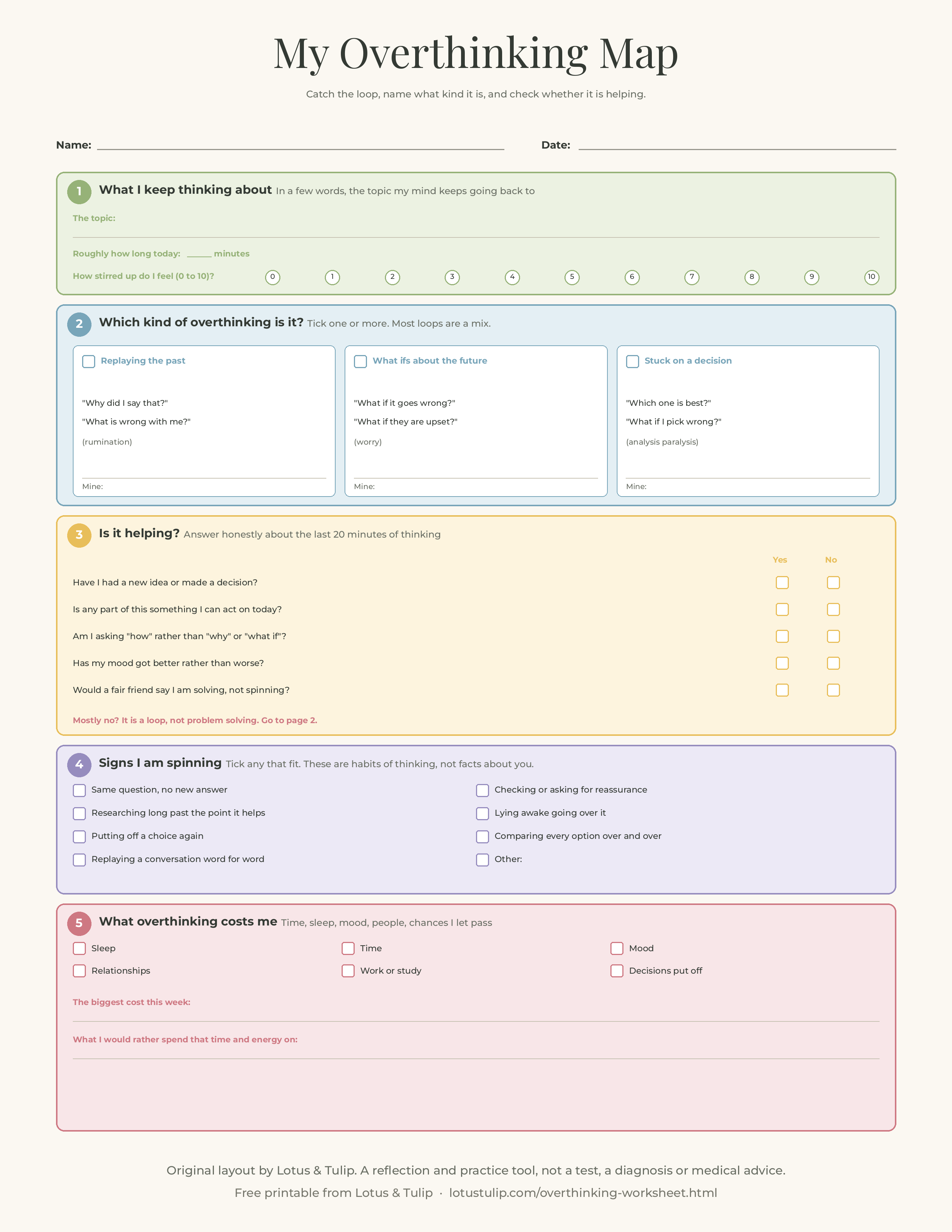
- Name the topic in a few words. On page 1, write what your mind keeps going back to, roughly how many minutes it took today, and how stirred up you feel from 0 to 10. Short is better: "the comment at dinner", not the whole story.
- Sort which kind it is. Tick replaying the past, what ifs about the future, or stuck on a decision. Many loops are a mix, so tick more than one if they fit. Naming the kind tells you which part of page 2 to use.
- Run the "is it helping?" check. Think about the last 20 minutes. Have you had a new idea or made a decision? Is any of it something you can act on today? Are you asking how rather than why or what if? Is your mood better or worse? If the answers are mostly no, it is a loop, not problem solving.
- Tick the signs and the costs. Same question with no new answer, checking or asking for reassurance, researching long past the point it helps, lying awake. Then tick what it is costing you: sleep, time, mood, relationships, work, decisions put off. Seeing the cost on paper makes it easier to choose to stop.
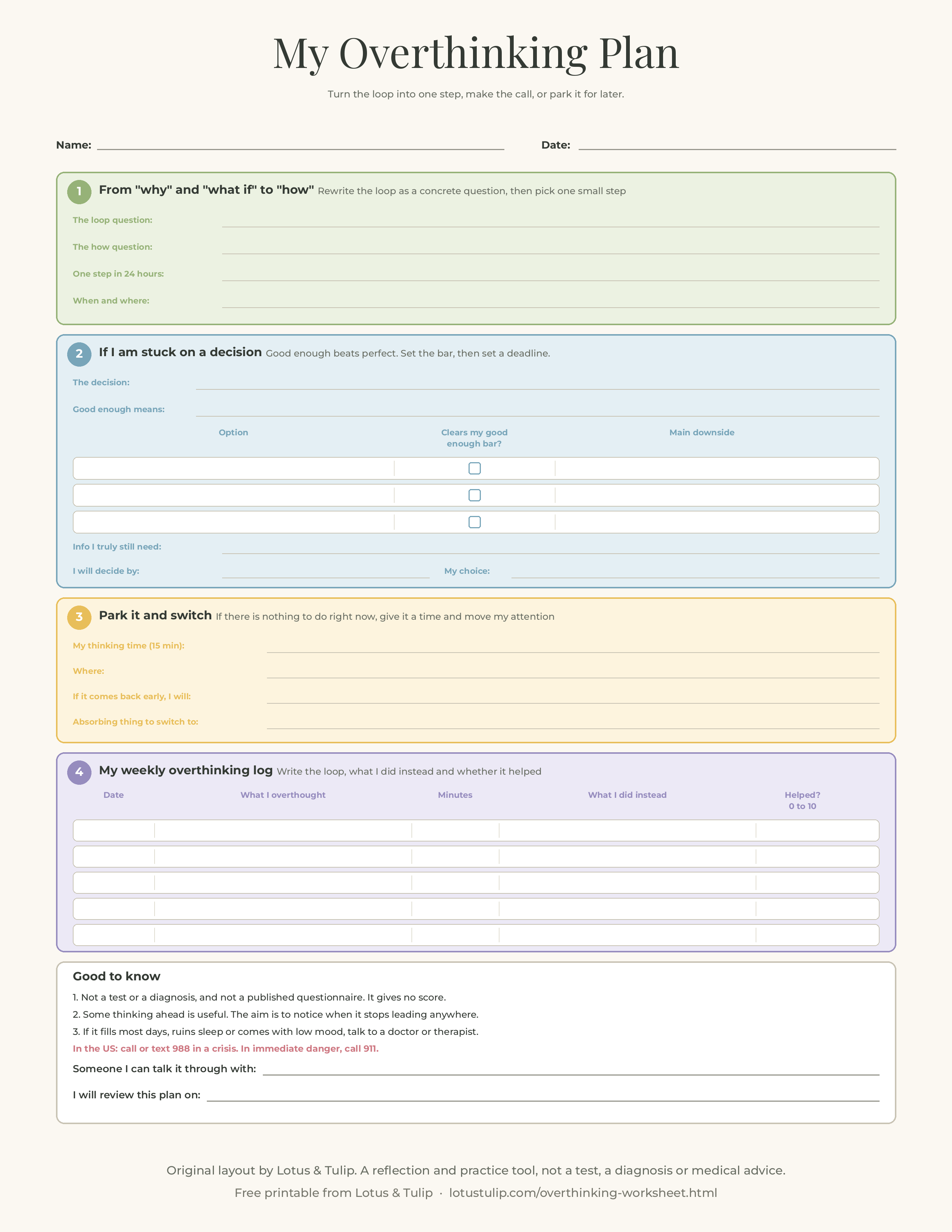
- Turn the why or what if into a how question. On page 2, write the loop question, then rewrite it as a concrete how question. "Why do I always mess things up?" becomes "How can I prepare for Thursday's meeting?" "What if she is angry with me?" becomes "How could I check in with her this week?"
- Pick one step for the next 24 hours. Make it small and specific, with a time and place: "Text her at lunch: are we OK after Saturday?" Acting on one step gives the loop something to end on.
- If it is a decision, set a good enough bar and a deadline. Write the decision and what good enough means to you, in two or three must haves. List up to three options and tick which ones clear the bar. Write the one piece of information you truly still need, if any, then a decide by date. When a choice clears the bar, take it.
- If there is nothing to do right now, park it and switch. Choose a 15 minute thinking time later in the day and a place for it. When the loop comes back early, note it and tell yourself it has a slot. Then move to something absorbing that needs your attention, such as a call, a walk with a podcast, cooking or a game. Our worry time worksheet goes deeper on this part.
- Log it for a week and review. Each day, write what you overthought, the minutes, what you did instead and whether it helped from 0 to 10. After a week, look for patterns: the topics, the times of day and which moves worked best. If overthinking fills most of your day, ruins your sleep or comes with low mood or panic, talk to a doctor or therapist. In the US, call or text 988 in a mental health crisis, and call 911 if you are in immediate danger.
Common mistakes
- Trying to stop thinking altogether. Pushing a thought away tends to bring it back. The aim is not an empty mind, it is noticing when thinking has stopped leading anywhere and choosing what to do next.
- Thinking harder to get certain. Overthinking promises that one more round will bring certainty. It rarely does. Accept "good enough to act on" as the finish line.
- Researching as a way to avoid deciding. More reviews, more forums, more opinions. Information helps up to a point, then it becomes another loop. Write down the one fact you really need, get it, and stop.
- Turning the worksheet into reassurance. Filling in the same page about the same fear several times a day to feel safe is a checking habit. For repeated, sticky thoughts, see our intrusive thoughts worksheet and talk to a therapist.
- Using it only at 2 am. At night, everything feels bigger and harder to solve. Write the topic on a note and give it a thinking time the next day. Our sleep hygiene worksheet has more on winding down.
- Treating all reflection as a problem. Thinking through a hard conversation, learning from a mistake or planning ahead are useful. If it gives you a new idea or a next step, it is not overthinking.
Examples
- The dinner comment: On Sunday night he kept replaying a joke he made about a friend's new job and spent about an hour on "why do I always say the wrong thing?" The is it helping check was all no. His how question was "How can I find out if she minded?" His one step: a short message at lunch on Monday. She replied with a laughing emoji. He logged 60 minutes before and 5 minutes after, helped 8 out of 10.
- The scan result: She had a follow up scan booked in ten days and kept running through what ifs every evening. There was nothing to act on until the appointment, so she used park it and switch: a 15 minute thinking time at 6 pm at the kitchen table, then a walk or a call with her sister. When the thoughts came back early, she wrote "6 pm" on a sticky note. Her log showed the evening loops shrank from about an hour to under 20 minutes over the week.
- The therapist and the apartment hunt: A client had viewed 23 apartments in two months and turned down three good ones, each time sure something better was coming. His therapist used the decision box. Good enough meant three things: under $1,800 a month, under 40 minutes to work, and a second bedroom for an office. Two of the current options cleared the bar. He set a decide by date of Friday, signed for one, and they used the weekly log to track regret, which faded faster than he expected.
Free printable: overthinking worksheet
This free printable is an original Lotus & Tulip layout on US Letter, in our own wording. It is not the Perseverative Thinking Questionnaire, a worry or rumination scale, or the Maximization Scale, and it does not give a score. Page 1, My Overthinking Map, covers what you keep thinking about, how long and how stirred up you feel, which kind of overthinking it is, the is it helping check, signs you are spinning and what it costs you. Page 2, My Overthinking Plan, covers turning why and what if into how with one step in 24 hours, a good enough decision box with a deadline, park it and switch, a weekly log, someone to talk it through with and a review date.
Download the free overthinking worksheet (PDF, 2 pages, US Letter)
Prefer single images? Page 1: my overthinking map (PNG) · Page 2: my overthinking plan (PNG)
Free to print for yourself or for use with your own clients or groups. Please link to this page rather than re-uploading the file. A reflection and practice tool, not a test, a diagnosis or a substitute for therapy. In the US, call or text 988 in a mental health crisis. In immediate danger, call 911.
Related resources
- Rumination worksheet: when the loop is mostly replaying the past
- Worry time worksheet: postpone what ifs to one daily window
- Journaling prompts for anxiety: 39 prompts and a free worry journal page to write the loop down and end with a step
- Worry tree worksheet: sort a worry into act now or let go
- Catastrophizing worksheet: when the what ifs end in the worst case
- Decisional balance worksheet: weigh the pros and cons of a big change
- Perfectionism worksheet: when nothing ever feels good enough
- CBT thought record worksheet: test one hot thought against the evidence
- Mindfulness worksheets for adults: practice noticing thoughts without following them
- All therapist worksheets: CBT, DBT, ACT and more
- Motivational interviewing worksheet: when the stuck feeling is mixed feelings about a change
FAQ
What is an overthinking worksheet?
An overthinking worksheet is a structured page that helps you catch a thinking loop, name what kind it is (replaying the past, what ifs about the future or being stuck on a decision), check whether it is actually helping, and turn it into a next step, a decision or a planned time to think. The free 2 page printable on this page adds a weekly log. It is an original reflection tool, not a test or a published questionnaire.
What is the difference between overthinking and rumination?
Rumination is one kind of overthinking: going over the past and your own feelings, usually with why questions, and closely linked with low mood. Overthinking is the broader everyday term. It also covers worry, which is about the future and linked with anxiety, and getting stuck on decisions. Research suggests worry and rumination share much of the same underlying process.
How do I stop overthinking?
You usually cannot stop the first thought, but you can stop following it. Notice the loop, ask whether the last 20 minutes produced anything new, and if not, either turn the question into a concrete how question with one small step, set a good enough bar and a deadline for a decision, or park it for a set thinking time and switch to something absorbing. Logging what works helps you get faster at it.
Is overthinking a mental illness?
No. Overthinking is not a diagnosis, and everyone does it sometimes. It is common in anxiety, depression, OCD and after stressful events, and research links persistent repetitive negative thinking with those problems. If it takes up hours of your day, keeps you from sleeping or comes with low mood or panic, it is worth talking to a doctor or therapist.
What is analysis paralysis?
Analysis paralysis is an everyday term for overthinking a decision so much that you cannot make it. It often comes with wanting the best possible option rather than a good enough one, which researchers call maximizing, and with researching long past the point where it helps. Setting your must haves and a decide by date in advance is a practical way out.
Why do I overthink at night?
At night there are fewer distractions, you are tired, and problems feel bigger and harder to solve. Lying in bed is also a time when there is nothing you can act on. Writing the topic down, giving it a thinking time the next day and using a wind down routine usually works better than trying to solve it in bed.
Can therapists use this worksheet with clients?
Yes. It is free to print for use with your own clients or groups. Please link to this page rather than re-uploading the file. It works well as a first session tool to work out whether a client's repetitive thinking is mostly rumination, worry or indecision, and the weekly log makes a natural between session task. It is not a validated measure, so use a clinical tool such as the PTQ if you need a score.
Sources
- Borkovec, T. D., Robinson, E., Pruzinsky, T., and DePree, J. A. (1983). Preliminary exploration of worry: Some characteristics and processes. Behaviour Research and Therapy, 21(1), 9 to 16.
- Ehring, T., and Watkins, E. R. (2008). Repetitive negative thinking as a transdiagnostic process. International Journal of Cognitive Therapy, 1(3), 192 to 205.
- Ehring, T., Zetsche, U., Weidacker, K., Wahl, K., Schönfeld, S., and Ehlers, A. (2011). The Perseverative Thinking Questionnaire (PTQ): Validation of a content-independent measure of repetitive negative thinking. Journal of Behavior Therapy and Experimental Psychiatry, 42(2), 225 to 232.
- Iyengar, S. S., Wells, R. E., and Schwartz, B. (2006). Doing better but feeling worse: Looking for the "best" job undermines satisfaction. Psychological Science, 17(2), 143 to 150.
- Lyubomirsky, S., and Nolen-Hoeksema, S. (1995). Effects of self-focused rumination on negative thinking and interpersonal problem solving. Journal of Personality and Social Psychology, 69(1), 176 to 190.
- Nolen-Hoeksema, S. (2000). The role of rumination in depressive disorders and mixed anxiety/depressive symptoms. Journal of Abnormal Psychology, 109(3), 504 to 511.
- Scheibehenne, B., Greifeneder, R., and Todd, P. M. (2010). Can there ever be too many options? A meta-analytic review of choice overload. Journal of Consumer Research, 37(3), 409 to 425.
- Schwartz, B., Ward, A., Monterosso, J., Lyubomirsky, S., White, K., and Lehman, D. R. (2002). Maximizing versus satisficing: Happiness is a matter of choice. Journal of Personality and Social Psychology, 83(5), 1178 to 1197.
- Ward, A., Lyubomirsky, S., Sousa, L., and Nolen-Hoeksema, S. (2003). Can't quite commit: Rumination and uncertainty. Personality and Social Psychology Bulletin, 29(1), 96 to 107.
- Watkins, E. R. (2008). Constructive and unconstructive repetitive thought. Psychological Bulletin, 134(2), 163 to 206.
- Watkins, E. R., Taylor, R. S., Byng, R., Baeyens, C., Read, R., Pearson, K., and Watson, L. (2012). Guided self-help concreteness training as an intervention for major depression in primary care: A Phase II randomized controlled trial. Psychological Medicine, 42(7), 1359 to 1371.