
Therapist worksheets · Motivation and change · Updated 2026-11-05
Decisional Balance Worksheet: Pros and Cons of Change, How to Use It Well, and a Free Printable
Ready-made printable: Relapse Prevention Worksheets Holiday 20% off: about $9.20, was $12 (EUR 10) · instant digital download
Buy on Etsy
A decisional balance worksheet asks a person to look at a possible change from four sides: what is good about how things are now, what is not so good about how things are now, what might be hard about changing, and what might be good about changing. It is one of the most common handouts in substance use treatment, health coaching, school counseling and general therapy, and it shows up in almost every stages of change workbook.
It is also one of the most misunderstood. The research behind motivational interviewing (MI) suggests that a full, evenly weighted pros and cons exercise can actually lower commitment to change in someone who is still on the fence. Used at the right moment and in the right way, the same four boxes are a calm, respectful way to think a decision through. This guide covers where the tool came from, when it helps, when to choose something else, how to run it with teens and adults, the DBT version for urges, common mistakes, and what the evidence honestly says. You also get a free three page US Letter printable.
This page is educational. It is not a substitute for assessment or treatment by a licensed clinician, especially for substance use, eating disorders, or anything involving safety.
Jump to the free decisional balance worksheet (PDF) · How to use it, step by step · The MI caution every clinician should know
What a decisional balance is
A decisional balance is a structured way of listing the expected gains and losses of a choice. In counseling the choice is usually a behavior change: drinking less, quitting vaping, starting medication, going back to school, leaving a job, ending a relationship, using a coping skill instead of an old habit.
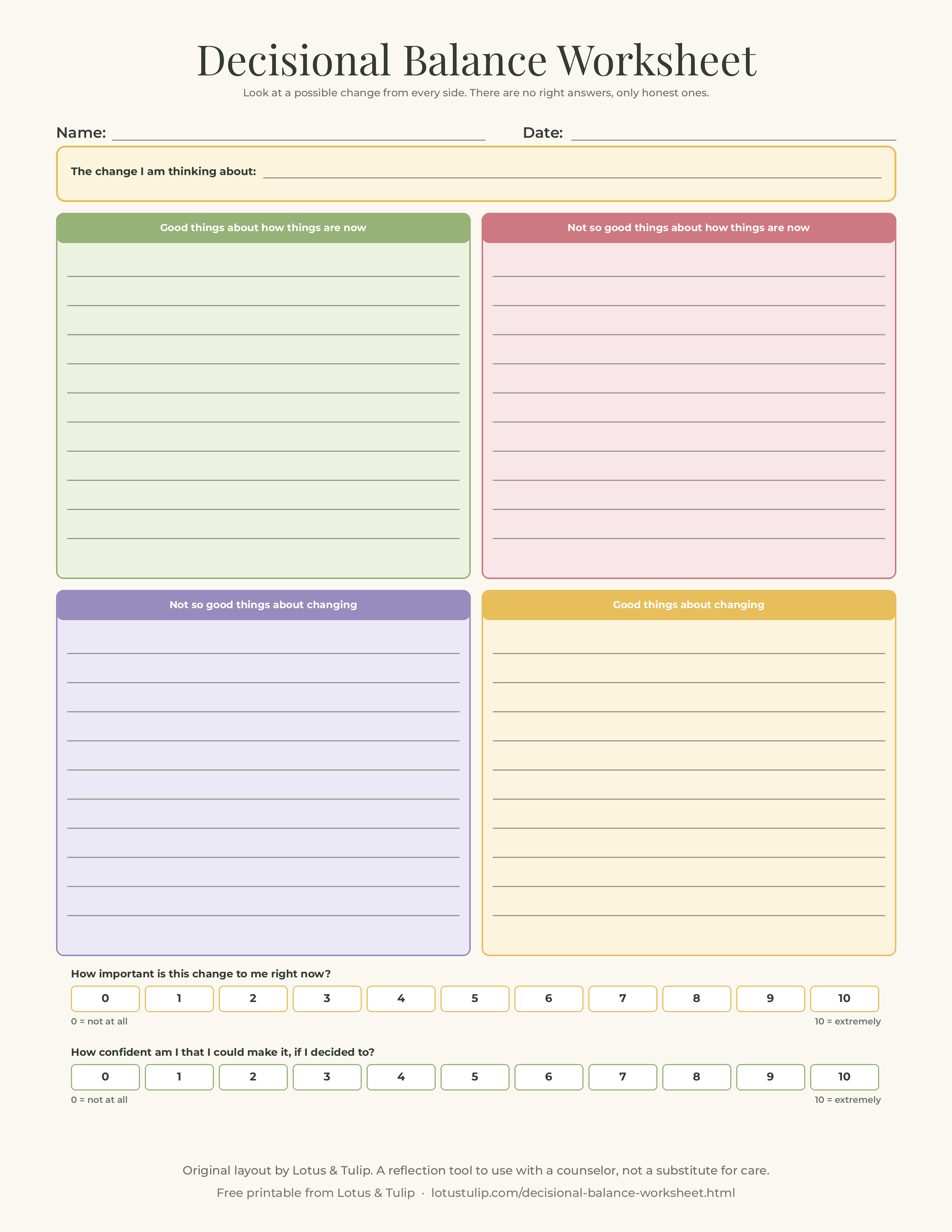
The classic worksheet is a two by two grid:
- Good things about how things are now (the benefits of not changing).
- Not so good things about how things are now (the costs of not changing).
- Not so good things about changing (the costs, effort or losses of change).
- Good things about changing (the benefits of change).
Some versions collapse this to two columns, "pros of changing" and "cons of changing." The four box version is more complete because the cost of staying the same is not always just the mirror image of the benefit of changing. A teen who vapes may list "my friends all do it" as a good thing about now and "I would feel left out at lunch" as a cost of changing. Those are related, but writing both makes the social pull visible.
Where it came from
The idea of writing down reasons on each side of a choice is old. In a 1772 letter to the chemist Joseph Priestley, Benjamin Franklin described dividing a sheet of paper into two columns, listing pros and cons over several days, and crossing out reasons of roughly equal weight. He called it "moral or prudential algebra."
The modern clinical version comes from psychologists Irving Janis and Leon Mann. In their 1977 book Decision Making: A Psychological Analysis of Conflict, Choice, and Commitment, they proposed a "decisional balance sheet" with four categories of anticipated consequences: practical gains and losses for oneself, practical gains and losses for important others, self approval or disapproval, and approval or disapproval from others. Their concern was how people make important decisions under stress, and how to help them avoid snap choices or defensive avoidance.
James Prochaska, Carlo DiClemente and colleagues then built decisional balance into the transtheoretical model, better known as the stages of change. When Velicer and colleagues (1985) tested a decisional balance questionnaire for smoking, the eight Janis and Mann categories collapsed statistically into just two factors: the pros and the cons of the behavior. That simpler two factor structure is what most worksheets still use.
Decisional balance and the stages of change
The stages of change describe readiness as a process rather than a yes or no switch. The commonly used stages are:
- Precontemplation: not considering change in the foreseeable future, often because the person does not see a problem or feels discouraged.
- Contemplation: aware of a problem and thinking about change, but not yet committed. Ambivalence lives here.
- Preparation: intending to act soon, often already taking small steps.
- Action: actively changing the behavior.
- Maintenance: keeping the change going and preventing relapse.
Prochaska and colleagues (1994) looked at decisional balance across 12 problem behaviors, including smoking, cocaine use, weight control, condom use, sunscreen use, exercise and mammography screening, in 3,858 participants. A fairly consistent pattern appeared: in precontemplation the cons of changing outweigh the pros, the pros rise as people move into contemplation, and the two lines usually cross before action. A companion paper described "strong and weak principles" of change: moving from precontemplation to action was linked with roughly a one standard deviation increase in perceived pros and about half a standard deviation decrease in perceived cons. A later meta-analysis by Hall and Rossi (2008) across 48 health behaviors found a broadly similar pattern.
The practical takeaway is that the balance of pros to cons is a reasonable marker of readiness. It does not automatically follow that asking someone to list every pro and con will move them toward change. That distinction is the heart of the next section.
A fair caveat: the stages of change model is influential but debated. Critics such as West (2005) argue the stage boundaries are arbitrary and that stage matched interventions have not consistently outperformed unmatched ones. Many clinicians still find the stages a useful, informal way to think about readiness, as long as they are not treated as rigid boxes.
The motivational interviewing caution
Early descriptions of motivational interviewing encouraged clinicians to "explore ambivalence," and decisional balance exercises were often used to do that. As MI matured, William Miller and Stephen Rollnick drew a clearer line between two different ways of responding to ambivalence:
- Decisional balance: explore the pros and cons of changing and of not changing evenly, without favoring either side.
- MI evocation: deliberately draw out and strengthen the person's own reasons for change (change talk), while acknowledging but not elaborating the reasons against change (sustain talk).
In a 2015 review in Behavioural and Cognitive Psychotherapy, Miller and Gary Rose summarized the clinical research this way: with people who are ambivalent, a decisional balance intervention tends to decrease commitment to change, while MI style evocation tends to promote it. When someone has already decided to change, the picture flips: evocation is unnecessary, and a decisional balance may further strengthen commitment. Their recommendation was that clinicians using MI to help an ambivalent person move toward change should not include a decisional balance as part of the intervention.
Why would listing the cons of change backfire? People tend to believe what they hear themselves say. If a session spends twenty minutes carefully building the case for drinking, vaping or skipping medication, the person leaves having rehearsed that case out loud. MI research links more change talk in sessions with better outcomes, and more sustain talk with worse ones. Mindset research by Peter Gollwitzer points the same way: deliberating every pro and con suits a person who is genuinely choosing, not one who is trying to build momentum.
So when is a decisional balance the right tool?
- When you want to stay neutral. Miller and Rose describe this as counseling with equipoise. Examples: deciding whether to move, whether to change majors, whether to try a medication with real tradeoffs, whether to stay in a relationship, whether to have surgery, or any decision where the clinician has no business favoring one outcome. Here, an even exploration of both sides is exactly the point.
- When the decision is already made. For someone in preparation, action or maintenance, revisiting the costs of the old pattern and the benefits of the new one can firm up commitment and feed a relapse prevention plan.
- As an assessment snapshot. A quick look at what is on each side can tell you where someone stands and what matters to them, as long as you do not then spend the session elaborating the case against change.
- For in the moment urges (DBT pros and cons). When a person has already decided they do not want to act on a crisis urge, a pros and cons sheet written in advance helps them remember why. More on this below.
When to choose something else
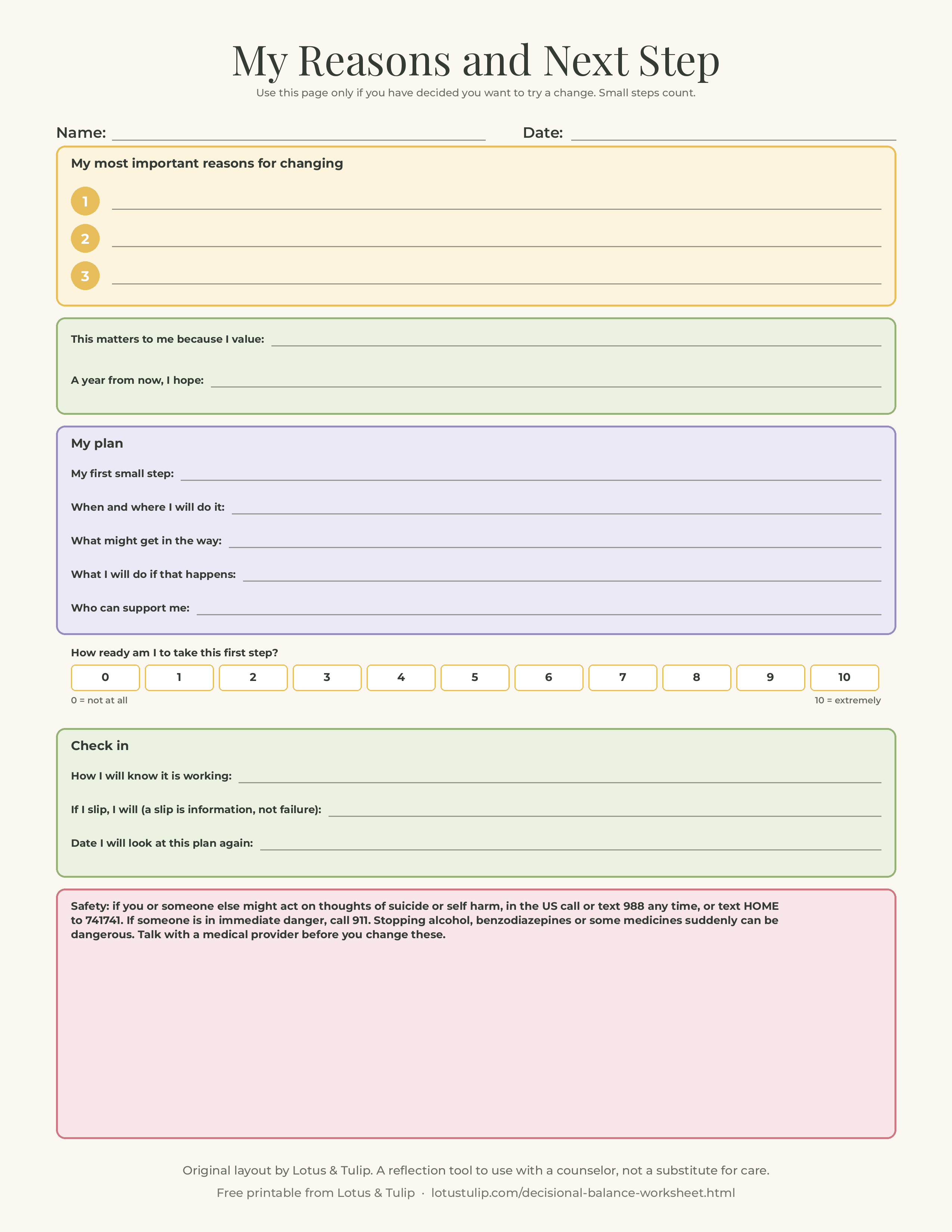
If the person is ambivalent and your goal, agreed with them, is to help them move toward a healthier change, MI suggests skipping the full four box exercise and using evocation instead: open questions about their own reasons, importance and confidence rulers, looking forward and looking back, and exploring values. Page 3 of the free printable, My Reasons and Next Step, is built around that approach.
How to use a decisional balance worksheet, step by step
- Decide your stance first. Ask yourself whether you are counseling with neutrality (a personal decision with no right answer) or helping someone toward a change they have said they want. Use the full grid for the first, and for people who have already decided. For ambivalent people and a change goal, lean on evocation and the reasons page instead.
- Ask permission and name the purpose. "Would it be okay if we looked at this from a few different angles? There are no wrong answers here." People engage more when they choose to.
- Define the change in one concrete sentence. "Cut down to two drinks on weekend nights" works better than "drink less." "Switch to the evening shift" is clearer than "fix my job." Write it in the top box.
- Start with what is good about how things are now. This feels counterintuitive, but naming the real benefits of the current pattern shows respect and lowers defensiveness. Then move to what is not so good about now. Reflect what you hear rather than arguing.
- Fill the changing side in the person's own words. Write their phrases, not your summary. "I would be less tired at work" carries more weight than "health benefits."
- Weigh, do not just count. One reason can outweigh five. Ask the person to circle the two or three items that matter most, or rate each from 1 to 5. Janis and Mann's categories can help here: how does this affect me practically, the people I care about, how I see myself, and how others see me?
- Use the rulers. On a 0 to 10 scale, how important is this change right now, and how confident are you that you could do it if you decided to? Then ask, "Why a 5 and not a 2?" The answer is usually change talk. "What would it take to move up one point?" points toward next steps.
- Summarize and ask, do not tell. Offer a short summary that ends with the person's most important reasons, then ask an open question: "So where does this leave you?" Accept the answer, including "I am not ready."
- If they decide to change, plan one small step. Move to a concrete plan: first step, when and where, likely obstacles, supports, and a date to review. If they are not ready, agree to revisit the topic and leave the door open.
A worked example (fictional)
Maya, 34, has been drinking four to five glasses of wine most evenings since a stressful promotion. She has already told her counselor that she wants to cut back and asks for help making a plan. Because she has decided, a full decisional balance can reinforce her choice.
- Good things about now: it helps me switch off after work; it is a ritual with my partner; I do not have to think about what else to do at 7 pm.
- Not so good about now: I wake up foggy; I snap at my kids in the morning; I spend about $150 a month; my doctor flagged my liver numbers.
- Not so good about changing: evenings will feel long at first; my partner might feel judged; I will need another way to unwind.
- Good about changing: clearer mornings; being the parent I want to be; saving money; feeling in control again.
Maya rates "being the parent I want to be" and "the liver numbers" as the heaviest items. Importance is 8 out of 10, confidence 5. Asked why 5 and not 2, she says she managed a dry January two years ago. Her first step: alcohol free Monday through Thursday for two weeks, a walk with her partner at 7 pm instead, and a check in with her doctor about safe reduction. She keeps the sheet on her phone to reread on hard evenings.
Had Maya instead arrived unsure whether her drinking was a problem at all, an MI informed counselor would likely skip the full grid, ask about what she has noticed, reflect any concerns she raises, and explore what matters to her, rather than inviting her to build a detailed case for the evening wine.
The DBT version: pros and cons for urges
Dialectical behavior therapy (DBT), developed by Marsha Linehan, includes a skill simply called Pros and Cons. It sits in the distress tolerance module as one of the crisis survival skills, alongside STOP, TIPP, distract and self-soothe. It is designed for moments when a strong urge (to self harm, use substances, binge, rage, quit impulsively) collides with what the person wants for their life.
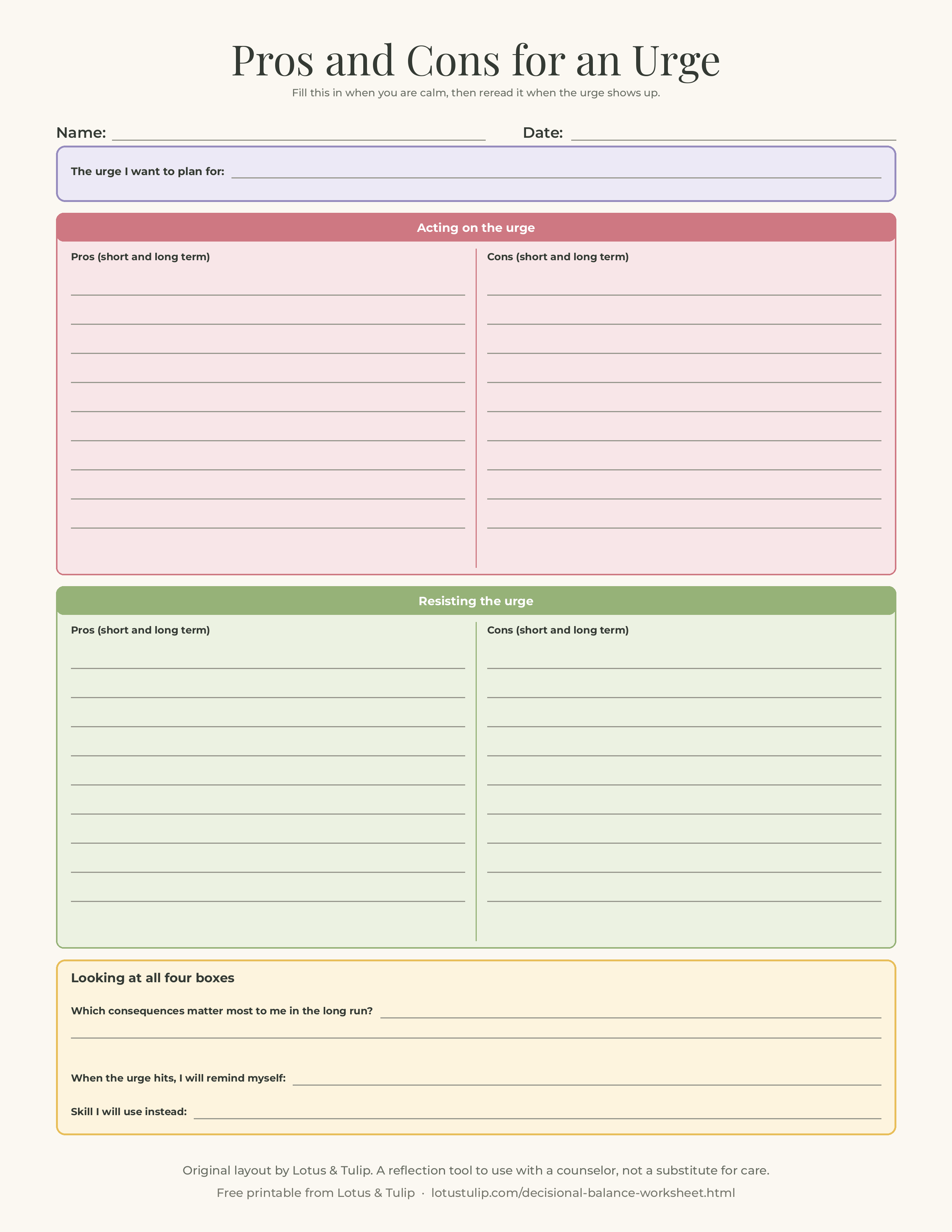
The DBT layout is also four boxes, but framed around an urge rather than a long term change:
- Pros of acting on the crisis urge.
- Cons of acting on the crisis urge.
- Pros of resisting the urge.
- Cons of resisting the urge.
Key differences from the MI style decisional balance:
- It is written in advance, when calm. In a crisis the thinking brain is offline. The sheet carries wise mind's reasoning into the hot moment.
- It separates short term and long term consequences. Acting on an urge usually wins in the short term (relief) and loses in the long term. Seeing that gap in writing is the point.
- The person has already chosen their direction. They want to resist the urge; the sheet helps them remember why. That makes it closer to the "already decided" use case Miller and Rose describe.
- It ends with a replacement skill. Knowing why not to act is half the plan. The other half is what to do instead.
Page 2 of the free printable, Pros and Cons for an Urge, follows this structure with short and long term prompts and a space for the skill to use instead. For more crisis tools, see our distress tolerance worksheets, DBT TIPP skills worksheet and behavior chain analysis worksheet.
Using a decisional balance with teens
Adolescents are especially sensitive to feeling lectured, which makes the MI caution even more important. Some practical adjustments:
- Lead with autonomy. "This is your call. I am curious what you think." Teens who feel pushed often defend the status quo harder, and the four box exercise can turn into a debate.
- Use their language. Let them write "good stuff" and "not so good stuff" headings if that feels more natural. Keep the sheet theirs.
- Prefer neutral topics for the full grid. A decisional balance works well for choices like switching schools, trying out for a team, quitting a job, or picking a course load. For risky behaviors like vaping or drinking where the counselor clearly hopes for change, use evocation and the reasons page instead of building out the pros of vaping in detail.
- Make it about goals. Linking a behavior to the teen's own goals (making varsity, getting a license, keeping a part time job, saving for something) usually goes further than health facts.
- Know your reporting duties. School counselors and therapists should be clear up front about confidentiality limits, especially around safety.
Our peer pressure worksheets for teens and goal setting worksheet for students pair well with the reasons page.
Using it with adults
- Health behavior change. Exercise, diet, sleep, medication adherence and screening are classic decisional balance territory, especially once someone is in preparation or action.
- Substance use. Use carefully. For ambivalent clients, MI evocation generally beats a full grid. For people who have decided, the grid can support relapse prevention by keeping the costs of the old pattern visible. Never encourage sudden stopping of alcohol, benzodiazepines or other medicines without medical input, since withdrawal can be dangerous.
- Life decisions. Career moves, relocation, relationship decisions and treatment choices are ideal for the neutral, full grid approach. Here the goal is clarity, not a particular answer.
- Couples and families. Each person can fill out their own grid privately, then share the items they rate highest. This often reveals that partners are weighing very different things.
Therapist tips
- Listen for change talk while the person writes. Desire, ability, reasons and need ("I want," "I could," "it would help," "I have to") are worth reflecting back. Commitment language ("I will," "I am going to") signals readiness for planning.
- Reflect sustain talk without amplifying it. "Wine is the one thing that helps you switch off right now" acknowledges the reason. Asking for three more examples of why wine is great strengthens it.
- Do not argue with the boxes. If you catch yourself correcting a client's pros with facts, you have probably slipped into the righting reflex, which MI describes as the urge to fix and persuade. It tends to produce more sustain talk.
- Revisit, do not repeat. A grid completed in week one can be revisited in week six to see what has shifted. That comparison is often more useful than a fresh sheet.
- Combine with values. Asking what the person cares about most makes the weighing step easier. Our ACT values worksheet is a good companion.
- Document neutrality. When you use the grid to stay neutral on a personal decision, it can help to note that in your record so the purpose is clear.
Common mistakes
- Using the full grid by default with every ambivalent client. This is the biggest one. Research summarized by Miller and Rose suggests it can lower commitment when change is the goal.
- Counting instead of weighing. Seven small cons do not outweigh one central value. Always ask which items matter most.
- Vague change statements. "Be healthier" cannot be weighed. Name a specific behavior.
- Writing it for the client. Your words are not their reasons. Let them hold the pen, or write their exact phrases.
- Stopping at the grid. If the person has decided, move to a concrete first step. A completed grid with no plan often fades.
- Using it in the middle of a crisis. A person in acute distress cannot weigh consequences well. Use crisis survival skills first, and complete the urge version in advance.
- Treating "not ready" as failure. Respecting a person's decision not to change right now keeps the relationship intact and the door open.
What the research says (honestly)
- As a marker of readiness, decisional balance holds up well. Across many behaviors, the pros of change tend to rise and the cons to fall as people move from precontemplation toward action (Prochaska et al., 1994; Hall and Rossi, 2008). Most of that evidence is cross sectional, so it describes a pattern rather than proving that changing the balance causes change.
- As an intervention for ambivalent people, an even pros and cons exercise has not shown a clear benefit, and several studies reviewed by Miller and Rose (2015) found it reduced commitment or behavior change. One small study without a control group (LaBrie et al., 2006) reported less drinking among college men after a decisional balance; Miller and Rose point out that its procedure explored the pros of change in an MI style rather than weighing both sides evenly.
- Motivational interviewing has a large evidence base across substance use and health behaviors, with effects that are generally small to moderate and vary by setting, clinician skill and population. It is not a cure all, and it works best as a way of having the conversation rather than a single technique.
- DBT has good evidence as a full treatment for people with chronic emotion dysregulation and self harm, but research has mostly tested the whole package. There is little direct trial evidence for the Pros and Cons skill on its own.
- The stages of change model remains useful as a rough guide, with real scientific debate about how distinct the stages are.
When to get extra help
Reach out to a licensed clinician if the decision involves substance use that may require medical withdrawal management, an eating disorder, self harm, thoughts of suicide, or a relationship where safety is a concern. A worksheet can support clear thinking. It should never replace care.
- In the US, call or text 988 (988 Suicide and Crisis Lifeline) any time for suicidal thoughts or emotional crisis.
- Text HOME to 741741 to reach the Crisis Text Line.
- Call 911 if someone is in immediate danger.
Free decisional balance worksheet (PDF)
The free decisional balance worksheet has three pages in US Letter size, written for teens and adults:
- Page 1: Decisional Balance Grid. A box for the change, the four classic boxes (good and not so good things about now, not so good and good things about changing), plus 0 to 10 importance and confidence rulers.
- Page 2: Pros and Cons for an Urge. A DBT style sheet for acting on versus resisting an urge, with short and long term prompts, a reminder line and the skill to use instead.
- Page 3: My Reasons and Next Step. An MI style page for people who have decided to try a change: top three reasons, values, a small first step, obstacles and supports, a readiness ruler, a check in box, and a US safety box listing 988, text HOME to 741741, and 911.
Download the free decisional balance worksheet (PDF, 3 pages, US Letter)
Prefer single images? Page 1: Decisional Balance Grid (PNG) · Page 2: Pros and Cons for an Urge (PNG) · Page 3: My Reasons and Next Step (PNG)
Free to print for your own use and for use with your own clients, students, or groups. This is an original layout by Lotus & Tulip, not an official MI or DBT form, and not affiliated with the authors cited. Please link to this page rather than re-uploading the file.
Related resources
- Overthinking worksheet for adults: when you keep weighing a choice and cannot commit, with a good enough decision box
- Motivational interviewing worksheet: OARS, change talk and both sides of ambivalence, with a free map and plan
- DBT pros and cons worksheet: the crisis urge version, acting on vs resisting, with a free grid and log
- Distress tolerance worksheets: STOP, ACCEPTS, self-soothe and IMPROVE for crisis moments.
- Behavior chain analysis worksheet: map what led to a behavior and where to step in next time.
- ACT values worksheet: clarify what matters before weighing a change.
- Behavioral activation worksheet: small, planned steps when motivation is low.
- Goal setting worksheet for students: turn a decision into a concrete plan.
- CBT thought record: test the thoughts that keep an old pattern going.
Sources
- Janis, I. L., and Mann, L. (1977). Decision Making: A Psychological Analysis of Conflict, Choice, and Commitment. Free Press.
- Prochaska, J. O., and DiClemente, C. C. (1983). Stages and processes of self-change of smoking: Toward an integrative model of change. Journal of Consulting and Clinical Psychology, 51(3), 390 to 395.
- Velicer, W. F., DiClemente, C. C., Prochaska, J. O., and Brandenburg, N. (1985). Decisional balance measure for assessing and predicting smoking status. Journal of Personality and Social Psychology, 48(5), 1279 to 1289.
- Prochaska, J. O., Velicer, W. F., Rossi, J. S., et al. (1994). Stages of change and decisional balance for 12 problem behaviors. Health Psychology, 13(1), 39 to 46.
- Prochaska, J. O. (1994). Strong and weak principles for progressing from precontemplation to action on the basis of twelve problem behaviors. Health Psychology, 13(1), 47 to 51.
- Hall, K. L., and Rossi, J. S. (2008). Meta-analytic examination of the strong and weak principles across 48 health behaviors. Preventive Medicine, 46(3), 266 to 274.
- Miller, W. R., and Rose, G. S. (2015). Motivational interviewing and decisional balance: Contrasting responses to client ambivalence. Behavioural and Cognitive Psychotherapy, 43(2), 129 to 141.
- Miller, W. R., and Rollnick, S. (2013). Motivational Interviewing: Helping People Change (3rd ed.). Guilford Press.
- Miller, W. R., and Rollnick, S. (2023). Motivational Interviewing: Helping People Change and Grow (4th ed.). Guilford Press.
- LaBrie, J. W., Pedersen, E. R., Earleywine, M., and Olsen, H. (2006). Reducing heavy drinking in college males with the decisional balance: Analyzing an element of motivational interviewing. Addictive Behaviors, 31(2), 254 to 263.
- Linehan, M. M. (2015). DBT Skills Training Manual (2nd ed.). Guilford Press.
- West, R. (2005). Time for a change: Putting the Transtheoretical (Stages of Change) Model to rest. Addiction, 100(8), 1036 to 1039.
- 988 Suicide and Crisis Lifeline, 988lifeline.org. Crisis Text Line, crisistextline.org.
Decisional balance worksheet: FAQ
What is a decisional balance worksheet?
A decisional balance worksheet is a pros and cons tool that looks at a possible change from four sides: good and not so good things about how things are now, and good and not so good things about changing. It comes from Janis and Mann's 1977 decision making model and is widely used with the stages of change.
Is decisional balance part of motivational interviewing?
It used to be commonly paired with MI, but Miller and Rose (2015) concluded that a full decisional balance tends to lower commitment in ambivalent people when the goal is change. MI now favors evoking the person's own reasons for change. Decisional balance fits best when a counselor wants to stay neutral or when the person has already decided.
What are the four quadrants of a decisional balance?
The four quadrants are the benefits of staying the same, the costs of staying the same, the costs of changing, and the benefits of changing. Some worksheets use only two columns, pros and cons of changing, which matches the two factors found in later research.
How is DBT pros and cons different from a decisional balance?
DBT pros and cons is a distress tolerance skill for crisis urges. It compares acting on an urge with resisting it, looks at short and long term consequences, and is written ahead of time while calm so it can be reread in the moment. The person has usually already decided they want to resist.
Can I use a decisional balance with teenagers?
Yes, especially for neutral choices such as schools, activities or jobs. For risky behaviors where the counselor hopes for change, it is usually better to explore the teen's own goals and reasons than to list the benefits of the risky behavior in detail. Lead with autonomy and avoid lecturing.
What stage of change is decisional balance best for?
As an assessment, it is informative at any stage. As an exercise, it tends to help most when someone is neutral about a personal decision or has already moved into preparation, action or maintenance. For people in contemplation who are ambivalent about a change, MI evocation is usually the better choice.
Can I print the free decisional balance worksheet for clients?
Yes. The free PDF is an original Lotus & Tulip layout you can print for your own use and for your own clients, students or groups. Please link to this page instead of re-uploading the file.