
School counselors · Updated 2026-11-07
Middle School Transition Activities (with Free Printable)
Ready-made printable: Middle School Transition Group Curriculum Holiday 20% off: about $11.04, was $14 (EUR 12) · instant digital download
Buy on EtsyTry it free first: download session 1 free (group at a glance, lesson plan and student page, PDF, 68 KB). Run it with your group, then get all 8 sessions. No email needed.

Middle school transition activities are short, hands on practice rounds that help students in grades 5 and 6 get ready for, and settle into, a new school with more rooms, more teachers, lockers, bigger hallways and new faces. Good activities do three jobs at once: they shrink the unknown (schedules, routes, lockers, bells), they build the social side (keeping old friends, finding new people, handling group chats), and they give students a calm plan for the worries that come with any big change. This guide is for school counselors, school psychologists, school social workers, 5th and 6th grade teachers and parents. It gives you twelve transition activities you can run tomorrow, a six session small group sequence, adaptations, fictional examples, honest research and a free three page printable.
It is written for two real windows in the school year. The first is spring of 5th grade (or the last year of elementary school), when students are about to move up. The second is the first weeks and months of 6th grade, including students who arrive mid year as new students, who often get no orientation at all. If you are reading this in November, the second window is open right now: new 6th graders who still feel lost and new students who joined after the fall orientation are exactly the group these activities are for.
This page is distinct from our executive functioning worksheets for kids (planning and starting work in general), study skills activities for teens, time management activities for teens, friendship activities for teens, worry worksheet for kids, self advocacy activities for students and icebreaker activities for counseling groups. Those pages go deep on one skill. This one is about the move itself: the specific mix of procedural, academic and social changes that hit at once when a student changes schools.
We credit the sources these activities lean on, without claiming any affiliation or endorsement: Akos and Galassi (2004) on the academic, procedural and social parts of a school transition; Eccles and colleagues (1993) on stage environment fit in early adolescence; Alspaugh (1998) on achievement dips around the move to middle school; the Evans, Borriello and Field (2018) review of transition research; Cauley and Jovanovich (2006) on transition programs; and the ASCA Student Standards and CASEL framework that school counselors already use. The printable is an original Lotus and Tulip layout, not a copy of any of their materials.
This guide is educational. It is not therapy and not a diagnosis. Most nervousness about a new school is normal and fades as routines become familiar. Worry that does not ease after the first several weeks, school refusal, panic, a big drop in sleep or eating, or any talk of self harm needs a conversation with the school counselor, a doctor or a licensed clinician. In a crisis in the US, call or text 988 (Suicide and Crisis Lifeline), text HOME to 741741 (Crisis Text Line), or call 911 for immediate danger.
What a middle school transition really involves (and what it is not)
Adults often talk about "the transition" as one thing. Students experience it as a pile of small, concrete changes that land in the same week. Akos and Galassi (2004) surveyed 6th and 9th graders, their parents and teachers and found it useful to sort these changes into three parts. Their framing is the backbone of this guide:
- Procedural. Finding rooms, reading a schedule with rotating days, getting to class before the bell, opening a locker, carrying the right gear, lunch lines, buses, passing periods and rules that differ from class to class.
- Academic. More teachers with different expectations, more homework, grades that feel higher stakes, new subjects and more independent work.
- Social. Old friends in different classes, many new peers (often from several elementary schools), older students, clubs, teams, group chats and the fear of sitting alone.
The earlier studies Akos and Galassi review keep finding the same student worries about middle school: getting lost, older students and bullies, too much homework, school rules, making friends and lockers. Some of those studies also found that students look forward to parts of the move, such as more choices, new friends, clubs and changing classes. That second list matters. Transition activities that only talk about worries miss half the picture.
What transition activities are not. They are not a treatment for anxiety disorders, not a replacement for special education transition planning in an IEP or 504 plan, not a one time assembly that solves everything in an hour, and not a way to scare students about how hard middle school will be. They are practice and preparation: make the unknown known, rehearse the hard parts, connect students to people, and give them a calm plan.
Why transition practice matters
The change hits during a big developmental shift. Eccles and colleagues (1993) described a "stage environment fit" problem: young adolescents are developing a stronger need for autonomy and close relationships with adults outside the family, at the same moment many move into larger schools with less personal contact with each teacher. Activities that build connection and give students real, guided choices help close that gap.
Achievement can dip around the move. Alspaugh (1998) compared school districts and found a statistically significant achievement loss at the move to a separate middle school in 6th grade, compared with K to 8 schools that had no move. The dip was larger when several elementary schools fed into one middle school. That does not mean every student struggles. It means the move is worth planning for, especially academic routines like a planner and gear system.
Effects vary a lot between students. The Evans, Borriello and Field (2018) review describes the move to secondary school as stressful for many young people, with some negative academic impact, but with inconsistent findings on emotional wellbeing: some students do worse, some do better, many adjust well. That is a useful message for students and families. Most students settle in, and support makes it easier for the ones who do not.
Programs work better when they span the move. Cauley and Jovanovich (2006) reviewed transition programs and recommend activities aimed at students, families and staff, counseling and mentoring, and extra support for the students who find the move hardest, before, during and after the transition rather than as a single event. Practical rehearsal (building, schedule, locker) and a known adult are simple ways to put that into practice.
Middle school transition activities students will actually do
Each activity lists time, group size, setup and debrief. They are sorted roughly in the order a group would meet them: name the change, the procedural basics, the academic basics, the social side, calm tools, then the plan. Run one or two per session, or pick the ones your students need most.
1. Excited and nervous sort
Time: 10 to 15 minutes. Group: 4 to 8 students or a class. Setup: index cards with changes written on them ("lockers", "changing classes", "new kids", "more homework", "clubs", "lunch", "older students", "electives").
Students sort each card into Excited, Nervous or Both. Then each student picks one card and says one sentence about it. The key teaching point: excited and nervous often feel similar in the body, and both can be true about the same thing. Many students are relieved to hear that peers share their exact worry.
Debrief: "Which card had the most Both votes? What does that tell us?" Write the top three worries on chart paper. They become your agenda for the next sessions.
2. Question box
Time: 5 minutes to set up, then ongoing. Setup: a box or envelope and slips of paper.
Students write any question about middle school anonymously. Promise to answer every one that is safe to answer in the group, and do it. Common questions: "What if I cannot open my locker?", "Do you get lost?", "What if I have no one to sit with at lunch?", "Is there a lot of homework?", "Are the 8th graders mean?" If you work at the elementary school, invite a middle school counselor or a few current 6th graders (with permission) to answer them by video or in person.
Debrief: answer honestly. Do not promise that nothing will be hard. Say what is true: most students learn their way around in the first week or two, teachers expect new students to get lost at first, and there are adults whose job is to help.
3. Read a sample schedule
Time: 15 minutes. Setup: a real or sample 6th grade schedule with periods, room numbers, times, and if your school uses them, A and B days or rotating blocks.
Students answer questions from the schedule: "Where are you in third period on a B day?", "How many minutes between classes?", "When is lunch?" Students who have never seen a schedule with room numbers often find this the single most reassuring activity, because a schedule turns a scary building into a list.
Debrief: "Where would you keep your schedule on day one?" (phone photo, inside the binder, back of the planner). Agree on two places.
4. Map and route plan
Time: 15 to 20 minutes. Setup: a simple map of the middle school (ask the school for a floor plan or draw a sketch).
Using their sample schedule, students trace the route from homeroom to each class with a different colored pencil per period. They mark the bathroom nearest to each class, the counseling office, the nurse and the cafeteria. Then they write an "if I get lost" plan: stop, look for room numbers, ask any adult or a student with a lanyard, and remember that walking into class a little late on the first days is normal and forgiven.
Debrief: "What is your if I get lost plan in one sentence?" Students write it on the printable.
5. Combination lock practice
Time: 15 minutes. Setup: a few real combination padlocks (inexpensive and reusable) or a paper practice dial. Check what kind of locks your middle school actually uses. Built in locker locks and padlocks can work differently.
Teach the usual steps for a standard dial padlock: turn right (clockwise) a few full turns and stop on the first number, turn left one full turn past the second number and stop on it, then turn right to the third number and pull. Students practice in pairs with a timer, aiming for "open in under a minute" and then "open three times in a row". For many 5th graders this is the number one fear, and ten minutes of practice turns it into something they can do.
Debrief: "What will you do if the lock will not open between classes?" (try once more slowly, then go to class with what you have and ask the teacher or office for help at the next break).
6. Gear and color code system
Time: 15 minutes. Setup: a sample supply list, colored dots or markers.
Students assign one color per class (same color for the folder, the notebook, and the class on their schedule). They plan "locker stops": which classes they will visit their locker before, and what to grab each time. This connects directly to executive function skills. If students need more than a quick gear plan, see the executive function group curriculum (now about $11.04 on Etsy, was $14), which covers planning, starting, remembering and checking work.
Debrief: "Which class will you need your locker before most?"
7. Many teachers, one me
Time: 15 minutes. Setup: a chart with columns for teacher, where homework goes, how to ask for help, and one rule that is special to that class.
In elementary school, one or two teachers know a student well. In middle school, a student may have six or seven teachers, each with their own routines. Students practice filling in the chart from short fictional teacher descriptions, then plan to complete a real one in the first week. Pair it with a four step ask for help routine: pick a good moment (before or after class, not mid lesson), say what you tried, ask a specific question, say thank you.
Debrief: role play one ask. "Excuse me, I am new to this. Could you show me how you want homework turned in?"
8. Friends old and new
Time: 15 to 20 minutes. Setup: conversation starter cards and a list of clubs, teams and activities at the middle school.
Students name one friend they want to keep in touch with, even if they end up in different classes, and plan one way to do it (lunch, bus, after school). Then they practice three conversation starters with a partner, such as "Which elementary school did you go to?", "Are you trying out for anything?", "Do you know where room 214 is?" Finally, each student circles two clubs or activities they might try. Clubs give students a natural place to meet people with a shared interest, which is often easier than approaching a table in the cafeteria.
Debrief: "What is your lunch plan for day one?" Having a plan for the first lunch removes one of the most common fears.
9. Pressure, drama and group chats
Time: 20 minutes. Setup: short fictional scenarios.
Middle school often brings a first phone, bigger group chats and more peer pressure. Use scenarios such as "Someone in a group chat posts an embarrassing photo of a classmate and everyone is reacting", "Older kids dare you to skip class", or "A friend from elementary school says you cannot sit with them anymore." Students use a simple Stop, Think, Choose routine: stop before reacting, think about what is likely to happen with each option, and choose a response they can live with. Practice a few ways to say no ("No thanks, I am good", walking away, changing the subject) and agree on group chat basics: do not forward or screenshot something meant to hurt someone, and tell an adult when a chat turns into bullying or threats.
Debrief: "Who is an adult you could tell if a chat got out of hand?" For deeper friendship work, the middle school friendship group curriculum (now about $11.04 on Etsy, was $14) has eight sessions on group chats, conflict, leaving people out and repair.
10. Calm under change
Time: 15 minutes. Setup: none, or a breathing visual.
Teach two quick tools students can use in a hallway or classroom without anyone noticing. Box breathing: breathe in for four, hold for four, out for four, hold for four, repeated a few times. 5 4 3 2 1 grounding: notice five things you see, four you can touch, three you hear, two you smell and one you taste. Then practice the worry to plan move from the printable: write the worry, rate it 0 to 10, ask "how likely is it, really?", and write a plan if it does happen. A plan turns a vague fear into a next step.
Debrief: "Which tool will you try this week?" For a full stress group, see the middle school stress group curriculum (now about $11.04 on Etsy, was $14). Our 5 4 3 2 1 grounding worksheet is a free one page version of the grounding tool.
11. Trusted adults map
Time: 10 minutes. Setup: a list or photos of key adults at the middle school (counselor, nurse, front office, a few teachers).
Students write the names of two adults at the new school they could go to with a problem, and where to find them. If you work at the elementary school, ask the middle school for photos or a short welcome video from the counselor. Knowing one friendly face before day one is a simple and powerful support.
Debrief: "If something went wrong at lunch on day two, who would you go to?"
12. First week game plan and letter to future me
Time: 20 minutes. Setup: the printable and blank paper.
Students complete their game plan (route, locker steps, people, lunch plan, calm tool, questions) and write a short letter to themselves to open in October or after the first month: what they hope for, what they are worried about, and one piece of advice. Collect the letters and hand them back later. Students often laugh at how much smaller the worries look by then, which is a useful lesson in itself.
Debrief: celebrate. A small certificate or a group photo (with permission) marks the end of the group and the start of something new.
A six session middle school transition group sequence
If you want a short group, this six session outline uses the activities above. Each session is about 30 to 40 minutes, the length of a typical lunch or advisory group. A longer, fully scripted eight session version with forms is in the Next Stop transition group curriculum.
| Session | Focus | Activities | Take home |
|---|---|---|---|
| 1 | Looking ahead | Group agreements, excited and nervous sort, question box | Ask a family member what their first week of middle school was like |
| 2 | Finding my way | Read a sample schedule, map and route plan | Write your if I get lost plan |
| 3 | Lockers, gear and teachers | Lock practice, color code, many teachers chart, ask for help role play | Practice a lock or set up a color code at home |
| 4 | Friends and group chats | Friends old and new, conversation starters, Stop Think Choose scenarios | Pick two clubs to look into |
| 5 | Calm under change | Box breathing, 5 4 3 2 1 grounding, worry to plan, trusted adults map | Use one calm tool once before next session |
| 6 | My game plan | Complete the game plan, letter to future me, celebrate | Use the First Weeks Check-In Log |
For a 6th grade group that runs after the move (fall or mid year), swap session 2 for a real school walk and use the check-in log weekly. A pre and post check with a few simple items ("I know how to find my classes", "I know an adult I can go to", "I have someone to sit with at lunch", "I can open my locker") lets you show change without claiming more than a short group can deliver.
How to choose students for a transition group
Transition support works best in tiers. Whole grade activities (a visit, an orientation, a schedule practice lesson in class) reach everyone. A small group is for students who need more. Students who often benefit from a small group include:
- students whose teachers or families describe them as anxious, shy or worried about the move
- students coming from a small elementary school into a much larger middle school, or from a different district
- students who will not know many peers, for example because their friends are going to a different school
- students who struggled with organization or homework in 5th grade
- new students who arrive after the start of the year and missed orientation
- students who have had a hard year for other reasons (a family change, a loss, a move)
Use a short teacher referral and get family permission according to your school and district policy. Keep groups small, about four to eight students, so everyone gets to practice and talk. Students with an IEP or 504 plan may also need formal transition planning with the special education team. A counseling group can sit alongside that, not replace it.
Adaptations
Elementary side (spring of 5th grade). Focus on the unknown: schedules, maps, locks, the question box, and a visit or video tour. Coordinate with the middle school counselor so students hear consistent messages and meet a real adult from the new school.
Middle school side (fall of 6th grade). Focus on what is happening now: the check-in log, the many teachers chart, lunch and friendships, calm tools, and quick problem solving for what went wrong this week. Run it in the first six to eight weeks if you can.
New students mid year. Run a mini version with two or three students: a school walk, a schedule and locker check, the trusted adults map and a lunch buddy. Mid year arrivals often miss every orientation activity, so even two short sessions help.
Students with ADHD or executive function needs. Spend more time on the color code, locker stops, a single place for the schedule, and the check-in log. Use visual checklists. Coordinate with any 504 or IEP supports, and see our executive functioning worksheets for kids.
Anxious students. Break practice into small steps: look at the map, then walk part of the route, then the whole route, then the route during a busy time. Praise approach, not perfection. If anxiety stops a student from attending school or lasts many weeks, refer for further support.
Autistic students or students who benefit from visuals. Add photos of the real building, the real lunch line and the real locker. A short social story about the first day can help. See our social story template and visual schedule printable.
English learners and families new to US schools. Use pictures on the schedule and map, translated family letters where your district provides them, and a peer buddy who shares a language if possible. Explain US specific basics that may be new, such as lockers, passing periods and electives.
K to 8 schools. Some students do not change buildings, but the move from one teacher to many still happens. Use the many teachers chart, gear system and calm tools.
How to use middle school transition activities, step by step
- Safety sort. Check that this is a transition worry and not a crisis. Thoughts of self harm, abuse, a plan to hurt someone or a medical emergency come first: 988, HOME to 741741, or 911 when needed, plus your school safety protocol and a safety plan.
- Name the changes. List what will be different: rooms, teachers, lockers, schedule, peers, lunch, homework.
- Normalize both feelings. Use the excited and nervous sort so students see that peers share their worries and their hopes.
- Map the day. Read a real or sample schedule, trace routes on a map and write an if I get lost plan.
- Practice the lock and gear. Rehearse the combination lock until it is easy, and set up a color code and locker stops.
- Prepare for many teachers. Fill in a teacher routines chart and role play asking for help.
- Build the social side. Plan to keep one old friend, practice conversation starters, pick clubs, and rehearse group chat and peer pressure choices.
- Teach calm tools. Practice box breathing, 5 4 3 2 1 grounding and turning a worry into a plan.
- Make the first week plan and check in. Complete the game plan, name two trusted adults, and use the First Weeks Check-In Log for the first school days.
Students do not need every step. A student who already knows the building may only need the social steps; a student new to the district may need all of them.
School counselor, therapist, teacher and parent tips
School counselors. Transition work fits naturally into a comprehensive school counseling program and the ASCA Student Standards, which include learning strategies, self management skills and social skills. Partner across buildings: the elementary counselor runs spring sessions, the middle school counselor follows up in fall with the same language and printable. Track simple outcomes such as pre and post check items, attendance in the first month and students' self rated worry, rather than promising grade gains from a short group.
Therapists. Clients with anxiety, autism or ADHD often find school changes hard. Use the map, lock practice and worry to plan in session as graded practice, and coordinate with the school (with consent) so supports line up. If anxiety is the main issue, treat it directly. A transition plan is a support, not the treatment.
Teachers. In 5th grade, practice changing rooms or teachers for a subject in the spring if your school allows it, and teach how to use a planner. In 6th grade, post your routines clearly, expect students to get lost the first week, and greet students at the door. A few minutes of patience early saves weeks of stress.
Parents and caregivers. Attend orientation and walk the building together if you can. Practice the lock at home, set up the color code, and plan the first morning (wake time, bus or drop off, what to bring). Ask "what was one good thing and one hard thing today?" rather than "how was school?" Share your own first day story, including what went wrong and how it turned out.
Worked fictional examples
Maya, 5th grade, spring. Maya told her counselor she was "scared of everything" about middle school. In the excited and nervous sort she put lockers, getting lost and lunch in Nervous, and clubs and electives in Excited. After two lock practice sessions she opened a padlock three times in a row and asked to take one home. Her game plan named a friend to meet at lunch and the art club. Her worry rating about middle school went from 8 to 4 by the end of the group. (Fictional example.)
Jordan, new 6th grader in November. Jordan moved from another state in late October. He had no orientation and was eating lunch alone. His counselor ran a two session mini group with him and another new student: a school walk, a teacher routines chart, the trusted adults map and an introduction to the robotics club leader. His check-in log showed "talked to" filled in on four of seven days by the second week. (Fictional example.)
A counselor pair. An elementary counselor and a middle school counselor used the same printable. The elementary counselor ran four spring sessions; the middle school counselor collected the game plans over the summer and checked in with each student in the first two weeks. Students recognized the pages, which made the first fall meeting easier. (Fictional example.)
Middle school transition activities vs related guides
| Guide | Best when the main need is | Overlap with transition |
|---|---|---|
| Middle school transition activities (this page) | The move itself: building, schedule, lockers, many teachers, new peers | All three parts: procedural, academic, social |
| Executive functioning worksheets for kids | Planning, starting and finishing work in general | Gear system, planner and locker stops |
| Study skills activities for teens | Studying, notes and test prep | Academic part after the move |
| Friendship activities for teens | Making and keeping friends, conflict | Social part of the move |
| Worry worksheet for kids | General worry in younger children | Worry to plan step |
| Self advocacy activities for students | Knowing and asking for what you need | Ask for help with many teachers |
| Icebreaker activities for counseling groups | Opening any group | First session warm up |
What helps vs common myths
- Myth: one orientation day is enough. What helps: several touch points before and after the move, including follow up in the first weeks (Cauley and Jovanovich, 2006).
- Myth: talking about worries makes them worse. What helps: naming worries alongside hopes, then practicing the concrete skill behind each worry.
- Myth: students who seem fine do not need anything. What helps: whole grade basics for everyone, small groups for the students who need more, and a check in a few weeks after the move.
- Myth: middle school is mostly scary. What helps: honest balance. Many students look forward to more freedom, more choices and new friends, and most settle in.
- Myth: warning students how hard middle school is will prepare them. What helps: practice and connection. Scary warnings raise worry without giving a next step.
Common mistakes
- Running the whole program in one assembly and never following up after the move.
- Skipping the practical basics (locks, maps, schedules) in favor of talk only. For many students the practical piece is what lowers worry most.
- Forgetting students who arrive mid year.
- Promising that nothing will go wrong. Better: "Some things will be confusing at first, and here is your plan."
- Making the group about worries only, with no space for hopes and excitement.
- Treating persistent anxiety, school refusal or a big change in mood as a normal transition. Those need more support.
- Not coordinating with the receiving school, so students get different messages from each building.
When transition activities are not the right tool
Transition activities are a good first step for most students, but not for everything. Refer on, or add support, when:
- a student talks about self harm, suicide, abuse or not feeling safe. Follow your school protocol. In the US, call or text 988, text HOME to 741741, or call 911 in an emergency, and use a safety plan.
- a student refuses to go to school, has frequent panic or physical complaints every school morning, or the worry has not eased after several weeks.
- there are signs of bullying that need an adult response, not only coping skills. See our bullying activities for teens.
- a student has a disability that needs formal transition planning in an IEP or 504 plan.
- a family situation (a move, divorce, loss) is the bigger story. See our divorce worksheets for kids and grief activities for kids.
What the research says (honestly)
Three parts of a transition. Akos and Galassi (2004) surveyed 173 6th graders, 83 parents and 12 teachers about the move to middle school, and 320 9th graders, 61 parents and 17 teachers about the move to high school. They found that transitions bring both challenges and opportunities, and suggest that transition programs address academic, procedural and social parts, possibly at different times. That framing is the structure of the activities above.
Achievement dips. Alspaugh (1998) compared groups of school districts and found a statistically significant achievement loss associated with moving into a separate middle school at 6th grade, compared with K to 8 schools, and a larger loss when several elementary schools merged into one middle school.
Stage environment fit. Eccles and colleagues (1993) argued that some declines in motivation in early adolescence reflect a mismatch between young adolescents' growing needs (autonomy, close relationships with adults, challenge) and the environment of many middle schools. Connection to adults and real, guided choices are reasonable ways to improve that fit.
Mixed effects, many students adjust. The Evans, Borriello and Field (2018) review in Frontiers in Psychology concludes that the move to secondary school appears to have some negative academic consequences, while findings on emotional wellbeing are inconsistent, with some studies showing negative effects, some positive, and some negligible.
Programs that span the move. Cauley and Jovanovich (2006) reviewed transition practices and describe effective programs as ones with a planning team, activities for students, families and staff, counseling and mentoring, and targeted help for students who struggle most, with support before, during and after the move.
What this page does not claim. The activities here are a practical, standards aligned skill and confidence aid. They have not been tested as a package in a randomized trial, and we do not claim specific effect sizes. They do not treat anxiety disorders, ADHD or any other condition.
Free middle school transition printable (PDF)
The free middle school transition printable has three pages in US Letter size:
- Page 1: Middle School Transition Steps. Nine steps matching the HowTo above (safety sort, name changes, both feelings, map my day, locker and gear, many teachers, friends, calm tools, first week), plus three common worries turned into plans.
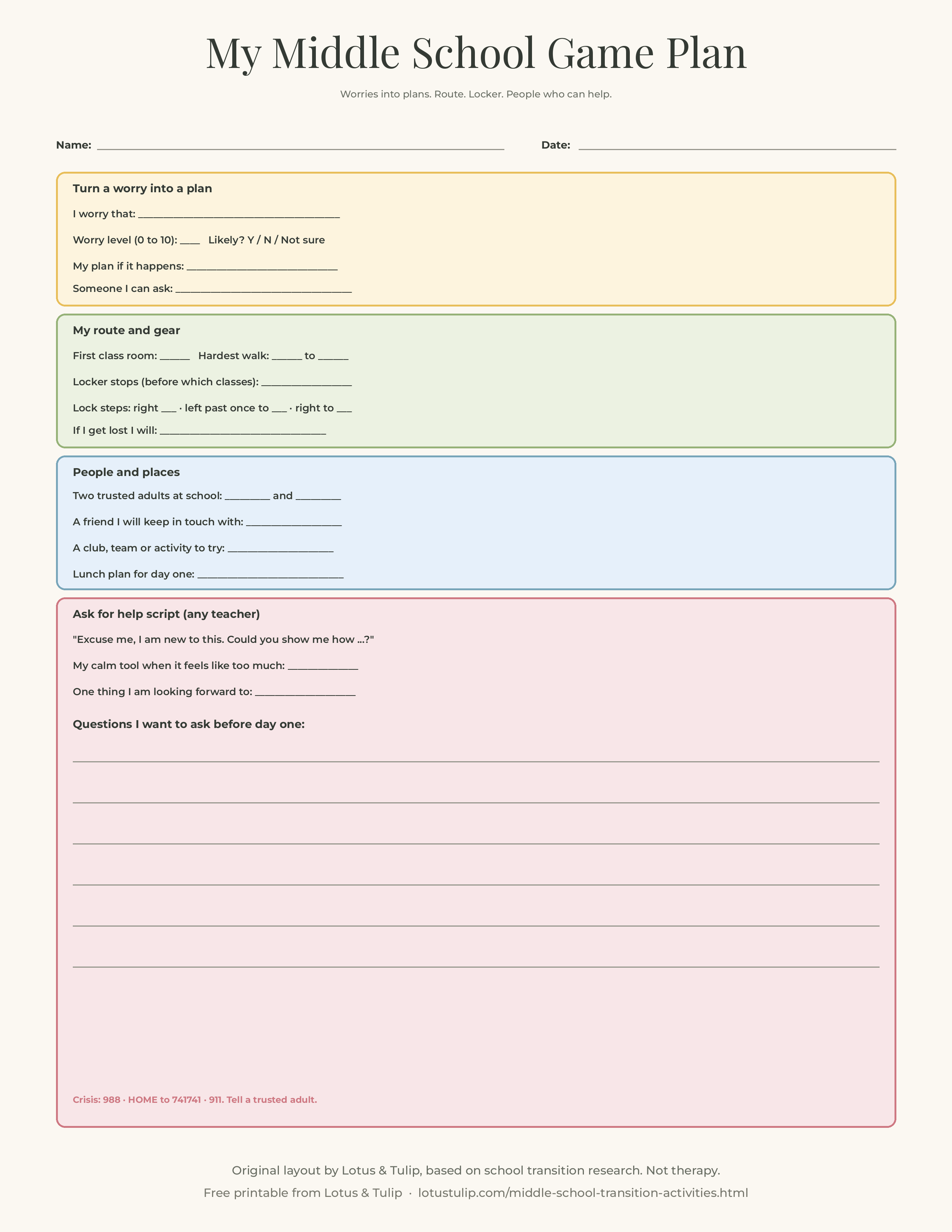
- Page 2: My Middle School Game Plan. Worry into a plan, route and gear (including combination lock steps and an if I get lost plan), trusted adults, a friend to keep, a club to try, a lunch plan, an ask for help script and questions to ask before day one.
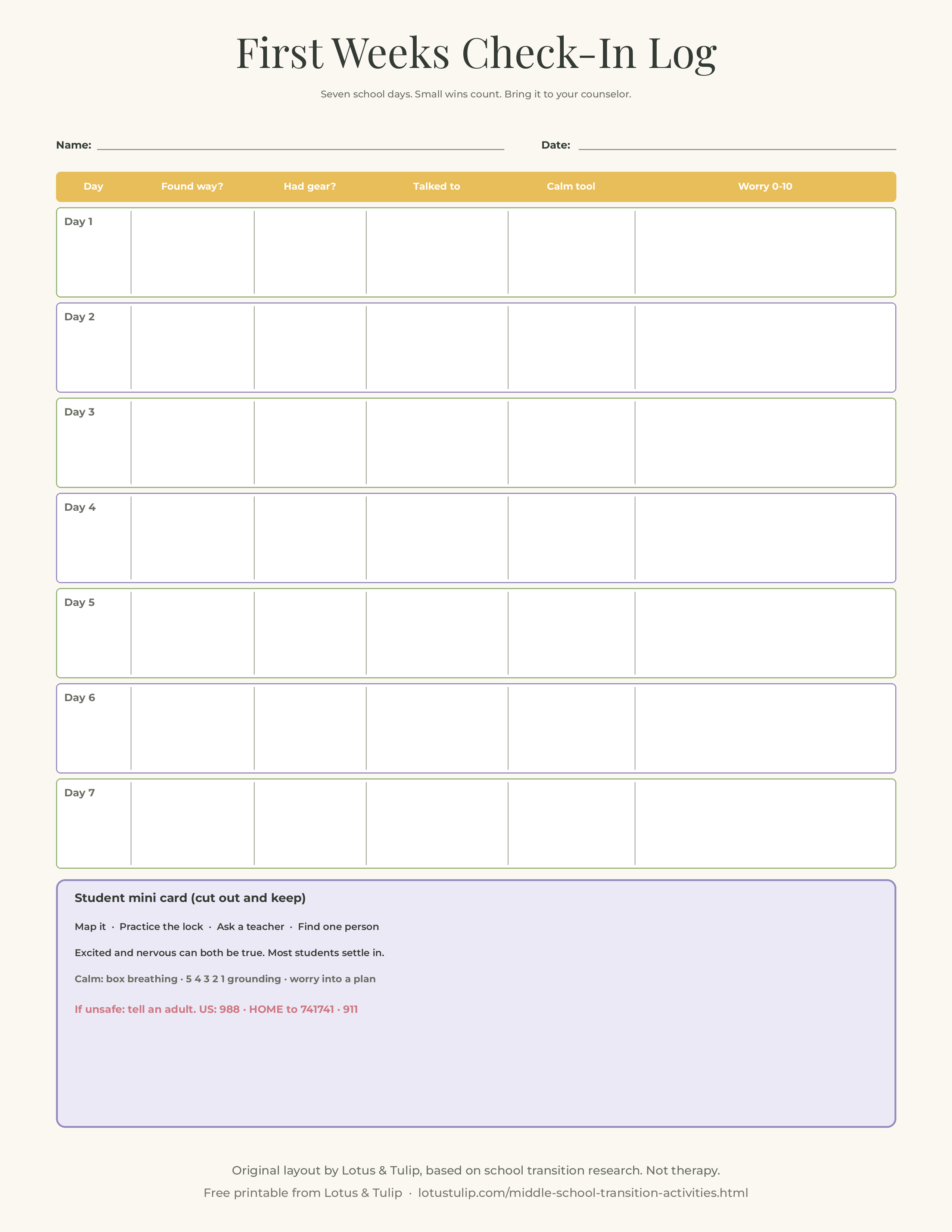
- Page 3: First Weeks Check-In Log + student mini card. Seven school days of found my way, had my gear, talked to, calm tool and worry rating, plus a cut out reminder card.
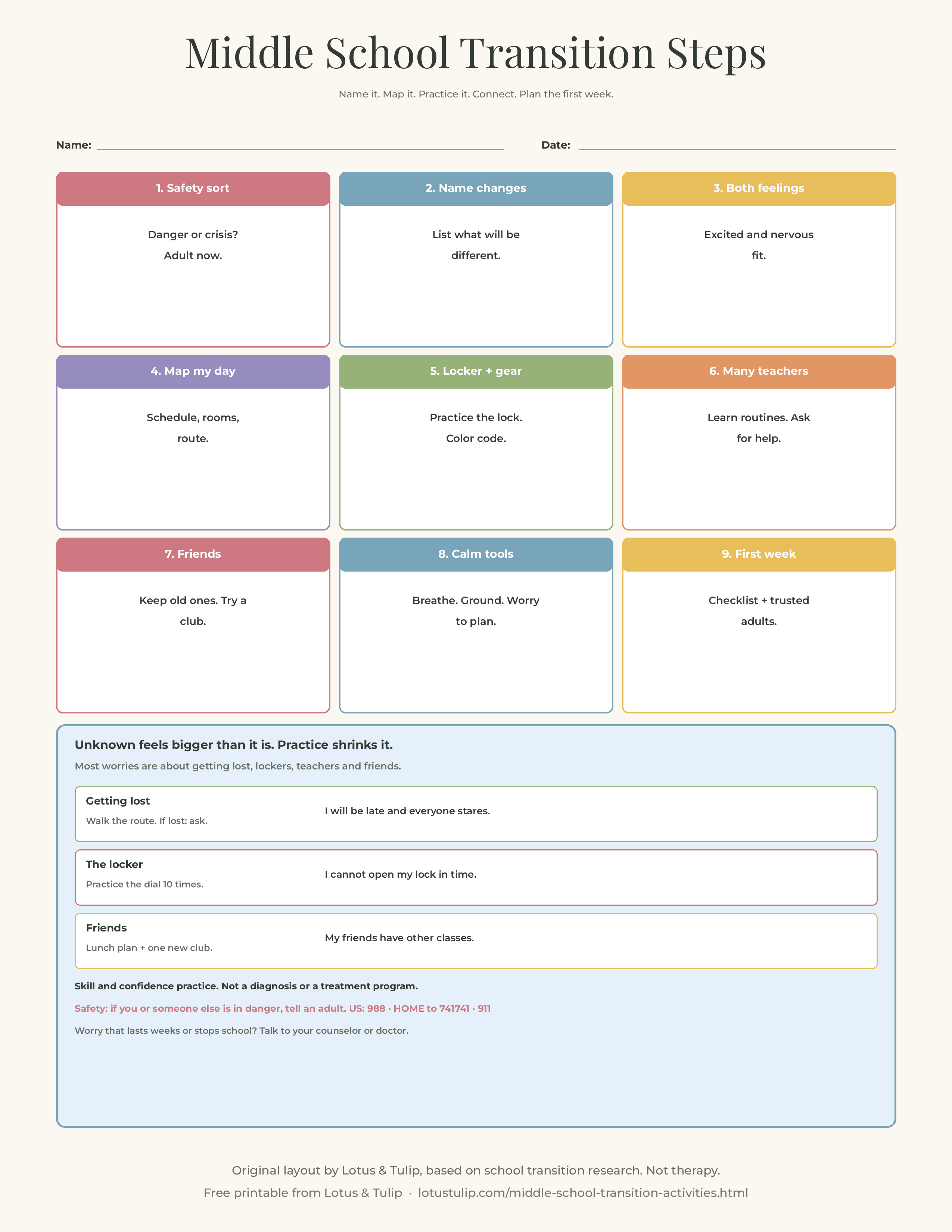
Download the free middle school transition printable (PDF, 3 pages, US Letter)
Prefer single images? Page 1: Transition Steps (PNG) · Page 2: My Game Plan (PNG) · Page 3: First Weeks Check-In Log (PNG)
Free to print for your own use and for use with your own students, clients or groups. This is an original layout by Lotus & Tulip, drawing on widely cited school transition research (Akos and Galassi 2004; Eccles et al. 1993; Alspaugh 1998; Evans, Borriello and Field 2018; Cauley and Jovanovich 2006). It is not affiliated with any author, agency, organization or curriculum named on this page, does not diagnose or treat any condition, and is not a substitute for therapy, evaluation or medical care. Please link to this page rather than re-uploading the file.
Related resources
- School counselor small group curriculums: every ready to teach eight session group in one place.
- Executive functioning worksheets for kids: planning and organization beyond the first week.
- Puberty worksheets for kids: body changes, hygiene and a free body care plan before the move up.
- Study skills activities for teens: the academic side once students are settled.
- Friendship activities for teens: when friendships are the full lesson.
- Worry worksheet for kids: general worry tools for younger students.
- Self advocacy activities for students: asking teachers for what you need.
- Icebreaker activities for counseling groups: openers for session one.
- Safety plan worksheet: when the moment is about staying safe.
Sources
- Akos, P., and Galassi, J. P. (2004). Middle and high school transitions as viewed by students, parents, and teachers. Professional School Counseling, 7(4), 212 to 221.
- Alspaugh, J. W. (1998). Achievement loss associated with the transition to middle school and high school. The Journal of Educational Research, 92(1), 20 to 25.
- Cauley, K. M., and Jovanovich, D. (2006). Developing an effective transition program for students entering middle school or high school. The Clearing House, 80(1), 15 to 25.
- Eccles, J. S., Midgley, C., Wigfield, A., Buchanan, C. M., Reuman, D., Flanagan, C., and Mac Iver, D. (1993). Development during adolescence: The impact of stage environment fit on young adolescents' experiences in schools and in families. American Psychologist, 48(2), 90 to 101.
- Evans, D., Borriello, G. A., and Field, A. P. (2018). A review of the academic and psychological impact of the transition to secondary education. Frontiers in Psychology, 9, 1482.
- American School Counselor Association. ASCA Student Standards: Mindsets and Behaviors for Student Success.
- Collaborative for Academic, Social, and Emotional Learning (CASEL). The CASEL 5 competencies (self awareness, self management, social awareness, relationship skills, responsible decision making).
Middle school transition activities: FAQ
What are middle school transition activities?
They are short, practical activities that help students in grades 5 and 6 prepare for and settle into middle school: reading a schedule, mapping routes, practicing a combination lock, learning many teachers' routines, keeping and making friends, handling group chats and using calm tools, ending with a first week plan.
When should a school counselor run a transition group?
Two good windows: spring of 5th grade, before the move, and the first six to eight weeks of 6th grade, after it. A short mini group also helps new students who arrive mid year and missed orientation.
Which students benefit most from a small transition group?
Students described as anxious or shy about the move, students coming from small or different schools, students who will not know many peers, students who struggled with organization, and new mid year students. Whole grade activities reach everyone else.
How many sessions does a transition group need?
Many counselors use six to eight sessions of about 30 to 40 minutes. This page includes a six session outline. The Next Stop curriculum on Etsy has a fully scripted eight session version with forms.
Is it normal for students to be nervous about middle school?
Yes. Getting lost, lockers, homework, older students and friends are some of the most common worries students name. Most students settle in during the first weeks. Worry that lasts many weeks or keeps a student from attending school deserves extra support.
Do transition activities help with anxiety disorders?
They are a support, not a treatment. Practice and preparation can lower everyday nervousness, but anxiety that stops a student from functioning needs evaluation and care from a qualified professional.
What should I do if a student says something worrying about safety?
Follow your school safety protocol right away. In the US, call or text 988, text HOME to 741741, or call 911 in an emergency, and use a safety plan with a qualified adult.