
Kids and teens · Anxiety and worry · Updated 2026-11-04
Worry worksheet for kids: worry time, a worry box and brave steps that actually help (free printable)
Ready-made printable: Worry Group Curriculum Holiday 20% off: about $11.04, was $14 (EUR 12) · instant digital download
Buy on Etsy
Every child worries. A preschooler worries about the dark, a second grader about a spelling test, a sixth grader about who to sit with at lunch. Most of that is normal and passes. But some children get stuck: the same "what if" loops round at bedtime, they ask the same reassurance question ten times, and they start skipping things they used to enjoy. This guide is for US school counselors, teachers, child and family therapists, and parents who want something practical to do about it. It explains the difference between ordinary worry and worry that needs more help, what the research actually supports, six kid friendly worry tools (naming the worry, sizing it, checking it like a detective, sorting what is in your control, worry time with a worry box, and brave steps), a nine step teaching plan, age by age tips, what to say and what to avoid as an adult, and common mistakes. It ends with a free three page printable: a Worry Detective worksheet, a Worry Time plan with cut out worry box slips, and a Brave Steps ladder.
Jump to the free worry worksheet printable
Worry vs anxiety: what is normal, and when is it too much?
Worry is thinking about something bad that might happen. Anxiety is the whole package: the worried thoughts, the body alarm (fast heart, tummy ache, tight chest), and the urge to avoid or escape. A small amount of both is useful. It is what makes a child look both ways before crossing the street or study for a test.
Many fears are expected at certain ages and tend to fade on their own: fear of strangers and separation in toddlers, the dark, monsters and loud noises in preschoolers, and worries about school, health, friends and "bad things in the news" in elementary and middle school. Teens tend to worry more about social standing, appearance, grades and the future.
Worry is more likely to need extra help when it is:
- Out of proportion. A small, unlikely event (a parent being five minutes late) triggers a big, long reaction.
- Frequent and sticky. The worry shows up most days and is hard to switch off, often at bedtime.
- Getting in the way. The child avoids school, sleepovers, sports, eating in front of others or speaking in class, or family routines bend around the worry.
- Showing up in the body. Regular headaches or stomach aches with no medical cause, trouble falling asleep, or tantrums before feared situations.
- Driving reassurance loops. "Are you sure?" "Promise?" "What if?" asked again and again, with any relief wearing off within minutes.
This is not rare. In the CDC's summary of 2023 to 2024 National Survey of Children's Health data, about 11% of US children ages 3 to 17 had current, diagnosed anxiety, and diagnosed anxiety becomes more common as children get older. A worksheet cannot diagnose or treat an anxiety disorder, but the skills below are the same building blocks used in evidence based treatment, and they are useful for any child who worries.
What the research says
Here is what the evidence supports, stated as carefully as the studies allow.
- CBT is the best studied treatment for childhood anxiety. A 2020 Cochrane review led by Anthony James pooled 87 randomized trials with 5,964 children and adolescents with anxiety disorders. Compared with a waitlist or no treatment, 49.4% of young people who had CBT no longer had their main anxiety diagnosis after treatment, compared with 17.8% of those on a waitlist. The authors rated that evidence as moderate quality and found little evidence that CBT beat usual care or other active treatments. The tools in this guide (naming worries, checking thoughts, problem solving, gradual brave steps) are core pieces of CBT for anxiety.
- Facing fears in small steps matters. Avoidance brings quick relief, which teaches the brain that the situation really was dangerous. Gradual exposure, done in small planned steps, is a central part of CBT for childhood anxiety and is the idea behind the Brave Steps ladder in the printable.
- Parents can help by reducing accommodation. Accommodation means the changes a family makes to spare a child anxiety: answering the same reassurance question over and over, speaking for a child, or skipping events. In a 2020 randomized trial in the Journal of the American Academy of Child and Adolescent Psychiatry, Eli Lebowitz and colleagues assigned 124 children ages 7 to 14 with anxiety disorders either to child CBT or to SPACE (Supportive Parenting for Anxious Childhood Emotions), a program delivered only to parents that teaches supportive statements and less accommodation. The parent only program was noninferior to CBT, and both groups improved.
- "Worry time" has early support, mostly in adults. Scheduling worries for a set time and place is called stimulus control or worry postponement. T. D. Borkovec and colleagues reported in 1983 that self labeled worriers who postponed worries to a daily worry period reported less daily worry than untreated controls. In a 2013 study in Behavior Modification, Sarah Kate McGowan and Evelyn Behar randomly assigned 53 people with high worry to two weeks of a daily 30 minute worry period or a comparison condition; the worry period group showed bigger drops in worry, anxiety and insomnia. Both studies were in adults and were small, so treat worry time for children as a sensible adaptation, not a proven cure.
- "Just stop thinking about it" tends to backfire. In a classic 1987 experiment by Daniel Wegner and colleagues, people told to suppress a thought (a white bear) went on to think about it more afterward. That is why the tools below help a child notice, contain and test a worry rather than push it away.
- Screening is now recommended. In 2022 the US Preventive Services Task Force recommended screening for anxiety in children and adolescents ages 8 to 18 in primary care. If a child's worry worries you, the pediatrician is a reasonable first call.
Six worry tools for kids
These six tools work best taught in order, one or two at a time, while the child is calm. The free printable covers all of them.
1. Name it and shrink it down to size
Help the child put the worry into one plain sentence: "I am worried that Mom will forget to pick me up." Vague dread is harder to work with than a clear sentence. Many counselors also help children give the worry a character: a worry monster, a worry bug, a little alarm that rings too loud. Treating the worry as something separate from the child (externalizing it) comes from narrative therapy and is used in popular CBT based books for children such as Dawn Huebner's What to Do When You Worry Too Much (we are not affiliated). It lets a child say "my worry is being loud today" instead of "I am a scaredy cat."
Then rate it. On the printable, the child colors a worry size from 1 (tiny) to 5 (huge). Rating before and after using a tool shows the child that worries change, which is half the lesson.
2. Notice the body alarm
Children often feel worry before they can name it: butterflies, a tight throat, hot cheeks, needing the bathroom. Teach that this is the body's alarm system doing its job a little too eagerly, not a sign that something is wrong with them. Pair this with one calming skill they already know, such as a slow breath out. Our breathing exercises for kids guide has 12 options with steps.
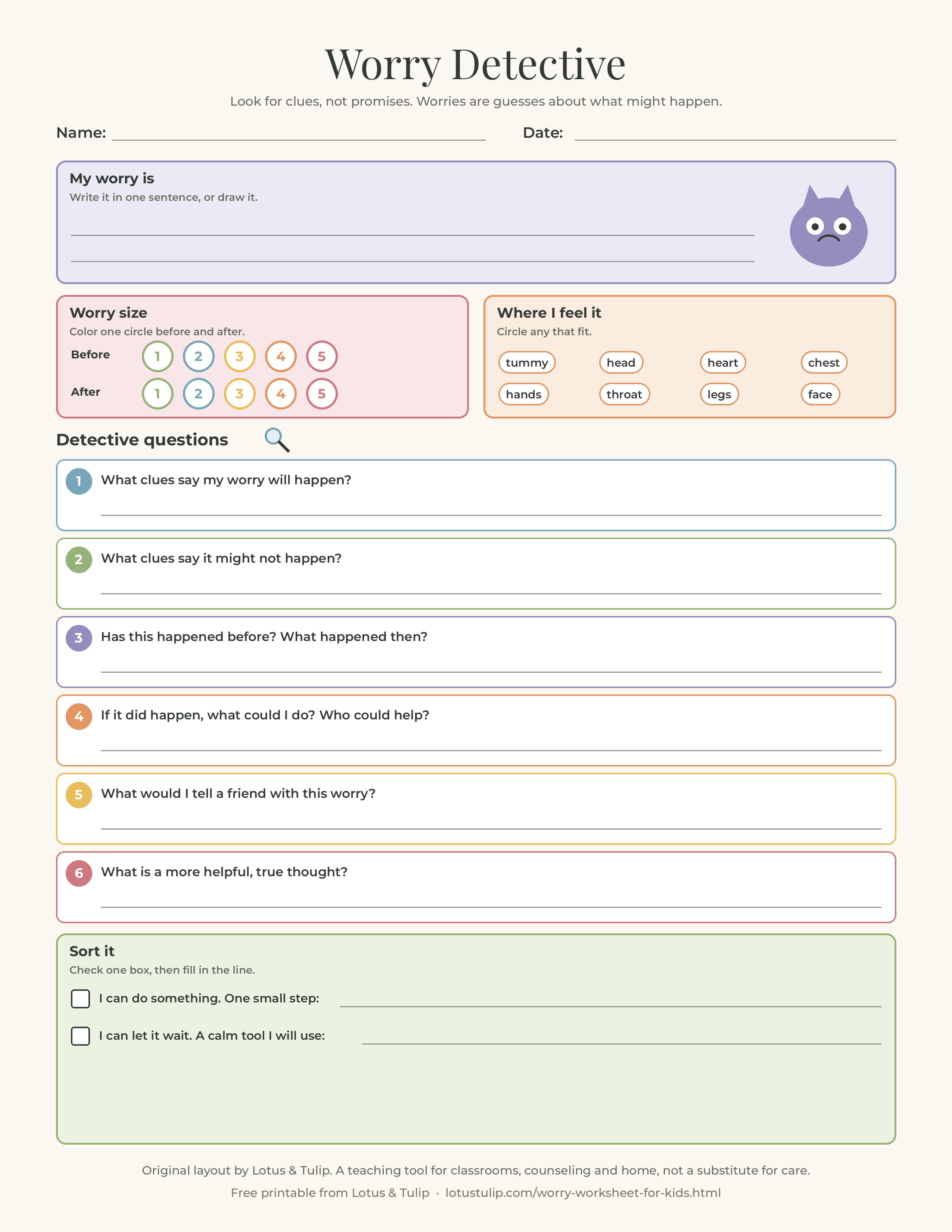
3. Be a worry detective
This is the kid friendly version of a CBT thought check. The child looks for clues, not reassurance:
- What exactly am I worried will happen?
- What clues say it will happen? What clues say it might not?
- Has this happened before? What happened then?
- If it did happen, what could I do? Who could help?
- What would I tell a friend who had this worry?
- What is a more helpful, true thought? ("Mom has been late twice and both times she came. If she is late, I can wait with Ms. Lee.")
The aim is a thought that is helpful and believable, not a promise that nothing bad will ever happen. "It will be fine!" is not a detective answer. "It might be hard, and I have handled hard things before" is.
4. Sort it: can I do something about it?
Some worries point to a real problem with a next step (I have not started my project), and some are about things a child cannot control (the weather on field day, a grandparent's illness). For the first kind, make a tiny plan with one action. For the second, the job is to notice the worry, use a calming tool and turn attention back to the present. Our circle of control worksheet goes deeper on this sort.
5. Worry time and a worry box
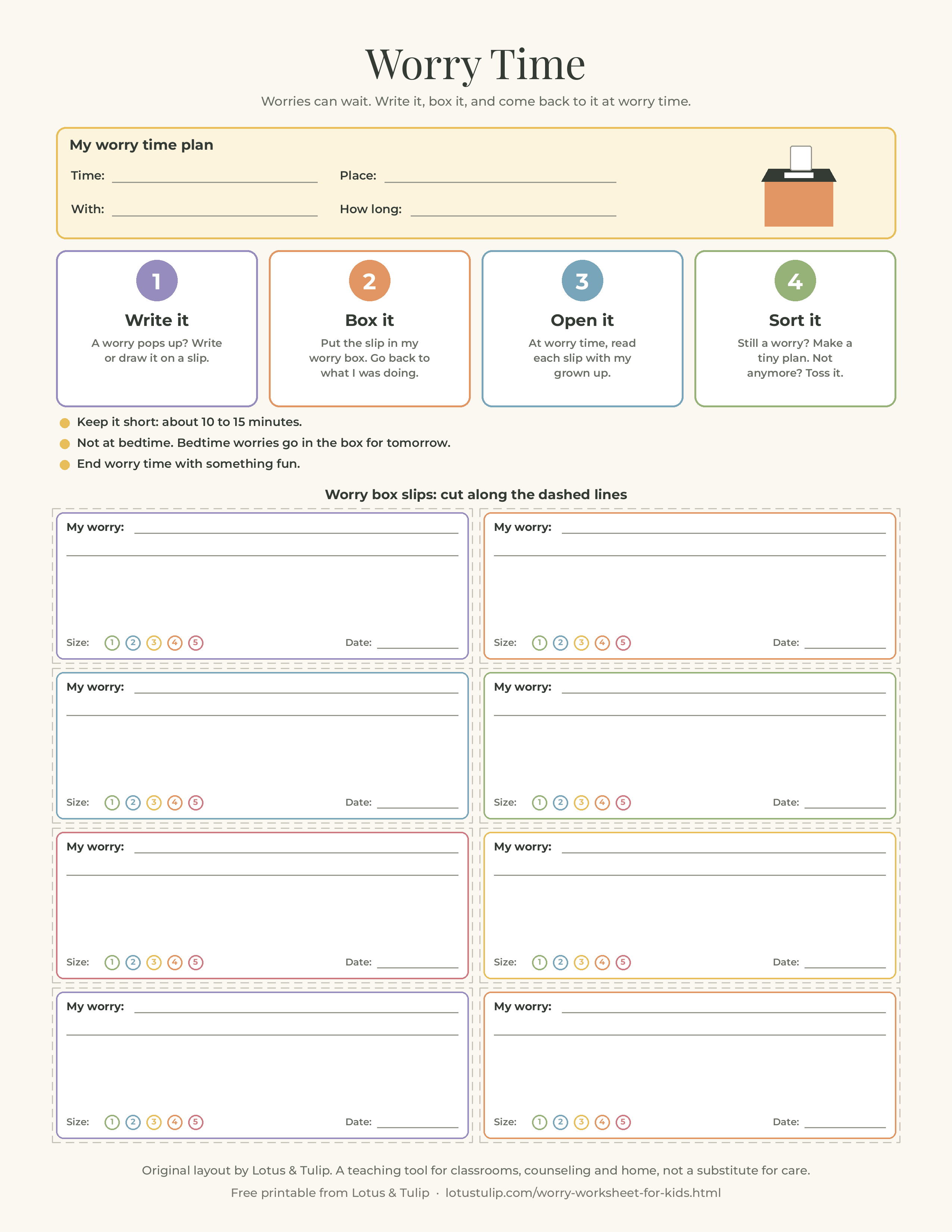
Worry time gives worries an appointment. When a worry pops up during the day, the child writes it on a slip (or tells an adult in one sentence), puts it in a worry box, jar or envelope, and goes back to what they were doing. Later, at a set worry time, the child and an adult open the box together, sort each slip (still a worry or not anymore? something I can do or not?), make a small plan for the ones that need it, and then close the box. The point is not to ban worry. It is to show the child that worries can wait, and that many have shrunk or vanished by the time worry time comes.
Practical rules for children:
- Keep it short. Adult studies used about 30 minutes. For most children, 10 to 15 minutes is plenty, shorter for young children.
- Same time and place each day. After school snack at the kitchen table works well. Avoid bedtime, which is the time you want worry free.
- End with something pleasant. A game, a story or outdoor time, so worry time is not the last thing the child remembers.
- Bedtime worries go in the box. A slip and a pencil by the bed lets a child "park" a worry for tomorrow.
6. Brave steps
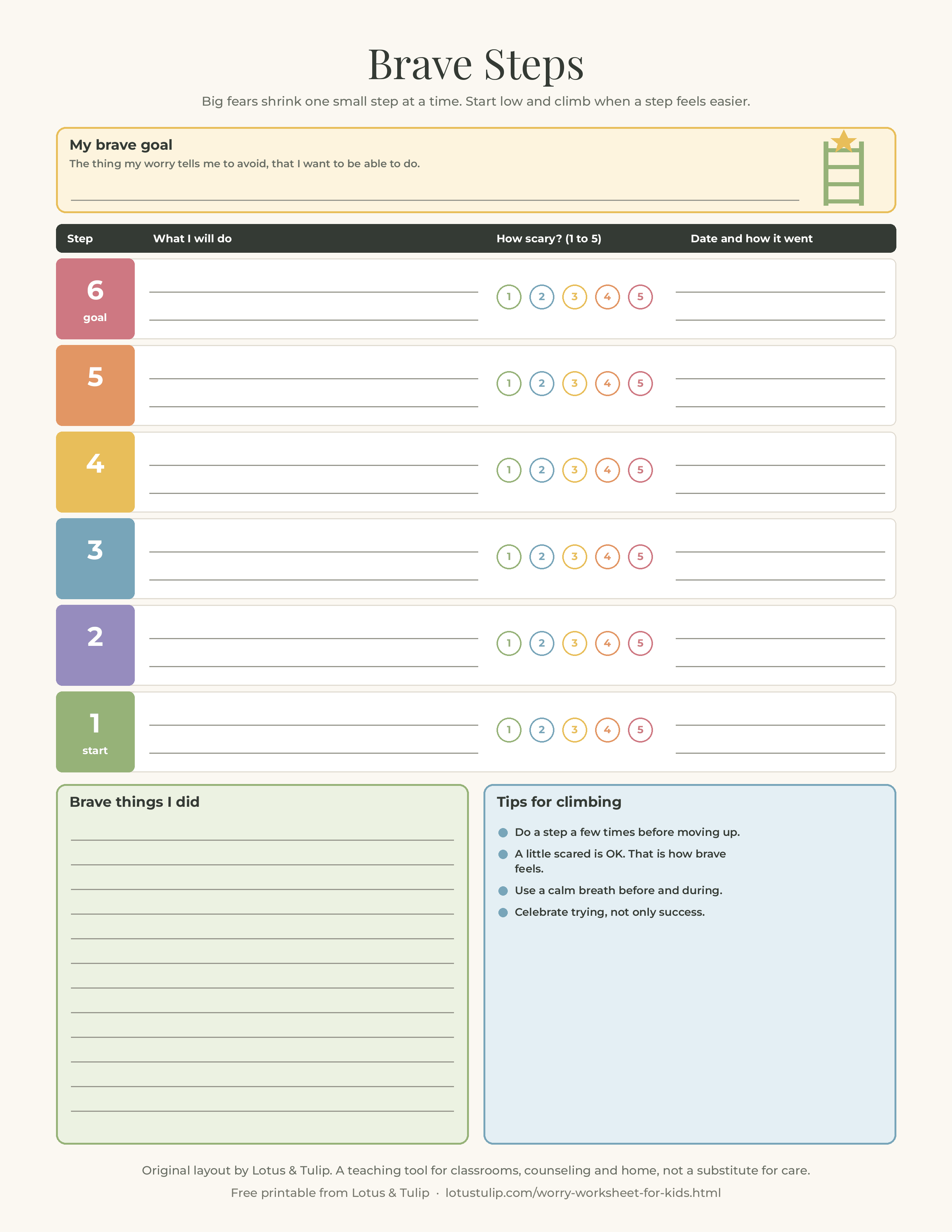
Avoidance is what keeps worry big. A brave steps ladder (sometimes called a fear ladder) breaks a feared goal into small steps, from a little scary to the goal itself, and the child climbs one step at a time, staying with each one until it feels easier. For a child afraid to order at a restaurant, steps might be: point to the menu item while a parent orders, say "please" and "thank you" to the server, order a drink, order a full meal. Let the child help choose the steps and rate how scary each one is from 1 to 5. Practice a step several times before moving up, and celebrate effort, not just success.
For a child with an anxiety disorder, OCD or trauma related fears, plan exposure steps with a licensed mental health professional rather than alone.
How to use a worry worksheet with kids, step by step
- Pick a calm moment. Introduce the worksheet when the child is relaxed, not mid worry. Skills learned calm are easier to use upset.
- Normalize worry first. Explain that everyone worries and that worry is the brain trying to protect us, sometimes too hard. One sentence is enough.
- Write the worry in one sentence. Use the child's words. Young children can draw it or dictate it.
- Rate the worry size. Color 1 to 5 on the worry size scale and note where they feel it in the body.
- Look for clues. Work through the Worry Detective questions together. Ask, do not tell. Accept "I don't know" and offer two options to choose from.
- Find a helpful thought. Help the child write a thought that is both true and kinder, then read it aloud.
- Sort and plan. Decide if there is one small thing to do. If yes, write it. If no, choose a calming tool and a "turn my attention to" activity.
- Re-rate the worry. Color the worry size again. A drop of even one point is worth pointing out. No change is also useful information.
- Set up worry time and a first brave step. Agree on a daily worry time, make the worry box, and pick one small brave step for the week. Review the ladder and slips at the next session.
Worry tools by age
| Age | What works | Keep in mind |
|---|---|---|
| Preschool (3 to 5) | Drawing the worry, a worry character or puppet, a decorated worry box or jar, very short worry time with a parent, one tiny brave step with lots of praise. | Detective questions are too abstract. Keep words simple and lean on routines, comfort and modeling calm. |
| Early elementary (5 to 8) | Worry monster or worry bug, worry size scale, worry box slips, simple clue questions ("Has this happened before?"), sticker charts for brave steps. | Children this age love making the box. Let them own it. Keep worry time to about 10 minutes. |
| Upper elementary (8 to 11) | The full Worry Detective worksheet, sorting in my control vs not, a brave steps ladder with 4 to 6 steps they help design. | They can spot thinking traps like "always" and "never." Praise the effort of checking, not the "right" answer. |
| Middle and high school (11 to 18) | Thought records, a worry log on their phone, scheduled worry time, problem solving steps, a self directed exposure plan. | Drop babyish characters if they cringe. Respect privacy, and connect the skills to goals they care about (sports, friends, sleep, grades). |
Worry activities for school counselors and therapists
- Worry box craft. In a first session, children decorate a tissue box, envelope or jar. It becomes the anchor for worry time between sessions.
- Worry or fact sort. Read short statements ("I might fail the test," "The test is on Friday") and have students sort them into worry thoughts and facts.
- Detective role play. One student reads a worry card; the group asks the detective questions and builds a helpful thought together.
- Brave steps share. Each session opens with students sharing a brave step from the week. Normalize steps that did not go perfectly.
- Worry size check in. A quick 1 to 5 rating at the start and end of each session gives you simple outcome data. Our anxiety small group guide has a free worry check in sheet for this.
What adults can say (and what to avoid)
Children borrow calm from the adults around them. The research on accommodation suggests a simple formula: show you understand the feeling, then show you believe the child can cope.
| Instead of | Try |
|---|---|
| "Don't worry, it's nothing." | "That sounds really worrying. I know you can handle hard things." |
| "I promise nothing bad will happen." | "I can't promise everything will go perfectly, but I will be here and we will figure it out." |
| Answering the same reassurance question for the tenth time | "I already answered that one. What would your worry detective say?" |
| "Fine, you can skip it." | "Let's find a smaller brave step you can do today." |
| "Stop thinking about it." | "Let's write it down and save it for worry time." |
Cutting back on reassurance and accommodation is easier said than done, and a child's anxiety usually rises at first. Go slowly, warn the child about the change ahead of time, and use the supportive statement every time. If the family is stuck, a therapist trained in a parent based approach can help.
Common mistakes
- Using the worksheet as a lecture. If the adult supplies all the answers, the child learns nothing. Ask, wait, offer choices.
- Chasing total certainty. The goal is "I can cope with not knowing," not "I am sure nothing bad will happen."
- Making worry time too long or at bedtime. Long worry sessions feed rumination, and bedtime worry time keeps a child awake.
- Jumping to the top of the ladder. Steps that are too big lead to escape, which strengthens the fear. Make the first step almost easy.
- Treating every worry the same. A worry about real danger, bullying or abuse is not a thinking trap. Take it seriously and act on it.
- Waiting too long to get help. If worry is getting in the way of school, sleep, friendships or family life for weeks, talk to the pediatrician, school counselor or a licensed therapist.
When to get more help
Reach out to a pediatrician, school counselor or licensed child therapist if worry lasts for weeks and is affecting school attendance, sleep, eating, friendships or family life, if a child has panic attacks, if fears are spreading to more situations, or if you see signs of depression, self harm or talk of not wanting to be alive. The American Academy of Child and Adolescent Psychiatry's 2020 clinical practice guideline describes both CBT and SSRI medication as having considerable research support as short term treatments for anxiety disorders in children and adolescents; which fits a given child is a decision to make with a clinician.
Safety note: If a child, teen or adult is struggling or having thoughts of suicide, call or text the 988 Suicide and Crisis Lifeline at 988 or chat at 988lifeline.org. It is free, confidential and available 24 hours a day. If someone is in immediate danger, call 911. This guide and printable are educational and are not a substitute for medical or mental health care.
Free worry worksheet printable (PDF)
This free printable is an original Lotus & Tulip design, sized for US Letter paper and suited to about ages 6 to 12, small groups and home (older students can use it too). It has three pages:
- Page 1: Worry Detective worksheet. Write or draw the worry, color the worry size before and after, mark where you feel it in your body, answer six detective questions, write a helpful thought and sort the worry into "I can do something" or "I can let it wait."
- Page 2: Worry Time plan and worry box slips. Set a daily worry time and place, follow the four step worry time routine, and cut out eight worry slips to fill in and drop into a worry box or jar.
- Page 3: Brave Steps ladder. Write a brave goal, break it into six steps from a little scary to the goal, rate each step from 1 to 5, and track the date and how it went, with a "brave things I did" box.
Download the free worry worksheet printable (PDF, 3 pages, US Letter)
Prefer single images? Page 1: Worry Detective (PNG) · Page 2: Worry Time plan and worry box slips (PNG) · Page 3: Brave Steps ladder (PNG)
Free to print for your own use and for use with your own students, clients or children. Please link to this page rather than re-uploading the file.
Related resources
- Nightmare worksheets for kids: moving worry time away from lights out, free bedtime worries map
- Separation anxiety worksheet for kids (free printable): a goodbye plan and a brave apart ladder
- CBT worksheets for kids (free printable): thought detective and a five step brave ladder
- Worry time worksheet: scheduled worry time and worry postponement for kids, teens and adults (free plan and log)
- Breathing exercises for kids, 12 techniques (free printable)
- Circle of control worksheet (free printable)
- Small group counseling curriculum for anxiety (free worry check in sheet)
- Positive self talk worksheet for kids and teens (free printable)
- Coping skills list for kids, 60 ideas (free printable)
- CBT thought record worksheet (free printable)
Sources
- Centers for Disease Control and Prevention. Data and Statistics on Children's Mental Health (National Survey of Children's Health, 2023 to 2024). cdc.gov.
- James, A. C., Reardon, T., Soler, A., James, G., and Creswell, C. (2020). Cognitive behavioural therapy for anxiety disorders in children and adolescents. Cochrane Database of Systematic Reviews, Issue 11, CD013162.
- Lebowitz, E. R., Marin, C., Martino, A., Shimshoni, Y., and Silverman, W. K. (2020). Parent-based treatment as efficacious as cognitive-behavioral therapy for childhood anxiety: a randomized noninferiority study of Supportive Parenting for Anxious Childhood Emotions. Journal of the American Academy of Child and Adolescent Psychiatry, 59(3), 362 to 372.
- Borkovec, T. D., Wilkinson, L., Folensbee, R., and Lerman, C. (1983). Stimulus control applications to the treatment of worry. Behaviour Research and Therapy, 21(3), 247 to 251.
- McGowan, S. K., and Behar, E. (2013). A preliminary investigation of stimulus control training for worry: effects on anxiety and insomnia. Behavior Modification, 37(1), 90 to 112.
- Wegner, D. M., Schneider, D. J., Carter, S. R., and White, T. L. (1987). Paradoxical effects of thought suppression. Journal of Personality and Social Psychology, 53(1), 5 to 13.
- US Preventive Services Task Force (2022). Screening for anxiety in children and adolescents: recommendation statement. JAMA, 328(14), 1438.
- Walter, H. J., Bukstein, O. G., Abright, A. R., et al. (2020). Clinical practice guideline for the assessment and treatment of children and adolescents with anxiety disorders. Journal of the American Academy of Child and Adolescent Psychiatry, 59(10), 1107 to 1124.
- Huebner, D. (2006). What to Do When You Worry Too Much: A Kid's Guide to Overcoming Anxiety. Magination Press. (Recommended reading; not affiliated.)
- 988 Suicide and Crisis Lifeline, 988lifeline.org.
FAQ
What is a worry worksheet for kids?
A worry worksheet is a printable page that walks a child through a worry step by step: naming it, rating how big it feels, checking the clues for and against it, finding a more helpful thought and deciding whether there is something to do about it. It is a kid friendly version of the thought checking used in cognitive behavioral therapy.
What is worry time for kids?
Worry time is a short, scheduled time each day, often 10 to 15 minutes after school, when a child and an adult look at the worries the child saved up. During the day, worries are written on slips and put in a worry box to wait. It teaches children that worries can be postponed and many shrink on their own. Avoid scheduling it at bedtime.
How does a worry box work?
A worry box is any box, jar or envelope where a child drops a written or drawn worry so they do not have to keep carrying it in their head. At worry time, the child and an adult open the box together, sort each slip, make a small plan for worries that need one, and throw away the slips that no longer matter.
What is a worry monster?
A worry monster is a character a child uses to stand for their worry, sometimes a plush toy with a zip mouth that "eats" worry slips. Giving worry a character helps children see it as something separate from themselves that they can talk back to, an idea drawn from narrative therapy and used in many CBT based books for kids.
How do I help my child stop worrying so much?
Rather than trying to stop worry entirely, teach your child to name the worry, check it like a detective, use a calming skill, save worries for worry time and take small brave steps toward things they avoid. Show you understand the feeling and that you believe they can cope, and gradually cut back on repeated reassurance. If worry interferes with daily life for weeks, talk to your pediatrician or a licensed therapist.
When is a child's worry a sign of an anxiety disorder?
Worry may point to an anxiety disorder when it is out of proportion to the situation, happens most days, lasts for weeks, and gets in the way of school, sleep, friendships or family life, or when a child avoids more and more situations. Only a qualified professional can diagnose this. The US Preventive Services Task Force recommends anxiety screening for children and teens ages 8 to 18.
Is this worry worksheet printable free?
Yes. It is free to print for your own use and for use with your own students, clients or children. Please link to this page rather than re-uploading the file.