
Kids and teens · Body image in children ages 5 to 12 · Updated 2026-11-14
Body image worksheets for kids: how body image starts, what research shows and a free body kind plan

Ages 5 to 11: Kids Feelings and Social Skills Worksheets, incl. feelings detective, body clues, a feelings thermometer, a coping skills menu and a calm down plan Holiday 20% off: about $11.04, was $14 (EUR 12) · fillable PDF, instant digital download
Buy on EtsyTry it free first: download a fillable sample (feelings thermometer and calm-down plan, PDF, 240 KB). Type into it on screen, then get the full pack. No email needed.
Strengths and inner coach: Self Esteem Worksheets for Kids and Teens, all 18 worksheets Holiday 20% off: about $9.20, was $12 (EUR 10) · instant digital download
Buy on EtsyKids and teens bundle: Kids and Teens Worksheets Bundle (feelings, anger, self esteem, social anxiety) Holiday 20% off: about $22.08, was $28 (EUR 24) · 80 pages, instant digital download
Buy on Etsy"My tummy is too big." "I can't wear that, I look fat." "Why don't I look like her?" Hearing words like these from a six or eight year old is upsetting, and many parents assume body worries only start in the teen years. Research says otherwise: children start to pick up messages about which bodies are "good" well before they reach middle school. The good news is that the adults around a child have real influence, and small, everyday changes in how a family talks about bodies, food and looks can make a difference.
This guide is for parents, teachers, school counselors and child therapists supporting children about 5 to 12. It explains what body image is, how early body worries start, what research shows (including its limits), why weight talk and teasing backfire, what body image worksheets can and cannot do, eight kinds of worksheets and activities, nine steps to use them, age adaptations, the school side, common mistakes and three short examples. It ends with a free 2 page printable: My Amazing Body and My Body Kind Plan.
Safety first: if a child talks, writes or draws about wanting to die or hurting themselves, call or text 988 (the 988 Suicide and Crisis Lifeline). If anyone is in immediate danger, call 911. See your pediatrician soon if your child is dieting, skipping meals, hiding food, making themselves sick, exercising to "burn off" food, losing weight or falling off their growth curve, or seems preoccupied with weight or shape. These can be early signs of an eating disorder, and early help matters.
Download the free body image worksheets for kids (PDF, 2 pages, US Letter)
Direct download, no email or sign up. See the pages first. Working with an adult or older teen? See the body image worksheet for adults and self esteem worksheets for kids.
What body image is, in plain words
Body image is how a child thinks and feels about their body: how they see it, what they believe about it and how those beliefs affect what they do. A child with a healthy body image can notice things they would like to be different and still feel basically okay in their body, enjoy using it and care for it. Positive body image is not the same as thinking you look perfect. Researchers describe it as appreciating and respecting your body, including what it can do, and filtering out messages that make you feel bad about it (Tylka and Wood-Barcalow, 2015).
For children, body image grows out of what they hear and see every day: comments from family, teasing or praise from friends, characters and adverts on screens and how the adults around them talk about their own bodies. That is why the most useful body image work for kids involves the grown ups, not only the child.
Signs a child is struggling with body image
- Negative talk about their body, such as "I'm fat," "I'm ugly" or "I hate my legs," that comes up again and again rather than once.
- Comparing, for example asking whether they are bigger than a friend or a sibling, or comparing themselves with people on screens.
- Avoiding things they used to enjoy, such as swimming, sports, dancing, photos or certain clothes, because of how they look.
- Changing how they eat to change their body, like asking about calories, refusing foods they call "fattening," skipping snacks or saying they need to diet.
- Checking, such as long times in front of the mirror, pinching their tummy or repeatedly asking "Do I look fat?"
- Distress after teasing, or being teased about weight, height, skin, hair or other features.
One comment is not a crisis. A pattern that lasts for weeks, or any change in eating or weight, is worth taking seriously and raising with your pediatrician.
What the research shows, honestly
- Body worries start young. In an Australian study, 135 children aged 5 to 8 chose figures showing their current and ideal body. Girls aged 6, 7 and 8 rated their ideal figure as significantly thinner than their current one, while 5 year old girls and boys of all ages did not show a significant gap. Awareness of dieting grew with age in both girls and boys. The authors concluded that the desire for thinness emerges in girls at around age 6, and girls' dissatisfaction was linked with how they saw their mothers' feelings about their own bodies (Lowes and Tiggemann, 2003).
- Even before school, some children have absorbed the message. A systematic review of 16 studies of children under 6 found that body dissatisfaction ranged from about 20% to 70%, depending on how it was measured, and that parents appeared to be an important influence (Tatangelo and colleagues, 2016). In a study of 111 five year old girls, 34% reported at least a moderate level of dieting tendencies; most were satisfied with their body size, but half showed some belief that thinner is better, and media exposure and appearance talk with peers were the strongest predictors (Damiano and colleagues, 2015).
- Peers and screens matter early. In a one year study of 97 girls aged 5 to 8, girls who believed their friends wanted to be thinner were more likely to want to be thinner themselves a year later, watching appearance focused TV predicted lower appearance satisfaction, and wanting to be thinner came before lower self esteem (Dohnt and Tiggemann, 2006). Among older children, the US Surgeon General's 2023 advisory reported that 46% of adolescents aged 13 to 17 said social media makes them feel worse about their body image.
- Weight talk at home is linked to more unhealthy eating, not less. In a US study of 2,793 adolescents and 3,709 parents, teens whose mothers or fathers talked with them about weight or size were more likely to diet, use unhealthy weight control behaviors and binge eat. When parents talked only about healthy eating, teens with overweight were less likely to diet or use unhealthy weight control behaviors (Berge and colleagues, 2013).
- Weight teasing has lasting effects. In Project EAT, about a quarter of 2,516 adolescents had been teased about their weight at least a few times a year. Five years later, boys who had been teased were more likely to have started binge eating (4.1% vs 1.4%) and unhealthy weight control behaviors (27.5% vs 19.3%), and girls who had been teased were more likely to have become frequent dieters (18.2% vs 11.0%) (Haines and colleagues, 2006).
- Pediatricians advise the same approach. The American Academy of Pediatrics recommends discouraging dieting and meal skipping, encouraging more frequent family meals, promoting a positive body image, and encouraging families not to talk about weight but about healthy eating and being active (Golden and colleagues, 2016).
- School programs help a little, and the effects can fade. A review of classroom body image programs for young teens found 16 programs, of which 7 improved body image on at least one measure, with small effects (d = 0.22 to 0.48); effective programs included media literacy, self esteem and peer influence (Yager and colleagues, 2013). A single 90 minute lesson for 1,707 British students aged 11 to 13 gave short term benefits that were not maintained a few weeks later (Diedrichs and colleagues, 2015). A five session version taught by teachers to 848 students, compared with 647 controls, improved body esteem after the program and at 2 and 6 months, with small effects (d = 0.15 to 0.26) (Diedrichs and colleagues, 2021).
- Parents of young children can help. In an exploratory Australian trial, children whose parents received Confident Body, Confident Child, a program on positive body image and healthy eating for parents of preschoolers, reported higher body esteem 18 months later than children of parents in other groups (Hill, Hart and Paxton, 2020). The sample was small (89 children), so treat this as promising rather than proven.
- The limits. Most studies are with girls, many are cross sectional or short term, and effects are usually small. We found no trials of body image worksheets on their own for children. Worksheets are tools inside the approaches with evidence: focusing on what bodies do, questioning appearance ideals and comparison, reducing weight talk and teasing, and involving parents and schools.
Why weight talk, diet talk and teasing backfire
Many adults comment on weight out of love or worry: "You don't need seconds," "Are you sure you want that?" or "You've filled out." Others criticize their own bodies in front of children without thinking. These comments are understandable, and research suggests they usually make things harder.
- Children learn what adults value. When grown ups talk a lot about weight, shape and dieting, children learn that bodies are something to judge and fix.
- Weight focused talk is linked to unhealthy eating. In the study of 2,793 teens above, weight talk from parents went with more dieting and binge eating, while talk about healthy eating did not (Berge and colleagues, 2013).
- Dieting is a risk, not a fix. The AAP notes that dieting is a risk factor for both obesity and eating disorders in adolescents (Golden and colleagues, 2016).
- Teasing, even "just joking," hurts. Family weight teasing predicted weight problems and disordered eating five years later in Project EAT (Neumark-Sztainer and colleagues, 2007).
- What helps instead: talk about what bodies do, who your child is and how they treat others, and talk about food as fuel, fun and family time rather than "good" and "bad." Leave weight conversations to your pediatrician, ideally out of your child's hearing.
What body image worksheets can and cannot do
They can: help a child notice and name body thoughts; shift attention from how the body looks to what it does; build a sense of worth based on character, skills and relationships; plan what to do when they hear body talk or teasing; practice spotting unrealistic images on screens; and give parents, teachers and counselors a shared, positive language.
They cannot: diagnose or treat an eating disorder, replace a pediatrician, therapist or dietitian, or undo daily weight talk at home or harsh teasing at school. If eating or weight is changing, worksheets are a supplement to medical care, not a substitute.
8 kinds of body image worksheets and activities for kids
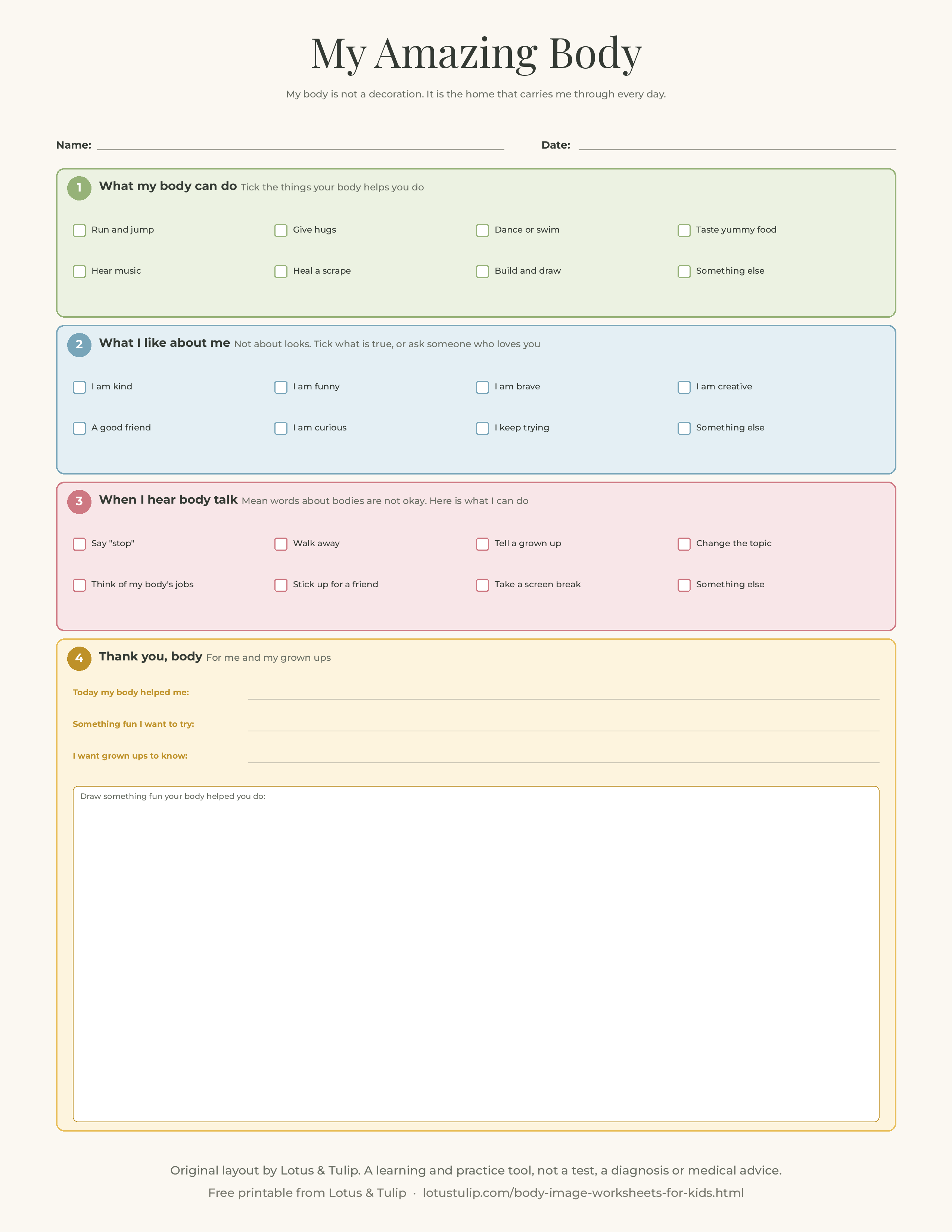
- What my body can do. A list or drawing of the things the child's body lets them do: run, hug, dance, taste, hear music, heal a scrape. This "body functionality" focus comes from adult research that found it improved body image (Alleva and colleagues, 2015), adapted here for children.
- What I like about me that is not about looks. Kindness, humor, bravery, creativity, being a good friend. Ask a parent or teacher to add one too.
- Body talk response plan. What to do when someone says something mean about bodies: say "stop," walk away, change the topic, stick up for a friend or tell a grown up.
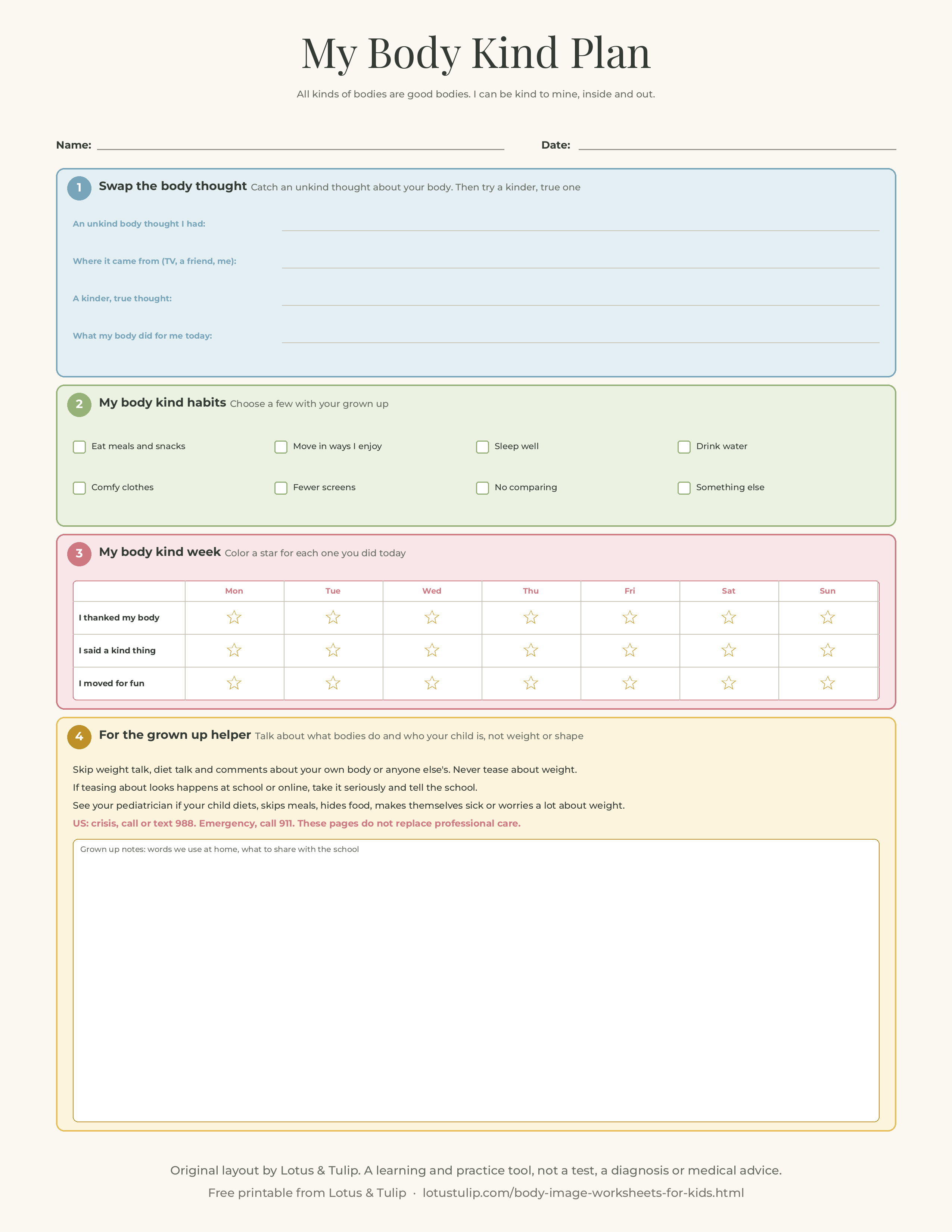
- Swap the body thought. A simple, child sized version of thought work: write an unkind body thought, where it came from and a kinder, true thought.
- Real or edited? A media literacy activity: look at ads or posts together and spot filters, editing, lighting and posing. Media literacy was a common feature of effective school programs (Yager and colleagues, 2013).
- All kinds of bodies. Look at photos of people of different sizes, shapes, ages, abilities and skin colors doing things they love, and talk about what each body helps that person do.
- Body kind habits. Regular meals and snacks, moving for fun, sleep, water, comfortable clothes and time away from screens, framed as caring for the body, not changing it.
- Body kind week chart. A weekly chart with stars for thanking your body, saying a kind thing and moving for fun.
How to use body image worksheets for kids, step by step
- Check in with yourself first. Notice how you talk about your own body, food and other people's looks in front of your child. Children absorb this more than any worksheet.
- Agree on family rules. Agree as a family (and with grandparents if possible) on no weight teasing, no diet talk and no comments about anyone's body. Praise effort, kindness and skills instead.
- Open the conversation gently. At a calm time, say: "I've noticed you've been saying things about your tummy. Bodies come in all shapes and sizes, and they all change as you grow. Let's do a page about what your body can do."
- Fill in My Amazing Body together. Tick what the child's body helps them do and what they like about themselves that is not about looks. Let them draw something fun their body helped them do.
- Plan for body talk. On the same page, choose what your child will do when they hear mean words about bodies. Role play once or twice so the words are ready.
- Swap one body thought. On My Body Kind Plan, write one unkind body thought, where it came from (a show, a friend, an ad) and a kinder, true thought. Do not argue about looks ("You're not fat!"); move the focus to what the body does and who the child is.
- Pick a few body kind habits. Choose two or three habits to try this week, such as moving in a way they enjoy or a screen break. Keep the focus on feeling good, never on weight.
- Use the star chart for a week. Color a star each day for thanking your body, saying a kind thing and moving for fun. Do it alongside your child if you can.
- Review and watch for warning signs. After a week or two, talk about what helped. If your child is dieting, skipping meals, losing weight, hiding food or making themselves sick, or if worries grow, see your pediatrician and ask about a referral to a therapist.
How to adapt it by age
- Ages 5 to 7: keep it concrete and playful. Focus on what bodies do, using movement games, drawing and picture books that show many kinds of bodies. Parents do most of the work by changing how the family talks about bodies and food.
- Ages 8 to 10: children can fill in the pages themselves and start simple thought swaps. Add "real or edited?" activities as screen time grows, and talk about teasing and how to respond.
- Ages 11 to 12: puberty brings fast body changes, and social media often arrives. Talk ahead of time about how bodies change, discuss comparison and editing, and respect privacy. Let them lead the plan and choose what to share.
Supporting body image at school
- Make appearance teasing a clear no. Treat comments about weight, shape, skin or other features like any other bullying, and follow up when it happens.
- Watch the words. Avoid labeling foods "good" and "bad," weighing children in front of classmates or using weight as an example in lessons.
- Teach media literacy. Lessons on editing, filters and advertising are a common part of school programs that help (Yager and colleagues, 2013).
- Celebrate what bodies do. In PE and play, focus on fun, skill and effort rather than shape or size.
- Know the warning signs. Teachers and counselors often notice skipped lunches, distress about changing for PE or a child who stops eating in front of others. Share concerns with the family and the school counselor.
- Use evidence based lessons. School counselors can look for programs evaluated in trials, such as the teacher led programs described above, and use this printable as a follow up activity.
Free to print for your own child, students, clients or groups. Please link to this page rather than re-uploading the file. A learning and practice tool that does not replace professional advice. In a mental health crisis, call or text 988. In an emergency, call 911.
Buy the self esteem worksheets on Etsy
Common mistakes
- Reassuring only about looks. "You're not fat, you're beautiful!" is kind, but it still tells a child that looks are what matter. Add what their body does and who they are.
- Talking about weight "for their health." Comments about weight, portions or "getting chubby" are linked with more dieting and binge eating, not healthier habits. Talk about healthy eating and activity instead.
- Criticizing your own body in front of children. "I look awful in this" teaches the same lesson as criticizing theirs.
- Labeling foods "good" or "bad." This can turn into guilt and secret eating. Talk about foods as everyday and sometimes foods, and enjoy meals together.
- Brushing off teasing. "Just ignore them" is not enough. Weight teasing predicts later eating problems; involve the school.
- Waiting when eating changes. Dieting, skipping meals or weight loss in a child needs a pediatrician visit, not only a worksheet.
Examples
- Mia, 6: started saying her tummy was "too fat" after a cousin's comment. Her parents asked relatives to stop commenting on bodies, and together they filled in My Amazing Body. Mia drew herself doing a cartwheel and started saying "my legs are strong" when she cartwheeled.
- Jayden, 9: was teased about his weight at recess and began skipping lunch. His mom told the school, which addressed the teasing, and booked a pediatrician visit. With the school counselor he made a body talk plan and practiced saying "Not cool, stop" and walking to a teacher. He was eating lunch again within a few weeks.
- Sophie, 12: spent hours comparing herself with filtered photos. With her parents she did "real or edited?" activities, swapped body thoughts on the plan and chose a nightly screen break. She agreed to see a therapist when her worries did not ease.
Free printable: body image worksheets for kids
This printable is an original Lotus & Tulip layout. It is not a screening questionnaire or a diagnostic tool and gives no score. Page 1, My Amazing Body, has ticks for what my body can do, what I like about me that is not about looks and what I can do when I hear body talk, plus notes lines and a drawing box. Page 2, My Body Kind Plan, has a swap the body thought section, body kind habits, a 7 day star chart and notes for the grown up helper, including when to see the pediatrician and the 988 and 911 numbers.
Download the free body image worksheets for kids (PDF, 2 pages, US Letter)
Prefer single images? Page 1: My Amazing Body (PNG) · Page 2: My Body Kind Plan (PNG)
Related resources
- Self esteem worksheets for kids: real self esteem and praise that works
- Puberty worksheets for kids: when a changing body needs words and a plan, free growing up map
- Bullying worksheets for kids: rude vs mean vs bullying, and how to be an upstander
- Body image worksheet for adults: for parents working on their own body image
- Depression worksheets for kids: when low mood and harsh self talk go together
- Self esteem activities for teens: when body worries continue into the teen years
- Picky eating activities for kids: what is normal, what research shows and a free food explorer plan
- All counseling resources for kids and teens
FAQ
At what age do body image issues start in children?
Earlier than many parents expect. In one Australian study, girls aged 6 to 8 already picked a thinner ideal figure than their current one, and the authors concluded that the desire for thinness emerges in girls at around age 6. A review of studies of children under 6 found some body dissatisfaction even in preschoolers.
What causes poor body image in kids?
Usually several things together: weight talk and dieting in the family, teasing about weight or looks, friends who talk about wanting to be thinner, and appearance focused TV and social media. Research also links girls' body dissatisfaction to how they see their mothers' feelings about their own bodies.
Should I talk to my child about their weight?
The American Academy of Pediatrics encourages families not to talk about weight but about healthy eating and being active. In a large US study, parent conversations about weight were linked with more dieting and binge eating in teens, while conversations about healthy eating were not. Leave weight discussions to your pediatrician.
How do I respond when my child says "I'm fat"?
Stay calm and curious: "What made you think about that?" Avoid arguing about looks. Remind them that bodies come in many shapes and change as they grow, and talk about what their body does and who they are. If the comments keep coming, or eating changes, see your pediatrician.
What are body image activities for kids?
Good activities include listing what your body can do, naming qualities you like that are not about looks, planning what to do when you hear body talk, swapping an unkind body thought for a kinder one, spotting edited images in ads, and a weekly chart for body kind habits. The free printable on this page covers several of these.
When is poor body image a sign of an eating disorder?
See your pediatrician if your child is dieting, skipping meals, hiding food, making themselves sick, exercising to burn off food, losing weight or not growing as expected, or seems preoccupied with weight or shape. Early help matters. In a crisis, call or text 988, and call 911 in an emergency.
Do school body image programs work?
Some do, with small effects. A review found that 7 of 16 classroom programs for young teens improved body image on at least one measure, and a five session teacher led program improved body esteem for up to 6 months. A single lesson alone gave only short term benefits.
Sources
- Alleva, J. M., Martijn, C., Van Breukelen, G. J. P., Jansen, A., and Karos, K. (2015). Expand Your Horizon: a programme that improves body image and reduces self-objectification by training women to focus on body functionality. Body Image, 15, 81 to 89.
- Berge, J. M., MacLehose, R., Loth, K. A., Eisenberg, M., Bucchianeri, M. M., and Neumark-Sztainer, D. (2013). Parent conversations about healthful eating and weight: associations with adolescent disordered eating behaviors. JAMA Pediatrics, 167(8), 746 to 753.
- Damiano, S. R., Paxton, S. J., Wertheim, E. H., McLean, S. A., and Gregg, K. J. (2015). Dietary restraint of 5-year-old girls: associations with internalization of the thin ideal and maternal, media, and peer influences. International Journal of Eating Disorders, 48(8), 1166 to 1169.
- Diedrichs, P. C., Atkinson, M. J., Steer, R. J., Garbett, K. M., Rumsey, N., and Halliwell, E. (2015). Effectiveness of a brief school-based body image intervention "Dove Confident Me: Single Session" when delivered by teachers and researchers: results from a cluster randomised controlled trial. Behaviour Research and Therapy, 74, 94 to 104.
- Diedrichs, P. C., Atkinson, M. J., Garbett, K. M., and Leckie, G. (2021). Evaluating the "Dove Confident Me" five-session body image intervention delivered by teachers in schools: a cluster randomized controlled effectiveness trial. Journal of Adolescent Health, 68(2), 331 to 341.
- Dohnt, H., and Tiggemann, M. (2006). The contribution of peer and media influences to the development of body satisfaction and self-esteem in young girls: a prospective study. Developmental Psychology, 42(5), 929 to 936.
- Golden, N. H., Schneider, M., Wood, C., and the AAP Committee on Nutrition, Committee on Adolescence and Section on Obesity (2016). Preventing obesity and eating disorders in adolescents. Pediatrics, 138(3), e20161649.
- Haines, J., Neumark-Sztainer, D., Eisenberg, M. E., and Hannan, P. J. (2006). Weight teasing and disordered eating behaviors in adolescents: longitudinal findings from Project EAT (Eating Among Teens). Pediatrics, 117(2), e209 to e215.
- Hill, K. E., Hart, L. M., and Paxton, S. J. (2020). Confident Body, Confident Child: outcomes for children of parents receiving a universal parenting program to promote healthful eating patterns and positive body image in their pre-schoolers. International Journal of Environmental Research and Public Health, 17(3), 891.
- Lowes, J., and Tiggemann, M. (2003). Body dissatisfaction, dieting awareness and the impact of parental influence in young children. British Journal of Health Psychology, 8(2), 135 to 147.
- Neumark-Sztainer, D. R., Wall, M. M., Haines, J. I., Story, M. T., Sherwood, N. E., and van den Berg, P. A. (2007). Shared risk and protective factors for overweight and disordered eating in adolescents. American Journal of Preventive Medicine, 33(5), 359 to 369.
- Tatangelo, G., McCabe, M., Mellor, D., and Mealey, A. (2016). A systematic review of body dissatisfaction and sociocultural messages related to the body among preschool children. Body Image, 18, 86 to 95.
- Tylka, T. L., and Wood-Barcalow, N. L. (2015). What is and what is not positive body image? Conceptual foundations and construct definition. Body Image, 14, 118 to 129.
- US Surgeon General (2023). Social Media and Youth Mental Health: The U.S. Surgeon General's Advisory. hhs.gov/surgeongeneral.
- Yager, Z., Diedrichs, P. C., Ricciardelli, L. A., and Halliwell, E. (2013). What works in secondary schools? A systematic review of classroom-based body image programs. Body Image, 10(3), 271 to 281.
Lotus & Tulip is not affiliated with the researchers, agencies or organizations named on this page. Names in the examples are invented. This page is educational and does not replace professional advice, diagnosis or treatment.