
Kids and teens · Selective mutism in children ages 4 to 12 · Updated 2026-11-14
Selective mutism worksheets for kids: what selective mutism is, what research shows and a free brave talking ladder

Ages 5 to 11: Kids Feelings and Social Skills Worksheets, incl. feelings detective, body clues, a feelings thermometer, a coping skills menu and a calm down plan Holiday 20% off: about $11.04, was $14 (EUR 12) · fillable PDF, instant digital download
Buy on EtsyTry it free first: download a fillable sample (feelings thermometer and calm-down plan, PDF, 240 KB). Type into it on screen, then get the full pack. No email needed.
Fear ladders for clinicians: Anxiety Worksheets for Therapists, 20 pages incl. a worry log, the anxiety cycle, a fear ladder and grounding Holiday 20% off: about $11.04, was $14 (EUR 12) · fillable PDF, instant digital download
Buy on EtsyTry it free first: download a fillable sample (worry log and fear ladder, PDF, 258 KB). Type into it on screen, then get the full pack. No email needed.
Kids and teens bundle: Kids and Teens Worksheets Bundle (feelings, anger, self esteem, social anxiety) Holiday 20% off: about $22.08, was $28 (EUR 24) · 80 pages, instant digital download
Buy on EtsyAt home she never stops talking. She sings in the bath, argues with her brother and tells long stories at dinner. At school she has not said a word since September. Her teacher thinks she is shy, a relative says she is being stubborn, and the pediatrician says she will grow out of it. If this sounds familiar, your child may have selective mutism: an anxiety disorder in which a child who can speak well gets stuck and cannot speak in certain places or with certain people. It is not defiance and it is not ordinary shyness, and with the right steps most children make real progress.
This guide is for parents, teachers, school counselors, speech language pathologists and child therapists supporting children about 4 to 12. It explains what selective mutism is, how it differs from shyness, what research shows (including its limits), why pressure to talk backfires, what selective mutism worksheets can and cannot do, eight kinds of worksheets and activities, nine steps to use them, age adaptations, the school side, common mistakes and three short examples. It ends with a free 2 page printable: My Talking Map and My Brave Talking Ladder.
Safety first: if a child talks, writes or draws about wanting to die or hurting themselves, call or text 988 (the 988 Suicide and Crisis Lifeline). If anyone is in immediate danger, call 911. See your pediatrician soon if a child who used to talk everywhere suddenly stops talking after a frightening event or a big change, if speech or understanding seems delayed, or if you are not sure your child hears well.
Download the free selective mutism worksheets for kids (PDF, 2 pages, US Letter)
Direct download, no email or sign up. See the pages first. Worry shows up in other places too? See anxiety worksheets for kids and separation anxiety worksheets for kids.
What selective mutism is, in plain words
A child with selective mutism speaks normally where they feel safe, usually at home with close family, and consistently cannot speak in other places where talking is expected, most often at school. The NHS describes it as a freeze response: the expectation to talk triggers anxiety and panic, and talking becomes impossible in that moment. The child is not choosing to stay silent.
- It is consistent. The silence happens again and again in the same kinds of situations, not just on a bad day.
- It lasts. Under the standard diagnostic criteria (DSM-5), it has gone on for at least a month, not counting the first month at a new school, when many children are quiet.
- It gets in the way. It affects learning, friendships or daily life, for example a child who cannot ask to use the bathroom or tell a teacher they feel sick.
- It is not better explained by something else, such as not yet knowing the language spoken at school, a communication disorder like stuttering, or autism, although a child can have selective mutism together with these.
Children often look frozen, stiff or blank when someone expects them to talk, and may avoid eye contact. Some nod, point or whisper; others avoid any communication. It most often starts in early childhood, often between ages 2 and 4, and is usually first noticed when a child starts preschool or school (NHS).
Shy, slow to warm up or selective mutism?
Many children are quiet in new places and warm up after a few days or weeks. That is temperament, not a disorder. Signs that point to selective mutism instead: the contrast between home and school is huge, the silence continues for months rather than days, the child cannot speak even when they clearly want to (for example to ask for help or join a game they love), and the child seems tense or frozen rather than relaxed and quiet. If you are unsure, ask for an evaluation. The NHS advises parents not to accept the opinion that a child will simply grow out of it or is "just shy."
What the research shows, honestly
- It is less rare than people think. When kindergarten to second grade teachers in a large Los Angeles school district were asked to identify pupils meeting the criteria, 16 of 2,256 children had selective mutism, a rate of 0.71% (Bergman and colleagues, 2002). A Finnish study of second graders found about 2%, with more girls than boys (Kumpulainen and colleagues, 1998). In Jerusalem preschools the rate was 0.76% overall and 2.2% among children of immigrant families (Elizur and Perednik, 2003).
- It is closely tied to social anxiety. In a pilot study of 30 children with selective mutism, 97% were also diagnosed with social phobia or avoidant disorder, 70% of families had a close relative with social phobia and 37% a close relative with selective mutism, and there was no evidence that trauma caused it (Black and Uhde, 1995). A meta-analysis of 22 studies with 837 children found that 80% had another anxiety disorder, most often social phobia (69%) (Driessen and colleagues, 2020).
- Speech and language problems often hide behind it. In a Norwegian study of 54 children with selective mutism, 68.5% met criteria for a developmental disorder or delay (most often in speech and language), compared with 13% of matched children, and 31.5% had an elimination problem such as bedwetting or soiling (Kristensen, 2000). The silence can conceal these problems, so a speech language evaluation matters.
- Waiting is not a plan. In the Los Angeles sample, children improved somewhat over 6 months but stayed impaired compared with classmates, and the authors concluded that intervention is preferable to waiting for it to go away (Bergman and colleagues, 2002). In a Swiss follow up of 33 young adults who had selective mutism as children, the mutism had improved considerably, but phobic disorders were more common than in young adults without childhood problems (Steinhausen and colleagues, 2006).
- Behavioral treatment helps. In a randomized pilot trial of 21 children aged 4 to 8, 24 weeks of Integrated Behavior Therapy for Selective Mutism produced 75% treatment responders rated by blind evaluators, while waitlist children did not improve significantly, and gains held at 3 months (Bergman and colleagues, 2013). A Norwegian home and school based program for 24 children aged 3 to 9 significantly increased speech at school compared with a waitlist (Oerbeck and colleagues, 2014).
- Intensive group programs are promising. In a trial of 29 children aged 5 to 9, a 5 day intensive group behavioral treatment led to 50% clinical responders after 4 weeks, compared with 0% on a waitlist, and 8 weeks into the next school year 46% no longer met criteria (Cornacchio and colleagues, 2019).
- The effect holds across trials. A meta-analysis of 5 randomized trials with 233 participants found a large effect of psychological treatment compared with no treatment (g = 0.87) (Steains and colleagues, 2021).
- Earlier is better. One year after the Norwegian program, 78% of children aged 3 to 5 no longer had selective mutism, compared with 33% of children aged 6 to 9 (Oerbeck and colleagues, 2015). Five years later, 21 of 30 children were in full remission and 5 in partial remission, but half still found talking outside home somewhat challenging (Oerbeck and colleagues, 2018).
- Medication is a second line option. A systematic review found improvement in 66 of 79 children treated with SSRI medication, but only 3 of 10 studies had an unmedicated comparison group, and the evidence is limited. It is considered mainly for children who do not progress with psychosocial treatment (Manassis and colleagues, 2016).
- The limits. Trials are small, and we found no trials of selective mutism worksheets on their own. Worksheets are tools inside the approaches that have evidence: gradual, playful practice with speaking, guided by a therapist and carried out at home and school together.
Why pressure to talk backfires
It is natural to say "Just say hi to Grandma" or "You can have the toy if you say thank you." These reactions are understandable, and they usually make things harder.
- Pressure raises fear. The demand to talk is exactly what triggers the freeze, so more pressure means more freezing.
- Relief teaches silence. When a child is pushed to talk and the moment passes without speaking, the child feels huge relief. The NHS notes that this relief strengthens the belief that talking is a bad experience.
- Rescuing also keeps it going. The opposite trap is always answering for the child or never giving them a chance. Over time the child never practices. The aim is gentle chances to talk with no punishment for silence.
- Public praise embarrasses. A big "She talked!" in front of others draws attention, which many children with selective mutism dread. Respond warmly and calmly, and save the celebration for later, in private (NHS).
- What helps instead: take the pressure off, keep the fun on. Reassure your child that you know talking feels scary in some places and that small steps will make it easier. Accept nodding, pointing and writing as joining in. Then build small, planned steps toward speaking, one at a time.
What selective mutism worksheets can and cannot do
They can: help a child understand that their voice is still there and that getting stuck is a feeling, not a failure; map where talking feels easy and where it gets stuck; give the child ways to join in without speech while they practice; break speaking into small steps from easiest to hardest; plan supports at home and school; and give parents, teachers and clinicians one shared plan.
They cannot: diagnose selective mutism, rule out hearing, speech, language or developmental problems, replace a therapist or speech language pathologist, or make a child talk on a schedule. Progress usually comes in small steps with plateaus along the way, so a quiet week is not a sign the plan has failed.
8 kinds of selective mutism worksheets and activities for kids
- Brave voice explainer. A kid friendly page that says "my voice is still there, it just gets stuck in some places," with the child's own words or drawings. A good first page for children who feel blamed.
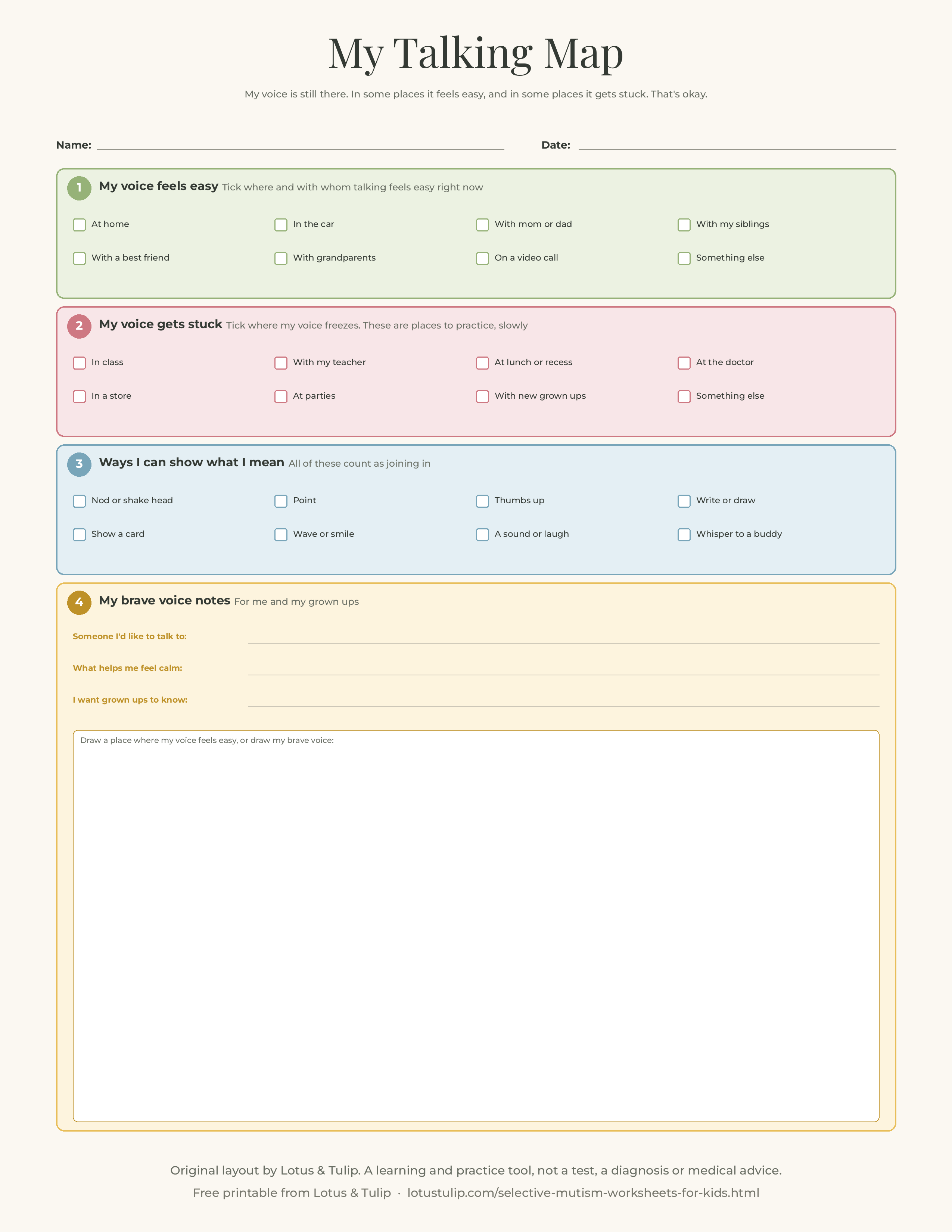
- Talking map. Where and with whom talking feels easy, and where it gets stuck. Many children can speak to some people at school, for example one friend on the playground, and these are starting points.
- Ways to show what I mean. Nodding, pointing, thumbs up, writing, drawing, cards and gestures. These are not a replacement for speech, but they let a child take part while they work toward talking.
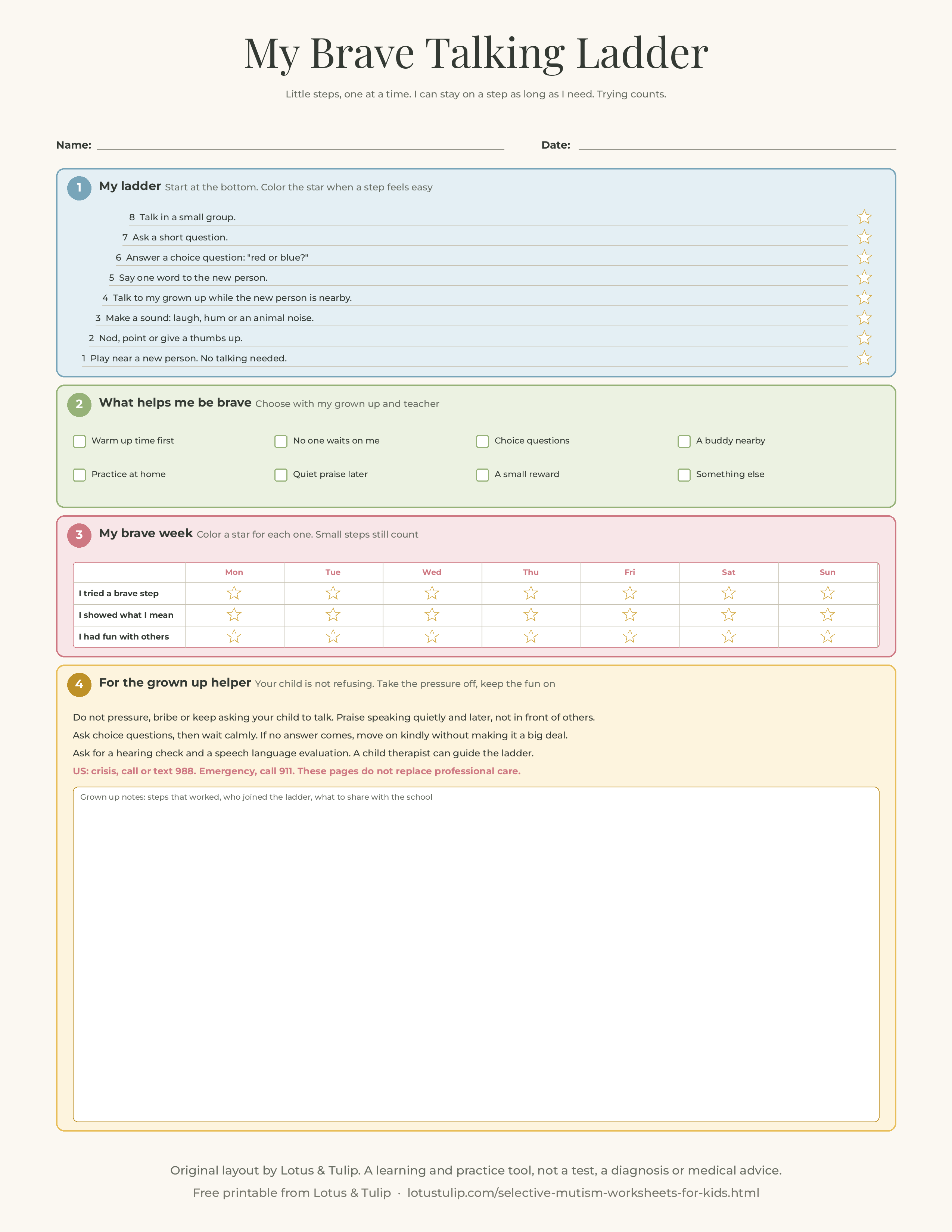
- Brave talking ladder. Small steps from no talking needed to talking in a group, such as making a sound, saying one word, answering a choice question and asking a question. Each step is practiced until it feels easy before moving up. Clinicians call this graded exposure and shaping.
- Sliding in plan. A plan for stimulus fading: the child talks with a parent while a new person comes gradually closer and then joins in, and the parent slowly steps back (NHS).
- Voice sharing steps. For some children, letting a teacher hear a recording or video of them speaking at home is an early step toward speaking face to face. Only with the child's agreement.
- Bathroom and help card. A card the child can show to ask for the bathroom, water or help. Children who cannot ask may hold on for hours or avoid drinking all day (NHS).
- Brave week chart with stars. A weekly chart for trying a brave step, showing what they mean and having fun with others. Reward effort and steps, not just words.
How to use selective mutism worksheets for kids, step by step
- Get a checkup and evaluation. Ask your pediatrician for a hearing check and a referral for a speech language evaluation and to a child psychologist or therapist who knows selective mutism. Your child may not talk during the visit; good clinicians expect this.
- Take the pressure off. Tell family, teachers and coaches to stop asking your child to talk, stop bribing and stop saying "she's shy" in front of her. Ask them to focus on fun and give your child time to warm up.
- Explain it simply. At a calm time, say: "I know your voice gets stuck sometimes, and that feels scary. Your voice is still there. We'll practice with little steps, and you'll never be in trouble for not talking."
- Fill in the talking map together. On My Talking Map, tick where talking feels easy and where it gets stuck, and the ways your child can show what they mean. Add people your child would like to talk to one day.
- Build the ladder. On My Brave Talking Ladder, start with steps your child can almost do already. The printed steps are examples; adjust them with your therapist for each person and place, for example the teacher in an empty classroom before the class arrives.
- Practice little and often. Short, playful practice several times a week works better than one long session. Games where talking is part of the fun, such as guessing games or reading a favorite book aloud, are easier than questions.
- Ask choice questions and wait. Questions like "Do you want the red one or the blue one?" are easier than open questions. Ask, then wait calmly for a few seconds. If no answer comes, move on kindly without comment.
- Praise brave steps quietly. When your child speaks, respond warmly and naturally, as you would with any child, and save the big celebration for later in private. Color the star on the chart together.
- Review every week or two. Look at the ladder with your child and the school: which steps feel easy now, what is next and what got in the way. If progress stalls for several weeks, or anxiety or mood get worse, check in with your therapist or pediatrician and bring the worksheets.
How to adapt it by age
- Ages 4 to 6: keep it playful. Parents do most of the planning. Use play, puppets, animal noises and turn taking games, and do the sliding in steps at the preschool or classroom before or after hours. Early help matters most at this age.
- Ages 7 to 9: let the child fill in the talking map, help choose ladder steps and pick small rewards for practice. Bring the teacher into practice sessions in an empty classroom.
- Ages 10 to 12: respect privacy and independence. Let them lead the plan and choose who knows about it. Older children often understand anxiety well and can rate how hard each step feels. Steps can include ordering food, answering the phone or talking in a small group of chosen classmates.
Supporting a child with selective mutism at school
- Remove pressure to speak. Do not insist on answers, do not make a child read aloud or present in front of the class yet, and never punish silence or take away recess for not answering.
- Accept other ways to join in. Allow nodding, pointing, cards, whiteboards and written answers. Use choice questions and yes or no questions, and let the child answer by pointing.
- Plan the basics. Agree on a bathroom card or signal and a way to say they feel sick or hurt. This is a safety issue.
- Use one key adult. A teacher, aide or school counselor who meets the child for short, fun one to one time is often the first school person the child talks to. Start in a quiet room, with a parent present at first if needed.
- Assess fairly. Reading and language skills can be checked with recordings made at home, written answers or one to one testing with a trusted adult.
- Make it official if needed. Supports such as alternative participation, adjusted assessments and a key adult can be written into a 504 plan or IEP. A speech language pathologist and the school psychologist can help design the plan. Share the talking map and ladder so home and school use the same steps.
Free to print for your own child, students, clients or groups. Please link to this page rather than re-uploading the file. A learning and practice tool that does not replace professional advice. In a mental health crisis, call or text 988. In an emergency, call 911.
Buy the kids feelings worksheets on Etsy
Common mistakes
- Calling it shyness or stubbornness. Selective mutism is an anxiety problem. Labels like "shy" or "stubborn," especially in front of the child, add shame and pressure.
- Bribing or pushing. "You'll get a sticker if you say hi" turns every moment into a test. Rewards work for planned, small ladder steps the child agreed to, not for on the spot demands.
- Jumping steps. Going straight from silence to "read this to the class" usually ends in freezing. Move up only when a step feels easy.
- Answering for the child every time. Helping is kind, but if adults always speak for the child, there are no chances to practice. Give a choice question, wait, then help.
- Missing speech and language problems. Many children with selective mutism also have speech, language or developmental difficulties. Ask for a speech language evaluation.
- Waiting too long. Younger children respond best, and the problem rarely fixes itself fully without help. Start the plan and the evaluation now.
Examples
- Lily, 5: chatted at home but froze at kindergarten. Her parents asked relatives to stop pushing her to talk and saw the pediatrician, who arranged a hearing test and speech evaluation. With the therapist's help, her mom played a guessing game with Lily in the empty classroom after school while the teacher sorted papers nearby, then came closer, then joined the game. Within a few weeks Lily whispered answers to the teacher, and the class came later.
- Diego, 8: spoke to one friend on the playground but not to any adult at school. His talking map showed this, so his ladder started there: the school counselor joined the two boys for a card game, first just listening, then asking choice questions. Diego used a bathroom card in class, and his 504 plan allowed written answers while he practiced.
- Ava, 11: had selective mutism since preschool and also social anxiety. With a therapist she rated each step from easy to hard and practiced ordering at a cafe with her dad nearby, answering the phone at home and talking in a small group of two chosen classmates. She chose her own rewards and decided what her teachers were told.
Free printable: selective mutism worksheets for kids
This printable is an original Lotus & Tulip layout. It is not a screening questionnaire or a diagnostic tool and gives no score. Page 1, My Talking Map, has ticks for where my voice feels easy, where my voice gets stuck and ways I can show what I mean, plus lines for someone I'd like to talk to, what helps me feel calm and what I want grown ups to know, and a box to draw. Page 2, My Brave Talking Ladder, has an 8 step ladder from playing near a new person to talking in a small group with a star for each step, a menu of what helps me be brave, a 7 day star chart for trying a brave step, showing what I mean and having fun with others, and notes for the grown up helper with US 988 and 911 numbers.
Download the free selective mutism worksheets for kids (PDF, 2 pages, US Letter)
Prefer single images? Page 1: My Talking Map (PNG) · Page 2: My Brave Talking Ladder (PNG)
Related resources
- Anxiety worksheets for kids: worry, body clues and brave steps
- Separation anxiety worksheets for kids: a goodbye plan and a brave apart ladder
- Social skills worksheets for kids: joining in, turn taking and friendship skills
- Social anxiety worksheets for teens: when fear of being judged continues into the teen years
- Exposure hierarchy worksheet: how to build a fear ladder step by step
- Breathing exercises for kids: calm body skills before a brave step
- Self esteem worksheets for kids: when being stuck hurts confidence
- All counseling resources for kids and teens
FAQ
What is selective mutism in children?
Selective mutism is an anxiety disorder in which a child speaks normally in some places, usually at home, but consistently cannot speak in others, most often at school, for at least a month. The child is not refusing or being stubborn. The expectation to talk triggers a freeze response, and speaking feels impossible in that moment.
Is selective mutism just shyness?
No. Shy children usually warm up after a while. Children with selective mutism stay unable to speak in certain places for months, even when they badly want to, for example to ask for help. Research links it closely to social anxiety: in one meta-analysis, 69% of children with selective mutism also had social phobia.
Will my child grow out of selective mutism?
Some children improve over time, but many stay impaired without help, and younger children respond best to treatment. In one Norwegian study, 78% of children aged 3 to 5 no longer had selective mutism a year after a home and school program, compared with 33% of children aged 6 to 9. Starting early is better than waiting.
How is selective mutism treated?
The main treatment is behavioral therapy or CBT that removes pressure and builds speaking in small steps, using graded exposure, stimulus fading and shaping, with parents and school involved. In a randomized pilot trial of 21 children aged 4 to 8, 75% responded to Integrated Behavior Therapy for Selective Mutism. Medication is sometimes added when progress is very slow.
Should I reward my child for talking?
Rewards can help when they are for small, planned steps your child agreed to practice, such as saying one word to a new person. Avoid on the spot bribes like "you can have it if you say please," which add pressure. Praise speaking warmly but quietly, and celebrate later in private.
How can teachers help a child with selective mutism?
Remove pressure to speak, accept nonverbal answers, use choice questions, agree on a bathroom and help card, give the child one key adult for short fun one to one time, and assess reading with recordings or written work. Supports can be written into a 504 plan or IEP. Coordinate the steps with the family and therapist.
Who diagnoses and treats selective mutism in the US?
Start with your pediatrician, who can check hearing and refer you. A child psychologist or psychiatrist diagnoses selective mutism, and a speech language pathologist checks speech and language and often helps with treatment. School psychologists and counselors can help with the school plan. In a crisis, call or text 988, and call 911 in an emergency.
Sources
- American Psychiatric Association (2013). Diagnostic and Statistical Manual of Mental Disorders, fifth edition (DSM-5), selective mutism.
- Bergman, R. L., Piacentini, J., and McCracken, J. T. (2002). Prevalence and description of selective mutism in a school-based sample. Journal of the American Academy of Child and Adolescent Psychiatry, 41(8), 938 to 946.
- Bergman, R. L., Gonzalez, A., Piacentini, J., and Keller, M. L. (2013). Integrated Behavior Therapy for Selective Mutism: a randomized controlled pilot study. Behaviour Research and Therapy, 51(10), 680 to 689.
- Black, B., and Uhde, T. W. (1995). Psychiatric characteristics of children with selective mutism: a pilot study. Journal of the American Academy of Child and Adolescent Psychiatry, 34(7), 847 to 856.
- Cornacchio, D., Furr, J. M., Sanchez, A. L., and colleagues (2019). Intensive group behavioral treatment (IGBT) for children with selective mutism: a preliminary randomized clinical trial. Journal of Consulting and Clinical Psychology, 87(8), 720 to 733.
- Driessen, J., Blom, J. D., Muris, P., Blashfield, R. K., and Molendijk, M. L. (2020). Anxiety in children with selective mutism: a meta-analysis. Child Psychiatry and Human Development, 51(2), 330 to 341.
- Elizur, Y., and Perednik, R. (2003). Prevalence and description of selective mutism in immigrant and native families: a controlled study. Journal of the American Academy of Child and Adolescent Psychiatry, 42(12), 1451 to 1459.
- Kristensen, H. (2000). Selective mutism and comorbidity with developmental disorder/delay, anxiety disorder, and elimination disorder. Journal of the American Academy of Child and Adolescent Psychiatry, 39(2), 249 to 256.
- Kumpulainen, K., Räsänen, E., Raaska, H., and Somppi, V. (1998). Selective mutism among second-graders in elementary school. European Child and Adolescent Psychiatry, 7(1), 24 to 29.
- Manassis, K., Oerbeck, B., and Overgaard, K. R. (2016). The use of medication in selective mutism: a systematic review. European Child and Adolescent Psychiatry, 25(6), 571 to 578.
- NHS. Selective mutism. nhs.uk/mental-health/conditions/selective-mutism (reviewed February 2023).
- Oerbeck, B., Stein, M. B., Wentzel-Larsen, T., Langsrud, Ø., and Kristensen, H. (2014). A randomized controlled trial of a home and school-based intervention for selective mutism: defocused communication and behavioural techniques. Child and Adolescent Mental Health, 19(3), 192 to 198.
- Oerbeck, B., Stein, M. B., Pripp, A. H., and Kristensen, H. (2015). Selective mutism: follow-up study 1 year after end of treatment. European Child and Adolescent Psychiatry, 24(7), 757 to 766.
- Oerbeck, B., Overgaard, K. R., Stein, M. B., Pripp, A. H., and Kristensen, H. (2018). Treatment of selective mutism: a 5-year follow-up study. European Child and Adolescent Psychiatry, 27(8), 997 to 1009.
- Steains, S. Y., Malouff, J. M., and Schutte, N. S. (2021). Efficacy of psychological interventions for selective mutism in children: a meta-analysis of randomized controlled trials. Child: Care, Health and Development, 47(6), 771 to 781.
- Steinhausen, H. C., Wachter, M., Laimböck, K., and Metzke, C. W. (2006). A long-term outcome study of selective mutism in childhood. Journal of Child Psychology and Psychiatry, 47(7), 751 to 756.
Lotus & Tulip is not affiliated with the researchers, agencies or organizations named on this page. Names in the examples are invented. This page is educational and does not replace professional advice, diagnosis or treatment.