
Kids and teens · Social skills, friendships and getting along · Updated 2026-11-04
Social skills worksheets for kids: what to teach, activities that work, and a free printable
Ready-made printable: Social Skills Small Group Curriculum for School Counselors, Grades 2 to 5 Holiday 20% off: about $11.04, was $14 (EUR 12) · instant digital download
Buy on Etsy
Some children walk onto a playground and are in a game within two minutes. Others hover at the edge, or barge in and grab the ball, or talk for ten minutes about trains while the other kids drift away. Adults often describe all of these children as needing "social skills," but they need very different things. One child does not know how to join in. Another knows exactly how, but is too anxious to try. A third can do it perfectly in a counseling office and then forgets everything the moment recess gets loud.
This guide is for school counselors, teachers, child therapists, special education teams and parents in the US who want practical, honest help with teaching social skills to kids. It covers what social skills actually are, how to tell a skill gap from a performance gap, what to expect at different ages, what research does and does not show about social skills training, activities for the classroom, counseling sessions and home, a step by step teaching plan, common mistakes, and a free three page set of social skills worksheets for kids: a social skills checklist, a skill steps planner and twelve role play cards.
Jump to the free social skills worksheets for kids
What are social skills? A plain language definition
Social skills are the specific, learnable behaviors we use to get along with other people: starting and keeping a conversation, joining a game, taking turns, reading how someone feels, handling disagreement and fixing things after a mistake. For kids, a simple definition works well: social skills are the things we say and do that help us get along, make friends and work things out.
It helps to sort them into a few families, because children are rarely weak at everything. The free checklist below uses four groups:
- Listening and talking. Showing you are listening, waiting for a pause before talking, asking questions about what someone said, staying on a shared topic and ending a conversation politely.
- Joining and playing. Asking to join a game or group, inviting others, sharing, taking turns, following game rules and losing (or not going first) without a meltdown.
- Feelings and clues. Noticing facial expressions, tone of voice and body language, giving people personal space, and naming your own feelings with words rather than actions.
- Problems and repair. Saying no or stop kindly, disagreeing calmly, apologizing and making it right, compromising, and asking an adult for help when something is too big to handle alone.
Social skills are related to, but not the same as, social competence. Researchers usually use social competence to mean how well a child actually does socially: whether peers accept them, whether they have friends, whether things go smoothly. Skills are the building blocks; competence is the result. A child can have the skills and still struggle socially because of anxiety, a mismatched peer group, bullying or a chaotic environment. That is one reason worksheets alone rarely fix social problems, and why this guide spends time on practice in real settings.
Why social skills matter, and where they fit in SEL
In the CASEL framework, which many US schools use to organize social and emotional learning, most of what parents call social skills falls under relationship skills: the abilities to establish and maintain healthy and supportive relationships and to navigate settings with diverse individuals and groups. CASEL's examples include communicating effectively, developing positive relationships, practicing teamwork and collaborative problem solving, resolving conflicts constructively, resisting negative social pressure, and seeking or offering support and help. Reading other people's feelings sits under the neighboring competency, social awareness, and staying calm enough to use any of it sits under self management.
The strongest long term evidence on why early social skills matter comes from a 2015 study by Damon Jones, Mark Greenberg and Max Crowley in the American Journal of Public Health. They followed 753 children from low income neighborhoods in the Fast Track project. Kindergarten teachers had rated each child's prosocial skills, with items such as "cooperates with peers without prompting," "is helpful to others" and "resolves problems on own." Thirteen to nineteen years later, children with higher kindergarten ratings were more likely to have graduated from high school on time, finished a college degree and held stable, full time work, and less likely to have been involved with police, to have spent time in detention or to rely on public assistance, even after the researchers controlled for many family and child factors.
An honest caveat: this is a correlational study. It shows that early social skills predict later outcomes, not that teaching social skills will produce those outcomes. Children who cooperate well at five may also differ in ways the study could not measure. Still, it is a strong argument for taking social skills seriously early, rather than assuming kids will "grow out of" difficulties.
Can't do or won't do? Skill gaps versus performance gaps
The single most useful question before choosing any social skills worksheet is this: does the child not know how, or know how but not do it? Researcher Frank Gresham, who helped develop the widely used Social Skills Improvement System rating scales, has written for decades about this distinction:
- Acquisition deficit (can't do). The child has never learned the skill. Ask them to show you how to join a game and they cannot describe or act out the steps. These children need direct teaching: modeling, steps, rehearsal and feedback.
- Performance deficit (won't do, or doesn't do). The child can explain and role play the skill perfectly, but does not use it in real life. The reasons vary: anxiety, low motivation, the skill not paying off with these particular peers, or a competing behavior (grabbing works faster than asking). These children need less teaching and more prompting, encouragement, practice in real settings and reinforcement when they use the skill.
- Fluency deficit. The child knows the skill and wants to use it, but it is slow, awkward or falls apart under pressure. These children need lots of short practice, gradually harder situations and coaching in the moment.
It is also worth noticing what gets in the way. Strong emotions, impulsivity, anxiety and sensory overload can all block skills a child genuinely has. A child who shoves when frustrated may need emotional regulation support first. Our emotional regulation worksheets for kids and coping skills list for kids cover that side.
A quick way to check: give the child a role play card from the free printable and ask them to act it out with you. If they can do it well in a calm room, you are probably looking at a performance gap, and the next step is real world practice rather than another worksheet.
Social skills by age: what to expect
Children develop at different rates, and culture shapes what "polite" looks like, so treat these as rough guides rather than a checklist to diagnose with. The CDC's developmental milestones (updated in 2022) are a good reference for younger children.
- Ages 3 to 4 (preschool). The CDC lists noticing other children and joining them to play around age 3, and asking to play with other children and comforting others who are hurt or sad around age 4. Sharing and turn taking are still hard and need lots of adult support. Short, adult led games are the best teaching ground.
- Ages 5 to 6 (kindergarten and first grade). By about age 5, the CDC lists following rules or taking turns when playing games with other children. Children are learning to wait, to join a group activity and to use words instead of grabbing. Expect lots of tattling and rule focused conflict; this is normal.
- Ages 7 to 9 (second to fourth grade). Friendships become more stable and more important. Kids start to understand that others can have different thoughts and feelings in the same situation, and they can learn compromise, good sportsmanship and simple repair. Exclusion and "you can't play" moments start to appear.
- Ages 10 to 12 (upper elementary to middle school). Peer opinion matters more than ever. Skills shift toward reading subtle cues, handling group dynamics, managing conflict in group chats, resisting peer pressure and standing up for others. Many children who coped fine earlier start to struggle at this stage because the social rules get more complicated. The middle school friendship group curriculum is built for this age.
When to seek more help. If a child has no friends at all over a long period, is consistently rejected or bullied, seems uninterested in other children, has strong difficulty with back and forth conversation, or if social problems come with persistent anxiety, low mood or aggression, talk to the school counselor, pediatrician or a licensed child therapist. A worksheet is a teaching tool, not an evaluation.
What the research says about teaching social skills (with honest caveats)
Social skills training is one of the most common interventions in schools and child therapy, and the evidence is real but more modest than many product descriptions suggest.
- Broad SEL programs help. Joseph Durlak and colleagues' 2011 meta-analysis of 213 school based universal SEL programs, covering more than 270,000 students from kindergarten through high school, found improvements in social and emotional skills, attitudes and positive social behavior, fewer conduct problems, and an average gain of 11 percentile points in academic achievement. These were whole programs delivered over time, often by trained teachers, not single worksheets.
- Effects are often strongest on knowledge and in the short term. An early meta-analysis by Andreas Beelmann, Uwe Pfingsten and Friedrich Lösel (1994) found that social competence training produced its clearest effects on social cognitive skills, with smaller effects on actual social interaction and adjustment, and weaker effects at follow up than right after training.
- Generalization is the big problem. Gresham, Sugai and Horner (2001), reviewing social skills training for students with high incidence disabilities, concluded that effects were modest and often did not carry over to new settings or last over time. They argued for more intensive teaching, matching instruction to the type of deficit, and teaching skills in the places where they are actually needed.
- Group social skills programs for autistic youth: modest, uneven effects. A 2017 meta-analysis by Jacquelyn Gates, Erin Kang and Matthew Lerner pooled 19 randomized trials of group social skills interventions for youth on the autism spectrum. The overall effect was medium. But when broken down by who did the rating, children reported large gains that came almost entirely from knowing more about social skills rather than using them; parents and observers saw small improvements; and teacher ratings did not change significantly. The authors concluded these programs appear modestly effective but may not generalize to school.
The practical lesson from all of this: teaching the steps is the easy part. The real work is practice in real settings, prompting at the right moment, and noticing when the child uses the skill. That is why the free printable includes a "Try it for real" section and a weekly practice tracker, not just a list of rules.
A note for neurodivergent children. Many autistic adults have pointed out that traditional social skills training sometimes taught children to mask, for example by forcing eye contact that feels uncomfortable or suppressing harmless stims. Researcher Damian Milton's "double empathy problem" (2012) argues that social difficulties between autistic and non autistic people run in both directions, rather than being a deficit located only in the autistic person. A respectful approach focuses on skills the child wants and that help them connect, such as joining a game they enjoy, asking a friend about their interests or saying no safely, and does not require eye contact. Our checklist says "I look toward the person who is talking" for exactly this reason.
The core teaching cycle: Tell, Show, Practice, Feedback, Use
Most effective social skills teaching, from classroom SEL programs to behavioral skills training used in special education, follows the same basic cycle:
- Tell. Name the skill, explain why it helps, and break it into three to five short steps a child can remember. "Joining a game: Watch, Wait, Ask, Plan B."
- Show. Model it. Act out a good example, and sometimes a funny wrong example ("Watch me join this game by grabbing the ball. What went wrong?"). Children learn a lot from spotting mistakes.
- Practice. Role play several times with different partners and situations. Swap parts so the child also experiences being on the other side.
- Feedback. Give specific, encouraging feedback: "You waited for the pause. That was perfect. Next time, try smiling when you ask."
- Use. Plan a real situation where the child will try the skill this week, prompt beforehand, and check in after. This step is the one most programs skip, and it is the one that matters most for generalization.
Social skills activities for kids in the classroom
- Skill of the week. Pick one skill, post the steps on the board, model it on Monday, practice in short role plays, and catch students using it all week with specific praise. Ten minutes a day beats one long lesson.
- Role play cards. Use the free cards in pairs or as a whole class. One pair acts it out, the class suggests a second way, and the pair tries again. Keep it light and fast.
- Conversation ball. Students toss a soft ball; whoever catches it must ask a question or add a comment about what the last person said. It makes "staying on topic" visible.
- Cooperative games with a twist. Build a tower together without talking, or with only one person allowed to touch the blocks. Debrief afterward: what helped the group work together?
- Good sport practice. Play quick games specifically to practice losing well. Agree beforehand on what a good sport says ("Good game," "Want to play again?") and celebrate it more than the win.
- Read aloud pauses. Stop during stories to ask: What social skill could this character use right now? What would you say if you were them?
- Morning meeting greetings. Daily greetings practice names, friendly tone and turn taking, and give quieter students a predictable, low pressure way to talk.
Social skills activities for school counselors and therapists
- Start with the checklist. Have the child (and, if useful, a teacher or parent) complete the social skills checklist. Pick one goal skill together. Children work harder on goals they chose.
- Test the skill in session. Use a role play card to see whether you are dealing with a skill gap or a performance gap, then plan accordingly.
- Small groups. A small group of four to six children with a mix of strengths gives natural practice partners. Our social skills small group curriculum covers listening, joining in, taking turns, reading cues and repairing across eight sessions for grades 2 to 5.
- Play based practice. Board games, block towers and card games are natural places to practice turn taking, waiting, losing and polite disagreement, with less pressure than direct talk. The play therapy games and activities pack adds talk prompts to games you already have.
- Video and replay. With permission, record a role play and watch it back together. Many children spot their own body language more easily on screen.
- Coach the setting, not just the child. Share the child's goal skill and steps with the teacher or recess staff so they can prompt and praise at the right moment. This is the best single way to improve generalization.
- Debrief real moments. When something goes wrong at school, walk through it afterward with the skill steps: what happened, which step got missed, what could work next time. Our problem solving worksheet for kids and conflict resolution worksheet help here.
How to teach social skills at home
- Practice during family life. Dinner conversations, board game nights and car rides are full of chances to practice asking questions, waiting for a turn and losing well.
- Prepare before social events. Before a birthday party or playdate, run through one skill in a quick rehearsal: "When you arrive, what could you say to Maya?" Keep it to one skill.
- Arrange small, structured playdates. One friend, a clear activity and a set end time give a struggling child a better chance of success than a big, unstructured gathering.
- Notice and name it. "I saw you let your brother go first. That was really generous." Specific praise tells children exactly which behavior to repeat.
- Model it yourself. Children watch how adults apologize, disagree and listen. Saying "I'm sorry I snapped at you, I was frustrated" teaches repair better than any worksheet.
- Talk with the school. If your child is struggling, share what you are working on with the teacher or counselor so practice is consistent across settings. Our friendship worksheets for kids include tips for parents on friendship troubles.
How to teach social skills to kids, step by step
- Observe first. Watch the child in a real setting such as recess, group work or a playdate, and note exactly what happens. Look for specific moments, not general impressions.
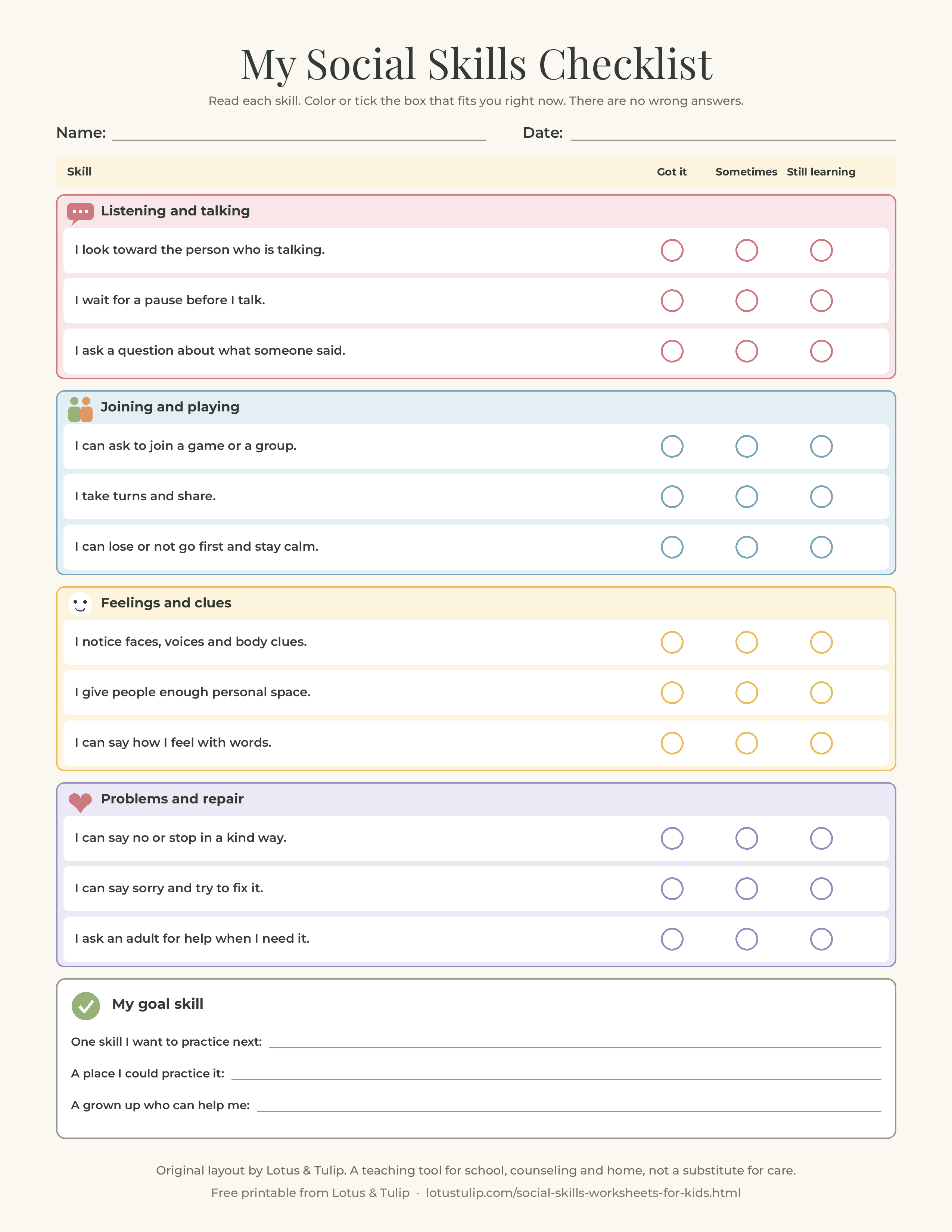
- Complete the social skills checklist. Use page 1 of the free printable with the child, and if helpful ask a teacher or parent to fill one in too. Look for patterns and strengths as well as gaps.
- Pick one goal skill. Choose one skill that would make the biggest difference right now, ideally one the child cares about. Write it in the "My goal skill" box.
- Check can't do versus won't do. Ask the child to act out the skill with a role play card. If they can do it calmly, focus on real world practice and encouragement; if not, teach the steps directly.
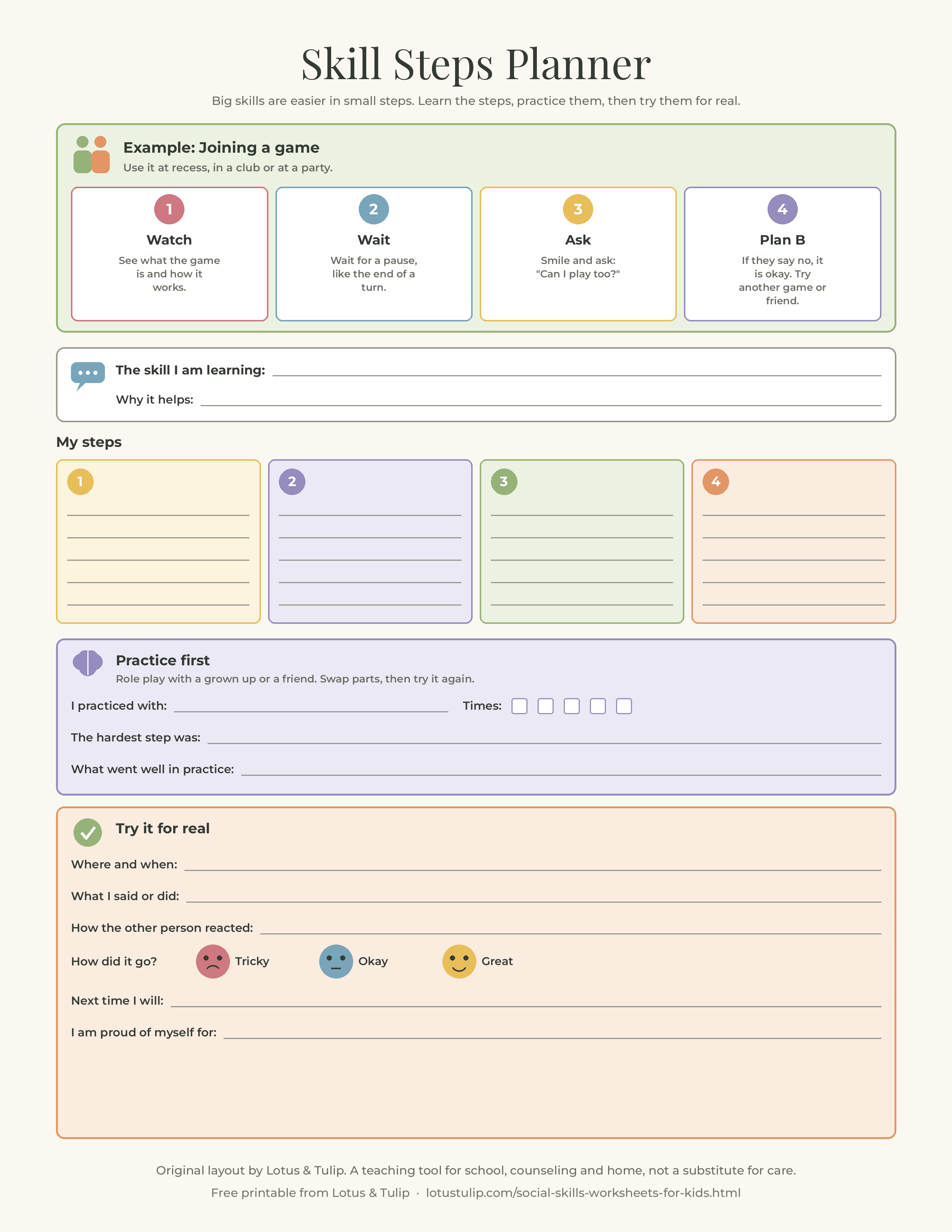
- Break the skill into steps. Use the Skill Steps Planner to write three to five short, concrete steps in the child's own words, like the Watch, Wait, Ask, Plan B example.
- Model and role play. Show the skill, then practice it several times with different partners and scenarios from the role play cards, swapping parts each time.
- Give specific feedback. Praise exactly what went well and suggest one small change for the next try. Keep practice short, positive and fun.
- Plan a real try. Agree on where and when the child will use the skill this week, and let the teacher or parent know so they can prompt and notice it.
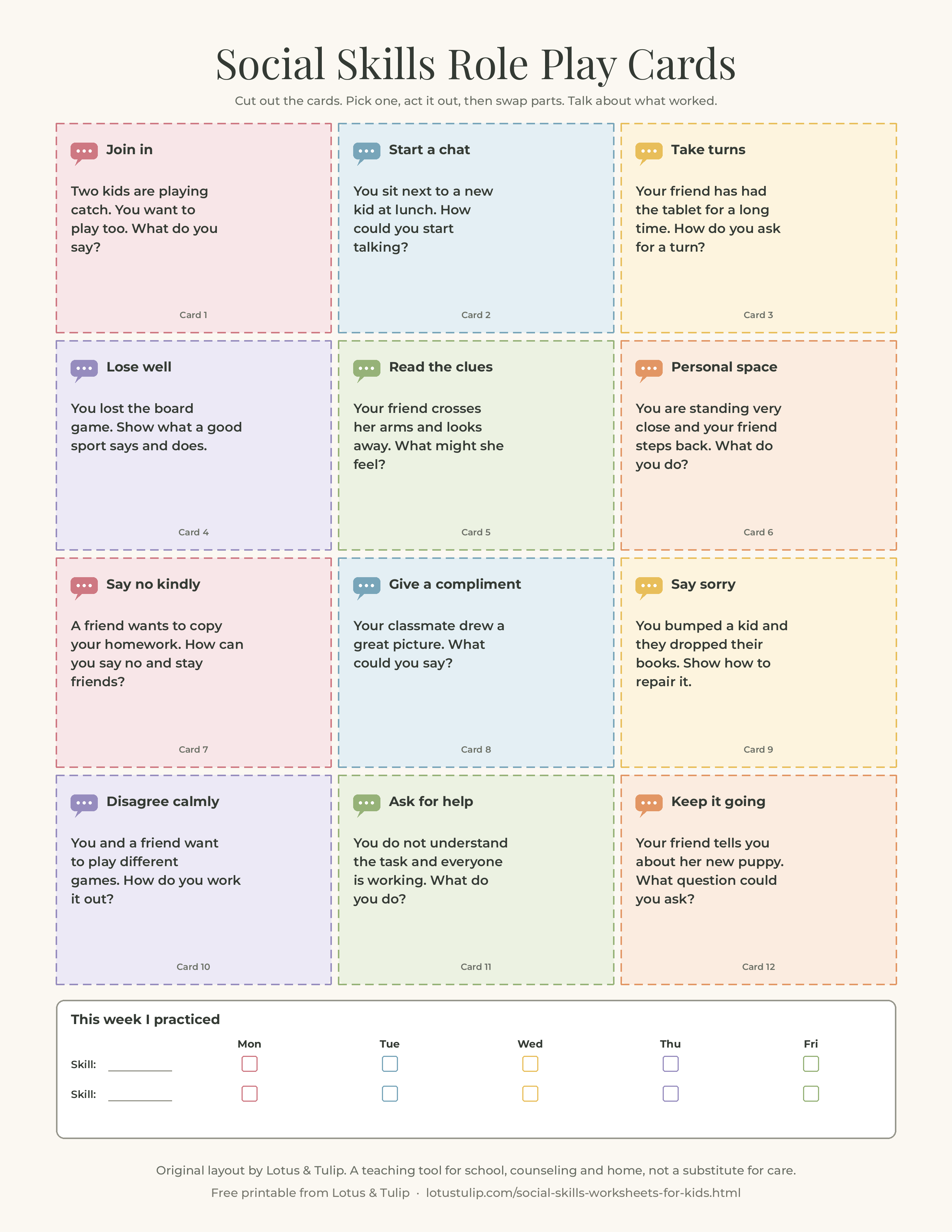
- Track, review and move on. Use the weekly tracker on page 3, review how real tries went, and once the skill is used fairly often, keep praising it occasionally and pick the next goal skill.
Tips that make social skills worksheets work
- One skill at a time. A worksheet that covers twelve skills in one session teaches none of them. Pick one and practice it all week.
- Keep the language short. Three to five steps, each a word or a short phrase, are easier to remember in the moment than a paragraph.
- Use the child's real situations. Replace generic scenarios with the actual playground game, lunch table or group chat the child is dealing with.
- Make it active. Worksheets should start a role play, not replace it. Fill in a section, then get up and practice.
- Let drawing count. Younger children or reluctant writers can draw their steps or act them out while an adult writes.
- Celebrate attempts, not just success. Asking to join a game and hearing "no" still counts as using the skill. That is why the planner includes a Plan B step.
Common mistakes when teaching social skills
- Teaching only in the counseling office. Skills practiced only in a quiet room often stay there. Plan real world practice from the start.
- Assuming every child needs teaching. Many children know the skill already. If anxiety or motivation is the barrier, more lessons can feel patronizing. Support, encouragement and easier first steps work better.
- Too many rules at once. A long list of do's and don'ts overwhelms children. Short, positive steps work better than "don't interrupt, don't stand too close, don't talk too long."
- Focusing only on the child. Peer culture, adult supervision and how the school responds to exclusion all matter. Sometimes the most effective change is a structured recess game or a buddy system.
- Forcing eye contact or masking. Insisting on eye contact or suppressing harmless behaviors can cause distress, especially for autistic children, without improving connection. Teach alternatives, like facing the speaker or nodding.
- Using worksheets as punishment. "You hit, so you have to do a social skills worksheet" turns the tool into a consequence. Keep skill practice separate from discipline.
- Stopping too soon. Social skills need weeks of practice, not one lesson. Plan for regular, short practice over time.
Free social skills worksheets for kids (PDF)
This free printable is an original Lotus & Tulip design, sized for US Letter paper and suited to about ages 5 to 12 (kindergarten to grade 6) in classrooms, counseling sessions, small groups and at home. Younger children can use it with an adult reading and writing for them. It has three pages:
- Page 1: My Social Skills Checklist. Twelve skills in four groups (listening and talking, joining and playing, feelings and clues, problems and repair), each rated Got it, Sometimes or Still learning, plus a "My goal skill" box for the next skill to practice, a place to practice it and a grown up who can help.
- Page 2: Skill Steps Planner. A worked example (Joining a game: Watch, Wait, Ask, Plan B), then a blank planner: the skill and why it helps, four steps, a "Practice first" role play section with tick boxes, and a "Try it for real" section with where and when, what happened, a three face rating and a next time plan.
- Page 3: Social Skills Role Play Cards. Twelve cut out scenario cards (join in, start a chat, take turns, lose well, read the clues, personal space, say no kindly, give a compliment, say sorry, disagree calmly, ask for help and keep it going) and a Monday to Friday practice tracker.
Download the free social skills worksheets for kids (PDF, 3 pages, US Letter)
Prefer single images? Page 1: Social Skills Checklist (PNG) · Page 2: Skill Steps Planner (PNG) · Page 3: Role Play Cards and Tracker (PNG)
Free to print for your own use and for use with your own students, clients or children. Please link to this page rather than re-uploading the file.
Related resources
- Selective mutism worksheets for kids: when a child cannot speak at school, a free talking map and brave talking ladder
- Conversation skills worksheet (free printable): the five parts of a conversation, follow-up questions and a practice ladder
- Personal space worksheet (free printable): the space bubble, the arm's length check and three zones
- Tattling vs telling worksheet (free printable): when to tell an adult, with a 12 scenario sort and a telling plan
- Friendship worksheets for kids (free printable)
- Empathy worksheets for kids (free printable)
- Conflict resolution worksheet (free printable)
- Problem solving worksheet for kids (free printable)
- Kindness activities for kids (free printable)
- Emotional regulation worksheets for kids (free printable)
- I statements worksheet (free printable)
- Free social story template
- Self esteem worksheets for kids (free printable)
Sources
- Beelmann, A., Pfingsten, U., and Lösel, F. (1994). Effects of training social competence in children: a meta-analysis of recent evaluation studies. Journal of Clinical Child Psychology, 23(3), 260 to 271.
- CASEL. The CASEL 5: relationship skills and social awareness. casel.org (What Is SEL? and CASEL's SEL Framework, 2020).
- Centers for Disease Control and Prevention. CDC's Developmental Milestones (Learn the Signs. Act Early.), milestones at 3, 4 and 5 years, revised 2022. cdc.gov.
- Durlak, J. A., Weissberg, R. P., Dymnicki, A. B., Taylor, R. D., and Schellinger, K. B. (2011). The impact of enhancing students' social and emotional learning: a meta-analysis of school-based universal interventions. Child Development, 82(1), 405 to 432.
- Gates, J. A., Kang, E., and Lerner, M. D. (2017). Efficacy of group social skills interventions for youth with autism spectrum disorder: a systematic review and meta-analysis. Clinical Psychology Review, 52, 164 to 181.
- Gresham, F. M., Sugai, G., and Horner, R. H. (2001). Interpreting outcomes of social skills training for students with high-incidence disabilities. Exceptional Children, 67(3), 331 to 344.
- Jones, D. E., Greenberg, M., and Crowley, M. (2015). Early social-emotional functioning and public health: the relationship between kindergarten social competence and future wellness. American Journal of Public Health, 105(11), 2283 to 2290.
- Milton, D. E. M. (2012). On the ontological status of autistic people: the "double empathy problem." Disability and Society, 27(6), 883 to 887.
Social skills worksheets for kids: FAQ
What are social skills for kids?
Social skills are the things children say and do to get along with others, make friends and work out problems. They include listening, joining a game, taking turns, reading facial expressions and body language, giving personal space, saying no kindly, apologizing and asking for help.
How do you teach social skills to kids?
Pick one skill, break it into three to five short steps, model it, role play it several times with feedback, then plan a real situation where the child will use it and check in afterward. Short, regular practice in real settings matters more than long lessons.
What is the difference between a skill deficit and a performance deficit?
A skill (acquisition) deficit means the child has not learned how to do the skill and needs direct teaching. A performance deficit means the child knows how but does not use it, often because of anxiety, motivation or a competing behavior, and needs prompting, encouragement and real world practice instead.
Does social skills training work?
It helps, but effects are often modest. Broad school SEL programs improve social behavior and skills on average, but research on social skills training shows children often learn more about skills than they use, and gains do not always carry over to new settings. Practicing in real settings and involving teachers and parents improves results.
What age should kids learn social skills?
Social skills develop from the preschool years onward. By about age 4 many children ask to play with others and comfort someone who is sad, and by about age 5 many take turns in games. Skills keep developing through elementary and middle school as social situations get more complex.
What are good social skills activities for kids?
Role play cards, a skill of the week with posted steps, conversation ball games, cooperative building challenges, good sport practice games, read aloud discussions about characters' choices and structured playdates all give children practice in a low pressure way.
Are these social skills worksheets free?
Yes. The three page social skills worksheets for kids are free to print for your own use and for use with your own students, clients or children. Please link to this page rather than re-uploading the file.