
Therapist worksheets · Anxiety and exposure · Updated 2026-11-05
Exposure Hierarchy Worksheet (Fear Ladder): How to Build One, with Examples and a Free Printable
Ready-made printable: Anxiety Worksheets for Therapists Fillable PDF: type into the fear ladder, plus worry log, exposure practice log, grounding and 0 to 10 anxiety scales (20 pages)
Holiday 20% off: about $11.04, was $14 (EUR 12) · instant digital download
Try it free first: download a fillable sample (worry log and fear ladder, PDF, 258 KB). Type into it on screen, then get the full pack. No email needed.

An exposure hierarchy, often called a fear ladder, is a ranked list of situations a person avoids because of anxiety, ordered from easier to harder, so they can practice facing them in planned steps. It is the backbone of exposure work in cognitive behavioral therapy (CBT) for phobias, social anxiety, panic, separation anxiety, generalized worry, and, as exposure and response prevention (ERP), for OCD. The ladder itself is simple. Building a good one, and using it well, is where most of the skill lives.
This guide is for therapists, school counselors, and parents working alongside a clinician. It covers what an exposure hierarchy is, how to rate fear with a 0 to 100 scale, how to write steps that are specific enough to practice, example ladders for kids, teens, and adults, how current research suggests running exposures (expectation testing, dropping safety behaviors, variety), common mistakes, and what the evidence honestly shows. You also get a free three page US Letter printable: a Fear Ladder Builder, an Exposure Practice Record, and a weekly Exposure Tracker with a US safety box.
This page is educational. It is not a substitute for assessment or treatment by a licensed clinician, especially for OCD, PTSD, panic with medical questions, or anxiety alongside self harm risk.
Jump to the free exposure hierarchy worksheet (PDF) · Example fear ladders · How to build one, step by step
What an exposure hierarchy is
Anxiety tends to grow through avoidance. Each time a person skips the party, checks the lock again, or leaves the store when the heart starts pounding, the relief teaches the brain that avoiding was what kept them safe. Exposure flips that pattern: the person approaches the feared situation on purpose, stays long enough to learn something new, and lets the outcome teach a different lesson.
Facing the hardest fear on day one is rarely realistic or necessary. An exposure hierarchy breaks the fear into steps. Each step names a concrete situation, a predicted fear rating, and usually the feared outcome. Work typically starts with steps that feel challenging but doable and moves up as earlier steps get easier.
The idea goes back to Joseph Wolpe's systematic desensitization in the 1950s, which paired a graded list of feared scenes with relaxation. Wolpe also introduced the Subjective Units of Distress Scale (SUDS), the 0 to 100 rating most fear ladders still use. Modern exposure therapy dropped the requirement to relax during exposure and moved to real life practice, but the graded ladder stayed.
The 0 to 100 fear rating (SUDS)
SUDS is a quick self rating of how much fear or distress a situation would cause, from 0 (completely calm) to 100 (the worst anxiety imaginable). It is not a lab measure. It is a shared language that helps a client and clinician order steps and notice change.
- 0 to 20: calm or slight unease.
- 30 to 50: clearly uncomfortable, still able to think and stay.
- 60 to 80: strong fear, strong urge to leave or do a safety behavior.
- 90 to 100: the hardest situations on the list.
Younger children often do better with a 0 to 10 thermometer or a 1 to 5 face scale than with 100 points. Our feelings thermometer printable works well as the rating tool for a kid sized ladder.
How to build an exposure hierarchy, step by step
- Name the fear and the feared outcome. Write what the person is afraid of in plain words, then what they believe will happen. "I am scared of dogs" becomes "If I get close to a dog, it will bite me and I will not be able to handle it." The feared outcome is what each exposure will test.
- List avoided situations and safety behaviors. Brainstorm everything the fear makes them avoid, escape, or do to feel safer: crossing the street, holding a parent's hand, checking, asking for reassurance, carrying medication they do not take, scripting what to say. Aim for 10 to 20 items before ranking.
- Make every step specific. "Talk to people" cannot be practiced. "Ask a cashier where the batteries are" can. Add details that change difficulty: who, where, how long, how close, alone or with support, with or without a safety behavior.
- Rate each step 0 to 100. Ask how much fear the step would cause if they did it today without any safety behaviors. Ratings are guesses, and that is fine.
- Order the ladder and fill the gaps. Sort from lowest to highest. If there is a big jump (for example 30 to 80), add in between steps by changing one variable at a time, such as distance, duration, or who is present.
- Pick a starting step together. Many clinicians start with something rated roughly 30 to 50: clearly uncomfortable but achievable. The client should agree to it. Exposure is done with a person, not to them.
- Plan the practice and the prediction. Before each exposure, write what the person expects to happen and how strongly they believe it (0 to 100 percent). Decide which safety behaviors they will drop and how long or how many times they will practice.
- Do the exposure, then record what actually happened. Stay with the situation long enough for the prediction to be tested. Afterward, compare the outcome with the prediction and write what was learned.
- Repeat, vary, and move up. Practice often, ideally between sessions too, in different places and at different times. When a step feels much easier or the prediction has clearly been tested, move to the next one. Update ratings as the ladder changes.
How to run exposures well (what current research suggests)
Older guidance told clients to stay in each exposure until anxiety dropped by about half. That still works for many people, but research on how exposure works has shifted the emphasis. Michelle Craske and colleagues (2008, 2014) describe an inhibitory learning approach: exposure does not erase the old fear memory. It builds a new, competing memory ("dogs usually do not bite, and I can cope when I am scared"). The goal is to make that new learning strong and easy to retrieve later. Practical points that follow:
- Test the prediction, not only the feeling. Ask "What do you expect will happen?" before, and "What actually happened?" after. Learning is stronger when the outcome clearly differs from the expectation. A drop in anxiety during the exposure is welcome but not required for progress.
- Drop safety behaviors where possible. Holding onto a safety behavior (sitting near the exit, rehearsing every sentence, carrying a water bottle "just in case") can leave the person crediting the behavior instead of learning they can cope. Blakey and Abramowitz (2016) reviewed this research and recommend fading safety behaviors, while noting the evidence is more mixed than once thought. Fading them gradually across the ladder is a reasonable middle path.
- Vary the practice. Different dogs, different stores, different times of day, different people. Variety helps the new learning travel to real life rather than staying tied to the therapy room.
- The ladder is a guide, not a rule. Craske's group suggests that some variability in order, including occasionally mixing levels, can strengthen learning. Clients do not have to master every rung before trying a harder one, as long as they agree to the step.
- Practice between sessions. Weekly sessions alone are rarely enough. Short, frequent home practice, logged on a simple tracker, is where much of the change happens.
- Do not neutralize afterward. Reassurance seeking, reviewing, or "undoing" right after an exposure can cancel the lesson. This matters most in OCD, where response prevention is half the treatment.
Example exposure hierarchies
The ladders below are fictional examples to show structure and specificity. Ratings are illustrative. A real ladder should come from the person's own fears and ratings.
Child, fear of dogs (age 8, ratings on a 0 to 10 thermometer)
- Look at photos of puppies for 2 minutes (2)
- Watch a short video of a dog barking and playing (3)
- Watch a calm neighbor's dog through a window (4)
- Stand 20 feet from a leashed calm dog with a parent (5)
- Stand 5 feet from the leashed dog (6)
- Touch the dog's back while the owner holds the leash (7)
- Let the dog sniff your hand (8)
- Walk past an unfamiliar leashed dog at the park (9)
- Give a dog a treat from a flat hand (10)
Teen, social anxiety
- Say "hi" to a classmate in the hallway (30)
- Ask a teacher a question after class (40)
- Order food at a counter without a friend ordering first (45)
- Ask a store employee for help finding something (50)
- Answer one question out loud in class (60)
- Join a lunch table conversation and share an opinion (70)
- Call a store to ask about hours (75)
- Give a 2 minute class presentation without reading from notes the whole time (90)
Adult, panic and fear of body sensations
- Climb two flights of stairs quickly and notice the heartbeat (30)
- Drink a cup of coffee (40)
- Spin in a desk chair for 30 seconds (50)
- Breathe through a thin straw for 60 seconds (60)
- Stand in the middle of a busy grocery store aisle for 10 minutes (70)
- Ride the highway as a passenger for one exit (80)
- Drive alone on the highway for two exits (95)
Body sensation exercises (interoceptive exposure) like spinning or straw breathing should be cleared with a medical provider first for anyone with heart, lung, seizure, or pregnancy related concerns.
Adult, OCD contamination (ERP)
- Touch a doorknob at home and wait 10 minutes before washing (35)
- Touch a public door handle and do not wash for 30 minutes (50)
- Sit on a public bench, then eat a snack after using hand sanitizer only once (60)
- Touch a shopping cart handle and then your face, no washing until the next meal (75)
- Touch the floor of a public restroom and then your clothes, no extra washing for the day (90)
ERP for OCD is best done with a clinician trained in it. Exposure without response prevention (for example touching the handle and then washing twice as long) usually does not help and can strengthen the cycle.
Using a fear ladder with kids and teens
- Make it visual. A literal ladder, stairs, or a mountain drawing works better than a table for younger kids. Let them color each rung when they climb it.
- Use a short scale. 0 to 10 or a five face scale. Point to it, do not just ask.
- Give them a vote. Kids who choose their next step are more likely to try it. Offer two options at a similar level.
- Coach the parent too. Parent accommodation (answering every reassurance question, speaking for the child, allowing avoidance) keeps anxiety going. Programs such as SPACE (Supportive Parenting for Anxious Childhood Emotions, Lebowitz and colleagues) work directly on reducing accommodation while staying warm. A parent's tone can be "I know this is hard, and I know you can handle it."
- Reward effort, not calm. Praise approaching the step, not how relaxed they looked. Small rewards for completed practice work well with a token chart.
- School counselors: brief, frequent practice fits naturally into school days (asking a question, ordering in the cafeteria, entering the classroom on time). Share the ladder with the family and outside therapist when there is one.
For more child friendly anxiety tools, see our anxiety worksheets for kids and worry worksheet for kids.
Common mistakes
- Vague steps. "Be more social" is a goal, not a rung. Every step needs a who, where and how long.
- Starting too high. A first step rated 85 often ends in escape, which can teach the old lesson again. Start where the person can stay.
- Starting too low forever. Repeating 10 point steps feels productive but teaches little. Move up when a step is easy.
- Hidden safety behaviors. Ask "What are you doing to make this feel safer?" after each exposure. Common ones: avoiding eye contact, distracting, checking a phone, mental reassurance, staying near an exit.
- Leaving when fear peaks. Planned exposures should end when the prediction has been tested or the agreed time is up, not at the moment fear is highest.
- Using relaxation as an escape hatch. Breathing skills are useful, but if they are used to get rid of fear the moment it appears, they can work like a safety behavior during exposure. Use them before or after, or to stay present, not to escape.
- Forcing it. Exposure is collaborative and consensual. Surprise "flooding" a child or partner with their fear damages trust and is not exposure therapy.
What the research says (honestly)
Exposure is one of the best supported ingredients in psychological treatment for anxiety, but results vary, many people improve rather than fully recover, and relapse can happen without ongoing practice.
- Adults. Hofmann and Smits (2008) pooled placebo controlled trials of CBT for adult anxiety disorders and found CBT outperformed placebo, with effects that differed by disorder. Exposure is a central component in most of those treatments.
- Children and teens. In the Child/Adolescent Anxiety Multimodal Study (CAMS; Walkup et al., 2008), 488 youths aged 7 to 17 with separation, generalized or social anxiety were randomized for 12 weeks. Rates rated much or very much improved were 80.7% for CBT plus sertraline, 59.7% for CBT alone, 54.9% for sertraline alone and 23.7% for placebo. The CBT in CAMS was based on Coping Cat, which includes graded exposure tasks.
- OCD. ERP is the psychological treatment with the strongest evidence for OCD and is recommended in major clinical guidelines. Many people improve substantially, and a meaningful share still have symptoms afterward.
- How exposure works. The inhibitory learning account (Craske et al., 2008, 2014) is influential and has shaped current practice tips such as expectancy violation and variability. Not every recommendation has been tested head to head in clinical trials yet, so treat them as well reasoned guidance rather than settled law.
When to get extra help
Seek a licensed clinician when fear is severe, when it involves trauma memories, when OCD is likely, when panic comes with unexplained medical symptoms, or when anxiety sits alongside depression, substance use or self harm. Exposure for trauma (for example prolonged exposure for PTSD) is a specialist treatment and should not be attempted from a worksheet.
- In the US, call or text 988 (988 Suicide and Crisis Lifeline) any time for suicidal thoughts or emotional crisis.
- Text HOME to 741741 to reach the Crisis Text Line.
- Call 911 if someone is in immediate danger.
Free exposure hierarchy worksheet (PDF)
The free exposure hierarchy worksheet has three pages in US Letter size, written for teens and adults and easy to adapt for kids:
- Page 1: Fear Ladder Builder. Space for the fear and feared outcome, safety behaviors to fade, and a 10 rung ladder with a 0 to 100 rating box for each step.
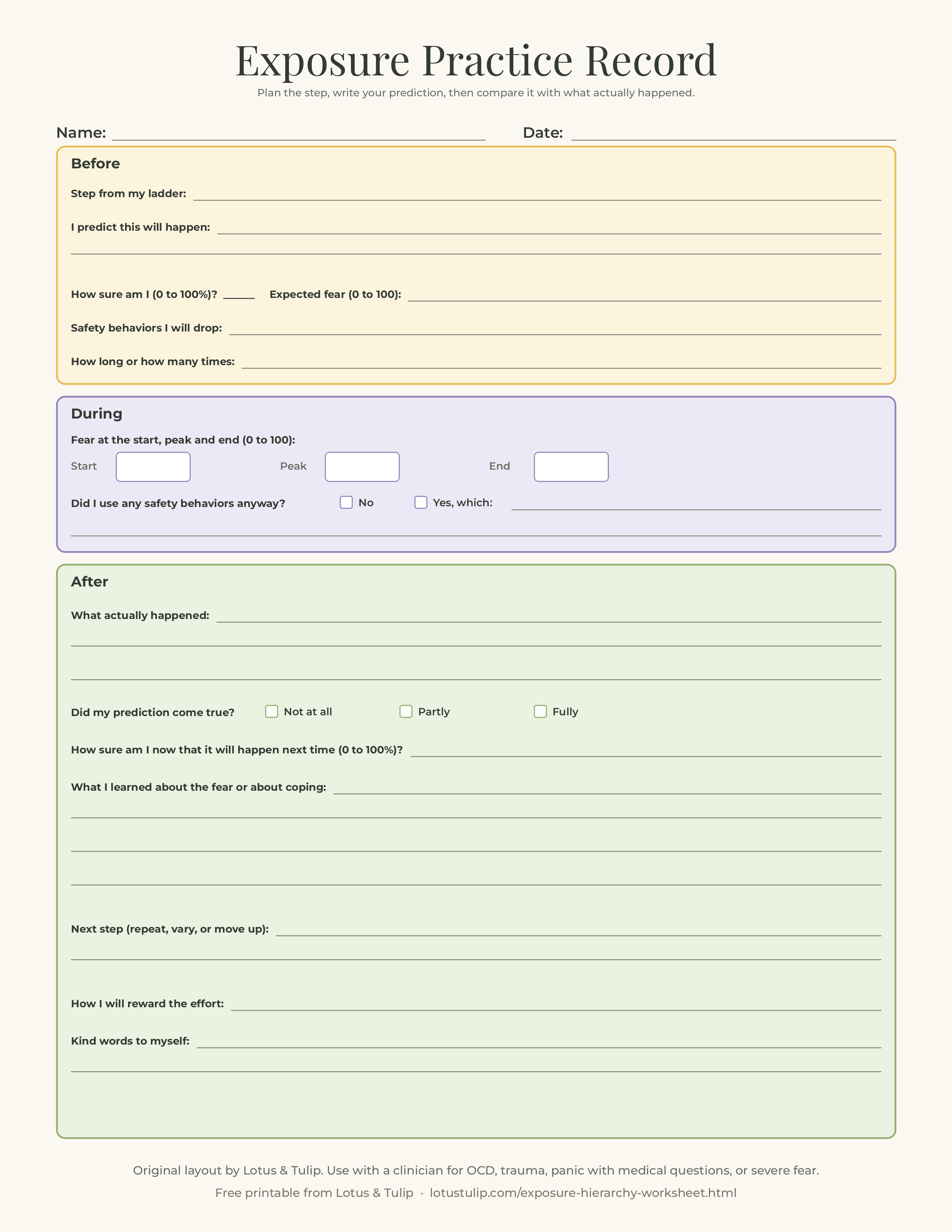
- Page 2: Exposure Practice Record. Before, during and after boxes: the step, the prediction and how strongly you believe it, safety behaviors you will drop, peak fear, what actually happened, and what you learned.
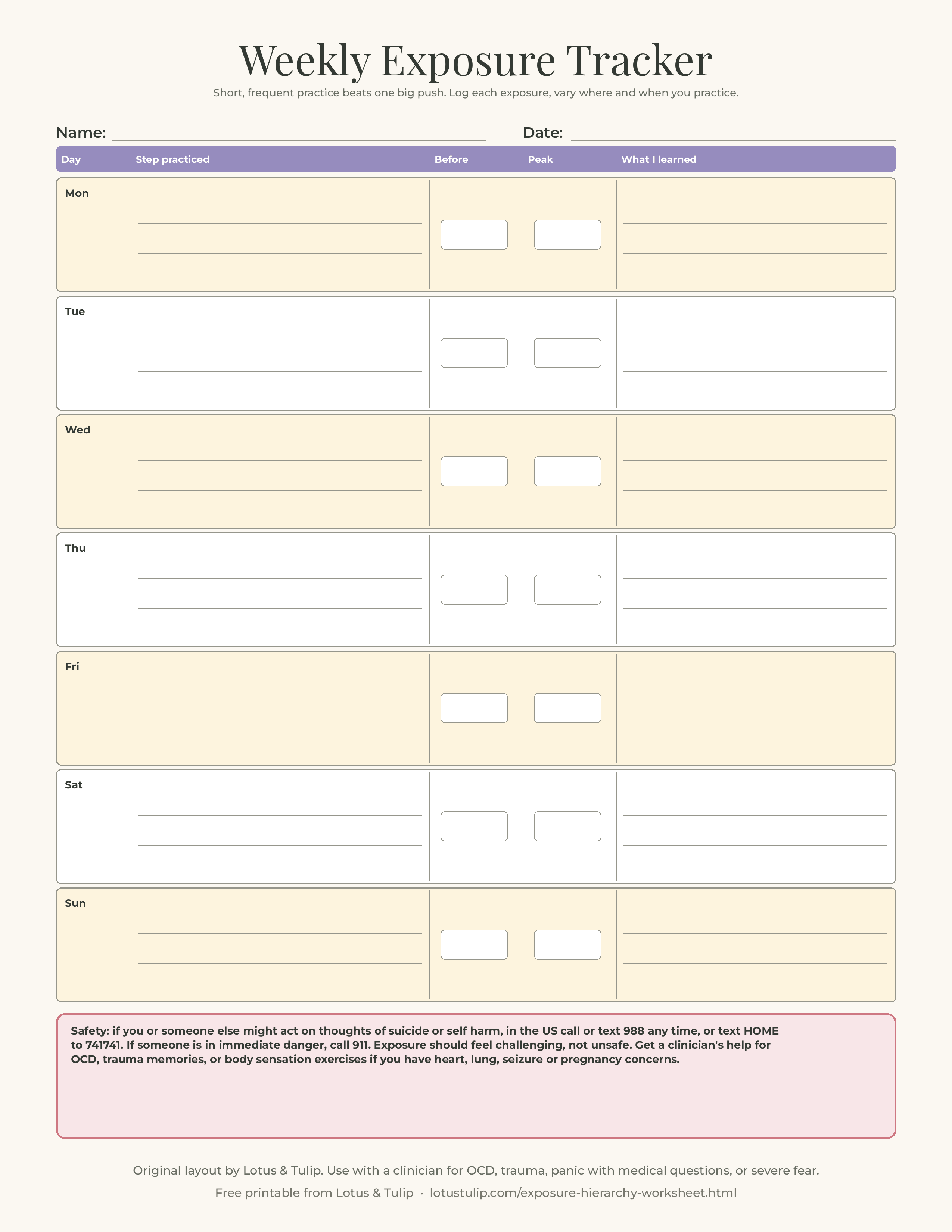
- Page 3: Weekly Exposure Tracker. A seven day log for practice, fear before and peak, and notes, plus a US safety box listing 988, text HOME to 741741, and 911.
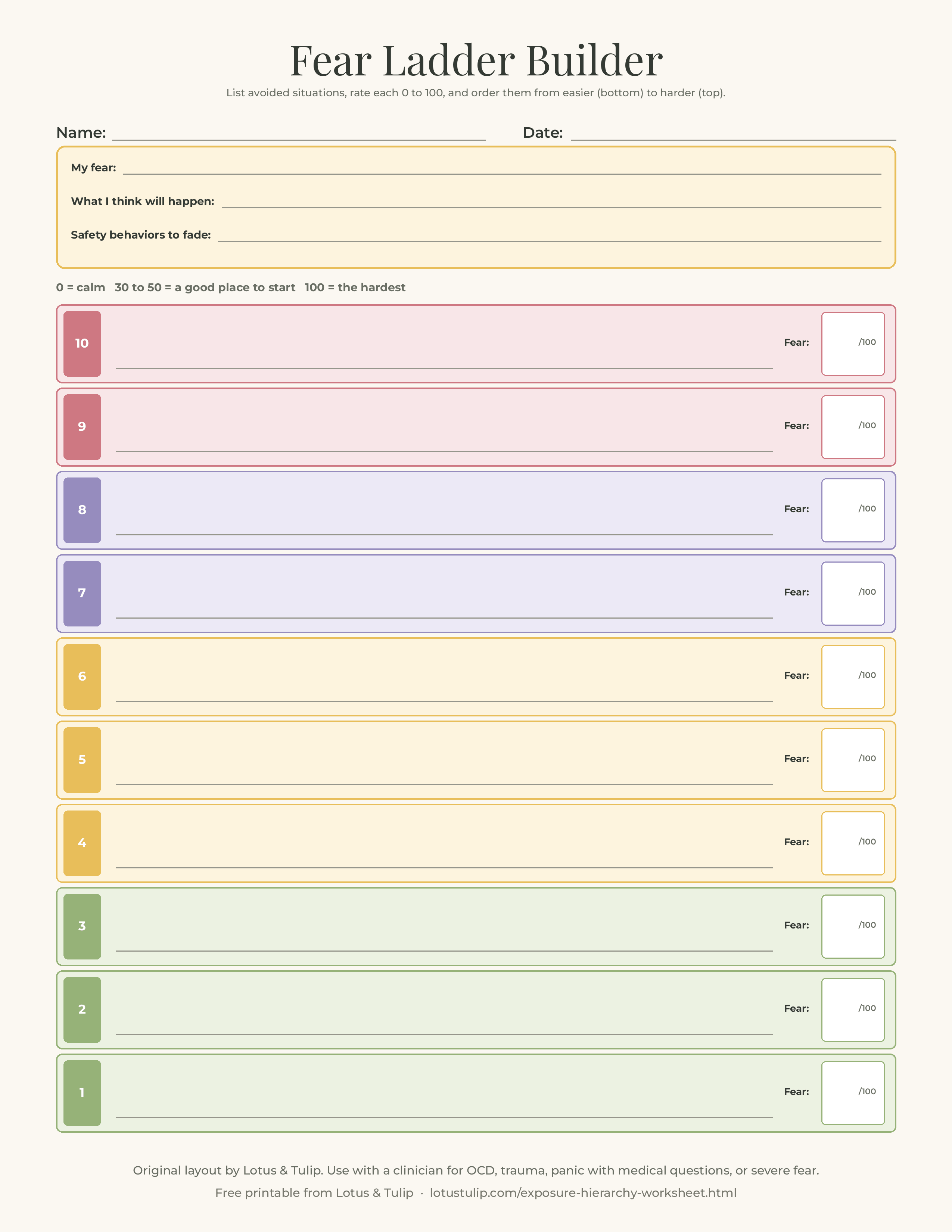
Download the free exposure hierarchy worksheet (PDF, 3 pages, US Letter)
Prefer single images? Page 1: Fear Ladder Builder (PNG) · Page 2: Exposure Practice Record (PNG) · Page 3: Weekly Exposure Tracker (PNG)
Free OCD and ERP starter pack: Working with OCD? The free OCD and ERP worksheets starter pack includes a ten rung exposure ladder that lists the ritual each step would trigger, plus the OCD cycle, an exposure practice record (distress at start, peak and end), a response prevention plan, riding the urge and a support page (8 pages, client use license, no email).
Free anxiety starter pack: The free anxiety worksheets starter pack includes a ten rung fear ladder with expected distress from 0 to 100, plus the anxiety cycle, a worry log, probability and catastrophe, grounding and a support and safety page from our paid anxiety set.
Free CBT starter pack: Want more pages for the same session? The free CBT worksheets starter pack adds an exposure ladder with expected and actual distress, plus five more real worksheets from our CBT set (8 pages, client use license, no email).
Free to print for your own use and for use with your own clients, students, or groups. This is an original layout by Lotus & Tulip. Please link to this page rather than re-uploading the file.
Related resources
- School refusal worksheets for teens: a return ladder for teens avoiding school, free printable
- Selective mutism worksheets for kids: a speaking ladder for children who freeze at school, free printable
- Separation anxiety worksheet for kids (free printable): a goodbye plan and a brave apart ladder
- Social anxiety worksheet for adults: map the cycle, drop safety behaviors and practice step by step, free printable.
- Anxiety worksheets for kids: worry, body clues and brave steps for younger children.
- Panic attack worksheet: map the panic cycle and plan interoceptive exposure, free printable.
- CBT thought record: catch and test anxious predictions in writing.
- Cognitive defusion worksheet: step back from sticky anxious thoughts.
- 5 4 3 2 1 grounding worksheet: a quick way to come back to the present after practice.
- Test anxiety worksheet: a focused plan for exam related fear.
- Feelings thermometer printable: a kid friendly rating scale for the ladder.
Sources
- Wolpe, J. (1958). Psychotherapy by Reciprocal Inhibition. Stanford University Press.
- Wolpe, J. (1969). The Practice of Behavior Therapy. Pergamon Press.
- Craske, M. G., Kircanski, K., Zelikowsky, M., Mystkowski, J., Chowdhury, N., and Baker, A. (2008). Optimizing inhibitory learning during exposure therapy. Behaviour Research and Therapy, 46(1), 5 to 27.
- Craske, M. G., Treanor, M., Conway, C. C., Zbozinek, T., and Vervliet, B. (2014). Maximizing exposure therapy: An inhibitory learning approach. Behaviour Research and Therapy, 58, 10 to 23.
- Blakey, S. M., and Abramowitz, J. S. (2016). The effects of safety behaviors during exposure therapy for anxiety: Critical analysis from an inhibitory learning perspective. Clinical Psychology Review, 49, 1 to 15.
- Hofmann, S. G., and Smits, J. A. J. (2008). Cognitive-behavioral therapy for adult anxiety disorders: A meta-analysis of randomized placebo-controlled trials. Journal of Clinical Psychiatry, 69(4), 621 to 632.
- Walkup, J. T., et al. (2008). Cognitive behavioral therapy, sertraline, or a combination in childhood anxiety. New England Journal of Medicine, 359, 2753 to 2766.
- Abramowitz, J. S., Deacon, B. J., and Whiteside, S. P. H. (2019). Exposure Therapy for Anxiety: Principles and Practice (2nd ed.). Guilford Press.
- Lebowitz, E. R., et al. (2020). Parent-based treatment as efficacious as cognitive-behavioral therapy for childhood anxiety: A randomized noninferiority study of Supportive Parenting for Anxious Childhood Emotions. Journal of the American Academy of Child and Adolescent Psychiatry, 59(3), 362 to 372.
- 988 Suicide and Crisis Lifeline, 988lifeline.org. Crisis Text Line, crisistextline.org.
Exposure hierarchy worksheet: FAQ
What is an exposure hierarchy?
An exposure hierarchy, or fear ladder, is a list of feared and avoided situations ranked from easier to harder, usually with a 0 to 100 fear rating for each. It guides gradual, planned exposure practice in CBT for anxiety and ERP for OCD.
How many steps should a fear ladder have?
Most ladders have about 8 to 15 steps. What matters more than the number is that steps are specific enough to practice and that there are no huge jumps in difficulty between neighboring steps.
Where should exposure start on the hierarchy?
Many clinicians start with a step rated around 30 to 50 out of 100: clearly uncomfortable but doable. The person should agree to the step. Starting very high often leads to escape, and staying very low for too long teaches little.
Does anxiety have to go down during an exposure for it to work?
Not necessarily. Current inhibitory learning research suggests the key is testing the feared prediction and learning that the outcome was different or more manageable than expected. Anxiety dropping is welcome but is not the only sign of progress.
What are safety behaviors in exposure therapy?
Safety behaviors are things people do to feel less anxious or prevent a feared outcome, such as staying near an exit, seeking reassurance, over preparing, or distracting. They can block new learning, so exposure plans usually fade them step by step.
Can parents use a fear ladder with their child?
Parents can support a fear ladder at home, ideally in partnership with a therapist. Keep steps small and specific, let the child help choose, praise effort, and reduce accommodation such as repeated reassurance. Seek professional help for severe fears, OCD or trauma.
Can I print the free exposure hierarchy worksheet for clients?
Yes. The free PDF is an original Lotus & Tulip layout you can print for your own use and for your own clients, students or groups. Please link to this page instead of re-uploading the file.