
Therapists and counselors · Updated 2026-11-08
ADHD Worksheets: Executive Function, Focus Plans, and Free Printable
Ready-made printable: ADHD Worksheets for Therapists Fillable PDF, 20 pages: task breakdown, time estimation log, daily top three, habit tracker and impulse pause
Holiday 20% off: about $11.04, was $14 (EUR 12) · instant digital download
Try it free first: download a fillable sample (break it down and getting unstuck, PDF, 282 KB). Type into it on screen, then get the full pack. No email needed.

ADHD worksheets give therapists, counselors and ADHD coaches a concrete way to turn executive function skills into daily habits: mapping where things break down, breaking tasks into a first small action, planning focus blocks, calibrating time estimates, setting up the environment, planning transitions and reviewing the week. This guide is written for US clinicians working with adults and college students with ADHD in private practice, community clinics, college counseling centers and telehealth. Adults with ADHD can use the free printable on their own too, though it works best beside a clinician or coach who can help adjust the plan.
You will get twelve worksheet backed practices with timing and debrief questions, a six session starter plan, adaptations for adults, college students, parents and telehealth, tips, mistakes, myths, three fictional examples, a comparison with nearby guides, honest research notes, seven FAQs, a nine step HowTo and a free three page US Letter printable: ADHD Care Steps, My Focus and Follow-Through Plan, and a Practice Log with nine pocket cards.
This page is written for adult clients. For younger children, see our executive functioning worksheets for kids. For teens, see impulse control activities for teens, time management activities for teens and study skills activities for teens. This page pulls adult focused executive function tools into one practical workflow.
We draw on published research and clinical guidance without claiming any affiliation or endorsement: Adele Diamond's 2013 Annual Review of Psychology paper on executive functions, Russell Barkley's 1997 model of ADHD and behavioral inhibition, the Safren and colleagues (2010, JAMA) trial of CBT for medication treated adults, the Solanto and colleagues (2010, American Journal of Psychiatry) trial of meta-cognitive therapy, the Shaw and colleagues (2014) review of emotion dysregulation in ADHD, NICE guideline NG87 and CDC data on adult ADHD in the United States. The printable is an original Lotus and Tulip layout.
This guide is educational. Worksheets do not diagnose ADHD, do not treat or cure it by themselves, and do not replace evaluation, medication or structured therapy when those are indicated. They are skill practice aids. If you or someone you support is thinking about suicide, call or text 988 (Suicide and Crisis Lifeline) or text HOME to 741741 (Crisis Text Line). For immediate danger, call 911. For a written plan for a crisis moment, see our safety plan worksheet.
What ADHD worksheets are (and are not)
ADHD worksheets are paper tools that help a client see their own patterns, choose a strategy that fits, practice it between sessions and review what actually happened. Good ones are short, visual and practical. They move the work from "I know what I should do" to "here is the first two minute step, here is when I will do it, and here is what I will do when I get pulled away." Much of the value comes from the conversation the page starts and from the review a week later.
Many adults with ADHD have spent years hearing that they are lazy, careless or not trying. A worksheet that treats the problem as a skills and systems gap, rather than a character flaw, can lower shame enough for real experiments to happen. That is one of the quiet benefits of putting the plan on paper.
What they are not.
- Not a diagnosis. A symptoms map or self rating page is educational. Diagnosing ADHD in adults requires a clinical evaluation by a qualified professional, with a developmental history, attention to other conditions and evidence of impairment across settings.
- Not a cure printable. ADHD is a neurodevelopmental condition. Worksheets can help clients build supports and habits. They do not make ADHD go away.
- Not a substitute for medication. For many adults, medication is a central part of care. Worksheets never replace a prescriber's assessment, and clinicians without prescribing authority should not advise on doses or timing.
- Not a kids only tool. Executive function pages for children rely on adult scaffolding. Adult pages need to respect autonomy, work schedules, relationships, money and parenting.
- Not a replacement for structured care. When symptoms are significant, a full evaluation, medication review, a structured CBT or meta-cognitive program, ADHD coaching or workplace accommodations may be what the client needs. Worksheets fit inside that care.
The pages in this guide avoid long, dense text and use boxes, short prompts and checkboxes. If a worksheet is so complicated that completing it requires strong executive function, it will fail the people it is meant for.
Core ideas that shape good ADHD worksheets
1. Executive functions are a family of skills. Adele Diamond (2013, Annual Review of Psychology) describes three core executive functions: inhibitory control (including self-control and interference control, which covers selective attention), working memory, and cognitive flexibility. Higher order skills such as planning, reasoning and problem solving build on these. Diamond also notes that stress, lack of sleep, loneliness and lack of exercise each impair executive functions, which is a useful reminder that sleep and movement pages belong in an ADHD plan. Explaining these domains in plain language helps clients see why they can be brilliant in some situations and stuck in others.
2. Barkley's model puts self-regulation at the center. Russell Barkley (1997, Psychological Bulletin) proposed a theory of ADHD in which a core deficit in behavioral inhibition affects four executive functions: working memory, self-regulation of affect, motivation and arousal, internalization of speech, and reconstitution (breaking down and recombining behavior). Clinically, this model is often summarized as "ADHD is a problem of doing what you know, not knowing what to do." Barkley also wrote extensively about time and ADHD, which many clients recognize as "time blindness." Treat these as clinical models, not settled fact: research on ADHD is diverse and not every client fits one theory.
3. Externalize what is hard to hold in mind. If working memory is unreliable, the plan has to live outside the head: on paper, a whiteboard, a phone alarm, a visible timer, a launch pad by the door. Many effective ADHD strategies are less about willpower and more about moving information and cues to the point of action. Worksheets are one form of external memory, but only if they are visible where the task happens.
4. Emotion dysregulation is common and impairing, but it is not a DSM symptom. Shaw, Stringaris, Nigg and Leibenluft (2014, American Journal of Psychiatry) reviewed the literature and concluded that emotion dysregulation is prevalent in ADHD across the lifespan and is a major contributor to impairment. They also noted that researchers disagree on whether it should be seen as a core feature of ADHD, a correlated but distinct dimension, or a separate subgroup. The DSM criteria focus on inattention and hyperactivity-impulsivity. In practice, it is fair to say that many adults with ADHD describe fast, intense emotions and that a plan for emotional surges belongs in the toolkit.
5. Structured psychosocial treatment has evidence for adults. Safren and colleagues (2010, JAMA) randomized 86 adults with ADHD who were already taking medication but still had clinically significant symptoms to 12 individual sessions of CBT or an attention matched comparison of relaxation with educational support. CBT produced lower post treatment scores on blinded ADHD ratings and more responders (67 percent versus 33 percent on the ADHD rating scale), and responders kept their gains at 6 and 12 month follow-up. Solanto and colleagues (2010, American Journal of Psychiatry) randomized 88 adults with ADHD to a 12 week group meta-cognitive therapy focused on time management, organization and planning, or to supportive group therapy, and found greater improvement in inattention symptoms with meta-cognitive therapy. These are structured, clinician delivered programs. A free printable is not the same thing, but it can borrow the same targets: planning, organization, task initiation and unhelpful thoughts.
6. Adult ADHD is common, and many adults are diagnosed late. A CDC report (Staley and colleagues, 2024, MMWR) estimated that in 2023 about 15.5 million US adults (6.0 percent) had a current ADHD diagnosis based on self report, and that more than half (55.9 percent) received the diagnosis at age 18 or older. About one third were receiving no treatment. That means many adult clients arrive in therapy newly diagnosed, untreated or unsure where to start.
7. Guidelines put worksheets in context. NICE guideline NG87 recommends medication for adults whose ADHD symptoms still cause significant impairment after environmental modifications have been implemented and reviewed, and recommends considering non-pharmacological treatment for adults who have made an informed choice not to take medication, have difficulty adhering to it, or have found it ineffective or poorly tolerated. When used, that support should include at least a structured supportive psychological intervention focused on ADHD, and may include elements of or a full course of CBT. US clinicians follow their own professional guidance, but the message is similar: environment, skills, psychological support and medication each have a place.
When you explain this to clients, keep it short and kind: "Your brain manages time, attention and starting tasks differently. That is not a moral failing. We are going to build systems that work with your brain, test them, and keep what helps."
Twelve worksheet backed ADHD practices
Use these in session and as optional between session practice. Times are approximate. Before assigning homework, check for depression, anxiety, substance use, sleep problems, suicidal thoughts and life crises that may need attention first. Practice each tool in session before sending it home, and keep the number of active strategies small.
1. Symptoms and context map (educational, not diagnostic)
Time: 15 to 20 minutes. When: first or second session.
Four boxes: attention and focus, starting and finishing, time and organization, feelings and impulses. In each box the client writes where it shows up (work, home, relationships, money, driving) and how much it costs them, from 0 to 10. This is not a rating scale and should not be used to diagnose. Its job is to show where the pain is so you can pick the first target. If the client has no formal diagnosis and the map shows broad impairment, discuss referral for evaluation.
Debrief: "If one of these boxes got 20 percent easier, which would change your week the most?"
2. Strengths and interest inventory
Time: 10 to 15 minutes. When: early, before problem lists dominate.
Prompts: times I was focused and productive, tasks I find easy to start, interests that pull me in, what people thank me for, conditions that help me (deadlines, novelty, company, movement, music). Many adults with ADHD have a long list of failures in their head and a short list of strengths. This page balances the picture and often reveals the conditions under which they already work well, which become design clues for the plan.
Debrief: "What was different about the days you were on fire, and can we copy any of it?"
3. Environment audit
Time: 15 minutes. When: session two or three.
Walk through the main places the client works and lives: desk, kitchen, bedroom, car, phone. For each: what pulls attention away, what is missing, what could be moved, hidden or added. Typical changes include a single visible launch pad for keys, wallet and bag, phone in another room during focus blocks, notifications off, a visible timer, a whiteboard for today's top three, and closed browser tabs. Environmental changes are low effort and high leverage because they do not depend on remembering.
Debrief: "What is one change you can make in five minutes today?"
4. Task breakdown and next action
Time: 10 to 15 minutes per task. When: early, and any time a task feels too big.
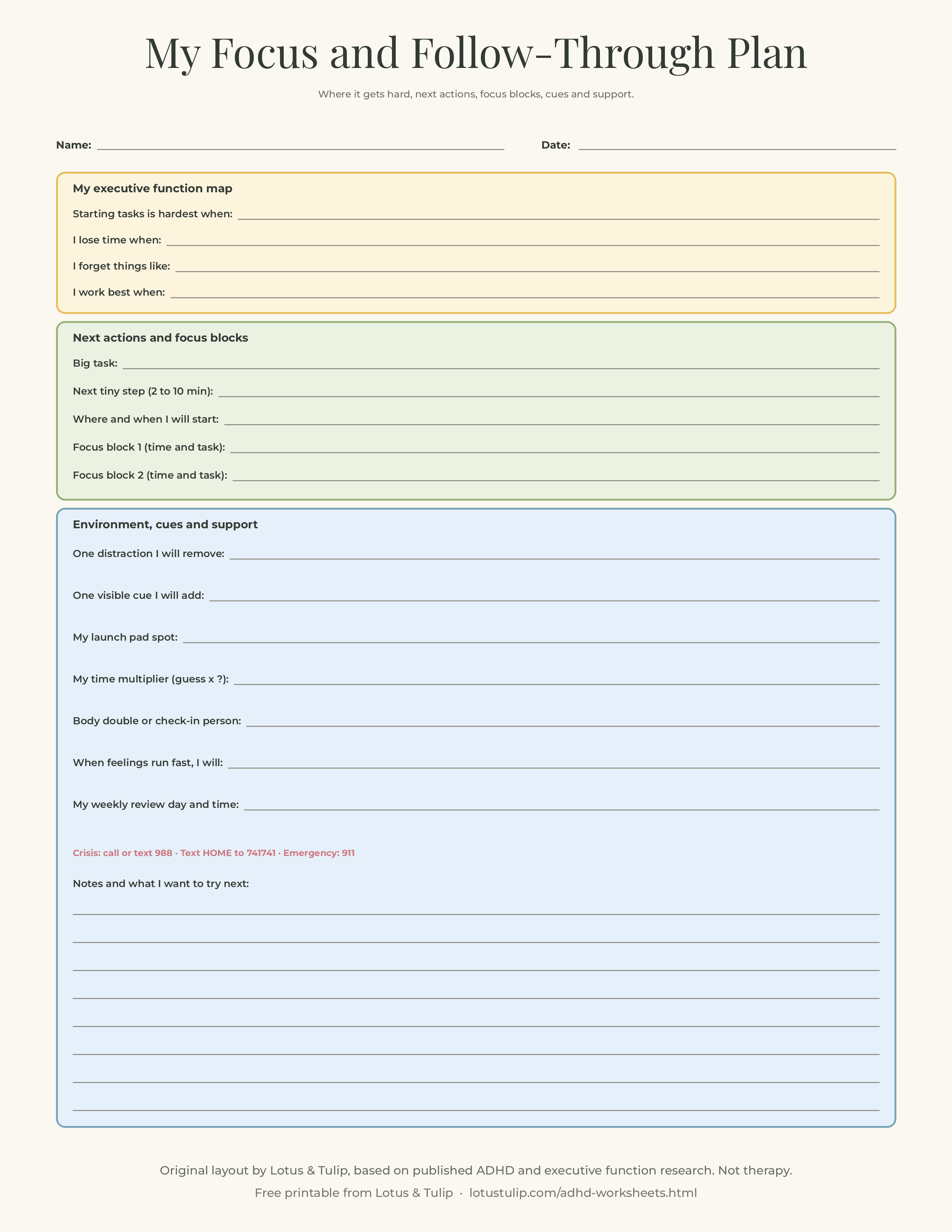
Write the big task at the top. Break it into steps until the first step can be done in two to ten minutes and is physical and specific ("open the tax folder and find last year's form," not "do taxes"). Circle the next action. Add when and where it will happen. This is one of the most useful ADHD tools because overwhelm often hides inside vague tasks. Page two of the free printable has a next actions box.
Debrief: "Is the first step small enough that you could start it right now in this room?"
5. Body double and accountability plan
Time: 10 minutes. When: when solo work keeps stalling.
Many adults with ADHD report that working beside another person, in person or on a video call, helps them start and stay with boring tasks. This is often called body doubling. It is widely used in coaching practice, but we have not found strong controlled research on it, so present it as an experiment, not a proven treatment. The page asks: which task, who could sit with me (friend, coworker, study group, online co-working session), when, and what I will report afterwards. Simple accountability, such as sending a photo of the finished step to a friend, belongs here too.
Debrief: "On a scale of 0 to 10, how much easier was starting with someone there?"
6. Time estimate calibration
Time: 5 minutes per entry, over one or two weeks. When: when lateness, missed deadlines or overpacked days are a theme.
Before a task, write a guess for how long it will take. Time it. Write the actual time. After eight to ten entries, many clients spot a pattern, such as consistently underestimating admin tasks or getting ready in the morning. The client can then use a personal correction factor ("whatever I think, add half again") and build buffers into the day. This turns time blindness from a vague complaint into data.
Debrief: "What is your personal multiplier, and where will you use it this week?"
7. Focus block planner
Time: 10 minutes to plan a day. When: once next actions exist.
Choose two or three focus blocks for the day, each with one named task, a start time, a length the client can actually sustain (often 15 to 30 minutes to start), and a short break plan. Use a visible timer. Put the hardest block at the client's best time of day. Page two of the free printable includes a focus block grid. The goal is not a perfect schedule; it is a few protected windows that happen most days.
Debrief: "Which block happened, which did not, and what got in the way?"
8. Distraction log
Time: 1 minute per entry. When: alongside focus blocks.
Keep a notepad next to the work. When a distraction or new idea pops up, write it down in a few words and return to the task. At the end of the block, sort the list: do later, schedule, delete. This captures the thought without acting on it, which often reduces the urge to switch tasks. Over a week the log also shows which distractions are external (phone, people, noise) and which are internal (ideas, worries, boredom), which shapes the environment audit.
Debrief: "What were your top three distractions, and which one can we design out?"
9. Transition checklist
Time: 10 minutes. When: when hyperfocus, lateness or getting out the door is a problem.
Write a short checklist for the hardest transitions of the day: leaving the house, starting work after a break, stopping a hyperfocus activity, going to bed. Each checklist has three to five steps and a cue (alarm, timer, sticky note on the door). A five minute warning timer before a hard stop often helps. Keep the checklist where the transition happens, not in a binder.
Debrief: "Which transition costs you the most, and what is the first cue that should start it?"
10. Sleep, movement and medication timing log (non-prescriptive)
Time: 2 minutes a day for one to two weeks. When: when focus varies a lot from day to day.
Columns: bedtime and wake time, movement, caffeine, medication taken and when (if prescribed), and focus rating for the day. The point is to spot patterns, not to change anything on your own. Any question about medication dose or timing goes to the prescriber, and the client can bring the log to that appointment. If chronic insomnia shows up, see our CBT-I worksheets and discuss it with the client's medical team. Diamond (2013) lists lack of sleep and lack of exercise among the factors that impair executive functions, so these basics deserve attention.
Debrief: "Looking at the log, what seems to come before your better focus days?"
11. Emotional surge plan
Time: 15 minutes. When: when frustration, rejection or anger spikes cause problems.
Prompts: early signs that a surge is building, situations that often trigger it (criticism, waiting, being interrupted, feeling rejected), a pause step ("hands off the keyboard, step away for 90 seconds"), one fast body skill and one thing I will say to myself. For fast physiological calming, many clinicians borrow DBT skills; see our TIPP skills worksheet and distress tolerance worksheets. Pair with kinder self talk, because shame after an outburst often fuels the next one.
Debrief: "What was the earliest moment you could have used the pause, and what would make that easier next time?"
12. Weekly review
Time: 10 to 15 minutes. When: once a week, ideally the same time and place.
Look back: what worked, what did not, what got done. Look ahead: appointments, deadlines, top three priorities, focus blocks for the week. Then pick one small system to adjust. Many adults with ADHD drop systems when they stop being new. A weekly review is the habit that keeps the other habits alive, and it gives you a natural agenda for the next session.
Debrief: "What is the one adjustment that would make next week smoother?"
Across all twelve practices, keep it small. Pick one or two tools at a time, practice them until they feel automatic, and add the next only when the first is working. Expect that strategies will lose their spark over time and need refreshing. That is normal, not failure.
Also plan for reading level, vision, language, culture and money. Large print, fewer prompts and oral completion help. Some clients prefer apps; that is fine if the app is simple and the client will actually open it. Paper works for many people because it is visible and does not ping.
A six session starter plan (skills practice, not a protocol)
This table is a starter structure for focused skills work with an adult who has an ADHD diagnosis or is being evaluated. It is assessment informed skills practice, not a validated treatment protocol. If you are trained in a structured program such as CBT for adult ADHD or meta-cognitive therapy, follow that program's materials.
| Session | Focus | Optional take home page |
|---|---|---|
| Self-monitoring checklist for students | Students checking their own attention or work in class | Classroom tool for kids and teens, with a free self-check sheet |
| 1 | Goals, history, current treatment, safety, symptoms and context map, strengths | Symptoms and context map, strengths inventory (practices 1 and 2) |
| 2 | Psychoeducation on executive functions, environment audit, first quick wins | Environment audit (practice 3) |
| 3 | Task breakdown and next action, body double or accountability plan | Next action page and accountability plan (practices 4 and 5) |
| 4 | Time estimate calibration, focus blocks, distraction log | Time log, focus block planner, distraction log (practices 6, 7 and 8) |
| 5 | Transitions, sleep and movement patterns, emotional surge plan | Transition checklist, daily log, surge plan (practices 9, 10 and 11) |
| 6 | Weekly review routine, relapse planning, shared decision about next steps or referral | Weekly review (practice 12) |
Six sessions is often not enough to make habits stick. Many clients benefit from monthly check-ins after the initial block, a structured group program, or ADHD coaching. Use a symptom or functioning measure your setting already uses at intake and periodically, so progress is not judged only by how many worksheets were completed.
How to use ADHD worksheets, step by step
- Check safety and the bigger picture first. Ask about mood, anxiety, substance use, sleep and suicidal thoughts. If risk is present, use crisis care and a safety plan before skills work.
- Clarify diagnosis and current care. Note whether the client has a formal evaluation and a prescriber, and refer for evaluation if needed. Worksheets are not diagnostic.
- Map where ADHD costs the most. Use the symptoms and context map and the strengths inventory to pick one or two targets.
- Explain executive functions in plain language. Frame the problem as a skills and systems gap, not a character flaw.
- Change the environment. Use the environment audit to remove distractions and add visible cues.
- Break one real task into a next action. Make the first step small, specific and scheduled.
- Plan focus blocks and track time. Set a few short focus blocks, use a timer and log time estimates against actual time.
- Plan for transitions and emotional surges. Write short checklists and a pause plan for the hardest moments.
- Review weekly and adjust. Keep what works, change one thing, and decide together whether more support is needed.
Print the free three page set once and keep a stack in your office. Many clients like to keep page two on the fridge or next to the desk, which is exactly where it should live. A plan in a drawer does not help a brain that forgets what it cannot see.
Adaptations
- Adults at work: Focus on calendar systems, email triage, meeting notes and protecting focus blocks. Discuss whether to request workplace accommodations, such as a quieter workspace, written instructions, flexible scheduling or noise cancelling headphones. In the US, the Job Accommodation Network (askjan.org) offers free guidance on accommodations.
- College students: Use a semester calendar with every deadline, weekly planning, study blocks in the library, and body doubling in study groups. Encourage contact with the campus disability services office early, since accommodations usually require documentation. Our study skills activities adapt well for first year students.
- Parents of children with ADHD (brief): Many parents of children with ADHD have ADHD themselves. Their own focus plan helps the whole household. For their children, see executive functioning worksheets for kids and encourage coordination with the child's pediatrician and school.
- Teens: This guide is written for adults. For adolescents, use developmentally adapted materials and involve caregivers where appropriate. See impulse control activities for teens and time management activities for teens.
- Telehealth: Screen share the printable or send it before the session. Body doubling works well on video. Ask clients to show their workspace on camera during the environment audit if they are comfortable with that. Agree on a plan if the connection drops.
- Co-occurring anxiety or depression: These are common in adults with ADHD and can look like or worsen executive function problems. Address them directly; worksheets for focus will not fix depression. Our anxiety worksheets for therapists pack can sit alongside this set.
When to refer: refer for a comprehensive evaluation when the client has no diagnosis and the picture suggests ADHD or another condition; to a prescriber for a medication review when symptoms remain impairing; to a structured CBT or meta-cognitive program or an ADHD coach when the client wants more intensive skills work; and to vocational or disability services for workplace or school accommodations. Refer urgently for suicidal thoughts, severe depression, mania, psychosis or substance use that dominates the picture.
Tips for therapists and counselors
- Practice each tool in session with a real task before assigning it.
- Keep pages short and visual. Fewer prompts, more white space.
- Put the plan where the task happens: desk, fridge, car, phone lock screen.
- Normalize partial completion. A half filled log with one insight is useful.
- Use the client's interests and urgency as fuel: novelty, challenge, deadlines, company.
- Expect systems to fade and plan a refresh before they do.
- Coordinate with prescribers and other providers when the client consents.
- Send a reminder text or email between sessions if your practice allows it; many clients appreciate an external cue.
- Start sessions by reviewing last week's plan, not by asking whether homework got done.
- Watch for shame. Respond to missed tasks with curiosity, not disappointment.
Common mistakes
- Handing over a complex planner that requires strong executive function to complete.
- Adding too many strategies at once.
- Using worksheets in place of an evaluation or a medication review.
- Giving advice about medication timing or doses without prescribing authority.
- Treating missed homework as resistance rather than as useful data about the system.
- Ignoring sleep, depression, anxiety and substance use.
- Stopping after early wins without a plan for when the novelty wears off.
Myths about ADHD and worksheets
- Myth: "People with ADHD are lazy." Reality: ADHD involves differences in attention, activity and self-regulation. Many adults with ADHD work very hard and still struggle with starting, organizing and finishing tasks.
- Myth: "Just try harder." Reality: Effort alone rarely fixes executive function problems. Systems, cues, environment changes, support and, for many people, medication tend to help more than willpower.
- Myth: "ADHD is only a childhood condition." Reality: ADHD can continue into adulthood. CDC data estimate that 6.0 percent of US adults had a current ADHD diagnosis in 2023, and more than half of them were diagnosed as adults.
- Myth: "Worksheets alone fix ADHD." Reality: Worksheets are practice aids. Structured psychosocial programs, medication and accommodations each have a role, chosen with the client.
- Myth: "If someone can focus on video games, they cannot have ADHD." Reality: Many people with ADHD can focus intensely on interesting or rewarding tasks. The difficulty is often with tasks that are boring, long or delayed in reward.
Three fictional examples
Priya, 31, project manager, newly diagnosed. Priya was diagnosed with ADHD at 30 after years of last minute deadlines and late nights. Her clinician started with the strengths inventory, which showed she did her best work in short sprints with company. They built two 25 minute focus blocks each morning, a distraction notepad and a Friday weekly review. The time estimate log revealed she underestimated email and reporting tasks by about half, so she started adding buffers. She also brought her sleep and focus log to her prescriber, who reviewed her medication. After two months she described her weeks as "less heroic and more predictable."
Jordan, 20, college sophomore. Jordan was on academic probation and avoided opening the learning portal because it made him feel sick with dread. His counselor used task breakdown to turn "catch up on everything" into one next action: open the portal and write down every overdue item. Jordan joined a library study group as a body double, set up a semester calendar and registered with disability services for extended deadlines. The emotional surge plan helped when he felt overwhelmed by grades. Jordan's counselor also coordinated with the campus health center for a medication evaluation.
Mel, 42, worksheets paused for safety. Mel came to therapy for disorganization and job problems. In session three, after losing her job, she said she had been thinking she would be better off dead. Her clinician set the focus plan aside, completed a safety plan together, discussed 988 and text HOME to 741741, increased session frequency and coordinated with her physician. ADHD skills work resumed weeks later, once Mel was safer and her depression was being treated.
In each example the clinician matched the page to the moment. Priya needed structure and data, Jordan needed tiny first steps and accommodations, and Mel needed safety before any worksheet.
How this page compares to nearby Lotus and Tulip guides
| Page | Best for | Not the same as ADHD worksheets |
|---|---|---|
| Executive functioning worksheets for kids | Children, with adult scaffolding | Kid friendly, not adult work and life planning |
| Impulse control activities for teens | Teen groups and sessions on pausing before acting | One domain, teen focus |
| Time management activities for teens | Teen planning and schedules | Teen school context, not adult work |
| Study skills activities for teens | Studying, notes and tests | Academic focus only |
| Flexible thinking worksheet | Cognitive flexibility and rigid thinking | One executive function, not a full plan |
| CBT worksheets for therapists (product) | General CBT tools across problems | Broader, not ADHD specific |
| Trauma worksheets | Stabilization after trauma | Different target; attention problems after trauma need careful assessment |
When not to use these worksheets
- Acute suicidal crisis or inability to stay safe. Use crisis care and a safety plan first. Call or text 988, text HOME to 741741, or call 911 for immediate danger.
- As a substitute for an evaluation when ADHD has not been assessed, or when symptoms could reflect another condition such as depression, anxiety, trauma, sleep disorders, substance use or a medical problem.
- When severe depression, mania, psychosis or substance use needs treatment first.
- When paperwork itself has become a source of shame or conflict. Work verbally and use one small cue instead.
- As a way to adjust medication without a prescriber.
Free 3 page ADHD worksheets printable (US Letter)
Download the free printable, print on US Letter and use in session or as optional practice between sessions.
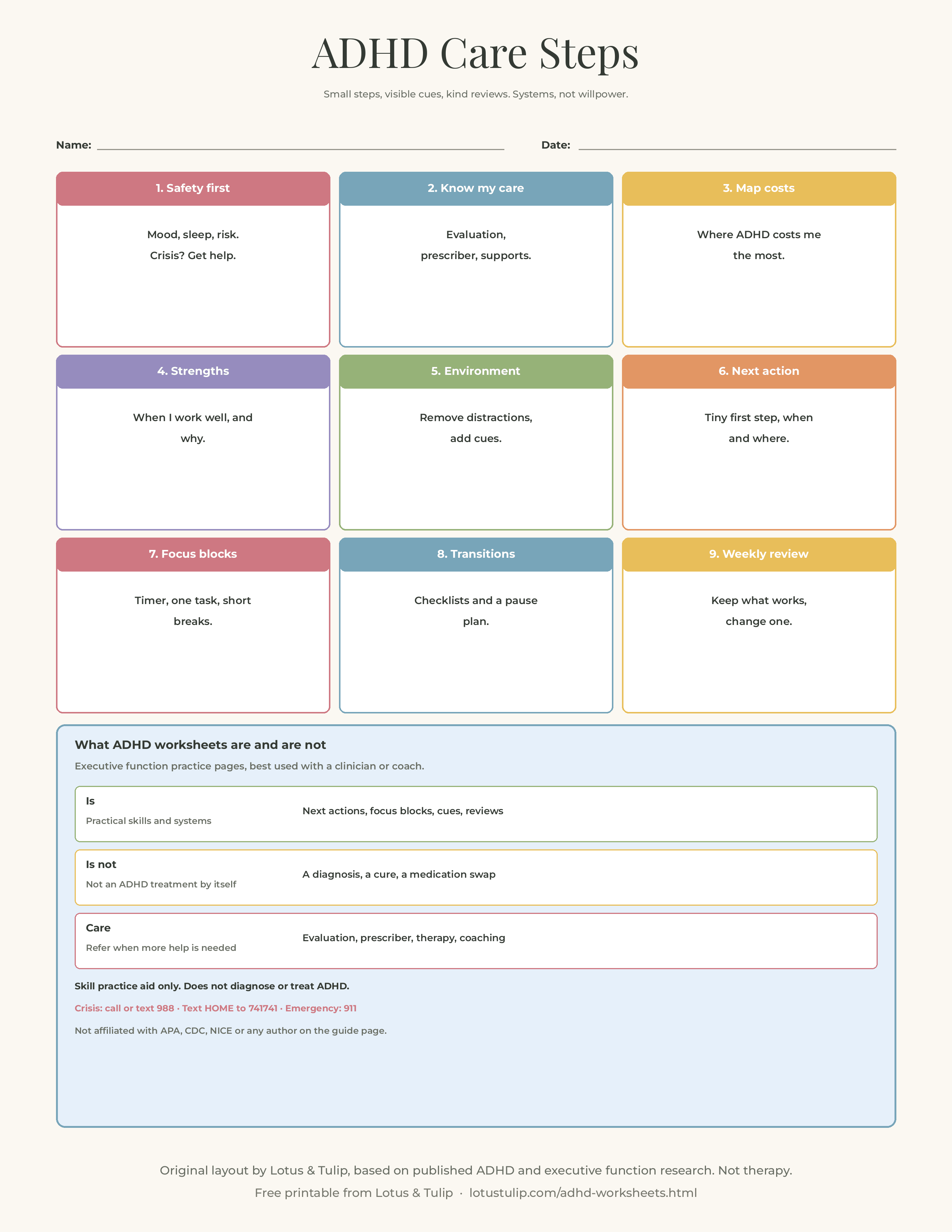
- Page 1: ADHD Care Steps. Nine steps that match the HowTo above, what ADHD worksheets are and are not, and crisis resources.
- Page 2: My Focus and Follow-Through Plan. Executive function map, next actions, focus blocks, environment changes and support people.
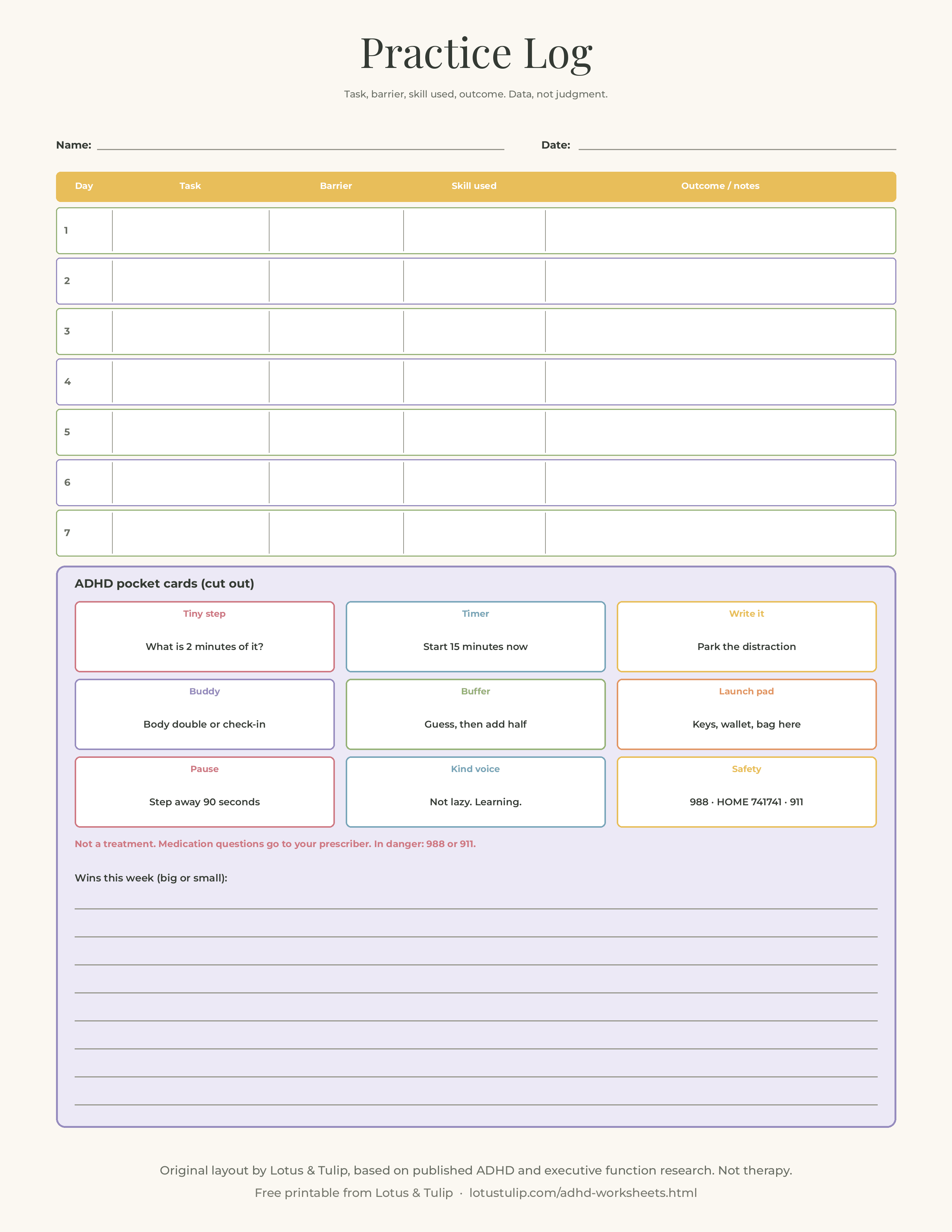
- Page 3: Practice Log. Seven rows for task, barrier, skill used, outcome and notes, plus nine pocket cards.
Download free PDF · Page 1 PNG · Page 2 PNG · Page 3 PNG
Free ADHD starter pack: Want more real pages? The free ADHD worksheets starter pack adds my brain, my profile, break it down, a time estimation log, getting unstuck, the impulse pause and a strengths and support plan from our paid ADHD set (8 pages, client use license, no email).
When the hardest part is starting at all, the procrastination worksheet for adults maps the avoid and relief loop and has a free get started plan with if-then plans and a start log. For planning the whole week, the time management worksheet for adults adds an estimate versus actual log, focus blocks with buffers and a parking lot.
Research notes (verified, with caveats)
- Diamond A. Executive functions. Annu Rev Psychol. 2013;64:135-168. Describes three core executive functions (inhibition, working memory, cognitive flexibility) and notes that stress, lack of sleep, loneliness and lack of exercise impair them.
- Barkley RA. Behavioral inhibition, sustained attention, and executive functions: constructing a unifying theory of ADHD. Psychol Bull. 1997;121(1):65-94. Proposes behavioral inhibition as a core deficit affecting working memory, self-regulation of affect, motivation and arousal, internalization of speech and reconstitution.
- Safren SA, Sprich S, Mimiaga MJ, et al. Cognitive behavioral therapy vs relaxation with educational support for medication-treated adults with ADHD and persistent symptoms: a randomized controlled trial. JAMA. 2010;304(8):875-880. 86 adults; 12 individual sessions; responders 67 percent vs 33 percent on the ADHD rating scale and 53 percent vs 23 percent on the Clinical Global Impression scale; gains maintained at 12 months among responders.
- Solanto MV, Marks DJ, Wasserstein J, et al. Efficacy of meta-cognitive therapy for adult ADHD. Am J Psychiatry. 2010;167(8):958-968. 88 adults; 12 weekly group sessions targeting time management, organization and planning; greater improvement in inattention symptoms than supportive group therapy.
- Shaw P, Stringaris A, Nigg J, Leibenluft E. Emotion dysregulation in attention deficit hyperactivity disorder. Am J Psychiatry. 2014;171(3):276-293. Review concluding that emotion dysregulation is prevalent in ADHD across the lifespan and a major contributor to impairment, with debate about how to classify it.
- Staley BS, Robinson LR, Claussen AH, et al. Attention-deficit/hyperactivity disorder diagnosis, treatment, and telehealth use in adults. MMWR. 2024;73(40). Estimated 15.5 million US adults (6.0 percent) with a current ADHD diagnosis in 2023 by self report; 55.9 percent diagnosed at 18 or older.
- National Institute for Health and Care Excellence. Attention deficit hyperactivity disorder: diagnosis and management (NG87). 2018, updated 2019. Places environmental modifications, medication and structured psychological support in a stepped approach for adults.
We do not invent effect sizes. The trials above tested structured, clinician delivered programs over 12 weeks, not standalone worksheets. The free printable is a skill practice aid inspired by the same targets and has not been tested in a randomized trial. Body doubling and time estimate logs are common in clinical and coaching practice but have limited direct research, so present them as experiments. Guidelines are updated over time, so check current versions before citing them in documentation.
The DSM-5-TR criteria for ADHD are copyrighted, so we do not reproduce them. In summary, CDC materials note that adults aged 17 and older need five or more symptoms of inattention and or hyperactivity-impulsivity, several symptoms present before age 12, symptoms in two or more settings, clear interference with functioning, and no better explanation by another condition. That is for a qualified clinician to assess, not a worksheet.
ADHD worksheets: FAQ
What are ADHD worksheets?
They are short, structured pages that help adults with ADHD practice executive function skills: mapping where problems show up, breaking tasks into next actions, planning focus blocks, calibrating time estimates, setting up the environment, planning transitions and reviewing the week. Therapists and coaches use them in session and between sessions.
Can ADHD worksheets diagnose ADHD?
No. Diagnosis in adults requires a clinical evaluation by a qualified professional, including developmental history, symptoms across settings, impairment and consideration of other conditions. A symptoms map is educational only.
Do worksheets replace ADHD medication?
No. For many adults, medication is an important part of care. Worksheets help build skills and systems and can complement medication. Questions about medication belong with a prescriber.
Is there evidence for skills based therapy for adult ADHD?
Yes, for structured programs. Randomized trials have found benefits for CBT in medication treated adults (Safren and colleagues, 2010) and for group meta-cognitive therapy (Solanto and colleagues, 2010). Those were 12 week clinician delivered programs. Worksheets borrow similar targets but are not tested as standalone treatments.
What is time blindness?
It is an informal term, popularized in Russell Barkley's writing, for difficulty sensing the passage of time and planning for the future. Time estimate logs, visible timers and buffers are common practical supports.
Can adults use the free printable without a therapist?
Yes. Many adults use the focus plan and practice log on their own. If you suspect ADHD and have not been evaluated, talk to a clinician. If you feel hopeless or unsafe, call or text 988, text HOME to 741741 or call 911 in an emergency.
Are these worksheets suitable for kids?
This set is written for adults and college students. For children, see our executive functioning worksheets for kids, and for teens see our impulse control and time management activities for teens.