
Kids and teens · Executive functioning skills, planning and organization · Updated 2026-11-04
Executive functioning worksheets for kids: a skills checklist, activities that help, and a free printable
Ready-made printable: Executive Function Group Curriculum Holiday 20% off: about $11.04, was $14 (EUR 12) · instant digital download
Buy on EtsyTry it free first: download session 1 free (group at a glance, lesson plan and student page, PDF, 69 KB). Run it with your group, then get all 8 sessions. No email needed.

Some children know the material and still fall apart at school. The homework is done but never turned in. The book report is started the night before it is due. The backpack is a landfill, the directions are forgotten halfway through, and a change in plans sets off a meltdown. Adults often call this laziness or a lack of effort. Very often it is something else: the brain skills that manage everything else, called executive functions, are still developing and need more support.
This guide is for school counselors, teachers, special education teams and parents in the US who want practical, honest help. It covers what executive functioning skills are, a plain language executive functioning skills checklist, what research does and does not show about improving these skills, how they develop by age, executive function activities for kids at school and at home, a step by step way to teach one skill at a time, common mistakes, and a free three page set of executive functioning worksheets for kids: a skills checklist, a Break It Down task planner and a week planner with launch and pack up checklists.
Jump to the free executive functioning worksheets for kids
What is executive functioning?
Executive functions are the mental skills we use to control our own attention, thinking and behavior so we can reach a goal. The Harvard Center on the Developing Child describes them as the brain's "air traffic control system": the skills that let us hold information in mind, filter distractions, switch gears and resist acting on frustration, the way a control tower manages planes on several runways at once.
Researchers usually describe three core executive functions. Adele Diamond's widely cited 2013 review in the Annual Review of Psychology lays them out this way:
- Working memory: holding information in mind and working with it, such as remembering three step directions or doing mental math.
- Inhibitory control: stopping an automatic response so you can choose a better one. That includes self control (not blurting out, not grabbing) and focused attention (ignoring distractions).
- Cognitive flexibility: switching between tasks, rules or points of view, and adjusting when plans change.
From these three, higher level skills are built: planning, organizing, managing time, problem solving and reasoning. This is where the everyday school picture comes from. A student who cannot plan a project, keep track of materials or estimate how long homework takes is usually struggling with some mix of these core skills, plus the demands of the task in front of them.
Akira Miyake and colleagues (2000, Cognitive Psychology), in a study of adults, described executive functions as showing "unity and diversity": they are related to each other but also separable. In practice, this means a child can be strong in one area and weak in another. A student might be wonderfully flexible and creative but unable to get started on a task, or very organized but easily derailed by a change in routine. That is why a skills checklist is more useful than a single label.
Executive functioning skills checklist
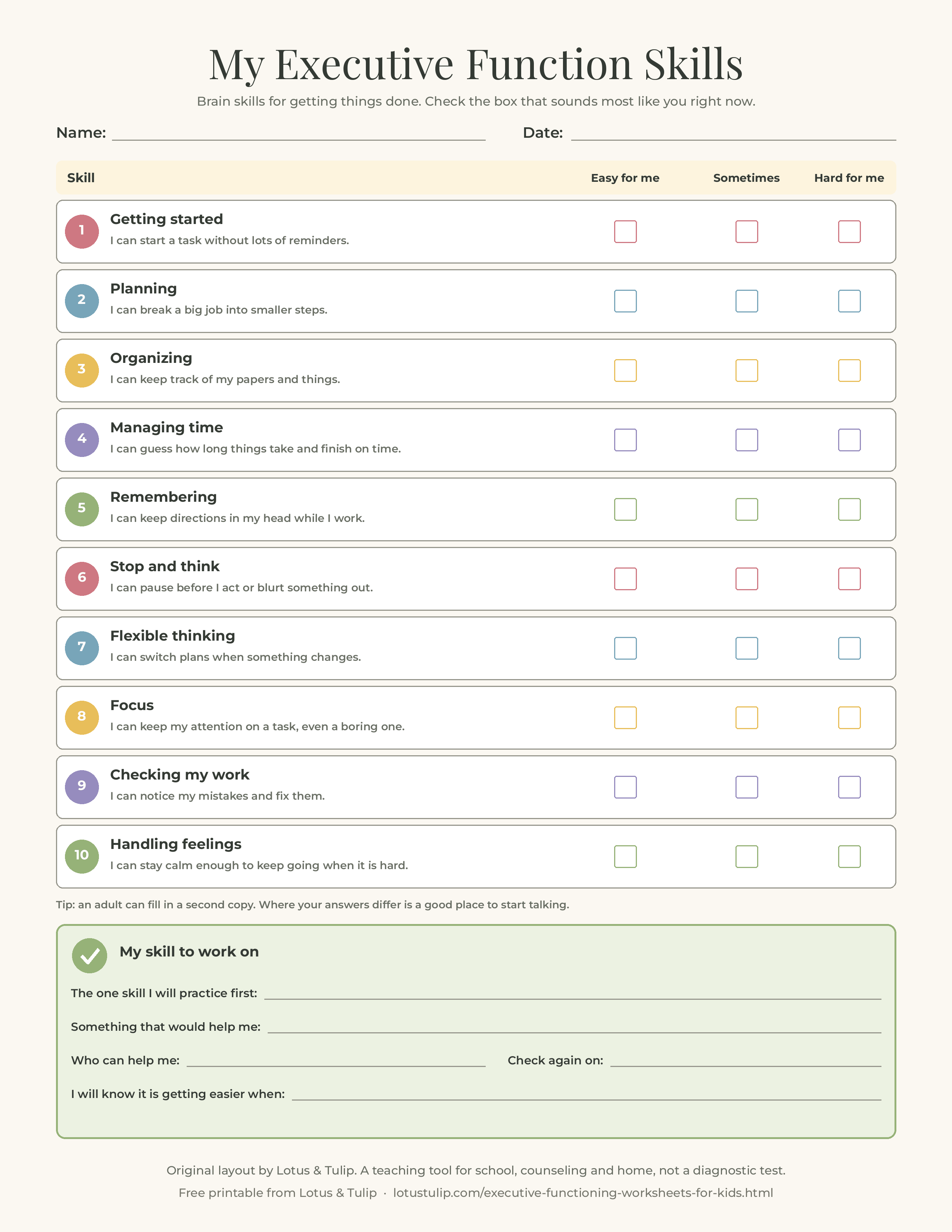
School teams and parents often use some version of the list below. The labels vary between books and rating scales, but these ten everyday skills cover most of what adults notice. Each one is written in kid friendly words, the same way it appears on page 1 of the free printable.
| Skill | In kid words | What a struggle can look like |
|---|---|---|
| Getting started (task initiation) | I can start a task without lots of reminders. | Stares at the page, sharpens pencils, says "I don't know how to start." |
| Planning and prioritizing | I can break a big job into smaller steps. | Projects are left until the night before, or the easy part gets done first and the main part never does. |
| Organizing | I can keep track of my papers and things. | Lost homework, crumpled papers, a desk or backpack where nothing can be found. |
| Managing time | I can guess how long things take and finish on time. | Thinks a 40 minute assignment will take 5 minutes, or that there is "plenty of time" right up to the deadline. |
| Remembering (working memory) | I can keep directions in my head while I work. | Forgets the second and third steps of directions, loses track mid task, needs repeated reminders. |
| Stop and think (inhibitory control) | I can pause before I act or blurt something out. | Calls out, rushes through work, acts first and thinks later. |
| Flexible thinking | I can switch plans when something changes. | Gets stuck on one way of doing things, gets very upset at schedule changes or a new rule. |
| Focus (sustained attention) | I can keep my attention on a task, even a boring one. | Starts well, then drifts, especially on long or repetitive work. |
| Checking my work (self monitoring) | I can notice my mistakes and fix them. | Turns in work without checking, is surprised by grades, misses careless errors. |
| Handling feelings (emotional control) | I can stay calm enough to keep going when it is hard. | Gives up or melts down when work gets hard or a mistake happens. |
An important caveat. A checklist like this is a conversation starter and a planning tool, not a diagnostic test. Standardized rating scales such as the BRIEF (Behavior Rating Inventory of Executive Function) are completed by parents, teachers and older students and interpreted by trained professionals. If a child's difficulties are significant, persistent or affecting learning, talk to the school team about an evaluation. Executive function difficulties are common in ADHD, but they also show up with anxiety, depression, learning disabilities, autism, sleep problems, stress and simply being young for a grade.
What the research says about improving executive functions
There is a lot of hype in this area, from brain training apps to programs that promise to "fix" executive function in weeks. The honest picture is more modest, and more useful.
These skills matter. Diamond's 2013 review summarizes evidence linking executive functions to school readiness, academic achievement, mental and physical health, and quality of life. One of the most cited long term studies is Terrie Moffitt and colleagues' 2011 paper in the Proceedings of the National Academy of Sciences. It followed a birth cohort of about 1,000 children in Dunedin, New Zealand, to age 32. Children with lower self control in childhood (rated by parents, teachers, observers and the children themselves) were more likely as adults to have health problems, money problems and criminal convictions, even after accounting for IQ and family social class. This is correlational research, so it cannot show that teaching self control causes better adult outcomes, but it does show why these skills are worth taking seriously.
They develop slowly, into early adulthood. The Harvard Center on the Developing Child notes that executive function skills start building in infancy and keep developing through adolescence and into the early twenties. A 9 year old is not a small adult with a lazy streak. Expecting middle schoolers to manage several teachers, deadlines and lockers on their own is a real jump, and many need structure for longer than adults expect.
They can improve with practice, but gains tend to be narrow. In a 2016 review in Developmental Cognitive Neuroscience, Adele Diamond and Daphne Ling concluded that executive functions can be improved at any age through training and practice, but that wide transfer does not seem to happen: people mainly get better at what they practice, and benefits to untrained tasks are limited. They also concluded that the most successful approaches will probably address emotional, social and physical needs, not only train the skill directly, because stress, sadness, loneliness and poor health all impair executive functions.
Brain training games are a weak bet. A meta-analysis by Monica Melby-Lervåg and Charles Hulme (2013, Developmental Psychology) looked at 23 studies of working memory training programs. Training reliably improved performance on working memory tasks similar to the ones practiced, in the short term. But there was no convincing evidence that it carried over to reading, arithmetic, verbal or nonverbal ability, or attention, and verbal working memory gains faded by follow up. In plain terms: a child who practices a memory game gets better at the memory game.
What that means for worksheets. If narrow practice gives narrow gains, then practice should happen on the real tasks a child struggles with: their actual homework, their actual backpack, their actual morning routine. That is the logic behind the free printable in this guide. It does not train abstract "brain skills." It gives a child a structure to use on real school work, and gives adults a way to step back gradually as the child takes over. Worksheets like these are supports and teaching tools. There is no good evidence that a worksheet on its own changes executive function, and we will not claim it does.
External supports are a legitimate strategy. Planners, checklists, timers and visual schedules work by putting information outside the head, so working memory does not have to hold it. This is a central idea in practical executive skills books such as Peg Dawson and Richard Guare's Executive Skills in Children and Adolescents and Smart but Scattered: change the environment and the task first, then teach the skill, then fade the support. Using a planner is not cheating. It is what organized adults do.
Executive functioning skills by age
Every child develops at a different pace, and children with ADHD or other differences may lag their peers in some skills by a few years. These are rough guides for what to expect and how much adult support to plan for.
| Age | What is typical | How adults can help |
|---|---|---|
| Ages 3 to 5 | Following simple one or two step directions, waiting briefly, beginning to play by rules in games. | Games like Simon Says, Red Light Green Light and freeze dance; picture routines; lots of pretend play. |
| Ages 6 to 8 | Short independent tasks, simple routines like packing a folder, beginning to plan a little ahead. | Picture or word checklists for routines, timers, one task at a time, games with rules and turn taking. |
| Ages 9 to 11 | Homework with some independence, multi step assignments with support, beginning time estimation. | Break It Down planners for projects, a weekly planner checked with an adult, a set homework time and place. |
| Ages 12 to 14 | Managing several classes and deadlines, longer projects, more self monitoring, but still uneven. | Weekly planning check ins, digital calendars, teaching how to study, gradually handing over control. |
| Teens 15 and up | Much more independence, though planning and impulse control are still maturing. | Coaching rather than doing, helping teens design their own systems, problem solving after setbacks. |
Executive function activities for kids
The Harvard Center on the Developing Child has a free activities guide, "Enhancing and Practicing Executive Function Skills with Children from Infancy to Adolescence," organized by age. The guide itself is candid that scientific studies have not proven the effectiveness of every activity, and that the suggestions reflect expert judgment about ways children can practice. Many of the ideas below are in the same spirit: playful, real world practice with steadily increasing challenge.
- Stop and go games. Simon Says, Red Light Green Light, freeze dance and "opposite day" games where children do the opposite of a cue all practice stopping an automatic response.
- Card and board games with rules. Games like Uno, Spot It, Set, Blink, memory matching games and chess ask children to hold rules in mind, switch strategies and wait their turn.
- Cooking and baking together. Following a recipe means reading steps, gathering materials, measuring, timing and checking. Let older children plan the shopping list too.
- Building from instructions. Building sets and model kits practice following multi step directions and checking work against a picture.
- Guess the time game. Before a task, the child guesses how long it will take, then times it. Over a few weeks, children's estimates usually get closer. Page 2 of the printable builds this in.
- Plan a small event. A family game night, a class party or a weekend outing: list what is needed, who does what, and when.
- Storytelling and retelling. Retelling a story in order, or making up a story with a beginning, middle and end, uses working memory and planning.
- Music, dance and sports. Learning a song, a dance routine or a play in a sport requires remembering sequences and adjusting quickly. Diamond and Ling noted that activities like martial arts, yoga and theatre looked promising but had limited evidence, so treat them as enjoyable practice, not treatment.
Executive functioning strategies in the classroom
- Post the steps. Write multi step directions on the board as a numbered list and leave them up. Children with weak working memory should not have to hold the steps in their heads.
- Chunk big assignments. Give projects with mini deadlines for each part, and check in at each one. A Break It Down planner turns this into a routine.
- Build in a start ritual. "Name, date, first problem" in the first two minutes helps students who struggle to begin.
- Make time visible. Visual timers and a clock showing how much work time is left help students who misjudge time.
- Use a daily pack up routine. Five minutes at the end of the day with a checklist (homework in the folder, planner filled in, notes home) prevents a lot of lost work.
- Teach how to use a planner. Many students are handed a planner and never shown how to use it. Model it, check it daily at first, then less often.
- Plan for transitions. Warnings before changes and a visual schedule help students who struggle with flexibility. See our free visual schedule printable for younger children.
Executive functioning support at home
- Same time, same place. A consistent homework time and spot cuts down on the daily negotiation and helps routines become automatic.
- Launch pad by the door. One spot for the backpack, shoes, coat and anything that needs to go to school the next day. Pack the night before.
- Morning and evening checklists. A short list on the fridge or bathroom mirror means fewer reminders from you. Page 3 of the printable has a morning launch list and a pack up list.
- Weekly planning check in. Ten minutes on Sunday evening to look at the week: what is due, what is coming up, what needs to be bought or prepared.
- Reduce distractions during work. Phones and tablets in another room during homework, and short breaks scheduled in advance.
- Protect sleep. Tired brains have weaker executive function. Our sleep hygiene worksheet covers simple changes that help.
- Stay calm and kind. Lectures about responsibility rarely help a child who cannot yet plan. Diamond and Ling point out that stress and sadness worsen executive function, so a calm, supportive tone is part of the strategy, not a soft extra.
How to teach executive functioning skills, step by step
- Pick one skill, not ten. Use the skills checklist with the child, and ideally have an adult fill in a second copy. Choose the one skill that is causing the most trouble right now, such as getting started or remembering homework.
- Change the environment first. Before asking the child to try harder, adjust the task and setting: post the steps, add a checklist, set a timer, move the backpack to the door. This is often where the quickest wins come from.
- Explain the skill in plain words. Tell the child what the skill is and why it helps, for example "Breaking a big job into steps makes it feel smaller and helps you know where to start."
- Model it out loud. Show your own thinking on a real task: "I have to clean the kitchen. Step one, clear the table. That will take about five minutes."
- Practice on a real task with support. Use the Break It Down planner on an actual assignment. Do it together the first few times, with the child doing as much as they can.
- Add if-then plans for the hard moments. Help the child decide in advance what they will do when they get distracted or stuck, for example "If I get stuck, then I will reread the directions and ask one question." Planning a specific response ahead of time is easier than deciding in the moment.
- Use the week planner and checklists daily. Check the planner together each day at first. Keep the morning launch and pack up checklists where they are used.
- Review and celebrate progress. At the end of the week, use the Friday check. Notice what went well and what to try differently. Praise effort and strategy use, not just results.
- Fade support slowly. As the routine becomes automatic, step back gradually: check every other day, then weekly. If things slip, add support back without shame. That is normal, not failure.
Tips that make executive functioning worksheets work
- Use them on real work. Planning a pretend project is fine for teaching, but the payoff comes from using the planner on the child's real assignments.
- Keep it short. A planner that takes 20 minutes to fill out is another task to avoid. Aim for two to five minutes.
- Make the first step tiny. "Open the book to page 42" is easier to start than "read chapter 3." Starting is often the hardest part.
- Expect time estimates to be off. Most children (and adults) underestimate how long things take. Comparing guesses to actual times without judgment is how estimates improve.
- Involve the child in designing the system. Children, especially older ones, are more likely to use a checklist they helped write.
- Coordinate home and school. When teachers and parents use the same planner and language, children get more consistent practice.
Common mistakes
- Treating it as a motivation problem. Many children with executive function struggles want to do well. Consequences alone rarely teach a skill a child does not have yet.
- Handing over independence too fast. Removing all support at the start of middle school often leads to a crash. Fade support gradually instead.
- Trying to fix everything at once. Ten new systems in one week is overwhelming. One skill, one routine, practiced until it sticks.
- Relying on brain training apps. As the research above shows, gains from these programs mostly stay inside the games.
- Using the checklist as a diagnosis. A checklist can show where to start. It cannot tell you whether a child has ADHD or another condition. That needs a proper evaluation.
- Ignoring sleep, stress and feelings. A child who is anxious, sad or exhausted will struggle with executive function no matter how good the planner is. Our emotional regulation worksheets for kids and test anxiety worksheet can help with the feelings side.
Free executive functioning worksheets for kids (PDF)
This free printable is an original Lotus & Tulip design, sized for US Letter paper and suited to about ages 7 to 14 (grades 2 to 8) in classrooms, counseling sessions, small groups, special education and at home. Younger children can use it with an adult reading and writing for them. It has three pages:
- Page 1: My Executive Function Skills. An executive functioning skills checklist with ten skills in kid friendly words (getting started, planning, organizing, managing time, remembering, stop and think, flexible thinking, focus, checking my work and handling feelings), each rated easy for me, sometimes or hard for me, plus a "my skill to work on" plan.
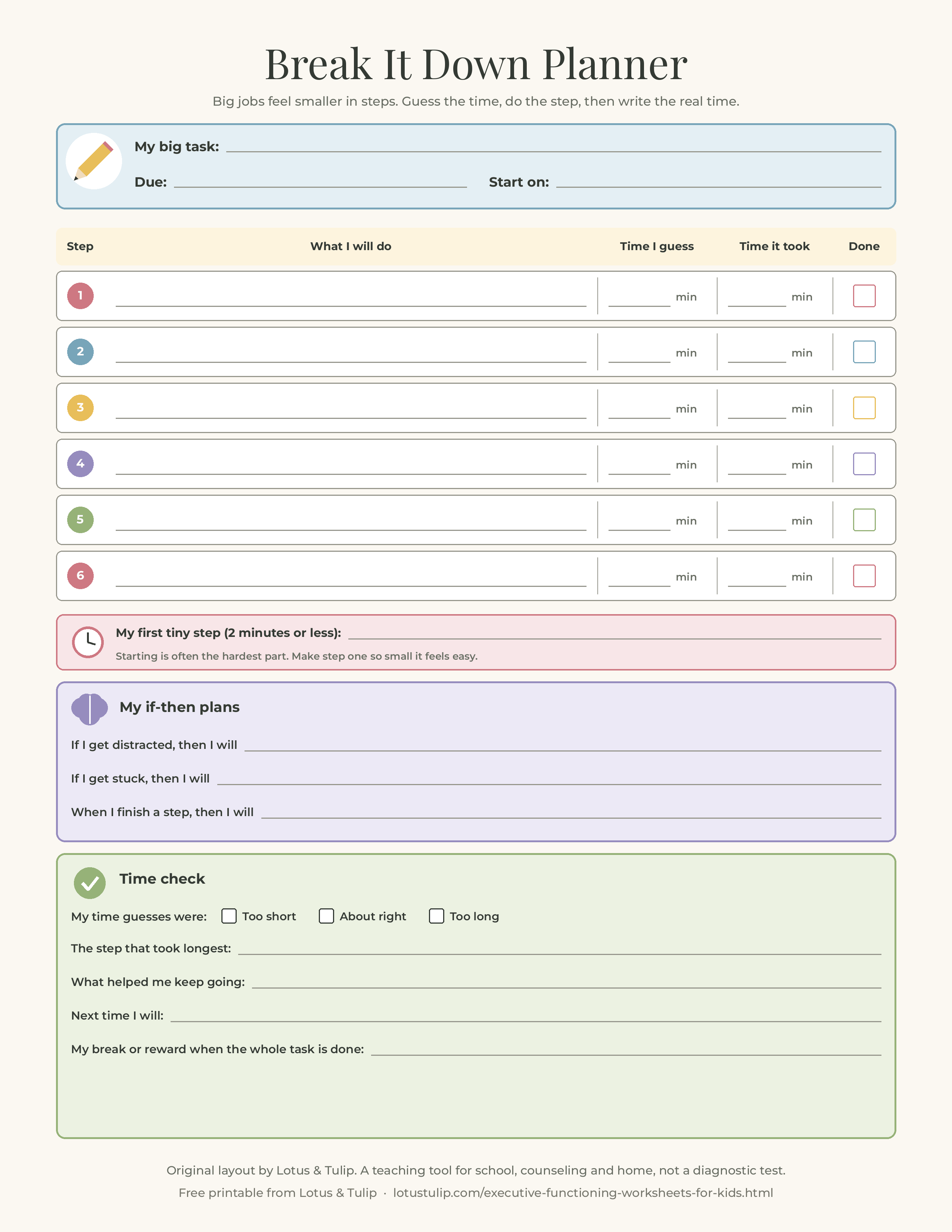
- Page 2: Break It Down Planner. A task breakdown worksheet for a big assignment: due and start dates, six steps with a time guess and the real time each took, a first tiny step, three if-then plans (distracted, stuck, finished a step) and a time check reflection.
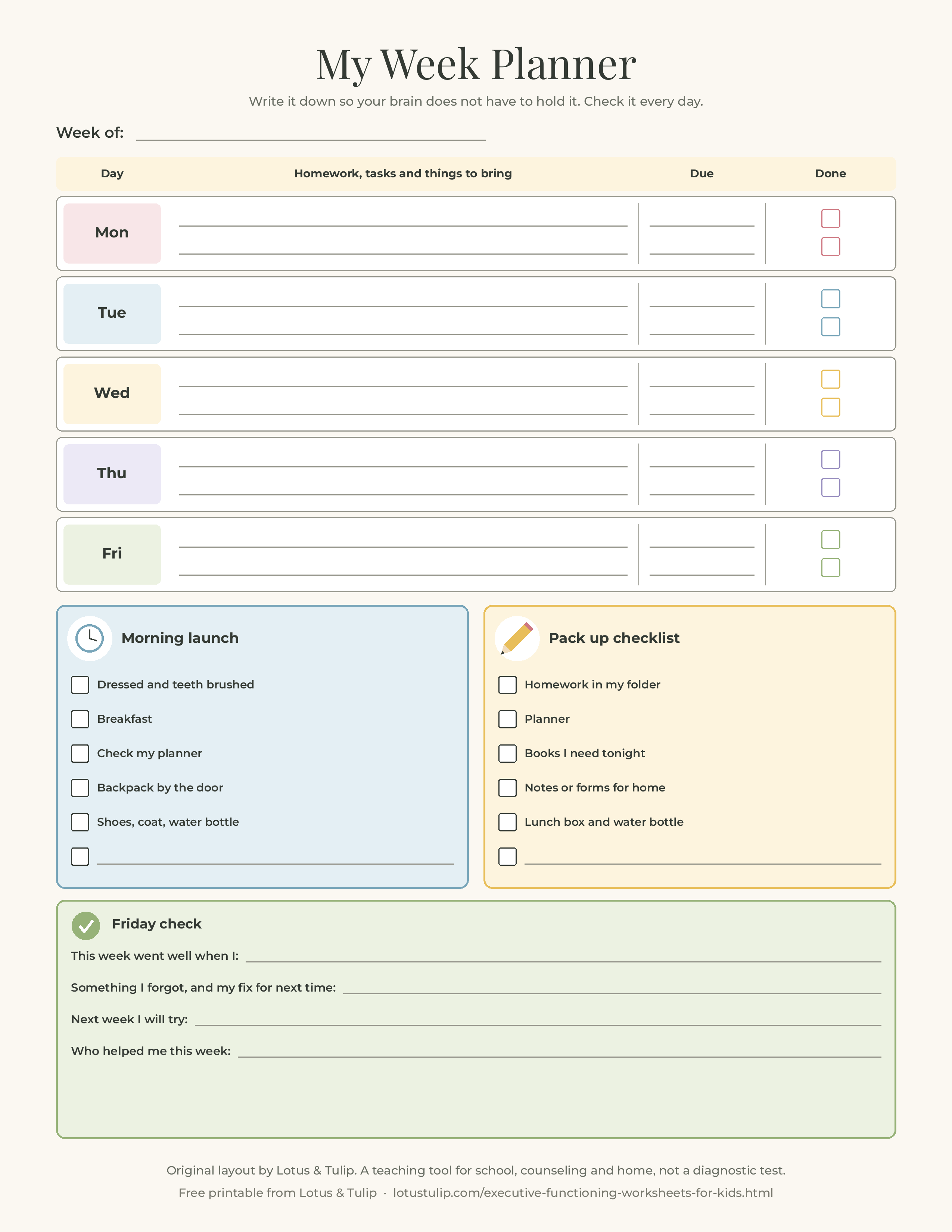
- Page 3: My Week Planner. A Monday to Friday homework and task planner with due dates and done boxes, a morning launch checklist, a pack up checklist (each with a blank line to add your own) and a Friday check.
Download the free executive functioning worksheets for kids (PDF, 3 pages, US Letter)
Prefer single images? Page 1: Skills Checklist (PNG) · Page 2: Break It Down Planner (PNG) · Page 3: Week Planner (PNG)
Free ADHD starter pack: Working with teens or adults instead? The free ADHD worksheets starter pack has six real executive function pages from our paid ADHD set, including break it down, a time estimation log and getting unstuck (8 pages, client use license, no email).
Free to print for your own use and for use with your own students, clients or children. Please link to this page rather than re-uploading the file.
Related resources
- Self-monitoring checklist for students: a free self-check sheet for focus and routines, with a weekly graph
- Goal setting worksheet for students (free printable)
- Problem solving worksheet for kids (free printable)
- Test anxiety worksheet (free printable)
- Emotional regulation worksheets for kids (free printable)
- Free visual schedule printable
- First then board printable
- Token board printable
- Growth mindset worksheet (free printable)
- Daily check in sheet for students
Sources
- Center on the Developing Child at Harvard University (2014). Enhancing and Practicing Executive Function Skills with Children from Infancy to Adolescence (activities guide). developingchild.harvard.edu.
- Dawson, P., and Guare, R. Executive Skills in Children and Adolescents: A Practical Guide to Assessment and Intervention. Guilford Press. Also Smart but Scattered, Guilford Press.
- Diamond, A. (2013). Executive functions. Annual Review of Psychology, 64, 135 to 168.
- Diamond, A., and Ling, D. S. (2016). Conclusions about interventions, programs, and approaches for improving executive functions that appear justified and those that, despite much hype, do not. Developmental Cognitive Neuroscience, 18, 34 to 48.
- Melby-Lervåg, M., and Hulme, C. (2013). Is working memory training effective? A meta-analytic review. Developmental Psychology, 49(2), 270 to 291.
- Miyake, A., Friedman, N. P., Emerson, M. J., Witzki, A. H., Howerter, A., and Wager, T. D. (2000). The unity and diversity of executive functions and their contributions to complex "frontal lobe" tasks. Cognitive Psychology, 41(1), 49 to 100.
- Moffitt, T. E., et al. (2011). A gradient of childhood self-control predicts health, wealth, and public safety. Proceedings of the National Academy of Sciences, 108(7), 2693 to 2698.
- National Scientific Council on the Developing Child (2011). Building the brain's "air traffic control" system: how early experiences shape the development of executive function. Working Paper 11. Harvard University.
Executive functioning worksheets for kids: FAQ
What are executive functioning skills in kids?
Executive functioning skills are the mental skills children use to manage their attention, thinking and behavior to reach a goal. The three core skills are working memory, inhibitory control and cognitive flexibility. From these come everyday skills like getting started, planning, organizing, managing time, focusing and checking work.
What are the 3 main executive functions?
Researchers usually describe three core executive functions: working memory (holding and using information in mind), inhibitory control (stopping an automatic response, including self control and focused attention) and cognitive flexibility (switching between tasks, rules or perspectives).
How can I help my child with executive functioning?
Pick one skill to work on, change the environment first with checklists, timers and visible steps, model the skill out loud, practice it on real tasks with support, and fade the support slowly. Keep a calm tone, protect sleep, and work with the school if difficulties are significant.
Do executive functioning worksheets work?
Worksheets work best as supports and teaching tools used on real tasks, like a planner for actual homework. Research suggests executive function practice mainly improves the skills practiced, so a worksheet used alone, away from real work, is unlikely to change much. Used daily with adult coaching, planners and checklists can make routines much easier.
At what age do executive functioning skills develop?
Executive functions begin developing in infancy and keep developing through adolescence and into the early twenties. Children of the same age can vary a lot, and children with ADHD may lag peers in some skills, so many middle and high schoolers still need structure and support.
Is poor executive functioning a sign of ADHD?
Executive function difficulties are common in ADHD, but they can also come with anxiety, depression, learning disabilities, autism, sleep problems, stress or simply being young for a grade. A checklist cannot diagnose ADHD. If you are concerned, ask the school or your pediatrician about an evaluation.
Are these executive functioning worksheets free?
Yes. The three page executive functioning worksheets for kids are free to print for your own use and for use with your own students, clients or children. Please link to this page rather than re-uploading the file.