
Therapist worksheets · Habits · Updated 2026-11-14
Habit tracker worksheet for adults: how habits really form, how to build or break one, and a step by step plan (free printable)
Habit work inside CBT and behavioral activation: CBT Worksheets for Therapists, 20 pages including thought records and core beliefs Holiday 20% off: about $11.04, was $14 (EUR 12) · fillable PDF, instant digital download
Buy on EtsyTry it free first: download a fillable sample (thought record and evidence for and against, PDF, 105 KB). Type into it on screen, then get the full pack. No email needed.
Habits that grow out of values: ACT Worksheets for Therapists, values, defusion and committed action pages Holiday 20% off: about $9.20, was $12 (EUR 10) · fillable PDF, instant digital download
Buy on EtsyTry it free first: download a fillable sample (values compass and unhooking from thoughts, PDF, 259 KB). Type into it on screen, then get the full pack. No email needed.
A full caseload: Therapist Worksheets Mega Bundle (8 packs incl. DBT, CBT, ACT, anxiety, grief and ADHD) Holiday 20% off: about $35.88, was $45 (EUR 39) · fillable PDFs for all 8 packs plus 160 printable pages, instant digital download
Buy on EtsyMost habit trackers are a grid of boxes and a hope. You tick the boxes for nine days, miss one, feel like you failed and stop. The research on habits points to a different approach: tie the new behavior to a cue you already meet every day, start with a version so small it is hard to skip, change the setting instead of leaning on willpower, and expect it to take weeks, not days, before it feels automatic.
This guide is for adults who want to build a habit (or break one) and for therapists, counselors and coaches who help clients do it. It covers what a habit actually is, how long habits really take to form, why the cue matters, how to break an unwanted habit, nine steps to use a habit tracker worksheet, common mistakes and three short examples. It ends with a free 2 page printable: My Habit Plan, for designing one habit, and My Habit Tracker, an 84 day tick grid with a weekly "how automatic does it feel" rating.
Download the free habit tracker worksheet (PDF, 2 pages, US Letter)
Direct download, no email or sign up. See the pages first. Setting a bigger goal first? See our goal setting worksheet for adults.
What a habit actually is
In psychology, a habit is not just something you do often. It is a behavior that has become linked to a cue, such as a place, a time of day or the action you just finished, so that the cue starts the behavior with little thought. Wendy Wood and Dennis Rünger (2016, Annual Review of Psychology) describe habits as learned links between contexts and responses, built up through repetition, often while the behavior is rewarded.
That is why so much of daily life runs on autopilot. In diary studies by Wood, Quinn and Kashy (2002, Journal of Personality and Social Psychology), college students were prompted every hour to write down what they were doing. Between about a third and a half of the behaviors they listed (35% in the first study, 43% in the second) were done almost every day and usually in the same place. During those habitual behaviors, people were often thinking about something else.
The practical point: a habit is not built by deciding to "be more disciplined". It is built by repeating the same small action in response to the same cue until the cue does the work.
How long does it take to form a habit?
Not 21 days. That number traces back to the 1960 self-help book Psycho-Cybernetics by plastic surgeon Maxwell Maltz, who wrote that it took "a minimum of about 21 days" for people to get used to a change such as a new face. He was not describing habit research, and later retellings dropped the word "minimum".
- The best known study. Phillippa Lally and colleagues at University College London (2010, European Journal of Social Psychology) asked 96 adults to pick one eating, drinking or exercise behavior and do it daily in the same context, such as after breakfast, for 12 weeks. They rated how automatic it felt every day. For the people whose data fit the model, the median time to reach 95% of their own maximum automaticity was 66 days, with a range of 18 to 254 days.
- Missing a day is not fatal. In the same study, missing a single opportunity caused only a very small dip in automaticity that did not have a lasting effect. Doing the behavior more consistently was linked to clearer habit formation overall.
- A 2024 review. Singh and colleagues (2024, Healthcare) pooled 20 studies with 2,601 participants on health habits such as exercise, healthy eating, flossing and drinking water. Four studies reported how long habit formation took: medians of 59 to 66 days and means of 106 to 154 days, with individual times from 4 to 335 days. Habit strength rose overall after interventions, morning habits and self-chosen habits tended to be stronger, and the authors note that many included studies had a high risk of bias.
So plan for about two to three months, accept that your number may be shorter or longer, and judge progress by how automatic the habit feels, not by a perfect streak. That is why our tracker runs for 12 weeks (84 days, the length of the Lally study) and asks for a weekly automaticity rating.
Why the cue matters: "after I..., I will..."
The most useful habit plans name a cue that already happens every day. Gardner, Lally and Wardle (2012, British Journal of General Practice) summarize simple habit advice for patients: choose one action, pick a time and place you meet every day, and repeat the action in that same context until it becomes automatic.
Where you place the new behavior can matter. In a flossing study by Judah, Gardner and Aunger (2013, British Journal of Health Psychology), 50 adults were asked to floss either just before or just after brushing their teeth. Those who flossed after brushing tended to form stronger flossing habits, and at an 8 month follow up they had stronger habits and flossed more often. Tying a new step to the end of an existing routine seems to work better than squeezing it in first.
An "after I..., I will..." line is a form of implementation intention, or if-then plan. Gollwitzer and Sheeran (2006, Advances in Experimental Social Psychology) pooled 94 tests with 8,461 participants and found that forming if-then plans had a medium to large effect on reaching goals (d = 0.65).
Why writing it down helps
A tracker is more than decoration. Harkin and colleagues (2016, Psychological Bulletin) analyzed 138 randomized studies with 19,951 participants. Interventions that got people to monitor their progress more often improved goal attainment (d = 0.40), and the effect was larger when progress was physically recorded or reported to someone else. A paper grid on the fridge counts.
How to break a habit
Breaking a habit is harder than starting one, because the old cue keeps firing. Three findings help:
- Watch for the slip. In two diary studies and an experiment, Quinn, Pascoe, Wood and Neal (2010, Personality and Social Psychology Bulletin) found that strong bad habits were controlled best by vigilant monitoring: thinking "don't do it" and watching carefully for slip ups. Other strategies did not help much with strong habits. Monitoring did not erase the habit; it strengthened conscious control in the moment.
- Change the setting. If you can remove or change the cue (move the snacks, charge the phone outside the bedroom, take a different route home), the old habit has less to respond to. Put the new habit where the cue used to be.
- Use life changes. In a field experiment with 800 people, Verplanken and Roy (2016, Journal of Environmental Psychology) found that a program promoting sustainable habits worked better for people who had recently moved house, with the window lasting about three months. A move, a new job or a new baby breaks old cues, which can make it a good time to start a new habit.
Some habits are not just habits. Hair pulling, skin picking and tics are treated with habit reversal training, a behavioral therapy first described by Azrin and Nunn (1973), which a trained clinician delivers. Habits tied to alcohol, drugs, gambling, eating problems or self harm also need professional support, not only a tracker.
The takeaway: habits form through repetition of a small action after a stable cue, usually over about two months, with big differences between people. A worksheet helps you design the cue, make the action easy and write your progress down. It is a planning tool, not a treatment for depression, anxiety, ADHD or addiction.
How to use a habit tracker worksheet, step by step
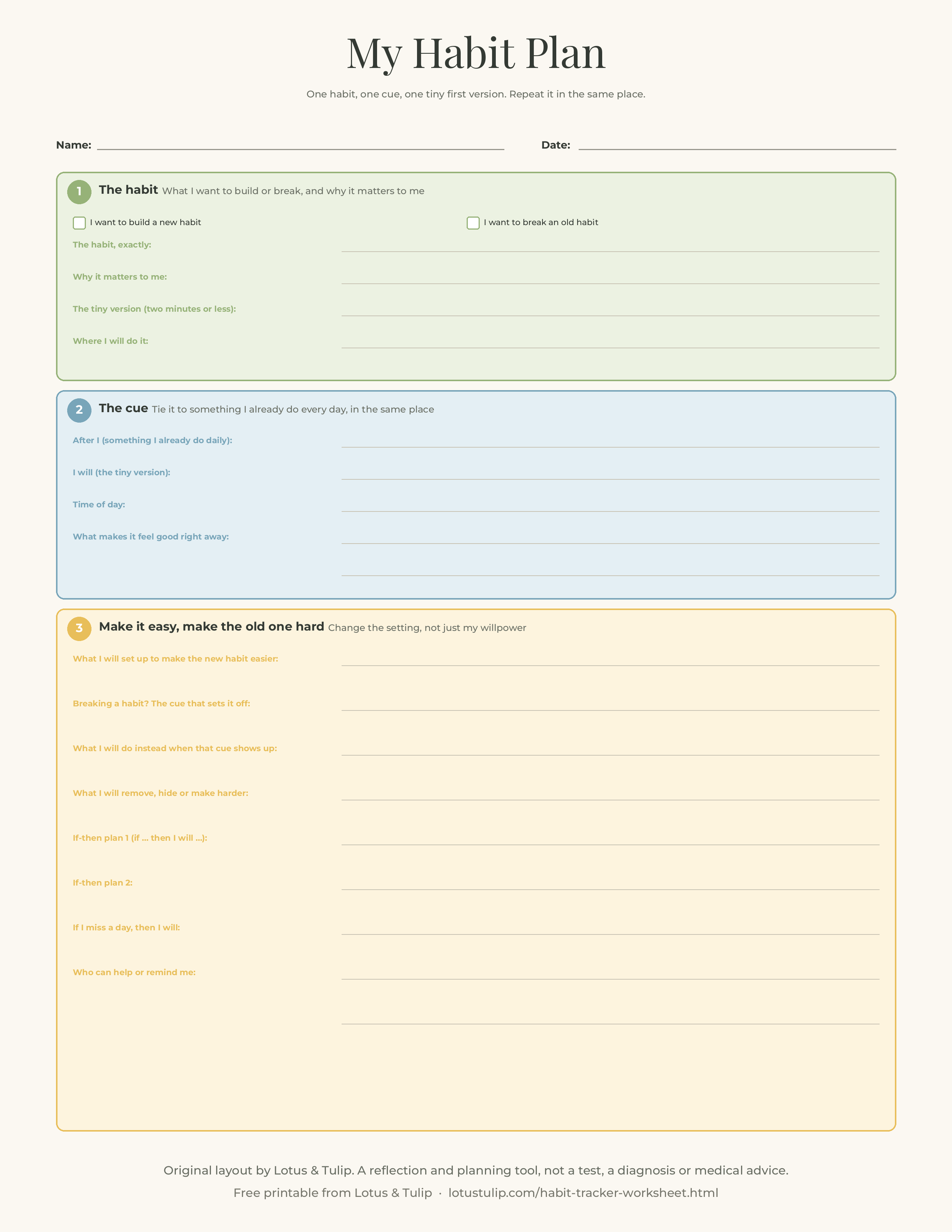
- Choose one habit. On page 1, tick whether you want to build a new habit or break an old one, and write it as a specific action: "walk for 10 minutes", not "be healthier". One habit at a time.
- Write why it matters to you. A habit you chose for your own reasons is easier to keep. If it is someone else's idea, find the part you want for yourself.
- Shrink it to a tiny version. Write a version that takes two minutes or less, such as "put on my walking shoes and step outside". The goal of the early weeks is repetition, not a big result. You can always do more.
- Pick the cue: "After I..., I will..." Choose something you already do every day in the same place, such as pouring your coffee, brushing your teeth or parking the car. Put the new habit right after it.
- Make it feel good right away. Write what will make the habit pleasant in the moment: a podcast only for walks, a tick on the tracker, a cup of tea after. Habits stick better when they are rewarding now, not only later.
- Change the setting. Write what you will set up to make the new habit easier (shoes by the door, the book on the pillow) and, for a habit to break, the cue that sets it off and what you will remove, hide or make harder.
- Write two if-then plans and a missed day plan. Plan for your two most likely obstacles: "If it is raining, then I walk the stairs at home for 10 minutes." Then write what you will do after a missed day. "If I miss a day, then I do the tiny version the next day, no matter what."
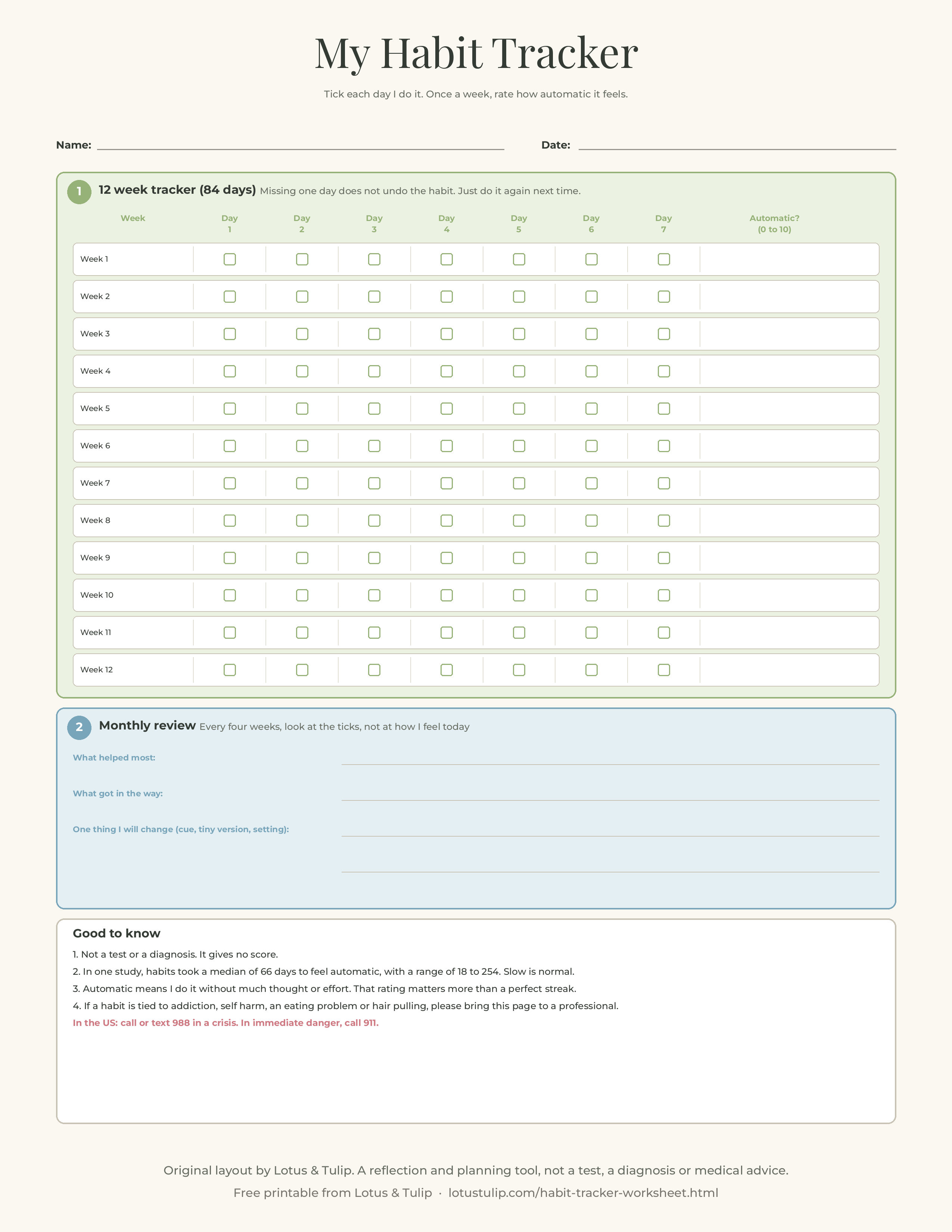
- Tick the tracker every day and rate it weekly. On page 2, tick each day you do it. Once a week, rate how automatic it feels from 0 to 10. Expect the rating to rise slowly and unevenly.
- Review every four weeks. Look at the ticks, not at how you feel today. Write what helped, what got in the way and one thing you will change: the cue, the tiny version or the setting. If low mood makes every habit feel impossible, or a habit involves addiction or self harm, talk to a professional, and in the US call or text 988, or call 911 in an emergency.
Common mistakes
- Starting too big. A 45 minute workout every day is a goal, not a starting habit. Start with a tiny version you can do on your worst day.
- No cue. "I will meditate more" has no trigger. "After I pour my morning coffee, I sit for two minutes" does.
- Too many habits at once. Six new habits on January 1 compete for the same attention. Build one until it feels automatic, then add the next.
- Treating a missed day as failure. Research suggests one missed day does not undo the process. The streak is a tool, not the point.
- Relying on willpower alone. Willpower is needed most where the setting works against you. Changing the setting is usually easier than resisting it every day.
- Expecting 21 days. If the habit still feels effortful after three weeks, that is normal. Most people need longer.
Examples
- Building a walking habit: A 44 year old nurse wanted to exercise but came home exhausted. Her tiny version: "After I park the car at home, I walk to the end of the street and back." It took about four minutes. By week four she often kept going for 15 minutes, and her weekly "how automatic" rating rose from 2 to 6 by week ten. She missed three days in week seven when her shifts changed, did the tiny version the next day and kept going.
- Breaking a late night phone habit: A man in his thirties scrolled in bed until 1 am. The cue was taking his phone into the bedroom. He moved the charger to the kitchen, put a paperback on his pillow and wrote: "After I plug in my phone in the kitchen, I read two pages in bed." His if-then plan: "If I want to check something, then I write it on the notepad by the charger." Most nights he was asleep before midnight by week three, which he tracked on page 2. For more on sleep, see our sleep hygiene worksheet.
- A therapy client and behavioral activation: A client recovering from depression wanted to "get back to doing things". With her therapist she picked one small daily habit linked to a value of connection: "After I finish breakfast, I send one message to a friend or family member." The tracker showed 52 of 84 days, more than she expected. Her therapist used the pattern of missed days to plan around her hardest mornings. For the wider approach, see our behavioral activation worksheet.
Free printable: habit tracker worksheet for adults
This free printable is an original Lotus & Tulip layout on US Letter, in our own wording. It is not the Self-Report Habit Index or any published questionnaire, and it gives no score. Page 1, My Habit Plan, covers whether you are building or breaking a habit, the habit exactly, why it matters, the tiny version and where you will do it, the cue ("After I..., I will..."), time of day, what makes it feel good right away, and a box to make it easy: what you will set up, the cue that sets off an old habit, what you will do instead, what you will remove or make harder, two if-then plans, a missed day plan and who can help. Page 2, My Habit Tracker, is a 12 week, 84 day tick grid with a weekly "how automatic does it feel" rating from 0 to 10, a monthly review and notes with US crisis lines.
Download the free habit tracker worksheet (PDF, 2 pages, US Letter)
Prefer single images? Page 1: habit plan (PNG) · Page 2: 84 day habit tracker (PNG)
Free to print for yourself or for use with your own clients or groups. Please link to this page rather than re-uploading the file. A reflection and planning tool, not a test, a diagnosis or a substitute for therapy. In the US, call or text 988 in a mental health crisis. In immediate danger, call 911.
Related resources
- Wheel of life worksheet: see which life area a new habit should serve
- Goal setting worksheet for adults: set the bigger goal, then build the daily habit that serves it
- Behavioral activation worksheet: small scheduled actions when low mood drains motivation
- Procrastination worksheet: when starting is the hard part
- Time management worksheet: find a stable slot in the week for a new habit
- Urge surfing worksheet: ride out the urge behind an old habit without acting on it
- Sleep hygiene worksheet: evening and bedtime habits for better sleep
- All therapist worksheets: CBT, DBT, ACT and more
- Skin picking and hair pulling worksheets for kids: habit reversal for children who pick skin, pull hair or bite nails, with a free busy hands plan
FAQ
What is a habit tracker worksheet?
A habit tracker worksheet is a page for planning one habit and recording each day you do it. The free 2 page printable on this page covers the habit, a tiny starting version, the cue ("After I..., I will..."), how to make it easy and the old habit hard, if-then plans, an 84 day tick grid and a weekly rating of how automatic the habit feels. It is an original tool and gives no score.
How long does it really take to form a habit?
Longer than 21 days for most people. In a 2010 UCL study of 96 adults, the median time for a daily habit to reach near maximum automaticity was 66 days, with a range of 18 to 254 days. A 2024 review of 20 studies found medians of 59 to 66 days and a range from 4 to 335 days. Expect about two to three months, with big differences between people.
Where does the 21 day habit rule come from?
It traces to the 1960 book Psycho-Cybernetics by plastic surgeon Maxwell Maltz, who wrote that people needed a minimum of about 21 days to adjust to changes such as a new face. It was an observation, not a habit study, and the word "minimum" was later dropped.
Does missing one day ruin a habit?
No. In the Lally et al. 2010 study, missing a single opportunity caused only a very small, short lived dip in how automatic the habit felt. What matters more is getting back to it the next time the cue comes up, which is why the worksheet asks for a missed day plan.
What is habit stacking?
Habit stacking is a popular name for linking a new habit to one you already do: "After I brush my teeth, I floss." In research terms it is an if-then plan that uses an existing routine as the cue. A 2013 flossing study found that people who flossed after brushing formed stronger flossing habits than those who flossed before.
How do I break a bad habit?
Find the cue that sets it off, remove or change that cue where you can, decide what you will do instead, and watch for the moment of the slip. Research on strong bad habits found that vigilant monitoring, thinking "don't do it" and watching for slip ups, worked better than other strategies. Hair pulling, skin picking, tics and habits tied to addiction or self harm need professional support.
Can therapists use this worksheet with clients?
Yes. It is free to print for use with your own clients or groups. Please link to this page rather than re-uploading the file. It works in session and as homework, alongside behavioral activation, values work or motivational interviewing. For clients in acute distress, focus on safety and support first; in the US, call or text 988 in a crisis, or call 911 in an emergency.
Sources
- Azrin, N. H., and Nunn, R. G. (1973). Habit-reversal: A method of eliminating nervous habits and tics. Behaviour Research and Therapy, 11(4), 619 to 628.
- Gardner, B., Lally, P., and Wardle, J. (2012). Making health habitual: The psychology of "habit-formation" and general practice. British Journal of General Practice, 62(605), 664 to 666.
- Gollwitzer, P. M., and Sheeran, P. (2006). Implementation intentions and goal achievement: A meta-analysis of effects and processes. Advances in Experimental Social Psychology, 38, 69 to 119.
- Harkin, B., Webb, T. L., Chang, B. P. I., and others (2016). Does monitoring goal progress promote goal attainment? A meta-analysis of the experimental evidence. Psychological Bulletin, 142(2), 198 to 229.
- Judah, G., Gardner, B., and Aunger, R. (2013). Forming a flossing habit: An exploratory study of the psychological determinants of habit formation. British Journal of Health Psychology, 18(2), 338 to 353.
- Lally, P., van Jaarsveld, C. H. M., Potts, H. W. W., and Wardle, J. (2010). How are habits formed: Modelling habit formation in the real world. European Journal of Social Psychology, 40(6), 998 to 1009.
- Maltz, M. (1960). Psycho-Cybernetics. Prentice-Hall.
- Quinn, J. M., Pascoe, A., Wood, W., and Neal, D. T. (2010). Can't control yourself? Monitor those bad habits. Personality and Social Psychology Bulletin, 36(4), 499 to 511.
- Singh, B., Murphy, A., Maher, C., and Smith, A. E. (2024). Time to form a habit: A systematic review and meta-analysis of health behaviour habit formation and its determinants. Healthcare, 12(23), 2488.
- Verplanken, B., and Roy, D. (2016). Empowering interventions to promote sustainable lifestyles: Testing the habit discontinuity hypothesis in a field experiment. Journal of Environmental Psychology, 45, 127 to 134.
- Wood, W., Quinn, J. M., and Kashy, D. A. (2002). Habits in everyday life: Thought, emotion, and action. Journal of Personality and Social Psychology, 83(6), 1281 to 1297.
- Wood, W., and Rünger, D. (2016). Psychology of habit. Annual Review of Psychology, 67, 289 to 314.