
Therapist worksheets · Making friends as an adult · Updated 2026-11-13
How to make friends as an adult: what research shows, where friendships actually start, and a step by step plan (free printable)
Skills for asking, listening and keeping a relationship going: DBT Worksheets for Therapists, incl. interpersonal effectiveness pages Holiday 20% off: about $11.04, was $14 (EUR 12) · fillable PDF, instant digital download
Buy on EtsyTry it free first: download a fillable sample (weekly diary card and checking the facts, PDF, 234 KB). Type into it on screen, then get the full pack. No email needed.
When worry or harsh self talk gets in the way: CBT Worksheets for Therapists, 20 pages including thought records and core beliefs Holiday 20% off: about $11.04, was $14 (EUR 12) · fillable PDF, instant digital download
Buy on EtsyTry it free first: download a fillable sample (thought record and evidence for and against, PDF, 105 KB). Type into it on screen, then get the full pack. No email needed.
A full caseload: Therapist Worksheets Mega Bundle (8 packs incl. DBT, CBT, ACT, anxiety, grief and ADHD) Holiday 20% off: about $35.88, was $45 (EUR 39) · fillable PDFs for all 8 packs plus 160 printable pages, instant digital download
Buy on EtsyAt school or a first job, friends often appeared without a plan. People were simply there, five days a week. Then you moved, started working from home, had a child, or the group chat went quiet, and it is no longer obvious how a new friendship is supposed to start. That is not a character flaw. Adult life removes the built-in hours that used to do the work for you.
This guide is for adults who want more friendship, and for the therapists, counselors and coaches who work with them. It is about forming and deepening friendships: where they actually start, how much time they take, and how to follow up. It is not a guide to the feeling of loneliness (see our loneliness worksheet), and it is not a lesson on the mechanics of a single conversation (see our conversation skills worksheet). It explains what research shows, nine practical steps, common mistakes and examples. It ends with a free 2 page printable: My Friendship Map, which starts with people and places already in your life, and My Friendship Plan, which covers one repeated context, a first move, a follow-up plan, a time log and a 4 week check.
Download the free making friends as an adult worksheets (PDF, 2 pages, US Letter)
Direct download, no email or sign up. See the pages first.
What making friends as an adult is, and what it is not
Making friends as an adult means repeatedly spending time with the same people, in a context you can return to, until acquaintance turns into something closer. The work is less about being interesting in one conversation and more about showing up again, following up and leaving enough hours for closeness to grow.
It is not the same as curing loneliness. Loneliness is the painful gap between the connections you have and the ones you want. You can feel lonely in a marriage, and you can be making new friends without feeling lonely yet. If the main problem is the feeling itself, start with the loneliness worksheet. If the main problem is "I do not know where to start or how to turn a hello into a friendship," this page is the better fit.
It is also not a partner or a family standing in for friends. A loving partner does not fully replace friends, and a wide circle of acquaintances does not fully replace one person who really knows you. Both kinds of connection can matter at once.
What the research says
- Friendship takes hours, and adults usually have fewer of them. Hall (2019) asked how many hours it takes to move up a level of friendship. In a 9 week study of 112 first-year students who had just moved to campus, the chance of calling someone a casual friend rather than an acquaintance rose above 50 percent after about 43 hours together in the first three weeks. Casual friends became friends after about 57 hours, and friends became good or best friends after about 119 hours. Hours together predicted closeness and, later in the term, predicted change in closeness. In a second study of 355 adults who had moved at least 50 miles in the past six months, the same transitions took longer: about 94 hours from acquaintance to casual friend, 164 hours from casual friend to friend, and 219 hours from friend to good or best friend. Hall notes that those adult figures are likely conservative (hours kept accumulating after the friendship had already shifted), and that college offers unusual amounts of unstructured shared time that working adults do not have. The practical point is not a magic number. It is that a single coffee is a start, not a friendship.
- How you spend the hours matters. In the adult study, time spent in leisure together predicted closeness, not only raw hours. In the student study, particular kinds of everyday talk (catching up, checking in, joking around and meaningful conversation) mattered; the mere portion of time spent talking did not. Small talk to pass the time is not the same as "what happened since I last saw you." You do not need a deep heart-to-heart on day one. You do need a reason to see each other again.
- Most American adults have fewer close friends than a generation ago, and work is the most common place they make them. In the May 2021 American Perspectives Survey of 2,019 US adults, Cox (2021) found that 49 percent reported three or fewer close friends, and 12 percent reported none. In a 1990 Gallup survey used as a comparison, those figures were 27 percent and 3 percent; 33 percent then said they had 10 or more close friends, compared with 13 percent in 2021. The comparison is imperfect (telephone then, online in 2021, which can change how people answer), but the direction is clear. Among people who had close friends, 54 percent said they had met a close friend at their own or their spouse's workplace, 47 percent at school, 40 percent through existing friends, 35 percent in their neighborhood, 21 percent at a place of worship, 19 percent in a club or organization, 10 percent through a child's school and only 8 percent online. The unglamorous places you already go are better bets than a one-off "make friends" event.
- Friendship circles also shrink with age, for structural reasons. In a meta-analysis of 277 studies with 177,635 participants, Wrzus, Hanel, Wagner and Neyer (2013) found that friendship networks decrease throughout adulthood, while family network size stays relatively stable. Job entry, parenthood and other adult life events track those changes. The same review found that friendship networks have also gotten smaller over the last 35 years, so "I used to have more friends" is often a life stage pattern and a wider trend, not proof that you are uniquely bad at this.
- Casual contacts still count, and thoughts can block the next step. Sandstrom and Dunn (2014) found that interactions with weak ties (acquaintances, not only close friends) were related to greater happiness and belonging, including on days when students talked with more classmates than usual. A lukewarm chat with a neighbor is not wasted. Meanwhile, a meta-analysis of loneliness interventions by Masi, Chen, Hawkley and Cacioppo (2011) found that, in 20 randomized studies, the overall effect was small but real (mean effect size -0.198). The most successful programs addressed maladaptive social cognition: the story you tell yourself after an awkward hello ("They found me boring"; "I blew it"; "No one wants another friend"). Going out more does not help much if that story keeps you from going back.
How to make friends as an adult, step by step
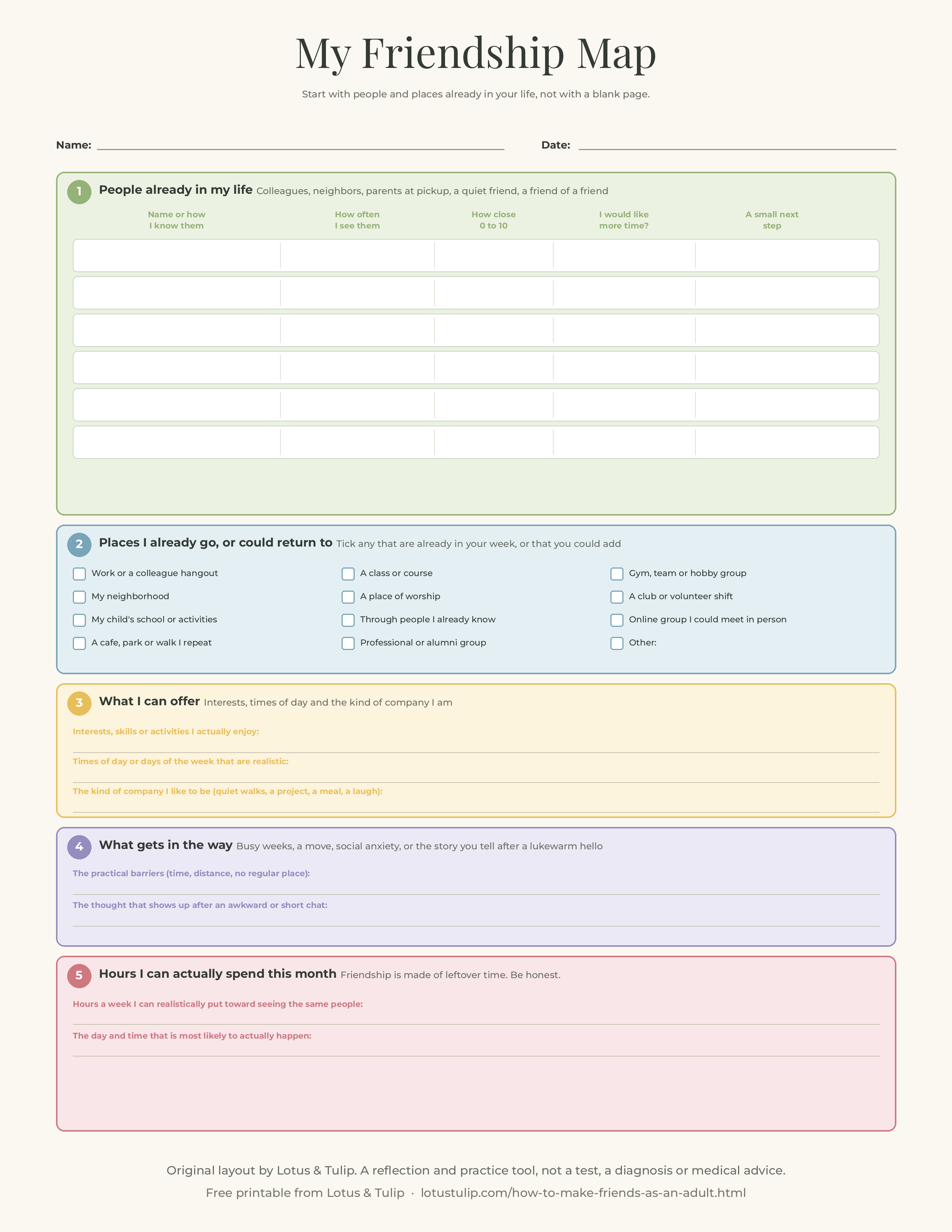
- Map who is already in your life. On page 1, list people you already see or could see again: colleagues, a neighbor, a parent at school pickup, someone from a class, a friend of a friend who went quiet. Rate how often you see them and whether you would like more time. Most adults are not starting from zero; they have let loose ties fade.
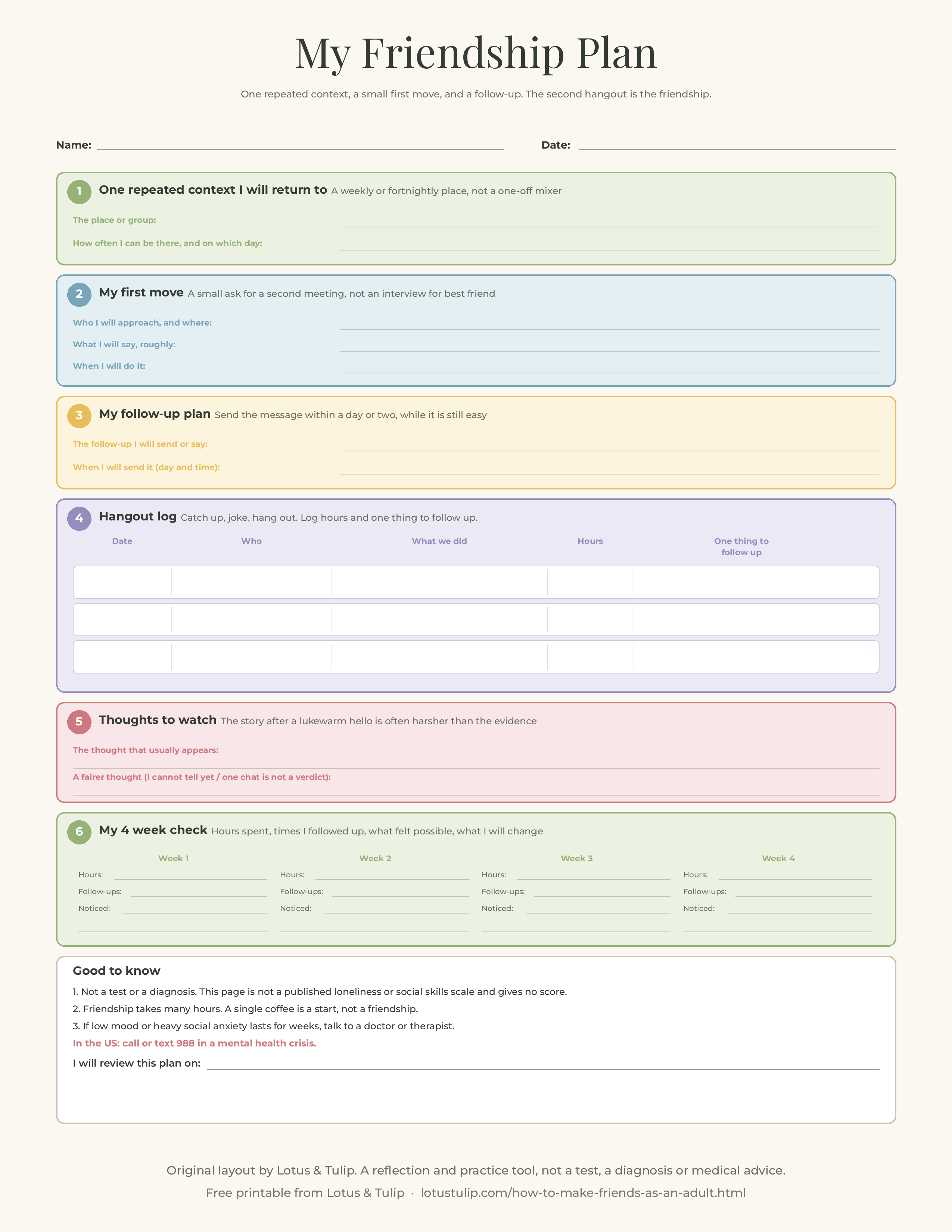
- Pick one repeated context, not a one-off mixer. On page 2, choose a place you can return to weekly or every other week: a class, a team, a faith community, a volunteer shift, a climbing gym, the same cafe, a professional group, or a sideline you already stand on. One-off events rarely supply the hours Hall's research describes.
- Budget real hours, honestly. Look at the week you actually have, not the week you wish you had. Friendship is made of leftover time, and working adults and parents have less of it. Even two hours a week in the same place adds up.
- Make a small first move. Write what you will say and when. "I am usually here on Tuesdays; want to grab a coffee after?" is enough. You are not interviewing for best friend. You are offering a second meeting.
- Follow up, on purpose. The second and third hangouts are the friendship. After a good (or even decent) first chat, send the message within a day or two, while it is still easy to say "I enjoyed that, shall we do it again?" Put a follow-up prompt on the plan page so it does not depend on courage in the moment.
- Catch up, joke and hang out, not only "go deep." Ask what happened since you last met. Share a small piece of your week. Do the activity you came for. Serious conversation can wait until there is a pattern of showing up.
- Watch the story you tell yourself after a lukewarm hello. On page 2, write the thought that usually appears ("I was awkward"; "They were just being polite") and a fairer one ("I cannot tell yet"; "One short chat is not a verdict"). If that thought is loud and frequent, a thought record from the CBT worksheets, or the social anxiety worksheet, will help more than another networking event.
- Treat weak ties as worthwhile. The barista, the person you nod to in the hallway, the parent you only see at Saturday practice: those contacts are related to belonging in their own right, and some of them are how closer friendships start. You do not have to force every acquaintance into a best-friend slot.
- Review after four weeks. Fill in the 4 week check: hours spent, times you followed up, what felt possible and what you will change. Keep the context, switch it, or shrink the plan. If low mood, heavy social anxiety or isolation is lasting for weeks and affecting work, sleep or relationships, talk to a doctor or therapist. In the US, call or text 988 in a mental health crisis.
Common mistakes
- Waiting for a community to appear. After college, communities almost never assemble themselves around you. You have to pick a place and return to it.
- Collecting first meetings and never following up. A calendar full of introductory coffees with no second dates is exhausting and does not create friends.
- Treating a lukewarm first chat as rejection. Most first conversations are a bit stiff. That is normal, not evidence that you are unlikeable.
- Trying to skip to best-friend intensity. Oversharing on meeting one can push people away. Closeness is built with hours and repeated, slightly deeper talks, not a single confession.
- Only using apps or one-off events. Online can help (8 percent of adults with close friends in the 2021 survey had made a close friend that way), but it still has to turn into repeated time in a real or regular setting.
- Expecting college-speed closeness while working full time. If you have far fewer shared hours than a first-year student, it will take longer. That is a scheduling fact, not a verdict on you.
Examples
- The new-in-town parent: After a move, she knew nobody except other parents at Saturday soccer. She stopped treating the sideline as dead time, learned two names, and asked one parent if they wanted to get tea after practice the following week. They did, then took turns bringing a thermos. Six weeks later she had one casual friend and a standing Saturday chat. The repeated context was already in her week; the follow-up was the missing piece.
- The remote worker: He had plenty of Slack contacts and no one to see on a Friday. He joined a climbing gym that ran a weekly beginners' session, went four times before he felt he "knew" anyone, and then asked one person to stay for food after. Two of those sessions felt awkward. He wrote that down on the plan page and went back anyway. The friendship started at week five, not week one.
- The person with a loud inner critic: After every work social she replayed what she had said and concluded she had been boring. She used a thought record for two of those evenings (the prediction was "they regretted talking to me"; the evidence was a colleague asking if she was coming to the next lunch). She kept going to the monthly lunch. The social anxiety worksheet and the CBT thought record were the tools; the lunch was the repeated context.
Free worksheets: how to make friends as an adult
This free printable is an original Lotus & Tulip layout on US Letter, in our own wording. It is not a published loneliness or social skills scale, and it does not give a score. Page 1, My Friendship Map, has a table of people already in your life, a checklist of places you already go, what you can offer, what gets in the way and an honest hours budget. Page 2, My Friendship Plan, covers one repeated context, a first move, a follow-up plan, a hangout log, thoughts to watch, a 4 week check and a review date.
Download the free making friends as an adult worksheets (PDF, 2 pages, US Letter)
Prefer single images? Page 1: my friendship map (PNG) · Page 2: my friendship plan (PNG)
Free to print for yourself or for use with your own clients or groups. Please link to this page rather than re-uploading the file. A reflection and practice tool, not a test, a diagnosis or a substitute for therapy. In the US, call or text 988 in a mental health crisis.
Related resources
- Loneliness worksheet for adults: when the hard part is the feeling of being disconnected, with a free map and plan
- Conversation skills worksheet: the parts of a conversation, follow-up questions and a free practice plan
- Social anxiety worksheet: when fear of being judged, not lack of a plan, is what holds you back
- Assertiveness worksheet: clear asks without aggression
- ACT values worksheet: if friendship is something you value, one committed step toward it
- Friendship activities for teens: the school and peer version, with a free printable
- All therapist worksheets: CBT, DBT, ACT and more
FAQ
How do you make friends as an adult?
Pick one place you can return to regularly, make a small first move, and follow up so you see the same person more than once. Friendship is built from repeated hours, not from a single good conversation. The free 2 page printable on this page walks through a map of people and places you already have, then a plan for one context, a first move and a follow-up.
How long does it take to make a friend?
There is no exact number, but it is more hours than most people expect. In Hall's 2019 research, first-year students crossed from acquaintance to casual friend around 43 hours in the first three weeks, and from casual friend to friend around 57 hours. For adults who had recently moved, the same transitions were estimated at about 94 and 164 hours, and Hall notes those adult figures are likely conservative. A weekly two hour class takes months, not days, to add up.
Where do adults make friends?
In the 2021 American Perspectives Survey, the most common place people with close friends had met one was at work (their own or a spouse's), followed by school, through existing friends and in the neighborhood. Clubs, places of worship and a child's school also appeared. Only 8 percent had made a close friend online. Start with a place you already go, or one you can add as a weekly habit.
Why is it harder to make friends after college or after a move?
School and early jobs pack people into the same rooms for many hours a week. Adult work, commuting, children and moves take that structure away. Friendship networks also tend to shrink across adulthood (Wrzus and colleagues, 2013). The skills are often the same; the hours and the built-in context are not.
What if I am shy or get socially anxious?
Use a smaller first move and a repeated context that has a built-in activity (a class, a team, a volunteer shift), so you are not standing around making small talk the whole time. After a chat, write down the harsh prediction and look at the actual evidence. If fear of being judged is the main barrier, use the social anxiety worksheet alongside this plan.
Can I use these worksheets with clients?
Yes. They are free to print for use with your own clients or groups. Please link to this page rather than re-uploading the file. They are a reflection and practice tool, not a test, a diagnosis or a substitute for therapy.
Sources
- Cox, D. A. (2021). The state of American friendship: Change, challenges, and loss. The Survey Center on American Life. Findings from the May 2021 American Perspectives Survey (2,019 US adults).
- Hall, J. A. (2019). How many hours does it take to make a friend? Journal of Social and Personal Relationships, 36(4), 1278 to 1296.
- Masi, C. M., Chen, H.-Y., Hawkley, L. C., and Cacioppo, J. T. (2011). A meta-analysis of interventions to reduce loneliness. Personality and Social Psychology Review, 15(3), 219 to 266.
- Sandstrom, G. M., and Dunn, E. W. (2014). Social interactions and well-being: The surprising power of weak ties. Personality and Social Psychology Bulletin, 40(7), 910 to 922.
- Wrzus, C., Hanel, M., Wagner, J., and Neyer, F. J. (2013). Social network changes and life events across the life span: A meta-analysis. Psychological Bulletin, 139(1), 53 to 80.