
Therapist worksheets · Updated 2026-11-03
Wise Mind worksheet: how to teach Reasonable Mind, Emotion Mind and Wise Mind in DBT, with practice ideas (free printable)
Ready-made printable: DBT Worksheets for Therapists Fillable PDF, 20 pages: weekly diary card, chain analysis, pros and cons, crisis survival plan and 0 to 10 suffering scales
Holiday 20% off: about $11.04, was $14 (EUR 12) · instant digital download
Try it free first: download a fillable sample (weekly diary card and checking the facts, PDF, 234 KB). Type into it on screen, then get the full pack. No email needed.

Wise Mind is usually the first DBT skill a client learns, and the one they come back to most. It gives a name to something many clients have never noticed: that they can act from pure logic, from pure feeling, or from a place that takes both seriously. This guide explains the three states of mind as Marsha Linehan teaches them, the Wise Mind practices from her handouts, how to teach the skill in session, worked examples for an adult client and a teen, adaptations, common mistakes and an FAQ. It ends with a free one page Wise Mind worksheet on US Letter paper.
This is educational information for therapists, school counselors and other helpers, not a substitute for DBT training or supervision. If a client is in danger, follow your crisis protocol. In the US, anyone in crisis can call or text 988, the Suicide and Crisis Lifeline, or call 911 in an emergency.
Jump to the free Wise Mind worksheet
What Wise Mind is and where it comes from
Wise Mind belongs to the mindfulness module of dialectical behavior therapy (DBT), the treatment developed by Marsha Linehan. In the second edition of her skills materials, DBT Skills Training Handouts and Worksheets (Guilford Press, 2015), it appears as Mindfulness Handout 3, "Wise Mind: States of Mind," followed by Mindfulness Handout 3A, "Ideas for Practicing Wise Mind," and Mindfulness Worksheet 3, "Wise Mind Practice."
The handout describes three states of mind:
- Reasonable Mind is cool, rational and task focused. In Reasonable Mind a person is ruled by facts, reason, logic and pragmatics, and values and feelings are not important.
- Emotion Mind is hot, mood dependent and emotion focused. In Emotion Mind a person is ruled by moods, feelings and urges to do or say things, and facts, reason and logic are not important.
- Wise Mind is described as the wisdom within each person: seeing the value of both reason and emotion, bringing left brain and right brain together, the middle path.
The handout draws these as two overlapping circles, with Wise Mind where they meet. That picture is the heart of the skill. Wise Mind is not the absence of emotion, and it is not logic with the feelings switched off. It is the place where a person can know the facts and know what they feel, and choose what to do from there.
The rest of the core mindfulness skills build on this. The "what" skills (observe, describe, participate) and "how" skills (nonjudgmentally, one-mindfully, effectively) that follow in the same module are, in practice, the ways clients get into Wise Mind and stay there.
Reasonable Mind, Emotion Mind and Wise Mind at a glance
| Reasonable Mind | Emotion Mind | Wise Mind | |
|---|---|---|---|
| Feels like | Cool, detached, "just get it done" | Hot, urgent, "I have to do something now" | Settled, clear, "I know what matters here" |
| Pays attention to | Facts, logic, plans | Feelings, moods, urges | Both, at the same time |
| Leaves out | Values and feelings | Facts and consequences | Nothing on purpose |
| Sounds like | "Feelings are irrelevant, the numbers say quit." | "I can't stand this, I'm quitting today." | "I'm exhausted and the job is hurting me. I'll start looking and decide by spring." |
Both Reasonable Mind and Emotion Mind are useful at times. Reasonable Mind gets taxes filed; Emotion Mind fuels love, grief and protest. The problem is acting from only one of them when a situation needs both.
Wise Mind practices from Linehan's handout
Mindfulness Handout 3A lists eight ideas for practicing Wise Mind, plus a space for the client's own. It advises practicing first when the skill is not needed, in easier situations, so it becomes automatic, and practicing with eyes closed and with eyes open. In plain words:
- Stone flake on the lake. Imagine being a small, flat, light flake of stone tossed onto a clear blue lake, gently floating down through the calm water to the smooth, sandy bottom. Notice what you see and feel on the way down, and settle your attention there, at your center.
- Walking down the spiral stairs. Imagine a spiral staircase inside you, winding down to your center. Walk down slowly, noticing sensations. You can rest on a step or turn on lights on the way, and you never have to go further than you want to.
- Breathing "wise" in, "mind" out. On the in breath, say "wise" to yourself; on the out breath, say "mind." Put your whole attention on each word, and continue until you sense you have settled into Wise Mind.
- Asking Wise Mind a question. Breathing in, silently ask Wise Mind a question. Breathing out, listen for the answer, without giving yourself the answer. If no answer comes, try again another time.
- Asking "Is this Wise Mind?" The same practice, asking about a specific action, thought or plan.
- Attending to the breath. Follow the breath in, and let your attention settle into your center at the bottom of the breath, or at the center of the forehead at the top of the breath.
- Expanding awareness. Breathing in, focus on your center. Breathing out, stay aware of your center while expanding awareness to the space you are in.
- Dropping into the pauses. Notice the pause after each inhale and after each exhale, and let yourself "fall into" the space within the pause.
Mindfulness Worksheet 3 turns these into a weekly checklist, with space to describe the situation and rate how effective the practice was. The free worksheet below is a different, original tool: it is for using Wise Mind on one real decision.
How to teach Wise Mind in session
- Start with the client's own examples. Ask about a time they acted on pure feeling and regretted it, and a time they were so logical they ignored something that mattered. Most clients recognize both within a minute.
- Draw the two circles. Label them, then ask where the overlap might be. Let the client name what Wise Mind feels like for them: calm, centered, "I just know," quiet.
- Normalize both minds. Make clear that Emotion Mind is not the bad one. Clients with a lot of shame about their emotions often hear "Emotion Mind" as criticism. It is information, not a flaw.
- Practice one exercise in the room. Breathing "wise" in, "mind" out is the easiest to start with because it needs no imagery. Do two minutes together, then ask what they noticed. "Nothing much" is a fine answer.
- Apply it to something small. Use a low stakes, real decision (whether to text a friend back tonight, what to do this weekend) before trying a loaded one.
- Assign practice between sessions. One practice a day, in a calm moment, logged on a worksheet. Review it next session: what helped, what got in the way.
- Link it to every other skill. Ask "What does Wise Mind say?" before DEAR MAN, before TIPP, before deciding whether to act on an urge. It becomes the question that ties the skills together.
Worked examples
Adult client: an angry email at work
Situation: Her manager forwarded her report to the team with a note pointing out two errors.
Emotion Mind: Humiliated and furious, 8 out of 10. Urge: reply all, defend every point, maybe say she is done with this job.
Reasonable Mind: The errors were real. Her reviews have been good. A reply all tonight would be seen by twenty people.
Settling in: She steps away from the screen and does three minutes of breathing "wise" in, "mind" out, then asks, on the in breath, "What do I do about this email?" and listens.
Wise Mind: "I'm embarrassed, and it was not fair to call me out in front of everyone. I also did make the errors. I'll fix them tonight and ask for a short meeting tomorrow to say how the group email landed." She rates herself 4 out of 10 afterward. The urge is still there, but she is not acting on it.
Teen: a group chat that left them out
Situation: A 15 year old sees photos from a party that friends planned in a group chat he was not part of.
Emotion Mind: Hurt, 9 out of 10. Urge: post something mean about them, or block them all.
Reasonable Mind: "It's just one party. It doesn't matter. Feelings are dumb."
Settling in: He imagines the stone flake drifting down to the bottom of the lake, then asks himself, "Is posting this Wise Mind?"
Wise Mind: "It does matter to me, and that's okay. Posting something mean would make it worse and I'd regret it. I'll talk to Sam, the one I'm closest to, tomorrow, and do something I like tonight." Notice that Wise Mind takes the hurt seriously, which Reasonable Mind refused to do.
For the conversation with Sam, the DEAR MAN worksheet helps him plan what to say.
Adaptations
- Teens: Keep it concrete and use their language. Many teens connect with "the part of you that knows what's actually right for you, even when you're mad." Use their real situations: friends, phones, parents, school.
- Younger children: Simplify to a "thinking side," a "feeling side" and a "wise side" in the middle, and use one short breathing practice. Drawing the two circles in different colors helps.
- Clients with a trauma history: Imagery of sinking or going down inside can feel unsafe for some clients. Offer the breath based practices first, practice with eyes open, and remind them, as the handout does, never to go further than they want to. Watch for signs a client is leaving their window of tolerance.
- Very logical clients: Some clients live in Reasonable Mind and think they are already wise. Spend time on what Reasonable Mind leaves out: values, needs, what they care about.
- High distress: At the top of the distress scale, Wise Mind can be hard to reach. Bring arousal down first with TIPP skills or 5 4 3 2 1 grounding, then ask what Wise Mind says.
Group activities for DBT skills groups
- Sort the statements: Read short statements aloud and have members call out which mind they come from. Disagreements make the best discussion.
- Three chairs: Set out three chairs. A volunteer speaks about a decision from the Reasonable Mind chair, then the Emotion Mind chair, then sits in the middle and speaks from Wise Mind.
- Practice of the week: Open each group with one Wise Mind practice from the handout, rotating through all eight.
- Wise Mind check in: At check in, each member names which mind they arrived in today.
Common mistakes
- Treating Wise Mind as "calm down." Wise Mind can include strong feelings. The goal is not to feel nothing; it is to include the facts too.
- Making Emotion Mind the villain. If clients learn that emotions are the problem, they may slide into Reasonable Mind and call it progress.
- Expecting instant answers. The handout is clear that if no answer comes, the client tries again another time. Some days Wise Mind is quiet.
- Only practicing in crisis. A skill first tried at 9 out of 10 rarely works. Practice in easy moments first.
- Confusing Wise Mind with what the client wants to hear. A useful check: does this answer still make sense tomorrow, and does it account for both the facts and the feelings?
Free Wise Mind worksheet
This one page Wise Mind worksheet is an original Lotus & Tulip design. The client writes the situation, then fills in what Reasonable Mind says (the facts, and what logic says to do) and what Emotion Mind says (feelings with a 0 to 10 rating, and urges). In the Wise Mind section they tick the practice they used to settle in, then write what feels true and wise when they hold both, a small next step, when they will do it and who could help. A short afterward check rates how settled they felt before and after. It prints on US Letter.
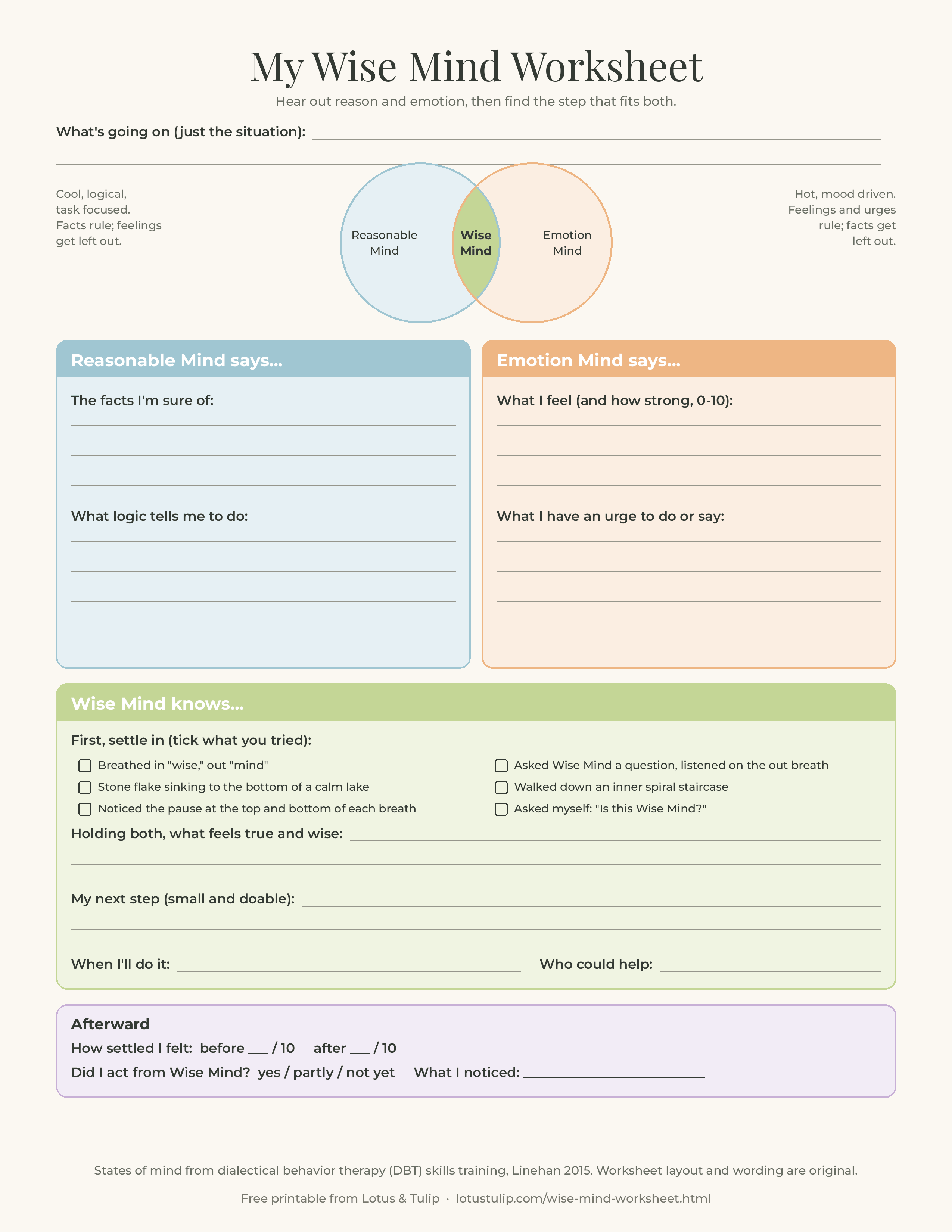
Download the free Wise Mind worksheet (PNG, US Letter)
Free DBT starter pack for teens: Working with a teen? The free DBT worksheets for teens starter pack adds this exact finding my wise mind page from our paid DBT set for teens, plus ride the emotion wave, check the facts, a distress tolerance toolkit, a weekly diary card and a safety and care page (8 pages, ages about 13 to 18, client use license, no email).
Free to print for use with your own clients, students or yourself. Please link to this page rather than re-uploading the file. Not affiliated with or endorsed by Marsha Linehan, Behavioral Tech or Guilford Press.
Related resources
- DBT STOP skill worksheet: ask wise mind before you act (free printable)
- DBT pros and cons worksheet: good day or good life, a wise mind conclusion (free printable)
- DBT validation worksheet: six levels and self-validation (free printable)
- DEAR MAN worksheet with script examples (free printable)
- DBT TIPP skills worksheet (free printable)
- Window of tolerance worksheet (free printable)
- 5 4 3 2 1 grounding worksheet (free printable)
- All therapist worksheets: CBT, DBT and ACT
FAQ
What is Wise Mind in DBT?
Wise Mind is the core mindfulness skill in Marsha Linehan's dialectical behavior therapy. Her handout describes it as the wisdom within each person: seeing the value of both reason and emotion, bringing them together, the middle path. In practice it means making a choice that respects both the facts and your feelings.
What is the difference between Reasonable Mind, Emotion Mind and Wise Mind?
Reasonable Mind is cool, rational and task focused, ruled by facts and logic, with feelings and values left out. Emotion Mind is hot and mood dependent, ruled by feelings and urges, with facts and logic left out. Wise Mind is where the two overlap, taking both into account.
How do you get into Wise Mind?
Linehan's handout suggests practices such as breathing "wise" in and "mind" out, imagining a stone flake floating to the bottom of a calm lake, walking down an inner spiral staircase, asking Wise Mind a question and listening for the answer on the out breath, asking "Is this Wise Mind?", and noticing the pauses between breaths. Practice first in calm moments so the skill is there when you need it.
Is Wise Mind the same as being calm?
No. A person can be in Wise Mind and still feel strong emotions. The difference is that the feelings are not the only thing deciding what they do; the facts and their values count too.
Can Wise Mind be taught to teens and kids?
Yes. Teens often connect with it when it is tied to their real situations, such as friends, phones and family. With younger children, simplify it to a thinking side, a feeling side and a wise side in the middle, and use one short breathing practice.
Is this Wise Mind worksheet free?
Yes. It is free to print for use with your own clients, students or yourself. Please link to this page rather than re-uploading the file.