
Kids and teens · Self control, waiting and stopping to think · Updated 2026-11-04
Impulse control worksheets for kids: how to teach self control, activities that help, and a free printable
Ready-made printable: Anger Management Small Group Curriculum for School Counselors Holiday 20% off: about $11.04, was $14 (EUR 12) · instant digital download
Buy on Etsy
Every classroom has them. The child whose hand shoots up and whose answer comes out before the question is finished. The child who grabs the ball, pushes to the front of the line, or knocks the tower down because the urge arrived faster than the thought. The child who melts down the second a screen goes off. Adults call this poor impulse control, and it is one of the most common reasons kids are referred to the school counselor.
The good news is that self control is not a fixed trait a child either has or lacks. It grows with age, it depends heavily on the situation, and it can be supported with clear steps, practice, and environments that make waiting easier. This guide is for school counselors, teachers, child therapists, special education teams and parents in the US. It covers what impulse control actually is, what to expect at different ages, what research honestly shows (including what the famous marshmallow test does and does not prove), a simple Stop and Think routine, activities and games for school and home, a 9 step teaching plan, and a free 3 page printable.
Jump to the free impulse control worksheets for kids
What is impulse control? A plain language definition
Impulse control is the ability to pause between a feeling or urge and an action, long enough to choose what to do. For kids, a simple definition works well: impulse control means stopping to think before you act, even when you really, really want to do something right now.
Psychologists usually place impulse control inside a wider set of skills called executive functions. Adele Diamond's widely cited 2013 review in the Annual Review of Psychology describes three core executive functions: working memory, cognitive flexibility, and inhibitory control. Inhibitory control is the scientific name for most of what parents mean by impulse control. It includes:
- Stopping an action. Not grabbing the toy, not hitting back, not running into the street.
- Waiting. Taking turns, waiting to be called on, waiting for a treat later.
- Holding back words. Not blurting out answers, not interrupting, not saying the hurtful thing.
- Staying with a task. Resisting the pull of a more fun distraction to finish homework or classwork.
Impulse control overlaps with emotional regulation, but they are not identical. Emotional regulation is about managing the feeling itself. Impulse control is about what you do with your body and words while the feeling is there. A child can feel furious and still choose not to throw the game piece. That gap between feeling and action is exactly what the free printable below helps children practice.
If impulse control is one part of a broader picture of planning, organizing and staying on task, our guide to executive functioning worksheets for kids covers the other skills.
Why impulse control matters
The strongest evidence on why childhood self control matters comes from the Dunedin study in New Zealand. Terrie Moffitt and colleagues, writing in PNAS in 2011, followed about 1,000 children from birth to age 32. Children's self control was measured between ages 3 and 11 using reports from parents, teachers, observers and the children themselves. Lower childhood self control predicted poorer physical health, more substance dependence, lower income and savings, and more criminal convictions in adulthood, and the pattern held across the whole range of self control, not only among the children with the most difficulty. The researchers also found the link held after accounting for childhood IQ and family social class.
In a smaller study, Angela Duckworth and Martin Seligman (2005, Psychological Science) found that self discipline measured in the fall predicted eighth graders' final grades better than IQ did.
An honest caveat: both are correlational studies. They show that children with stronger self control tend to do better later, not that a self control worksheet will change a child's adult income. Still, they are a solid argument for treating self control as a skill worth supporting, rather than assuming a child will simply grow out of it.
What the marshmallow test does and does not show
No article about kids and self control is complete without the marshmallow test, and it is worth getting right because it is often oversold.
In studies at Stanford in the late 1960s and early 1970s, Walter Mischel and colleagues offered preschoolers a choice: one small treat now, or two treats if they could wait alone until the researcher came back. Mischel, Ebbesen and Zeiss (1972) were mainly interested in how children waited. Children waited much longer when the treats were covered or out of sight, and when they distracted themselves by singing, playing with their hands or thinking fun thoughts. Later follow ups, including Shoda, Mischel and Peake (1990), reported that children who waited longer tended to do better as teenagers, including on SAT scores.
Two later findings changed how the test is understood:
- The long term link is smaller than once claimed. Tyler Watts, Greg Duncan and Haonan Quan (2018, Psychological Science) repeated the idea with a much larger and more diverse sample of over 900 children from a US national study. Waiting time at age 4 did predict achievement at age 15, but the link was about half the size of the original reports, and it shrank by roughly two thirds once the researchers accounted for family background, early cognitive ability and the home environment.
- Trust matters. Celeste Kidd, Holly Palmeri and Richard Aslin (2013, Cognition) first had children experience an adult who either kept or broke small promises. Children who had just experienced a reliable adult waited far longer on the marshmallow task than children who had experienced an unreliable one. Waiting is partly a rational decision about whether the reward will actually show up.
What this means in practice. The most useful lesson from the marshmallow research is the original one: self control depends a great deal on strategies and situations. Hiding the temptation, having something else to do with your hands and mind, and trusting that waiting pays off all make waiting easier. That is good news, because all three can be taught or arranged by adults. It is why the free Pause Plan page includes a Wait It Out menu of distraction strategies, and why keeping your own promises to children ("after you finish, we will go outside") is one of the quietest and most powerful ways to build their self control.
Impulse control by age: what to expect
Self control develops slowly across childhood and keeps developing through the teen years. Expectations that are too high for a child's age lead to a lot of unnecessary conflict. Treat these as rough guides, not a checklist to diagnose with.
- Ages 3 to 4 (preschool). Waiting is genuinely hard. Most children can wait briefly with adult help, follow simple stop and go games, and begin taking turns in short, adult led games. Grabbing, hitting when frustrated and big reactions to "no" are common and developmentally expected.
- Ages 5 to 6 (kindergarten and first grade). Children can follow classroom rules like raising a hand and lining up with reminders, and can play games with rules. They still blurt, interrupt and struggle when excited, tired or hungry. Visual cues and short, predictable routines help enormously.
- Ages 7 to 9 (second to fourth grade). Children can start using self talk ("I can wait"), plan ahead for tricky moments, and reflect afterward on what happened. They can learn named routines like Stop and Think and use them with prompts. Losing games and unfairness are common triggers.
- Ages 10 to 12 (upper elementary to middle school). Self control in calm situations is usually much stronger, but strong emotions, peer pressure and screens are new tests. Impulsive comments in group chats and online are a growing issue. Kids at this age respond well to understanding why their brain does what it does and to planning their own strategies.
Children also vary a lot within the same age. Temperament, sleep, hunger, stress, language skills and neurodevelopmental differences all affect self control on any given day. Most adults know from experience that their own self control is worse when they are exhausted, and children are the same.
When to seek more help. If impulsive behavior is frequent, intense, happens across settings (home and school), is clearly beyond what peers of the same age show, puts the child or others at risk, or comes with strong difficulties in attention, learning, mood or relationships, talk to the school counselor, pediatrician or a licensed child psychologist. Persistent impulsivity is one of the core features of ADHD, and a proper evaluation can open the door to the right support. A worksheet is a teaching tool, not an assessment or a treatment.
Why kids act on impulse: four common reasons
Before choosing a strategy, it helps to ask why a particular child acts before thinking. The same behavior, such as grabbing, can have different causes:
- The skill is still developing. Young children and many children with ADHD genuinely find stopping harder. They need more structure, more practice and more adult support, not more punishment.
- A big feeling takes over. Anger, excitement, frustration and anxiety can overwhelm a child's ability to pause. These children benefit from learning to notice their body's early warning signs and from calming tools such as those in our coping skills list for kids and breathing exercises for kids.
- They do not know what else to do. A child who grabs may simply not have a quick, ready alternative. Teaching a specific replacement ("ask for a turn next") is often more effective than only saying "don't grab."
- The impulsive behavior works. If shouting gets the screen time extended or pushing gets you to the front of the line, the behavior is being rewarded. Changing what happens after the behavior, and making the calm choice pay off, matters as much as teaching.
What the research says about teaching self control (with honest caveats)
Self control and executive function interventions are an active research area, and the honest picture is encouraging but more modest than many product descriptions suggest.
- Several approaches show benefits, especially with practice. Adele Diamond and Kathleen Lee's 2011 review in Science looked at interventions shown to aid executive function in children aged 4 to 12, including certain classroom curricula, computerized training, martial arts and mindfulness style activities. They concluded that the children with the weakest executive functions often benefit most, that skills need to be practiced repeatedly and progressively challenged, and that benefits tend to be narrow, mostly showing up on the skills that were actually practiced.
- Transfer is the big challenge. Later reviews, including Diamond and Ling (2016), stress that practicing one task rarely improves self control in everyday life unless the skill is used in many real situations. That is why a worksheet alone is never enough. The Pause Plan and practice tracker in the free printable are there to move the skill from paper into real moments.
- Games can build self regulation in young children. Megan McClelland and colleagues have developed and studied simple movement and music games for preschoolers, such as versions of Red Light, Purple Light and Freeze games where children must follow, then switch, rules. Schmitt, McClelland, Tominey and Acock (2015) reported self regulation gains from a short program of these games with Head Start preschoolers, with stronger effects for some groups of children than others.
- Broad SEL programs help on average. Joseph Durlak and colleagues' 2011 meta-analysis of 213 school based social and emotional learning programs found improvements in social and emotional skills and behavior and fewer conduct problems, along with an average 11 percentile point gain in academic achievement. Self management is one of the five CASEL competencies most of these programs target.
- Treat "willpower is a muscle that runs out" with caution. The popular idea of ego depletion, that self control is a limited resource used up through the day, was tested in a large multi lab replication led by Martin Hagger (2016) that found an effect close to zero. It is still true that tired, hungry and stressed kids struggle more, but it is not helpful to tell children their willpower has "run out."
Put together, the research points to a practical recipe: teach a short, memorable routine, practice it often in low stakes games, plan for the specific moments that are hardest, arrange the environment so waiting is easier, and make sure calm choices pay off in real life.
The Stop and Think routine
Many school counselors and SEL programs use some version of a stop, calm, think, act sequence. One well known early example is the turtle technique described by Marlene Schneider and Arthur Robin in 1976, in which children learn to "go into their shell," calm down and then think of a solution. Versions of it are still used with young children today.
The free printable uses four short steps, simple enough for a kindergartner and still useful for a sixth grader:
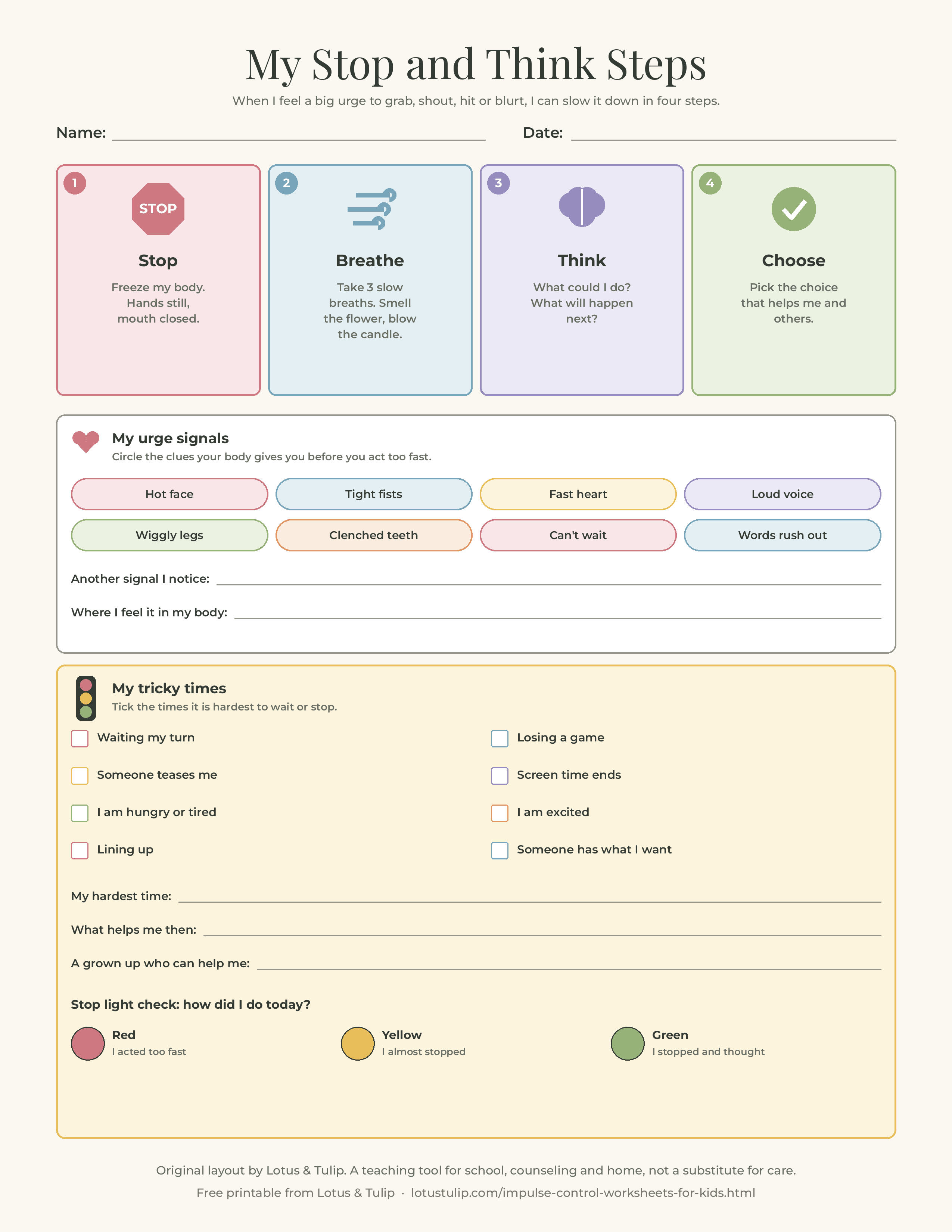
- Stop. Freeze your body. Hands still, mouth closed. Some children like to picture a stop sign or say "stop" quietly in their head.
- Breathe. Take three slow breaths. For younger kids, "smell the flower, blow out the candle" makes it concrete.
- Think. Ask two questions: What could I do? What will happen next if I do it?
- Choose. Pick the choice that helps you and others, and do it.
The routine works best when it is posted where children can see it, when adults model it out loud ("I am frustrated that the printer jammed. I am going to stop, breathe and think"), and when children practice it many times in calm moments before they need it in a hard one. Expecting a child to use a brand new skill for the first time in the middle of a meltdown rarely works.
Impulse control activities and games for kids
Games are one of the most effective and least stressful ways to practice stopping, waiting and switching. They give children many quick, low stakes chances to use self control and feel successful.
For the classroom and small groups
- Red Light, Green Light. The classic stopping game. Make it harder by switching the rules: red means go, green means stop.
- Simon Says. Children must act only when they hear "Simon says." A pure inhibition workout that most children already love.
- Freeze dance. Music on, dance; music off, freeze. Add challenge by asking for slow motion dancing or freezing in a specific shape.
- Head, Toes, Knees, Shoulders (opposite version). When the adult says "touch your head," children touch their toes, and so on. Reversing a well practiced response is hard and fun.
- Stop and Think practice cards. Use the 12 cards in the free printable. A child reads a scenario, acts out the four steps, then shows the best choice. Swap roles so children also see the situation from the other side.
- Wait for the signal. Before transitions, give a clear signal (a chime, a raised hand) and practice waiting for it. Celebrate the class when they wait well.
For counseling sessions
- Jenga or block towers. Slow, careful moves are built into the game, and a falling tower is a perfect low stakes moment to practice the Stop and Think steps. Our play therapy games and activities pack adds prompts to games you already own.
- Urge surfing for kids. Put a small treat or a favorite toy on the table and practice noticing the urge, rating it and watching it rise and fall while using a Wait It Out strategy.
- Body signals map. Help the child notice their own early warning signs (hot face, tight fists, fast heart) using page 1 of the printable. Children who notice the urge earlier have more time to stop.
At home
- Board and card games. Taking turns, waiting, and losing gracefully all happen naturally. Keep games short at first.
- Cooking and baking. Waiting for cookies to cool is a real world marshmallow test with a built in reward.
- Plan the tricky times. Use the Pause Plan to agree in advance what happens when screen time ends or a sibling has the toy.
- Use visual supports. A first then board, a visual schedule or a timer makes waiting concrete. "First homework, then tablet" is easier to wait for when a child can see it.
- Keep your promises. As the Kidd study suggests, children wait more when waiting reliably pays off.
How to teach impulse control to kids, step by step
- Pick one target behavior. Choose a specific, observable behavior to work on first, such as blurting answers, grabbing toys or pushing in line. Trying to fix everything at once rarely works.
- Find the tricky times. Use page 1 of the printable to identify when the behavior happens most: waiting, losing, transitions, teasing, being tired or hungry. Patterns tell you where to focus.
- Teach the body signals. Help the child notice what their body does just before they act on impulse. Earlier noticing means more time to pause.
- Teach the Stop and Think steps. Introduce Stop, Breathe, Think, Choose in a calm moment. Model it out loud and post the steps where the child can see them.
- Practice through games. Play stop and go games and use the practice cards several times a week. Short and frequent beats long and rare.
- Make a Pause Plan. Use page 2 to write if then plans for the two or three hardest moments: "When my turn is over and I want more, I will take a breath and ask when I can have another turn."
- Pick Wait It Out strategies. Have the child circle three distraction strategies they will actually use, such as counting, humming or holding a fidget.
- Prompt and praise in real life. Before a tricky moment, give a short reminder ("Remember your plan"). Afterward, notice specific effort: "You stopped and asked instead of grabbing. That was hard and you did it."
- Track and adjust. Use the weekly tracker on page 3 and the stop light check on page 1. If a plan is not working after a week or two, change the strategy, the environment or the expectation, not the child's sense of themselves.
Common mistakes to avoid
- Only saying what not to do. "Stop interrupting" without teaching what to do instead (wait for a pause, use a signal, write the idea down) leaves a gap the impulse fills.
- Teaching in the meltdown. A child in the middle of a big feeling cannot learn a new skill. Teach and practice when calm; prompt briefly in the moment; reflect afterward.
- Relying on willpower alone. Hiding temptations, adding structure and reducing waiting time are not cheating. They are exactly what the marshmallow research suggests.
- Shaming. Labels like "out of control" or "bad listener" tend to stick. Focus on the behavior and the plan, and keep the child's dignity intact.
- Expecting too much too soon. Self control is still developing for years. Celebrate progress, not perfection.
Free impulse control worksheets for kids (PDF)
This free printable is an original Lotus & Tulip design, sized for US Letter paper and suited to about ages 5 to 12 (kindergarten to grade 6) in classrooms, counseling sessions, small groups and at home. Younger children can use it with an adult reading and writing for them. It has three pages:
- Page 1: My Stop and Think Steps. The four steps (Stop, Breathe, Think, Choose) with simple pictures, a My Urge Signals section with eight body clues to circle, a My Tricky Times checklist with eight common triggers, lines for what helps and a grown up who can help, and a red, yellow and green stop light check for the day.
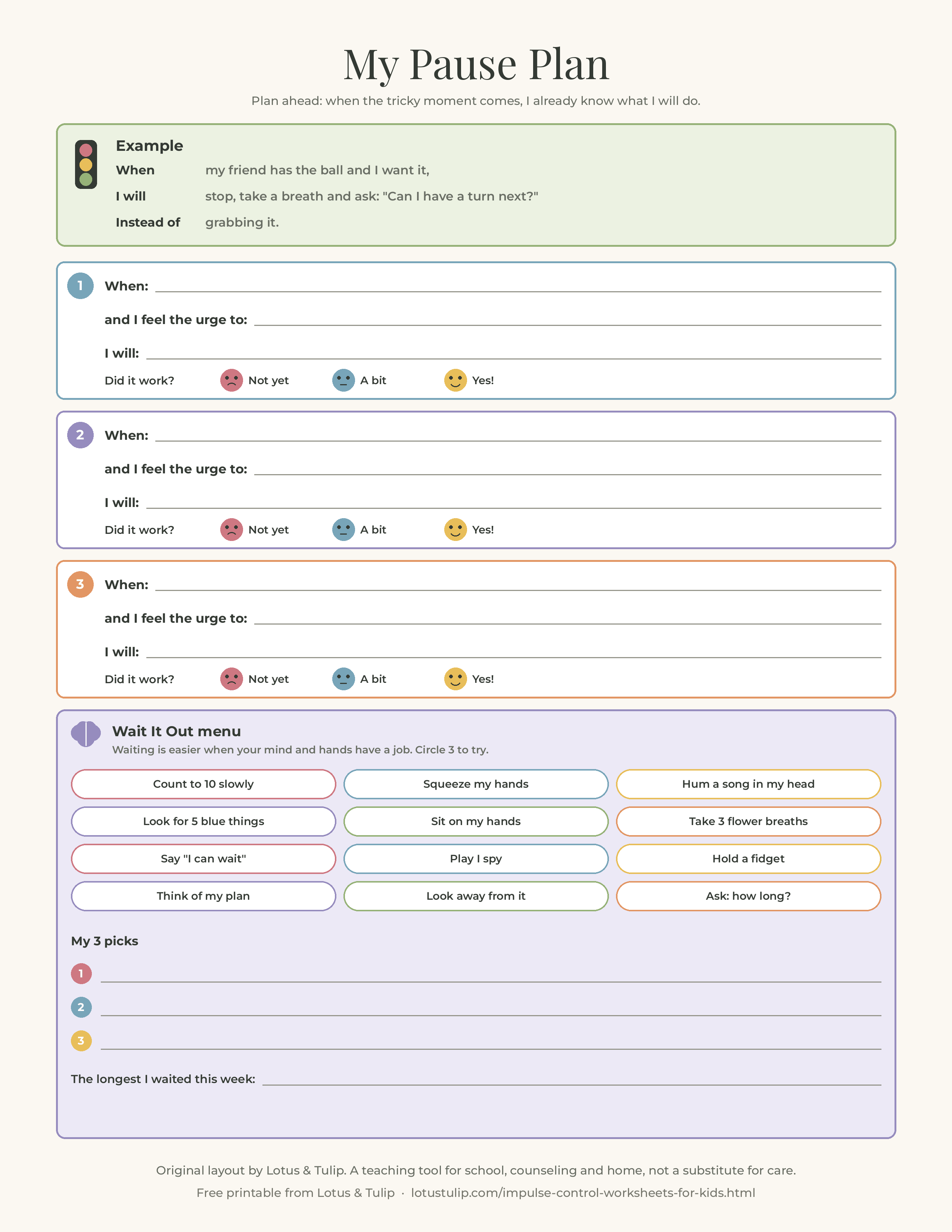
- Page 2: My Pause Plan. A worked example (When my friend has the ball and I want it, I will stop, take a breath and ask for a turn next, instead of grabbing it), three blank When, Urge and I Will plans with a three face rating, and a Wait It Out menu of 12 waiting strategies with space for the child's three picks.
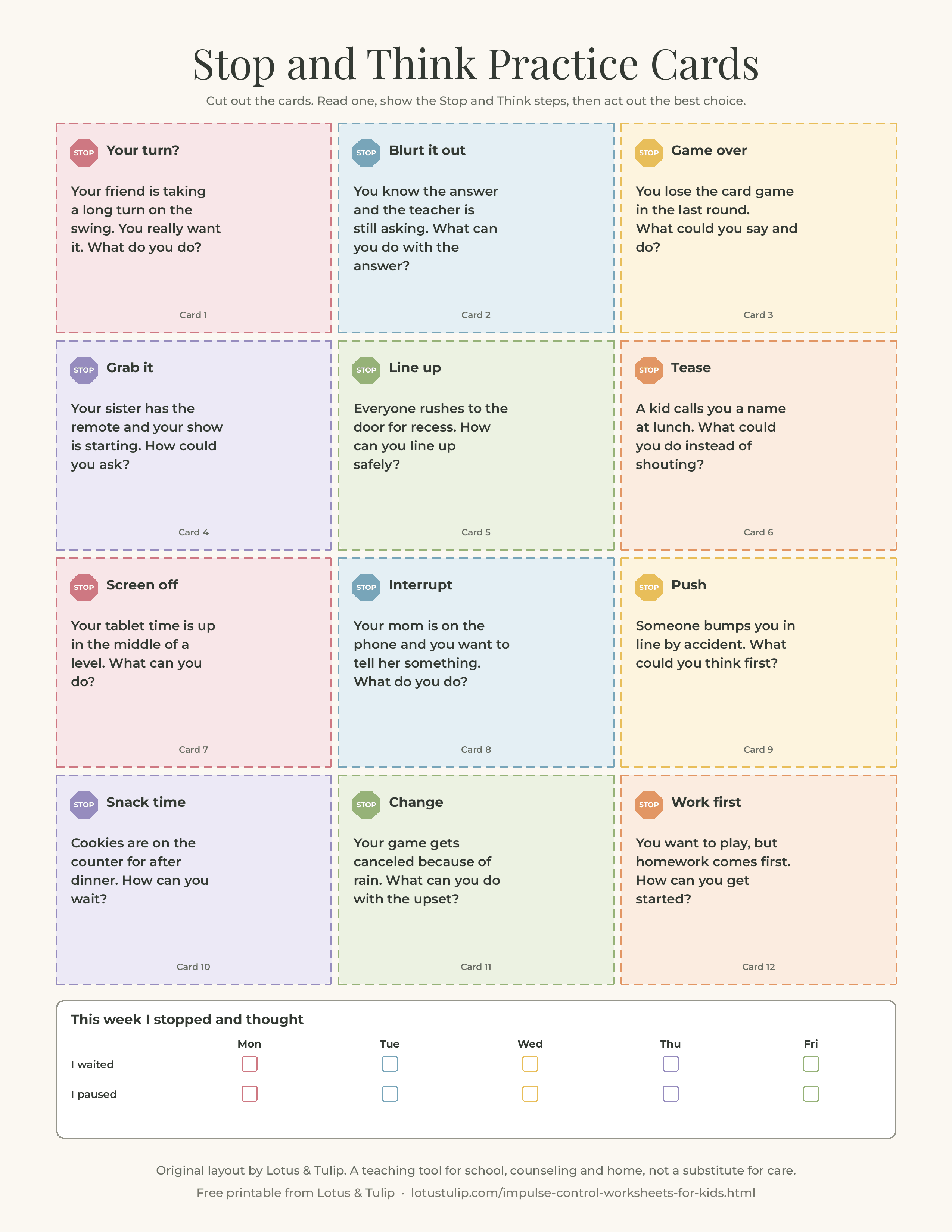
- Page 3: Stop and Think Practice Cards. Twelve cut out scenario cards (waiting for the swing, blurting an answer, losing a game, the TV remote, lining up, teasing, screen time ending, interrupting, an accidental bump, waiting for a treat, a canceled plan and work before play) plus a Monday to Friday tracker for waiting and pausing.
Download the free impulse control worksheets for kids (PDF, 3 pages, US Letter)
Prefer single images? Page 1: Stop and Think Steps (PNG) · Page 2: Pause Plan and Wait It Out Menu (PNG) · Page 3: Practice Cards and Tracker (PNG)
Free to print for your own use and for use with your own students, clients or children. Please link to this page rather than re-uploading the file.
Related resources
- Frustration tolerance worksheets for kids: stuck to unstuck steps and a free try again plan
- Behavior contract for students: a free template and tracker for one self control goal
- Executive functioning worksheets for kids (free printable)
- Emotional regulation worksheets for kids (free printable)
- Anger iceberg worksheet (free printable)
- Size of the problem worksheet (free printable)
- Problem solving worksheet for kids (free printable)
- Calm down corner ideas (free printable)
- Token board printable
- Social skills worksheets for kids (free printable)
Sources
- CASEL. The CASEL 5: self management. casel.org (What Is the CASEL Framework?).
- Diamond, A. (2013). Executive functions. Annual Review of Psychology, 64, 135 to 168.
- Diamond, A., and Lee, K. (2011). Interventions shown to aid executive function development in children 4 to 12 years old. Science, 333(6045), 959 to 964.
- Diamond, A., and Ling, D. S. (2016). Conclusions about interventions, programs, and approaches for improving executive functions that appear justified and those that, despite much hype, do not. Developmental Cognitive Neuroscience, 18, 34 to 48.
- Duckworth, A. L., and Seligman, M. E. P. (2005). Self-discipline outdoes IQ in predicting academic performance of adolescents. Psychological Science, 16(12), 939 to 944.
- Durlak, J. A., Weissberg, R. P., Dymnicki, A. B., Taylor, R. D., and Schellinger, K. B. (2011). The impact of enhancing students' social and emotional learning: a meta-analysis of school-based universal interventions. Child Development, 82(1), 405 to 432.
- Hagger, M. S., Chatzisarantis, N. L. D., and colleagues (2016). A multilab preregistered replication of the ego-depletion effect. Perspectives on Psychological Science, 11(4), 546 to 573.
- Kidd, C., Palmeri, H., and Aslin, R. N. (2013). Rational snacking: young children's decision-making on the marshmallow task is moderated by beliefs about environmental reliability. Cognition, 126(1), 109 to 114.
- Mischel, W., Ebbesen, E. B., and Zeiss, A. R. (1972). Cognitive and attentional mechanisms in delay of gratification. Journal of Personality and Social Psychology, 21(2), 204 to 218.
- Moffitt, T. E., Arseneault, L., Belsky, D., and colleagues (2011). A gradient of childhood self-control predicts health, wealth, and public safety. PNAS, 108(7), 2693 to 2698.
- Schmitt, S. A., McClelland, M. M., Tominey, S. L., and Acock, A. C. (2015). Strengthening school readiness for Head Start children: evaluation of a self-regulation intervention. Early Childhood Research Quarterly, 30, 20 to 31.
- Schneider, M., and Robin, A. (1976). The turtle technique: a method for the self-control of impulsive behavior. In J. Krumboltz and C. Thoresen (Eds.), Counseling Methods. Holt, Rinehart and Winston.
- Shoda, Y., Mischel, W., and Peake, P. K. (1990). Predicting adolescent cognitive and self-regulatory competencies from preschool delay of gratification. Developmental Psychology, 26(6), 978 to 986.
- Watts, T. W., Duncan, G. J., and Quan, H. (2018). Revisiting the marshmallow test: a conceptual replication investigating links between early delay of gratification and later outcomes. Psychological Science, 29(7), 1159 to 1177.
Impulse control worksheets for kids: FAQ
What is impulse control in kids?
Impulse control is a child's ability to pause between an urge and an action long enough to choose what to do. It includes stopping an action, waiting, holding back words and staying with a task. Psychologists call it inhibitory control and see it as one of the core executive functions.
How do you teach impulse control to a child?
Pick one target behavior, find the times it happens most, teach the child to notice body signals, and teach a short routine such as Stop, Breathe, Think, Choose. Practice it through games, make if then plans for the hardest moments, prompt before tricky times and praise specific effort afterward.
What are good impulse control activities for kids?
Red Light, Green Light, Simon Says, freeze dance, opposite versions of Head, Toes, Knees, Shoulders, block tower games, board games with turn taking and Stop and Think role play cards all give children quick, low stakes practice at stopping and waiting.
At what age do kids develop impulse control?
Impulse control starts developing in the preschool years and keeps improving through childhood and adolescence. Preschoolers need a lot of adult support to wait, school age children can learn named routines and plans, and preteens can use self talk and plan their own strategies, though strong emotions and peers still test them.
Is poor impulse control a sign of ADHD?
Not necessarily. Impulsivity is common in young children and varies with sleep, stress and situation. Persistent impulsivity that is clearly beyond peers of the same age, shows up at home and school, and causes real problems can be a sign of ADHD or another difficulty, so talk to the school counselor, pediatrician or a licensed child psychologist.
Does the marshmallow test predict success?
Less than once believed. A larger 2018 study found that waiting time at age 4 had a much smaller link to later achievement than the original studies, and the link shrank further after accounting for family background and early ability. The more useful lesson is that strategies, such as hiding the temptation and distraction, make waiting easier.
Are these impulse control worksheets free?
Yes. The three page impulse control worksheets for kids are free to print for your own use and for use with your own students, clients or children. Please link to this page rather than re-uploading the file.