
Therapist worksheets · Loneliness, connection and CBT · Updated 2026-11-13
Loneliness worksheet for adults: what loneliness is, what the research shows, and how to reconnect step by step (free printable)
When it comes with low mood: Depression and Behavioral Activation Worksheets for Therapists Holiday 20% off: about $9.20, was $12 (EUR 10) · instant digital download
Buy on EtsyThoughts like "no one wants me": CBT Worksheets for Therapists, 20 pages including thought records and core beliefs Holiday 20% off: about $11.04, was $14 (EUR 12) · fillable PDF, instant digital download
Buy on EtsyTry it free first: download a fillable sample (thought record and evidence for and against, PDF, 105 KB). Type into it on screen, then get the full pack. No email needed.
A full caseload: Therapist Worksheets Mega Bundle (8 packs incl. DBT, CBT, ACT, anxiety, grief and ADHD) Holiday 20% off: about $35.88, was $45 (EUR 39) · fillable PDFs for all 8 packs plus 160 printable pages, instant digital download
Buy on EtsyYou can be lonely in a full office, at a family dinner or lying next to a partner. You can also live alone, see few people and feel fine. Loneliness is not about how many people are around you. It is the painful gap between the connection you have and the connection you need, and it tends to make that gap wider: you start to expect rejection, you go out less, and the quiet seems to prove the point.
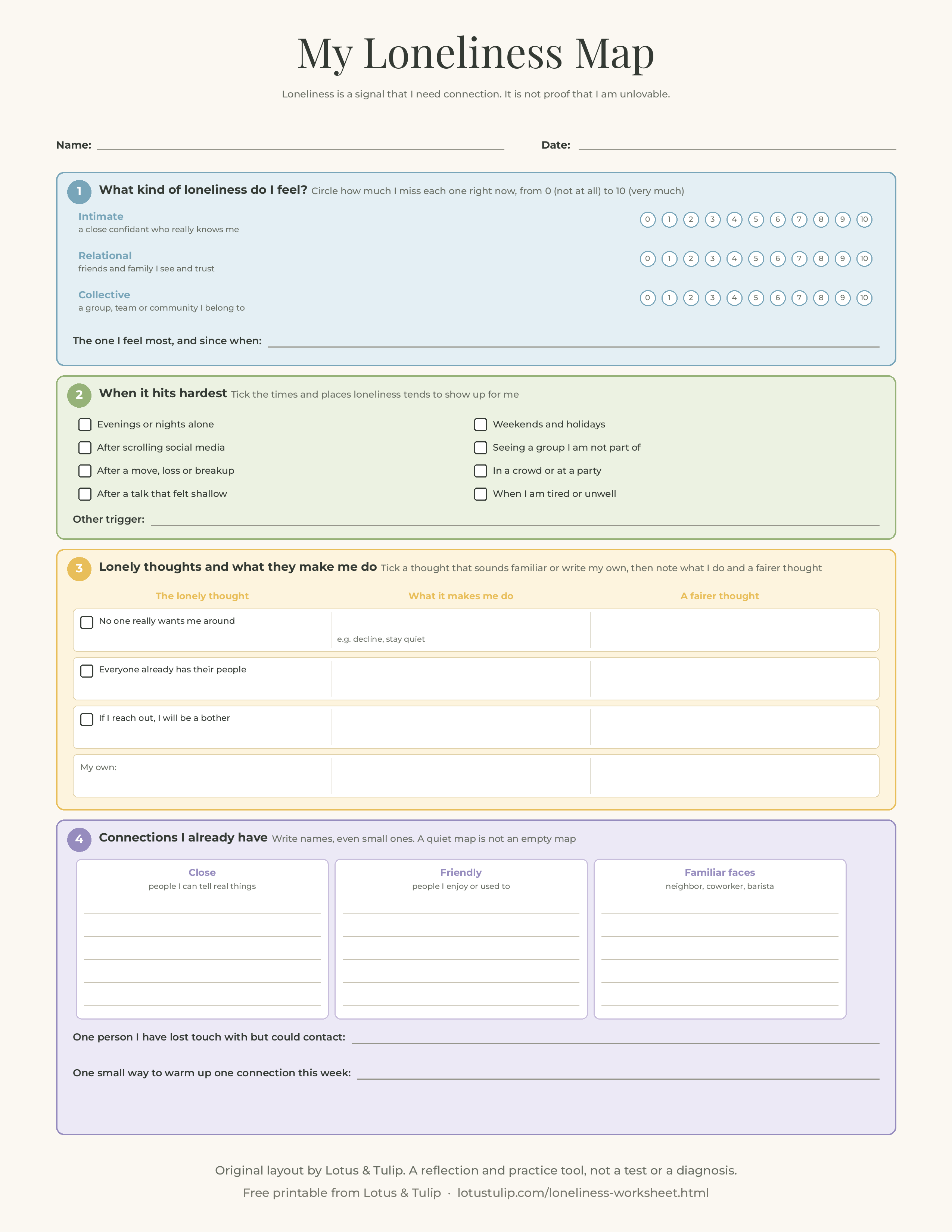
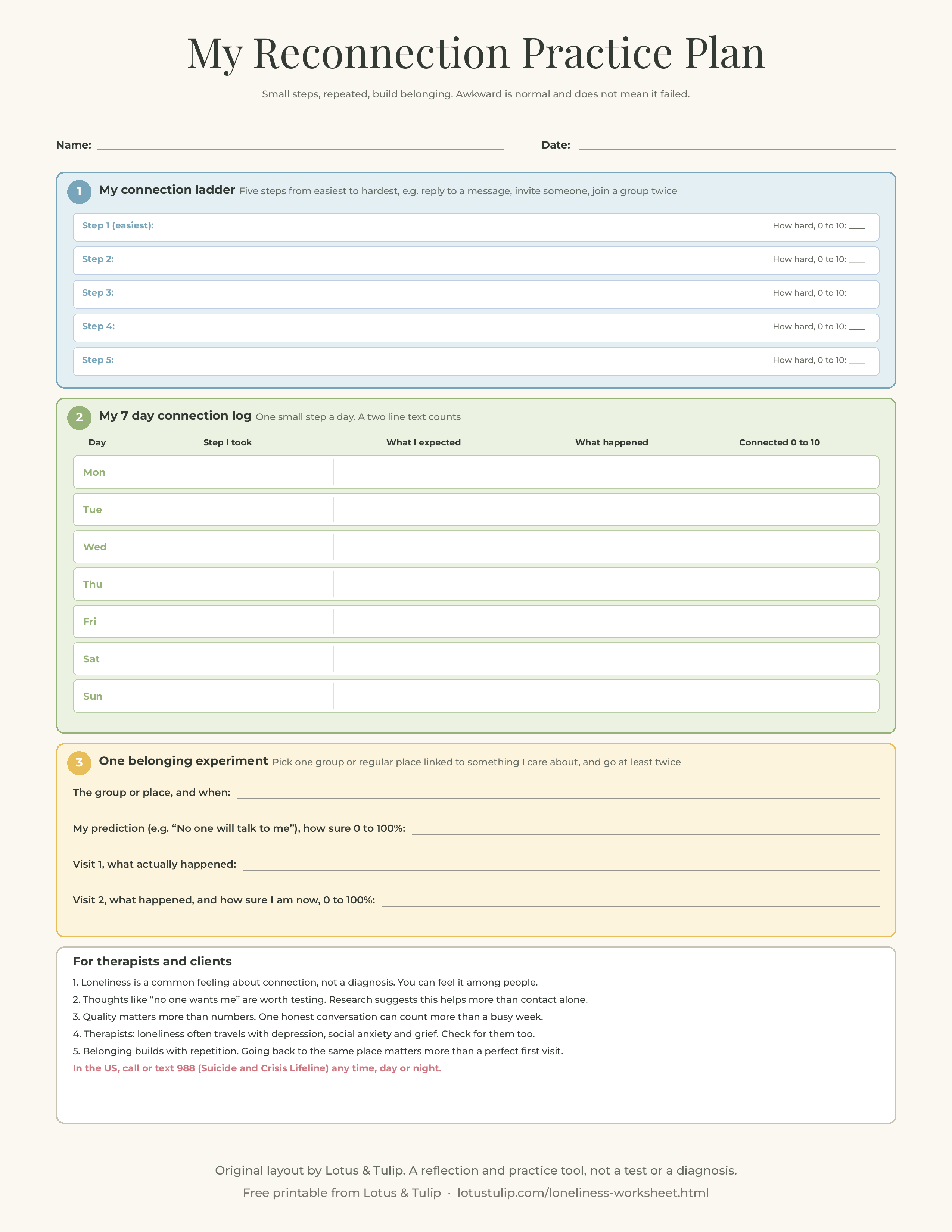
This guide is for adults and the therapists who work with them. It explains what loneliness is and is not, the different kinds, what the research does and does not show, nine practical steps, common mistakes and examples. It ends with a free 2 page printable: My Loneliness Map, which helps you see which kind of loneliness you feel, what triggers it, which thoughts keep it going and who is already in your life, and My Reconnection Practice Plan, with a ladder of small connection steps, a 7 day log and one belonging experiment.
Download the free loneliness worksheet (PDF, 2 pages, US Letter)
Direct download, no email or sign up. See the pages first.
What loneliness is, and what it is not
It is a feeling, not a head count. Researchers define loneliness as the distressing experience of perceived social isolation: your relationships feel fewer or less meaningful than you want them to be. Social isolation is the objective side, such as living alone or having little contact with others. The two overlap less than people expect. Someone can be isolated without feeling lonely, and someone with a busy social life can feel deeply lonely.
It is not a diagnosis. Loneliness is not a mental disorder in the DSM-5-TR, and feeling lonely does not mean something is wrong with you. Nearly everyone feels it at some point, especially after a move, a breakup, a loss, a new job, retirement or a change in health. It becomes a clinical concern when it is intense, lasts a long time, or travels with depression, social anxiety, grief or thoughts of suicide.
It is a signal. In their book Loneliness (2008), John Cacioppo and William Patrick describe loneliness as something like social hunger: a painful signal, shaped by evolution, that pushes us to repair and restore our bonds with others. Hunger is useful when it sends you to the kitchen. Loneliness is useful when it sends you toward people. The trouble starts when it does the opposite.
Different kinds of loneliness
Sociologist Robert Weiss (1973) drew a distinction that is still used today. Emotional loneliness is the absence of a close attachment figure, a person who really knows you, such as a partner or best friend. Social loneliness is the absence of a wider network of friends, neighbors or colleagues you belong with. One does not substitute for the other: a loving partner does not fully fill the lack of friends, and a crowd of friends does not fully fill the lack of an intimate confidant.
Later work by Louise Hawkley, Michael Browne and John Cacioppo (2005) found three related but separate dimensions in answers to the revised UCLA Loneliness Scale, in a sample of 2,531 young adults and a population based sample of 197 middle aged and older adults:
- Intimate: having or lacking someone who is a close confidant. In the second sample this was best predicted by marital status.
- Relational: having or lacking good friendships and family ties. This was best predicted by how often people saw friends and family.
- Collective: having or lacking a sense of belonging to a group beyond individuals, such as a team, congregation, club or community. This was best predicted by how many voluntary groups people belonged to.
Knowing which kind you feel matters, because the next step is different. Page 1 of the worksheet starts there.
Why loneliness keeps itself going
Hawkley and Cacioppo (2010) reviewed evidence that perceived isolation puts people on alert for social threat. Lonely people tend to notice rejection cues sooner, expect interactions to go badly and remember the negative parts of social events. Those expectations change behavior: a guarded tone, a shorter reply, a skipped invitation. Other people may respond with distance, which seems to confirm the original fear. The result is a loop that feels like protection in the moment and makes loneliness last longer.
Thoughts like "no one really wants me around", "everyone else already has their people" or "if I reach out, I will be a bother" are part of that loop. They are understandable, and sometimes they hold a grain of truth. They are still worth testing rather than obeying, which is what page 2 of the worksheet is for.
How researchers measure it
The best known measure is the UCLA Loneliness Scale. Version 3 (Russell, 1996) has 20 statements about how often you feel a certain way, each rated from 1 (never) to 4 (often), with some items reverse scored. In Russell's studies it showed high internal consistency and good one year test retest reliability. Short versions are used in large surveys.
Our free worksheet is not the UCLA scale and not a screening test. It uses our own wording to help you reflect, and it does not produce a score.
What the research shows
It is common in the US. The 2023 US Surgeon General's advisory, Our Epidemic of Loneliness and Isolation, reported that in recent years about one in two US adults reported experiencing loneliness, and that was before the COVID-19 pandemic. The advisory called on health workers to ask about social connection and laid out six pillars for a national strategy, from local social infrastructure to a culture of connection.
Social connection is linked with survival. Holt-Lunstad, Smith and Layton (2010) combined 148 studies with 308,849 participants and found a 50% greater likelihood of survival over the follow up period for people with stronger social relationships. A second meta-analysis by Holt-Lunstad and colleagues (2015), of 70 studies with about 3.4 million participants, found that after adjusting for other factors, loneliness was linked with a 26% greater likelihood of death, social isolation with 29% and living alone with 32%.
Read those numbers carefully. These are observational studies. They show that loneliness and isolation predict earlier death even when researchers adjust for health and other factors, but they cannot prove that loneliness causes it. Poor health can also cause isolation. Headlines comparing loneliness to smoking 15 cigarettes a day come from comparing effect sizes across studies, not from a direct test.
Changing thinking may help more than adding contact. Masi, Chen, Hawkley and Cacioppo (2011) did a meta-analysis of interventions to reduce loneliness. They grouped them into four kinds: improving social skills, enhancing social support, increasing opportunities for contact and addressing maladaptive social cognition, meaning the expectations and interpretations that keep the loop going. Among the randomized studies, interventions that addressed social cognition, all using some form of cognitive behavioral therapy or reframing, had larger effects than the other three. The authors noted that this rested on only four randomized studies of that type.
The honest caveat. There is no trial of this worksheet. The evidence on loneliness interventions is still uneven, many studies are small or focused on older adults, and effects in randomized studies are smaller than in uncontrolled ones. The steps below combine the two ingredients the research points to most: testing lonely thoughts and taking small, real steps toward people. They work best alongside a therapist, and they are not a substitute for treating depression, social anxiety or grief.
How to use a loneliness worksheet, step by step
- Name the feeling without shame. Start with the idea that loneliness is a common human signal, not a verdict on your worth. Saying "I am lonely right now" is often harder, and more useful, than saying "I am fine, just busy".
- Find your kind of loneliness. On page 1, rate how much you miss a close confidant (intimate), friends and family (relational) and a group to belong to (collective), each from 0 to 10. The highest rating points to where to start.
- Map your triggers. Tick the times and places it hits hardest, such as evenings, weekends, holidays, after scrolling or after seeing a group you are not part of. Patterns tell you when to plan support.
- Catch the lonely thoughts. Mark the thoughts that sound familiar, such as "no one would notice if I disappeared" or "people are just being polite". Note what each one makes you do, for example decline, wait or stay quiet.
- Take stock of who is already there. List current connections in three circles: close, friendly and familiar faces like a neighbor, barista or coworker. Many people find their map is not empty, just quiet.
- Build a small connection ladder. On page 2, write five steps from easy to harder, such as replying to a message, starting a short chat, sending an invitation, joining a group once and going back a second time. Rate how hard each feels from 0 to 10.
- Log one step a day for 7 days. For each day, note the step, what you expected, what happened and how connected you felt afterwards. Small counts: a two line text to an old friend is a real step.
- Run one belonging experiment. Pick one group or regular place connected to something you care about, write your prediction, such as "no one will talk to me", and how sure you are from 0 to 100%. Go at least twice, because belonging usually builds with repetition, then compare what happened with your prediction.
- Review and plan the next rung. At the end of the week, look at your log with your therapist or on your own. What surprised you? Which thought turned out weaker than it sounded? Choose the next step and keep going.
For more on testing predictions, see the behavioral experiment worksheet, and for planning small activities when mood is low, the behavioral activation worksheet.
Common mistakes
- Treating it as a numbers problem. Adding more contact helps some people, but research points to the quality of connection and the thoughts about it. One honest conversation can matter more than three crowded events.
- Waiting to feel ready. Loneliness makes reaching out feel risky, so the right moment rarely arrives. Small steps taken while uneasy are the point.
- Judging a step by one try. A first visit to a group is often awkward for everyone. Decide in advance to go at least twice before judging whether it fits.
- Missing depression, social anxiety or grief. Loneliness often travels with these. If low mood, panic in social situations, recent loss or hopelessness are present, address them directly with appropriate care.
- Letting it become one more thing to fail. A missed day or an unanswered text is not proof that no one cares. Rough notes are fine, and the plan can be adjusted.
Examples
- The recent mover: Rated relational loneliness 8 out of 10 after relocating for work. Triggers: weekends and Sunday evenings. Thought: "everyone here already has their friends". Ladder: chat with a coworker at lunch, then join a weekly running group. Prediction for the group: "no one will talk to me", 75% sure. After two visits, two people knew her name, and sureness fell to 30%.
- The new retiree: Felt collective loneliness most, missing the sense of being part of a team. His connection map showed a neighbor and two former colleagues he had not called. He volunteered weekly at a food bank and set a monthly lunch with one former colleague. Linked page: the ACT values worksheet for choosing groups that fit what matters to him.
- The partnered parent: Had a partner and children but rated intimate loneliness high, because conversations were only about logistics. Thought: "if I say I am lonely, it will sound like a complaint". Step: told her partner one feeling a day for a week. Worked on the thought "they do not really care" with the cognitive distortions worksheet.
Free loneliness worksheet
This free printable is an original Lotus & Tulip layout on US Letter, in our own wording. Page 1, My Loneliness Map, has 0 to 10 ratings for intimate, relational and collective loneliness, a checklist of triggers, a table of lonely thoughts and what they make you do, and a three circle inventory of the connections you already have. Page 2, My Reconnection Practice Plan, has a five step connection ladder, a 7 day log, one belonging experiment with before and after ratings, and notes for therapists and clients, including the US 988 crisis line.
Download the free loneliness worksheet (PDF, 2 pages, US Letter)
Prefer single images? Page 1: my loneliness map (PNG) · Page 2: my reconnection practice plan (PNG)
Free to print for use with your own clients or for yourself. Please link to this page rather than re-uploading the file. A reflection tool, not a test, a diagnosis or a substitute for therapy. In the US, call or text 988 in a crisis.
Related resources
- How to make friends as an adult: where adult friendships start, how many hours they take, and a free friendship map and plan
- Conversation skills worksheet: starting, following up and wrapping up conversations, with a free practice plan
- Behavioral activation worksheet: small planned activities when mood is low
- Behavioral experiment worksheet: testing predictions in real life
- Attachment styles worksheet: patterns in close relationships
- Grief worksheets for adults: when loneliness follows a loss
- Self compassion worksheet: a kinder way to meet painful feelings
- All therapist worksheets: CBT, DBT, ACT and more
FAQ
What is loneliness?
Loneliness is the distressing feeling that your relationships are fewer or less meaningful than you want them to be. It is about perceived connection, so you can feel lonely among people and feel fine alone.
Is loneliness a mental health diagnosis?
No. Loneliness is not a disorder in the DSM-5-TR. It is a common human experience, but when it is intense or long lasting, or comes with depression, social anxiety or grief, it is worth bringing to a therapist or doctor.
What is the difference between social and emotional loneliness?
Robert Weiss (1973) described emotional loneliness as missing a close attachment figure, such as a partner or best friend, and social loneliness as missing a wider network of friends or community. Later research added collective loneliness, missing a sense of belonging to a group.
How common is loneliness in the US?
The 2023 US Surgeon General's advisory reported that in recent years about one in two US adults reported experiencing loneliness, even before the COVID-19 pandemic.
What actually helps with loneliness?
A 2011 meta-analysis found that, in randomized studies, interventions that addressed lonely thoughts and expectations, mostly with cognitive behavioral methods, had larger effects than those that only added social contact or support. Practical steps include naming your kind of loneliness, testing lonely thoughts and taking small repeated steps toward people and groups.
Is this loneliness worksheet free?
Yes. It is free to print for use with your own clients or for yourself. Please link to this page rather than re-uploading the file.
Sources
- Cacioppo, J. T., and Patrick, W. (2008). Loneliness: Human Nature and the Need for Social Connection. W. W. Norton.
- Hawkley, L. C., Browne, M. W., and Cacioppo, J. T. (2005). How can I connect with thee? Let me count the ways. Psychological Science, 16(10), 798 to 804.
- Hawkley, L. C., and Cacioppo, J. T. (2010). Loneliness matters: A theoretical and empirical review of consequences and mechanisms. Annals of Behavioral Medicine, 40(2), 218 to 227.
- Holt-Lunstad, J., Smith, T. B., and Layton, J. B. (2010). Social relationships and mortality risk: A meta-analytic review. PLoS Medicine, 7(7), e1000316.
- Holt-Lunstad, J., Smith, T. B., Baker, M., Harris, T., and Stephenson, D. (2015). Loneliness and social isolation as risk factors for mortality: A meta-analytic review. Perspectives on Psychological Science, 10(2), 227 to 237.
- Masi, C. M., Chen, H. Y., Hawkley, L. C., and Cacioppo, J. T. (2011). A meta-analysis of interventions to reduce loneliness. Personality and Social Psychology Review, 15(3), 219 to 266.
- Office of the US Surgeon General (2023). Our Epidemic of Loneliness and Isolation: The US Surgeon General's Advisory on the Healing Effects of Social Connection and Community. US Department of Health and Human Services.
- Russell, D. W. (1996). UCLA Loneliness Scale (Version 3): Reliability, validity, and factor structure. Journal of Personality Assessment, 66(1), 20 to 40.
- Weiss, R. S. (1973). Loneliness: The Experience of Emotional and Social Isolation. MIT Press.