
Therapist worksheets · Procrastination, avoidance and CBT · Updated 2026-11-13
Procrastination worksheet for adults: why we put things off, what the research shows, and how to get started step by step (free printable)
Thoughts and avoidance behind the delay: CBT Worksheets for Therapists, 20 pages including thought records, core beliefs and an exposure ladder Holiday 20% off: about $11.04, was $14 (EUR 12) · fillable PDF, instant digital download
Buy on EtsyTry it free first: download a fillable sample (thought record and evidence for and against, PDF, 105 KB). Type into it on screen, then get the full pack. No email needed.
When it comes with low mood: Depression and Behavioral Activation Worksheets for Therapists Holiday 20% off: about $9.20, was $12 (EUR 10) · instant digital download
Buy on EtsyA full caseload: Therapist Worksheets Mega Bundle (8 packs incl. CBT, anxiety, DBT, ACT, grief and ADHD) Holiday 20% off: about $35.88, was $45 (EUR 39) · fillable PDFs for all 8 packs plus 160 printable pages, instant digital download
Buy on EtsyThe form has been on the kitchen counter for three weeks. Every time you see it, your stomach drops a little, so you look away and do something else. The something else feels better for a few minutes, and the form stays where it is. Later the deadline gets closer, the dread gets bigger and the task feels even harder to touch. Most people know this loop well, and most people call it laziness. The research says it is something else.
This guide is for adults and the therapists who work with them. It explains what procrastination is and is not, why it happens, what the treatment research does and does not show, nine practical steps, common mistakes and examples. It ends with a free 2 page printable: My Procrastination Map, which helps you see what you are putting off, the feeling behind it and the loop that keeps it going, and My Get Started Plan, with tiny first steps, if-then plans, a start log that compares dread before with how you feel after, and a line for forgiving yourself and restarting.
Download the free procrastination worksheet (PDF, 2 pages, US Letter)
Direct download, no email or sign up. See the pages first.
What procrastination is, and what it is not
It is not planned delay. Putting a task off because something else matters more, or because you are waiting for information you need, is good planning. Piers Steel (2007), in the best known review of the research, describes procrastination as voluntarily delaying an intended course of action despite expecting to be worse off for the delay. The key words are intended and worse off: you mean to do it, you know waiting will cost you, and you wait anyway.
It is not laziness. People who procrastinate are often busy all day. They answer email, tidy, run errands and help others, just not with the one task that feels bad. The problem is not a lack of effort but where the effort goes.
It is not a diagnosis. Procrastination is a behavior pattern, not a disorder in the DSM-5-TR. It can travel with depression, anxiety, ADHD and perfectionism, and chronic, severe delay is worth bringing to a therapist or doctor, but procrastinating does not mean you have any of these. This worksheet is a reflection and practice tool, not a test.
How common is it?
Very. Steel's review summarized estimates that 80% to 95% of college students procrastinate, that almost half do so consistently and problematically, and that around 15% to 20% of adults in the general population procrastinate chronically. These figures come from older self-report surveys, so treat them as rough, but they make one point clearly: if you procrastinate, you are in large company.
Why we put things off
What predicts it. Steel's meta-analysis pooled 691 correlations. The strongest and most consistent predictors were features of the task, namely how unpleasant it feels (task aversiveness) and how far away the reward or deadline is, along with low confidence in being able to do it (self-efficacy), impulsiveness and lower conscientiousness, including being easily distracted and less organized. Steel described this with temporal motivation theory: we are less motivated by tasks that feel bad, whose payoff is uncertain and whose reward is far away, and more pulled by whatever is pleasant right now.
It is about mood. Fuschia Sirois and Timothy Pychyl (2013) argued that procrastination is best understood as putting short-term mood repair ahead of long-term goals. The task brings up boredom, anxiety, confusion, frustration or self-doubt. Avoiding it brings instant relief. That relief is the reward that teaches us to avoid again next time, while the cost lands on our future self. Page 1 of the worksheet maps this loop.
The link with perfectionism is specific. A meta-analysis by Sirois, Molnar and Hirsch (2017) found that procrastination was positively related to perfectionistic concerns, such as fear of mistakes and doubts about one's work (r = .23), and negatively related to perfectionistic strivings, meaning high personal standards (r = -.22). In other words, it is the fear of falling short, not high standards, that goes with putting things off. If that sounds familiar, the perfectionism worksheet for adults goes deeper.
What it costs
An early study by Dianne Tice and Roy Baumeister (1997) followed college students across a semester. Procrastinators reported less stress early in the term, when the work was still far off, but more stress and illness toward the end, and they earned lower grades. A larger cohort study by Johansson and colleagues (2023) followed 3,525 Swedish university students. Higher procrastination was associated with slightly worse depression, anxiety and stress symptoms nine months later, and with higher risk of poor sleep, physical inactivity, loneliness, economic difficulties and disabling pain in the arms, after controlling for many other factors. The associations were small and the study was observational, so it cannot prove that procrastination caused these outcomes, but the direction fits what many people feel: the relief is short and the costs build.
What the treatment research shows
People can change. Wendelien van Eerde and Katrin Klingsieck (2018) pooled 24 intervention studies with 1,173 participants. Procrastination dropped substantially after interventions, the gains held at follow up, and cognitive behavioral therapy reduced procrastination more than the other types of intervention they compared (self-regulation training, other therapeutic approaches and strengths based approaches). The duration of the intervention did not change the result.
Self-help CBT can work. In a randomized trial, Alexander Rozental and colleagues (2015) assigned 150 adults to guided internet CBT, unguided internet CBT or a waiting list. Both treatments reduced procrastination more than waiting, with moderate effects (for example d = 0.70 guided and d = 0.50 unguided on the Pure Procrastination Scale), and the guided and unguided versions did not differ significantly. About a third of participants reached clinically significant change. A one year follow up found the gains were maintained.
If-then plans help people start. Peter Gollwitzer and Paschal Sheeran (2006) pooled 94 tests of implementation intentions, plans in the form "if situation X, then I will do Y", and found a medium to large effect on reaching goals (d = 0.65). This research covers goals in general, not procrastination alone, but it is why page 2 asks you to tie your first step to a specific time and place.
Forgiving yourself can help. Michael Wohl, Timothy Pychyl and Shannon Bennett (2010) surveyed 119 first year students before two midterm exams. Students who had procrastinated a lot on studying for the first exam, and who forgave themselves for it, procrastinated less before the second, and the link ran through less negative feeling. It was a small correlational study, not a trial, but it matches the mood repair account: guilt makes the task feel worse, so it is easier to go back once the guilt eases.
The honest caveats. Most studies are small, many samples are students and many rely on self-report. There is no trial of this worksheet. It borrows the common ingredients of CBT approaches to procrastination: understanding the loop, breaking tasks down, planning when and where to start, handling distraction and responding to slips with less self-blame.
How to use a procrastination worksheet, step by step
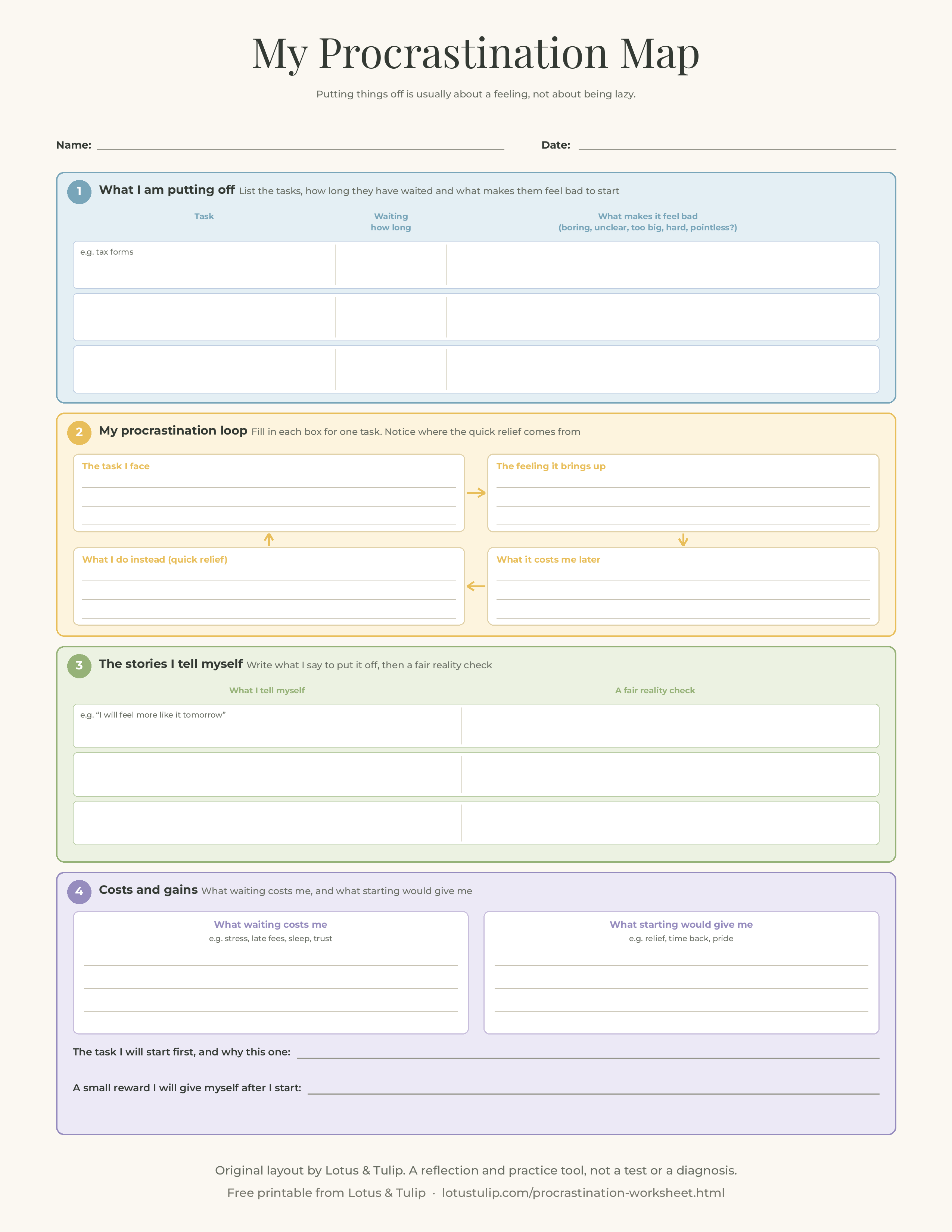
- List what you are putting off. On page 1, write up to three tasks you have been delaying and how long each has waited. Be specific: "call the insurance company about the claim", not "life admin".
- Name what makes each task feel bad. Is it boring, unclear, too big, hard, pointless to you or a reminder of something painful? Naming the feeling turns a vague dread into a problem you can work on.
- Map the loop. For one task, fill in the four boxes: the task, the feeling it brings up, what you do instead for quick relief and what that costs you later. Most people notice the relief lasts minutes and the cost lasts days.
- Catch your stories. Write what you tell yourself to put it off, such as "I will feel more like it tomorrow" or "I work better under pressure", and next to it a fair reality check based on what usually happens.
- Weigh costs and gains. List what waiting costs you and what starting would give you, then choose the one task you will start first.
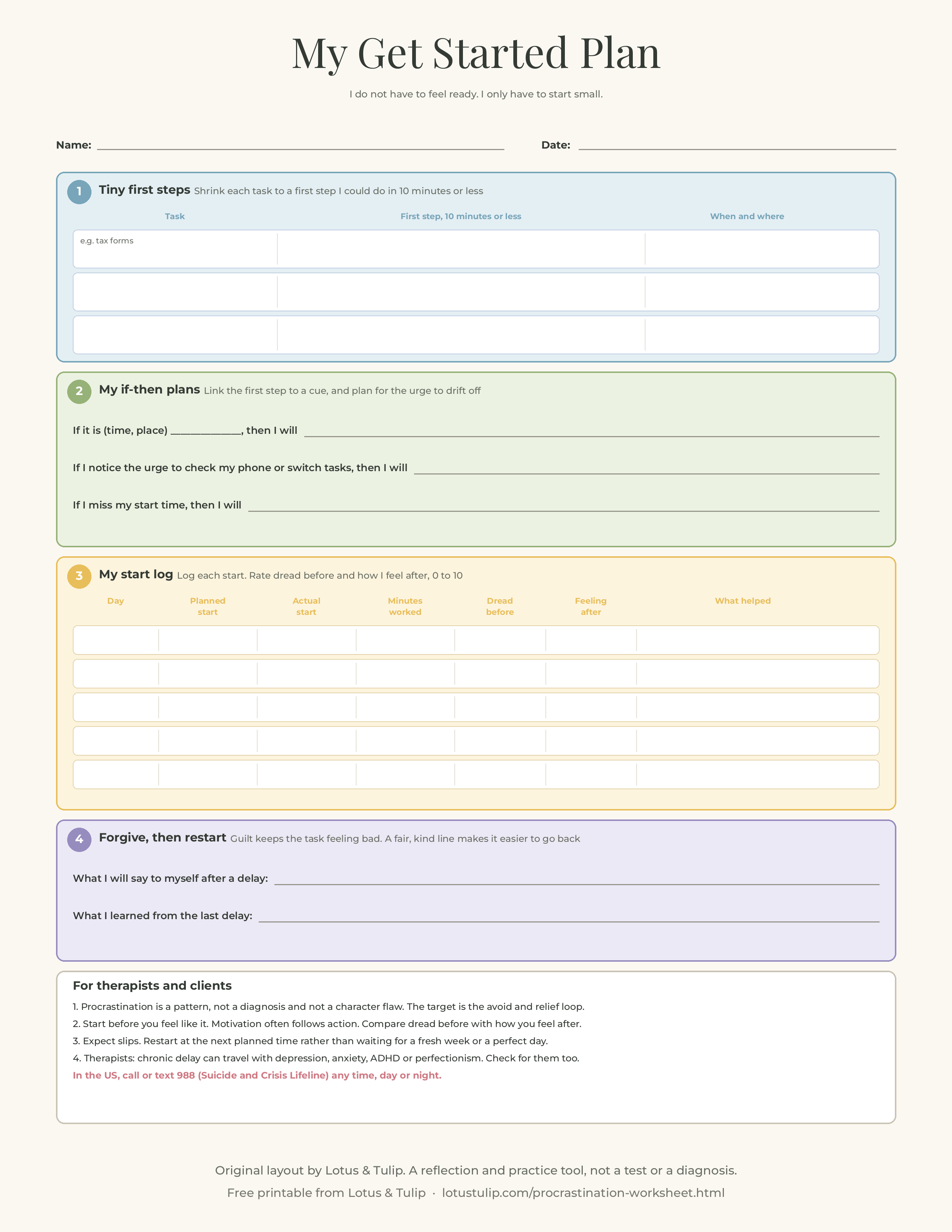
- Shrink it to a 10 minute first step. On page 2, write a first step so small it feels almost silly: open the folder, write the subject line, find the phone number. The goal is to start, not to finish.
- Write if-then plans. Tie the first step to a time and place ("If it is 9:00 on Saturday at the kitchen table, then I will open the tax folder") and plan for the moments that usually derail you, such as the urge to check your phone or a missed start time.
- Start before you feel ready, and log it. Each time you start, write the planned and actual start, how many minutes you worked and your dread before and feeling after, from 0 to 10. Over a week, most people see that the dread before is higher than the discomfort during.
- Forgive the delay and restart. When you slip, write a fair and kind line to yourself and one thing you learned, then restart at the next planned time. The self compassion worksheet has more practice for this.
When putting things off comes with low energy and withdrawal, the behavioral activation worksheet uses the same start small logic for mood, and the cognitive distortions worksheet helps with all-or-nothing thinking about tasks.
Common mistakes
- Waiting to feel motivated. Motivation often follows action rather than coming first. Plan to start while still feeling reluctant.
- First steps that are too big. "Write the report" is a project, not a step. If you still avoid the first step, make it smaller.
- Harsh self-talk. Calling yourself lazy feels like accountability but adds guilt, and guilt makes the task feel worse. Aim for fair, not soft.
- Productive procrastination. Cleaning the whole kitchen instead of making one phone call is still avoidance. Notice when useful tasks are standing in for the one that matters.
- Missing what travels with it. If delay comes with persistent low mood, worry, attention problems that go back to childhood, or hopelessness, address those directly with appropriate care. A worksheet is not enough on its own.
Examples
- The freelancer: Had put off sending invoices for six weeks. Feeling: anxiety about chasing money and seeming pushy. Story: "I will do them all on Friday." Reality check: Friday had come and gone five times. First step: open the invoice template and fill in one client's name, 10 minutes. If-then plan: "If it is 8:30 on Monday at my desk, then I will send one invoice before opening email." Start log: dread before 8, after 3.
- The parent: Avoided booking a medical checkup for over a year. The loop showed the task felt unclear (which doctor, which insurance) more than scary. First step: find the insurance card and write down the member services number. Coach line after missing the first planned time: "It has waited a year; one missed evening does not matter. Tomorrow at lunch."
- The graduate student: Put off a literature review because every start felt like it had to be good. The stories column was full of "it is not ready yet". She noticed the overlap with perfectionistic concerns, used the perfectionism worksheet for a good enough standard and set a first step of reading one abstract and writing two rough sentences.
Free procrastination worksheet for adults
This free printable is an original Lotus & Tulip layout on US Letter, in our own wording. Page 1, My Procrastination Map, has a table for the tasks you are putting off and what makes them feel bad, a four box map of the avoid and relief loop, a table for the stories you tell yourself with a fair reality check, and a costs and gains section with the task you will start first. Page 2, My Get Started Plan, has tiny first steps with when and where, three if-then plans, a start log with dread before and feeling after from 0 to 10, a forgive and restart section and short notes for therapists and clients.
Download the free procrastination worksheet (PDF, 2 pages, US Letter)
Prefer single images? Page 1: my procrastination map (PNG) · Page 2: my get started plan (PNG)
Free to print for use with your own clients or for yourself. Please link to this page rather than re-uploading the file. A reflection tool, not a test, a diagnosis or a substitute for therapy. In the US, call or text 988 in a crisis.
Related resources
- Habit tracker worksheet for adults: make the first step a tiny daily habit tied to a cue
- Goal setting worksheet for adults: a clear goal, the real obstacle and if-then plans for the moments you stall
- Perfectionism worksheet for adults: when the fear of falling short keeps you from starting
- Behavioral activation worksheet: small steps when low mood drains motivation
- Self compassion worksheet: a kinder response after a slip
- Cognitive distortions worksheet: all-or-nothing thinking and shoulds
- ADHD worksheets: when distraction and time blindness are part of the picture
- Time management worksheet for adults: plan a realistic week with focus blocks and buffers
- Time management activities for teens: the school counselor version
- All therapist worksheets: CBT, DBT, ACT and more
FAQ
What is a procrastination worksheet?
A procrastination worksheet is a structured page that helps you see what you are putting off, the feeling that makes the task hard to start and the loop that keeps the delay going, and then plan small first steps, if-then plans and a way to restart after a slip. Therapists use them in CBT for procrastination, and adults can use them on their own.
Is procrastination a mental health diagnosis?
No. Procrastination is a behavior pattern, not a disorder in the DSM-5-TR. It can go along with depression, anxiety, ADHD or perfectionism, so if it causes real distress or keeps getting worse, it is worth raising with a therapist or doctor.
Why do I procrastinate even when I want to do the task?
Research suggests procrastination is mainly about managing feelings in the moment. A task that feels boring, unclear, too big or threatening brings up discomfort, and avoiding it brings quick relief. That relief makes avoiding more likely next time, even though the costs come later.
Does CBT work for procrastination?
A meta-analysis of 24 intervention studies found that procrastination dropped after interventions and stayed lower at follow up, with CBT showing the largest reductions. A randomized trial of internet CBT found moderate improvements with and without therapist guidance, maintained after one year. Most studies are small, so more research is needed.
Is this procrastination worksheet free?
Yes. It is free to print for use with your own clients or for yourself. Please link to this page rather than re-uploading the file.
Sources
- Gollwitzer, P. M., and Sheeran, P. (2006). Implementation intentions and goal achievement: A meta-analysis of effects and processes. Advances in Experimental Social Psychology, 38, 69 to 119.
- Johansson, F., Rozental, A., Edlund, K., Côté, P., Sundberg, T., Onell, C., Rudman, A., and Skillgate, E. (2023). Associations between procrastination and subsequent health outcomes among university students in Sweden. JAMA Network Open, 6(1), e2249346.
- Rozental, A., Forsell, E., Svensson, A., Andersson, G., and Carlbring, P. (2015). Internet-based cognitive behavior therapy for procrastination: A randomized controlled trial. Journal of Consulting and Clinical Psychology, 83(4), 808 to 824.
- Rozental, A., Forsell, E., Svensson, A., Andersson, G., and Carlbring, P. (2017). Overcoming procrastination: One-year follow-up and predictors of change in a randomized controlled trial of Internet-based cognitive behavior therapy. Cognitive Behaviour Therapy, 46(3), 177 to 195.
- Sirois, F., and Pychyl, T. (2013). Procrastination and the priority of short-term mood regulation: Consequences for future self. Social and Personality Psychology Compass, 7(2), 115 to 127.
- Sirois, F. M., Molnar, D. S., and Hirsch, J. K. (2017). A meta-analytic and conceptual update on the associations between procrastination and multidimensional perfectionism. European Journal of Personality, 31(2), 137 to 159.
- Steel, P. (2007). The nature of procrastination: A meta-analytic and theoretical review of quintessential self-regulatory failure. Psychological Bulletin, 133(1), 65 to 94.
- Tice, D. M., and Baumeister, R. F. (1997). Longitudinal study of procrastination, performance, stress, and health: The costs and benefits of dawdling. Psychological Science, 8(6), 454 to 458.
- van Eerde, W., and Klingsieck, K. B. (2018). Overcoming procrastination? A meta-analysis of intervention studies. Educational Research Review, 25, 73 to 85.
- Wohl, M. J. A., Pychyl, T. A., and Bennett, S. H. (2010). I forgive myself, now I can study: How self-forgiveness for procrastinating can reduce future procrastination. Personality and Individual Differences, 48(7), 803 to 808.