
Therapist worksheets · Body image · Updated 2026-11-14
Body image worksheet for adults: what research shows helps, body checking, and a step by step plan (free printable)
For the harsh thoughts about your body: CBT Worksheets for Therapists, 20 pages including thought records and core beliefs Holiday 20% off: about $11.04, was $14 (EUR 12) · fillable PDF, instant digital download
Buy on EtsyTry it free first: download a fillable sample (thought record and evidence for and against, PDF, 105 KB). Type into it on screen, then get the full pack. No email needed.
Values, defusion and living fully in your body: ACT Worksheets for Therapists, incl. values, defusion and committed action pages Holiday 20% off: about $9.20, was $12 (EUR 10) · fillable PDF, instant digital download
Buy on EtsyTry it free first: download a fillable sample (values compass and unhooking from thoughts, PDF, 259 KB). Type into it on screen, then get the full pack. No email needed.
A full caseload: Therapist Worksheets Mega Bundle (8 packs incl. DBT, CBT, ACT, anxiety, grief and ADHD) Holiday 20% off: about $35.88, was $45 (EUR 39) · fillable PDFs for all 8 packs plus 160 printable pages, instant digital download
Buy on EtsyYou catch your reflection in a shop window and the rest of the afternoon is colored by it. Someone tags you in a group photo and you untag it before anyone notices. You change outfits three times, skip the pool party, and check the same part of your body in every mirror you pass. None of it makes you feel better for long.
This guide is for adults who want a calmer, fairer relationship with their body, and for the therapists, counselors and coaches who help them. It explains what body image is, what research shows about what keeps a negative body image going and what helps, nine practical steps, common mistakes and three short examples. It ends with a free 2 page printable: My Body Image Map, for seeing when the bad body days happen and what you do about them, and My Body Image Plan, for building a kinder, more accurate view and cutting back the habits that keep it stuck.
Download the free body image worksheet (PDF, 2 pages, US Letter)
Direct download, no email or sign up. See the pages first.
What body image is (and is not)
Body image is how you see, think about and feel about your body, and what you do because of those thoughts and feelings. It is not the same as how your body actually looks. Two people with very similar bodies can feel completely differently about them, and the same person can feel fine on Tuesday and awful on Friday without anything about their body changing.
A useful way to think about it has three parts:
- Thoughts: what your mind says about your body ("my arms are disgusting," "everyone is looking at my stomach").
- Feelings: shame, disgust, anxiety, sadness or frustration when you see or think about your body.
- Behaviors: checking (mirrors, pinching, weighing, comparing) and avoiding (photos, mirrors, swimming, certain clothes, intimacy, events).
The worksheet works on all three, because changing only the thoughts rarely holds if the checking and avoiding carry on.
What the research says
- Body image can improve, but expect steady work, not a quick fix. Alleva and colleagues (2015) pooled 62 tests of stand-alone body image interventions from 43 randomized controlled studies, with 3,846 participants. On average the interventions produced a small to medium improvement in body image (d = 0.38). Once the authors corrected for bias in the studies the effect was still reliable but small. They identified twelve change techniques linked to improvement and three that were linked to worse results, which is a good reason to use structured, tested approaches rather than random tips.
- Focusing on what your body does helps. In the Expand Your Horizon trial (Alleva, Martijn, Van Breukelen, Jansen and Karos, 2015), 81 women aged 18 to 30 with a negative body image were randomly assigned to three short writing exercises about their body's functionality (senses and physical abilities, health and creative pursuits, self care and communicating with others) or to an active control. The functionality group ended up more satisfied with both their appearance and their body's functionality, with more body appreciation and less self objectification, and the gains held at a one week follow up. The plan page opens with this exercise.
- Checking and avoiding keep the problem going. Shafran, Fairburn, Robinson and Lask (2004) interviewed 64 women in treatment for eating disorders: 92% repeatedly checked their bodies to assess shape or weight, and checking was linked to more eating disorder symptoms. In a second study with 110 women, the clinical group showed much more checking and avoidance than women without an eating disorder. The authors describe both habits as direct expressions of placing too much weight on shape and weight. You do not need an eating disorder for the same loop to apply in a milder form.
- Scrolling invites comparison. Fardouly, Diedrichs, Vartanian and Halliwell (2015) randomly assigned 112 young women to browse their own Facebook account, a fashion magazine website or a neutral website for 10 minutes. The Facebook group came away in a more negative mood than the neutral group, and women who tend to compare their appearance with others reported wanting to change more about their face, hair and skin after Facebook. That is why the plan page has a comparison box.
- Positive body image is more than the absence of hating your body. Tylka and Wood-Barcalow's 2015 review describes positive body image as distinct from negative body image and made up of several parts: appreciating your body, accepting it even with features you would not choose, a broad idea of beauty, caring for your appearance without letting it define you, and filtering messages in a way that protects you. It does not require loving every feature.
- Mirror exposure is a therapist led tool. Griffen, Naumann and Hildebrandt's 2018 review concludes that mirror exposure, guided practice looking at the whole body in a mirror while describing it neutrally, improves body satisfaction in trials, including for people with eating disorders. It also notes that most trials were small or uncontrolled, included few men, and that adverse events were reported. Try it with a clinician rather than alone if mirrors are very distressing for you.
How to use a body image worksheet, step by step
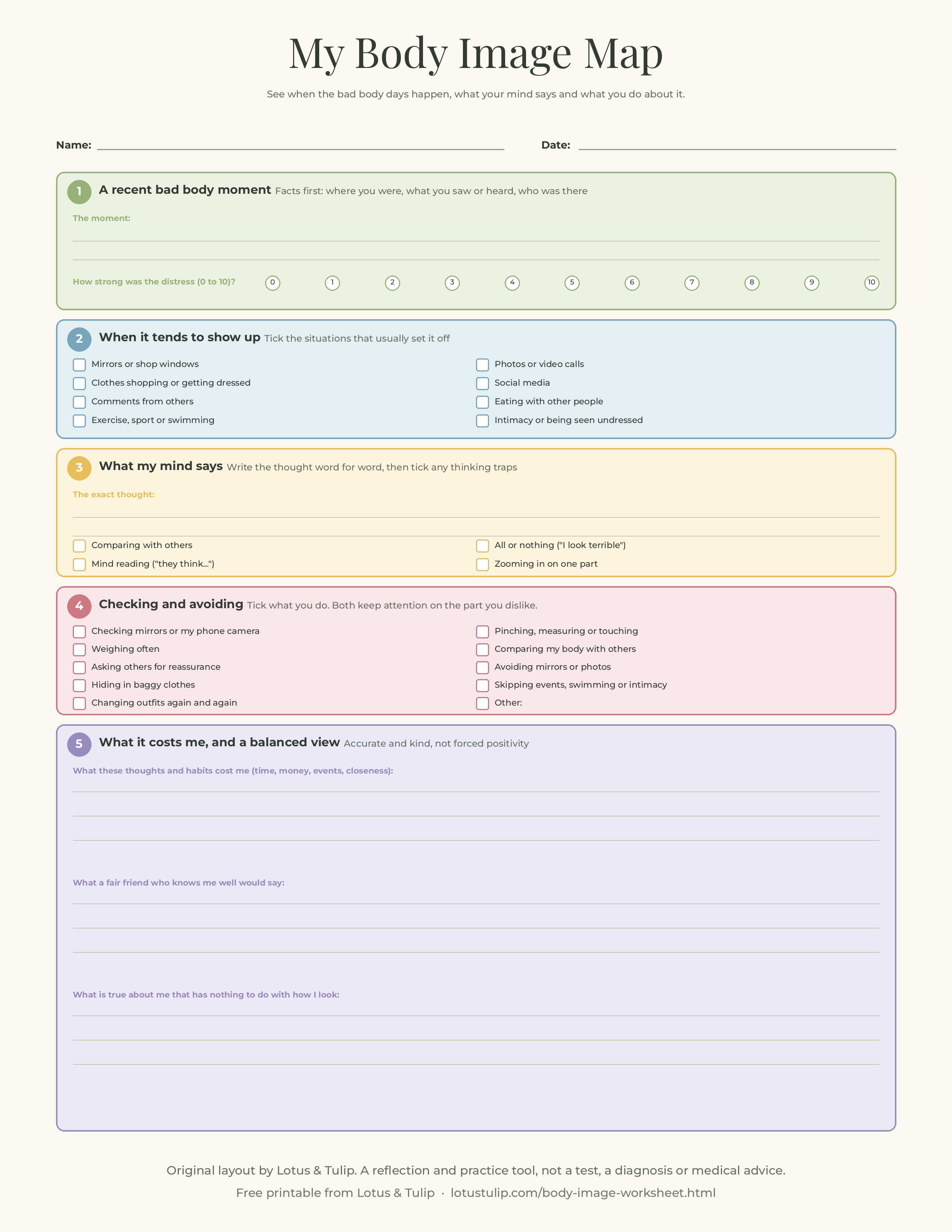
- Pick one recent bad body moment. On page 1, write a specific moment from the last few days: where you were, what you saw or heard, and who was there. Specific beats general. "Trying on jeans in the fitting room on Saturday" gives you more to work with than "I hate my body."
- Tick when it tends to show up and rate it. Tick the situations that usually set it off (mirrors, photos, clothes shopping, social media, comments from others, eating with people, exercise, intimacy) and rate how strong the distress was from 0 to 10. Patterns appear after two or three moments.
- Write what your mind said, word for word. Copy the exact thoughts, however harsh. Then tick any thinking traps you notice: comparing with others, all or nothing ("I look terrible"), mind reading ("they think I have let myself go"), zooming in on one part and ignoring the rest. Seeing the thought as a sentence on paper puts a little distance between you and it.
- Spot the checking and the avoiding. Tick what you do: checking mirrors, pinching or measuring, weighing often, comparing your body with others, asking for reassurance, avoiding photos or mirrors, hiding in baggy clothes, skipping swimming, events or intimacy. Most people are surprised by how much time this takes.
- Count the cost. Write what these habits and thoughts cost you: time, money, missed events, closeness, mood, focus at work. This is your reason to try something different when it feels uncomfortable.
- Write a balanced view. In the last box on page 1, write what a fair friend who knows you well would say about the thought, and what is true about you that has nothing to do with appearance. The goal is accurate and kind, not forced positivity.
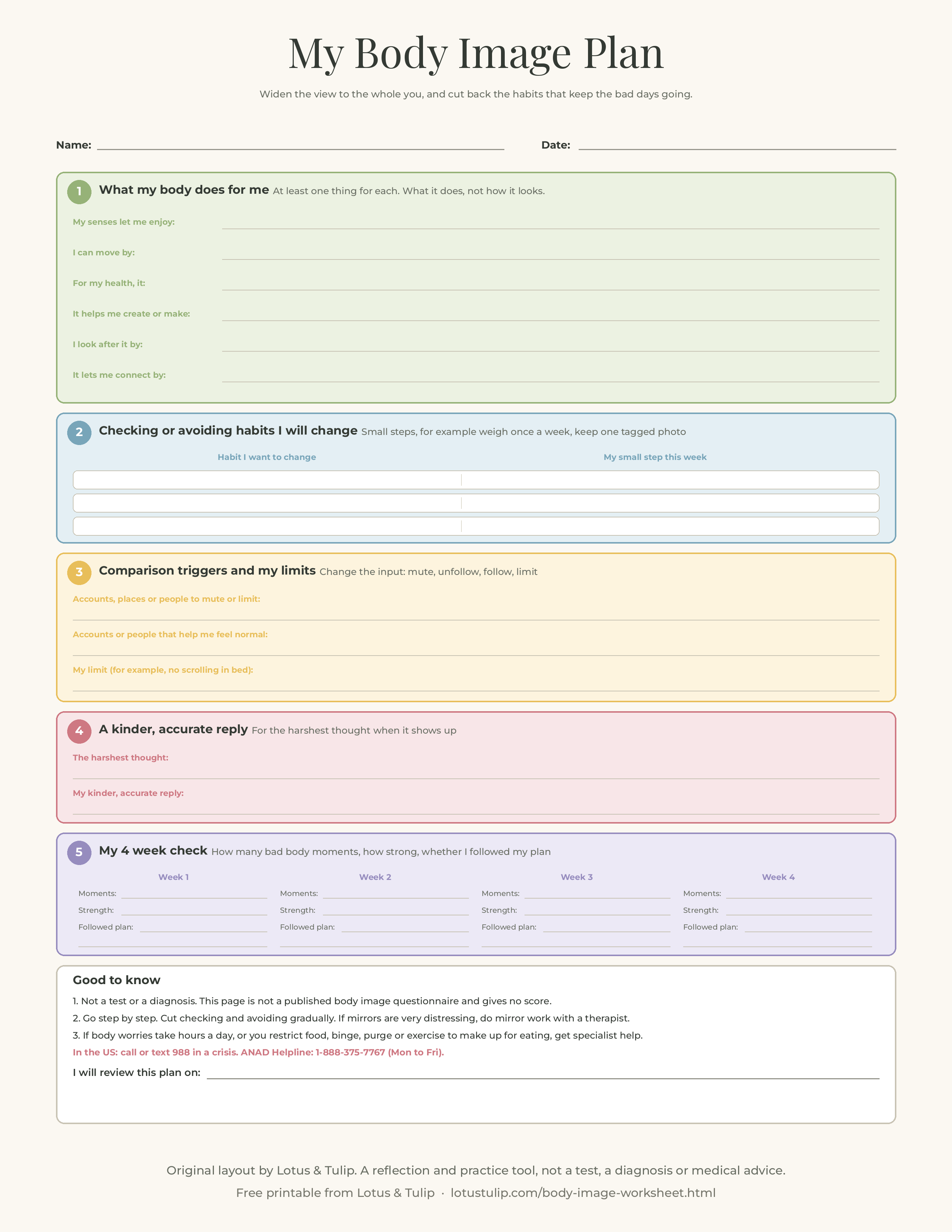
- List what your body does for you. On page 2, write at least one thing for each area: what your senses let you enjoy, how you move, what your body does for your health, what you create or make, how you look after yourself, and how you connect with people. This is the functionality exercise from the research above.
- Pick one checking or avoiding habit to change this week. In the table, write the habit and a small step: weigh once a week instead of daily, walk past one mirror without stopping, keep one tagged photo, wear the shorts to the barbecue. Then fill in the comparison box: accounts to mute, accounts that help, and a realistic limit. Add one harsh thought and a kinder, accurate reply you will use when it shows up.
- Review after four weeks. Fill in the 4 week check: how many bad body moments, how strong, and how often you followed your plan. Fewer checks and more things you did instead of avoiding are real progress even if the thoughts still visit. If body worries take up hours a day, or come with restricting food, bingeing, purging or exercising to compensate, get specialist help (see the end of this guide). In the US, call or text 988 in a mental health crisis.
Common mistakes
- Waiting to like your body before living fully. Postponing the beach, the photos or the dating app "until I lose the weight" keeps avoidance in charge. Doing the thing first is often what changes the feeling.
- Checking for reassurance. One more look in the mirror or one more weigh in feels like it will settle the worry. It usually brings a brief relief and then more doubt, and keeps your attention on the part you dislike.
- Swapping criticism for forced affirmations. Telling yourself "I love my body" when you do not believe it can backfire. An accurate, neutral or kind statement ("this is my body today, and it carried me through a long shift") is easier to believe.
- Zooming in on one feature. Staring closely at one area makes it look bigger and worse. Describing your whole body neutrally is more accurate.
- Feeding the comparison. Following accounts that make you feel worse and scrolling them at night keeps the comparison running. Change the input.
- Treating it as vanity. Body image distress is common and can be serious. It deserves care, not dismissal, and therapists should screen for eating disorders and body dysmorphic disorder rather than assume it is minor.
Examples
- The wedding photos: After her cousin's wedding, she untagged every photo and avoided the family chat. On page 1 she wrote the moment (seeing a side view photo), the thought ("I looked huge next to everyone"), and ticked comparing, zooming in and avoiding photos. The cost box said it all: she had no pictures of herself with her grandmother. On page 2 she listed what her body did that day (danced for two hours, hugged everyone, carried her niece) and set a small step: keep one tagged photo each week. By week four she had sent two photos to her grandmother.
- The gym mirror: He checked his chest and arms in every mirror at the gym and on his phone camera several times a day, and still felt small. The map showed checking dozens of times a day and skipping the beach with friends. With his therapist he set a limit (mirror only for form during lifts, no phone checks) and listed what his body does beyond how it looks. The checks dropped over four weeks, and his therapist screened for body dysmorphic disorder because the time spent was so high.
- The therapist and the new parent: A client a year after giving birth said she avoided intimacy and scrolled before and after photos at night. Her therapist used page 1 to name the thoughts and the comparison trigger, then the comparison box to mute those accounts and follow parents with ordinary bodies. The functionality list (her body grew and fed a baby, walks the stroller up the hill every day) became the reply she used for the harshest thought. At the 4 week check the nightly scrolling had stopped and they moved on to talking with her partner.
Free printable: body image worksheet for adults
This free printable is an original Lotus & Tulip layout on US Letter, in our own wording. It is not a published body image questionnaire, and it does not give a score. Page 1, My Body Image Map, covers a recent bad body moment and how strong it was, when it tends to show up, what your mind says and the thinking traps, checking and avoiding, what it costs you, and a balanced view. Page 2, My Body Image Plan, covers what your body does for you, one checking or avoiding habit to change, comparison triggers and limits, a kinder reply to the harshest thought, a 4 week check and a review date.
Download the free body image worksheet (PDF, 2 pages, US Letter)
Prefer single images? Page 1: my body image map (PNG) · Page 2: my body image plan (PNG)
Free to print for yourself or for use with your own clients or groups. Please link to this page rather than re-uploading the file. A reflection and practice tool, not a test, a diagnosis or a substitute for therapy. If you are struggling with food or your body, the ANAD Eating Disorders Helpline offers free support and referrals at 1-888-375-7767 (Monday to Friday, 9 am to 9 pm Central Time). In the US, call or text 988 in a mental health crisis. In immediate danger, call 911.
Related resources
- Self esteem worksheets for adults: when the body thoughts sit on top of a wider "not good enough" belief
- Perfectionism worksheet for adults: when appearance standards are impossible to meet
- Shame vs guilt worksheet: for the shame that often comes with body image distress
- Self-compassion worksheet: a kinder inner voice, with research and a free printable
- Cognitive defusion worksheet: seeing a body thought as a thought, not a fact
- Cognitive distortions worksheet: the thinking traps behind "everyone is looking at me"
- All therapist worksheets: CBT, DBT, ACT and more
- Body image worksheets for kids: helping children ages 5 to 12 feel at home in their bodies, with a free body kind plan
FAQ
What is a body image worksheet?
A body image worksheet is a structured page that helps you notice when negative body thoughts show up, write them down, spot the checking and avoiding habits that keep them going, and plan a kinder, more accurate view and small changes in behavior. The free 2 page printable on this page is an original reflection tool, not a test or a published questionnaire.
Do body image exercises actually work?
They can help, with realistic expectations. A 2015 meta-analysis of 62 tests of stand-alone body image interventions (3,846 participants) found a small to medium average improvement, which stayed reliable but became small after correcting for bias. Approaches with good support include CBT style work on thoughts and checking, focusing on body functionality, and therapist guided mirror exposure.
What is positive body image?
Researchers describe positive body image as more than not disliking your body. It includes appreciating and accepting your body, including features you would not choose, a broad idea of beauty, caring for your appearance without letting it define you, and protecting yourself from harmful messages. You do not have to love every part of your body to have a positive body image.
What is body checking?
Body checking means repeatedly examining your body to assess its shape, size or weight: mirror checking, pinching, measuring, weighing often or comparing with others. In one study of women in eating disorder treatment, 92% checked their bodies this way. Checking brings brief relief but keeps attention on the feared part, so cutting back gradually is part of the plan.
When is it more than a body image problem?
Get specialist help if worries about your appearance take up a lot of time each day, if you restrict food, binge, purge or exercise to make up for eating, or if you avoid much of your life because of how you look. These can be signs of an eating disorder or body dysmorphic disorder, both of which are treatable. The ANAD Helpline (1-888-375-7767, Monday to Friday, 9 am to 9 pm Central Time) offers free support and referrals. In a crisis, call or text 988.
Can therapists use this worksheet with clients?
Yes. It is free to print for use with your own clients or groups. Please link to this page rather than re-uploading the file. Screen for eating disorders and body dysmorphic disorder before starting, and do mirror based work in session rather than as unsupervised homework if mirrors are very distressing for the client.
Sources
- Alleva, J. M., Martijn, C., Van Breukelen, G. J. P., Jansen, A., and Karos, K. (2015). Expand Your Horizon: A programme that improves body image and reduces self-objectification by training women to focus on body functionality. Body Image, 15, 81 to 89.
- Alleva, J. M., Sheeran, P., Webb, T. L., Martijn, C., and Miles, E. (2015). A meta-analytic review of stand-alone interventions to improve body image. PLoS ONE, 10(9), e0139177.
- ANAD (National Association of Anorexia Nervosa and Associated Disorders). Eating Disorders Helpline. anad.org.
- Fardouly, J., Diedrichs, P. C., Vartanian, L. R., and Halliwell, E. (2015). Social comparisons on social media: The impact of Facebook on young women's body image concerns and mood. Body Image, 13, 38 to 45.
- Griffen, T. C., Naumann, E., and Hildebrandt, T. (2018). Mirror exposure therapy for body image disturbances and eating disorders: A review. Clinical Psychology Review, 65, 163 to 174.
- Shafran, R., Fairburn, C. G., Robinson, P., and Lask, B. (2004). Body checking and its avoidance in eating disorders. International Journal of Eating Disorders, 35(1), 93 to 101.
- Tylka, T. L., and Wood-Barcalow, N. L. (2015). What is and what is not positive body image? Conceptual foundations and construct definition. Body Image, 14, 118 to 129.