
Therapist worksheets · Perfectionism, self-criticism and CBT · Updated 2026-11-13
Perfectionism worksheet for adults: what clinical perfectionism is, what the research shows, and how to practice good enough step by step (free printable)
Rules, shoulds and self-criticism: CBT Worksheets for Therapists, 20 pages including thought records, core beliefs and an exposure ladder Holiday 20% off: about $11.04, was $14 (EUR 12) · fillable PDF, instant digital download
Buy on EtsyTry it free first: download a fillable sample (thought record and evidence for and against, PDF, 105 KB). Type into it on screen, then get the full pack. No email needed.
When it comes with worry and checking: Anxiety Worksheets for Therapists, 20 pages incl. the anxiety cycle, fear ladder and safety behaviors audit Holiday 20% off: about $11.04, was $14 (EUR 12) · fillable PDF, instant digital download
Buy on EtsyTry it free first: download a fillable sample (worry log and fear ladder, PDF, 258 KB). Type into it on screen, then get the full pack. No email needed.
A full caseload: Therapist Worksheets Mega Bundle (8 packs incl. CBT, anxiety, DBT, ACT, grief and ADHD) Holiday 20% off: about $35.88, was $45 (EUR 39) · fillable PDFs for all 8 packs plus 160 printable pages, instant digital download
Buy on EtsyHigh standards are not the problem. Plenty of people aim high, work hard and still sleep well. Perfectionism becomes a problem when your sense of worth rides on hitting the standard, when falling short brings a wave of self-criticism, and when hitting it brings only a brief sigh of relief before the bar quietly moves higher. The email gets rewritten six times, the report sits unfinished because it is not ready, and the weekend goes to work no one asked for.
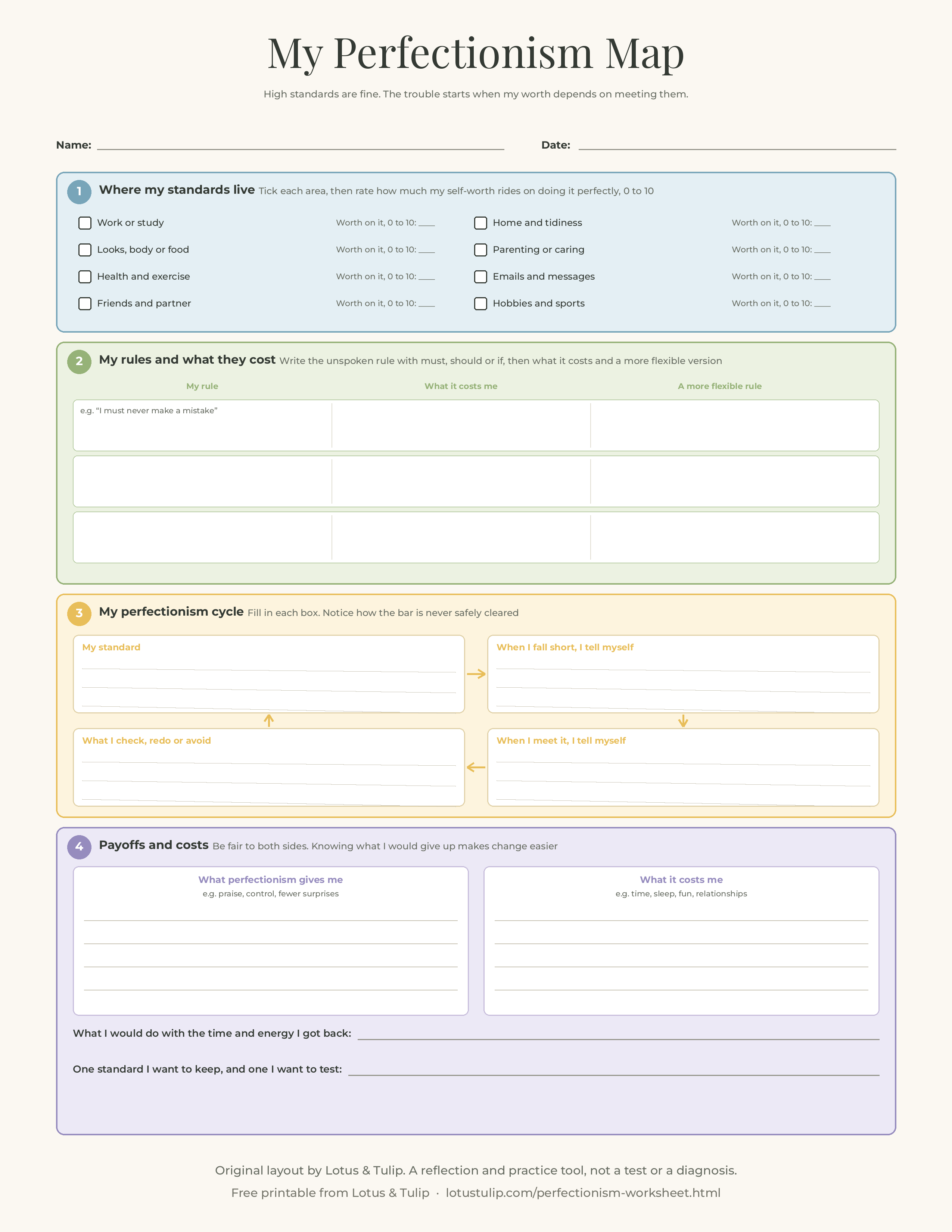
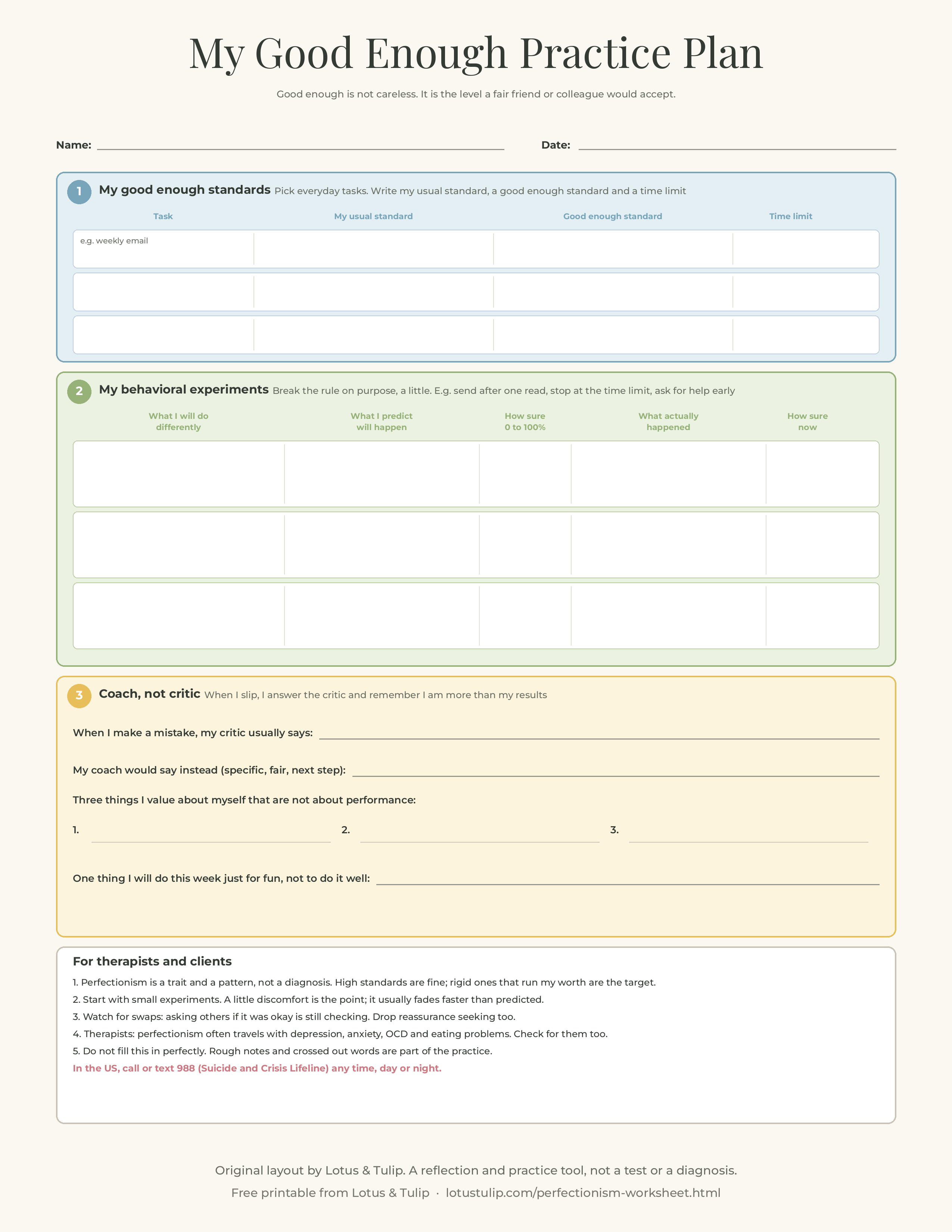
This guide is for adults and the therapists who work with them. It explains what clinical perfectionism is and is not, the main ways researchers describe it, what the treatment research does and does not show, nine practical steps, common mistakes and examples. It ends with a free 2 page printable: My Perfectionism Map, which helps you see where your standards live, the rules behind them and the cycle that keeps them going, and My Good Enough Practice Plan, with good enough targets, behavioral experiments rated from 0 to 100% and a kinder response to mistakes. Working with a younger client? See the perfectionism worksheet for teens, which is written for school counselors and teenagers.
Download the free perfectionism worksheet (PDF, 2 pages, US Letter)
Direct download, no email or sign up. See the pages first.
What perfectionism is, and what it is not
It is not the same as high standards. Wanting to do good work, caring about details and being conscientious are often strengths. The difference is in what happens around the standard: how rigid it is, how much your self-worth depends on it, and how you treat yourself when you miss it.
Clinical perfectionism. In an influential 2002 paper, Roz Shafran, Zafra Cooper and Christopher Fairburn defined clinical perfectionism as the overdependence of self-evaluation on the determined pursuit and achievement of self-imposed, personally demanding standards in at least one area that matters to the person, despite adverse consequences. In plain words: "I am only as good as my last performance, and I keep pushing even when it hurts me."
It is not a diagnosis. Perfectionism is a personality trait, not a disorder in the DSM-5-TR. Egan, Wade and Shafran (2011) reviewed evidence that it works as a transdiagnostic process, meaning one shared ingredient across several problems. It shows up across depression, anxiety, obsessive-compulsive problems and eating disorders, and perfectionism is one of the listed features of obsessive-compulsive personality disorder, but having perfectionistic habits does not mean you have any of these. This worksheet is a reflection and practice tool, not a test.
How researchers describe perfectionism
Two multidimensional measures shaped most of the research. We describe them here so you can read the literature; we do not reproduce their items, and our worksheet is not either scale.
- Frost and colleagues (1990) described six dimensions in their Multidimensional Perfectionism Scale: concern over mistakes, personal standards, parental expectations, parental criticism, doubts about actions and organization.
- Hewitt and Flett (1991) described three directions in their Multidimensional Perfectionism Scale: self-oriented (I demand perfection of myself), other-oriented (I demand perfection of others) and socially prescribed (I believe others demand perfection of me).
Strivings and concerns. Reviewing this work, Joachim Stoeber and Kathleen Otto (2006) grouped the many subscales into two broad factors. Perfectionistic strivings are the high personal standards and the drive toward them. Perfectionistic concerns are the worry about mistakes, doubts, fear of others' judgment and the felt gap between expectations and results. Research on strivings is mixed, while concerns are the side most consistently tied to distress. A large meta-analysis by Limburg, Watson, Hagger and Egan (2017), covering 284 studies and 2,047 effect sizes, found that both dimensions were associated with depression, anxiety, obsessive-compulsive and eating disorder symptoms, which supports seeing perfectionism as transdiagnostic.
This is why the worksheet does not ask you to give up your standards. It asks you to loosen the concerns: the rigid rules, the self-criticism, the checking and the avoidance.
The cycle that keeps it going
Shafran, Cooper and Fairburn proposed that clinical perfectionism is kept going by a biased way of judging performance. When people with perfectionism miss their standard, they respond with harsh self-criticism. When they meet it, they decide the standard was not demanding enough and raise it. Either way the bar is never safely cleared, and self-worth stays on the line.
In practice, clinicians often see the same loop fed by everyday behaviors that feel protective: checking work again and again, redoing tasks, comparing with others, overpreparing, and avoiding or putting off tasks that cannot be done perfectly. Those behaviors cost time and never give the chance to learn that a good enough result is usually fine. Page 1 of the worksheet maps this cycle; page 2 tests it.
Is perfectionism increasing?
Thomas Curran and Andrew Hill (2019) ran a cross-temporal meta-analysis of 164 samples and 41,641 American, Canadian and British college students who completed the Hewitt and Flett scale between 1989 and 2016. All three directions increased over time. The largest rise was in socially prescribed perfectionism: by their estimate, the average student in 2017 scored higher than about two thirds of students in 1989. These are college samples and trends in group averages, so they say nothing about any one person, but they fit what many therapists hear in session: a strong sense that others expect flawless results.
What the treatment research shows
CBT for perfectionism has growing support. Lloyd, Schmidt, Khondoker and Tchanturia (2015) pooled eight studies of psychological interventions targeting perfectionism in people with related clinical problems or high perfectionism. They found large reductions from before to after treatment in personal standards, concern over mistakes and self-oriented perfectionism, a medium reduction in socially prescribed perfectionism, and medium reductions in anxiety and depression.
Randomized trials point the same way. Suh, Sohn, Kim and Lee (2019) analyzed 10 randomized trials and found medium effects compared with control conditions on perfectionistic strivings (g = 0.48) and perfectionistic concerns (g = 0.55), with medium effects on depression and anxiety. Online and face to face formats did not differ significantly. Galloway, Watson, Greene, Shafran and Egan (2022) analyzed 15 randomized trials of CBT for perfectionism, guided self-help and face to face, with 912 participants (mean age 23). Effects were large for concern over mistakes (g = 0.89) and clinical perfectionism (g = 0.87), medium for personal standards (g = 0.57), depression (g = 0.60) and eating disorder symptoms (g = 0.61), and small to medium for anxiety (g = 0.42).
The honest caveats. A 2023 reanalysis of 16 trials by Smith and colleagues, including Hewitt and Flett, found clear benefits for concern over mistakes and clinical perfectionism, but no significant differences from control on several other perfectionism measures, a dropout rate of 27% that was higher in treatment than control, and no significant between-group effects at follow up. Most trials are small, many participants were students, and few compared CBT with another active treatment. There is no trial of this worksheet. It borrows the core ingredients of CBT for perfectionism, which are understanding the cycle, testing rules with behavioral experiments, reducing checking and avoidance, and widening the base of self-worth, and it works best alongside a therapist.
How to use a perfectionism worksheet, step by step
- Pick the areas where it bites. On page 1, tick where your standards live: work, home, appearance, parenting, health, messages, relationships or hobbies. For each one you tick, rate from 0 to 10 how much your self-worth rides on doing it perfectly. Start with the highest.
- Write the rule out loud. Perfectionism runs on rules that rarely get said: "I must never make a mistake at work", "If the house is messy, people will think less of me." Write two or three as plainly as you can, using must, should or if.
- Count the costs and the payoffs. List what the rule gives you, such as praise, a sense of control or fewer surprises, and what it costs, such as time, sleep, missed fun, strained relationships or tasks left undone. Be fair to both sides. Change is easier when you know what you are giving up.
- Map your cycle. Fill in the four boxes: the standard, what you tell yourself when you fall short, what you tell yourself when you meet it, and what you check, redo or avoid. Most people notice that success gives them less relief than they expected.
- Set a good enough standard. On page 2, choose one everyday task and write your usual standard next to a good enough standard and a time limit. Good enough is not careless; it is the level a fair colleague or friend would accept.
- Plan one behavioral experiment. Pick something small that breaks the rule on purpose: send an email after one read, leave one small typo in a casual message, stop a task at the time limit, or ask for help before it is polished. Write what you predict will happen and how sure you are, from 0 to 100%.
- Run it and record what happened. Notice what others actually did, how long your discomfort lasted and whether the outcome mattered a week later. Rate again from 0 to 100% how sure you are of the prediction now.
- Answer mistakes with a coach, not a critic. Write the sentence you will use the next time you slip, in the voice of a supportive coach: specific, fair and focused on the next step. The self compassion worksheet has more practice for this.
- Widen your base of worth. List things you value about yourself that have nothing to do with performance, and one activity you will do this week just for its own sake. Review the plan with your therapist or on your own, then choose the next experiment.
For more on testing predictions, see the behavioral experiment worksheet, and for all-or-nothing thinking and shoulds, the cognitive distortions worksheet.
Common mistakes
- Trying to do the worksheet perfectly. It happens more often than you would think. Rough notes, crossed out words and half filled boxes are fine. That is part of the practice.
- Aiming to lower every standard. The goal is flexible standards and a self-worth that does not depend on them, not giving up on quality. Keep the standards that serve you and test the ones that cost too much.
- Experiments that are too big. Start where discomfort is noticeable but manageable, such as a short email or a small household task, before moving to a big work deliverable.
- Swapping one safety behavior for another. Sending the email after one read but then asking a coworker three times whether it was fine is still checking. Notice reassurance seeking and cut it too.
- Missing what travels with it. Perfectionism often comes with depression, anxiety, obsessive-compulsive symptoms or disordered eating. If those are present, or if self-criticism turns into hopelessness or thoughts of self-harm, address them directly with appropriate care.
Examples
- The analyst: Rated work 9 out of 10 for how much her worth depended on it. Rule: "Every report must be flawless before anyone sees it." Cycle: rereading reports four or five times and finishing late at night. Experiment: send a routine weekly update after one read through. Prediction: "my manager will think I am sloppy", 80% sure. What happened: no comment, and the one small error she spotted later did not matter. Sureness now: 25%.
- The parent: Felt she had to have a spotless home and homemade meals every night, or she was failing her family. Costs: exhaustion and snapping at her kids. Good enough standard: a 20 minute tidy each evening and two simple meals a week. Experiment: invite a friend over without deep cleaning first. Prediction 70%, after the visit 15%. Linked page: the people pleasing worksheet, for the fear of being judged.
- The graduate student: Put off a thesis chapter for months because a first draft "would be terrible". The cycle showed avoidance, not low standards. Good enough standard: a rough draft of 500 words in 45 minutes, written without editing. Coach sentence: "First drafts are supposed to be rough. I can fix it later." He used the ACT values worksheet to reconnect with why he chose the program.
Free perfectionism worksheet for adults
This free printable is an original Lotus & Tulip layout on US Letter, in our own wording. Page 1, My Perfectionism Map, has a checklist of areas with 0 to 10 ratings for how much self-worth rides on each, a table for your rules with their costs and a more flexible version, a four box map of the perfectionism cycle, and a costs and payoffs list. Page 2, My Good Enough Practice Plan, has good enough standards with time limits, three behavioral experiments with before and after ratings from 0 to 100%, a coach sentence for mistakes, a worth beyond achievement list and notes for therapists and clients, including the US 988 crisis line.
Download the free perfectionism worksheet (PDF, 2 pages, US Letter)
Prefer single images? Page 1: my perfectionism map (PNG) · Page 2: my good enough practice plan (PNG)
Free to print for use with your own clients or for yourself. Please link to this page rather than re-uploading the file. A reflection tool, not a test, a diagnosis or a substitute for therapy. In the US, call or text 988 in a crisis.
Related resources
- Body image worksheet for adults: when perfectionism is about how you look, with a free 2 page printable
- Procrastination worksheet for adults: when the fear of falling short keeps you from starting, with a free get started plan
- Perfectionism worksheet for teens: the school counselor version, with a free 3 page printable
- Impostor syndrome worksheet: when success still feels like luck, with a free evidence file
- Self-esteem worksheets for adults: the bottom line belief and a free fairer view practice plan
- Behavioral experiment worksheet: testing predictions in real life
- Cognitive distortions worksheet: all-or-nothing thinking and shoulds
- Self compassion worksheet: a kinder response to mistakes
- All therapist worksheets: CBT, DBT, ACT and more
FAQ
What is a perfectionism worksheet?
A perfectionism worksheet is a structured page that helps you notice where perfectionism shows up, the rules and self-criticism behind it and what it costs, and then practice good enough standards through small experiments. Therapists use them in CBT for perfectionism, and adults can use them on their own.
Is perfectionism a mental health diagnosis?
No. Perfectionism is a personality trait and a transdiagnostic process, not a disorder in the DSM-5-TR. It is linked with depression, anxiety, obsessive-compulsive problems and eating disorders, so if it causes real distress it is worth bringing to a therapist or doctor.
What is the difference between healthy striving and perfectionism?
Healthy striving means aiming high while staying flexible and treating yourself fairly when you fall short. Perfectionism ties self-worth to meeting rigid standards, brings harsh self-criticism after mistakes and raises the bar after success. Researchers call these perfectionistic strivings and perfectionistic concerns, and the concerns are most consistently linked with distress.
What is clinical perfectionism?
Shafran, Cooper and Fairburn (2002) defined clinical perfectionism as judging yourself largely on the determined pursuit of demanding, self-imposed standards in at least one important area, despite negative consequences. They proposed it is kept going by self-criticism after failure and by raising standards after success.
Does CBT work for perfectionism?
Meta-analyses of randomized trials have found medium to large reductions in perfectionism, especially concern over mistakes and clinical perfectionism, along with improvements in depression and anxiety. A 2023 reanalysis found the benefits were clearest for those measures, that dropout was notable and that effects at follow up were not significant, so more and larger trials are needed.
Is this perfectionism worksheet free?
Yes. It is free to print for use with your own clients or for yourself. Please link to this page rather than re-uploading the file.
Sources
- Curran, T., and Hill, A. P. (2019). Perfectionism is increasing over time: A meta-analysis of birth cohort differences from 1989 to 2016. Psychological Bulletin, 145(4), 410 to 429.
- Egan, S. J., Wade, T. D., and Shafran, R. (2011). Perfectionism as a transdiagnostic process: A clinical review. Clinical Psychology Review, 31(2), 203 to 212.
- Frost, R. O., Marten, P., Lahart, C., and Rosenblate, R. (1990). The dimensions of perfectionism. Cognitive Therapy and Research, 14(5), 449 to 468.
- Galloway, R., Watson, H., Greene, D., Shafran, R., and Egan, S. J. (2022). The efficacy of randomised controlled trials of cognitive behaviour therapy for perfectionism: A systematic review and meta-analysis. Cognitive Behaviour Therapy, 51(2), 170 to 184.
- Hewitt, P. L., and Flett, G. L. (1991). Perfectionism in the self and social contexts: Conceptualization, assessment, and association with psychopathology. Journal of Personality and Social Psychology, 60(3), 456 to 470.
- Limburg, K., Watson, H. J., Hagger, M. S., and Egan, S. J. (2017). The relationship between perfectionism and psychopathology: A meta-analysis. Journal of Clinical Psychology, 73(10), 1301 to 1326.
- Lloyd, S., Schmidt, U., Khondoker, M., and Tchanturia, K. (2015). Can psychological interventions reduce perfectionism? A systematic review and meta-analysis. Behavioural and Cognitive Psychotherapy, 43(6), 705 to 731.
- Shafran, R., Cooper, Z., and Fairburn, C. G. (2002). Clinical perfectionism: A cognitive-behavioural analysis. Behaviour Research and Therapy, 40(7), 773 to 791.
- Smith, M. M., Hewitt, P. L., Sherry, S. B., Flett, G. L., and colleagues (2023). A meta-analytic test of the efficacy of cognitive behavioural therapy for perfectionism: A replication and extension. Canadian Psychology, 64(4), 355 to 376.
- Stoeber, J., and Otto, K. (2006). Positive conceptions of perfectionism: Approaches, evidence, challenges. Personality and Social Psychology Review, 10(4), 295 to 319.
- Suh, H., Sohn, H., Kim, T., and Lee, D. (2019). A review and meta-analysis of perfectionism interventions: Comparing face-to-face with online modalities. Journal of Counseling Psychology, 66(4), 473 to 486.