
Therapist worksheets · ACT cognitive defusion · Updated 2026-11-05
Cognitive Defusion Worksheet: ACT Defusion Techniques, Examples and a Free Printable
Ready-made printable: ACT Worksheets for Therapists Fillable PDF: type into the defusion record, plus values compass, choice point, committed action plan and weekly values tracker (20 pages)
Holiday 20% off: about $9.20, was $12 (EUR 10) · instant digital download
Try it free first: download a fillable sample (values compass and unhooking from thoughts, PDF, 259 KB). Type into it on screen, then get the full pack. No email needed.

A client says, "I'm a failure," and says it the way you would say "it's raining." It is not an opinion to them. It is the weather. You could argue with the thought, collect evidence against it, or reframe it. Sometimes that helps. Other times the argument only makes the thought louder, and the client leaves the session more tangled in it than before. Acceptance and Commitment Therapy (ACT) offers a different move: instead of changing what the thought says, change how the person relates to it. That move is called cognitive defusion.
This guide explains what defusion is and is not, the core techniques (including "I'm having the thought that", leaves on a stream, naming the story, silly voices, thanking your mind and Titchener's word repetition, often taught as "milk, milk, milk"), when not to use them, examples for adults and teens, a worked example, how to teach defusion step by step and an honest look at the research. At the end there is a free three page printable: a Noticing My Thoughts worksheet, a Defusion Technique Menu and a Defusion Practice Log.
Jump to the free cognitive defusion worksheets (PDF) · See a worked example
What cognitive defusion is
ACT, developed by Steven Hayes, Kirk Strosahl and Kelly Wilson, describes six core processes of psychological flexibility: acceptance, cognitive defusion, being present, self as context, values and committed action. Defusion is the process aimed at thinking itself.
The starting idea is cognitive fusion. When we are fused with a thought, we treat it as the literal truth, as an order we must follow, or as a threat we must get rid of. The words "I can't do this" stop being a sentence passing through the mind and start being the reality we live inside. Fusion is not always a problem. When you read a recipe, being fused with the instructions is helpful. It becomes a problem when fusion with a thought pulls a person away from what matters to them: skipping the job interview because "they'll see I'm a fraud", or avoiding friends because "no one really likes me".
Defusion is the opposite stance. It means stepping back far enough to see a thought as a thought: words and pictures produced by a busy mind, which may or may not be true and may or may not be helpful. In the words of the ACT literature, defusion techniques try to change the function of a thought by changing the context in which it occurs, rather than trying to change its form, frequency or content. The thought "I'm a failure" may still show up. What changes is how much it pushes the person around.
A simple way to say this to clients: fusion is looking from your thoughts, like glasses you forgot you were wearing. Defusion is looking at your thoughts, like taking the glasses off and holding them in your hand.
What defusion is not
Clients, and sometimes clinicians new to ACT, often confuse defusion with other things. Clearing these up early saves a lot of frustration.
- It is not getting rid of thoughts. The goal is not that the thought disappears or gets quieter, although that sometimes happens as a side effect. If a client starts using defusion as a clever way to make thoughts go away, it usually stops working, because it has turned into another control strategy.
- It is not deciding the thought is false. Defusion does not argue with content. "I'm having the thought that I'll be late" works whether or not you will actually be late. Some thoughts are true and still unhelpful to hold tightly.
- It is not making fun of the person. Silly voices and songs are aimed at the words, never at the person's pain. Done with warmth, they lighten the grip of the thought. Done carelessly, they can feel invalidating.
- It is not suppression or distraction. In defusion you actually make contact with the thought, often more directly than before. You just hold it differently.
- It is not the same as cognitive restructuring. CBT restructuring asks, "Is this thought accurate?" Defusion asks, "Is this thought helpful right now, and can I let it be here without obeying it?" The two can work together, and many clinicians use both.
Signs a client is fused with a thought
Fusion is easy to see once you know what to look for. Listen for:
- Absolute language. Always, never, everyone, no one, nothing works.
- Thoughts stated as facts about the self. "I am broken" rather than "I feel broken today."
- Reason giving. Long chains of why they cannot do something: "I can't go because I'll get anxious, and if I get anxious people will notice, and then..."
- Old, rehearsed stories. The same account of who they are and why things go wrong, told in almost the same words week after week.
- Rule following. "I have to be perfect or I've failed." "I shouldn't need help."
- Arguing in session. When the therapist offers another view and the client defends the thought as if defending themselves.
- Behavior narrowing. The thought shows up and the same avoidance follows every time.
The Cognitive Fusion Questionnaire (CFQ; Gillanders and colleagues, 2014) is a brief, seven item self report measure of fusion that some clinicians use before and after an ACT course of treatment. It is not required to teach defusion, but it can make change visible.
Cognitive defusion techniques
There are dozens of defusion exercises in the ACT literature. Most of them work by one of a few levers: adding a frame ("I'm having the thought that"), changing the sound or form of the words, watching thoughts come and go, or naming the pattern. Here are the most useful core techniques, with a short script for each.
1. "I'm having the thought that..."
The simplest defusion technique and a good one to start with. The client takes a sticky thought and says it in three steps:
- As it is: "I'm going to mess this up."
- With a frame: "I'm having the thought that I'm going to mess this up."
- With a second frame: "I notice I'm having the thought that I'm going to mess this up."
Ask what changed between the first and third version. Most people report a little more space, as if the thought moved from inside their head to a short distance in front of them. Nothing about the content has been disputed. The frame alone does the work. This one is easy to use outside session because it fits in a single breath.
2. Leaves on a stream
A mindfulness based defusion exercise that teaches watching thoughts rather than following them. A short script you can adapt:
"Sit comfortably and let your eyes close or rest on a spot in front of you. Imagine you are sitting beside a gently flowing stream, with leaves floating past on the water. For the next few minutes, each time a thought comes into your mind, whether it is a word, a picture or a worry, place it on a leaf and let it float by. If a thought is 'this is stupid' or 'I'm not doing this right', put that on a leaf too. Don't push the leaves or try to speed up the stream. If you notice you have been pulled into a thought and lost the stream, that is normal. Gently notice it and come back. Put the next thought on a leaf."
Afterward, ask what it was like. The most useful learning is usually the moment they got hooked and noticed it. That moment of noticing is defusion in action. Variations for clients who do not like streams: cars passing on a road, clouds in the sky, suitcases on an airport carousel or words scrolling past on a screen.
3. Naming the story
Many painful thoughts are part of a larger, familiar story. "I'll be alone forever." "Everyone leaves." "I'm never good enough." Invite the client to give the whole story a title, like a book or a movie: "the Not Good Enough story" or "the Everyone Leaves movie". When the old thoughts show up, they can say, "Ah, there's the Not Good Enough story again."
Naming works because it lets the client recognize a pattern without reliving every chapter. It also adds a touch of distance and, often, a touch of humor. Clients do best when they choose the title themselves.
4. Silly voices and singing
Have the client say the thought slowly in the voice of a cartoon character, a sports commentator or a robot, or sing it to "Happy Birthday" or another simple tune. "I'm so stupid" sung to a birthday melody tends to lose some of its weight.
This works by changing the form of the words while keeping the content. Always check first: some thoughts carry trauma or deep grief, and a silly voice would feel dismissive. When in doubt, ask permission and pick a gentler technique.
5. Thanking your mind
The mind is a problem solving machine. It warns, predicts and criticizes, often in the hope of keeping us safe. When an unhelpful thought shows up, the client can respond with a light, sincere "Thanks, mind" or "Thank you, mind, I've got this." It acknowledges the mind's effort without obeying it. Russ Harris often pairs this with a sense of the mind as an overprotective friend who means well.
6. Word repetition ("milk, milk, milk")
The oldest defusion technique in the ACT toolbox, first described by Edward Titchener in the early twentieth century. Start with a neutral word:
- Say "milk" once and notice what shows up: the white color, the cold, the taste.
- Now say "milk" out loud, quickly, over and over, for about 30 to 45 seconds.
- Notice what happened to the meaning. For most people the word becomes a strange sound, just a noise in the mouth.
Then repeat the exercise with a single word that captures a painful self judgment, such as "stupid", "fat" or "failure". After 30 to 45 seconds of fast repetition, ask the client to rate how uncomfortable and how believable the word feels now. This is the exercise tested by Masuda and colleagues in 2004 (see research below). It is especially good for teaching the idea that words are, at one level, sounds.
More techniques worth knowing
- Write it, then look at it. Writing a thought on a card and holding it at arm's length makes the distance literal.
- The hands as thoughts metaphor. Hold your hands in front of your face so they block your view (fused), then slowly lower them to your lap (defused). The hands are still there; you can just see the room again.
- Passengers on the bus. The client is the driver, and thoughts are noisy passengers shouting directions. They can ride along without taking the wheel.
- Is it helpful? Rather than "Is it true?", ask "If I let this thought steer, will it take me toward the life I want?"
- Noticing the mind's commentary. Describe thoughts as a running radio station, sometimes called Radio Doom and Gloom: you don't have to turn it off to stop dancing to it.
Cognitive defusion examples
Here is how defusion looks with common sticky thoughts. Notice that none of the responses argue with the content.
| Fused thought | Defusion response | Technique |
|---|---|---|
| I'm going to fail this exam. | "I'm noticing the thought that I'm going to fail." | I'm having the thought |
| Nobody likes me. | "Here's the Nobody Likes Me story again." | Naming the story |
| I'm so stupid. | "Stupid, stupid, stupid..." for 30 seconds, then rerate. | Word repetition |
| Something terrible will happen if I don't check. | "Thanks, mind. I hear you." Then do the next planned step. | Thanking your mind |
| I can't cope with this. | Sing it slowly to "Happy Birthday" and notice what changes. | Silly voice or song |
| I'll never get better. | Put it on a leaf and let it float downstream. | Leaves on a stream |
| I shouldn't need help. | "Is holding this tightly helping me get the life I want?" | Workability question |
Examples for adults
- Work anxiety. A nurse returning from leave has the thought "I've forgotten everything and I'll make a mistake." She uses "I'm having the thought that..." in the car park, then walks into her shift. The thought comes along; she goes anyway.
- Depression. A man who has been out of work for months names the familiar story "the Washed Up story". When it shows up while he is writing applications, he says, "There it is," and keeps typing.
- Social anxiety. Before a party, a client writes "Everyone will think I'm boring" on a card, looks at it, puts it in her pocket, and takes it with her.
- Chronic pain. A client with back pain notices "This pain means I can't do anything" and practices leaves on a stream before a short walk, letting the thought float by without letting it decide.
- Self criticism. A perfectionist professional thanks her mind when it says "That email wasn't good enough" and sends it after one reread instead of five.
Examples for teens
- Before a test. "I'm going to blank" becomes "My brain is doing the blanking prediction again." The teen takes three slow breaths and starts with an easy question.
- Social media. After seeing friends at an event she wasn't invited to, a teen notices "They hate me" and names it "the Left Out story", then texts one friend instead of spiraling for an hour.
- Sports. A soccer player who missed a penalty has "I always choke" on repeat. His coach teaches him to say it in a sports commentator voice during warm ups. It still shows up, but it is funnier and smaller.
- Body image. A teen repeats the word "ugly" fast for 30 seconds in session, rates believability before and after, and notices it dropped from 8 to 5.
Teens often like defusion because it doesn't ask them to pretend they feel positive. The ACT workbook for teens by Ciarrochi, Hayes and Bailey (2012) frames this as noticing that the mind is a word machine that never switches off.
A worked example, start to finish
Maya is 34 and works in marketing. She has a presentation to her team on Thursday. Every time she opens the slides, her mind says, "You're going to freeze, everyone will see you're a fraud." She has spent three evenings rewriting the first slide instead of practicing the talk.
- Step 1: Notice and name the thought. On the Noticing My Thoughts page she writes it out word for word: "I'm going to freeze and everyone will see I'm a fraud."
- Step 2: Rate it. Believability 9 out of 10. Distress 8 out of 10.
- Step 3: Notice what it makes her do. Rewrite slides, avoid rehearsing aloud, stay up late.
- Step 4: Ask about workability. If she lets the thought steer, she will be tired and unrehearsed on Thursday, which makes freezing more likely, not less.
- Step 5: Choose a technique. She tries "I'm noticing the thought that..." and then names the story: "the Fraud story". She also tries singing it in a silly voice and finds it too much for now, so she drops that one.
- Step 6: Rerate. Believability 6, distress 5. The thought is still there, but it feels like something her mind is saying rather than a fact about her.
- Step 7: Take a values based action. She values contributing and being reliable for her team. She sets a timer and rehearses the talk aloud twice, saying "there's the Fraud story" each time it shows up.
On Thursday the thought came back as she stood up. She said "thanks, mind" quietly to herself and started. She did not freeze, though her voice shook for the first minute. On her practice log she wrote: "Thought showed up. Did the thing anyway." That is the goal of defusion: not a quiet mind, but a free hand.
How to teach cognitive defusion, step by step
- Find the cost of fusion. Ask the client to describe a recent time a thought stopped them from doing something they care about. Defusion only makes sense when there is a cost.
- Explain fusion with a metaphor. Use the hands in front of the face or the glasses metaphor so the client can feel the difference between looking from a thought and looking at it.
- Start with a neutral demonstration. Do the milk, milk, milk exercise with a neutral word, so the client experiences the effect before trying it with something painful.
- Catch a sticky thought in their own words. Write it down exactly and rate believability and distress from 0 to 10.
- Try two or three techniques in session. For example, "I'm having the thought that", naming the story and word repetition. Rerate after each and notice which feels most useful for this person and this thought.
- Debrief without chasing a feeling. If the numbers dropped, great. If not, ask whether the client could hold the thought a little more lightly or act alongside it. Defusion is measured by what the person can do, not only by how they feel.
- Link it to values. Ask what they would do this week if the thought came along for the ride but did not get to drive. Agree on one small action.
- Assign daily practice. One short leaves on a stream practice a day, plus using the chosen technique when the thought shows up in real life, recorded on the practice log.
- Review and adjust. Next session, look at the log together. Keep techniques that worked, drop ones that felt invalidating and look for the moments the client noticed being hooked, since that noticing is the core skill.
When not to use defusion (or slow down)
Defusion is a low risk skill for most people, but it is not right for every moment or every thought.
- When a thought points to real danger. "This person might hurt me" or "this lump needs checking" are thoughts that call for action, not distance. Defusion is for unhelpful thoughts, not useful warnings.
- Thoughts of suicide or self harm. Defusion can be part of a broader ACT treatment, but suicidal thoughts always need a proper risk assessment and safety planning first. Do not use defusion as a way to brush them aside.
- Trauma memories and grief. Playful techniques like silly voices can feel deeply invalidating with trauma content or a recent loss. Lead with validation, use gentler techniques such as "I'm noticing" or leaves on a stream, and always ask permission.
- Before the relationship is ready. If a client does not yet feel understood, defusion can sound like "your thoughts don't matter". Validate first.
- As a control strategy. If a client is using defusion only to make anxiety go away, gently point this out. When the goal shifts from "make it stop" to "let it be here while I do what matters", defusion tends to work better.
- Psychosis and severe dissociation. ACT has been studied in psychosis, but techniques there should be guided by a clinician trained in that work.
Defusion and cognitive restructuring: how they fit together
Therapists trained in CBT often ask whether defusion contradicts the thought record. It does not have to. Restructuring and defusion answer different questions:
- Restructuring examines the content: is the thought accurate, what is the evidence, what is a more balanced view? It is useful when a client is open to looking at the evidence and the thought is clearly distorted. See our cognitive distortions worksheet and core beliefs worksheet.
- Defusion changes the relationship to the thought: can I see it as a thought and act on my values anyway? It is useful when arguing with a thought makes it stronger, when the thought is partly true, or when the client already knows the thought is unrealistic but it still pushes them around.
A practical rule of thumb: if two rounds of evidence gathering haven't loosened a thought, try defusion. And if a defused client is ready to look at the evidence, restructuring often goes more smoothly from that calmer stance. Positive self talk, covered in our positive self talk worksheet, is a third option that works best for kids and for building new habits of speech rather than arguing with old ones.
Common mistakes when teaching defusion
- Teaching it as a trick to feel better. If the client hears "this will make the thought go away", they will judge it a failure the first time it doesn't.
- Using humor without permission. Silly voices are powerful but can easily feel mocking. Ask first, and never laugh at the client, only at the strange way minds talk.
- Too many techniques at once. Pick two or three and practice them well. A menu is useful for later; in early sessions, depth beats variety.
- Skipping values. Defusion on its own can feel pointless. Defusion in service of doing something that matters is what makes it stick.
- Talking about it instead of doing it. Defusion is experiential. Explaining it for ten minutes is far less useful than a two minute exercise in the room.
- Arguing about whether the thought is true. Once you start debating content, you have left defusion. That is fine if you mean to switch to restructuring, but be clear which you are doing.
- Forgetting real life practice. A skill used only in session rarely transfers. The practice log matters.
What the research says (honestly)
Defusion has been studied in two ways: small experiments that test a single defusion technique, and larger trials of ACT as a whole, where defusion is one part of a package. Here is what that work does and does not show.
- Word repetition in the lab. Masuda, Hayes, Sackett and Twohig (2004) tested Titchener's rapid word repetition technique with self relevant negative thoughts in a series of single case alternating treatment designs with eight undergraduate students. Defusion reduced both the discomfort and the believability of the thoughts more than a distraction task or a thought control task, and control studies suggested the effect was probably not due to demand characteristics. It was a very small, nonclinical sample, so it shows the technique can work in the short term, not that it treats a disorder.
- Defusion compared with brief restructuring. Larsson, Hooper, Osborne, Bennett and McHugh (2016, Behavior Modification) had participants manage a personally relevant negative thought over five days with a defusion strategy, a cognitive restructuring strategy or no instruction. Defusion lowered believability, increased comfort and willingness to have the thought and increased positive affect significantly more than both other conditions, and negative thought frequency fell in the defusion group. Again, a nonclinical sample and brief strategies, but a useful comparison.
- Components meta-analysis. Levin, Hildebrandt, Lillis and Hayes (2012, Behavior Therapy) meta-analyzed 66 laboratory based component studies of ACT processes. They found significant positive effects for defusion, as well as acceptance, present moment, values and mindfulness components, compared with inactive comparison conditions. Components that included experiential methods such as exercises and metaphors had larger effects than those with a rationale alone, which is a good argument for doing the exercises rather than explaining them.
- ACT as a whole. A meta-analysis by A-Tjak and colleagues (2015, Psychotherapy and Psychosomatics) of 39 randomized trials with 1,821 patients found ACT more effective than waitlist, psychological placebo and treatment as usual, and not significantly different from established treatments such as CBT. Defusion is part of every standard ACT protocol, but these trials test the package, not defusion alone.
- Measuring fusion. The Cognitive Fusion Questionnaire (Gillanders and colleagues, 2014, Behavior Therapy) was developed across studies with more than 1,800 people and showed good reliability, validity and sensitivity to treatment effects, giving clinicians a way to track fusion over time.
What we cannot honestly claim: that any single defusion exercise is a treatment for depression, anxiety or any other condition, or that defusion works for every person and every thought. The best evidence for defusion alone comes from short laboratory studies, mostly with students. The best evidence for ACT comes from trials of the whole approach. Defusion is a sensible, well supported part of that approach, and the most convincing evidence for one client is often their own practice log.
Safety notes and when to get more help
Defusion is a skill for unhelpful, sticky thoughts. It is not a crisis tool and it is not a substitute for care. If you or someone you are working with might act on thoughts of suicide or self harm:
- In the US, call or text 988 (988 Suicide and Crisis Lifeline), any time, day or night.
- Text HOME to 741741 to reach the Crisis Text Line.
- Call 911 if there is immediate danger.
For in the moment crisis skills, see our distress tolerance worksheets. If thoughts are constant, intrusive and come with strong urges to check, clean or seek reassurance, that may be OCD, which usually needs exposure and response prevention with a trained clinician alongside any defusion work.
Tips for therapists and group leaders
- Model it yourself. "My mind is telling me I'm explaining this badly" is a gentle way to show defusion live.
- Collect the client's own words. Defusion works best on the exact phrasing the mind uses, not a tidy summary.
- Use it with the hexaflex. Pair defusion with the ACT values worksheet so every defusion exercise ends with "and now, what matters?"
- In groups, normalize. Have each member write one sticky thought anonymously, then read a few aloud. People are often relieved that their mind says the same things as everyone else's.
- Bridge from DBT. Clients who know DBT will recognize something of the observer stance from wise mind and the mindfulness skills. Defusion gives that stance specific tools for thoughts.
- Keep it brief. Two to five minutes of practice in each session often does more than one long exercise.
Free cognitive defusion worksheets (PDF)
The free cognitive defusion worksheets have three pages in US Letter size, written for teens and adults:
- Page 1: Noticing My Thoughts. Write a sticky thought in your own words, rate how believable and distressing it is, notice what it makes you do, ask whether it is helpful, try "I'm having the thought that..." and rerate, then choose one values based action.
- Page 2: Defusion Technique Menu. Eight techniques on one page, each with a one line how to, a tick box for "tried it" and a 0 to 10 usefulness rating, plus space to name your story.
- Page 3: Defusion Practice Log. Seven days, with columns for the thought, the technique used, believability before and after, and what you did next, plus a weekly review and crisis line box with 988, the Crisis Text Line and 911.
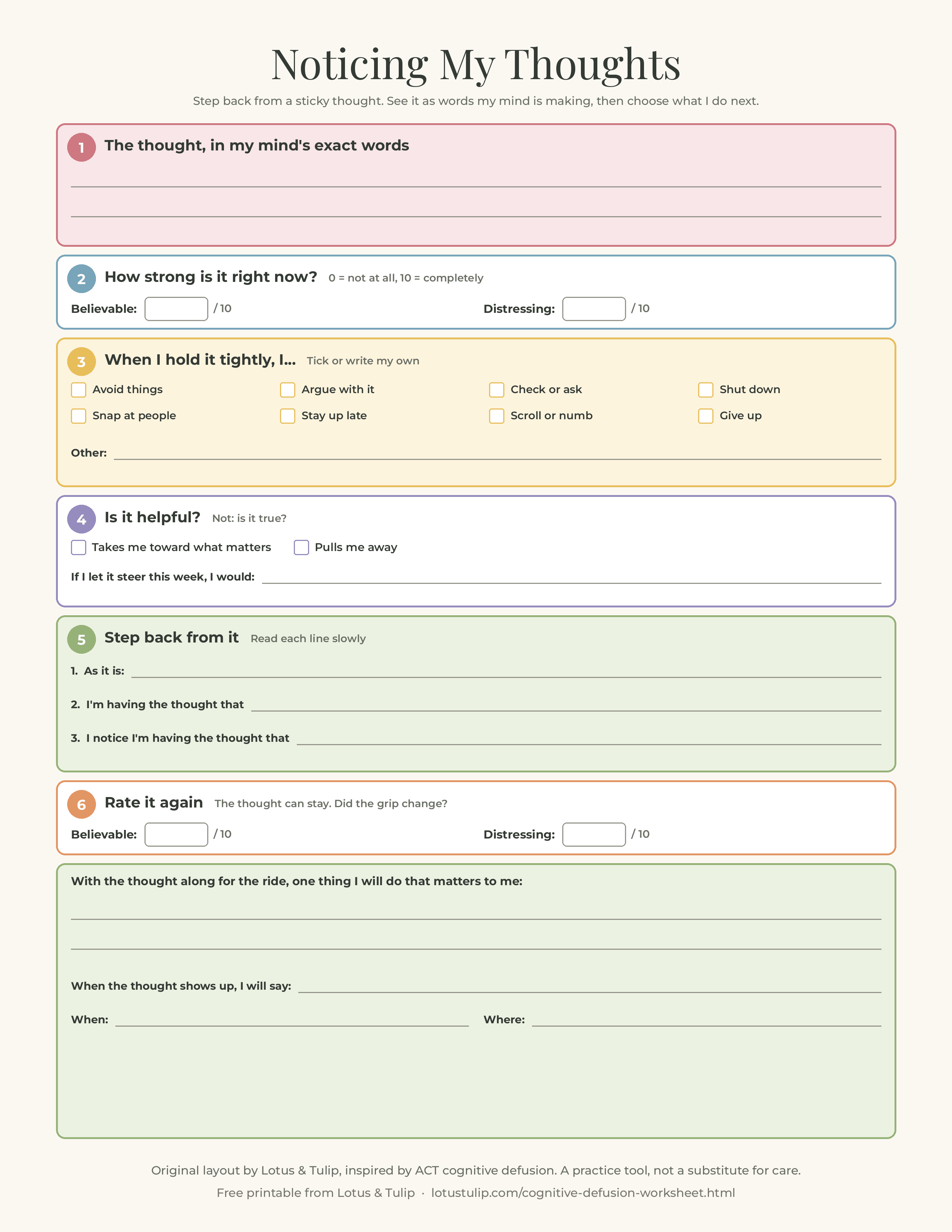
Download the free cognitive defusion worksheets (PDF, 3 pages, US Letter)
Prefer single images? Page 1: Noticing My Thoughts (PNG) · Page 2: Defusion Technique Menu (PNG) · Page 3: Defusion Practice Log (PNG)
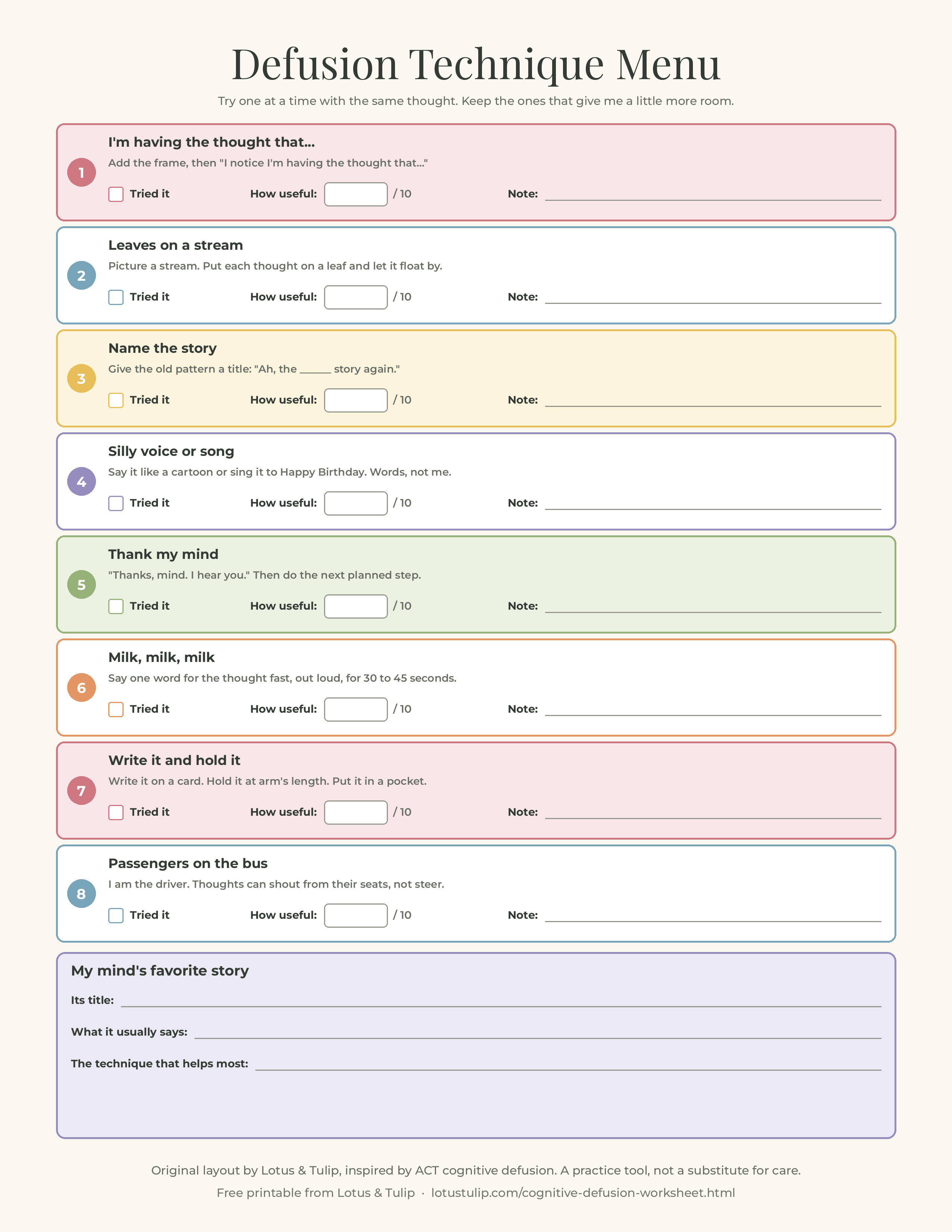
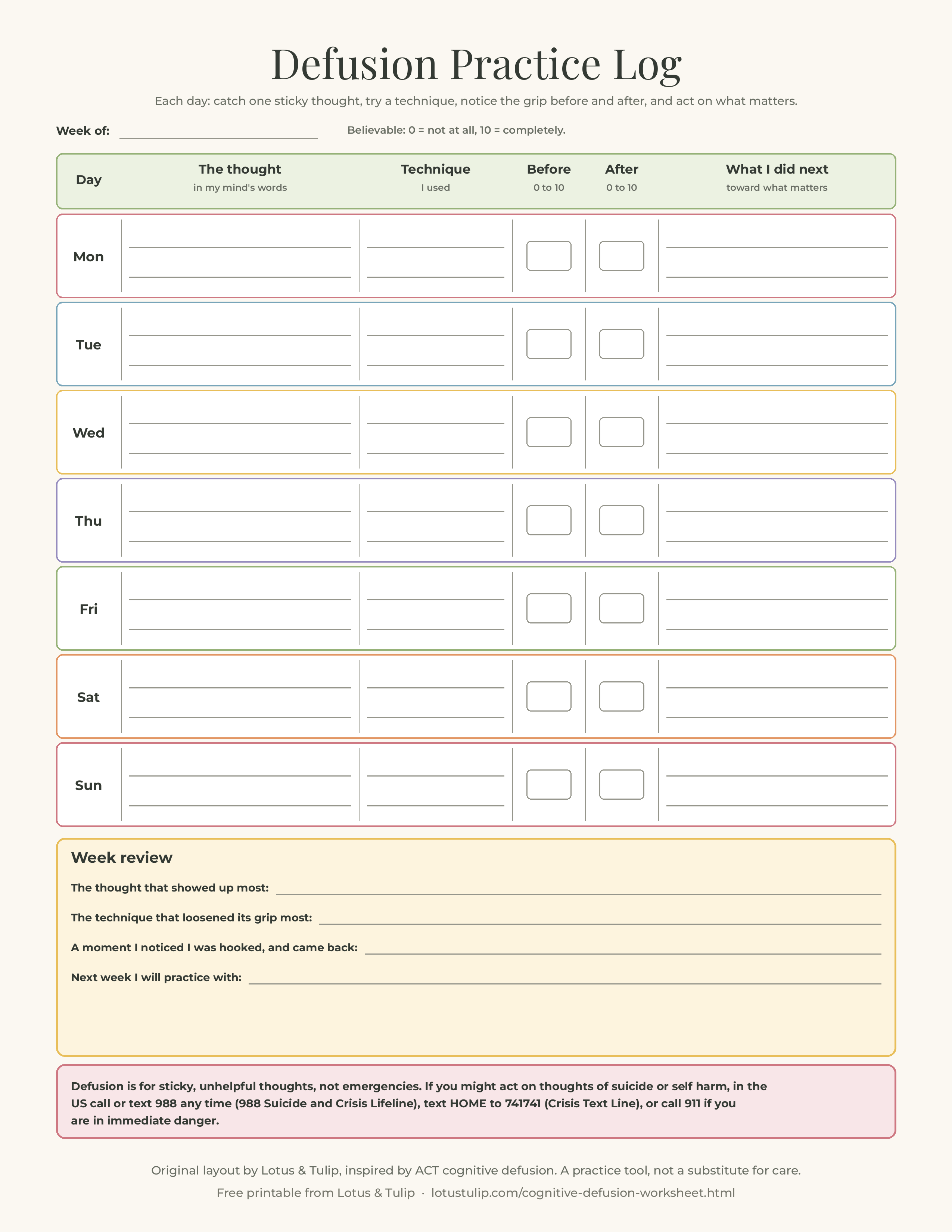
Free to print for your own use and for use with your own clients or groups. This is an original layout by Lotus & Tulip, not a copy of any ACT manual or workbook. Please link to this page rather than re-uploading the file.
Related resources
- Intrusive thoughts worksheet: let unwanted thoughts come and go without suppressing or neutralizing, free printable
- ACT values worksheet: the other half of defusion, knowing what you are stepping toward.
- ACT worksheets for therapists: values, defusion and committed action pages for adult clients.
- Cognitive distortions worksheet: the CBT approach to examining thought content.
- Core beliefs worksheet: finding the deeper stories that sticky thoughts come from.
- CBT thought record: a structured way to test a thought against the evidence.
- Positive self talk worksheet: building kinder inner speech, especially with kids.
- Wise mind worksheet: the DBT observer stance that pairs well with defusion.
- Radical acceptance worksheet: the DBT skill closest to ACT acceptance.
Sources
- Hayes, S. C., Strosahl, K. D., and Wilson, K. G. (2012). Acceptance and Commitment Therapy: The Process and Practice of Mindful Change, second edition. Guilford Press.
- Harris, R. (2019). ACT Made Simple, second edition. New Harbinger.
- Masuda, A., Hayes, S. C., Sackett, C. F., and Twohig, M. P. (2004). Cognitive defusion and self-relevant negative thoughts: examining the impact of a ninety year old technique. Behaviour Research and Therapy, 42(4), 477 to 485.
- Larsson, A., Hooper, N., Osborne, L. A., Bennett, P., and McHugh, L. (2016). Using brief cognitive restructuring and cognitive defusion techniques to cope with negative thoughts. Behavior Modification, 40(3), 452 to 482.
- Levin, M. E., Hildebrandt, M. J., Lillis, J., and Hayes, S. C. (2012). The impact of treatment components suggested by the psychological flexibility model: a meta-analysis of laboratory-based component studies. Behavior Therapy, 43(4), 741 to 756.
- A-Tjak, J. G. L., Davis, M. L., Morina, N., Powers, M. B., Smits, J. A. J., and Emmelkamp, P. M. G. (2015). A meta-analysis of the efficacy of acceptance and commitment therapy for clinically relevant mental and physical health problems. Psychotherapy and Psychosomatics, 84(1), 30 to 36.
- Gillanders, D. T., Bolderston, H., Bond, F. W., and colleagues (2014). The development and initial validation of the Cognitive Fusion Questionnaire. Behavior Therapy, 45(1), 83 to 101.
- Ciarrochi, J., Hayes, L., and Bailey, A. (2012). Get Out of Your Mind and Into Your Life for Teens. New Harbinger.
- 988 Suicide and Crisis Lifeline, 988lifeline.org. Crisis Text Line, crisistextline.org.
Cognitive defusion: FAQ
What is cognitive defusion in ACT?
Cognitive defusion is one of the six core processes of Acceptance and Commitment Therapy. It means stepping back from a thought so you can see it as words and pictures produced by the mind, rather than as a literal truth or an order. The goal is not to remove the thought but to reduce its grip on what you do.
What is an example of cognitive defusion?
A simple example is adding a frame to a painful thought. "I'm a failure" becomes "I'm having the thought that I'm a failure", and then "I notice I'm having the thought that I'm a failure." Most people feel a little more space with each step, without arguing with the thought.
What are the main cognitive defusion techniques?
Common techniques include "I'm having the thought that...", leaves on a stream, naming the story, saying a thought in a silly voice or singing it, thanking your mind, and rapid word repetition (the "milk, milk, milk" exercise first described by Titchener). Writing a thought on a card and the passengers on the bus metaphor are also widely used.
How is defusion different from cognitive restructuring?
Cognitive restructuring in CBT examines whether a thought is accurate and looks for a more balanced alternative. Defusion leaves the content alone and changes your relationship to the thought, asking whether it is helpful and whether you can act on your values while it is present. Many therapists use both.
Does cognitive defusion work?
Small laboratory studies have found that defusion techniques reduce the believability and discomfort of negative thoughts more than distraction, thought control or brief restructuring (Masuda and colleagues, 2004; Larsson and colleagues, 2016), and a meta-analysis of 66 component studies found positive effects for defusion (Levin and colleagues, 2012). Defusion alone has not been proven as a standalone treatment for any disorder; the strongest clinical evidence is for ACT as a whole.
Can teens use cognitive defusion?
Yes. Teens often like defusion because it does not ask them to think positively. Naming the story, silly voices and "my brain is doing that thing again" work well. ACT has been adapted for teens, including the workbook by Ciarrochi, Hayes and Bailey (2012). Use humor carefully and check that it does not feel dismissive.
Can I print the free cognitive defusion worksheets for clients?
Yes. The free PDF is an original Lotus & Tulip layout you can print for your own use and for your own clients, students or groups. Please link to this page instead of re-uploading the file.