
Kids and teens · Depression in children ages 5 to 12 · Updated 2026-11-14
Depression worksheets for kids: how depression looks in children, what research shows and a free feelings weather check and little lifts plan

Ages 5 to 11: Kids Feelings and Social Skills Worksheets, incl. feelings detective, body clues, a feelings thermometer, a coping skills menu and a calm down plan Holiday 20% off: about $11.04, was $14 (EUR 12) · fillable PDF, instant digital download
Buy on EtsyTry it free first: download a fillable sample (feelings thermometer and calm-down plan, PDF, 240 KB). Type into it on screen, then get the full pack. No email needed.
Kinder self talk: Self Esteem Worksheets for Kids and Teens, all 18 worksheets Holiday 20% off: about $9.20, was $12 (EUR 10) · instant digital download
Buy on EtsyKids and teens bundle: Kids and Teens Worksheets Bundle (feelings, anger, self esteem, social anxiety) Holiday 20% off: about $22.08, was $28 (EUR 24) · 80 pages, instant digital download
Buy on EtsyDepression is not only a teen or adult problem. Children can have it too, and in children it often looks different: more grumpy than tearful, more tummy aches than words, more "I'm bored" and "I'm stupid" than "I feel depressed." Because younger children rarely have the words, the adults around them, parents, teachers, school counselors and pediatricians, are usually the ones who notice first.
This guide is for parents, school counselors and child therapists working with children about 5 to 12. It explains how depression shows up in kids, how it differs from ordinary sadness, what research shows about treatment (including its limits), eight kinds of depression worksheets for kids, nine steps to use them, how to adapt them by age, common mistakes, three short examples and when to get help. It ends with a free 2 page printable: My Feelings Weather Check and My Little Lifts Plan.
Safety first: if a child talks about wanting to die, hurting themselves or not wanting to be alive, take it seriously and do not leave them alone. In the US, call or text 988 (the 988 Suicide and Crisis Lifeline) or chat at 988lifeline.org. If a child is in immediate danger, call 911.
Download the free depression worksheets for kids (PDF, 2 pages, US Letter)
Direct download, no email or sign up. See the pages first. Working with older students? See our depression activities for teens. Clinicians working with adults: depression worksheets for therapists.
How depression looks in children
Everyone feels sad sometimes. A bad day, a lost game or a fight with a friend can bring a few hours or days of low mood, and that is a normal part of growing up. Depression is different in three ways: it lasts, it spreads into many parts of life, and it gets in the way of school, friends, play and family life.
Clinicians diagnose major depression using the DSM-5 criteria: five or more of nine symptoms for at least two weeks, a change from how the person usually is, and at least one of them must be low mood or a loss of interest or pleasure. The criteria include two notes specifically for children. In children and adolescents, the low mood can be an irritable mood rather than a sad one. And instead of weight loss, clinicians should consider a child's failure to make expected weight gain. Only a qualified professional can diagnose depression; the lists below are for noticing, not labeling.
Signs adults often notice in children:
- Mood: sad, tearful, irritable, cranky or easily angered most days; small things lead to big meltdowns.
- Less fun: losing interest in games, friends, sports or hobbies they used to love; "nothing is fun" or "I'm bored" all the time.
- Body: tired a lot, sleeping much more or less, eating more or less, frequent stomachaches or headaches with no clear medical cause.
- Thinking: trouble focusing, slower schoolwork, harsh self talk such as "I'm stupid," "Nobody likes me" or "Everything is my fault."
- Behavior: pulling away from friends and family, not wanting to go to school, more clinginess in younger children.
- Danger signs: talk about death, dying or not wanting to be alive, giving things away, or self harm. These need help the same day.
Depression also overlaps with other conditions. Anxiety is common alongside it, and some signs (irritability, poor focus, tiredness) can also come from ADHD, sleep problems, grief, bullying or a medical issue such as thyroid problems or anemia. That is why a check with the pediatrician is a sensible first step.
What the research shows, honestly
- It is less common in children than in teens, but real. A meta-analysis of 26 population studies with close to 60,000 observations (Costello, Erkanli and Angold, 2006) estimated the prevalence of depression at 2.8% for children under 13 and 5.6% for ages 13 to 18. The same analysis found no evidence that rates had risen across birth cohorts from 1965 to 1996 when depression was assessed with structured interviews at the time.
- Current US figures. According to the CDC, based on 2023 to 2024 National Survey of Children's Health data, 4% of US children ages 3 to 17 had current, diagnosed depression (3% of boys and 5% of girls), compared with 11% for anxiety. Diagnosed numbers do not tell the whole story, because some children with depression are never diagnosed.
- Screening is recommended from 12, not before. In 2022 the US Preventive Services Task Force recommended screening for major depressive disorder in adolescents aged 12 to 18 (grade B), but concluded that the evidence is insufficient to recommend for or against routine screening in children 11 or younger. That does not mean younger children cannot be depressed. It means that for younger children, adults noticing signs and asking for an evaluation matters even more.
- Therapy helps, but effects are modest, and the evidence is weaker for younger children. A meta-analysis of 55 randomized trials of psychotherapy for depression in young people aged 4 to 18 (Eckshtain and colleagues, 2020) found an average effect of g = 0.36 at the end of treatment and 0.21 at follow-up, with no improvement over 13 years of newer research. An evidence review of 42 randomized trials (Weersing and colleagues, 2017) concluded that evidence for child treatments is "notably weaker" than for teens: CBT for clinically depressed children was rated possibly efficacious, with mixed results, while CBT and interpersonal therapy are well established for adolescents.
- Families are a strong part of the answer. In a randomized trial with 134 children aged 7 to 14 with depressive disorders (Tompson and colleagues, 2017), 15 sessions of family focused treatment led to adequate clinical response in 77.7% of children, compared with 59.9% for individual supportive therapy. Both groups improved, and families in the family focused group reported more knowledge and skills for managing depression.
- Medication is a medical decision with a warning. Fluoxetine is FDA approved for major depression in children and teens aged 8 to 18. All antidepressants carry an FDA boxed warning that they increased the risk of suicidal thoughts and behavior in children, adolescents and young adults in short term studies, so close monitoring and communication with the prescriber are essential. Decisions about medication belong with a pediatrician or child psychiatrist.
- Asking about suicide does not plant the idea. A review by Dazzi and colleagues (2014, Psychological Medicine) of studies in adults and adolescents found none showing a statistically significant increase in suicidal thoughts after people were asked about them. Talking about it may even reduce them.
The practical message: worksheets do not treat depression on their own. They help a child put feelings into words, help adults notice patterns and give a structure for small daily steps that therapists also use. They work best alongside warm adult support and, when depression is likely, professional care.
8 kinds of depression worksheets for kids
- Feelings check in. A daily or weekly way to name and rate feelings. Weather pictures work well for younger children ("Today I feel cloudy"). See our feelings thermometer printable.
- Body and energy clues. A tick list of how feelings show up in the body: tired, tummy aches, hard to sleep, not hungry. This helps children who cannot yet name emotions.
- Fun then and now. List things that used to be fun and whether they still are. Loss of interest is one of the core signs adults should watch.
- Little lifts menu. A menu of small, doable activities that often lift mood a little: playing outside, music, time with a pet, helping someone. This is the child sized version of behavioral activation, which our behavioral activation worksheet explains for adults.
- Mood before and after. A simple plan where the child rates mood 0 to 10 before and after a small activity. Over a week, this shows the child that doing something can shift a feeling, even a little.
- Heavy thought, kinder thought. Catching a harsh thought ("I'm bad at everything") and finding a kinder, truer one. See our CBT worksheets for kids and positive self talk worksheet.
- People I can tell. A helper list at home, at school and one more trusted adult, plus a simple safety rule.
- Gratitude and good moments. Noticing one good thing each day. Useful as a gentle add on, but never as a replacement for listening to sad feelings. See our gratitude worksheet for kids.
How to use depression worksheets for kids, step by step
- Start with connection, not the sheet. Choose a calm moment. Sit beside the child, say what you have noticed without judgment ("You seem tired and grumpy a lot lately, and I care about how you feel"), and listen more than you talk.
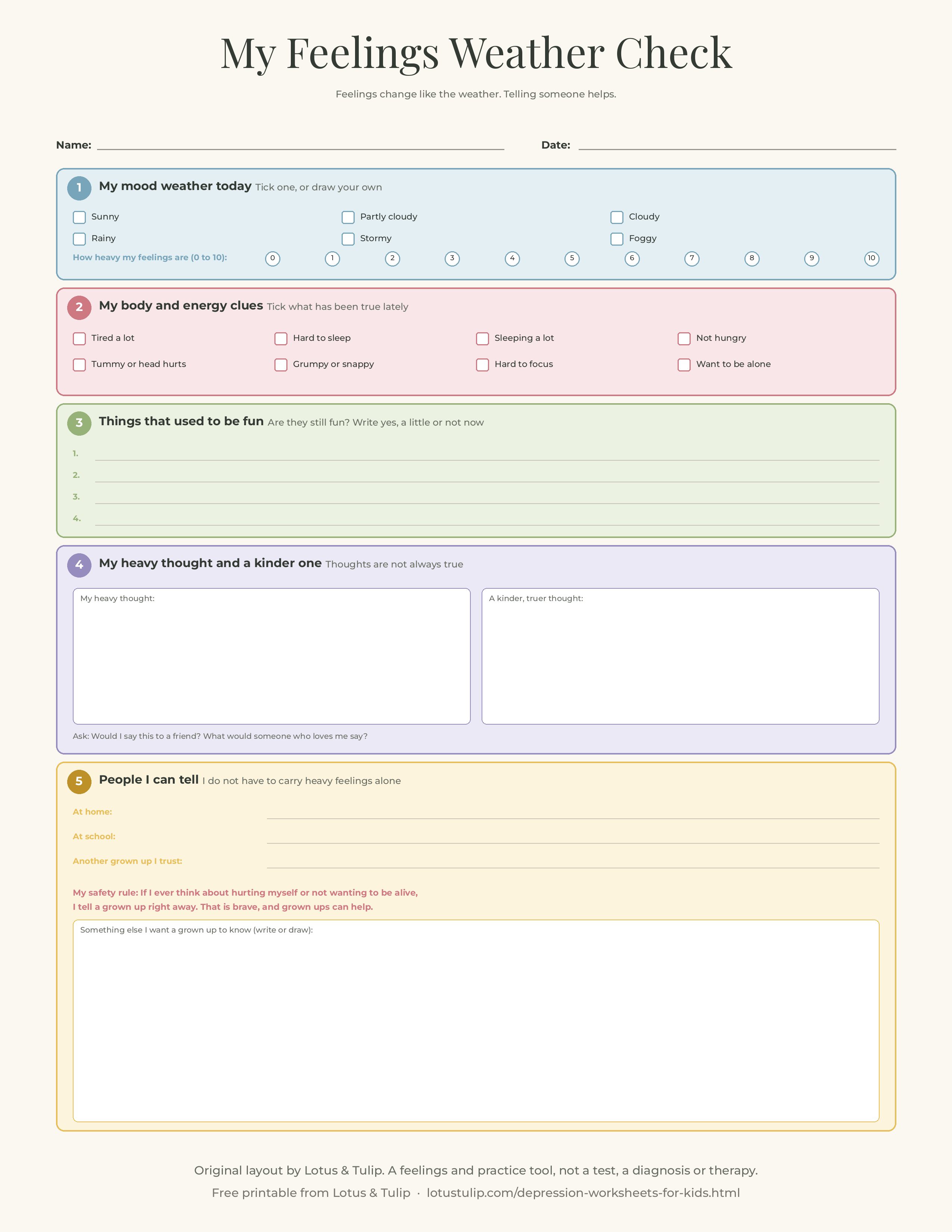
- Check the mood weather. On My Feelings Weather Check, the child ticks a weather picture and rates how heavy their feelings are from 0 to 10. Drawing counts as an answer.
- Notice body and energy clues. Tick what has been true lately. Write down patterns to share with the pediatrician or counselor.
- Look at fun then and now. List up to four things that used to be fun and write yes, a little or not now. Do not argue with the answer.
- Catch one heavy thought. Write it down, then ask: "Would you say this to a friend? What would someone who loves you say?" Help the child find a kinder, truer thought. Do not force cheerfulness.
- Name people to tell and the safety rule. Fill in helpers at home, at school and one more trusted adult. Read the safety rule together in a calm voice. Keep the conversation open.
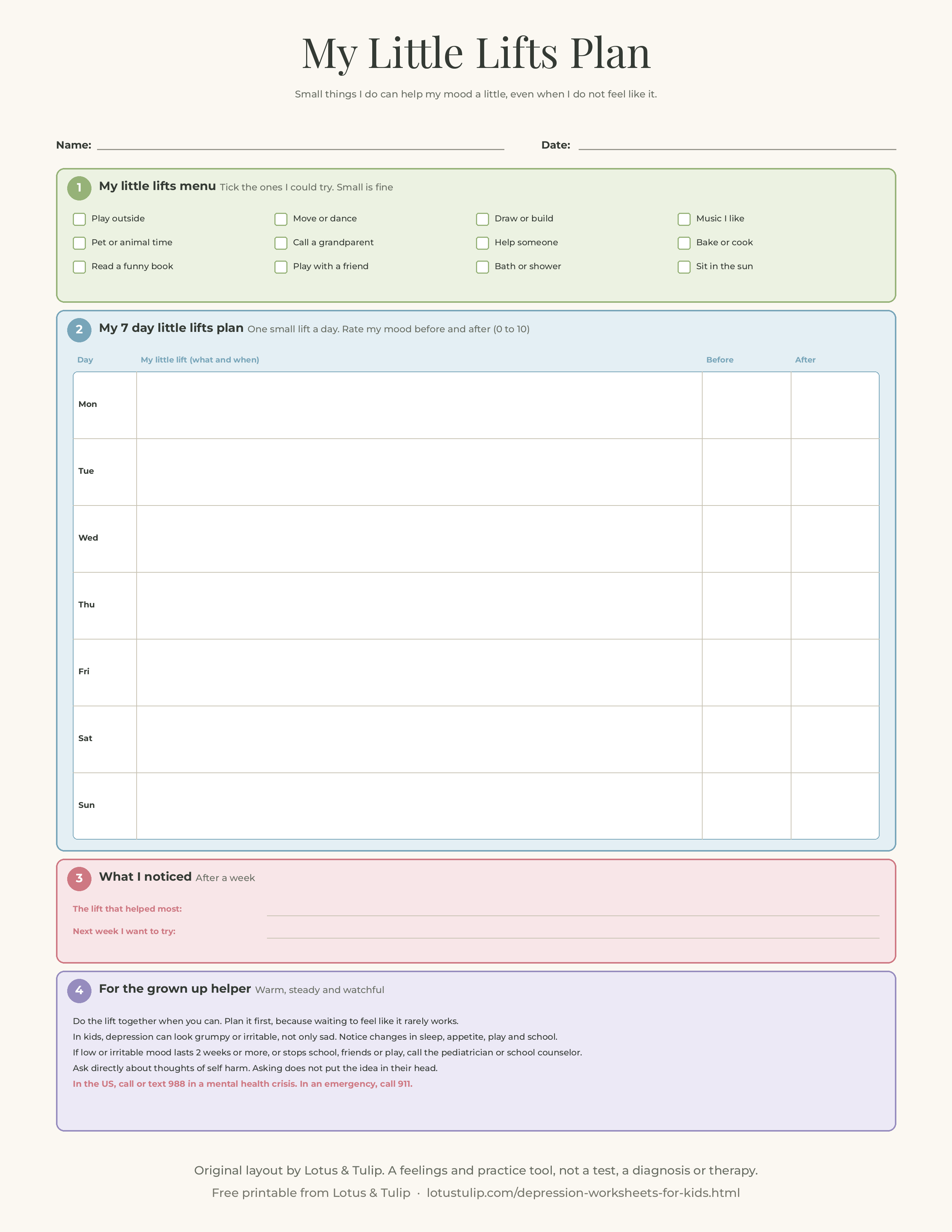
- Pick little lifts. On My Little Lifts Plan, tick a few small activities. Choose easy ones first, because depression drains energy.
- Plan, do, and rate before and after. Each day, plan one lift and when it will happen, then rate mood before and after. Do the lift together when possible. Planning ahead matters, because waiting until the child feels like it rarely works.
- Review the week and get help when needed. Look at what helped most and choose next week's lifts. If low or irritable mood lasts two weeks or more, or stops school, friends, sleep, eating or play, contact the pediatrician, school counselor or a licensed child therapist. In the US, call or text 988 in a mental health crisis, or call 911 in an emergency.
How to adapt it by age
- Ages 5 to 7: Use the weather pictures, drawing and puppets or stuffed animals ("How is Bear feeling today?"). Adults do the writing. One feeling, one helper and one little lift is plenty.
- Ages 8 to 10: Most children can fill in both pages with some help. The before and after ratings and stickers for each lift work well. Link thoughts to real situations such as school, friends and sports.
- Ages 11 to 12: Children can explore thoughts more deeply and plan their own lifts. Respect privacy, and agree in advance what you will need to share with other adults (for example, any safety concern). Our depression activities for teens may fit better for mature 12 year olds.
- After a loss or big change: Grief, divorce, a move or illness in the family can bring sadness that looks like depression. Give time and support, and watch whether it lifts. See our grief activities for kids and divorce worksheets for kids.
Using these worksheets in school counseling
School counselors can use the feelings weather check as a brief individual check in and the little lifts plan as a weekly goal between sessions. Because the USPSTF does not recommend routine depression screening under age 12, staff noticing and referring matters: teachers who see a child withdraw, fall behind or become newly irritable should share concerns with the counselor. Follow your district's suicide risk protocol whenever a child mentions death or self harm, contact parents or guardians as your protocol requires, and never use these pages as a screening tool or diagnosis. In groups, keep sharing optional and focus on coping skills, not personal disclosures.
Common mistakes
- Waiting for the child to say "I'm depressed." Most children will not. Watch for irritability, loss of fun, body complaints and changes in sleep, appetite or school.
- Reading irritability as only bad behavior. Consequences alone will not fix a mood problem. Ask what is going on underneath.
- Forced positivity. "Cheer up" or "Look on the bright side" can make children feel unheard. Name the feeling first.
- Making lifts too big. A depressed child may not manage a whole soccer practice. Five minutes outside counts.
- Avoiding the safety question. Asking calmly about thoughts of self harm is safe and important.
- Using a worksheet instead of help. If signs last two weeks or more, a worksheet supports professional care. It does not replace it.
Examples
- A 6 year old who stopped playing: A kindergartner stopped wanting to go to the playground and cried most mornings. Her mom used the weather pictures; she drew rain every day for a week. Mom shared the sheet with the pediatrician, who checked for medical causes and referred the family to a child therapist. At home they did one little lift a day together, such as feeding the ducks for five minutes.
- A 9 year old who was "always angry": A fourth grader's teacher reported more outbursts and missed homework. With the school counselor, he ticked "tired a lot," "hard to sleep" and "grumpy or snappy," and wrote that soccer was "not now" fun anymore. His heavy thought was "I'm bad at everything." The counselor called his parents, who arranged an evaluation, and the counselor kept a weekly check in using the little lifts plan.
- An 11 year old after a move: A sixth grader felt lonely after moving states. Her before and after ratings showed that video calls with her old best friend and walking the dog lifted her mood by 2 or 3 points. Over a month, the sheets helped her and her parents see that her low mood was slowly lifting, and they kept watching with her school counselor.
Free printable: depression worksheets for kids
This printable is an original Lotus & Tulip layout. It is not a screening questionnaire or a diagnostic tool, and it gives no score. Page 1, My Feelings Weather Check, helps a child put feelings into words: today's mood weather and how heavy the feelings are from 0 to 10, body and energy clues to tick, things that used to be fun and whether they still are, a heavy thought and a kinder truer one, people I can tell at home, at school and one more trusted adult, a simple safety rule and a space to write or draw anything else they want a grown up to know. Page 2, My Little Lifts Plan, turns small steps into a habit: a menu of 12 little lifts, a 7 day plan with mood before and after, what I noticed after a week, and notes for the grown up helper with when to get help and US crisis lines.
Download the free depression worksheets for kids (PDF, 2 pages, US Letter)
Prefer single images? Page 1: My Feelings Weather Check (PNG) · Page 2: My Little Lifts Plan (PNG)
Free to print for your own child, students, clients or groups. Please link to this page rather than re-uploading the file. A feelings and practice tool, not a test, a diagnosis or a substitute for therapy. In the US, call or text 988 in a mental health crisis. In immediate danger, call 911.
Buy the kids feelings worksheets on Etsy
Related resources
- Trauma worksheets for kids: a calm and safe plan and a reminders plan for ages 5 to 12
- Depression activities for teens: behavioral activation, thought checks and connection
- Resilience activities for kids: a bounce back plan and resilience builder
- CBT worksheets for kids: thoughts, feelings and brave steps
- Coping skills list for kids: 60 ideas by category
- Emotional regulation worksheets for kids: name it and calm it
- Self esteem worksheets for kids: strengths and kind self talk
- Safety plan worksheet: for clinicians and older youth
- All counseling resources for kids and teens
- Body image worksheets for kids: when harsh self talk is about the body, a free body kind plan
FAQ
Can young children really have depression?
Yes. Depression is less common in children than in teens, but it does happen. A large meta-analysis estimated a prevalence of about 2.8% in children under 13, and the CDC reports that 4% of US children ages 3 to 17 have current, diagnosed depression. Children usually cannot name it, so adults need to watch for changes.
What are the signs of depression in a child?
Common signs include sad or irritable mood most days, losing interest in things that used to be fun, changes in sleep or appetite, tiredness, stomachaches or headaches, trouble concentrating, harsh self talk and pulling away from friends and family. In children, depression often looks more grumpy or irritable than sad. Talk of death or self harm needs help the same day.
How is depression different from normal sadness in kids?
Normal sadness is tied to an event and passes within hours or days, and the child can still enjoy things. Depression lasts, with symptoms most of the day nearly every day for at least two weeks, spreads into many parts of life and gets in the way of school, friends, play and family. Only a qualified professional can diagnose it.
Do depression worksheets for kids work?
Worksheets are tools, not treatments on their own. They help children put feelings into words, help adults spot patterns and structure small daily steps similar to those used in therapy. Research shows therapy for youth depression helps modestly, with weaker evidence for younger children than teens, and that involving families can improve results.
What activities help a child with depression?
Small, planned, doable activities often help a little: time outside, movement, music, time with a pet, creative play, helping someone and time with a trusted person. Plan them ahead rather than waiting until the child feels like it, rate mood before and after, and keep a steady, warm routine with regular sleep and meals.
Should I ask my child about suicide?
Yes, if you are worried. Ask calmly and directly, for example "Sometimes when kids feel this sad they think about not wanting to be alive. Have you had thoughts like that?" Research reviews have found that asking does not increase suicidal thoughts. If the answer is yes, stay with the child and call or text 988 in the US, or call 911 if they are in immediate danger.
When should a child see a professional for depression?
Contact a pediatrician, school counselor or licensed child therapist if low or irritable mood or loss of interest lasts two weeks or more, if it stops school, friends, sleep, eating or play, if it keeps getting worse, or right away if a child talks about death, self harm or not wanting to be alive. In the US, call or text 988 in a mental health crisis, or call 911 in an emergency.
Sources
- American Psychiatric Association (2013). Diagnostic and Statistical Manual of Mental Disorders, fifth edition (DSM-5), criteria for major depressive episode, notes for children and adolescents.
- Centers for Disease Control and Prevention (updated 2026). Data and statistics on children's mental health, citing the 2023 to 2024 National Survey of Children's Health. cdc.gov.
- Costello, E. J., Erkanli, A., and Angold, A. (2006). Is there an epidemic of child or adolescent depression? Journal of Child Psychology and Psychiatry, 47(12), 1263 to 1271.
- Dazzi, T., Gribble, R., Wessely, S., and Fear, N. T. (2014). Does asking about suicide and related behaviours induce suicidal ideation? What is the evidence? Psychological Medicine, 44(16), 3361 to 3363.
- Eckshtain, D., Kuppens, S., Ugueto, A., Ng, M. Y., Vaughn-Coaxum, R., Corteselli, K., and Weisz, J. R. (2020). Meta-analysis: 13-year follow-up of psychotherapy effects on youth depression. Journal of the American Academy of Child and Adolescent Psychiatry, 59(1), 45 to 63.
- Tompson, M. C., Sugar, C. A., Langer, D. A., and Asarnow, J. R. (2017). A randomized clinical trial comparing family-focused treatment and individual supportive therapy for depression in childhood and early adolescence. Journal of the American Academy of Child and Adolescent Psychiatry, 56(6), 515 to 523.
- US Food and Drug Administration. Fluoxetine prescribing information (DailyMed), indications and boxed warning on suicidal thoughts and behaviors.
- US Preventive Services Task Force (2022). Screening for depression and suicide risk in children and adolescents: recommendation statement. JAMA, 328(15), 1534 to 1542.
- Weersing, V. R., Jeffreys, M., Do, M. T., Schwartz, K. T., and Bolano, C. (2017). Evidence base update of psychosocial treatments for child and adolescent depression. Journal of Clinical Child and Adolescent Psychology, 46(1), 11 to 43.
Lotus & Tulip is not affiliated with the researchers, agencies or organizations named on this page. This page is educational and does not replace professional advice, diagnosis or treatment.