
Kids and teens · Puberty talks for kids 8 to 12 · Updated 2026-11-15
Puberty worksheets for kids: when puberty starts, what research shows and a free growing up map and body care plan

Ages 5 to 11: Kids Feelings and Social Skills Worksheets, incl. feelings detective, body clues, a feelings thermometer, a coping skills menu and a calm down plan Holiday 20% off: about $11.04, was $14 (EUR 12) · fillable PDF, instant digital download
Buy on EtsyTry it free first: download a fillable sample (feelings thermometer and calm-down plan, PDF, 240 KB). Type into it on screen, then get the full pack. No email needed.
Confidence while growing: Self Esteem Worksheets for Kids and Teens, all 18 worksheets Holiday 20% off: about $9.20, was $12 (EUR 10) · instant digital download
Buy on EtsyKids and teens bundle: Kids and Teens Worksheets Bundle (feelings, anger, self esteem, social anxiety) Holiday 20% off: about $22.08, was $28 (EUR 24) · 80 pages, instant digital download
Buy on EtsyA sudden smell after soccer practice. A question in the car that you did not see coming. A child who used to change anywhere and now locks the bathroom door. Puberty rarely arrives with an announcement, and many parents feel they have missed the moment for "the talk." The good news is that there is no single talk to get right. Children do best with many short, calm conversations that start before the changes do, and a simple worksheet can make those conversations much easier to begin.
This guide is for parents, school counselors, school nurses, teachers and therapists supporting children about 8 to 12. It explains what puberty is and when it usually starts, what research shows about timing and how children feel about it, why silence and one big talk backfire, what worksheets can and cannot do, eight kinds of puberty worksheets, nine steps to use them, age adaptations, the school side, common mistakes and three short examples. It ends with a free 2 page printable: My Growing Up Map and My Body Care Plan.
When to call a doctor or get help: ask your child's doctor if signs of puberty appear before age 8 in a girl or before age 9 in a boy, or if there are no signs by about 13 in a girl or 14 in a boy. Also call the doctor about very heavy or very painful periods. If a child talks about wanting to die or hurting themselves, call or text 988 (the 988 Suicide and Crisis Lifeline) and stay with them. If anyone is in immediate danger, call 911. If a child tells you someone has touched them in a way that is not okay, stay calm, believe them and contact your local child protective services or the police.
Download the free puberty worksheets for kids (PDF, 2 pages, US Letter)
Direct download, no email or sign up. See the pages first. Worried about how your child feels about their body? See body image worksheets for kids. Getting ready for the move up? See middle school transition activities.
What puberty is, in plain words
Puberty is the stretch of years when a child's body slowly changes into an adult body. Hormones from the brain tell the body to start these changes, and they happen in a rough order over several years rather than all at once. According to the National Institute of Child Health and Human Development (NICHD), the physical changes of puberty typically begin between ages 8 and 13 in girls and between ages 9 and 14 in boys.
Common changes include a growth spurt, more sweat and body odor, oilier skin and pimples, and hair under the arms and around the genitals. In girls, the first sign is usually breast buds, and periods tend to come a couple of years later. In boys, the testicles and penis grow, the voice gets deeper, and erections and wet dreams (ejaculation during sleep) become more common. Feelings change too: many children feel more self conscious, care more about what friends think and have bigger mood swings.
Puberty is not a problem to fix. It is normal development. The goal of puberty worksheets is that children know what is coming, have words for it, know who to ask and feel that their changing body is okay.
Signs a child is ready for more puberty talk
- Body changes you can see or smell, such as body odor, breast buds, oily skin or a growth spurt.
- Questions or jokes about bodies, periods or "the talk," or words picked up from friends, videos or older siblings.
- New privacy, such as closing doors, not wanting to change in front of others or avoiding swimming or PE changing rooms.
- Worry or teasing, such as a child who is the first or last in class to develop and feels different.
- Puberty lessons coming up at school, often in the upper elementary grades.
- Mood changes, such as more irritability, tears or wanting more time alone.
Most children are ready to learn the basics before the first changes appear. Telling a 9 year old about periods before her first period is far kinder than explaining it after a frightening surprise at school.
What the research shows, honestly
- Puberty can start earlier than many adults expect. In a US study of 17,077 girls aged 3 to 12 seen in pediatric practices, the average age of the first signs of breast development was 8.87 years in Black girls and 9.96 years in white girls. By age 8, 48.3% of Black girls and 14.7% of white girls had begun to develop (Herman-Giddens and colleagues, 1997). A later study that followed more than 1,200 girls over time found a median age for breast development of 8.8 years in Black girls, 9.3 in Hispanic girls and 9.7 in white and Asian girls (Biro and colleagues, 2013).
- Boys start early too. In a US study of 4,131 boys seen for well child care, the average age at which genital development began was 10.14 years in white boys, 9.14 in Black boys and 10.04 in Hispanic boys, 6 months to 2 years earlier than in older studies (Herman-Giddens and colleagues, 2012).
- First periods usually come at about 12, with a wide normal range. In a US national sample of 2,510 girls, the median age at first period was 12.43 years, fewer than 10% started before 11, and 90% had started by 13.75 (Chumlea and colleagues, 2003). The American College of Obstetricians and Gynecologists notes that the median age at first period has stayed between 12 and 13 in well nourished populations, and that clinicians should teach girls and caregivers what to expect from a first period (ACOG Committee Opinion 651, 2015).
- The trend is toward earlier periods. In a US cohort of 71,341 people, the average age at first period fell from 12.5 years for those born in 1950 to 1969 to 11.9 years for those born in 2000 to 2005, and early first periods (before 11) rose from 8.6% to 15.5% (Wang and colleagues, 2024). These are recalled ages, but they match the message of the other studies: start talking by about 8.
- Early timing can be hard emotionally. A meta-analysis of 101 studies found that young people who go through puberty earlier than their peers have a somewhat higher risk of emotional and behavior problems, in both boys and girls, though the effects were small (Ullsperger and Nikolas, 2017). A review of research on girls who develop early describes detrimental psychological outcomes such as depressive symptoms and weighs biological, social and selection explanations, so the reasons are not only hormones (Mendle, Turkheimer and Emery, 2007). Early developers especially need preparation and support, not surprise.
- Many children feel unprepared. A systematic review of 20 qualitative studies of low income girls in the US concluded that they were often unprepared for puberty and had largely negative experiences of it (Herbert and colleagues, 2017).
- Talking with parents matters, a little and over time. A meta-analysis of 52 studies with 25,314 teens found that parent and teen communication about sex was linked with safer sex behavior later on. The effect was small, and it was larger for girls and for talks with mothers (Widman and colleagues, 2016). Starting early with calm puberty talks makes the later, harder conversations easier for both of you.
- The limits. We found no trials of puberty worksheets on their own. The studies above describe timing and the value of preparation and communication. Worksheets are a practical way to start and repeat those conversations, not a proven treatment.
Why silence and "one big talk" backfire
- Children fill gaps with friends and the internet. If adults say nothing, children still learn about puberty, just from less reliable sources.
- A surprise can feel frightening. A first period or first wet dream without any warning can feel like something is wrong, and a child may be too embarrassed to tell anyone.
- One big talk is too much at once. Children remember little from a long, awkward lecture, and they may feel they cannot come back with questions.
- What helps instead: short, calm conversations that start early, correct names for body parts, honest answers at the child's level and a clear message that questions are always welcome. Many children prefer side by side talks, such as in the car, on a walk or while doing a worksheet, to face to face talks.
What puberty worksheets can and cannot do
They can: show what a child already knows and wants to know; give words for body parts and changes; normalize mixed feelings; build hygiene habits; prepare a ready kit for school; name trusted adults; and give parents, counselors and nurses a shared, low pressure way to start the talk.
They cannot: diagnose early or late puberty, replace a check up, cover everything about sex and relationships, or protect a child on their own. Medical worries belong with a doctor, and anything about unsafe touch needs action from adults, not only a worksheet.
8 kinds of puberty worksheets for kids
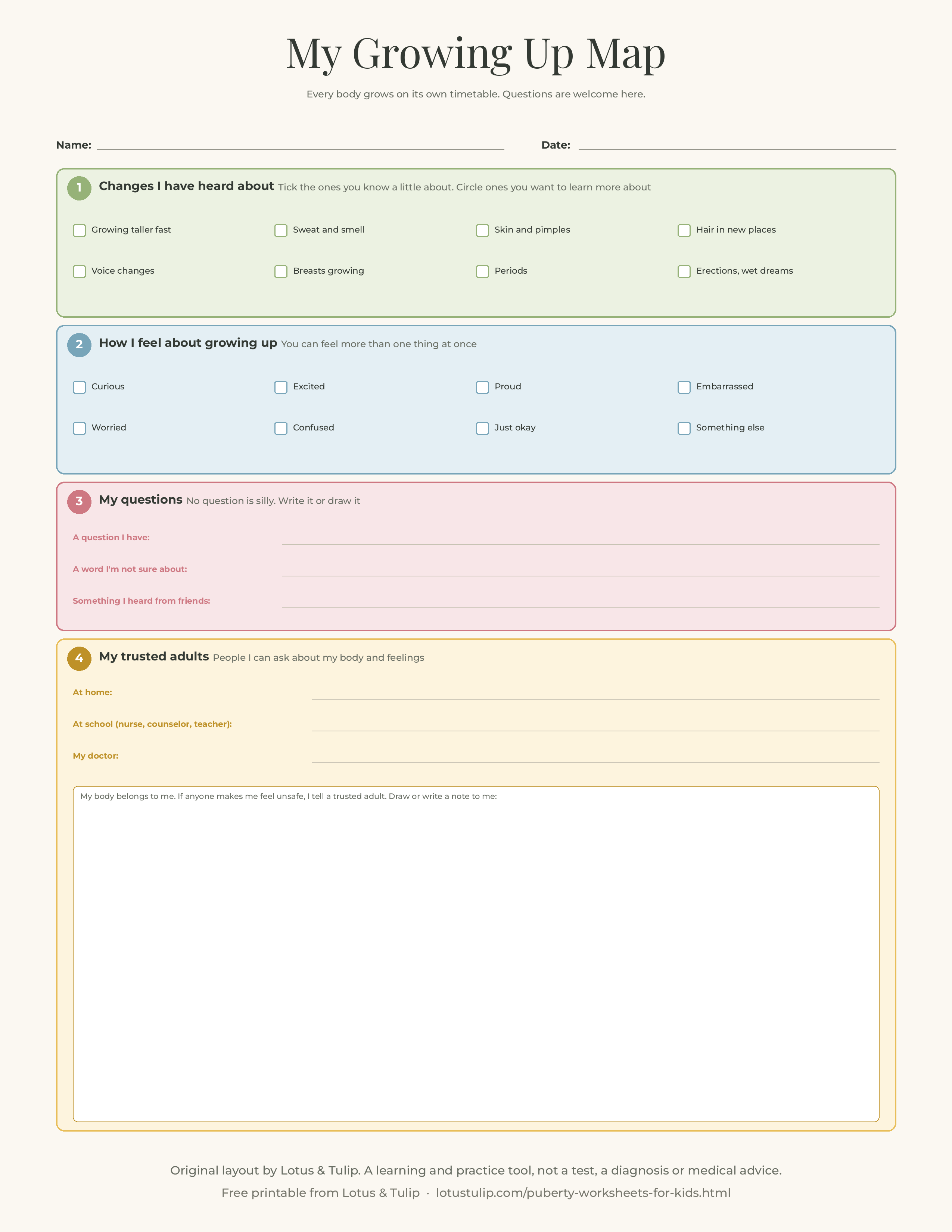
- Growing up map. Which changes the child has heard about and which ones they want to learn more about. It is a starting point, not a quiz.
- Feelings about growing up. Curious, proud, embarrassed, worried or all of them at once. Naming feelings makes them easier to talk about.
- Question box. A place to write or draw questions, including words heard from friends, so children can ask without saying the question out loud.
- Body parts and correct names. A simple labeled diagram or matching page using medical words, which helps children describe health problems and any unsafe touch.
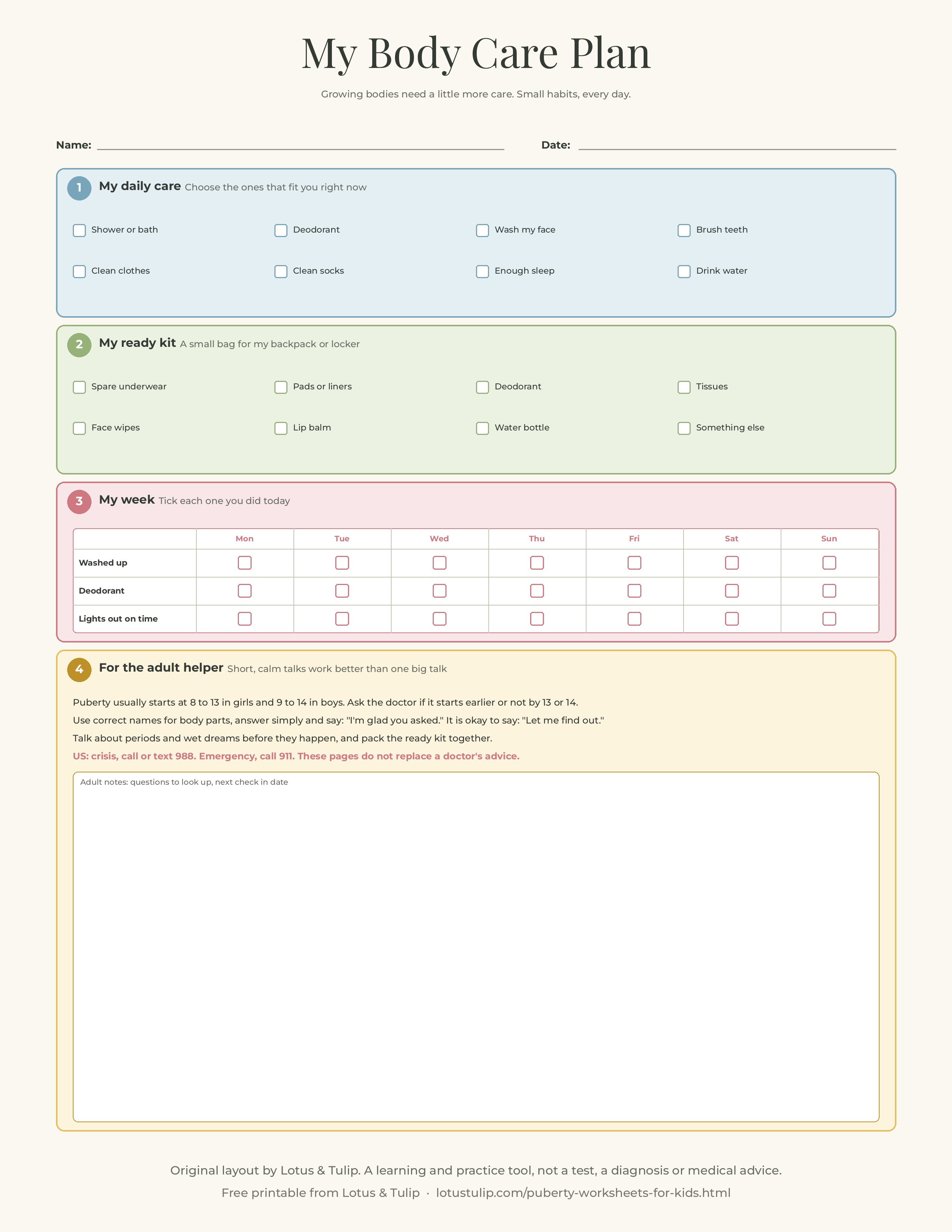
- Body care plan. Daily hygiene habits such as showering, deodorant, washing the face and clean clothes, chosen by the child.
- Ready kit checklist. A small bag for the backpack or locker with spare underwear, pads or liners, deodorant and tissues.
- Trusted adults and body safety. Who the child can ask at home, at school and at the doctor, and the rule that their body belongs to them.
- Weekly tracker. Washed up, deodorant, lights out on time. Tracking small habits builds independence without nagging.
How to use puberty worksheets for kids, step by step
- Start early and check your own facts. Aim to begin by about age 8, before the first changes. Read a trusted source such as your child's doctor, the NICHD or a good puberty book so you feel ready for common questions.
- Pick a calm, side by side moment. In the car, on a walk or at the kitchen table, not in front of siblings. Try: "Bodies change as kids grow up. I want you to know what's coming, and you can ask me anything."
- Fill in My Growing Up Map together. Let the child tick the changes they have heard about and circle the ones they want to know more about. Do not correct or tease. What they tick tells you where to start.
- Name the feelings. Use the feelings section to say that excited, embarrassed and worried can all be true at once, and share a short, light memory of your own if it helps.
- Answer one question at a time. Use correct names, keep answers short and check: "Does that answer your question?" If you do not know, say "Let me find out" and come back to it.
- Talk about periods and wet dreams before they happen. All children should learn about both, whatever their sex, so nobody is shocked or teased. Explain that both are normal signs of a healthy body.
- Make the body care plan and ready kit. On My Body Care Plan, let the child choose daily care steps and pack the ready kit together. Shopping for deodorant or pads together makes it practical rather than awkward.
- Name trusted adults and the body safety rule. Write down people the child can ask at home, at school and at the doctor. Make it clear that their body belongs to them, that secrets about touching are never okay, and that they will not be in trouble for telling.
- Use the tracker and come back often. Tick the weekly tracker for a few weeks, praise effort and keep returning to the question box. Check in again before school puberty lessons, before middle school and whenever a new change appears. Call the doctor if puberty seems very early or very late, and get help quickly if your child seems very low.
How to adapt it by age
- Ages 8 to 9: keep it simple and concrete: bodies change, there are correct names, everyone grows at a different time, and you can always ask. Introduce periods and body odor before they appear. Drawing counts as an answer.
- Ages 10 to 11: most children are noticing changes in themselves or classmates. Cover all the main changes for both sexes, hygiene habits, the ready kit, mood changes and teasing. This is a good time to prepare for school puberty lessons.
- Ages 12 to 13: respect growing privacy. Offer a book or a trusted website and let the child read on their own, then check in. Talk about body image, social media, crushes and consent. For older teens, see self esteem activities for teens.
- Children with autism, ADHD or developmental differences: start earlier, use pictures, step by step visual routines for showering and period care, and practice with real products before they are needed. Repeat often and keep the language literal.
Supporting children through puberty at school
- Coordinate with families. Let parents know when puberty lessons are planned and what will be covered, so they can prepare their child and continue the talk at home.
- Make period supplies easy to get. A discreet supply in the nurse's office or restrooms, and a clear way to ask for a bathroom pass without explaining.
- Use a question box. Anonymous written questions let students ask what they would never say out loud. Answer them factually and kindly.
- Stop teasing quickly. Early or late developers are easy targets. Treat comments about bodies, bras, voices or smell as bullying. See bullying worksheets for kids.
- Think about PE and changing rooms. Offer private changing options for students who need them, and allow time for deodorant after PE.
- Know when to refer. School counselors and nurses can refer to the child's doctor for very early or late development, and must follow mandated reporting procedures if a child discloses abuse.
Free to print for your own child, students, clients or groups. Please link to this page rather than re-uploading the file. A learning and practice tool that does not replace a doctor's advice. In a mental health crisis, call or text 988. In an emergency, call 911.
Buy the self esteem worksheets on Etsy
Common mistakes
- Waiting until the first change. By then, many children have already heard confusing or scary versions from friends. Start by about 8.
- Using cute names for body parts. Correct names help children describe health problems and any unsafe touch clearly.
- Only telling girls about periods, or only boys about wet dreams. Every child should understand the changes of both sexes, which cuts teasing and confusion.
- Teasing or commenting on a child's body. Jokes about bras, voices or smell, even from family, can make a child feel ashamed and less likely to ask.
- Making hygiene a battle. Nagging and shaming rarely work. Let the child choose products and steps, and use the tracker instead of reminders.
- Ignoring mood changes. Some irritability is normal, but long lasting sadness, withdrawal or talk of self harm needs a doctor or therapist.
Examples
- Maya, 9: had noticed breast buds and was hiding under big sweatshirts. Her mom used My Growing Up Map in the car on the way to dance. Maya circled "Periods" and wrote "Will it happen at school?" in the question box. They packed a ready kit for her backpack together, and Maya said she felt "less weird" knowing other girls in her class were changing too.
- Ethan, 11: refused to shower after soccer and got upset when his dad mentioned the smell. The school counselor used the body care plan in a small group, without singling anyone out. Ethan chose his own deodorant and a shower right after practice, and ticked the tracker for three weeks. The arguments at home stopped.
- Sofia, 12: was one of the last in her class to develop and felt left behind. Her doctor checked her and said she was within the normal range. With her school counselor she used the feelings section and the self esteem pages to work on "My body grows on its own timetable." She also found an adult at school she could ask questions.
Free printable: puberty worksheets for kids
This printable is an original Lotus & Tulip layout. It is not a test or a medical check and gives no score. Page 1, My Growing Up Map, has ticks for changes I have heard about and how I feel about growing up, lines for my questions and my trusted adults, and a body safety reminder. Page 2, My Body Care Plan, has a daily care checklist, a ready kit checklist, a 7 day tracker and notes for the adult helper, including the usual age range, when to see a doctor and the 988 and 911 numbers.
Download the free puberty worksheets for kids (PDF, 2 pages, US Letter)
Prefer single images? Page 1: My Growing Up Map (PNG) · Page 2: My Body Care Plan (PNG)
Related resources
- Body image worksheets for kids: when a changing body brings body worries
- Self esteem worksheets for kids: building confidence that does not depend on looks
- Personal space worksheet: body boundaries and body safety
- Middle school transition activities: getting ready for the move up
- Emotional regulation worksheets for kids: for bigger moods and feelings
- All counseling resources for kids and teens
FAQ
What age should I start talking to my child about puberty?
By about age 8, and earlier if you notice changes. Puberty typically begins between 8 and 13 in girls and 9 and 14 in boys, and US studies show many girls begin breast development around age 9 or earlier. Starting before the changes means your child is prepared rather than surprised.
What age does puberty start for girls and boys?
The NICHD says the physical changes typically begin between 8 and 13 in girls and between 9 and 14 in boys. In girls the first sign is usually breast buds, and in boys it is growth of the testicles. First periods usually come at about 12, with a wide normal range.
When is puberty too early or too late?
Signs of puberty before age 8 in girls or before 9 in boys can be precocious puberty, and no signs by about 13 in girls or 14 in boys can be delayed puberty. Both are worth a visit to your child's doctor, who can check whether it is within the normal range.
Should boys learn about periods and girls learn about wet dreams?
Yes. Every child should understand the main changes for both sexes. It reduces confusion and teasing, and helps children be kind to classmates who are going through changes at different times.
How do I talk to my child about puberty without it being awkward?
Keep talks short and frequent, choose side by side moments such as car rides, use correct names and answer one question at a time. A worksheet gives you both something to look at and a natural way to start. It is fine to say "I feel a bit awkward too, but this is important."
Can puberty affect my child's mood?
Yes. Many children feel more self conscious and moody during puberty. Research also links going through puberty earlier than peers with a somewhat higher risk of emotional problems. Keep talking, and see a doctor or therapist if low mood, anxiety or withdrawal lasts for weeks.
How can schools support students through puberty?
Tell families when puberty lessons are planned, keep period supplies easy to get, use an anonymous question box, stop body teasing quickly, offer private changing options and refer to the child's doctor or follow mandated reporting procedures when needed.
Sources
- American College of Obstetricians and Gynecologists (2015). Committee Opinion No. 651: Menstruation in girls and adolescents: using the menstrual cycle as a vital sign. Obstetrics and Gynecology, 126(6), e143 to e146.
- Biro, F. M., Greenspan, L. C., Galvez, M. P., Pinney, S. M., Teitelbaum, S., Windham, G. C., and colleagues (2013). Onset of breast development in a longitudinal cohort. Pediatrics, 132(6), 1019 to 1027.
- Chumlea, W. C., Schubert, C. M., Roche, A. F., Kulin, H. E., Lee, P. A., Himes, J. H., and Sun, S. S. (2003). Age at menarche and racial comparisons in US girls. Pediatrics, 111(1), 110 to 113.
- Herbert, A. C., Ramirez, A. M., Lee, G., North, S. J., Askari, M. S., West, R. L., and Sommer, M. (2017). Puberty experiences of low-income girls in the United States: a systematic review of qualitative literature from 2000 to 2014. Journal of Adolescent Health, 60(4), 363 to 379.
- Herman-Giddens, M. E., Slora, E. J., Wasserman, R. C., Bourdony, C. J., Bhapkar, M. V., Koch, G. G., and Hasemeier, C. M. (1997). Secondary sexual characteristics and menses in young girls seen in office practice. Pediatrics, 99(4), 505 to 512.
- Herman-Giddens, M. E., Steffes, J., Harris, D., Slora, E., Hussey, M., Dowshen, S. A., and colleagues (2012). Secondary sexual characteristics in boys: data from the Pediatric Research in Office Settings Network. Pediatrics, 130(5), e1058 to e1068.
- Mendle, J., Turkheimer, E., and Emery, R. E. (2007). Detrimental psychological outcomes associated with early pubertal timing in adolescent girls. Developmental Review, 27(2), 151 to 171.
- National Institute of Child Health and Human Development (NICHD). About puberty and precocious puberty. nichd.nih.gov.
- Ullsperger, J. M., and Nikolas, M. A. (2017). A meta-analytic review of the association between pubertal timing and psychopathology in adolescence: are there sex differences in risk? Psychological Bulletin, 143(9), 903 to 938.
- Wang, Z., Asokan, G., Onnela, J. P., Baird, D. D., Jukic, A. M. Z., Wilcox, A. J., and colleagues (2024). Menarche and time to cycle regularity among individuals born between 1950 and 2005 in the US. JAMA Network Open, 7(5), e2412854.
- Widman, L., Choukas-Bradley, S., Noar, S. M., Nesi, J., and Garrett, K. (2016). Parent-adolescent sexual communication and adolescent safer sex behavior: a meta-analysis. JAMA Pediatrics, 170(1), 52 to 61.
Lotus & Tulip is not affiliated with the researchers, agencies or organizations named on this page. Names in the examples are invented. This page is educational and does not replace professional advice, diagnosis or treatment.