
Therapist worksheets · Coping skills · Updated 2026-11-14
Coping skills worksheets for adults: problem focused vs emotion focused coping, what research shows, and how to build your own coping menu (free printable)
Crisis survival, self-soothing and riding out urges: DBT Worksheets for Therapists, skills handouts for adult clients across all four DBT skill areas Holiday 20% off: about $11.04, was $14 (EUR 12) · fillable PDF, instant digital download
Buy on EtsyTry it free first: download a fillable sample (weekly diary card and checking the facts, PDF, 234 KB). Type into it on screen, then get the full pack. No email needed.
Problem solving and the thoughts that make stress bigger: CBT Worksheets for Therapists, 20 pages including thought records and core beliefs Holiday 20% off: about $11.04, was $14 (EUR 12) · fillable PDF, instant digital download
Buy on EtsyTry it free first: download a fillable stress sample (problem solving steps and coping cards, PDF, 197 KB). Type into it on screen, then get the full pack. No email needed.
A full caseload: Therapist Worksheets Mega Bundle (8 packs incl. DBT, CBT, ACT, anxiety, grief and ADHD) Holiday 20% off: about $35.88, was $45 (EUR 39) · fillable PDFs for all 8 packs plus 160 printable pages, instant digital download
Buy on EtsyA tense email from your manager lands at 6 pm. You could start drafting a reply, call a friend, go for a walk, pour a large glass of wine, or lie awake replaying it until 2 am. All of those are coping. Some of them help tomorrow, some only help for the next hour, and a few make tomorrow harder.
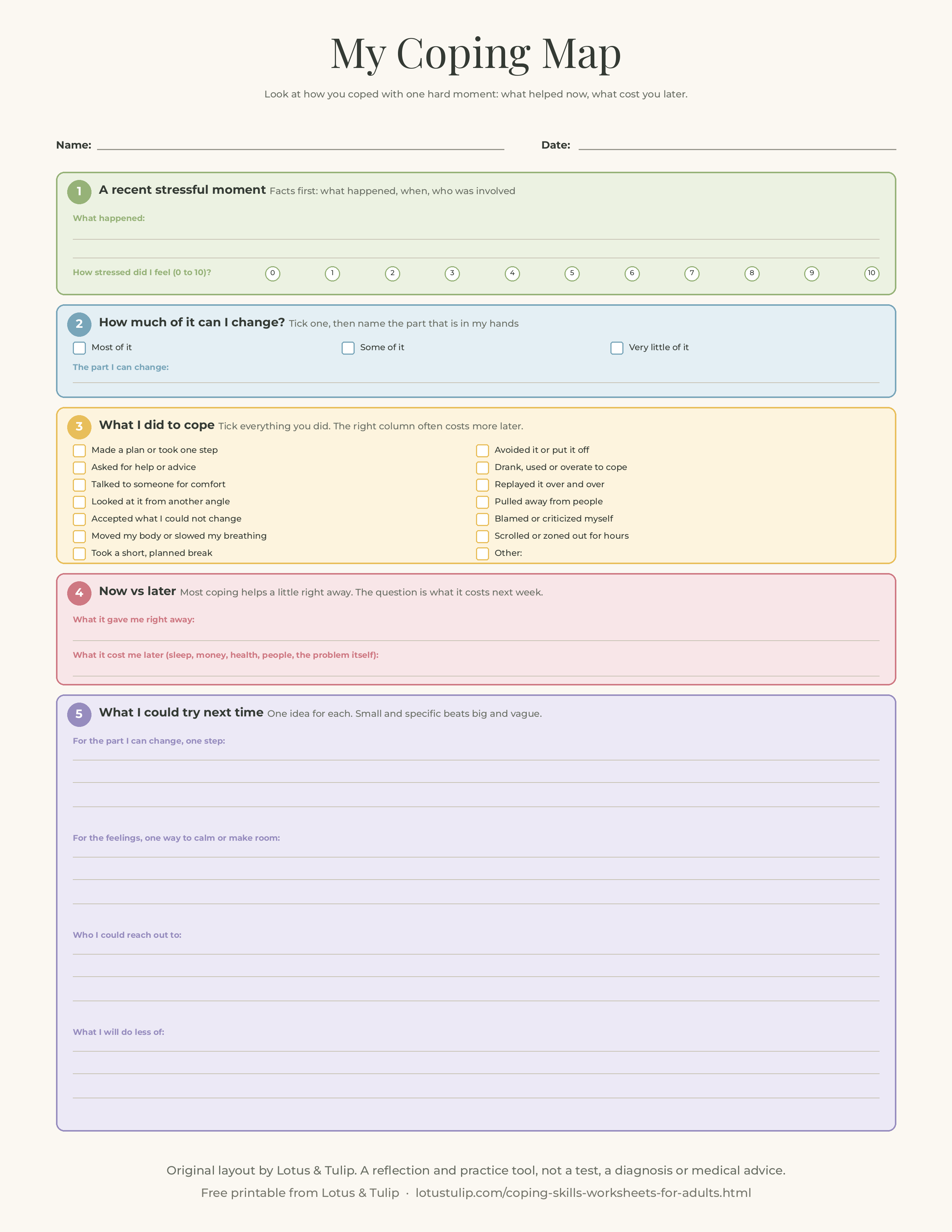
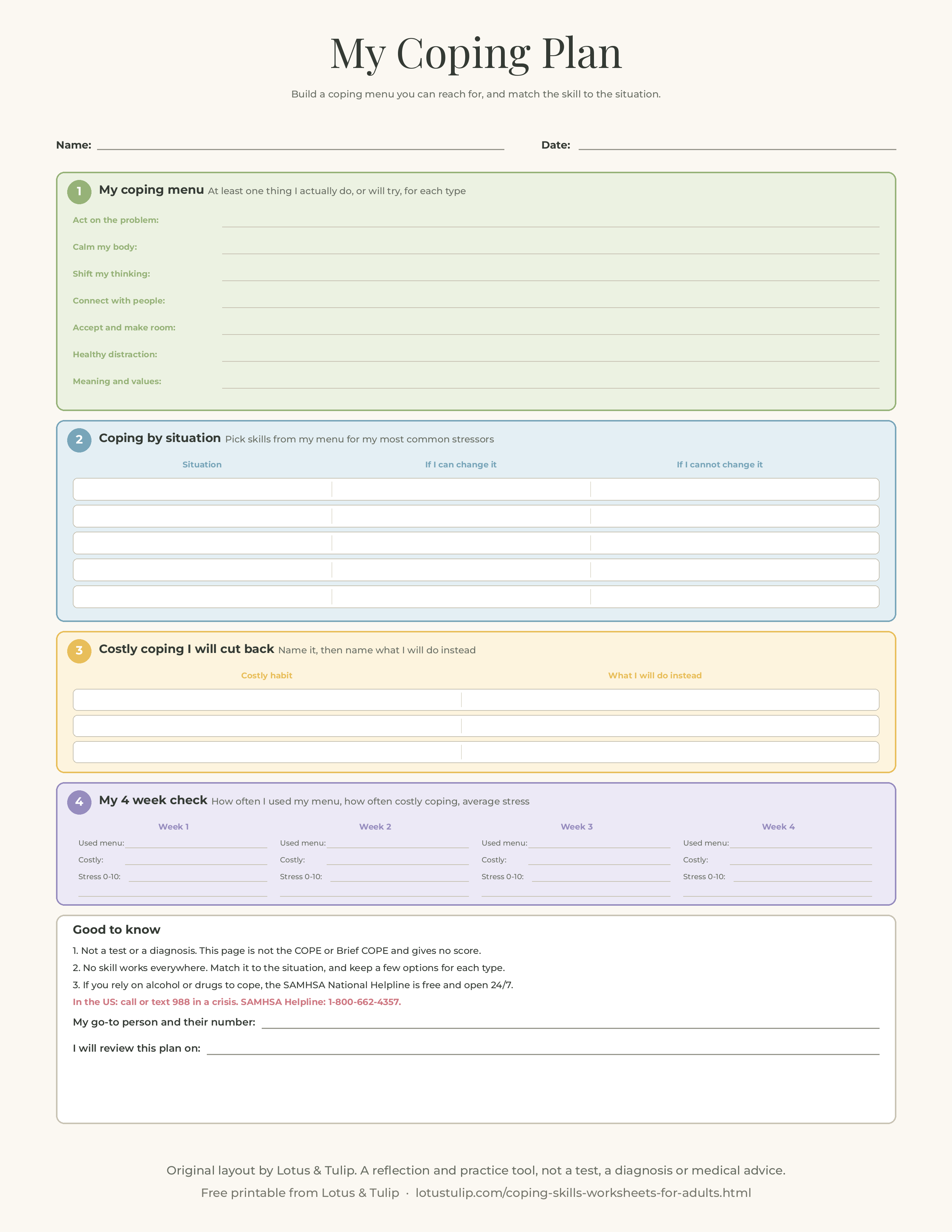
This guide is for adults who want a clearer picture of how they cope, and for the therapists, counselors and coaches who help them. It explains what coping actually is, the two ways researchers sort it (problem focused vs emotion focused, approach vs avoidance), what the research honestly shows, a coping skills list for adults by type, nine practical steps, common mistakes and three short examples. It ends with a free 2 page printable: My Coping Map, for looking at how you coped with one hard moment, and My Coping Plan, a personal coping menu matched to the situations you face most.
Download the free coping skills worksheets for adults (PDF, 2 pages, US Letter)
Direct download, no email or sign up. See the pages first.
What coping is (and is not)
Coping is anything you do, in your head or in action, to manage a situation that feels like more than you can easily handle. The most cited definition comes from the psychologists Richard Lazarus and Susan Folkman, who in their 1984 book Stress, Appraisal, and Coping described coping as "constantly changing cognitive and behavioral efforts to manage specific external and/or internal demands that are appraised as taxing or exceeding the resources of the person" (p. 141).
Three things follow from that definition, and the worksheet is built on all three:
- Coping is an effort, not a result. In Lazarus and Folkman's model, coping counts as coping whether or not it works. Drinking to get through the evening is coping. So is calling your sister. The useful question is not "am I coping?" but "what is this way of coping costing me?"
- Coping changes from moment to moment. It is not a fixed personality trait. You can cope well with a work deadline and badly with a fight with your partner in the same week.
- Coping depends on how you read the situation. What is at stake, and what you believe you can do about it, shapes which kind of coping makes sense.
Two ways to sort coping
Problem focused vs emotion focused. One of the earliest splits, from Folkman and Lazarus (1980), separates coping by what it is aimed at. Problem focused coping tackles the cause of the stress: making a plan, taking the next step, asking for practical help. Emotion focused coping tackles the distress itself: seeking comfort, distracting yourself, reframing, or, less helpfully, using alcohol or drugs. In their 2004 review in the Annual Review of Psychology, Folkman and Moskowitz describe this split as a useful way of talking about many kinds of coping in broad brushstrokes. In daily life one action can do both: a call to a friend can calm you and also produce a plan. Our stress management worksheet uses this split to sort stressors by how much of each you can change.
Approach vs avoidance. A second split, set out by Susan Roth and Lawrence Cohen in 1986, asks whether your thinking and feeling are turned toward the threat or away from it. Approach coping includes, for example, facing the problem, gathering information and working through the feelings. Avoidance coping includes, for example, denial, putting things off, numbing and pulling away. Roth and Cohen were clear that avoidance is not always bad: in small doses it can lower distress, buy time and let you take in hard news gradually, and denial can help early in a crisis, or in a situation that cannot be controlled and is too threatening to take in all at once. The trouble comes when avoidance becomes the default and the problem, or the feeling, never gets dealt with.
This worksheet uses both lenses. Page 1 asks how much of the situation you can change and whether what you did moved you toward the problem or away from it. Page 2 turns that into a menu with options for both.
What the research says
- No single coping style wins everywhere. Penley, Tomaka and Wiebe (2002) ran a series of meta-analyses on coping and health in nonclinical adult samples. Problem focused coping was linked with better overall health outcomes, while avoidance, wishful thinking, distancing, confrontive coping, self-control, seeking social support and accepting responsibility were each linked with worse outcomes. Planful problem solving and positive reappraisal were not significantly linked with overall outcomes. Crucially, many of these links changed with the type of outcome (physical or psychological) and the type of stressor, including how controllable it was and how long it lasted. These are correlations, so they cannot show that a strategy causes better or worse health; someone under heavy stress may seek more support precisely because things are bad.
- Rumination and avoidance stand out. Aldao, Nolen-Hoeksema and Schweizer (2010) combined 241 effect sizes from 114 studies on six regulation strategies and symptoms of anxiety, depression, eating and substance related problems. Rumination showed a large association with symptoms, and avoidance and suppression medium to large ones, while problem solving was associated with fewer symptoms (a medium to large effect). Reappraisal and acceptance showed small to medium associations, which the authors called surprising given how central those skills are in CBT and acceptance based therapies. Replaying a problem over and over can feel like working on it. The research suggests it is closer to the opposite.
- Flexibility matters more than any one skill. Cheng, Lau and Chan (2014) pooled research from 1978 to 2013 on coping flexibility and adjustment to stressful life changes (k = 329, N = 58,946). Overall the link was small to moderate (r = .23). It was strongest when flexibility meant a good fit between the strategy and the situation, or feeling able to adapt to change, and weakest when it simply meant having a long list of strategies. In other words, a coping menu helps most when you also know which item suits which situation. That is why page 2 has a "coping by situation" table.
- Coping questionnaires describe, they do not diagnose. The COPE inventory (Carver, Scheier and Weintraub, 1989) measures 13 kinds of coping: five problem focused (active coping, planning, suppression of competing activities, restraint, seeking instrumental support), five that can be seen as emotion focused (seeking emotional support, positive reinterpretation, acceptance, denial, turning to religion) and three the authors call arguably less useful (focusing on and venting emotions, behavioral disengagement and mental disengagement). Carver's 1997 Brief COPE shortened it to 28 items across 14 two item scales, first tested with adults recovering after Hurricane Andrew. Carver himself notes that there is no overall score on the Brief COPE and that he recommends no particular way of working out a person's dominant coping style. Our free printable is not the COPE or the Brief COPE, and it gives no score.
A coping skills list for adults, by type
These seven types match the coping menu on page 2. Aim for at least one option you will actually use in each row, including some that take under five minutes.
- Act on the problem: write the next single step, break a task into 20 minute chunks, make the phone call you are avoiding, get information, set a limit or say no, ask for practical help.
- Calm your body: slow breathing with a longer out breath, a brisk 10 minute walk, cold water on your face, stretching, a shower, eating a proper meal, protecting sleep.
- Shift your thinking: name the thinking trap, ask what you would tell a friend, look for what you can still control, write the worst, best and most likely outcome, schedule worry for later.
- Connect with people: text one person, ask for a hug, talk it through with someone who listens well, join a group, see your therapist, ask a colleague how they handled the same thing.
- Accept and make room: name the feeling and let it be there, remind yourself that this is a hard moment and hard moments pass, write about it for 10 minutes, let go of what is not yours to fix.
- Healthy distraction: a set episode or chapter, a puzzle, music, cooking, a hobby, a short game. Planned and time limited, not hours of scrolling.
- Meaning and values: ask what matters to you in this situation, do one small thing that fits who you want to be, find any part of it that could teach you something, pray or meditate if that is part of your life.
How to use coping skills worksheets for adults, step by step
- Pick one recent stressful moment. On page 1, write a specific moment from the last week: what happened, when and who was involved. Then rate how stressed you felt from 0 to 10. "Sunday night, reading the email about the reorganization" gives you more to work with than "work is stressful."
- Decide how much of it you can change. Tick most, some or very little, then write the part that is in your hands. Even a situation you cannot change usually has a small piece you can: how you prepare, who you tell, how you look after yourself through it.
- Tick everything you actually did. Be honest, including the things you are not proud of. The left column (making a plan, asking for help, talking to someone, reframing, accepting, moving your body, a planned break) tends to help over time. The right column (avoiding, drinking or overeating to cope, replaying it, pulling away, self blame, hours of scrolling) often costs more later.
- Compare now with later. Write what your coping gave you right away and what it cost you later: sleep, money, health, relationships, or the problem itself getting bigger. Most costly coping works in the short term, which is exactly why it sticks.
- Plan what you could try next time. In the last box on page 1, write one step for the part you can change, one way to calm or make room for the feelings, one person you could reach out to, and one thing you will do less of.
- Build your coping menu. On page 2, fill in at least one option for each of the seven types: act on the problem, calm your body, shift your thinking, connect with people, accept and make room, healthy distraction, and meaning and values. Use the list above for ideas, and write things you will really do, not things you think you should do.
- Match skills to your common situations. In the "coping by situation" table, list two to five stressors that come up often, such as conflict at work, money worries, caring for a parent or a health problem. For each, write what you will do if you can change it and what you will do if you cannot. Changeable problems usually call for acting on the problem plus something to calm your body. Problems you cannot change call for acceptance, support, meaning and kind distraction.
- Pick one costly habit to cut back. Write the habit (for example, a drink every evening to unwind, or replaying arguments in bed) and what you will do instead. Replacing is easier than just stopping. Add the name and number of your go-to person at the bottom of the page.
- Practice and review after four weeks. Try menu items when you are only mildly stressed so they are easier to reach for when it is bad. Each week, note how often you used your menu, how often you used costly coping and your average stress. If stress stays high, or you are relying on alcohol or drugs to get through, talk to a doctor or therapist. The SAMHSA National Helpline (1-800-662-4357) is free, confidential and open 24/7. In the US, call or text 988 in a mental health crisis.
Common mistakes
- Using one strategy for everything. Problem solving a grief you cannot fix leads to frustration. Soothing yourself about a bill you could pay today leads to a bigger bill. Match the skill to the situation.
- Mistaking rumination for problem solving. Going over the same conversation for the tenth time feels productive. If no new step comes out of it, it is rumination, and it is one of the strategies most consistently linked with anxiety and low mood.
- Treating all distraction as avoidance. A planned 30 minute break can help you come back to a problem calmer. Distraction becomes a problem when it is open ended and the issue never gets looked at.
- Writing a menu and never practicing it. Skills you have only read about are hard to reach for at a stress level of 8. Try them at 3 or 4 first.
- Only listing emotion focused options. Bubble baths and breathing help, but if every item on your menu is about feeling better, nothing on it changes the situation. Make sure at least one row is about action.
- Using a coping questionnaire as a verdict. Tools like the Brief COPE describe what someone did with a particular stressor. They are not a diagnosis, and a high score on one scale does not make someone a "bad coper."
Examples
- The reorganization email: After hearing about layoffs, he spent three evenings refreshing the company intranet and replaying meetings in bed. On page 1 he rated the moment 8, ticked "some of it" can change, and in the cost box wrote "four hours of sleep a night." His next time plan: update his resume for 30 minutes (act on it), a walk after work (calm his body), and a call with a former colleague who had been through a layoff (connect). By week four his average stress was a 5 and he had two interviews lined up.
- The caregiver: She looks after her mother, who has dementia, and felt guilty that nothing she did made it better. The map showed she was trying to problem solve something that could not be solved, and that she had stopped seeing friends. On her coping by situation table she split it: what she can change (a respite day each week, a support group, sharing tasks with her brother) and what she cannot (the illness itself), where she wrote acceptance, a short walk and a weekly phone call with an old friend.
- The therapist and the evening drink: A client said a few glasses of wine every night were the only thing that helped after work. His therapist used the now vs later box without judgment: relief right away, poor sleep and irritability the next day. They built a menu together, with cooking dinner, a 20 minute run and calling his brother as the new unwind routine, and named the drinking as the one costly habit to cut back. The therapist also gave him the SAMHSA Helpline number and checked drinking at each session.
Free printable: coping skills worksheets for adults
This free printable is an original Lotus & Tulip layout on US Letter, in our own wording. It is not the COPE or the Brief COPE, and it does not give a score. Page 1, My Coping Map, covers a recent stressful moment and how stressed you felt, how much of it you can change, what you did to cope, what it gave you now and cost you later, and what you could try next time. Page 2, My Coping Plan, covers a personal coping menu across seven types, coping by situation, costly coping to cut back, a 4 week check, your go-to person and a review date.
Download the free coping skills worksheets for adults (PDF, 2 pages, US Letter)
Prefer single images? Page 1: my coping map (PNG) · Page 2: my coping plan (PNG)
Free to print for yourself or for use with your own clients or groups. Please link to this page rather than re-uploading the file. A reflection and planning tool, not a test, a diagnosis or a substitute for therapy. If you rely on alcohol or drugs to cope, the SAMHSA National Helpline offers free, confidential treatment referral and information at 1-800-662-4357, 24 hours a day. In the US, call or text 988 in a mental health crisis. In immediate danger, call 911.
Related resources
- Stress management worksheet for adults: sort your stressors by how much you can change, with a free stress map and plan
- Emotion regulation worksheets for adults: name a feeling, choose a strategy and ride it out
- Distress tolerance worksheets: DBT crisis survival skills for getting through without making it worse
- DBT TIPP skills worksheet: fast ways to bring intense emotion down
- Rumination worksheet: when replaying a problem has replaced solving it
- Coping skills worksheets for teens: the teen version, with a 60 skill list
- All therapist worksheets: CBT, DBT, ACT and more
- Motivational interviewing worksheet: help someone find their own reasons to try a new coping habit
- Problem solving worksheet for adults: the step by step side of problem focused coping, with a free map and plan
FAQ
What are coping skills worksheets for adults?
Coping skills worksheets for adults are structured pages that help you look at how you handle stress, notice which ways of coping help and which cost you later, and build a personal list of skills matched to the situations you face. The free 2 page printable on this page has a coping map for one hard moment and a coping plan with a coping menu. It is an original reflection tool, not a test or a published questionnaire.
What are the main types of coping?
Researchers most often sort coping two ways. Problem focused coping tackles the cause of stress (planning, taking action, asking for practical help), while emotion focused coping manages the distress (seeking comfort, reframing, acceptance, distraction). Approach coping turns toward the problem and the feelings, while avoidance coping turns away from them. Most people use a mix of all of these.
Is problem focused coping better than emotion focused coping?
Not always. Problem focused coping tends to be linked with better health outcomes on average, but research shows the links depend on the situation, including how controllable the stressor is and how long it lasts. When you can change something, acting on it usually helps. When you cannot, emotion focused skills such as acceptance and support are often the better fit. Choosing the right strategy for the situation matters more than any single strategy.
What are examples of unhealthy coping skills in adults?
Common ones are using alcohol or drugs to get through, avoiding or putting off the problem, replaying it over and over (rumination), pulling away from people, harsh self blame, overeating, and hours of scrolling or zoning out. Most of them bring quick relief, which is why they stick. The worksheet's "now vs later" box helps you weigh that relief against what it costs.
Is avoidance always a bad way to cope?
No. A short, planned break or a little denial early in a crisis can lower distress and give you time to take in hard news. Avoidance becomes a problem when it is the default, so the issue or the feeling never gets dealt with. In research it is among the strategies most consistently linked with anxiety and depression symptoms.
Can therapists use these worksheets with clients?
Yes. They are free to print for use with your own clients or groups. Please link to this page rather than re-uploading the file. They work well early in treatment to map a client's current coping, and again later to review progress. If a client relies heavily on alcohol or drugs to cope, assess substance use directly and share the SAMHSA National Helpline (1-800-662-4357) if they need a referral.
Sources
- Aldao, A., Nolen-Hoeksema, S., and Schweizer, S. (2010). Emotion-regulation strategies across psychopathology: A meta-analytic review. Clinical Psychology Review, 30(2), 217 to 237.
- Carver, C. S. (1997). You want to measure coping but your protocol's too long: Consider the Brief COPE. International Journal of Behavioral Medicine, 4(1), 92 to 100.
- Carver, C. S., Scheier, M. F., and Weintraub, J. K. (1989). Assessing coping strategies: A theoretically based approach. Journal of Personality and Social Psychology, 56(2), 267 to 283.
- Cheng, C., Lau, H. P. B., and Chan, M. P. S. (2014). Coping flexibility and psychological adjustment to stressful life changes: A meta-analytic review. Psychological Bulletin, 140(6), 1582 to 1607.
- Folkman, S., and Lazarus, R. S. (1980). An analysis of coping in a middle-aged community sample. Journal of Health and Social Behavior, 21(3), 219 to 239.
- Folkman, S., and Moskowitz, J. T. (2004). Coping: Pitfalls and promise. Annual Review of Psychology, 55, 745 to 774.
- Lazarus, R. S., and Folkman, S. (1984). Stress, Appraisal, and Coping. New York: Springer. Definition of coping, p. 141.
- Penley, J. A., Tomaka, J., and Wiebe, J. S. (2002). The association of coping to physical and psychological health outcomes: A meta-analytic review. Journal of Behavioral Medicine, 25(6), 551 to 603.
- Roth, S., and Cohen, L. J. (1986). Approach, avoidance, and coping with stress. American Psychologist, 41(7), 813 to 819.
- SAMHSA (Substance Abuse and Mental Health Services Administration). National Helpline, 1-800-662-HELP (4357). samhsa.gov.