
Therapist worksheets · Emotion regulation for adults · Updated 2026-11-13
Emotion regulation worksheets for adults: what emotion regulation is, what research shows helps, and how to name a feeling, choose a strategy and ride it out (free printable)
The full DBT skill set: DBT Worksheets for Therapists, skills handouts for adult clients across all four DBT skill areas, including emotion regulation Holiday 20% off: about $11.04, was $14 (EUR 12) · fillable PDF, instant digital download
Buy on EtsyTry it free first: download a fillable sample (weekly diary card and checking the facts, PDF, 234 KB). Type into it on screen, then get the full pack. No email needed.
Making room for hard feelings: ACT Worksheets for Therapists, incl. values, defusion and committed action pages Holiday 20% off: about $9.20, was $12 (EUR 10) · fillable PDF, instant digital download
Buy on EtsyTry it free first: download a fillable sample (values compass and unhooking from thoughts, PDF, 259 KB). Type into it on screen, then get the full pack. No email needed.
A full caseload: Therapist Worksheets Mega Bundle (8 packs incl. CBT, anxiety, DBT, ACT, grief and ADHD) Holiday 20% off: about $35.88, was $45 (EUR 39) · fillable PDFs for all 8 packs plus 160 printable pages, instant digital download
Buy on EtsyA small comment at work ruins your whole afternoon. A text from your ex leaves you shaky for hours. You know you are overreacting, and knowing it does not help. Or the opposite: you push feelings down so hard that you feel flat, then snap over something tiny. Both are problems of emotion regulation, and both respond to practice.
This guide is for adults who want more say over how their emotions play out and for the therapists, counselors and coaches who work with them. It explains what emotion regulation is (and is not), what research shows about which strategies help and which backfire, nine practical steps, common mistakes and examples. It ends with a free 2 page printable: My Emotion Map, an emotion log for spotting your patterns and the strategies you lean on, and My Emotion Regulation Plan, which covers lowering your vulnerability, naming the feeling, picking a strategy at the right moment, rethinking the situation and a 7 day check.
Download the free emotion regulation worksheets (PDF, 2 pages, US Letter)
Direct download, no email or sign up. See the pages first.
What emotion regulation is
Emotion regulation means influencing which emotions you have, when you have them and how you experience and express them. That is close to the definition the psychologist James Gross gave in 1998. It is not the same as getting rid of feelings or staying calm all the time. Sometimes regulating well means letting yourself feel sad at a funeral, or turning anger into a clear request instead of a shout.
You can step in at five points. Gross's process model describes five families of strategies, in the order an emotion unfolds: situation selection (choosing which situations you walk into), situation modification (changing the situation you are in), attentional deployment (where you put your attention, for example distraction), cognitive change (rethinking what the situation means, often called reappraisal) and response modulation (changing your reaction once the emotion is already there, for example slow breathing or hiding your expression). The earlier you step in, the less work it usually takes.
Emotion dysregulation is a pattern, not a diagnosis. Gratz and Roemer (2004) described difficulties in emotion regulation as several related problems: not accepting your emotions, trouble getting things done while upset, trouble controlling impulses while upset, low awareness of emotions, feeling there is nothing you can do once upset, and low clarity about what you feel. Their 36 item Difficulties in Emotion Regulation Scale (DERS) measures these six areas. The worksheet below is not the DERS and gives no score, but the same six areas are a useful checklist for where to start.
What the research says helps
- Rethinking tends to work better than hiding. Gross and John (2003) compared two everyday strategies across five studies. People who habitually used reappraisal (changing how they think about a situation) reported more positive emotion, less negative emotion, closer relationships and better well-being. People who habitually used suppression (hiding what they feel on the outside) reported the reverse. These are correlational findings, but they match the experimental work.
- In experiments, cognitive change has the clearest effect. Webb, Miles and Sheeran (2012) pooled 306 experimental comparisons of strategies from Gross's model. Cognitive change, such as reappraising the situation or taking another person's perspective, had a small to medium effect on emotional outcomes. Response modulation had a small effect overall: hiding the outward expression of an emotion helped, but trying to suppress the feeling itself or push away thoughts of the event did not. Attentional strategies had no effect on average, because they pulled in opposite directions: distraction helped, while concentrating on the feelings made things worse.
- Rumination, avoidance and suppression are linked with more problems. Aldao, Nolen-Hoeksema and Schweizer (2010) combined 241 effect sizes from 114 studies on everyday strategies and symptoms of anxiety, depression, eating problems and substance use. Rumination had the strongest link with symptoms, and avoidance and suppression were also clearly linked. Problem solving was linked with fewer symptoms, reappraisal with somewhat fewer, and acceptance pointed the same way without reaching significance. In plain words: cutting back on the unhelpful strategies matters at least as much as adding helpful ones.
- Putting feelings into words helps. In a brain imaging study, Lieberman and colleagues (2007) found that labeling the emotion in a picture ("angry", "scared") reduced activity in the amygdala, a brain area involved in emotional reactions, compared with other ways of looking at the same pictures. Naming a feeling is a small step, but it is the base of most emotion regulation programs.
- Emotion regulation skills can be taught. Dialectical behavior therapy (DBT), developed by Marsha Linehan, teaches an emotion regulation module that covers understanding and naming emotions, checking the facts, opposite action, problem solving and lowering vulnerability through daily habits (Linehan, 2015). DBT was built for people with intense, hard to manage emotions, and the skills are now widely used with many adult clients.
Put together: get to know your emotions and name them, notice which strategies you lean on and what they cost, look after the basics that make you more reactive, step in early where you can, use reappraisal and problem solving when the situation allows, accept and ride out what you cannot change, and cut back on rumination, avoidance and bottling things up. That is what the two pages below walk through.
How to use emotion regulation worksheets, step by step
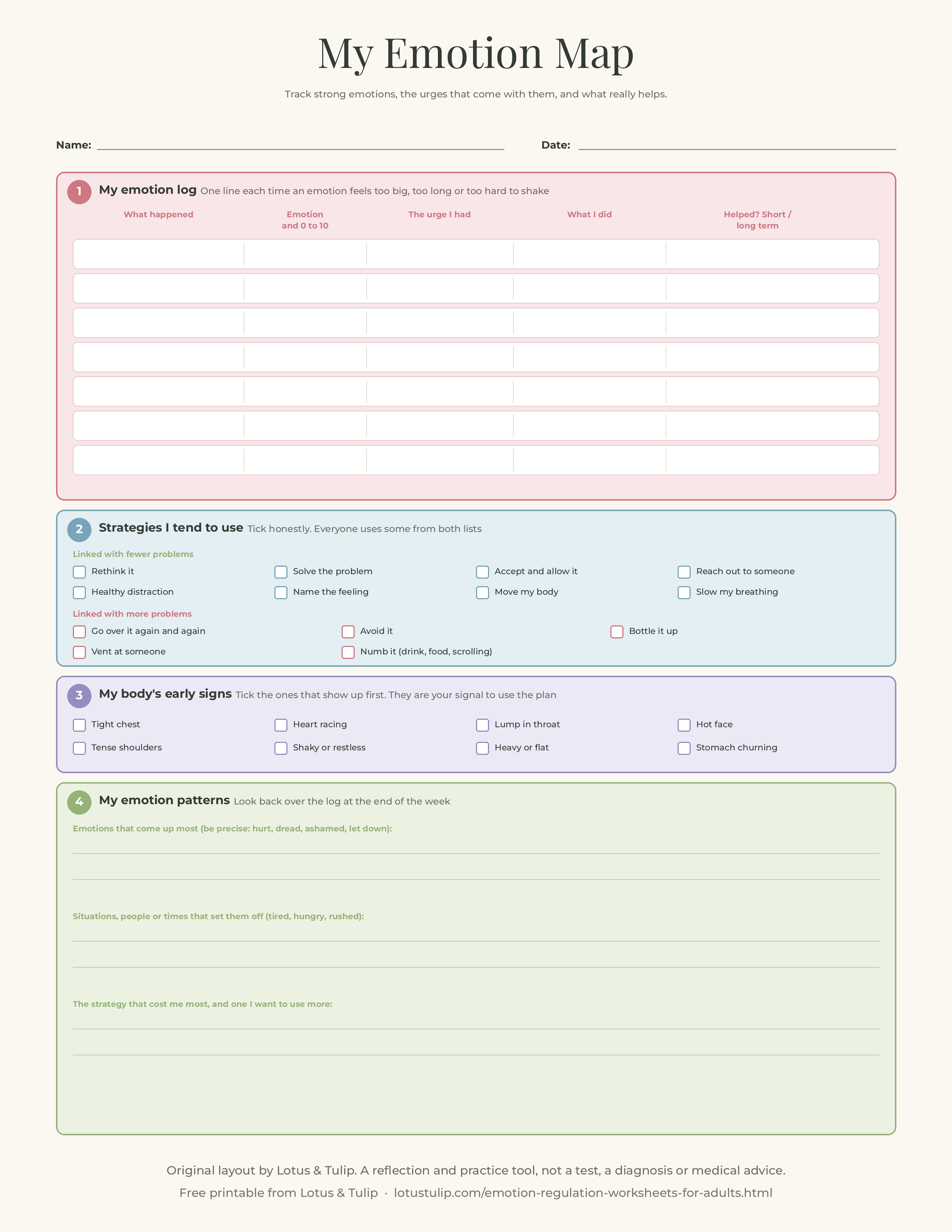
- Log strong emotions for a week. On page 1, write one line each time an emotion feels too big, too long or too hard to shake: the situation, the emotion and how strong it was from 0 to 10, the urge you had, what you actually did, and whether it helped in the short run and the long run. Small episodes count. Patterns hide in the everyday ones.
- Name the emotion as precisely as you can. "Bad" or "stressed" is a start. "Embarrassed", "disappointed" or "dreading" is better, because each points to a different need. If finding the word is hard, a feelings wheel helps. Naming is a skill that grows with practice.
- Tick the strategies you tend to use. Page 1 has two short lists: strategies research links with fewer problems (rethinking, problem solving, accepting, reaching out, a healthy distraction) and ones linked with more (going over it again and again, avoiding, bottling it up, venting at someone, numbing with alcohol, food or scrolling). Be honest. Everyone uses some of the second list.
- Find your patterns. At the end of the week, look for repeat situations, times of day and emotions. Many people find that their worst moments cluster when they are tired, hungry, ill, rushed or have had no break all day.
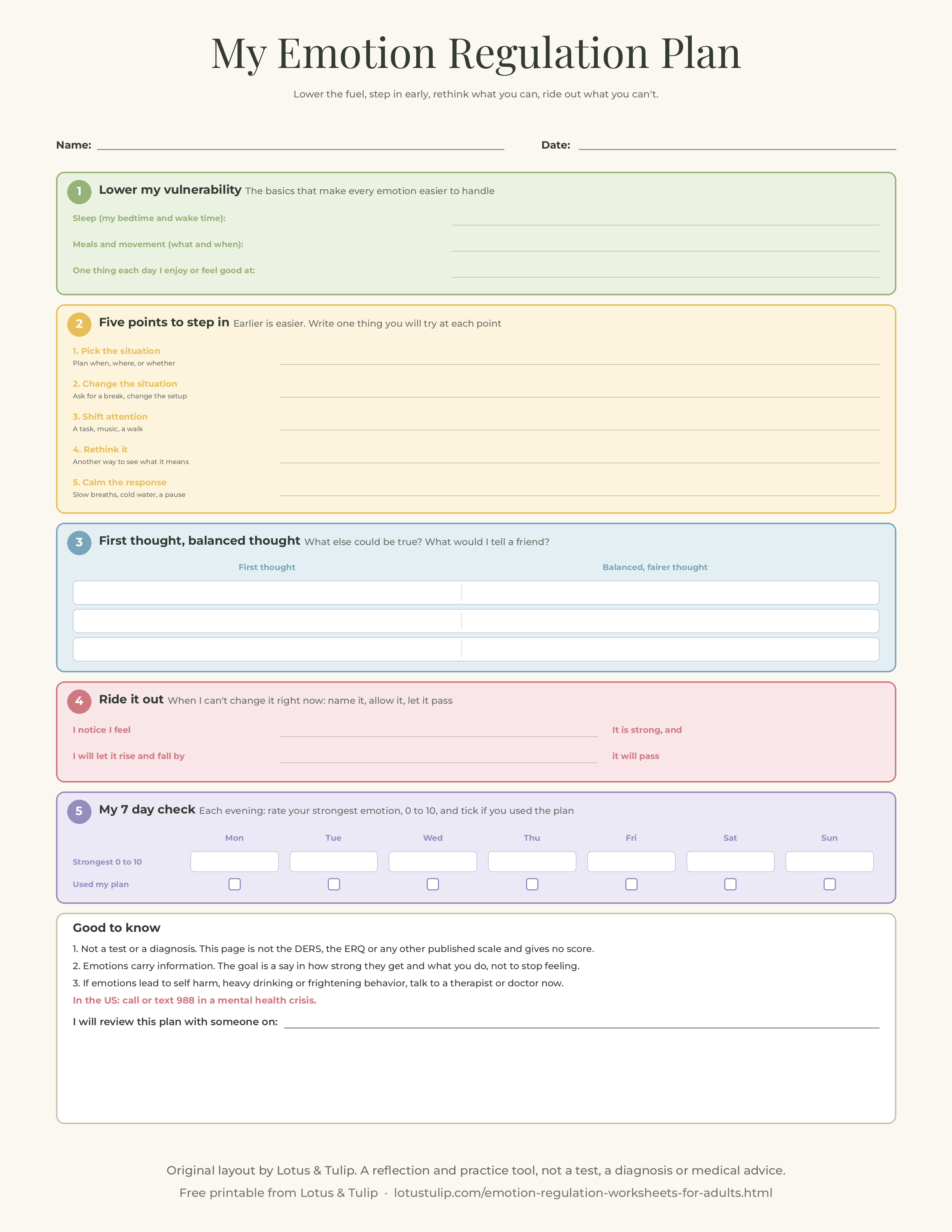
- Lower your vulnerability first. On page 2, plan the basics: sleep, regular meals, movement, limits on alcohol, and at least one thing each day you enjoy or that gives you a sense of mastery. DBT teaches this as the PLEASE and ABC skills. It is the least exciting step and often the one that helps most. The DBT PLEASE skills worksheet goes deeper.
- Choose a strategy for the right moment. Page 2 lists the five points from Gross's model in plain words: pick the situation, change the situation, shift attention, rethink it, and calm the response. For each of your common situations, write one thing you will try. Before a hard conversation, for example, you might plan the time and place. During it, you might rethink one hot thought. Afterward, you might take a walk rather than replay it.
- Practice rethinking on paper. Use the table on page 2 to write the first thought ("She ignored me, she must be annoyed with me") and a more balanced one ("She was rushing to a meeting, I can ask later"). The goal is a fairer view, not forced positivity. The check the facts worksheet and the cognitive restructuring worksheet add more structure.
- Accept and ride out what you cannot change. Some feelings fit the facts and some situations cannot be fixed today. Then the skill is to let the emotion rise and fall without feeding it: notice it, breathe, and remind yourself that emotions pass when you stop arguing with them. When the urge is to act in a way you will regret, opposite action and urge surfing help.
- Check in daily and review weekly. Each evening, rate your strongest emotion from 0 to 10 and tick whether you used a strategy from your plan. After a week, compare with the log. Keep what helped, drop what did not and adjust the plan. Most people need several weeks of practice before a new strategy feels natural.
Common mistakes
- Trying to stop feeling. Emotions carry information. The aim is to have a say in how strong they get and what you do with them, not to stop having them. Trying to suppress the feeling itself tends not to work.
- Treating rumination as problem solving. Going over a situation again and again feels productive but usually keeps the emotion going. If you have thought about it three times without a new step, switch to a concrete action or a distraction. The rumination worksheet covers this in depth.
- Using one strategy for everything. Distraction is useful in a traffic jam and unhelpful for a problem that needs solving. Reappraisal is useful for a misread text and not for a situation that really is unfair. Flexibility matters more than any single strategy.
- Waiting until you are at a 9. Most skills are much easier at a 4 than at a 9. Learn your early signs and use the plan sooner.
- Skipping the basics. Poor sleep, skipped meals, alcohol and no rest make everyone more reactive. If your log shows emotions clustering at certain times, change the conditions as well as the reactions.
- Using a worksheet when the situation needs more. If emotions lead to self harm, thoughts of suicide, substance misuse or frightening behavior, get professional help now. A worksheet is a tool, not a treatment.
Examples
- The nurse after night shifts: Her log showed tears and irritability almost every time she drove home after a run of nights, with the urge to snap at her kids. She planned a 20 minute nap before family time, ate a proper meal before leaving work and agreed with her partner that hard topics wait until her second day off. Her evening ratings dropped from mostly 7s to mostly 4s within two weeks.
- The worrier at work: He ticked "going over it again and again" on almost every line, usually after feedback from his manager. He set a rule: after feedback, write one concrete next step, then take a 10 minute walk. On paper he rethought "She thinks I'm useless" as "She flagged two fixes and approved the rest."
- The bottler: A client in her 30s rarely logged anything above a 3 but often felt numb and then exploded over small things. With her therapist she practiced naming emotions twice a day, starting with a feelings wheel. Over a month her log shifted from "fine" to "disappointed", "lonely" and "resentful", and the explosions became rarer as she began to raise issues earlier.
Free emotion regulation worksheets for adults
This free printable is an original Lotus & Tulip layout on US Letter, in our own wording. It is not the Difficulties in Emotion Regulation Scale (DERS), the Emotion Regulation Questionnaire (ERQ) or any other published questionnaire, and it does not give a score. Page 1, My Emotion Map, has a 7 line emotion log (situation, emotion and 0 to 10, urge, what I did, helped short term and long term), a checklist of strategies you tend to use, a checklist of body signs and space for your patterns. Page 2, My Emotion Regulation Plan, has a vulnerability plan, five points to step in, a first thought to balanced thought table, a ride it out plan, a 7 day check and a review date.
Download the free emotion regulation worksheets (PDF, 2 pages, US Letter)
Prefer single images? Page 1: my emotion map (PNG) · Page 2: my emotion regulation plan (PNG)
Free to print for yourself or for use with your own clients or groups. Please link to this page rather than re-uploading the file. A reflection and practice tool, not a test, a diagnosis or a substitute for therapy. In the US, call or text 988 in a mental health crisis.
Related resources
- Coping skills worksheets for adults: build a personal coping menu and match the skill to the situation
- Mindfulness worksheets for adults: a practice log, everyday anchors and a free 2 page PDF
- Window of tolerance worksheet: noticing when you are too revved up or shut down
- Distress tolerance worksheets: getting through a crisis without making it worse
- DBT TIPP skills worksheet: fast ways to bring intense emotion down
- Opposite action worksheet: act against the urge when it does not fit the facts
- Anger management worksheets for adults: when the emotion is mostly anger
- Stress management worksheet: problem focused and emotion focused coping
- All therapist worksheets: CBT, DBT, ACT and more
FAQ
What are emotion regulation worksheets?
Emotion regulation worksheets are structured pages that help you track strong emotions, the urges and strategies that come with them and what those strategies cost, then plan how to lower your vulnerability, step in earlier, rethink situations and ride out feelings you cannot change. This set has two pages: an emotion map and an emotion regulation plan.
What are examples of emotion regulation skills?
Common ones include naming the emotion, reappraisal (rethinking what a situation means), problem solving, acceptance, healthy distraction, slow breathing, checking the facts and opposite action from DBT, and daily habits such as sleep, regular meals and exercise that make you less reactive.
Is suppressing emotions bad?
Habitually hiding what you feel is linked with less positive emotion and weaker relationships (Gross and John, 2003), and in experiments trying to suppress the feeling itself did not reduce it (Webb, Miles and Sheeran, 2012). Holding back an expression now and then, for example in a meeting, is normal. The problem is relying on it as your main strategy.
What causes poor emotion regulation in adults?
There is rarely one cause. Temperament, growing up where feelings were dismissed or punished, trauma, ongoing stress, poor sleep and conditions such as ADHD, depression, anxiety or borderline personality disorder can all play a part. The good news is that the skills can be learned at any age.
Can I use these worksheets with clients?
Yes. Therapists, counselors and coaches can print them for their own clients or skills groups. The emotion log works well as homework between sessions. Please link to this page rather than re-uploading the file.
When is it a reason to see a professional?
If emotions lead to self harm, thoughts of suicide, heavy drinking or drug use, frightening behavior, or they are seriously affecting your work or relationships, talk to a doctor or therapist. If you are thinking about suicide, in the US call or text 988.
Sources
- Aldao, A., Nolen-Hoeksema, S., and Schweizer, S. (2010). Emotion-regulation strategies across psychopathology: A meta-analytic review. Clinical Psychology Review, 30(2), 217 to 237.
- Gratz, K. L., and Roemer, L. (2004). Multidimensional assessment of emotion regulation and dysregulation: Development, factor structure, and initial validation of the Difficulties in Emotion Regulation Scale. Journal of Psychopathology and Behavioral Assessment, 26(1), 41 to 54.
- Gross, J. J. (1998). The emerging field of emotion regulation: An integrative review. Review of General Psychology, 2(3), 271 to 299.
- Gross, J. J., and John, O. P. (2003). Individual differences in two emotion regulation processes: Implications for affect, relationships, and well-being. Journal of Personality and Social Psychology, 85(2), 348 to 362.
- Lieberman, M. D., Eisenberger, N. I., Crockett, M. J., Tom, S. M., Pfeifer, J. H., and Way, B. M. (2007). Putting feelings into words: Affect labeling disrupts amygdala activity in response to affective stimuli. Psychological Science, 18(5), 421 to 428.
- Linehan, M. M. (2015). DBT skills training manual (2nd ed.). New York: Guilford Press.
- Webb, T. L., Miles, E., and Sheeran, P. (2012). Dealing with feeling: A meta-analysis of the effectiveness of strategies derived from the process model of emotion regulation. Psychological Bulletin, 138(4), 775 to 808.