
Therapist worksheets · Problem solving therapy · Updated 2026-11-14
Problem solving worksheet for adults: how problem solving therapy works, what research shows and a step by step plan (free printable)
Thought records for the negative problem orientation behind "I can't cope": CBT Worksheets for Therapists, 20 pages including thought records and core beliefs Holiday 20% off: about $11.04, was $14 (EUR 12) · fillable PDF, instant digital download
Buy on EtsyTry it free first: download a fillable sample (thought record and evidence for and against, PDF, 105 KB). Type into it on screen, then get the full pack. No email needed.
When the problem turns into worry and what ifs: Anxiety Worksheets for Therapists, 20 pages incl. a worry log, the anxiety cycle and grounding Holiday 20% off: about $11.04, was $14 (EUR 12) · fillable PDF, instant digital download
Buy on EtsyTry it free first: download a fillable sample (worry log and fear ladder, PDF, 258 KB). Type into it on screen, then get the full pack. No email needed.
A full caseload: Therapist Worksheets Mega Bundle (8 packs incl. DBT, CBT, ACT, anxiety, grief and ADHD) Holiday 20% off: about $35.88, was $45 (EUR 39) · fillable PDFs for all 8 packs plus 160 printable pages, instant digital download
Buy on EtsySome problems keep coming back because nobody ever sat down and took them apart: the overdue bills, the coworker who takes credit, the parent who needs more care than you can give. When a problem feels too big, most of us either freeze and avoid it, or grab the first idea that comes to mind. Neither tends to work for long.
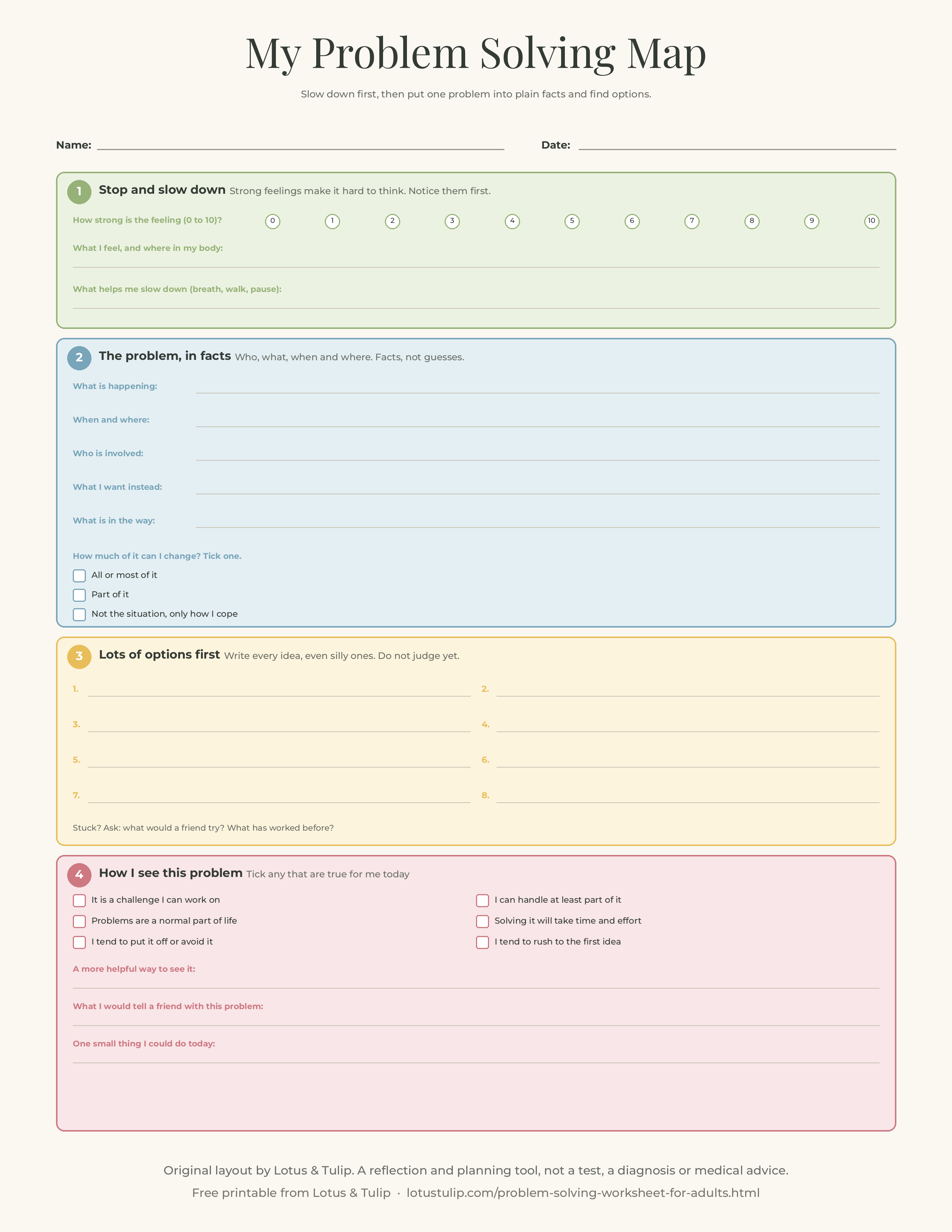
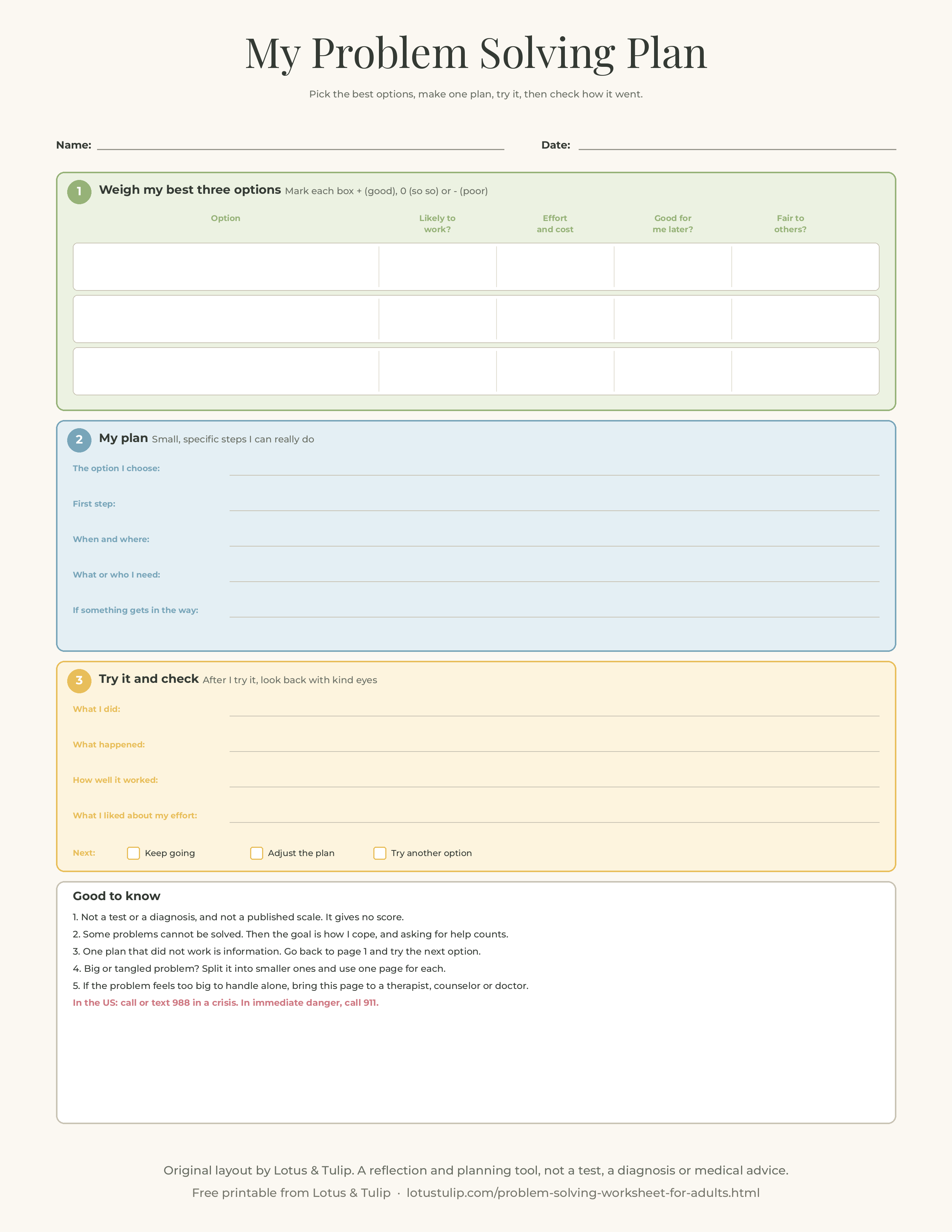
Problem solving therapy (PST) teaches a calmer, more structured way through. This guide is for therapists, counselors, case managers and coaches who use problem solving with adult clients, and for adults who want to try it on their own. It explains what PST is, the difference between how you see problems and how you solve them, what the research honestly shows, nine practical steps to use a problem solving worksheet, common mistakes and three short examples. It ends with a free 2 page printable: My Problem Solving Map, for slowing down and putting one problem into facts and options, and My Problem Solving Plan, for weighing options, making a plan and checking how it went.
Download the free problem solving worksheet for adults (PDF, 2 pages, US Letter)
Direct download, no email or sign up. See the pages first.
What problem solving therapy is
Problem solving therapy is a structured, cognitive behavioral approach that teaches people a step by step way to handle stressful life problems and the feelings that come with them. It grew out of a 1971 paper by Thomas D'Zurilla and Marvin Goldfried, who argued that training people in general problem solving skills could help them cope with many kinds of problems in daily life. Arthur Nezu, Christine Maguth Nezu and D'Zurilla later developed it into a treatment manual (2013).
The idea behind it is simple: stress and distress often come less from the problems themselves than from how we react to them and how we try to solve them. PST works on both. It is used for depression, stress, caregiving strain, health problems and many everyday difficulties, and is often described as transdiagnostic.
PST is about real problems in the outside world: money, work, relationships, health, housing. That makes it different from sorting worries or challenging thoughts, though it pairs well with both.
Two parts: how you see problems and how you solve them
In the D'Zurilla and Nezu model, social problem solving has two parts.
Problem orientation is your general attitude toward problems. A positive orientation means seeing problems as challenges, believing they can usually be solved, trusting that you can handle them and accepting that solving them takes time and effort. A negative orientation means seeing problems as threats, doubting that you can cope and getting easily upset and frustrated when problems come up.
Problem solving style is what you actually do. The model describes three styles:
| Style | What it looks like | Example |
|---|---|---|
| Rational problem solving | Defining the problem, looking for options, weighing them, trying one and checking how it went | "Let me write down what is actually going on and list a few things I could do." |
| Impulsive or careless | Rushing, grabbing the first idea, not thinking through consequences | Quitting a job on the spot after a bad meeting |
| Avoidance | Putting things off, waiting for problems to solve themselves, leaving them to others | Leaving letters from the bank unopened |
These five dimensions (positive orientation, negative orientation, rational problem solving, impulsive or careless style and avoidance style) are what the Social Problem-Solving Inventory, Revised (SPSI-R; D'Zurilla, Nezu and Maydeu-Olivares, 2002) measures. It has a 52 item long form and a 25 item short form. It is a copyrighted, published questionnaire, so we describe it here and do not reproduce its items. Our worksheet is not the SPSI-R and does not give a score.
The four rational problem solving skills
Rational problem solving breaks down into four skills, which most PST programs teach in order:
- Problem definition and formulation: gathering the facts, separating them from assumptions, naming a realistic goal and spotting what stands in the way.
- Generation of alternatives: brainstorming many possible solutions before judging any of them. Quantity first tends to produce better ideas.
- Decision making: predicting the likely results of the best options, for yourself and others, in the short and long term, and choosing one or a combination.
- Solution implementation and verification: carrying out the plan, watching what happens and comparing it with the goal. If it did not work, you go back to an earlier step.
The contemporary version of PST adds tools for the emotional side. One is often summarized as Stop, Slow down, Think and Act: notice that strong feelings are building, pause, calm the body, then work through the problem solving steps. Our worksheet starts with a slow down box for this reason.
What the research says
- PST works better than no treatment and about as well as other therapies. A 2007 meta-analysis by Malouff, Thorsteinsson and Schutte pooled 31 studies (2,895 participants) on mental and physical health problems. PST was clearly more effective than no treatment (d = 1.37), and more effective than treatment as usual and attention placebo (both d = 0.54), but not significantly more effective than other bona fide treatments (d = 0.22). Effects were larger when programs included problem orientation training and homework, and when a developer of PST helped run the study.
- For depression, the full package matters. Bell and D'Zurilla (2009) analyzed 21 samples of PST for depression. PST was as effective as other psychosocial therapies and medication, and more effective than no treatment and support or attention controls. It worked better when it included training in a positive problem orientation and all four rational problem solving skills, rather than skills alone.
- Honest effect sizes are smaller. Cuijpers and colleagues (2018) included 30 randomized trials of PST for adult depression (3,530 patients). The overall effect against control groups was large (g = 0.79), but results varied a lot between studies and there were signs of publication bias. In the 9 studies with low risk of bias the effect was g = 0.34, which is small but comparable to other psychotherapies for depression.
- A brief version can work in primary care. In a 1995 trial in the BMJ, Mynors-Wallis and colleagues randomly assigned 91 primary care patients with major depression to six sessions over 12 weeks of problem solving treatment, the antidepressant amitriptyline or a placebo. At 12 weeks, 60% of the problem solving group had recovered, compared with 52% on amitriptyline and 27% on placebo. The six sessions added up to about three and a half hours of therapy time on average.
The takeaway: PST is a well studied, practical approach with real but modest effects, and the attitude part (problem orientation) seems to matter as much as the steps. A worksheet supports practice. It is not the whole therapy.
How to use a problem solving worksheet, step by step
- Pick one problem, and make it a real one. Choose a current, specific problem rather than "my life" or "everything". If there are several, start with one that matters but is not the hardest. Big problems can be split into smaller ones, one page each.
- Stop and slow down first. In box 1 on page 1, rate how strong the feeling is from 0 to 10 and note where you feel it in your body. If it is high, take a few slow breaths, go for a short walk or come back later. Strong emotion narrows thinking, so this step is not a detour.
- Write the problem as facts. In box 2, write what is happening, when and where, and who is involved, without guesses about other people's motives. Then write what you want instead and what is in the way. A problem is the gap between how things are and how you want them to be.
- Check what is in your control. Tick whether you can change all or most of it, part of it or only how you cope. If the situation cannot be changed, the problem becomes "how do I look after myself in this", which is still a problem you can solve.
- Brainstorm before you judge. In box 3, write at least six options, including unlikely ones. Ask what a friend would suggest, or what has worked before. Do not cross anything out yet.
- Notice how you see the problem. In box 4, tick the statements that fit. If you lean toward avoiding or rushing, or toward "I can't handle this", write a more helpful way to see it, or what you would say to a friend in the same spot.
- Weigh the best three options. On page 2, copy your three most promising options into the table and mark each one for how likely it is to work, the effort and cost, whether it is good for you later and whether it is fair to others. Choose the best fit, or combine two.
- Make a small, specific plan. Write the option you chose, the first step, when and where, what or who you need and what you will do if something gets in the way. A first step you are nearly sure you can do beats a perfect plan you never start.
- Try it, then check. After you act, fill in what you did, what happened and how well it worked. Note something you liked about your own effort. Then tick keep going, adjust the plan or try another option. If the problem involves your safety or someone else's, or you are in crisis, get help now: in the US, call or text 988, and call 911 in an emergency.
Common mistakes
- Skipping the slow down step. Trying to brainstorm at a 9 out of 10 usually produces either nothing or the most impulsive option.
- Defining the problem too broadly. "My marriage" cannot be solved in one sitting. "We argue about money on Sunday evenings" can be worked on.
- Judging ideas while brainstorming. Criticizing each idea as it comes stops the flow. Collect first, weigh later.
- Treating every problem as solvable. Some things, like a loss or a chronic illness, cannot be fixed. PST then turns to the parts you can change, including how you cope and who you lean on.
- Teaching only the steps. Research suggests the attitude part matters. If a client believes "nothing ever works for me", work on that too, for example with a cognitive restructuring worksheet.
- Calling it failure when the first plan does not work. The check step exists because first tries often need adjusting. It is information, not proof that you are bad at problems.
Examples
- Bills piling up: A woman in her thirties had stopped opening mail after a reduction in her hours. Her feeling was an 8. After a short walk, she wrote the facts: three overdue bills, one rent payment due in two weeks. Her options included calling the utility company, asking about a payment plan, picking up extra shifts and asking a sister for a short loan. She chose to call the utility company first, on Tuesday at lunch, with the bill in front of her. They agreed to a payment plan, and she ticked "keep going" for the next bill.
- A caregiver at the limit: A man caring for his father with dementia felt he had to do everything himself. He first ticked "I can't handle it" and "I tend to put it off". With his counselor, he wrote what he would tell a friend: "You need help, and asking for it is part of caring." His options included adult day programs, asking his brother for one weekend a month and a caregiver support group. He chose to call a local adult day program for information, and asked his brother the same week.
- Conflict at work: A nurse kept getting the worst shifts and wanted to quit on the spot. In the slow down box she noted her anger at 7. Her facts showed the schedule was made by one supervisor and nobody had raised it. She weighed quitting, talking to the supervisor and asking HR about the scheduling policy. She chose to ask for a short meeting with the supervisor, with two dates she was available, and planned to go to HR if nothing changed within a month.
Free printable: problem solving worksheet for adults
This free printable is an original Lotus & Tulip layout on US Letter, in our own wording. It is not the SPSI-R or any other published scale, and it does not give a score. Page 1, My Problem Solving Map, covers a slow down check with a 0 to 10 rating, the problem in facts and what I want instead, how much of it I can change, a brainstorm of up to eight options and a check of how I see the problem. Page 2, My Problem Solving Plan, covers weighing the best three options, a small specific plan, trying it and checking how it went, plus notes with US crisis lines.
Download the free problem solving worksheet for adults (PDF, 2 pages, US Letter)
Prefer single images? Page 1: problem solving map (PNG) · Page 2: problem solving plan (PNG)
Free to print for yourself or for use with your own clients or groups. Please link to this page rather than re-uploading the file. A reflection and planning tool, not a test, a diagnosis or a substitute for therapy. In the US, call or text 988 in a mental health crisis. In immediate danger, call 911.
Related resources
- Problem solving activities for teens: the same steps, shaped for school age
- Problem solving worksheet for kids: a simple five step model for children
- Stress management worksheet for adults: sort stressors by how much you can change
- Coping skills worksheets for adults: problem focused and emotion focused coping
- Worry tree worksheet: decide whether a worry needs a plan or letting go
- Decisional balance worksheet: weigh the pros and cons of a big change
- Circle of control worksheet: what you can and cannot change
- All therapist worksheets: CBT, DBT, ACT and more
FAQ
What is a problem solving worksheet for adults?
A problem solving worksheet for adults is a structured page that walks you through one real problem: slowing down, defining the problem in facts, brainstorming options, weighing them, making a plan and checking how it went. The free 2 page printable on this page follows the steps used in problem solving therapy. It is an original tool, not a published questionnaire or a score.
What are the steps of problem solving therapy?
PST teaches four rational problem solving skills: defining and formulating the problem, generating alternative solutions, making a decision, and carrying out the solution and checking the result. Contemporary PST adds work on problem orientation (how you see problems) and tools for managing strong emotions first, often summarized as Stop, Slow down, Think and Act.
Does problem solving therapy work?
Yes, with modest effects. A 2007 meta-analysis of 31 studies found PST more effective than no treatment, treatment as usual and attention placebo, and about as effective as other genuine treatments. For adult depression, a 2018 meta-analysis of 30 trials found effects that were small in the most rigorous studies (g = 0.34) but comparable to other psychotherapies.
What is problem orientation?
Problem orientation is your general attitude toward problems. A positive orientation sees problems as challenges you can probably handle with time and effort. A negative orientation sees them as threats and doubts your ability to cope. Research on PST for depression suggests that programs including training in a positive orientation work better than skills training alone.
Can therapists use this worksheet with clients?
Yes. It is free to print for use with your own clients or groups. Please link to this page rather than re-uploading the file. It works well as in-session practice and as homework, which research links to larger effects. It does not replace PST training or a validated measure such as the SPSI-R if you need a score.
What if my problem cannot be solved?
Some problems, like a loss, a diagnosis or another person's choices, cannot be fixed. Then the problem becomes how you will cope, care for yourself and get support. Tick "only how I cope" on page 1 and brainstorm options for that. If you feel hopeless or unsafe, in the US call or text 988, or call 911 in an emergency.
Is problem solving therapy the same as CBT?
PST is generally considered part of the cognitive behavioral family, but it is its own approach. CBT often focuses on changing thoughts and behaviors linked to symptoms, while PST focuses on how people approach and solve real life problems. The two are often combined.
Sources
- Bell, A. C., and D'Zurilla, T. J. (2009). Problem-solving therapy for depression: A meta-analysis. Clinical Psychology Review, 29(4), 348 to 353.
- Cuijpers, P., de Wit, L., Kleiboer, A., Karyotaki, E., and Ebert, D. D. (2018). Problem-solving therapy for adult depression: An updated meta-analysis. European Psychiatry, 48, 27 to 37.
- D'Zurilla, T. J., and Goldfried, M. R. (1971). Problem solving and behavior modification. Journal of Abnormal Psychology, 78(1), 107 to 126.
- D'Zurilla, T. J., Nezu, A. M., and Maydeu-Olivares, A. (2002). Social Problem-Solving Inventory, Revised (SPSI-R): Technical manual. Multi-Health Systems.
- Malouff, J. M., Thorsteinsson, E. B., and Schutte, N. S. (2007). The efficacy of problem solving therapy in reducing mental and physical health problems: A meta-analysis. Clinical Psychology Review, 27(1), 46 to 57.
- Mynors-Wallis, L. M., Gath, D. H., Lloyd-Thomas, A. R., and Tomlinson, D. (1995). Randomised controlled trial comparing problem solving treatment with amitriptyline and placebo for major depression in primary care. BMJ, 310(6977), 441 to 445.
- Nezu, A. M., Nezu, C. M., and D'Zurilla, T. J. (2013). Problem-solving therapy: A treatment manual. Springer Publishing Company.
- Society of Clinical Psychology (APA Division 12). Problem-solving therapy for depression. Psychological treatments archive.