
Kids and teens · Coping skills for ages 12 to 18 · Updated 2026-11-04
Coping skills worksheets for teens: a 60 skill list, how to match a skill to the moment, and a free printable
Ready-made printable: Coping Skills Cards for Kids and Teens Holiday 20% off: about $5.52, was $7 (EUR 6) · instant digital download
Buy on Etsy
Most teenagers already cope. They put in earbuds, go quiet, text a friend, scroll, sleep, snap at a sibling, or push through. Some of these help and some quietly make things worse. Good coping skills work is less about giving a teen a brand new toolbox and more about helping them see what they already do, keep what works, and add a few skills that fit their life.
This guide is for school counselors, therapists, teachers, youth workers and parents of teens about 12 to 18. It explains what coping skills are, what the research actually shows, the main types of coping, a 60 skill coping skills list for teens sorted by category, how to choose the right skill for the right moment, activities for groups and sessions, a 9 step teaching plan, and when coping skills are not enough. At the end there is a free three page printable: a Coping Skills Menu, a Coping Plan for hard moments, and a weekly Coping Skills Tracker.
Jump to the free coping skills worksheets for teens
What are coping skills? A definition teens can use
The most quoted definition comes from psychologists Richard Lazarus and Susan Folkman. In their 1984 book Stress, Appraisal, and Coping, they described coping as "constantly changing cognitive and behavioral efforts to manage specific external and/or internal demands that are appraised as taxing or exceeding the resources of the person." That is accurate, but no fifteen year old talks like that.
A version that works with teens, and the one on page 1 of the printable: a coping skill is anything you do on purpose to get through a hard moment, a hard feeling or a hard situation. Three parts of that sentence matter.
- Anything you do. Coping includes actions (going for a walk), thoughts (telling yourself "this is one test, not my whole future") and choices about people (asking for help).
- On purpose. Coping is effortful. Automatic reactions such as a racing heart or a flash of anger are stress reactions, not coping. Coping is what you do next.
- To get through. Coping is not only about fixing a problem. Sometimes the problem cannot be fixed, and coping means tolerating, accepting or getting through it until it passes.
Lazarus and Folkman also pointed out that coping includes all attempts to manage stress, whether they work or not. That is a useful idea to share with teens: vaping, isolating and doomscrolling are coping too. They are just coping that costs a lot.
Why coping skills matter for teens: what the research shows
Teen mental health in the United States has been a concern for more than a decade. The CDC's Youth Risk Behavior Survey (YRBS) asks a nationally representative sample of high school students about their health every two years. In the 2023 survey:
- About 40% of high school students had felt so sad or hopeless almost every day for two weeks or more in a row that they stopped doing some usual activities. That figure was 30% in 2013, peaked at 42% in 2021, and dipped slightly in 2023.
- About 29% reported poor mental health most of the time or always in the past 30 days.
- About 20% had seriously considered attempting suicide in the past year, and about 9% had attempted suicide.
- Female students reported persistent sadness or hopelessness far more often than male students (about 53% versus 28%).
A CDC analysis of the same survey looked at protective factors, including being physically active, getting 8 or more hours of sleep, parental monitoring, school connectedness and playing on a sports team. Every protective factor was linked with a lower prevalence of at least one mental health or suicide risk indicator. Many of these protective factors line up with everyday coping skills: moving your body, protecting sleep and staying connected to people.
The best single summary of coping research in young people is a 2017 meta-analysis by Bruce Compas and colleagues in Psychological Bulletin. It pooled 212 studies with 80,850 children and adolescents. After accounting for publication bias, the pattern was clear:
- Linked with fewer symptoms of anxiety, depression and behavior problems: adaptive coping and emotion regulation overall, primary control coping (trying to change the problem or your reaction to it directly) and secondary control coping (adapting to the problem, for example through acceptance, reframing or distraction).
- Linked with more symptoms: disengagement coping, plus the specific strategies of avoidance, denial and emotional suppression (bottling feelings up).
Two honest caveats. First, most of these studies were cross sectional, so they show links, not proof that teaching a skill causes the improvement. Second, these are averages. A skill that is helpful for one teen in one moment can be unhelpful for another. That is why the most useful coping work is personal: teens try skills, notice what happens and build their own short list.
The main types of coping (and why the type matters)
You will see coping grouped in several ways. Two are worth teaching to teens because they help them choose a skill rather than grab the nearest one.
Problem focused vs emotion focused coping
- Problem focused coping tries to change the situation: making a study plan, talking to the teacher about a grade, setting a boundary with a friend, asking for an extension, breaking a project into steps.
- Emotion focused coping tries to change how you feel about the situation: slow breathing, a walk, music, talking it through, journaling, reframing a thought.
Neither type is better. Problem focused coping tends to fit situations you can change. Emotion focused coping tends to fit situations you cannot change, such as a parent's illness, a breakup that has already happened, or waiting for test results. Most real situations need some of both: calm down enough to think, then act.
Engaging vs disengaging coping
This is the split from the Compas research, and it is the most practical one for teens.
- Change it (primary control). Problem solving, asking for help with the problem, expressing feelings in a healthy way, calming the body.
- Adapt to it (secondary control). Accepting what cannot change, looking at the situation another way, finding something positive or meaningful in it, and taking a planned break through distraction.
- Escape it (disengagement). Avoiding the situation, denying it is happening, wishful thinking, shutting feelings down. These often give relief in the short term, which is why they are so tempting, but they are the strategies most linked with more symptoms over time.
Note that distraction appears in the "adapt" group, not the "escape" group. A planned twenty minute break with a show before starting homework is healthy distraction. Six hours of gaming so you never have to think about the homework is avoidance. The difference is whether you come back to the problem.
Healthy vs unhealthy coping: swaps teens can actually make
Telling a teen "stop vaping" or "get off your phone" rarely works on its own. Unhealthy coping usually does something useful in the moment: it numbs, distracts, gives a rush, or creates distance. A better question is "what does this do for you, and what else could do that job at a lower cost?" These swaps keep the job and lower the cost.
- Instead of scrolling for hours to avoid feelings: set a 15 minute timer, scroll on purpose, then do one small next step.
- Instead of isolating in your room all evening: text one person, or sit in a shared room with headphones on.
- Instead of snapping at people when overwhelmed: say "I need ten minutes" and leave the room, then come back.
- Instead of all night cramming and no sleep: a 25 minute study block plus a fixed lights out time.
- Instead of skipping school or class to avoid anxiety: a gradual plan with a counselor, starting with the easiest class.
- Instead of bottling everything up: write it in a notes app, then decide if you want to share it.
- Instead of using vaping, alcohol or other substances to calm down: a strong body skill such as cold water on the face, intense exercise or paced breathing, and a conversation with a trusted adult about support for quitting.
- Instead of self harm: this one needs more than a swap. Tell a trusted adult, use a safety plan made with a counselor or therapist, and in a crisis call or text 988.
Coping skills list for teens: 60 ideas in 5 categories
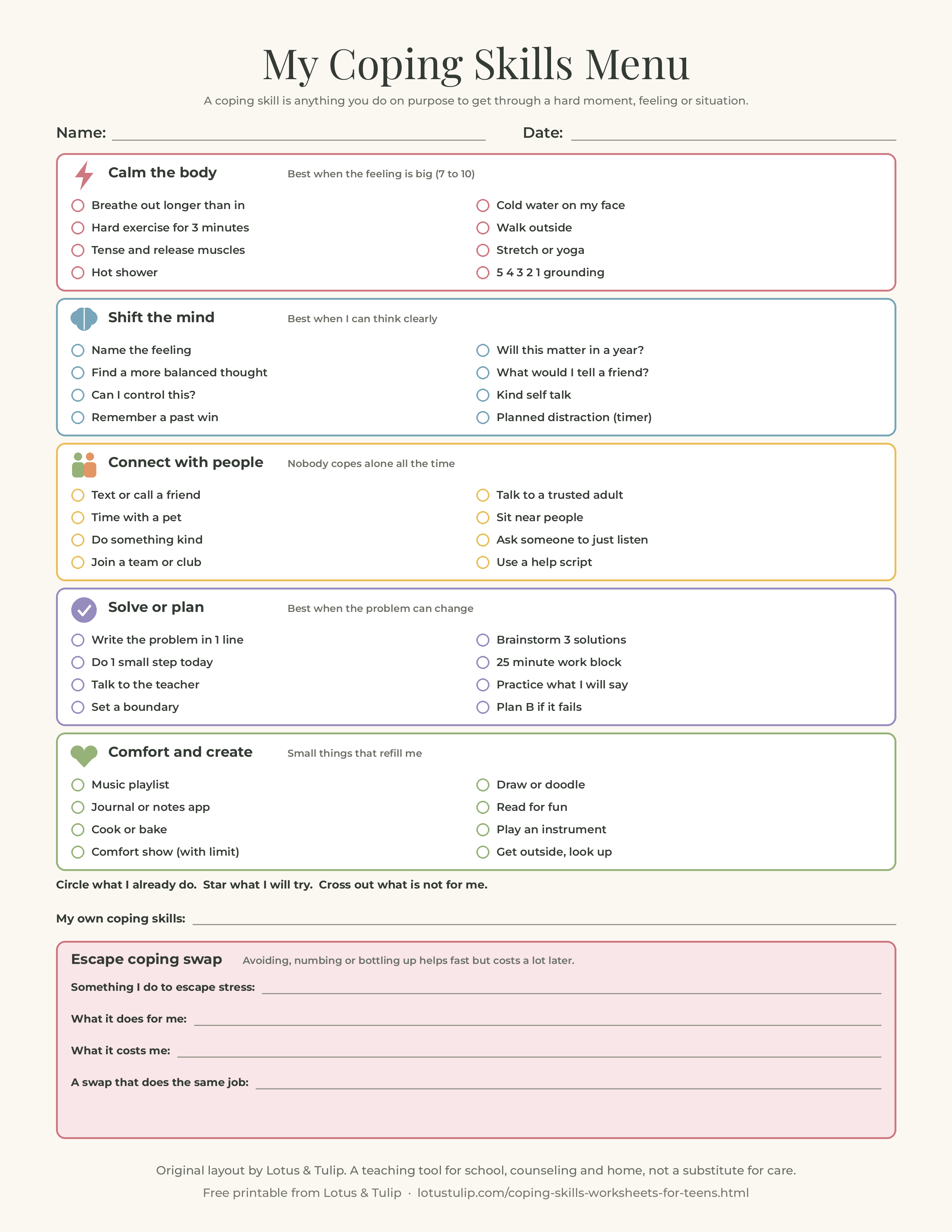
Use this list to build a personal menu, not as homework. Ask a teen to circle anything they already do, star anything they would try, and cross out anything that sounds awful. The crossed out items are useful information too. Page 1 of the printable has a shorter version of this list in the same five categories.
1. Calm the body (best when stress is high)
- Paced breathing: breathe out longer than you breathe in, for example in for 4 and out for 6.
- Cold water on the face or a cold drink.
- Hard exercise for a few minutes: sprints, jumping jacks, push ups, stairs.
- A walk, ideally outside.
- Progressive muscle relaxation: tense and release each muscle group.
- Stretching or yoga.
- A hot shower or bath.
- Grounding with the five senses (the 5 4 3 2 1 grounding exercise).
- Holding something cold, textured or squishy.
- Shooting hoops, skating, dancing or any movement you enjoy.
- Eating something and drinking water if you have not in a while.
- A short nap or an earlier bedtime.
2. Shift the mind (best when you can think clearly)
- Name the feeling in a few words: "I am anxious and embarrassed."
- Ask "Will this matter in a week? A year?"
- Look for a more balanced thought (see the CBT thought record).
- Spot thinking traps such as all or nothing thinking (see the cognitive distortions worksheet).
- Ask "What would I say to a friend in this situation?"
- Sort worries into "can control" and "cannot control" (the circle of control).
- Schedule a 15 minute worry time instead of worrying all day.
- Write down three things that went okay today.
- Kind self talk: "This is hard and I am handling it."
- Remember a past hard thing you got through.
- Mindful noticing: describe what is happening without judging it.
- Planned distraction: a puzzle, a game, a show, with a time limit.
3. Connect with people
- Text or call a friend.
- Talk to a parent, relative, coach, teacher or counselor.
- Spend time with a pet.
- Ask for a hug.
- Sit near people even if you do not talk.
- Do something kind for someone else.
- Join a club, team, group or online community that is positive and moderated.
- Ask someone to just listen, not fix.
- Use a script to ask for help: "I am having a hard time with ___. Can we talk?"
- Plan something to look forward to with a friend.
- Volunteer.
- Reach out to a crisis line if you have no one to talk to right now.
4. Solve or plan (best when the problem can change)
- Write the problem in one sentence.
- Brainstorm three possible solutions, even silly ones.
- Pick one small first step and do it within 24 hours.
- Break a big task into 25 minute blocks.
- Make a to do list and cross off one thing.
- Email or talk to a teacher about a deadline.
- Practice a hard conversation out loud first (try I statements or DEAR MAN).
- Set a boundary (see the healthy boundaries worksheet).
- Get organized: clean your desk, pack your bag the night before.
- Look up reliable information about the thing you are worried about.
- Ask "What is the next right thing?"
- Decide what you will do if your plan does not work.
5. Comfort and create
- Music: a calm playlist, or a loud one to match the mood and then shift it.
- Draw, doodle, paint or color.
- Journal or write a letter you will not send.
- Read something you enjoy.
- Cook or bake.
- Play an instrument.
- Build, craft or fix something.
- Take photos.
- Watch a comfort show or video.
- Get outside and look at the sky, trees or water.
- Make a comfort box with things that help you calm down.
- Pray, meditate or use your faith or values if that is part of your life.
How to match a coping skill to the moment
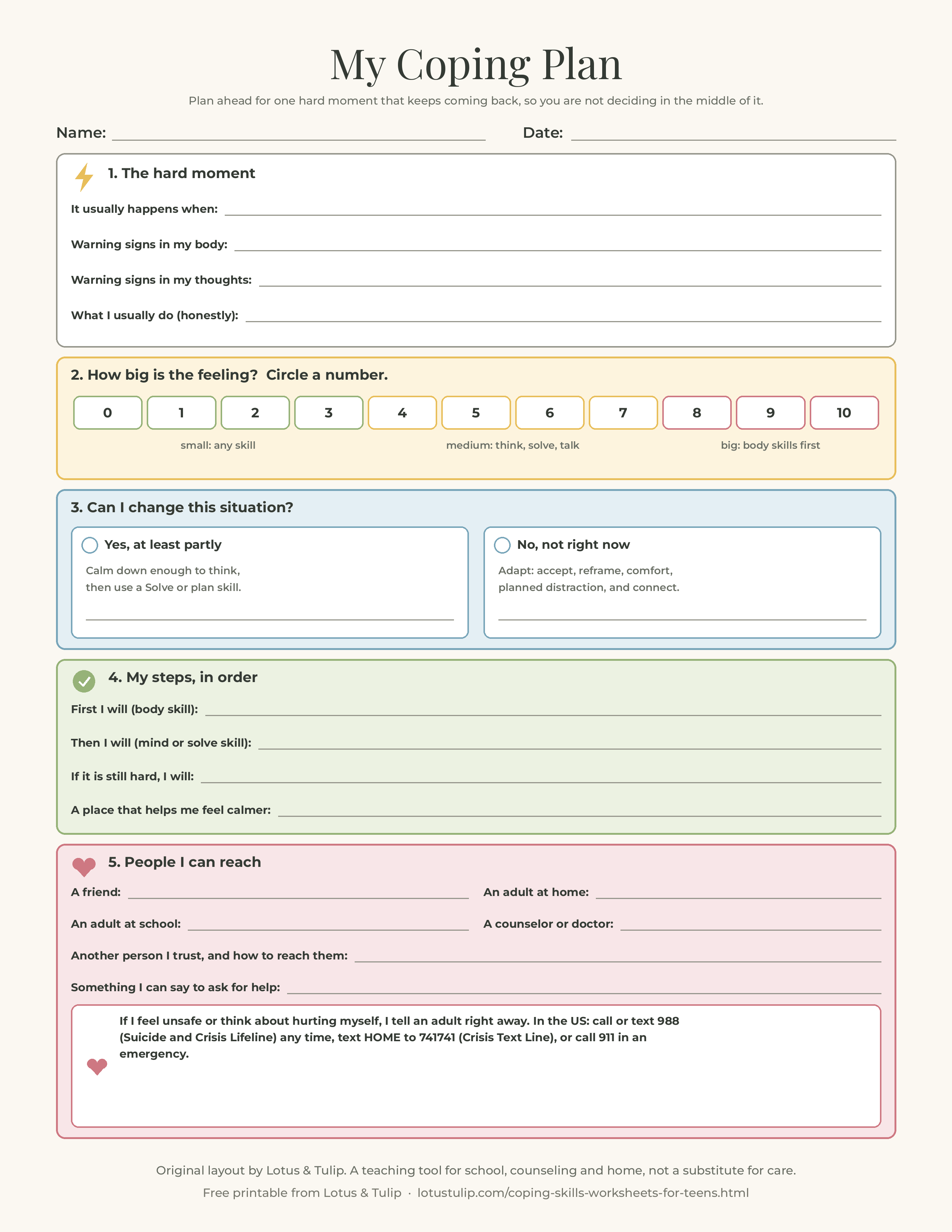
A long list is only useful if a teen can pick from it when stressed. Two quick questions make that easier, and they are built into page 2 of the printable.
Question 1: How big is the feeling right now, from 0 to 10?
- 0 to 3, small. Almost any skill works. This is the best time to practice new ones.
- 4 to 7, medium. Thinking skills, problem solving and talking to someone usually still work.
- 8 to 10, big. The thinking brain is harder to reach. Start with body skills first: cold water, hard exercise, paced breathing. In DBT, the TIPP skills (Temperature, Intense exercise, Paced breathing, Paired muscle relaxation) are designed for exactly this level. Once the feeling drops, move to thinking or solving skills.
The window of tolerance and the feelings thermometer are good companion tools for this step.
Question 2: Can I change this situation?
- Yes, at least partly: calm down enough to think, then use a solve or plan skill.
- No, not right now: use an adapt skill such as acceptance, reframing, comfort or planned distraction, and connect with someone.
- Not sure: ask someone you trust to help you sort it.
This mirrors the change it or adapt to it split from the research. It also teaches teens that "I cannot fix this" is not the same as "I cannot cope with this."
CBT and DBT coping skills for teens
Many school counselors and therapists draw on cognitive behavioral therapy (CBT) and dialectical behavior therapy (DBT) for coping skills work. Both have teen adaptations with research behind them. For example, a randomized trial by Mehlum and colleagues (2014) with 77 adolescents in Norway who had repeated self harm found that 19 weeks of DBT for adolescents reduced self harm, suicidal ideation and depressive symptoms more than enhanced usual care. That was a full treatment delivered by trained clinicians, not a worksheet, but the skills it teaches are widely used in simpler forms.
Skills teens often find practical:
- STOP (DBT). Stop, Take a step back, Observe, Proceed mindfully. A quick brake before reacting.
- TIPP (DBT). Body based skills for very high distress. Teens should check with a doctor before the cold water version if they have a heart condition or eating disorder.
- ACCEPTS (DBT). Distraction with Activities, Contributing, Comparisons, Emotions (doing something that creates a different feeling), Pushing away, Thoughts and Sensations.
- Wise Mind (DBT). Finding the balance between emotion mind and reasonable mind (see the Wise Mind worksheet).
- Thought record (CBT). Situation, automatic thought, feeling, evidence for and against, balanced thought.
- Behavioral activation (CBT). Scheduling small, doable activities that bring pleasure or a sense of achievement, especially when mood is low (see the behavioral activation worksheet).
Coping skills activities for teens
These work in small groups, classrooms, individual sessions and at home. Most take 10 to 20 minutes.
- Coping audit. Teens list everything they did the last time they felt stressed, then sort each item into change it, adapt to it or escape it. No judgment, just sorting. This is often eye opening.
- Skill sampling. Try three short skills in one session, one from the body category, one from the mind category and one from the connect category. Rate each from 1 to 5 for "how much did that help?"
- Cost and benefit swap. Pick one unhealthy coping habit. List what it does for you and what it costs you. Find a swap that does the same job.
- Scenario cards. Read short scenarios (a failed test, a group chat that turns on you, a fight at home, a cancelled plan) and choose a coping skill for each based on feeling size and whether it can change.
- Playlist for every mood. Build three short playlists: one to calm down, one to get energized, one for when you need to feel it.
- Coping kit. Assemble a small kit with items that help: a stress ball, gum, a photo, a list of people to text, a short card of go to skills.
- Help seeking role play. Practice the words for asking an adult for help, including the scenario where the first adult is not helpful and you try a second.
- Test drive week. Each teen picks one new skill and uses it every day for a week, tracking it on page 3.
- Teach back. Teens teach a skill to the group or to a younger student. Explaining a skill is one of the best ways to remember it.
- Values check. Ask "Does this way of coping fit the person I want to be?" The ACT values worksheet pairs well.
How to teach coping skills to teens, step by step
- Start with respect, not a lecture. Tell teens they already cope and that the goal is to build on what works for them. Teens disengage quickly if coping skills feel like a lesson on what they are doing wrong.
- Define coping in one sentence. A coping skill is anything you do on purpose to get through a hard moment, a hard feeling or a hard situation.
- Run a coping audit. Have teens list how they coped with a recent stressful moment and sort each item into change it, adapt to it or escape it.
- Explain the research simply. Changing or adapting to a problem is linked with fewer symptoms over time, while avoiding, denying and bottling up is linked with more. Escape coping is not bad, it is just expensive if it becomes the main plan.
- Build a personal menu. Use page 1 of the printable. Teens circle what they already do, star what they will try and add their own ideas.
- Teach the two questions. How big is the feeling from 0 to 10, and can I change this? Practice with scenarios before teens need it for real.
- Make a coping plan. Use page 2 to plan for one specific hard moment that comes up often, such as test anxiety, conflict at home or a bad night of sleep.
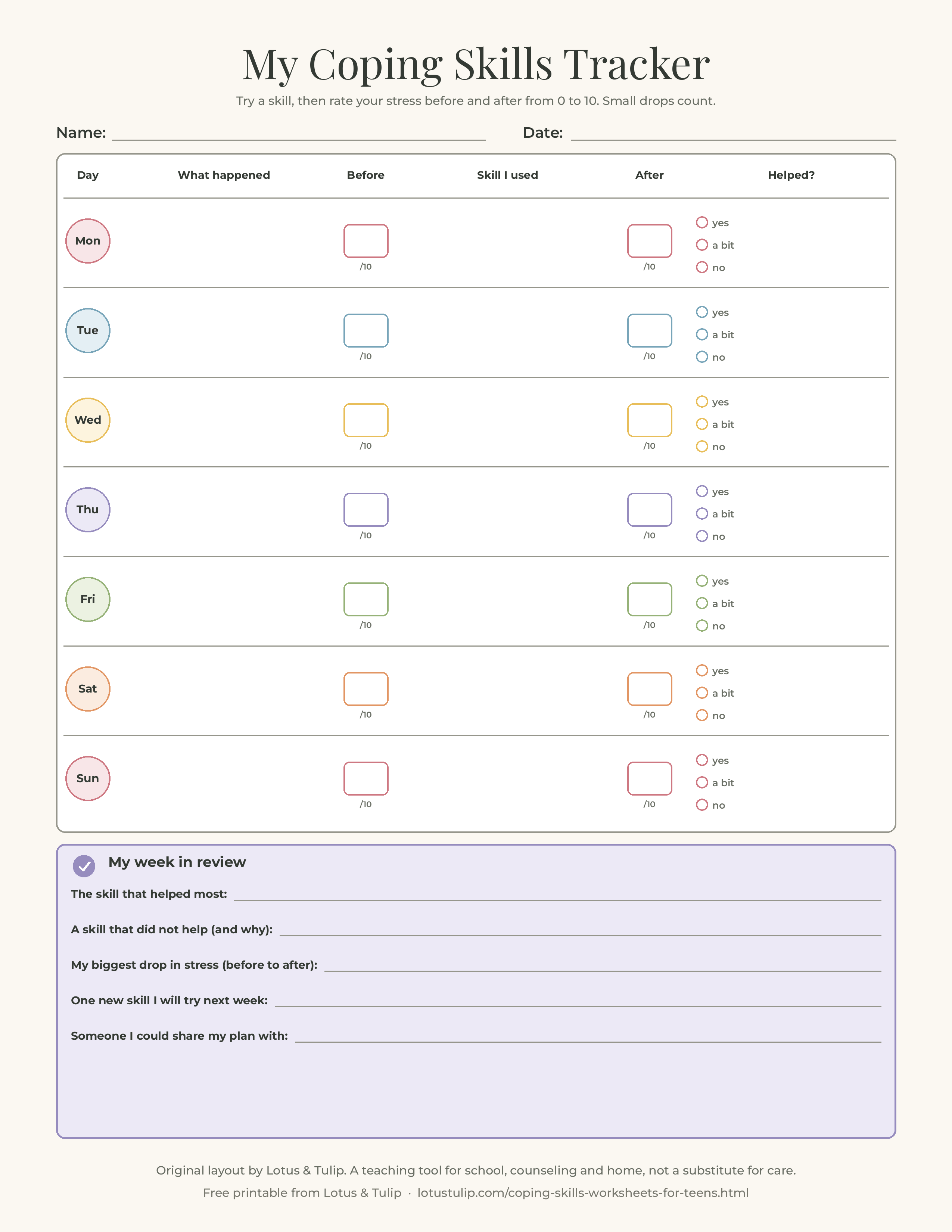
- Practice and track for a week. Use page 3. Teens rate stress before and after each skill and note whether it helped. Small changes count.
- Review, adjust and connect to support. Keep what helped, drop what did not and try something new. Make sure every teen knows at least two adults they can talk to and how to reach 988.
When coping skills are not enough
Coping skills are useful for everyday stress and for supporting treatment. They are not a substitute for professional help when a teen is struggling. Involve a school counselor, doctor or mental health professional if a teen:
- Has felt sad, hopeless, anxious or irritable most days for two weeks or more.
- Has stopped doing things they used to enjoy, or is pulling away from friends and family.
- Has big changes in sleep, eating or energy.
- Is using alcohol, vaping or other substances to cope.
- Is hurting themselves, or talking or posting about death, suicide or not wanting to be here.
- Has experienced trauma, abuse or a major loss and is not recovering.
If a teen may be in danger, act now. In the United States, call or text 988 (the 988 Suicide and Crisis Lifeline) or chat at 988lifeline.org, any time. Teens can also text HOME to 741741 to reach the Crisis Text Line. If someone is in immediate danger, call 911.
For counselors and therapists: a coping skills menu is not a suicide safety plan. If a teen has suicidal thoughts, use a structured approach such as the Safety Planning Intervention developed by Barbara Stanley and Gregory Brown, which covers warning signs, internal coping strategies, people and places for distraction, people to ask for help, professionals to contact and making the environment safer. Follow your school or agency risk assessment protocol.
Common mistakes when teaching coping skills to teens
- Teaching skills only in a crisis. Skills are hardest to learn when stress is at 9 out of 10. Practice when things are calm.
- Using childish materials. Teens can tell when a worksheet was written for an eight year old. Use real scenarios, real language and their own examples.
- Treating every distraction as avoidance. Planned breaks are healthy. The question is whether the teen comes back to the problem.
- Offering one skill for everything. Deep breathing will not fix a conflict with a friend. Match skills to the feeling size and the situation.
- Shaming unhealthy coping. Shame pushes behavior underground. Curiosity ("what does it do for you?") opens the door to a swap.
- Forgetting the basics. Sleep, food, movement and connection make every other skill work better. The AASM recommends 8 to 10 hours of sleep per 24 hours for teens aged 13 to 18.
- Skipping the safety step. Every coping lesson should end with who to tell and how to reach 988.
Free coping skills worksheets for teens (PDF)
The free printable has three pages in US Letter size, written for ages about 12 to 18:
- Page 1: My Coping Skills Menu. A one sentence definition, 40 coping skills in five categories (calm the body, shift the mind, connect, solve or plan, comfort and create) to circle or star, space to add your own, and an escape coping swap box.
- Page 2: My Coping Plan. A plan for one hard moment that keeps coming back: warning signs, a 0 to 10 feeling check, the "can I change it?" choice, first, second and third steps, people to reach and a help box with 988 and the Crisis Text Line.
- Page 3: My Coping Skills Tracker. Seven rows to log the situation, stress before and after from 0 to 10, the skill used and whether it helped, plus a week review.
Download the free coping skills worksheets for teens (PDF, 3 pages, US Letter)
Prefer single images? Page 1: Coping Skills Menu (PNG) · Page 2: Coping Plan (PNG) · Page 3: Coping Skills Tracker (PNG)
Free DBT starter pack for teens: Working with a teen? The free DBT worksheets for teens starter pack adds a distress tolerance toolkit and a weekly diary card from our paid DBT set for teens, plus finding my wise mind, ride the emotion wave, check the facts and a safety and care page (8 pages, ages about 13 to 18, client use license, no email).
Free to print for your own use and for use with your own students, clients or teens. Please link to this page rather than re-uploading the file.
Related resources
- Coping skills worksheets for adults: the adult version, with a coping menu by type and situation and a free 2 page PDF
- Stress management worksheets for teens (free printable)
- Coping skills list for kids (free printable)
- DBT TIPP skills worksheet (free printable)
- CBT thought record (free printable)
- 5 4 3 2 1 grounding worksheet (free printable)
- Window of tolerance worksheet (free printable)
- Circle of control worksheet (free printable)
- Sleep hygiene worksheet (free printable)
- Test anxiety worksheet (free printable)
Sources
- Lazarus, R. S., and Folkman, S. (1984). Stress, Appraisal, and Coping. Springer. Definition of coping, p. 141.
- Compas, B. E., Jaser, S. S., Bettis, A. H., Watson, K. H., Gruhn, M. A., Dunbar, J. P., Williams, E., and Thigpen, J. C. (2017). Coping, emotion regulation, and psychopathology in childhood and adolescence: A meta-analysis and narrative review. Psychological Bulletin, 143(9), 939 to 991.
- Centers for Disease Control and Prevention (2024). Youth Risk Behavior Survey Data Summary and Trends Report: 2013 to 2023.
- Verlenden, J. V., and colleagues (2024). Mental health and suicide risk among high school students and protective factors: Youth Risk Behavior Survey, United States, 2023. MMWR Supplements, 73(4).
- Mehlum, L., Tormoen, A. J., Ramberg, M., and colleagues (2014). Dialectical behavior therapy for adolescents with repeated suicidal and self-harming behavior: a randomized trial. Journal of the American Academy of Child and Adolescent Psychiatry, 53(10), 1082 to 1091.
- Paruthi, S., and colleagues (2016). Recommended amount of sleep for pediatric populations: a consensus statement of the American Academy of Sleep Medicine. Journal of Clinical Sleep Medicine, 12(6), 785 to 786.
- Stanley, B., and Brown, G. K. (2012). Safety Planning Intervention: a brief intervention to mitigate suicide risk. Cognitive and Behavioral Practice, 19(2), 256 to 264.
- 988 Suicide and Crisis Lifeline, 988lifeline.org. Crisis Text Line, crisistextline.org.
Coping skills worksheets for teens: FAQ
What are coping skills for teens?
Coping skills are anything a teen does on purpose to get through a hard moment, feeling or situation. They include body skills such as paced breathing and exercise, thinking skills such as reframing a thought, connecting with people, problem solving, and comfort or creative activities such as music and drawing.
What are healthy coping skills for teenagers?
Healthy coping skills help in the moment without causing bigger problems later. Examples are exercise, a walk outside, paced breathing, talking to a friend or trusted adult, journaling, music, breaking a problem into steps, planned breaks and protecting sleep. Research links trying to change a problem or adapting to it with fewer symptoms over time, and avoidance, denial and bottling feelings up with more.
What are examples of unhealthy coping skills?
Common examples are avoiding the problem for long periods, isolating, hours of scrolling or gaming to avoid feelings, lashing out, skipping school, using alcohol, vaping or other substances, and self harm. These often bring quick relief, which is why they stick, but they usually make stress worse over time. Self harm and substance use need support from a trusted adult or professional.
How do you teach coping skills to a teenager?
Start by respecting the coping they already do, then run a coping audit, explain the difference between changing, adapting to and escaping a problem, build a personal skills menu, teach them to check how big the feeling is and whether the situation can change, make a plan for one hard moment, and track skills for a week.
What is the difference between problem focused and emotion focused coping?
Problem focused coping tries to change the situation, for example making a study plan or talking to a teacher. Emotion focused coping tries to change how you feel about it, for example breathing, exercise, reframing or talking it through. Problem focused coping fits situations you can change, and emotion focused coping fits situations you cannot change. Most situations need both.
What coping skills work best when a teen is very upset?
When a feeling is 8 to 10 out of 10, body based skills usually work best because thinking clearly is hard. Cold water on the face, a few minutes of hard exercise and slow breathing with a longer out breath are common choices, such as the DBT TIPP skills. Once the feeling drops, thinking and problem solving skills become easier to use.
Are these coping skills worksheets for teens free?
Yes. The three page coping skills worksheets for teens printable is free to print for your own use and for use with your own students, clients or teens. Please link to this page rather than re-uploading the file.