
Therapist worksheets · DBT distress tolerance · Updated 2026-11-05
Distress Tolerance Worksheets: DBT Crisis Survival Skills (STOP, ACCEPTS, Self-Soothe, IMPROVE) with a Free Printable
Ready-made printable: DBT Worksheets for Therapists Fillable PDF, 20 pages: weekly diary card, chain analysis, pros and cons, crisis survival plan and 0 to 10 suffering scales
Holiday 20% off: about $11.04, was $14 (EUR 12) · instant digital download
Try it free first: download a fillable sample (weekly diary card and checking the facts, PDF, 234 KB). Type into it on screen, then get the full pack. No email needed.

Distress tolerance is the DBT skill set for getting through a painful moment without making it worse. Not fixing the problem, not feeling better right away, just getting from this minute to the next one without the text you will regret, the drink, the slammed door or the act of self harm. Dialectical behavior therapy (DBT) teaches it as one of four skill areas, next to mindfulness, emotion regulation and interpersonal effectiveness.
This guide walks through the crisis survival skills one by one: STOP, pros and cons, TIPP, distracting with ACCEPTS, self-soothing with the five senses and IMPROVE the moment. It covers when to use them and, just as important, when not to, a worked example, how to teach the skills to clients and students, what changes for teens, common mistakes and what the research actually shows. There is a free three page printable at the end: a STOP skill card with a crisis check, an ACCEPTS and self-soothe menu, and a one page crisis survival plan.
Jump to the free distress tolerance worksheets (PDF) · See a worked example
What distress tolerance means in DBT
Marsha Linehan, who developed DBT, describes distress tolerance as the ability to tolerate and survive crisis situations and to accept life as it is in the moment. In the second edition of the DBT skills materials (Linehan, 2015), the distress tolerance module has three goals: survive crisis situations without making them worse, accept reality as it is, and become free of having to satisfy every desire, urge or intense emotion.
The module splits into two families of skills:
- Crisis survival skills help you get through a short, intense crisis: STOP, pros and cons, TIP skills, distract with ACCEPTS, self-soothe and IMPROVE the moment. This guide focuses on these.
- Reality acceptance skills help with pain that will not go away: radical acceptance, turning the mind, willingness, half smile and willing hands, and mindfulness of current thoughts. These are covered in our radical acceptance worksheet guide.
The core idea is simple and a little uncomfortable. Some pain cannot be fixed tonight. When that is true, the most skillful move is often not to solve anything but to avoid adding a second problem on top of the first one. Crisis survival skills are short term tools for exactly that.
What counts as a crisis (and when to use these skills)
In DBT terms, a crisis is a situation that is highly stressful, short term and creates intense pressure to resolve it right now. The skills materials list when crisis survival skills make sense:
- You are in intense pain that cannot be helped quickly.
- You want to act on your emotions, but acting would make things worse.
- Emotion mind threatens to overwhelm you, and you need to stay skillful.
- You are overwhelmed, yet demands still have to be met (a shift, an exam, kids to feed).
- Arousal is extreme, but the problem cannot be solved immediately.
Just as clearly, the skills are not meant for everyday problems, for solving all of life's problems, or for building a life worth living. That last point matters. Someone who uses distraction for every hard feeling is not tolerating distress, they are avoiding it, and avoidance tends to keep problems going. Linehan's teaching notes make the same point: overused, crisis skills can become a way of never facing what needs to change. Crisis skills buy time. Other skills, like problem solving, opposite action and emotion regulation, use that time.
A quick self check: if the urge is strong, the situation is time limited and acting now would make it worse, it is a crisis survival moment. If the problem is ongoing (a hard relationship, a job you dislike, grief), the skill you need is probably acceptance or problem solving, not a distraction list.
The STOP skill
STOP is the first crisis survival skill in the 2015 materials, adapted by Linehan from work by Perepletchikova and Axelrod. It is built for the half second between an urge and an action.
- S: Stop. Freeze. Do not react. Do not move a muscle, speak or hit send. Your emotions may try to make you act without thinking; staying still keeps you in control.
- T: Take a step back. Step back from the situation, physically if you can. Take a break. Take a slow breath. Do not let the feeling make you act impulsively.
- O: Observe. Notice what is going on inside and outside you. What is the situation? What are you thinking and feeling? What are other people saying or doing? Facts first, story second.
- P: Proceed mindfully. Act with awareness. Think about your goals and ask your wise mind: which actions will make this better, and which will make it worse?
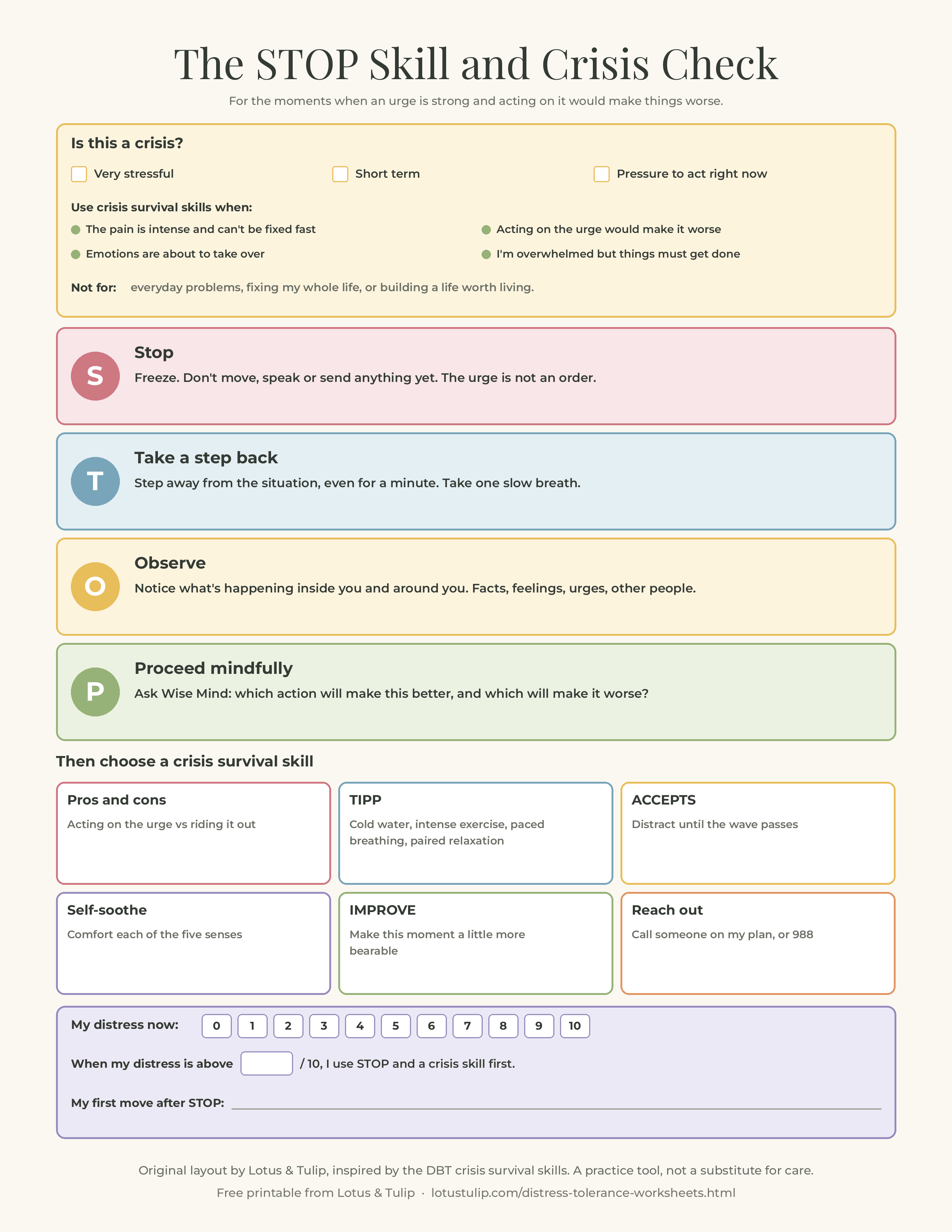
STOP works best when it is rehearsed. In session, many clinicians have clients practice saying the word "stop" (out loud or in their head) and physically freezing during a mild trigger, so the response is already familiar when a big one arrives. Page 1 of the free printable puts STOP on a single card with a crisis check above it.
Pros and cons
The DBT version of pros and cons is a four box grid, not a two column list. You weigh:
- the pros of acting on the crisis urge,
- the cons of acting on the crisis urge,
- the pros of resisting the urge and tolerating the distress,
- the cons of resisting.
Filling in all four boxes is the point. Clients usually know the cons of the urge already; writing down its honest pros ("it would stop the feeling for a few minutes") makes the exercise believable, and writing the short and long term cons of acting makes the trade visible. The skills materials also recommend doing pros and cons before a crisis, carrying the list, and reviewing it when the urge shows up. In the moment, nobody builds a careful grid; they read one they made earlier. That is why page 3 of the printable is a plan you write when calm.
TIPP: change your body chemistry fast
When emotional arousal is so high that thinking skills cannot get in, DBT uses the body. TIP (often written TIPP) stands for Temperature (cold water on the face while holding your breath), Intense exercise, Paced breathing (slowing down to roughly five or six breaths per minute, breathing out longer than in) and Paired muscle relaxation. The cold water step uses the body's dive response to slow the heart rate quickly. The handout carries a caution worth repeating: people with heart or medical conditions, a low resting heart rate, those taking beta blockers, people allergic to cold and anyone with an eating disorder should check with their health care provider before using the cold water or intense exercise skills.
TIPP is covered in full, with a free printable, in our DBT TIPP skills worksheet guide.
Distract with Wise Mind ACCEPTS
ACCEPTS is a menu of ways to take your attention off the crisis long enough for the wave to pass. Each letter is a category, so clients can build personal options under each one:
- A: Activities. Do something that needs some attention: a walk, cleaning one drawer, a game, a TV episode, cooking, a puzzle.
- C: Contributing. Do something for someone else: help a friend, send a kind message, volunteer, make a small surprise for someone. Attention moves outward.
- C: Comparisons. Compare how you feel now with a time you felt worse and got through it, or with how others cope. Used gently, this is perspective, not guilt.
- E: Different emotions. Do something that brings up a different feeling: a comedy, upbeat music, an old funny video, an emotional film if sadness is not the problem.
- P: Pushing away. Mentally leave the situation for a while: imagine putting it in a box on a high shelf, write it down and put it in a drawer, decide to think about it at a set time later.
- T: Other thoughts. Fill your mind with something else: count to 10 or count colors in the room, recite song lyrics, do mental math, read.
- S: Other sensations. Use strong, safe physical sensations: hold ice, take a cold shower, squeeze a stress ball, listen to loud music, eat something sour.
The phrase "Wise Mind" in front of ACCEPTS is a reminder that distraction is chosen, time limited and in service of a goal. Scrolling for four hours is not ACCEPTS. Watching one episode so that you do not text your ex at 1 a.m., then going to bed, is.
Self-soothe with the five senses
Self-soothing means being kind to yourself through each of the senses. Many people who struggle with intense emotions were never taught to comfort themselves, or feel they do not deserve comfort, so this skill can be harder than it sounds. The skill uses all five senses:
- Vision: look at the sky, photos you love, a candle flame, a tidy corner of the room.
- Hearing: a calming playlist, rain sounds, a favorite voice message, humming.
- Smell: a scented lotion, fresh coffee, a candle, clean laundry, a sprig of mint.
- Taste: a cup of tea, a mint, one piece of chocolate eaten slowly and mindfully.
- Touch: a soft blanket, a warm shower, petting a dog or cat, a weighted blanket, lotion on your hands.
The 2015 materials also include a body scan as a self-soothing practice. For clients with trauma histories, a body scan can feel unsafe at first; offering eyes open options and short versions helps. For a grounding sequence that uses the same senses in a structured way, see the 5-4-3-2-1 grounding worksheet.
IMPROVE the moment
IMPROVE is about replacing an awful moment with a slightly better one. It is often the bridge from crisis survival to acceptance:
- I: Imagery. Picture a safe, calm place in detail, or imagine things going well, or imagine the painful feelings draining away.
- M: Meaning. Look for purpose or value in the pain, or in how you are getting through it. Not "everything happens for a reason", but "what can I take from this?"
- P: Prayer. Open your heart to a higher power, or to your own wise mind. Asking for strength to bear the pain, rather than for it to vanish.
- R: Relaxing actions. A hot bath, stretching, slow breathing, a massage, changing your facial expression.
- O: One thing in the moment. Put all your attention on what you are doing right now: washing this cup, walking this block. Pain is often worse when we are living the past and future at once.
- V: Vacation. Take a brief, planned break: a short nap, 20 minutes with a book, a drive with the phone off. Brief is the key word; a vacation from adulthood for a week does not count.
- E: Encouragement and rethinking. Cheerlead yourself: "This too shall pass." "I can stand it." "I've survived this before." "I'm doing the best I can."
A worked example, start to finish
Jordan, 27, has been in DBT skills group for six weeks. At 11:40 p.m. her partner sends a short message saying he needs space and will talk tomorrow. Jordan's distress shoots to 9 out of 10. The urges: call him ten times, send a long angry message, and drink the bottle of wine in the kitchen.
- Crisis check. Very stressful: yes. Short term: the conversation will happen tomorrow. Pressure to act now: huge. Acting would make it worse: almost certainly. This is a crisis survival moment.
- STOP. She puts the phone face down on the table and says "stop" in her head. She steps out onto the balcony and takes a long breath out. Observing: "My chest is tight, I'm thinking he's leaving, I want to call him. Fact: he said he'll talk tomorrow."
- TIPP. Distress is still at 8, so she splashes cold water on her face and does two minutes of slow breathing. It drops to 6.
- Pros and cons. She reads the grid on her phone that she wrote in group. Pro of calling: relief for a minute. Cons: last time it led to a three day fight and she felt ashamed. Pros of waiting: she shows up to tomorrow's conversation calm and on her own terms.
- ACCEPTS and self-soothe. She texts a friend who said she could message late (contributing and connection), puts on one episode of a comedy (different emotions), makes peppermint tea (taste and smell) and takes a warm shower.
- IMPROVE. In bed she repeats, "This is painful, and I can stand it until morning."
Nothing is solved. Her partner might still want space. But the crisis did not get bigger: no ten calls, no message she regrets, no wine. Tomorrow she will use other skills (interpersonal effectiveness, and maybe radical acceptance) for the actual conversation. That is distress tolerance doing its job.
How to teach distress tolerance skills, step by step
- Start with the why. Explain that some pain cannot be fixed right away, and that the goal is to get through the moment without making it worse. Ask what crisis behaviors have cost the client in the past.
- Teach the crisis check. Define a crisis (very stressful, short term, pressure to act now) and name what the skills are not for, so they do not become avoidance.
- Introduce STOP with a rehearsal. Practice freezing, stepping back and observing during a mild, planned trigger in session, such as recalling a minor irritation.
- Build a pros and cons grid together. Pick one real crisis urge and fill in all four boxes. Have the client photograph it or keep it in their wallet.
- Demonstrate TIPP in the room. Try paced breathing or paired muscle relaxation together, check medical cautions before suggesting cold water or intense exercise, and have the client rate distress before and after.
- Fill the ACCEPTS and self-soothe menu. Have the client write at least one personal idea for each letter and each sense, focusing on options available at night, at school or at work.
- Add IMPROVE phrases. Help the client write two or three encouraging statements in their own words, and one calm image they can call up quickly.
- Write the crisis survival plan. Combine warning signs, the pros and cons, skills in order, people to contact, ways to make the space safer and crisis line numbers on one page.
- Assign practice between sessions. Ask the client to practice one skill daily when distress is moderate (4 to 6 out of 10), not only during emergencies, and to note what helped.
- Review and refine. Next session, look at what was used, what worked and what was skipped. Swap out ideas that did not help and keep building the plan.
For school counselors: DBT STEPS-A (Mazza, Dexter-Mazza, Miller, Rathus and Murphy, 2016) is a classroom curriculum for grades 6 to 12 that teaches DBT skills in 30 lessons. Distress tolerance is lessons 6 to 12, with crisis survival skills and ACCEPTS first, then self-soothe and IMPROVE, then TIP, then pros and cons. It is a useful model if you are teaching these skills to a class or small group rather than in therapy.
Distress tolerance for teens
Teenagers often have the most to gain from crisis survival skills, because impulsive moments (a message sent in anger, a fight at school, self harm after a breakup) can have outsized consequences. Rathus and Miller adapted the DBT skills for adolescents in the DBT Skills Manual for Adolescents (2015), with simpler language and family involvement. A few things help:
- Make it about their goals. "This is how you keep your phone, stay on the team, keep your friends" lands better than "this is how you behave."
- Use their sensations and distractions. Teens know what actually absorbs them: a specific game, a playlist, sour candy, a cold drink, drawing. Let them fill the menu.
- Plan for phones. Many teen crises happen through a screen. STOP before sending is a skill worth practicing on its own: "Phone down, step away, wait 10 minutes."
- Involve a caregiver. Parents can learn the same words, offer self-soothe options and avoid lecturing during a crisis. Validation first, problem solving later.
- Keep safety visible. Put 988 and the Crisis Text Line on the plan, and make sure the teen knows that using a crisis line is a skill, not a failure.
For more ready teen pages, see our guide to coping skills worksheets for teens and the window of tolerance worksheet, which explains why skills are harder to use when someone is far outside their window.
Common mistakes with distress tolerance skills
- Using them for everything. Crisis skills are for crises. Daily distraction from ongoing problems becomes avoidance.
- Waiting until a 10 out of 10 to try them for the first time. Skills learned at a 3 or 4 are much easier to reach at an 8.
- Expecting to feel good. The goal is to not make things worse. Feeling slightly less awful counts as success.
- Making the menu too vague. "Do something fun" fails at midnight. "Watch one episode of my comfort show, then sleep" works.
- Skipping the cons of resisting. In pros and cons, honest boxes make the exercise credible. If resisting feels terrible, write that down.
- Ignoring medical cautions with TIPP. Cold water and intense exercise are not for everyone; check first.
- Treating a crisis line as a last resort. Reaching out early is one of the most skillful crisis moves there is.
What the research says (honestly)
Most of the research on distress tolerance comes from studies of DBT as a whole, or of DBT skills training groups, rather than tests of a single skill like ACCEPTS. Here is what that research does and does not support.
- Skills use matters. In a secondary analysis of a trial with 108 women with borderline personality disorder, Neacsiu, Rizvi and Linehan (2010) found that people in DBT used about three times as many skills as people in the comparison treatment by the end of treatment, and that skills use fully mediated the decrease in suicide attempts and depression and the increase in anger control, and partially mediated the drop in nonsuicidal self injury.
- Skills training alone can help. Linehan and colleagues (2015, JAMA Psychiatry) compared standard DBT with versions that dropped either the skills group or individual therapy in 99 women at high suicide risk. The versions that included skills training did better on several outcomes, including reductions in self harm frequency, than the version without it.
- Brief skills groups. McMain and colleagues (2017) randomized 84 people with borderline personality disorder at high suicide risk to 20 weeks of DBT skills group or a waitlist. The skills group had greater reductions in suicidal and self harm episodes, and better distress tolerance, emotion regulation and anger outcomes at 32 weeks. A secondary analysis of the same trial found that gains in mindfulness and distress tolerance each helped explain the improvements.
- Adolescents. Mehlum and colleagues (2014) found DBT for adolescents reduced self harm, suicidal ideation and depressive symptoms more than enhanced usual care in 77 adolescents with repeated self harm.
- Measuring distress tolerance. The Distress Tolerance Scale (Simons and Gaher, 2005) is a 15 item self report measure with four parts: tolerance, appraisal, absorption and regulation. It is sometimes used to track change over treatment.
What we cannot honestly claim: that any single crisis skill, on its own, has been shown to prevent suicide, or that a worksheet replaces treatment. The skills are part of a structured therapy, and the evidence is strongest when they are taught and coached by trained clinicians.
Safety notes and when to get more help
Crisis survival skills help people ride out urges, but they are not a substitute for care when someone is in danger. If you or someone you are working with might act on thoughts of suicide or self harm:
- In the US, call or text 988 (988 Suicide and Crisis Lifeline), any time, day or night.
- Text HOME to 741741 to reach the Crisis Text Line.
- Call 911 if there is immediate danger.
For clinicians, a distress tolerance plan works alongside, not instead of, a full safety plan and risk assessment. If a client is using crisis skills many times a day, that is information: the underlying problems probably need more direct work.
Tips for therapists and group leaders
- Personalize every list. Generic examples are a starting point; the client's own ideas are what get used.
- Practice in session. Do paced breathing, a short self-soothe exercise or STOP together. Skills that have never been tried in a safe setting rarely get tried in a crisis.
- Use a distress rating. A simple 0 to 10 before and after each skill gives clients data on what works for them.
- Pair crisis skills with change skills. After the crisis passes, help the client move to problem solving, opposite action or acceptance.
- Keep the plan portable. Encourage a photo on the phone, a copy in a wallet and one on the fridge.
Free distress tolerance worksheets (PDF)
The free distress tolerance worksheets have three pages in US Letter size, written for teens and adults:
- Page 1: The STOP Skill and Crisis Check. A crisis check (very stressful, short term, pressure to act now), when to use crisis skills and when not to, the four STOP steps in plain words, the six crisis survival options and a 0 to 10 distress line with a personal "use skills above" threshold.
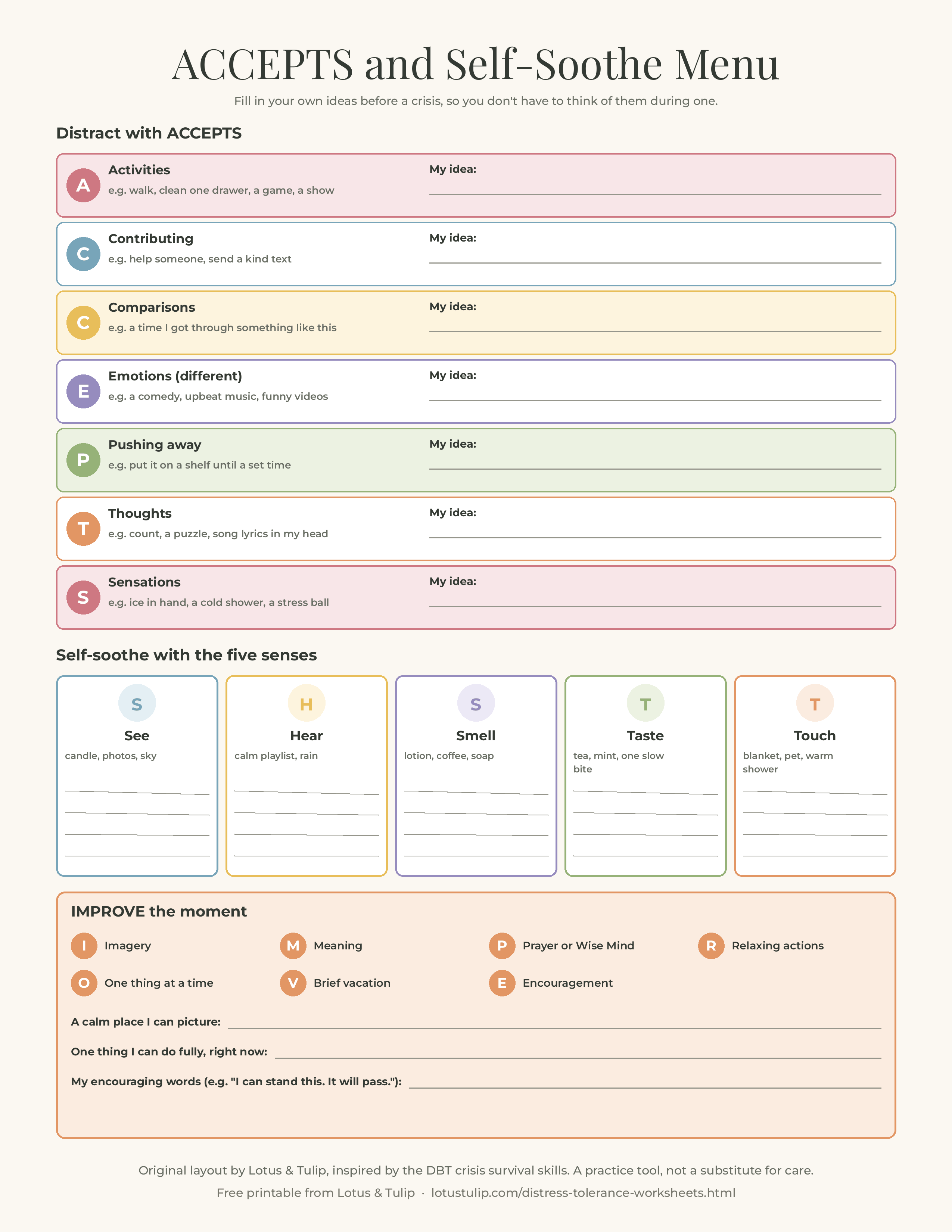
- Page 2: ACCEPTS and Self-Soothe Menu. All seven ACCEPTS categories with examples and space for your own idea, a five senses self-soothe menu with writing lines, and an IMPROVE the moment strip with a calm image, one thing in the moment and encouraging words.
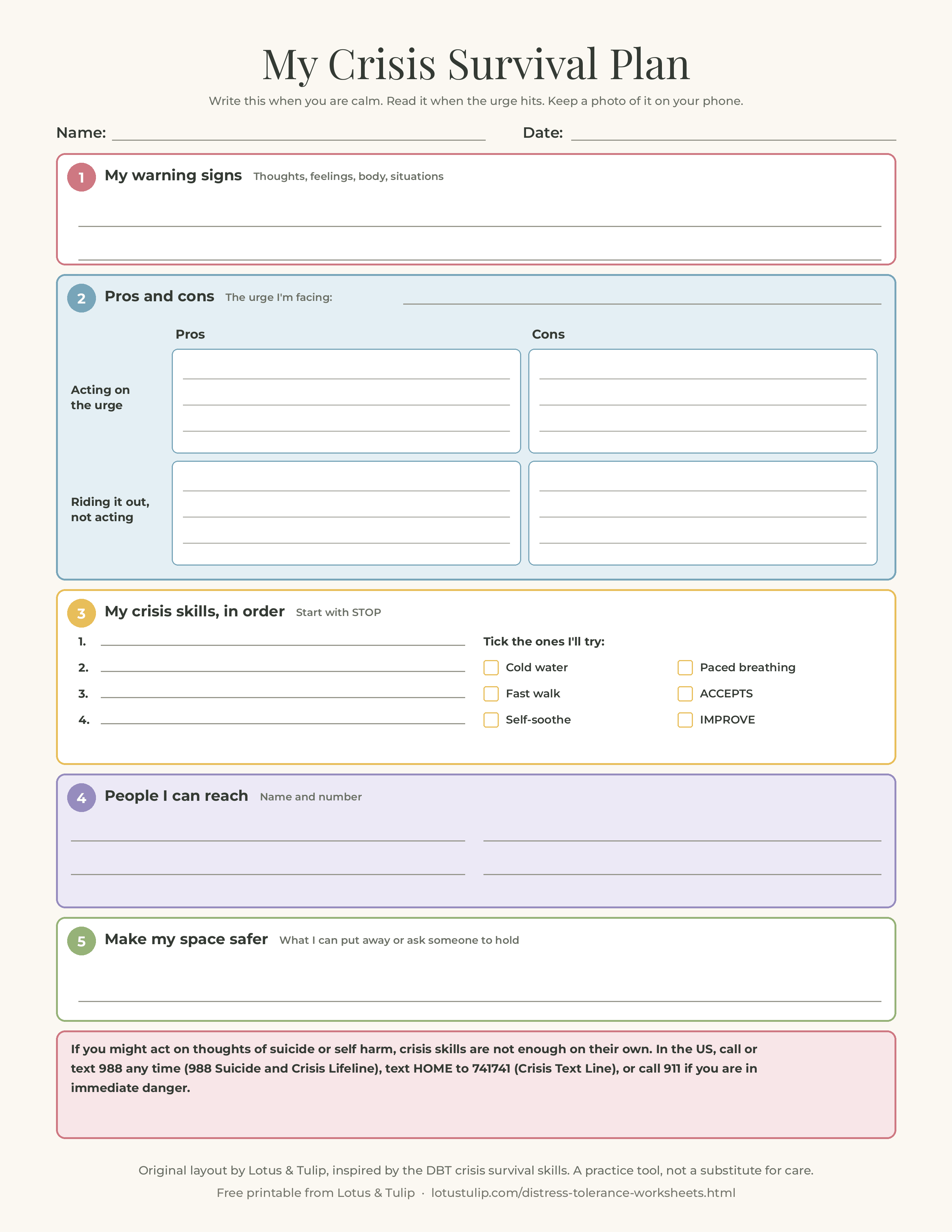
- Page 3: My Crisis Survival Plan. Warning signs, a four box pros and cons grid (acting on the urge vs riding it out), skills in order starting with STOP, people I can reach, how to make my space safer, and a safety box with 988, the Crisis Text Line and 911.
Download the free distress tolerance worksheets (PDF, 3 pages, US Letter)
Prefer single images? Page 1: The STOP Skill and Crisis Check (PNG) · Page 2: ACCEPTS and Self-Soothe Menu (PNG) · Page 3: My Crisis Survival Plan (PNG)
Free DBT starter pack for teens: Working with a teen? The free DBT worksheets for teens starter pack adds a teen distress tolerance toolkit from our paid DBT set for teens, plus finding my wise mind, ride the emotion wave, check the facts, a weekly diary card and a safety and care page (8 pages, ages about 13 to 18, client use license, no email).
Free to print for your own use and for use with your own clients or groups. This is an original layout by Lotus & Tulip, not a copy of the DBT manual handouts. Please link to this page rather than re-uploading the file.
Related resources
- Coping skills worksheets for adults: the wider coping menu for everyday stress, beyond crisis skills
- Emotion regulation worksheets for adults: an emotion log, five points to step in and a free 2 page PDF
- DBT STOP skill worksheet: STOP on its own, with a pocket card, a practice log and teen examples.
- DBT pros and cons worksheet: the four box grid on its own, with short and long term markers, a pocket card and a practice log.
- Radical acceptance worksheet: the reality acceptance half of distress tolerance.
- DBT TIPP skills worksheet: temperature, intense exercise, paced breathing and paired muscle relaxation in detail.
- Opposite action worksheet: the emotion regulation skill for acting against an unhelpful urge.
- Wise mind worksheet: the DBT state of mind that STOP asks you to consult.
- Window of tolerance worksheet: why skills are harder to reach when you are far outside your window.
- 5-4-3-2-1 grounding worksheet: a structured senses exercise for anxiety and panic.
- Coping skills worksheets for teens: more teen friendly coping pages.
Sources
- Linehan, M. M. (2015). DBT Skills Training Manual, second edition. Guilford Press.
- Linehan, M. M. (2015). DBT Skills Training Handouts and Worksheets, second edition. Guilford Press. Distress Tolerance Handouts 1 to 9.
- Rathus, J. H., and Miller, A. L. (2015). DBT Skills Manual for Adolescents. Guilford Press.
- Mazza, J. J., Dexter-Mazza, E. T., Miller, A. L., Rathus, J. H., and Murphy, H. E. (2016). DBT Skills in Schools: Skills Training for Emotional Problem Solving for Adolescents (DBT STEPS-A). Guilford Press.
- Neacsiu, A. D., Rizvi, S. L., and Linehan, M. M. (2010). Dialectical behavior therapy skills use as a mediator and outcome of treatment for borderline personality disorder. Behaviour Research and Therapy, 48(9), 832 to 839.
- Linehan, M. M., Korslund, K. E., Harned, M. S., and colleagues (2015). Dialectical behavior therapy for high suicide risk in individuals with borderline personality disorder: a randomized clinical trial and component analysis. JAMA Psychiatry, 72(5), 475 to 482.
- McMain, S. F., Guimond, T., Barnhart, R., Habinski, L., and Streiner, D. L. (2017). A randomized trial of brief dialectical behaviour therapy skills training in suicidal patients suffering from borderline disorder. Acta Psychiatrica Scandinavica, 135(2), 138 to 148.
- Mehlum, L., Tormoen, A. J., Ramberg, M., and colleagues (2014). Dialectical behavior therapy for adolescents with repeated suicidal and self-harming behavior: a randomized trial. Journal of the American Academy of Child and Adolescent Psychiatry, 53(10), 1082 to 1091.
- Simons, J. S., and Gaher, R. M. (2005). The Distress Tolerance Scale: development and validation of a self-report measure. Motivation and Emotion, 29(2), 83 to 102.
- 988 Suicide and Crisis Lifeline, 988lifeline.org. Crisis Text Line, crisistextline.org.
Distress tolerance worksheets: FAQ
What is distress tolerance in DBT?
Distress tolerance is one of the four DBT skill areas. It teaches how to survive a crisis without making it worse and how to accept painful reality that cannot be changed right now. It has two parts: crisis survival skills (STOP, pros and cons, TIP, ACCEPTS, self-soothe, IMPROVE) and reality acceptance skills such as radical acceptance.
What are the six crisis survival skills?
In the 2015 DBT skills materials, the crisis survival skills are STOP, pros and cons, TIP (changing your body chemistry with temperature, intense exercise, paced breathing and paired muscle relaxation), distracting with Wise Mind ACCEPTS, self-soothing with the five senses, and IMPROVE the moment.
What does STOP stand for in DBT?
STOP stands for Stop (freeze, do not react), Take a step back, Observe what is happening inside and around you, and Proceed mindfully by asking your wise mind which action will make the situation better or worse.
What does ACCEPTS stand for?
ACCEPTS is a set of distraction categories: Activities, Contributing, Comparisons, different Emotions, Pushing away, other Thoughts and other Sensations. Each letter is a type of distraction you can fill with your own ideas before a crisis.
When should you not use distress tolerance skills?
Crisis survival skills are for short, intense crises where acting on an urge would make things worse. They are not meant for everyday problems or for solving ongoing life problems. Used all the time, they can turn into avoidance; ongoing problems need problem solving, emotion regulation or acceptance skills.
Are distress tolerance skills good for teens?
Yes. DBT has been adapted for adolescents (Rathus and Miller, 2015) and for schools in the DBT STEPS-A curriculum for grades 6 to 12. Teens do best when they choose their own distractions and soothing options, practice STOP before sending messages, and have 988 and the Crisis Text Line on their plan.
Can I print the free distress tolerance worksheets for clients?
Yes. The free PDF is an original Lotus & Tulip layout you can print for your own use and for your own clients, students or groups. Please link to this page instead of re-uploading the file.