
Kids and teens · School counseling · Updated 2026-11-03
Size of the problem worksheet: how to teach kids big problem vs little problem, with a free printable
Ready-made printable: Anger Management Small Group Curriculum for School Counselors Holiday 20% off: about $11.04, was $14 (EUR 12) · instant digital download
Buy on Etsy
A broken pencil and a classmate who gets hurt on the playground are both problems, but they do not deserve the same reaction. Many children have not learned that difference yet. A small hiccup can turn into tears, yelling or a shutdown, while a real problem sometimes goes unreported because the child does not know it is serious. "Size of the problem" is a simple way to teach the difference: first decide how big the problem really is, then choose a reaction that matches it. This guide is for school counselors, teachers, special education staff, child therapists and parents. It covers what the idea means and where it comes from, a five level scale with matching reactions, how to teach it step by step, how to use it in the moment without dismissing a child's feelings, classroom and small group activities, ideas for home, an answer key for common scenarios, and the mistakes that make it backfire. It ends with a free three page printable: a five level size of the problem scale, 20 scenario cards for a sorting activity, and a reflection sheet.
Jump to the free size of the problem worksheet
What "size of the problem" means
The idea has two parts. The first is the size of the problem itself: how serious it is, who needs to help, and how long it will take to fix. The second is the size of the reaction: what the child says and does on the outside. The goal is for the two to match. A small problem gets a small reaction (a sigh, a calm "oh no", a quick fix). A big problem gets a bigger reaction, and that is expected and healthy (being upset, crying, telling an adult right away).
Three questions do most of the work, and children can learn to ask them on their own:
- Is anyone hurt or unsafe? If yes, it is a big problem or an emergency, and an adult needs to know now.
- Can I fix it myself, or do I need help?
- How long will it take to fix: a few minutes, an hour or a day, or much longer?
Notice what the questions do not ask. They do not ask how big the feeling is. Feelings are real at any size, and a child can feel very upset about a small problem. The skill is noticing that the feeling is big while the problem is small, and then choosing a reaction that fits the problem. That is a self-management skill, one of the five core social and emotional competencies in the CASEL framework that many US schools use for SEL.
Where the idea comes from
Size of the problem is closely tied to Social Thinking, the methodology developed by speech language pathologist Michelle Garcia Winner and published by Think Social Publishing. Social Thinking teaches that problems come in different sizes and that our reaction size should match the problem size, and it is one of the storybook concepts in the We Thinkers! curriculum for young learners. Social Thinking is a registered trademark of Think Social Publishing, Inc. Five level scales for emotions and behavior are also well known from Kari Dunn Buron and Mitzi Curtis's book The Incredible 5-Point Scale. The scale, cards and reflection sheet on this page are an original, general teaching tool made by Lotus & Tulip. They are not affiliated with or endorsed by Social Thinking, Think Social Publishing or the authors of The Incredible 5-Point Scale, and if you want those programs in full, their own books and training are the place to go.
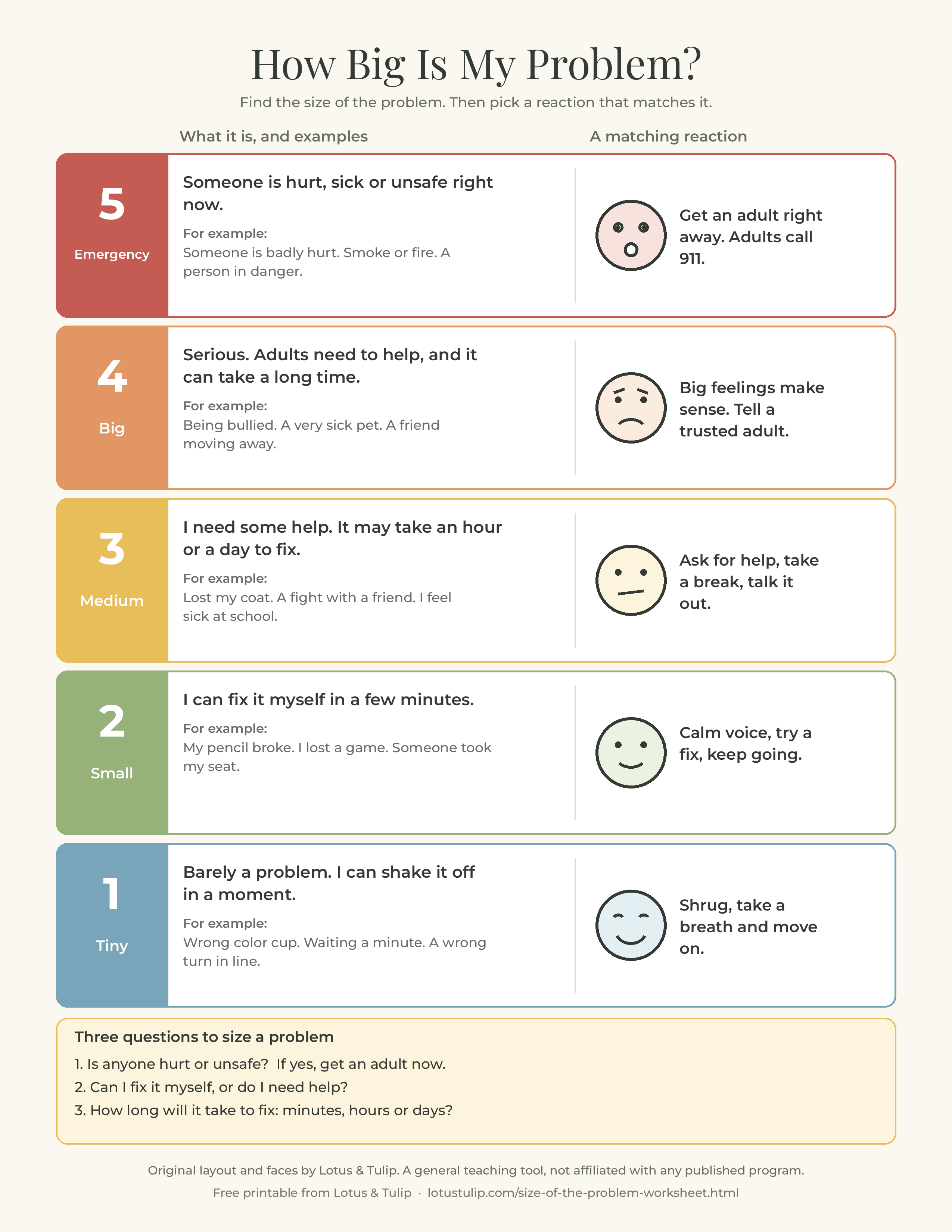
The five levels of the size of the problem scale
Many classrooms use three sizes: small, medium and big. Three is a good start for kindergarten and first grade. Five levels give older children more room to be precise, and they separate a big problem from a true emergency, which matters for safety. The free scale uses these five levels:
| Level | What it is | Examples | A matching reaction |
|---|---|---|---|
| 1 Tiny | Barely a problem. I can shake it off in a moment. | The wrong color cup, waiting a minute, a wrong turn in line | Shrug, take a breath and move on |
| 2 Small | I can fix it myself in a few minutes. | A broken pencil, losing a game, someone took my seat | Calm voice, try a fix, keep going |
| 3 Medium | I need some help. It may take an hour or a day to fix. | A lost coat, a fight with a friend, feeling sick at school | Ask for help, take a break, talk it out |
| 4 Big | Serious. Adults need to help, and it can take a long time. | Being bullied, a very sick pet, a best friend moving away | Big feelings make sense. Tell a trusted adult and get support |
| 5 Emergency | Someone is hurt, sick or unsafe right now. | Someone is badly hurt, smoke or fire, a person in danger | Get an adult right away. Adults call 911 |
The levels are a starting point for discussion, not a rule book. The same event can change size with the details: a classmate bumping into you is small, a classmate who pushes you hard on purpose every day is big. Talking through those details is where most of the learning happens.
Who this helps
- Children who melt down, yell or shut down over small frustrations, such as losing a game or a change in plans.
- Students in anger management, coping skills and social skills small groups.
- Autistic children and children with ADHD who benefit from a concrete, visual way to think about something abstract.
- Anxious children who treat many problems as emergencies, and quieter children who treat real problems as small and do not tell anyone.
- Whole classrooms, as a shared language: "Is that a size 2 or a size 4?" is faster and calmer than a lecture.
How to teach the size of the problem, step by step
- Teach it on a calm day. Introduce the idea in a lesson, a small group or a quiet moment at home, never in the middle of an upset. Children cannot learn a new thinking skill while they are flooded.
- Introduce the scale and the three questions. Show the five levels and read the examples together. Teach the three questions: is anyone hurt or unsafe, can I fix it myself, and how long will it take.
- Separate the problem from the feeling. Explain that feelings can be big even when a problem is small, and that is okay. The scale is about the problem and the reaction, not about whether a feeling is allowed.
- Model with your own small problems. Think out loud: "I spilled my coffee. Is anyone hurt? No. Can I fix it? Yes, with a paper towel. That is a size 2, so I will say oops and clean it up."
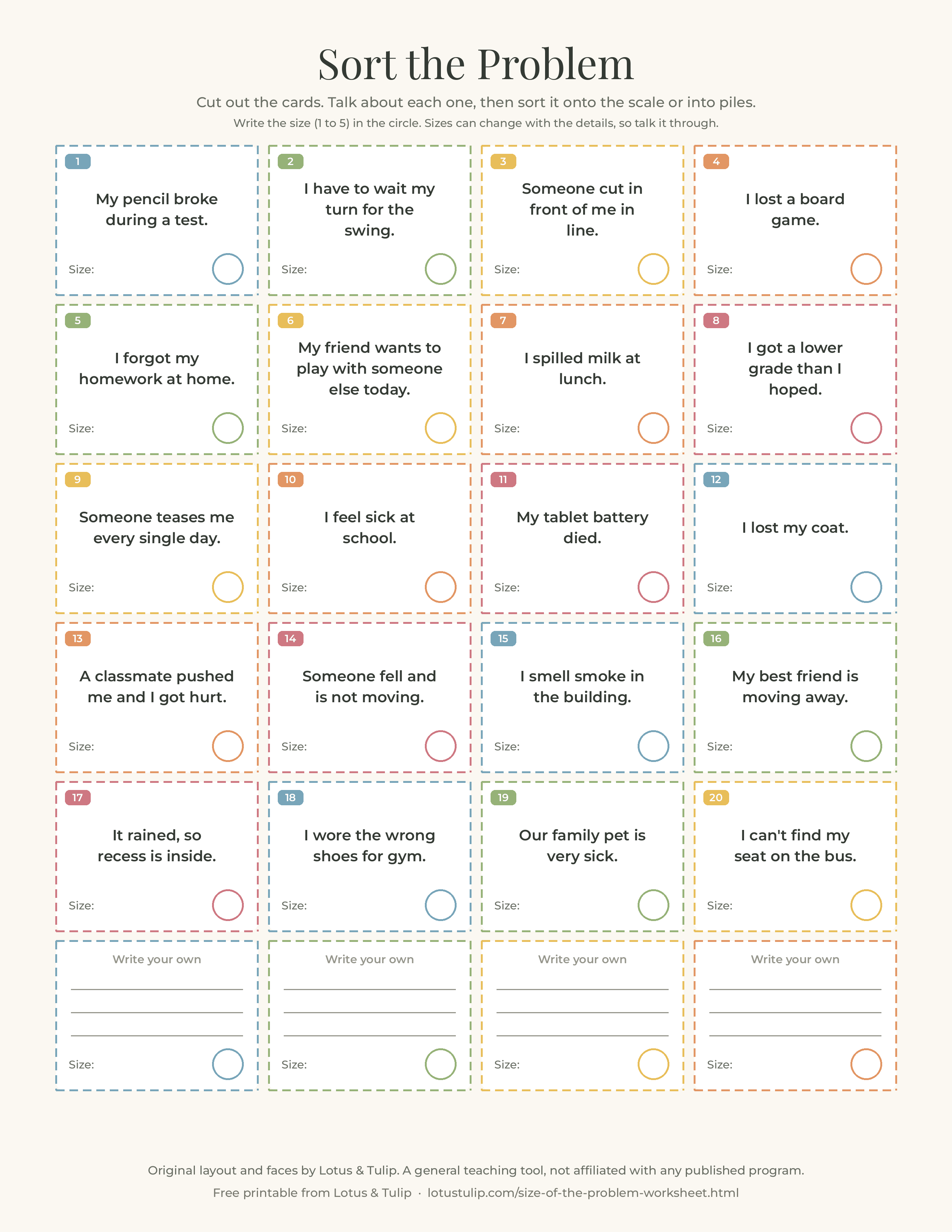
- Sort the scenario cards. Use the 20 cards in the free printable. Children read a card, ask the three questions and place it on the scale or into small, medium and big piles. Accept different answers when the reasoning is good, and ask what detail would change the size.
- Talk about reaction size. For a few cards, ask what a tiny, medium and huge reaction would look like. Children quickly see that a huge reaction to a broken pencil creates a new problem of its own, while a tiny reaction to someone getting hurt is not safe either.
- Practice matching reactions. Role play two or three scenarios with a matched reaction. Keep it light and specific: what you say, what your voice sounds like, what your body does, who you go to.
- Post the scale and use it in the moment, briefly. Put the scale where children can see it. When a problem happens, first help the child calm down, then point to the scale and ask one question: "What size is this problem?"
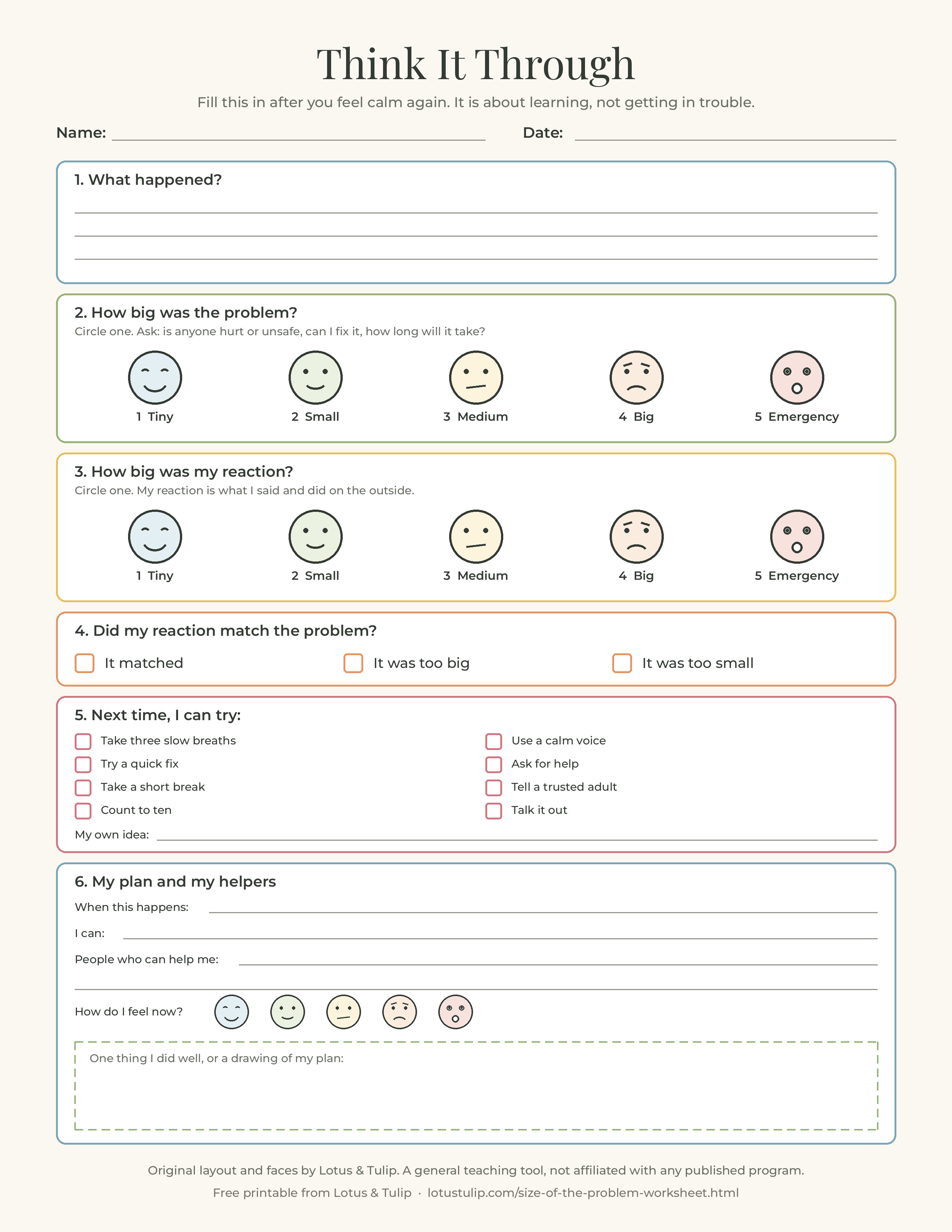
- Reflect afterwards and celebrate matches. Once the child is calm, use the reflection sheet to look back at what happened, the problem size, the reaction size and a plan for next time. Notice and praise matched reactions too, not only mismatches.
Using it in the moment without dismissing feelings
The quickest way to make this tool backfire is to use it as a put down. "That's a small problem, stop crying" teaches a child that their feelings are wrong and that adults do not listen. A better sequence is: connect, calm, then size.
- Connect first. "You really wanted to win that game. That's frustrating."
- Calm the body. A few slow breaths, a sip of water, a short break or a calm down corner. See our calm down corner ideas and coping skills list for kids for options.
- Then size it together. "Let's look at the scale. Is anyone hurt? Can we fix it? What size do you think it is?" Let the child answer rather than announcing the size.
- Choose the next step. For small problems, a quick fix. For medium problems, who can help. For big problems, reassurance that adults will take it seriously.
A feelings thermometer pairs well with the scale: the thermometer measures how big the feeling is, the scale measures how big the problem is, and the gap between them is a useful thing to talk about.
Important cautions
- Safety problems are never small. Teach clearly that bullying, someone being hurt, touching that feels wrong, threats, weapons or anything unsafe is always a big problem or an emergency, and that telling an adult is always the right reaction. Children should never worry that they are "making a big deal" about a safety concern.
- Sizes depend on the child. A schedule change may be a size 1 for one child and genuinely hard for an autistic child who relies on routine. Use the scale to build understanding, not to judge. A visual schedule or a social story can make changes smaller in the first place.
- Frequent big reactions may need more support. If a child is having daily meltdowns, aggression or signs of anxiety, trauma or depression, a worksheet is not enough. Talk with the school counselor, school psychologist or a child therapist about a fuller plan.
- Adults model it too. Children notice when adults yell about traffic or spilled milk. Sizing your own problems out loud is one of the most powerful ways to teach this.
Size of the problem activities for the classroom and small groups
- Card sort. Pairs sort the 20 scenario cards, then compare with another pair and discuss any card they sized differently.
- Four corners. Label corners of the room small, medium, big and emergency. Read a scenario and have students walk to the size they choose, then ask one or two to explain.
- Change one detail. Take a small problem and change one detail to make it bigger ("you lost your coat" becomes "you lost your coat and it is snowing and you have to walk home"). Then make it smaller again.
- Reaction size charades. Act out a tiny, medium or huge reaction to the same problem while the group guesses which size it was and whether it matched.
- Story characters. Pause a read aloud and ask what size the character's problem is and whether their reaction matched.
- Problem box. Students write problems from their week on the blank cards, anonymously, for the group to size and solve together.
The idea fits naturally into an anger management group, a coping skills group or a social skills group: it gives every later session a shared vocabulary. The anger iceberg worksheet and circle of control worksheet are good next lessons.
Using the size of the problem at home
Parents can use the same scale and the same words as school, which helps children generalize the skill. Post it on the fridge, size your own problems out loud, and use the reflection sheet at a calm time, such as after dinner, rather than right after a blow up. Keep it short: one question ("What size was that?") is often enough. When your child matches a reaction well, name it: "Your shoelace broke and you just tied a knot and kept going. That was a size 2 reaction to a size 2 problem."
Scenario cards: a suggested answer key
These are the sizes many adults would choose for the cards in the free printable. Different answers are fine when a child can explain them, and the discussion matters more than the number.
| Scenario | Likely size | Why |
|---|---|---|
| I have to wait my turn for the swing. | 1 | No one is hurt, and it fixes itself in minutes. |
| My tablet battery died. | 1 | Charge it later and do something else. |
| It rained, so recess is inside. | 1 or 2 | Disappointing, but the day goes on. |
| My pencil broke during a test. | 2 | Raise a hand or grab another pencil. |
| I lost a board game. | 1 or 2 | A sad moment, then play again or move on. |
| I spilled milk at lunch. | 2 | Get napkins and clean it up. |
| I forgot my homework at home. | 2 or 3 | May need to talk to the teacher and make a plan. |
| I lost my coat. | 3 | Needs adult help with the lost and found. |
| I feel sick at school. | 3 | Tell the teacher and go to the nurse. |
| A classmate pushed me and I got hurt. | 3 or 4 | Someone got hurt, so an adult needs to know. |
| Someone teases me every single day. | 4 | Repeated teasing can be bullying, and adults need to help. |
| My best friend is moving away. | 4 | A real loss that takes a long time to adjust to. |
| Someone fell and is not moving. | 5 | Someone may be badly hurt. Get an adult right away. |
| I smell smoke in the building. | 5 | Possible fire. Tell an adult immediately. |
Common mistakes
- Using it during the meltdown. Sizing a problem needs a calm brain. Calm first, size second.
- Telling instead of asking. "That's a small problem" is a verdict. "What size do you think it is?" builds the skill.
- Treating big feelings as bad. The goal is a matched reaction, not no feelings. Big problems deserve big feelings.
- Only using it to correct. If the scale only comes out when a child is in trouble, it becomes a punishment chart. Use it for praise and for adult problems too.
- Skipping the safety message. Every lesson should repeat that unsafe situations are always big and always worth telling an adult.
- One lesson and done. Like any skill, this needs practice over weeks, with the scale visible and the same words used by every adult.
Free size of the problem worksheet (printable PDF)
This free printable is an original Lotus & Tulip design, sized for US Letter paper. It has three pages:
- Page 1: size of the problem scale. Five color coded levels from 1 Tiny to 5 Emergency, each with what it is, examples, a face and a matching reaction, plus the three questions to size a problem.
- Page 2: scenario cards for sorting. 20 numbered cards with everyday school and home problems, each with a size circle, plus 4 blank cards to write your own.
- Page 3: reflection sheet. What happened, how big the problem was, how big my reaction was, whether it matched, eight things I can try next time, my plan and helpers, and how I feel now.
Download the free size of the problem worksheet (PDF, 3 pages, US Letter)
Prefer single images? Page 1: five level size of the problem scale (PNG) · Page 2: 20 scenario cards and 4 blanks (PNG) · Page 3: reflection sheet (PNG)
Free anger management starter pack: Working on big reactions? The free anger management worksheets starter pack adds an anger thermometer, the anger iceberg, stop, think, choose, a cool-off menu, a cool-down plan and a support and safety page from our paid anger set.
Free to print for use with your own students, clients or children. Please link to this page rather than re-uploading the file. A general teaching tool, not a substitute for an individual plan from a child's team. Social Thinking is a registered trademark of Think Social Publishing, Inc.; this printable is not affiliated with or endorsed by Social Thinking.
Related resources
- Frustration tolerance worksheets for kids: a 5 level frustration meter and a free try again plan
- Tattling vs telling worksheet (free printable): when to tell an adult, with a 12 scenario sort and a telling plan
- Feelings thermometer printable (free worksheet)
- Anger iceberg worksheet (free printable)
- Coping skills list for kids (free printable)
- Calm down corner ideas (free calm down steps printable)
- Circle of control worksheet (free printable)
- Daily check in for students (free weekly sheet)
FAQ
What is the size of the problem?
Size of the problem is a way to teach children that problems come in different sizes and that their reaction should match the size of the problem. Children ask whether anyone is hurt or unsafe, whether they can fix it themselves and how long it will take, then choose a reaction that fits. The idea is closely associated with Social Thinking, the methodology developed by Michelle Garcia Winner.
What is the difference between a big problem and a little problem?
A little problem is one a child can fix alone in a few minutes, such as a broken pencil or losing a game. A big problem is serious, needs adults to help and can take a long time to fix, such as bullying or a family pet being very sick. An emergency, where someone is hurt or unsafe right now, is the biggest size and always needs an adult immediately.
How do you teach size of the problem to kids?
Teach it on a calm day with a visual scale, model sizing your own small problems out loud, sort scenario cards together, talk about what matched and unmatched reactions look like, then use the scale briefly in real moments after the child has calmed down. Reflect afterwards and praise matched reactions.
What age is a size of the problem worksheet for?
Most often kindergarten through about fifth grade, and it also works for many middle schoolers and older students with social or emotional learning needs. For kindergarten and first grade, start with three sizes (small, medium, big) before moving to the five level scale.
Is size of the problem the same as the Zones of Regulation?
No. The Zones of Regulation, created by Leah Kuypers, sorts feelings and states of alertness into four colored zones. Size of the problem looks at how serious a problem is and whether the reaction matches it. Many schools use both, because knowing how big a feeling is and how big a problem is are related but different skills.
Should I tell a child their problem is small?
It works better to ask than to tell. Connect with the feeling first, help the child calm down, then ask "What size do you think this problem is?" Telling a child their problem is small while they are upset can feel dismissive and often makes the reaction bigger.
Is this size of the problem printable free?
Yes. It is free to print for use with your own students, clients or children. Please link to this page rather than re-uploading the file.