
Therapist worksheets · Assertiveness · Updated 2026-11-05
Assertiveness Worksheet: Skills, Scripts and a Free Printable for Clear Communication
Ready-made printable: Boundaries Worksheets for Therapists Holiday 20% off: about $9.20, was $12 (EUR 10) · instant digital download
Buy on Etsy
Assertiveness is the skill of saying what you think, feel and need clearly and respectfully, without talking yourself down and without talking over someone else. It sits between passivity (staying quiet to keep the peace) and aggression (pushing your way through). A good assertiveness worksheet turns that idea into practice: sorting styles, claiming basic rights, writing an ask or a no, and logging what happened so the next try gets easier.
This guide explains what assertive communication is, how it differs from passive, aggressive and passive aggressive patterns, why it matters for relationships, work and mental health, and which skills to rehearse. It covers rights and common myths, I statements, broken record, fogging, negative assertion, body language, adult and teen examples, therapist tips, common mistakes, and when assertiveness is unsafe. You also get a free three page US Letter printable.
This page is educational. It is not therapy, legal advice or a substitute for assessment by a licensed clinician. If you are in an abusive or dangerous situation, safety planning comes first. In the US, call or text 988, text HOME to 741741, or call 911 in an emergency. For intimate partner violence, the National Domestic Violence Hotline is 1-800-799-7233.
Jump to the free assertiveness worksheet (PDF) · How to practice, step by step · Assertive vs passive vs aggressive
What assertive communication is
Robert Alberti and Michael Emmons, whose book Your Perfect Right helped bring assertiveness training into everyday language, describe assertiveness as action that promotes equality in relationships: standing up for yourself without denying the other person's rights. Speed, Goldstein and Goldfried (2018), writing in Clinical Psychology: Science and Practice, summarize assertive behavior as any action that reflects a person's own best interest, including standing up for oneself without significant anxiety, expressing feelings comfortably, or exercising rights without denying the rights of others.
In plain terms, assertive communication usually means:
- You name the situation in facts, not insults.
- You own your feelings and needs with "I" language.
- You make a clear request or a clear no.
- You leave room for the other person to respond.
- You stay respectful of both people's dignity, even when the answer is no.
Assertiveness is not the same as always getting your way. It is the skill of showing up honestly. Outcomes still depend on the other person, the power balance and the setting. That honesty is why worksheets help: they slow the moment down so you can plan words before the conversation starts.
Assertive, passive, aggressive and passive aggressive
Most people slide between styles depending on the person and the stakes. Sorting examples on a worksheet makes the pattern visible.
| Style | What it looks like | Typical effect |
|---|---|---|
| Passive | Avoids the issue, softens every request, apologizes for having needs, hopes the other person notices. | Short term peace, longer term resentment, unmet needs, feeling invisible. |
| Aggressive | Blames, threatens, interrupts, uses volume or sarcasm to win, ignores the other person's rights. | May get compliance, damages trust, invites retaliation or silence. |
| Passive aggressive | Agrees on the surface, then delays, "forgets," digs with jokes, or gives the silent treatment. | Confusion and conflict without an honest conversation; the problem stays unsolved. |
| Assertive | States facts, feelings and a request or limit clearly, listens, and holds the boundary without attack. | Higher chance of a workable outcome; both people know where they stand. |
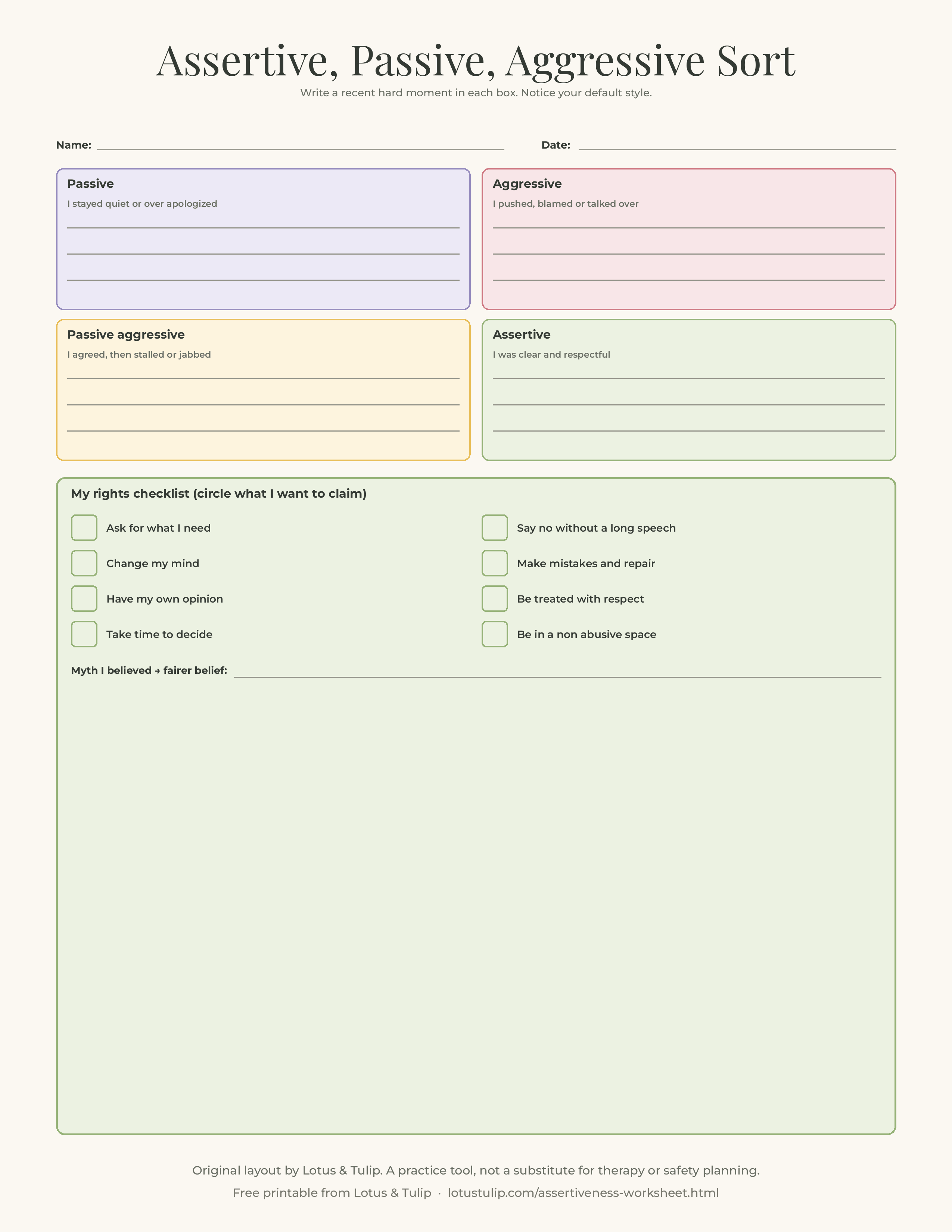
A quick self check: after a hard talk, do you feel smaller (passive), victorious at someone else's expense (aggressive), vaguely angry while pretending you are fine (passive aggressive), or steady even if the answer was no (assertive)? The free printable's first page is a sort for these styles.
Why assertiveness matters
Unassertiveness shows up across many clinical and everyday problems. Speed and colleagues (2018) review decades of research linking lower assertiveness with depression, anxiety and lower self esteem and relationship satisfaction, and they note that assertiveness training, through behavior rehearsal and cognitive work, can increase assertive behavior and improve those same areas. Their point is not that assertiveness cures every problem. Their point is that it is a forgotten, useful, transdiagnostic skill that got buried when research shifted toward DSM disorder packages.
Historically, assertiveness training sat near the center of clinical behavior therapy in the 1970s and 1980s. Publication volume then dropped sharply. Speed and colleagues report that a PsycINFO search for "assertiveness training" found about 762 articles from 1967 to 1999 (roughly 23 per year) and only about 181 from 2000 onward (roughly 11 per year), even as scientific publishing overall grew. The skills did not disappear. They moved into larger packages under other names, including DBT interpersonal effectiveness (DEAR MAN, GIVE, FAST), social skills training and parts of Acceptance and Commitment Therapy's committed action work.
More recent evidence is mixed in quality but directionally supportive:
- A 2026 meta-analysis of 12 randomized trials (503 participants) found assertiveness training reduced social anxiety compared with no treatment, waitlist or placebo controls, with a medium overall effect (Hedges' g = 0.62, 95% CI 0.32 to 0.92). Heterogeneity was moderate, and the comparison was largely against inactive controls, not against gold standard CBT for social anxiety.
- Omura and colleagues (2017) systematically reviewed assertiveness communication training for healthcare professionals and students. Across eight included studies, training often improved self reported assertiveness or observed speaking up behavior for nurses and trainees, with weaker results for one short session with experienced anesthesiologists. No included study measured direct patient safety outcomes, and study designs varied too much for a meta-analysis.
Honest takeaway: assertiveness training is a skills package with a long clinical history and supportive evidence, especially for social anxiety and workplace speaking up. It is not a magic fix, effect sizes are moderate, and a worksheet alone is not a treatment trial.
Rights and myths
Many people stay passive because they believe they do not have the right to ask, refuse or change their mind. Assertiveness training often starts by naming basic interpersonal rights. Alberti and Emmons emphasize equality and mutual respect rather than "getting your way." Manuel J. Smith's 1975 book When I Say No, I Feel Guilty popularized a related "bill of assertive rights," including the rights to say no, to change your mind, to make mistakes and to not have to justify every choice. Different authors list slightly different rights. The useful clinical point is the same: your needs count, and so do the other person's.
Common myths worth rewriting on a worksheet:
- "Assertive means rude." Rudeness is aggression dressed as honesty. Assertive speech can be warm, brief and firm.
- "Saying no is selfish." A clear no protects time, energy and honesty. A resentful yes often costs the relationship more.
- "If I am assertive, people will leave." Some people will push back. Others respect clarity. Staying silent to keep everyone already costs closeness.
- "I should only speak up if I can prove I am right." You can state a preference or a limit without winning a debate.
- "Real confidence never feels nervous." Most people feel a spike of anxiety the first times they practice. Skill grows with reps, not with waiting to feel fearless.
- "If I explain enough, they have to agree." Over explaining is often anxiety in a costume. State the point, offer one reason if you want, then stop.
- "Assertiveness is only for loud people." Quiet, steady delivery is still assertive. Volume is not the measure. Clarity is.
Have clients write their strongest myth at the top of a session note and a replacement belief underneath: "Saying no makes me selfish" becomes "Saying no lets me keep the promises I already made." Page 1 of the free printable includes a myth rewrite line.
Core assertiveness skills
Use the skills below as a menu. Cross link to the fuller Lotus & Tulip pages where a skill already has its own guide, instead of copying those manuals here.
I statements
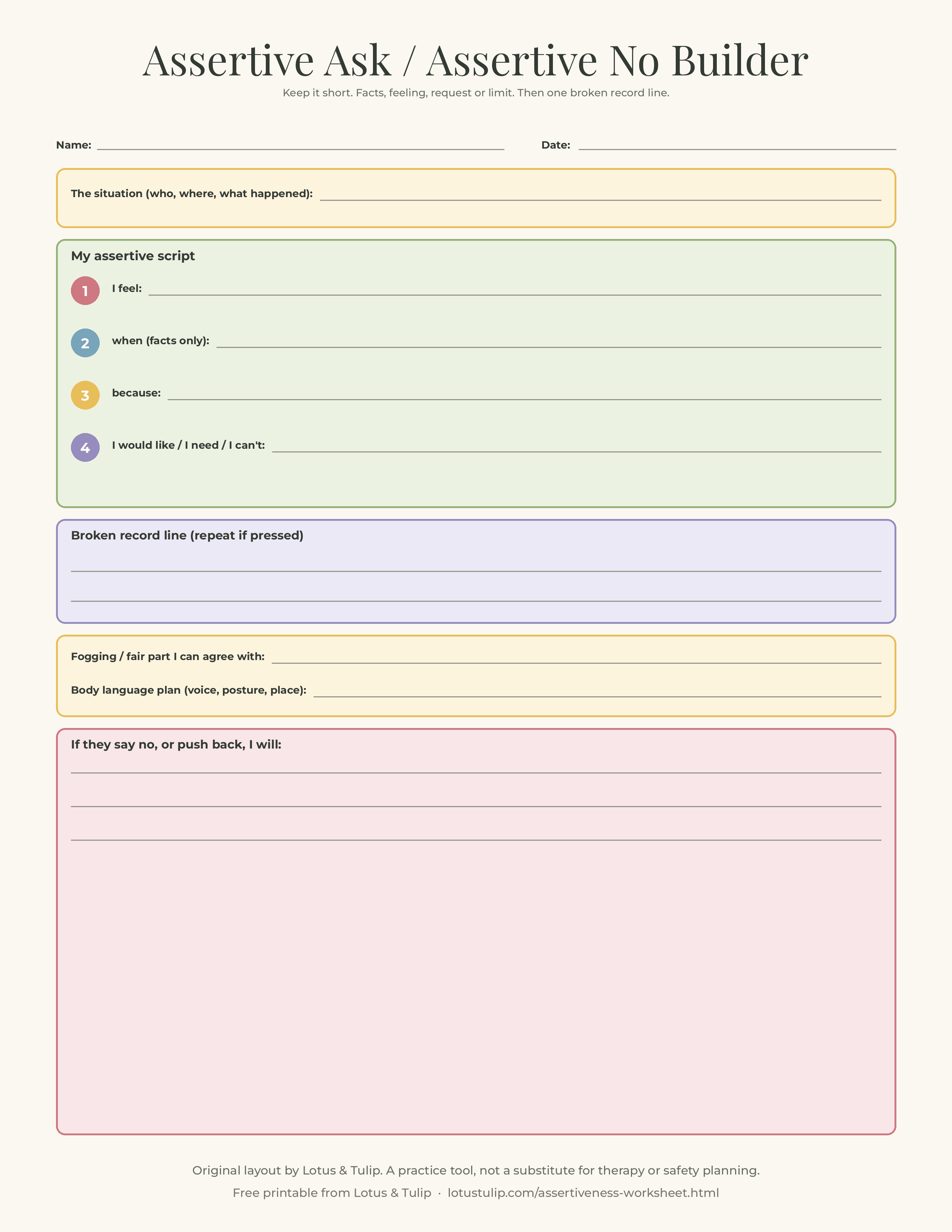
A simple frame is: I feel ___ when ___ because ___. I would like ___. Keep the "when" factual. Swap blame words ("you never care") for observable events ("when plans change at the last minute"). Our I statements worksheet has a builder and practice cards.
Broken record
From Smith's assertiveness methods: calmly repeat your main point without getting pulled into side arguments. "I can't lend money this month." "I hear that you're frustrated, and I still can't lend money this month." Broken record is not stonewalling. It is staying on the request or the limit.
Fogging
Also from Smith: agree with any fair part of a criticism without collapsing. "You might be right that I was late." Fogging reduces the fuel an argument needs, then you can return to your point.
Negative assertion
Own a real mistake without over apologizing or attacking yourself. "You're right, I missed that deadline. Here is my plan to finish by Friday." This pairs well with self respect skills in DBT's FAST.
Asking and refusing
An assertive ask is specific, timed and optional for the other person: "Could you review this by Thursday at noon?" An assertive no is clear and brief: "No, I can't take that on." You can add a short reason or an alternative if you want, but you do not owe a long defense. For a structured ask or no, use DEAR MAN. For keeping the relationship warm while you ask, see GIVE and FAST. For the limit itself, see the healthy boundaries worksheet.
Body language and voice
Words land better when posture, face and voice match them. Aim for a steady volume, a calm pace, shoulders unhunched, and eye contact that fits the culture and the relationship. Practice in a mirror or on video. Clients who whisper every request often get treated as if the request were optional.
Timing and place
Assertiveness is easier when both people can actually hear it. Pulling someone aside, asking "Is now an okay time for a two minute request?" and avoiding public call outs protects dignity on both sides. Urgent safety issues are the exception: speak up anyway, then document.
Listening as part of assertiveness
Assertive does not mean monologue. After you ask or refuse, pause. Reflect a piece of what you heard ("It sounds like Friday is tight for you too") before you repeat your point. Listening lowers defensiveness and keeps you out of aggressive steamrolling. Our conflict resolution page walks through that turn taking in more detail.
How to practice assertiveness, step by step
- Pick one real situation. Choose something small to medium, not the hardest fight of your life. A coworker who dumps last minute tasks, a friend who cancels late, a relative who comments on your body.
- Name your current style. Passive, aggressive, passive aggressive or mixed. What do you usually do, and what does it cost you?
- Write the rights that apply. For example: I can say no. I can ask for time. I can change my mind. I can be treated with respect.
- Draft an I statement ask or no. Use I feel / when / because / I would like, or a short DEAR MAN script. Keep it under four sentences.
- Add a broken record line. One sentence you can repeat if the other person argues, jokes or guilt trips.
- Plan body language. Where will you sit or stand, how loud will you speak, what will you do with your hands?
- Rehearse out loud. Role play with a therapist, friend or mirror, including pushback. Recording yourself once is often enough to spot apologizing or trailing off.
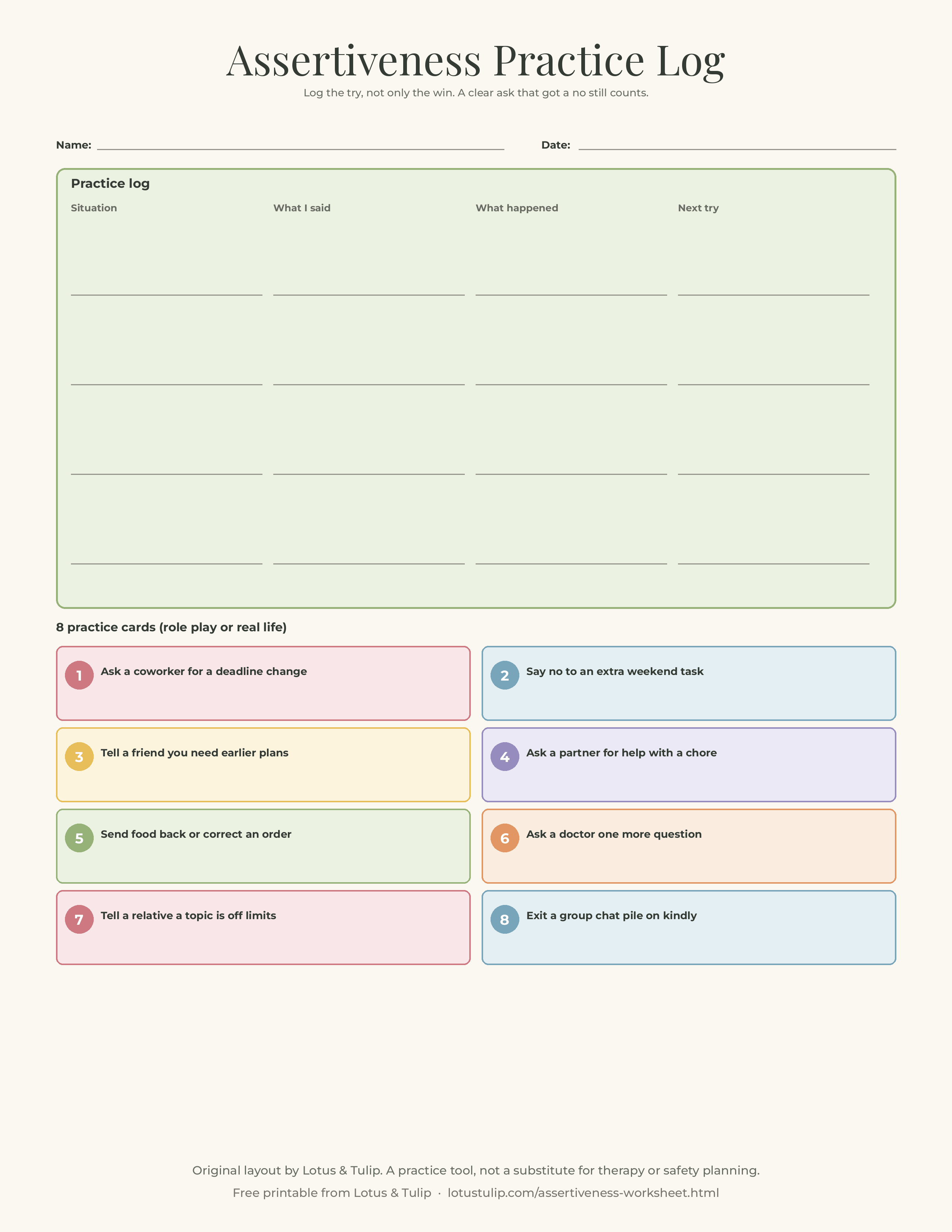
- Try it in real life and log it. Note the situation, what you said, what happened, and one tweak for next time. Page 3 of the free printable is built for this.
- Review and level up. After a few reps, choose a slightly harder situation. Pair assertiveness with boundaries, conflict repair or peer pressure scripts as needed.
A worked example (fictional)
Sam, 34, keeps agreeing to weekend shifts. Resentment builds, then Sam snaps at a manager and feels guilty for days.
- Old pattern: "Sure, I can cover," said with a tight smile (passive), followed by cold silence in the group chat (passive aggressive).
- Rights Sam claimed: I can protect one weekend a month. I can say no without a speech.
- Script: "I can't cover this Saturday. I already have plans I need to keep. I can help find a swap for next month if that helps."
- Broken record: "I hear it's short staffed, and I'm still not available Saturday."
- What happened: The manager was briefly annoyed, then asked someone else. Sam felt anxious for an hour, then relieved. Next session, Sam practiced asking for schedule notice earlier in the week.
Adult examples at work and in relationships
- Workload: "I can take the Tuesday deadline if we move the Friday report, or I can keep Friday and you'll need someone else for Tuesday. Which do you prefer?"
- Meeting talk time: "I'd like two minutes to finish this point," said once, then a pause instead of speeding up and shrinking.
- Partner chores: "I feel overwhelmed when the dishes sit overnight because mornings get chaotic. I would like us to finish the kitchen before we sit down."
- Family comments: "I'm not discussing my weight. Let's talk about the trip instead." Then change the subject or leave the room if it continues.
- Friendships: "I want to hang out, and I need plans made before the day of. Last minute invites don't work for me."
- Money: "I can't lend that amount. I can help you look at other options if you want."
- Health care: "I still have questions about side effects. I need five more minutes before we decide."
- Neighbors: "The music after 11 is waking us up. Please keep it down after 11, or we'll need to involve the building manager."
Notice that several scripts offer a choice or a next step without undoing the limit. Negotiation is allowed. Self abandonment is not. For couples who need shared practice, the conflict resolution worksheet and couples pages in the shop give a repair structure after the assertive talk.
Workplace notes: document pattern problems (dates, asks, replies) before a formal conversation with HR. Use email follow ups after verbal agreements ("Confirming I'll deliver X by Thursday, and Y moves to next week"). Assertiveness includes creating a record, not only speaking in the moment.
Teen adaptations
Teens face peer pressure, group chats, dating and adults who still hold real power (parents, teachers, coaches). Adaptations that help:
- Shorter scripts. Two sentences beat a paragraph. "No thanks, I'm good" is assertive.
- Digital practice. Draft the text, wait five minutes, send. Screenshots of old pressure moments make good worksheet examples.
- Power awareness. Assertiveness with a peer is different from assertiveness with a principal. Teach teens to escalate safely: trusted adult, school counselor, written record.
- Peer pressure links. Pair this page with peer pressure worksheets for teens and positive self talk when fear of looking "mean" blocks a no.
- Role confusion. Teens often think assertiveness means talking back. Separate respect for a person's role from agreeing with every request. "I hear the curfew is 10. Can we talk about 10:30 for Friday only, with a check in text?" is assertive. Insults are not.
- Group settings. Practice exit lines for parties and chats: "I'm heading out," "I'm mute for homework," "Not for me." Rehearse once in session so the words are available under pressure.
Parents and caregivers can model the skill by narrating their own small assertive moments ("I told my coworker I can't take that call after dinner") without turning the teen's worksheet into a lecture.
Therapist tips
- Start with values and costs. Ask what silence is buying and what it is costing. Motivation sticks better than a lecture on rights.
- Grade tasks. Build a ladder from low stakes (sending food back) to higher stakes (salary, family secrets). Exposure logic applies.
- Role play both sides. Have the client practice the assertive line, then play the difficult other person so they can use fogging and broken record.
- Watch for aggression in disguise. "I'm just being honest" can be a cover for contempt. Coach tone and specifics.
- Coordinate with DBT IE skills. DEAR MAN for the objective, GIVE for the relationship, FAST for self respect. Do not make clients memorize every acronym at once.
- Assess safety first. In coercive control or domestic abuse, classic assertiveness homework can increase risk. Safety planning and specialized support come first.
- Measure small wins. Log attempts, not only perfect outcomes. An ask that got a no can still be a successful assertive act.
Common mistakes
- Writing a courtroom speech. Long justifications invite debate. Short and clear is kinder.
- Apologizing for the ask. "Sorry to bother you, this is probably stupid, but..." trains people to dismiss you.
- Smuggling a boundary as a hint. Hints are easy to miss. Say the limit.
- Punishing after a no. Assertiveness includes hearing no without revenge.
- Practicing only in your head. Silent rehearsal rarely rewires the panic response. Voice it.
- Ignoring culture and context. Directness norms differ. Teach clients to stay honest while matching setting, role and safety.
When assertiveness is unsafe
Assertiveness assumes a minimum of safety and reciprocity. It is the wrong first tool when:
- There is ongoing physical, sexual or severe emotional abuse.
- The other person has shown that pushback leads to retaliation, stalking or harm to children or pets.
- You are in a rigid hierarchy where speaking up needs a formal channel, a witness or a union or HR process first.
- You are flooded (panic, rage, dissociation). Regulate first, then speak. Distress tolerance and grounding skills help in that window.
In those cases, prioritize safety planning, documentation and professional support over "just being more assertive."
What the research says (honestly)
- Strong clinical tradition, uneven modern trials. Alberti and Emmons popularized a practical model. Speed, Goldstein and Goldfried (2018) argue the older outcome literature supports assertiveness training for anxiety, depression, self esteem and relationship satisfaction, while noting that research attention declined after the 1980s.
- Social anxiety: a 2026 meta-analysis of 12 RCTs (n = 503) reported a medium effect (g = 0.62) versus inactive controls. That is encouraging for AT as a skills option, not proof it beats full CBT packages.
- Healthcare speaking up: Omura et al. (2017) found suggestive benefits for nurses and students, with design limits and no direct patient outcome data.
- Worksheets are tools, not treatments. No major trial tests a three page printable by itself. Use them inside coaching, counseling, groups or self help with care.
When to get extra help
Seek a licensed clinician if anxiety, depression, trauma or relationship fear make every ask feel impossible, or if conflict at home or work keeps escalating. Get urgent help for thoughts of suicide, violence or immediate danger.
- In the US, call or text 988 (988 Suicide and Crisis Lifeline) any time.
- Text HOME to 741741 to reach the Crisis Text Line.
- Call 911 if someone is in immediate danger.
- For intimate partner violence, the National Domestic Violence Hotline: 1-800-799-7233.
Free assertiveness worksheet (PDF)
The free assertiveness worksheet has three pages in US Letter size, for adults and older teens:
- Page 1: Assertive, Passive, Aggressive Sort and My Rights. Sort recent examples into styles, then check rights you want to claim and rewrite one myth.
- Page 2: Assertive Ask / Assertive No Script Builder. I feel / when / because / I would like lines, plus broken record and fogging prompts.
- Page 3: Practice Log and Practice Cards. Four log rows for real tries, plus eight short practice prompts you can cut apart or reuse in session.
Download the free assertiveness worksheet (PDF, 3 pages, US Letter)
Prefer single images? Page 1: Sort and Rights (PNG) · Page 2: Ask and No Builder (PNG) · Page 3: Practice Log and Cards (PNG)
Free to print for your own use and for use with your own clients, students, or groups. This is an original layout by Lotus & Tulip, not an official form from Alberti and Emmons, Smith, or any treatment manual, and not affiliated with those authors. Please link to this page rather than re-uploading the file.
Related resources
- Anger management worksheets for adults: when needs come out as anger instead
- People pleasing worksheet: noticing the automatic yes, with a free kind no practice plan
- Healthy boundaries worksheet: turn assertiveness into limits you can keep.
- DEAR MAN worksheet: structure an ask or a no.
- GIVE and FAST worksheet: protect the relationship and your self respect.
- I statements worksheet: cleaner feeling and request language.
- Conflict resolution worksheet: steps after the hard talk.
- Peer pressure worksheets for teens: refusal skills for group pressure.
- Positive self talk worksheet: challenge the thoughts that block a clear ask.
Sources
- Alberti, R., and Emmons, M. Your Perfect Right: Assertiveness and Equality in Your Life and Relationships. Impact Publishers (multiple editions).
- Smith, M. J. (1975). When I Say No, I Feel Guilty. Bantam.
- Speed, B. C., Goldstein, B. L., and Goldfried, M. R. (2018). Assertiveness training: A forgotten evidence-based treatment. Clinical Psychology: Science and Practice. Society of Clinical Psychology summary available at societyofclinicalpsychology.org.
- Meta-analysis of randomized trials on assertiveness training for social anxiety (2026): 12 RCTs, 503 participants, Hedges' g = 0.62 versus inactive controls. International Journal of Applied Positive Psychology.
- Omura, M., Maguire, J., Levett-Jones, T., and Stone, T. E. (2017). The effectiveness of assertiveness communication training programs for healthcare professionals and students: A systematic review. International Journal of Nursing Studies, 76, 120 to 128.
- Linehan, M. M. (2015). DBT Skills Training Manual (2nd ed.). Guilford. Interpersonal effectiveness skills (DEAR MAN, GIVE, FAST).
- 988 Suicide and Crisis Lifeline, 988lifeline.org. Crisis Text Line, crisistextline.org. National Domestic Violence Hotline, thehotline.org.
Assertiveness worksheet: FAQ
What is an assertiveness worksheet used for?
An assertiveness worksheet helps you practice clear, respectful communication. Typical pages sort passive, aggressive and assertive examples, list interpersonal rights, build an ask or a no script, and log real life practice so the skill improves over time.
What is the difference between assertive and aggressive?
Assertive speech states your needs and limits while respecting the other person's rights. Aggressive speech aims to win through blame, threats, insults or intimidation. You can be firm and still be assertive.
How do I write an assertive I statement?
Try: I feel (emotion) when (specific situation) because (impact), and I would like (clear request). Keep the situation factual and the request doable. See our I statements worksheet for more examples.
Does assertiveness training actually work?
Older clinical research and newer reviews suggest it can increase assertive behavior and help with anxiety, mood, self esteem and relationship satisfaction. A 2026 meta-analysis of 12 RCTs found a medium effect on social anxiety versus inactive controls. Results vary, and a worksheet is a practice tool inside broader care, not a stand alone cure.
What if saying no feels unsafe?
Trust that feeling. In abuse, coercion or retaliation risk, skip classic assertiveness homework and focus on safety planning with a qualified professional or hotline. Assertiveness needs a minimum of safety to be appropriate.
Can teens use an assertiveness worksheet?
Yes, with shorter scripts, examples from school and group chats, and clear guidance about when to involve a trusted adult. Pair it with peer pressure and self talk pages when fear of rejection is the main block.
Can I print the free assertiveness worksheet for clients?
Yes. The free PDF is an original Lotus & Tulip layout that you can print for your own use and for your own clients, students or groups. Please link to this page instead of re-uploading the file.