
Kids and teens · Updated 2026-11-06
Friendship Activities for Teens (with Free Printable)
Ready-made printable: Middle School Friendship Small Group Curriculum for Counselors Holiday 20% off: about $11.04, was $14 (EUR 12) · instant digital download
Buy on EtsyTry it free first: download session 1 free (group at a glance, lesson plan and student page, PDF, 71 KB). Run it with your group, then get all 8 sessions. No email needed.

Friendship skills for teens are the practical habits that help middle and high school students join groups, keep healthy friendships, repair after conflict, set boundaries, and navigate digital life without losing themselves. Teen friendship is not the same as elementary playground joining. Peers, phones, identity, dating, sports teams, and group chats raise the stakes. Belonging still matters, and so does knowing when a friendship is costing too much.
This Lotus and Tulip page is a teen-focused friendship activities guide with an original free three page US Letter printable. It targets searches families and helpers actually use: friendship activities for teens, friendship worksheets for teenagers, teen friendship skills printable, and how to make friends in middle school or high school. It is distinct from our friendship worksheets for kids page (ages about 5 to 12, joining in and a friendship traffic light), from peer pressure worksheets for teens, from social skills worksheets for kids, from the conflict resolution worksheet, from icebreaker activities for counseling groups, from self esteem activities for teens, and from bullying worksheets for kids. Those neighbors help. This page centers adolescent friendship: healthy vs unhealthy patterns, belonging, digital repair, boundaries, and a concrete plan teens will actually use.
We credit research lineages honestly: peer relationship and friendship quality research associated with Hartup, Bukowski, Newcomb, and related developmental reviews; school connectedness and peer belonging work summarized by CDC school connectedness guidance and by adolescent connectedness studies (including Bond and colleagues on social and school connectedness); supportive peer relationship syntheses in early adolescence; and school SEL reviews such as Durlak and colleagues as program-level context, not proof that this printable remits diagnoses. We are not affiliated with those authors, any textbook publisher, or any branded friendship curriculum. This printable is an original educational layout, not a copy of any copyrighted worksheet and not a diagnosis or treatment.
This guide is educational. It is not therapy, not medical advice, and not a diagnosis. If thoughts of ending your life, plans to harm yourself or someone else, or a medical emergency show up, stop the worksheet and get help now: in the US, call or text 988, text HOME to 741741, or call 911. Our safety plan worksheet is a better first tool in that moment. Nearby tools: friendship for kids, peer pressure for teens, healthy boundaries, assertiveness, I statements, conflict resolution, self esteem for teens, bullying, icebreakers, emotional regulation for teens, and self compassion.
Jump to the free friendship printable (PDF) · How to use friendship activities for teens, step by step · Worked examples · Comparisons
What teen friendship skills are (and how they differ from kids friendship)
Kids friendship pages often teach joining a game, sharing, saying sorry, and spotting green vs red friendship signals with adult coaching. Teen friendship skills keep those basics and add autonomy, identity, and digital complexity.
Teen friendship skills include:
- Joining and belonging without people-pleasing yourself into a role you hate.
- Reading healthy vs unhealthy patterns (respect, reciprocity, repair vs control, contempt, isolation).
- Digital friendship habits for group chats, stories, leaving someone out, and ghosting, without moralizing phones as evil.
- Conflict repair that cools first, then uses clear I-statements and a next step.
- Boundaries with friends about time, secrets, rides, substances, gossip, and romantic overlap.
- Ending or stepping back when a friendship is unsafe or chronically draining, with adult support when needed.
Teens also weigh status, identity groups, sports and arts scenes, dating, and online audiences. A skill that worked on the elementary playground (ask once, wait to be invited) may need a teen version: show up to a club twice, text a low-stakes invite, repair a public chat without a performance.
Healthy vs unhealthy friendship (without black-and-white labels)
Healthy friendships are not conflict-free. They are repairable. Unhealthy friendships are not always dramatic. They can look like constant one-way effort, jokes that always land on one person, or pressure dressed as loyalty.
Healthier patterns often include: mutual effort over weeks (not every hour), respect for no, curiosity about each other, room for other friends, repair after hurts, and safety for body, privacy, and values.
Warning patterns often include: control of who you talk to, threats to end the friendship if you disagree, public humiliation, repeated boundary trampling after clear asks, isolation from other supports, and pressure to hide harm from adults. For bullying-specific framing (power imbalance, repetition, intent to harm), use bullying worksheets. For dare and refusal scenes, use peer pressure worksheets for teens.
Teach teens to rate friendship quality on a few concrete questions: Do I feel more like myself after we hang out? Can I say no without a punishment campaign? Do we both initiate sometimes? When we hurt each other, does repair happen?
Joining and belonging in middle and high school
Belonging is a real need. Loneliness in adolescence is common and painful. Skill practice helps, and so does structure: clubs, teams, faith groups, hobby spaces, lunch tables with a plan, and school counseling groups. Avoid the myth that one perfect best friend fixes everything. Many teens do better with a small web of "good enough" connections plus one or two closer ties.
Low-stakes joining moves:
- Show up twice to the same club before deciding it is not for you.
- Ask a classmate one specific question about a shared class or team.
- Send a short invite: "Want to grab lunch Thursday after practice?"
- Pair an interest with people (game night, study block, walk home) instead of waiting for chemistry to appear from nowhere.
- Use a counselor icebreaker or group opener when social anxiety is high. See icebreaker activities.
Belonging is not the same as fitting every crowd. Teens can practice "I want friends who..." lists that name values (kind, curious, reliable) rather than status alone. Pair with self esteem activities for teens when worth feels tied only to who texts back.
How to use friendship activities for teens, step by step
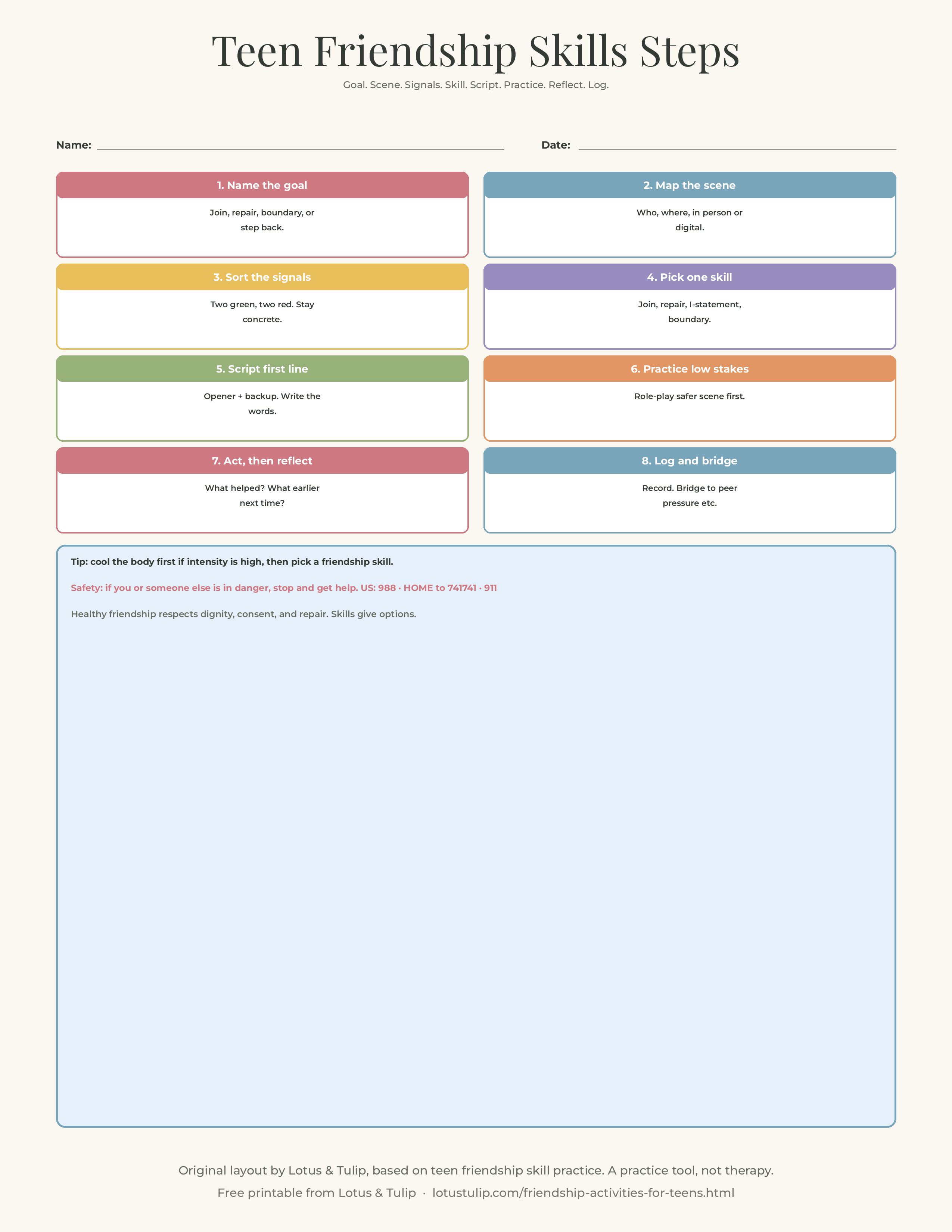
- Check safety and fit. If acute crisis, bullying with imminent harm, or anyone is in danger, pause. Use crisis pathways first: 988, HOME to 741741, or 911 when needed. Prefer a safety plan in that moment. For bullying response and upstander plans, use the bullying page.
- Name the friendship goal. Join a group? Repair one conflict? Set a boundary? Step back from an unhealthy pattern? Write one clear goal on the free plan page.
- Map the scene. Who, where, in person or digital, what usually goes wrong, what you want instead.
- Sort healthy vs unhealthy signals. List two green signals and two red signals you already notice. Stay concrete.
- Pick one skill from the menu. Join move, digital repair, I-statement, boundary line, cool-down before talk, or ask-an-adult step.
- Script the first line. Teens freeze without words. Write one opener and one backup. Pair with I statements or assertiveness when needed.
- Practice at low stakes. Role-play with a counselor, parent, or trusted peer. Try the skill in a safer scene before the hardest chat.
- Act, then reflect. What happened? What helped? What will you try earlier next time?
- Log and bridge. Record the practice on the log page. Bridge to peer pressure, boundaries, conflict resolution, emotion regulation, or self esteem when those are the real load.
Practice on ordinary friction first (a missed lunch invite, a short group chat snub) before relying on skills in a public pile-on or a friendship ending. Skill grows with reps.
Digital friendship: group chats, leaving out, and ghosting
Phones are part of teen friendship, not a side quest. Moralizing ("just delete social media") often shuts teens down. Teach workable habits instead.
Group chats. Chats can build belonging and also create rapid exclusion. Skills: wait before reacting while hot, cool the body first (see emotion regulation for teens), ask clarifying questions in private, request a boundary ("Please don't share my screenshots"), and exit chats that are mostly cruelty.
Leaving out. Being left out of a story, a party, or a side chat hurts. Separate accidental misses from repeated targeting. Accidental: a calm check-in. Repeated targeting with power imbalance: treat it closer to bullying and get adult help.
Ghosting. Sudden silence can mean many things: overwhelm, conflict avoidance, loss of interest, or safety. Teach teens not to chase endlessly, to send one clear check-in, and to protect dignity if there is no reply. Ghosting is sometimes a clumsy exit and sometimes a safety move. Do not force teens to stay in contact that feels unsafe.
Screenshot ethics. Ask before sharing private messages. Repair if a screenshot spread without consent. Pair with values talk, not only rules talk.
Conflict repair with friends
Conflict is normal. Repair is the skill. Hot venting in the group chat usually reheats the problem. Cool first, then talk.
Repair sequence teens can use:
- Cool body and rate intensity 0 to 10.
- Own your part without a fake apology that blames them.
- Use an I-statement: feeling, situation, need or ask. See I statements.
- Listen for their side without planning your rebuttal the whole time.
- Agree on one next step (time, topic, boundary, or cool-off plan).
- Follow through. Repair without change becomes a loop.
For structured six-step problem solving with younger language or classroom cards, see the conflict resolution worksheet. For anger-heavy blowups, see anger management activities for teens.
Boundaries with friends
Boundaries are lines that protect time, body, privacy, values, and other relationships. They are not punishments. Teens often fear that a boundary will end the friendship. Sometimes it will. Sometimes it saves it.
Common teen boundary topics: how late you text, sharing passwords, gossip about others, substance use, rides and money, romantic partners inside the friend group, and how conflict is handled in public.
Practice a short boundary line: "I'm not comfortable with that. I still want to hang out Friday, and I need us not to share private chats." Pair with healthy boundaries and assertiveness. If a friend punishes every boundary, that is data about friendship quality.
Worked fictional examples
Teen example, lunch table (fictional): Maya, age 13, wants to join a quieter lunch table after her old group drifted. Goal: belonging without begging. Plan: sit nearby twice with a book, then ask one classmate about the science project. Result: one friendly chat, a later invite to the art club table. Written on the free friendship plan as a join move.
Teen example, group chat pile-on (fictional): Jordan, age 16, sees a joke about them spreading in a larger chat. Cue: face heat, urge to fire back. Cool body: phone face down, walk, three breaths. Choose: private message to one trusted friend, then a clear request to take the screenshot down. Reflect: "Public clapbacks at a 7 make it worse." Bridge to emotion regulation skills.
Teen example, boundary with a close friend (fictional): Sam, age 15, has a friend who demands late-night venting every night and gets angry when Sam sleeps. Script: "I care about you. I can't text after 11 on school nights. Let's talk after school instead." If the friend escalates with guilt trips, Sam practices stepping back and telling a parent or counselor.
School counselor note (fictional): In a twelve minute meeting, a counselor helps a student fill goal, scene, two green signals, two red signals, one scripted first line, and one after-plan. Optional practice, never forced disclosure of peer names in group. Follow district crisis and bullying protocols when risk appears. For multi-session groups, pair with a friendship or social skills curriculum rather than stacking every worksheet in one period.
Teen friendship vs kids friendship, peer pressure, social skills kids, conflict resolution, and icebreakers
| Teen friendship (this page) | Kids friendship | Peer pressure for teens | Social skills for kids | Conflict resolution | Icebreakers | |
|---|---|---|---|---|---|---|
| Main job | Belonging, healthy vs unhealthy patterns, digital repair, boundaries, teen friendship plan | Joining in, conversation, traffic light for younger kids | Refusal skills and dare scripts | Broad social skill steps and role plays for kids | Six-step solve and win-win plans | Group openers and warm-ups |
| Best early use | When teens need friendship skills with digital and identity complexity | Younger kids with adult coaching | When the scene is a dare or pressure to break values | When foundational social steps are missing | When a concrete conflict needs structure | When a group needs a safe start |
| Output | Goal, signals, script, repair or boundary plan, practice log | Kid friendship skills and cards | Refusal plan and scripts | Skill checklist and role play cards | Problem solve page and scenario cards | Opener menu and plans |
| Cross link | This page | Kids friendship | Peer pressure teens | Social skills kids | Conflict resolution | Icebreakers |
These tools cooperate. Teen friendship builds the adolescent loop. Kids friendship keeps younger language. Peer pressure specializes refusal. Social skills kids widen foundational steps. Conflict resolution structures solve-talk. Icebreakers open groups safely. Self esteem and emotion regulation support the confidence and cool-down underneath. Teach one tool clearly before stacking four on day one.
School counselor, therapist, and parent tips
Teens. Prefer concrete scenes over lectures about "friendship as a construct." Let them reject babyish cartoons. "Goal, signals, one script, one next step" often lands better than a long theory talk. Keep experiments tiny and within their real control. Pair with middle school friendship group pages and self esteem activities when worth is tangled with who likes them. Use self compassion when every social miss becomes a shame spiral.
School counselors. Short meetings favor a compressed sequence: goal, scene, two green and two red signals, one scripted line, one after-plan. Groups can practice with low-stakes role plays and exit plans that respect hallway and chat safety. Follow district bullying and crisis protocols if risk appears. Optional practice, never forced disclosure of peer names. Avoid shaming "drama kids"; target the skill gap and the load (sleep, ADHD supports, exclusion, trauma), not the teen's worth. SEL programs (including findings summarized in school-based reviews such as Durlak and colleagues) can support social-emotional skill building at a program level. They do not prove that this free three page printable remits diagnoses.
Therapist tips:
- Stay in the client's language. Reflect their friend scenes and values. Do not overwrite with your favorite curriculum label on day one.
- Separate healthy conflict from unhealthy control out loud, repeatedly, without excusing harm.
- Lower arousal before repair talk. Flooded teens cannot use fancy worksheets well.
- Treat digital scenes as real friendship scenes. Screenshots, stories, and ghosting belong in the plan.
- Bridge to neighbors. Peer pressure for dares, boundaries and assertiveness for lines, conflict resolution for structure, emotion regulation for cool-downs, bullying tools for power-imbalance harm, self esteem for worth.
- Measure function. Ask what changed: clearer invites, earlier exits from cruel chats, better repair, fewer all-night guilt spirals, more adults told when safety is the issue.
Parents. Model friendship repair out loud ("I apologized to my coworker today"). Do not force teens to stay in every friendship to look polite. After a blow-up, prioritize safety, then repair, then skill practice when everyone is regulated. Do not turn the friendship plan into a new weapon ("fill this out or else") that makes the worksheet feel like punishment. Take bullying reports seriously and follow school procedures.
Common mistakes
- Teaching only "be nice" without naming control, contempt, or isolation.
- Using babyish materials that teens reject, or adult jargon that teens tune out.
- Moralizing phones instead of teaching digital repair and exit skills.
- Pushing repair while flooded or while the other person is still humiliating them in public.
- Forcing one best friend as the only success metric.
- Ignoring bullying, sleep, ADHD supports, trauma load, or substance pressure while blaming "friendship skills" alone.
- Using it in acute crisis instead of safety first.
- Treating the worksheet as therapy. Paper supports practice. It does not replace a clinician when problems are severe or lasting.
When not to use this worksheet
Good early uses: a teen who can name a friendship goal, mild to moderate friendship friction, homework between counseling sessions, school counseling check-ins, and building a join, repair, or boundary plan.
Prefer another tool first when:
- Acute safety risk or medical emergency: stabilize and get help (988, HOME to 741741, 911). Prefer a safety plan.
- Active violence, stalking, or imminent harm: prioritize safety, supervision, and emergency protocols over worksheets.
- Clear bullying with power imbalance: use bullying worksheets and school reporting pathways.
- Dare and refusal scenes: use peer pressure worksheets for teens.
- When younger language fits better: use friendship worksheets for kids.
- When the teen is too flooded to engage: co-regulate first, then return to plan work. See emotion regulation for teens.
What the research says (honestly)
Friendship activities and worksheets are a skill practice aid, not a standalone RCT treatment. Do not claim this free printable remits social anxiety, depression, trauma symptoms, or any diagnosis.
Peer relationship and friendship quality lineages. Developmental research associated with Willard Hartup, William Bukowski, Andrew Newcomb, and related peer relationship reviews has long treated friendship quality, peer acceptance, and close ties as important for child and adolescent adjustment. Credit those lineages with non-affiliation. This page is not a Hartup or Bukowski protocol and does not reproduce copyrighted measures or manual worksheets.
School connectedness and peer belonging. CDC school connectedness guidance describes connectedness as students feeling that adults and peers at school care about them as people and about their learning, and links stronger connectedness with lower odds of several health risks at a population guidance level. Adolescent studies of social and school connectedness (including longitudinal work such as Bond and colleagues) associate better early secondary connectedness with later mood, substance, and school-completion patterns, with important caveats about correlation, context, and study design. Recent reviews and meta-analyses on school connectedness and psychological well-being similarly treat connectedness as multi-component (belonging, teacher ties, peer ties). None of that proves this three page printable creates connectedness by itself.
Supportive peer relationships in early adolescence. Systematic reviews and exploratory meta-analytic work on supportive peer relationships highlight social-emotional skills, identity, and school environment as linked correlates. Treat those papers as research lineage with caveats, not as validation of this printable.
School SEL caveats (including Durlak and colleagues). School-based social and emotional learning reviews report average benefits for social-emotional skills and related outcomes at a program level. Those reviews are not proof that this free printable remits diagnoses or replaces counseling.
Honest caveat. Use teen friendship practice inside a coherent plan with adult support, bullying response, sleep and school supports, and neighboring emotion regulation, boundaries, and peer pressure tools when needed. For severe social anxiety, depression, trauma, psychosis, or acute risk, use disorder-appropriate care and crisis pathways. No study tests this three page Lotus and Tulip printable alone.
Free friendship printable for teens (PDF)
The free friendship printable has three pages in US Letter size:
- Page 1: Teen Friendship Skills Steps card. Eight step sequence from goal and scene through signals, skill choice, script, practice, reflect, and log, plus safety reminders.
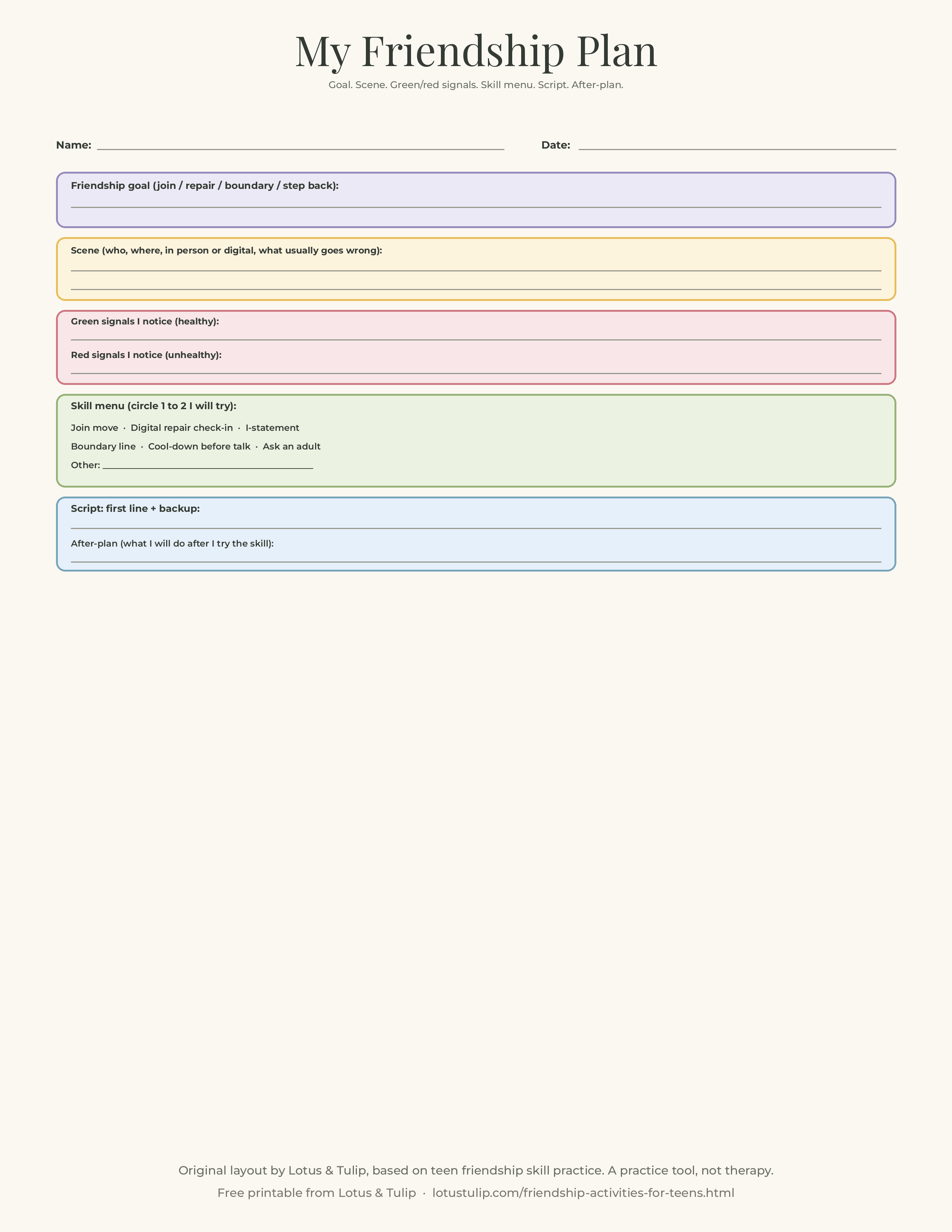
- Page 2: My Friendship Plan. Fill in goal, scene, healthy vs unhealthy signals, skill menu, repair or boundary script, and after-plan.
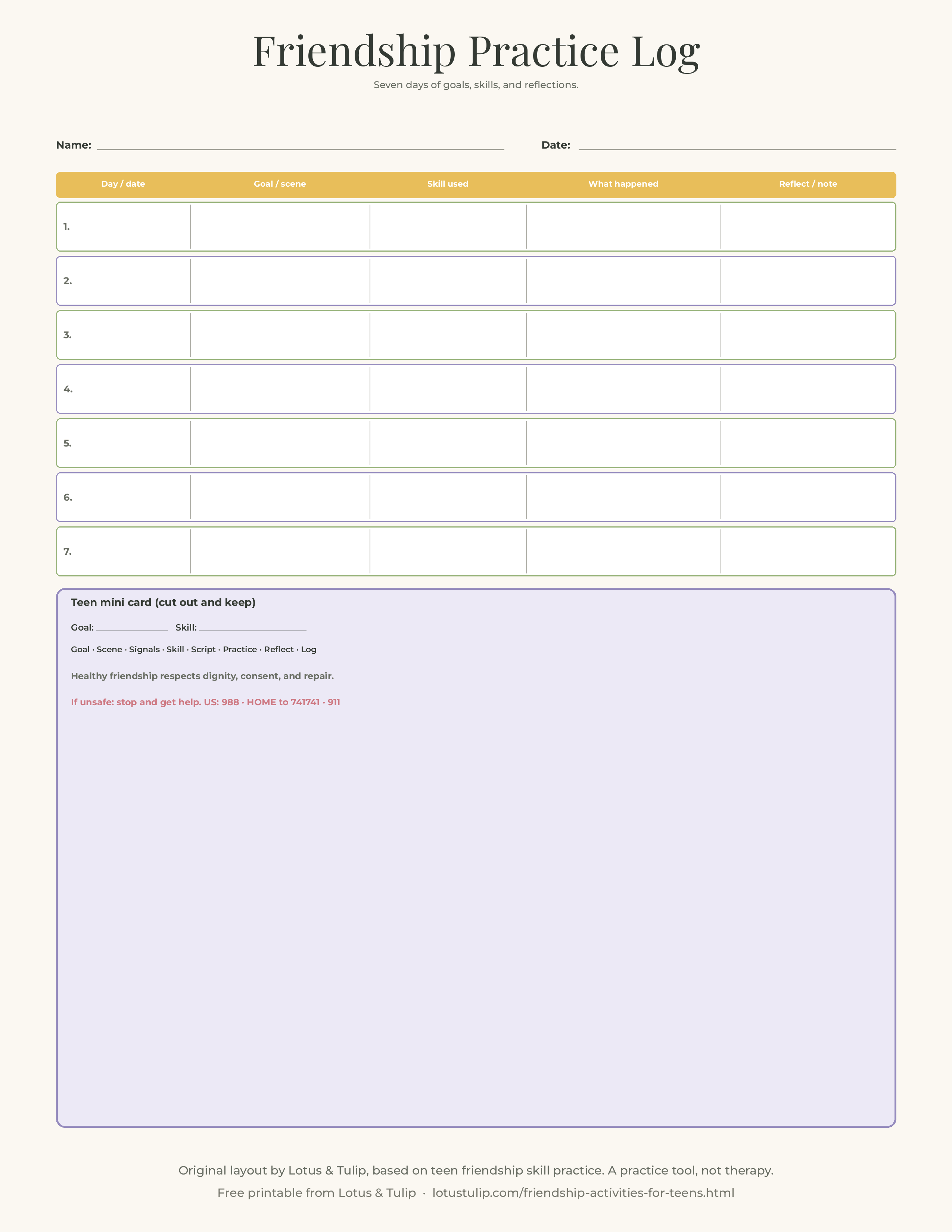
- Page 3: Practice Log + teen mini cards. Seven day rows plus cut out reminders for join, repair, and boundary lines.
Download the free friendship printable for teens (PDF, 3 pages, US Letter)
Prefer single images? Page 1: Teen Friendship Skills Steps (PNG) · Page 2: My Friendship Plan (PNG) · Page 3: Practice Log (PNG)
Free to print for your own use and for use with your own clients, students, or groups. This is an original layout by Lotus & Tulip, based on teen friendship skill practice associated with peer relationship and friendship quality research lineages, with school connectedness and supportive peer relationship reviews as context, and with school SEL reviews as program-level neighbors. It is not affiliated with those authors, any scale publisher, or any specific treatment or curriculum package, and is not a substitute for therapy. Please link to this page rather than re-uploading the file.
Related resources
- How to make friends as an adult: the grown up version, for parents and adult clients.
- Friendship worksheets for kids: younger joining in and traffic light.
- Peer pressure worksheets for teens: refusal skills and scripts.
- Social skills worksheets for kids: foundational social steps.
- Conflict resolution worksheet: six-step solve and win-win plans.
- Icebreaker activities for counseling groups: group openers.
- Self esteem activities for teens: worth beyond who texts back.
- Bullying worksheets for kids: rude vs mean vs bullying, upstander plans.
- Healthy boundaries worksheet: lines and scripts.
- Assertiveness worksheet: clear asks without aggression.
- I statements worksheet: feeling, situation, ask.
- Emotional regulation activities for teens: cool body then choose.
- Anger management activities for teens: cool-down and repair for anger.
- Self compassion worksheet: kinder self talk after social misses.
- Safety plan worksheet: when the moment is about staying safe and alive.
Sources
- Hartup, W. W., Bukowski, W. M., Newcomb, A. F., and related peer relationship / friendship quality developmental research lineages. Educational credit with clear non-affiliation. Not a claim that this printable is a Hartup or Bukowski protocol.
- Centers for Disease Control and Prevention (CDC). School connectedness guidance for youth (feeling cared for by adults and peers at school; population-level associations with health risks and protective patterns). Educational credit with clear non-affiliation. Guidance is not proof that this free sheet creates connectedness.
- Bond, L., Butler, H., Thomas, L., Carlin, J., Glerr, S., Bowes, G., and Patton, G. (2007). Social and school connectedness in early secondary school as predictors of late teenage substance use, mental health, and academic outcomes. Journal of Adolescent Health, 40(4), 357.e9 to 357.e18. Longitudinal associations with caveats. Credit only; not validation of this free page.
- Supportive peer relationships in early adolescence: systematic review and exploratory meta-analytic syntheses (including Frontiers in Psychology work organizing individual and environmental correlates). Research lineage with caveats; not technique-only proof of this printable.
- Durlak, J. A., Weissberg, R. P., Dymnicki, A. B., Taylor, R. D., and Schellinger, K. B. (2011). The impact of enhancing students' social and emotional learning: a meta-analysis of school-based universal interventions. Child Development, 82(1), 405 to 432. Program-level SEL context; not proof that this free sheet remits diagnoses.
- Honest caveat: teen friendship drills are a skill practice aid. Peer relationship reviews, school connectedness guidance and studies, supportive peer syntheses, and school SEL reviews are not the same as technique-only RCTs of this Lotus and Tulip printable.
Friendship activities for teens: FAQ
What are friendship activities for teens?
They are practice tools for joining and belonging, sorting healthy vs unhealthy patterns, repairing conflict, setting boundaries, and handling digital friendship scenes. They are educational skill aids, not therapy.
Is this the same as the kids friendship page?
No. The kids page uses younger language, joining in, and a friendship traffic light for ages about 5 to 12. This teens page centers adolescent friendship with digital life, boundaries, and autonomy-respecting plans.
How is this different from peer pressure or social skills worksheets?
Peer pressure pages focus on refusal in dare scenes. Social skills kids pages teach foundational steps for younger students. This page teaches the teen friendship loop: goal, signals, script, repair or boundary, reflect.
Can school counselors use it with teens?
Yes, often in short meetings with one goal, two signal pairs, and one scripted line. Keep practice optional and school safe. Follow bullying and crisis protocols when risk appears. Do not use the page as a diagnosis.
What should teens do about group chats and ghosting?
Cool first when hot, clarify in private when safe, set screenshot and respect boundaries, and exit chats that are mostly cruelty. For ghosting, one clear check-in is enough. Protect dignity and safety if there is no reply.
When should I not use this worksheet?
Do not use it as the first move in acute safety risk, medical emergency, active violence, or clear bullying that needs reporting and safety plans first. Stabilize and get help when needed: 988, HOME to 741741, or 911.
Is this affiliated with Hartup, Bukowski, CDC, Bond, or SEL manuals?
No. This is an original Lotus and Tulip educational layout. We credit research lineages with clear non-affiliation and do not reproduce copyrighted manual worksheets.