
Therapist worksheets · Social anxiety, safety behaviors and CBT · Updated 2026-11-13
Social anxiety worksheet for adults: what keeps it going, what the research shows, and how to practice step by step (free printable)
Fear ladder and safety behaviors: Anxiety Worksheets for Therapists, 20 pages incl. the anxiety cycle, fear ladder and safety behaviors audit Holiday 20% off: about $11.04, was $14 (EUR 12) · fillable PDF, instant digital download
Buy on EtsyTry it free first: download a fillable sample (worry log and fear ladder, PDF, 258 KB). Type into it on screen, then get the full pack. No email needed.
The thoughts behind the fear: CBT Worksheets for Therapists, 20 pages including thought records, core beliefs and an exposure ladder Holiday 20% off: about $11.04, was $14 (EUR 12) · fillable PDF, instant digital download
Buy on EtsyTry it free first: download a fillable sample (thought record and evidence for and against, PDF, 105 KB). Type into it on screen, then get the full pack. No email needed.
A full caseload: Therapist Worksheets Mega Bundle (8 packs incl. CBT, anxiety, DBT, ACT, grief and ADHD) Holiday 20% off: about $35.88, was $45 (EUR 39) · fillable PDFs for all 8 packs plus 160 printable pages, instant digital download
Buy on EtsyThe meeting is in ten minutes and you have already rehearsed your one comment four times. When it is your turn, your face feels hot, you speak quickly so it will be over, and you hold your coffee cup so nobody sees your hand. Afterwards you replay the moment on the drive home and decide everyone noticed. Next week, you say nothing at all. Many adults live some version of this, and many assume it is just who they are. The research suggests it is a pattern that can change.
This guide is for adults and the therapists who work with them. It explains what social anxiety is and is not, how common it is, the cognitive model that explains why it persists, what the treatment research shows, nine practical steps, common mistakes and examples. It ends with a free 2 page printable: My Social Anxiety Map, which helps you see the situations you fear, the predictions you make, where your attention goes and the safety behaviors that keep the fear alive, and My Social Practice Plan, a practice ladder with prediction and outcome logs and a fair way to review each situation afterwards.
Download the free social anxiety worksheet (PDF, 2 pages, US Letter)
Direct download, no email or sign up. See the pages first.
What social anxiety is, and what it is not
It is not shyness. Most people feel nervous before a speech or a first date, and many people are quiet or slow to warm up. That is ordinary. Social anxiety becomes a problem when fear of being judged, embarrassed or rejected is strong, lasting and starts to shape your life: you turn down jobs, skip classes, avoid phone calls or sit through events in dread.
Social anxiety disorder is a diagnosis, but this worksheet is not a test. In the DSM-5-TR, social anxiety disorder describes marked fear or anxiety about one or more social situations where a person may be watched or evaluated by others, a fear of acting in a way, or showing anxiety symptoms, that will be judged negatively. The situations are avoided or endured with intense fear, the fear is out of proportion to the actual threat, it typically lasts six months or more and it causes real distress or impairment. Only a qualified clinician can make that diagnosis. You do not need one to use these pages.
It is not just a fear of talking. For some people the fear centers on performance, such as speaking or eating while others watch. For others it covers most interactions: small talk, phone calls, being introduced, saying no.
How common is it?
According to the National Institute of Mental Health, which reports data from the National Comorbidity Survey Replication (interviews from 2001 to 2003), an estimated 7.1% of US adults had social anxiety disorder in the past year, and an estimated 12.1% experience it at some point in their lives. Past year rates were higher in women (8.0%) than in men (6.1%) and highest in adults aged 18 to 29 (9.1%). Among adults with the disorder in the past year, about 29.9% had serious impairment. In the same survey, the median age at which social phobia began was 13 (Kessler and colleagues, 2005), which is why many adults say they have felt this way for as long as they can remember.
Why it keeps going: the cognitive model
Predictions of being judged. David Clark and Adrian Wells (1995) proposed the model that most CBT for social anxiety is built on. When a socially anxious person enters a feared situation, they predict a social disaster: "I will go blank", "they will see I am nervous", "they will think I am boring". The fear that follows is a reasonable response to that prediction. The prediction is the part worth testing.
Attention turns inward. In the model, attention shifts away from the other person and onto yourself: your racing heart, the heat in your face, how your voice sounds. People then use those inner sensations to imagine how they look from the outside, often as a vivid image of themselves blushing, shaking or looking foolish. Ronald Rapee and Richard Heimberg (1997) described a similar process, with the person comparing that mental image to what they think others expect. Inward focus also makes it harder to follow the conversation, which can make the feared awkwardness more likely.
Safety behaviors. These are the small things people do to prevent the feared outcome: rehearsing sentences, gripping a cup, avoiding eye contact, wearing a scarf to hide blushing, asking lots of questions so the focus stays on the other person, or leaving early. They feel protective, but they stop you from learning that the disaster would not have happened anyway, and some, like rehearsing, add to self-focus. Some, like avoiding eye contact or giving short answers, can also make you seem distant to others.
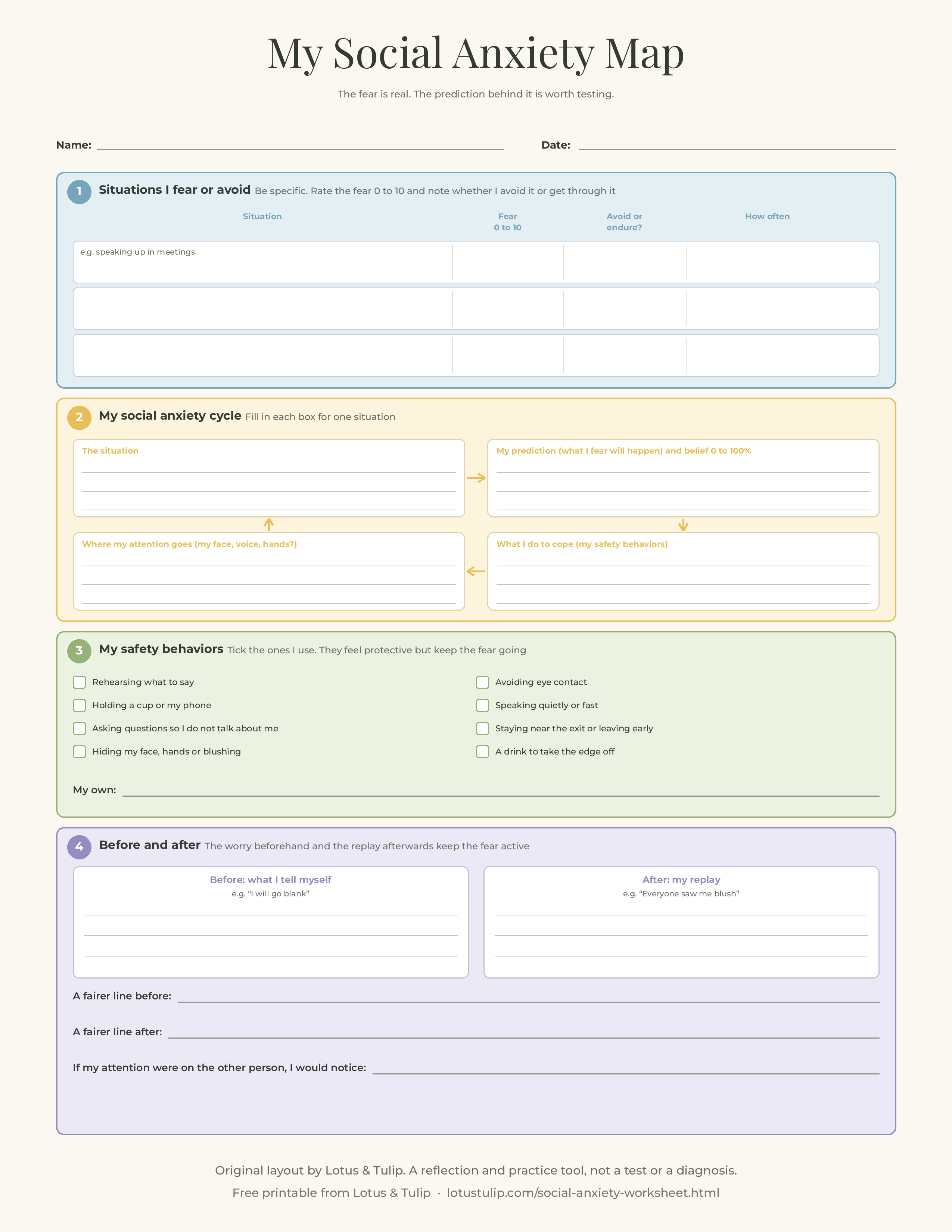
Before and after. Worry in the days before a situation and a detailed replay afterwards, often called the post-mortem, keep the fear active and tend to remember the moment as worse than it was. Page 1 of the worksheet maps each of these parts.
Others notice less than we think. In a well known experiment, Thomas Gilovich, Victoria Medvec and Kenneth Savitsky (2000) asked students to walk into a room wearing a T-shirt they found embarrassing. The wearers estimated that about half of the people in the room would notice it; in fact only about a quarter did. They called this the spotlight effect. The study was about everyday embarrassment, not social anxiety disorder, but it captures a key idea: the spotlight feels brighter from the inside.
What the treatment research shows
Individual CBT has the strongest evidence. Evan Mayo-Wilson and colleagues (2014) ran a network meta-analysis of 101 trials with 13,164 adults with social anxiety disorder. Compared with a waiting list, individual CBT had the largest effect of any psychological intervention (standardized mean difference -1.19), followed by group CBT (-0.92), exposure and social skills (-0.86) and supported self-help (-0.86). Unsupported self-help also helped (-0.75), though less. Individual CBT was the only psychological treatment that beat a psychological placebo, and the authors concluded it should be regarded as the best initial treatment. Among medications, SSRIs and SNRIs had the most consistent evidence for people who decline therapy.
Guidelines agree. The UK National Institute for Health and Care Excellence (NICE, 2013, CG159) recommends individual CBT developed specifically for social anxiety, based on the Clark and Wells or the Heimberg model, as the first choice for adults.
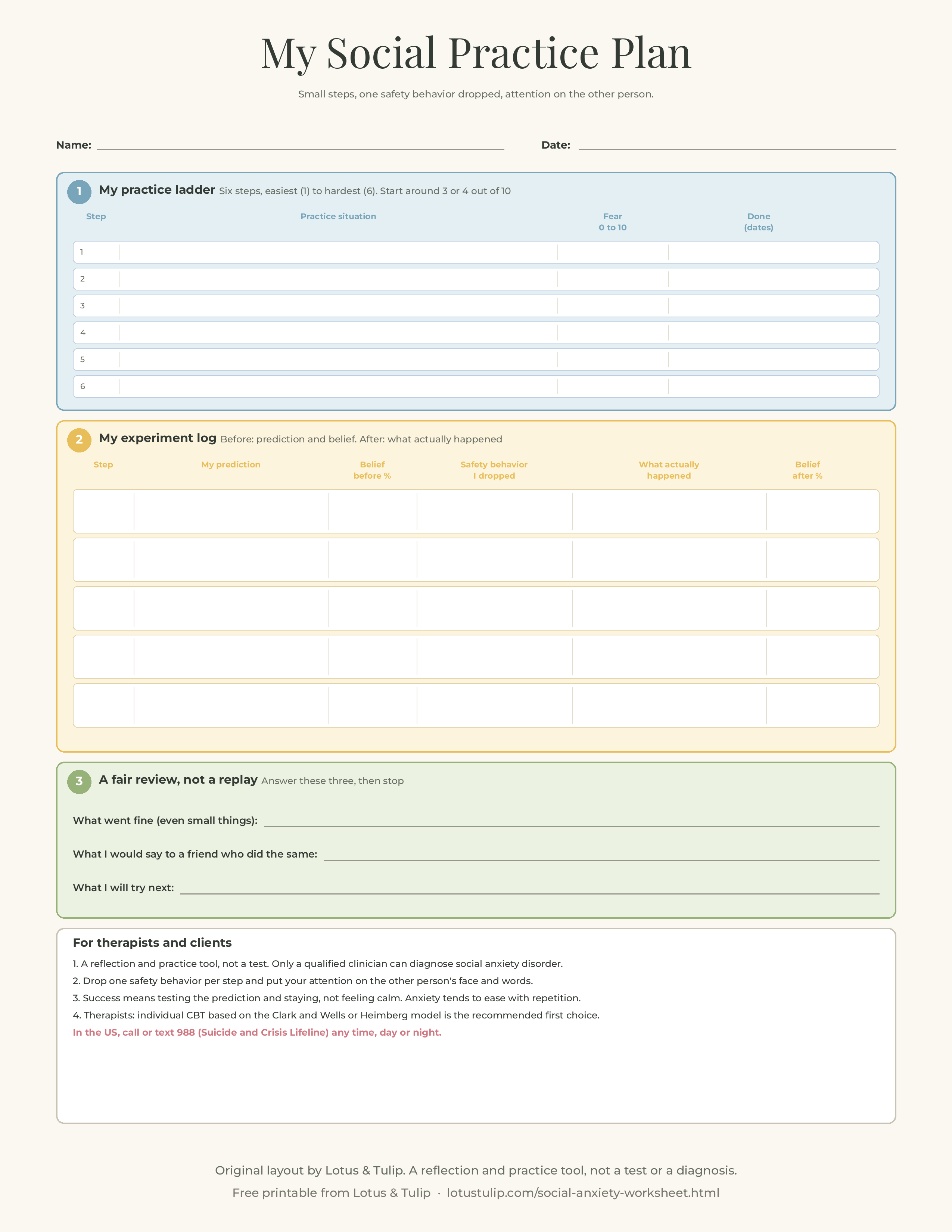
Dropping safety behaviors matters. In an early experiment, Adrian Wells and colleagues (1995) found that brief exposure while deliberately dropping safety behaviors reduced anxiety and belief in feared outcomes more than the same exposure on its own. Freda McManus, Catarina Sacadura and David Clark (2008) later tested this experimentally, asking people to increase or decrease their safety behaviors during a conversation, and concluded that safety behaviors act as a maintaining factor: using more of them went with more anxiety and stronger belief in feared outcomes. This is why page 2 asks you to plan which safety behavior to drop in each practice step.
The honest caveats. The trials test full therapy programs, not single worksheets, and there is no trial of this worksheet. Many studies compare treatments with a waiting list, which tends to inflate effects. Self-help with some support did well in the meta-analysis, but severe or long standing social anxiety deserves a proper assessment. This worksheet borrows the common ingredients of CBT: understanding the cycle, shifting attention outward, dropping safety behaviors, testing predictions in gradual steps and reviewing outcomes fairly.
How to use a social anxiety worksheet, step by step
- List the situations you fear or avoid. On page 1, write three specific situations, rate the fear from 0 to 10 and tick whether you avoid them or endure them. "Making a phone call to book a dentist" is more useful than "phones".
- Write your prediction. For one situation, write exactly what you fear will happen and how much you believe it, from 0 to 100%. "I will go red, stumble over my words and they will think I am incompetent: 80%."
- Notice where your attention goes. Write what you focus on in the moment: your face, your voice, your hands, how you imagine you look. Most people find their attention is almost all on themselves.
- List your safety behaviors. Write what you do to get through: rehearsing, avoiding eye contact, holding something, speaking quietly, staying near the exit, a drink to take the edge off. Be honest; these are the targets.
- Map the before and after. Write what you tell yourself in the hours before and what the replay sounds like afterwards. Then write one fairer line for each.
- Build a practice ladder. On page 2, list six practice steps from easiest to hardest, with a fear rating for each. Start where the fear is around 3 or 4 out of 10, such as asking a store worker where something is, and work up. The exposure hierarchy worksheet goes deeper on building ladders.
- Plan each step as an experiment. For the step you will try, write the prediction, the belief rating, the safety behavior you will drop and where you will put your attention instead: the other person's face and words.
- Do it, then log what actually happened. Straight after, write what happened, what others actually did, and your new belief rating. The behavioral experiment worksheet uses the same logic for any anxious prediction.
- Review fairly instead of replaying. Answer three questions: what went fine, what would I say to a friend who did the same, and what will I try next. Then move up the ladder when a step feels manageable. The self compassion worksheet helps when the inner critic is loud.
When the fear centers on not knowing what to say, the conversation skills worksheet adds simple practice for openers and follow up questions, and the assertiveness worksheet helps with saying no and asking for what you need.
Common mistakes
- Practicing with safety behaviors still on. Going to the party but staying glued to your phone teaches you that the phone saved you. Drop one safety behavior per step.
- Starting too high on the ladder. A first step at 9 out of 10 often ends in escape, which strengthens the fear. Start lower and repeat.
- Judging success by how anxious you felt. The goal is to test the prediction and stay in the situation, not to feel calm. Anxiety usually drops with repetition, not on the first try.
- The detailed post-mortem. Replaying every moment trains your memory to keep the worst version. Use the three review questions, then stop.
- Going it alone when it is severe. If social anxiety keeps you from work, school or relationships, or comes with depression, heavy drinking or thoughts of self-harm, see a therapist or doctor. CBT with a trained clinician has the strongest evidence.
Examples
- The new manager: Dreaded speaking in team meetings. Prediction: "My voice will shake and they will see I am not cut out for this, 75%." Safety behaviors: reading from notes word for word, no eye contact, speaking fast. Practice step: give a two sentence update from bullet points while looking at two colleagues. Outcome: one person nodded, another asked a follow up question. New belief rating: 40%.
- The graduate student: Avoided phone calls for years and let important calls go to voicemail. Ladder from calling a store to ask opening hours (fear 3) up to calling a professor's office (fear 8). Safety behavior dropped: writing a full script. After two weeks of one call a day, the opening hours call no longer rated above 1.
- The parent at school pickup: Stood apart and looked at her phone to avoid small talk, then felt left out. Her map showed her attention was all on whether she looked awkward. Experiment: put the phone away and ask one other parent a question about the upcoming field trip, with attention on their answer. Prediction: "They will think I am weird, 70%." Outcome: a five minute chat and an offer to share rides. Review line: "I did not say anything brilliant, and it went fine."
Free social anxiety worksheet for adults
This free printable is an original Lotus & Tulip layout on US Letter, in our own wording, not the items of any clinical scale. Page 1, My Social Anxiety Map, has a table for the situations you fear or avoid with a fear rating, a four box map of the cycle (the situation, my prediction, where my attention goes, what I do to cope), a safety behaviors checklist with space for your own, and a before and after section for anticipatory worry and the replay. Page 2, My Social Practice Plan, has a six step practice ladder, an experiment log with the prediction, belief before, safety behavior dropped, what actually happened and belief after, a fair review section and short notes for therapists and clients.
Download the free social anxiety worksheet (PDF, 2 pages, US Letter)
Prefer single images? Page 1: my social anxiety map (PNG) · Page 2: my social practice plan (PNG)
Free to print for use with your own clients or for yourself. Please link to this page rather than re-uploading the file. A reflection and practice tool, not a test, a diagnosis or a substitute for therapy. In the US, call or text 988 in a crisis.
Related resources
- How to make friends as an adult: one repeated context, a small first move and a follow-up
- Exposure hierarchy worksheet: build a step by step fear ladder
- Behavioral experiment worksheet: test an anxious prediction
- Conversation skills worksheet: openers, follow up questions and practice
- Loneliness worksheet: when avoiding people leaves you disconnected
- Cognitive distortions worksheet: mind reading and fortune telling
- Social anxiety activities for teens: the school counselor version
- All therapist worksheets: CBT, DBT, ACT and more
FAQ
What is a social anxiety worksheet?
A social anxiety worksheet is a structured page that helps you map the situations you fear, the predictions you make, where your attention goes and the safety behaviors you use, and then plan gradual practice that tests those predictions. Therapists use them in CBT for social anxiety, and adults can use them on their own.
Is social anxiety the same as being shy?
No. Shyness is a common temperament and is not a problem in itself. Social anxiety disorder involves marked, lasting fear of being judged that leads to avoidance or intense distress and gets in the way of daily life. Only a qualified clinician can diagnose it.
What is the best treatment for social anxiety in adults?
A network meta-analysis of 101 trials found individual cognitive behavioral therapy had the largest effect of the psychological treatments studied, and the NICE guideline recommends individual CBT designed for social anxiety as the first choice for adults. SSRIs and SNRIs had the most consistent evidence among medications. A doctor or therapist can help you choose.
What are safety behaviors in social anxiety?
Safety behaviors are things people do to prevent a feared social outcome, such as rehearsing what to say, avoiding eye contact, holding a drink to hide shaking or leaving early. They feel protective, but research suggests they keep anxiety going because they stop you learning that the feared outcome would not have happened anyway.
Is this social anxiety worksheet free?
Yes. It is free to print for use with your own clients or for yourself. Please link to this page rather than re-uploading the file.
Sources
- American Psychiatric Association. (2022). Diagnostic and statistical manual of mental disorders (5th ed., text rev.). American Psychiatric Association Publishing.
- Clark, D. M., and Wells, A. (1995). A cognitive model of social phobia. In R. G. Heimberg, M. R. Liebowitz, D. A. Hope, and F. R. Schneier (Eds.), Social phobia: Diagnosis, assessment, and treatment (pp. 69 to 93). Guilford Press.
- Gilovich, T., Medvec, V. H., and Savitsky, K. (2000). The spotlight effect in social judgment: An egocentric bias in estimates of the salience of one's own actions and appearance. Journal of Personality and Social Psychology, 78(2), 211 to 222.
- Kessler, R. C., Berglund, P., Demler, O., Jin, R., Merikangas, K. R., and Walters, E. E. (2005). Lifetime prevalence and age-of-onset distributions of DSM-IV disorders in the National Comorbidity Survey Replication. Archives of General Psychiatry, 62(6), 593 to 602.
- Mayo-Wilson, E., Dias, S., Mavranezouli, I., Kew, K., Clark, D. M., Ades, A. E., and Pilling, S. (2014). Psychological and pharmacological interventions for social anxiety disorder in adults: A systematic review and network meta-analysis. The Lancet Psychiatry, 1(5), 368 to 376.
- McManus, F., Sacadura, C., and Clark, D. M. (2008). Why social anxiety persists: An experimental investigation of the role of safety behaviours as a maintaining factor. Journal of Behavior Therapy and Experimental Psychiatry, 39(2), 147 to 161.
- National Institute for Health and Care Excellence. (2013). Social anxiety disorder: Recognition, assessment and treatment (Clinical guideline CG159).
- National Institute of Mental Health. Social anxiety disorder (statistics page, based on the National Comorbidity Survey Replication).
- Rapee, R. M., and Heimberg, R. G. (1997). A cognitive-behavioral model of anxiety in social phobia. Behaviour Research and Therapy, 35(8), 741 to 756.
- Wells, A., Clark, D. M., Salkovskis, P., Ludgate, J., Hackmann, A., and Gelder, M. (1995). Social phobia: The role of in-situation safety behaviors in maintaining anxiety and negative beliefs. Behavior Therapy, 26(1), 153 to 161.