
Social skills · Kids, teens and adults · Updated 2026-11-13
Conversation skills worksheet: the parts of a conversation, what research shows, and how to practice in real life (free printable)
Social skills group: Social Skills Small Group Curriculum, Grades 2 to 5, 8 sessions with lesson plans and student pages Holiday 20% off: about $11.04, was $14 (EUR 12) · instant digital download
Buy on EtsyAges 5 to 11: Kids Feelings and Social Skills Worksheets, incl. joining in and starting a chat with conversation starters Holiday 20% off: about $11.04, was $14 (EUR 12) · fillable PDF, instant digital download
Buy on EtsyTry it free first: download a fillable sample (feelings thermometer and calm-down plan, PDF, 240 KB). Type into it on screen, then get the full pack. No email needed.
When worry gets in the way: CBT Worksheets for Therapists, 20 pages including thought records and core beliefs Holiday 20% off: about $11.04, was $14 (EUR 12) · fillable PDF, instant digital download
Buy on EtsyTry it free first: download a fillable sample (thought record and evidence for and against, PDF, 105 KB). Type into it on screen, then get the full pack. No email needed.
A student answers every question with one word, then walks away. A teen talks for ten minutes about trains and never notices the other person checking the clock. An adult with social anxiety rehearses every sentence in their head and comes home sure it went badly. These are different problems, but they share one thing: a conversation is a back and forth, and the back and forth can be learned.
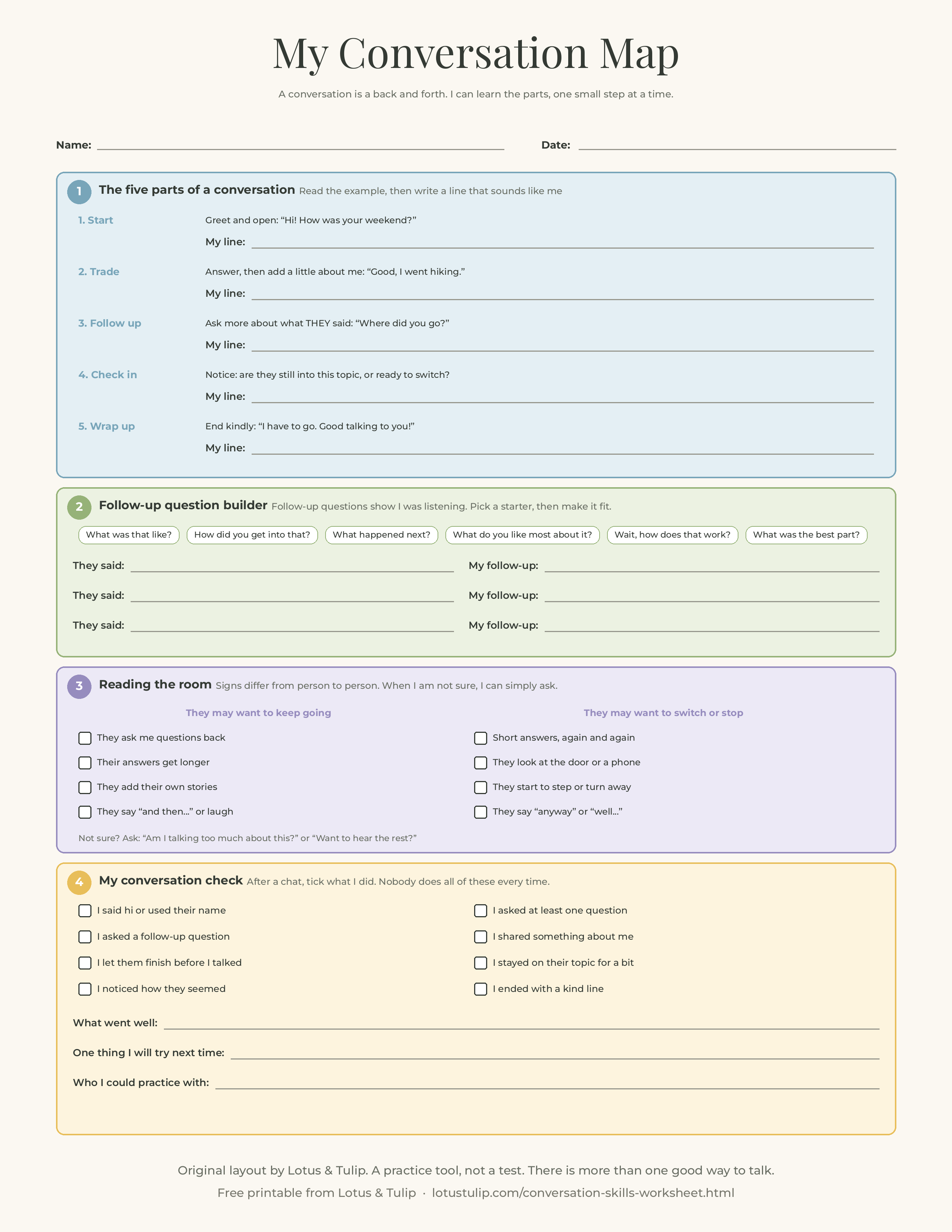
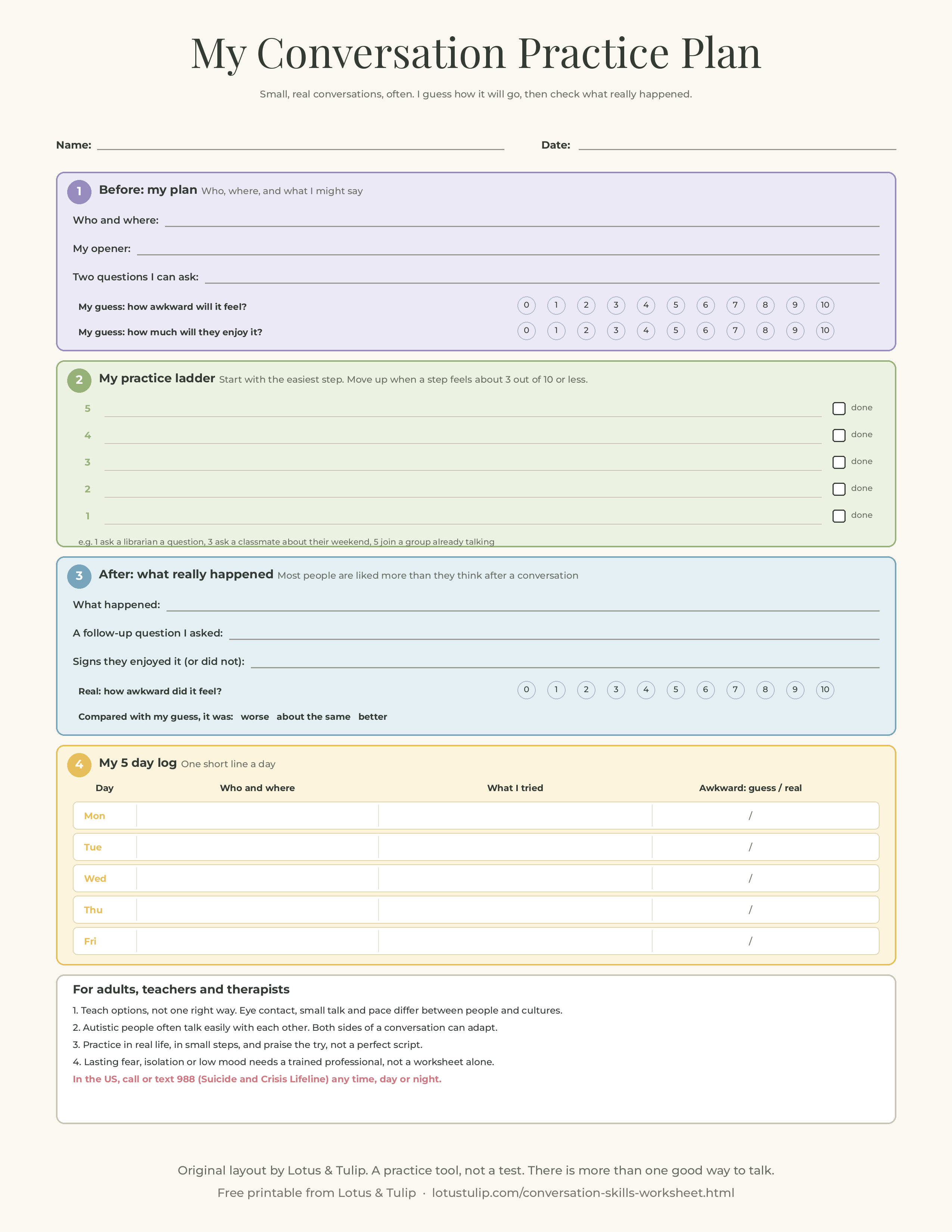
This guide is for school counselors, speech language pathologists, teachers, therapists and parents, and for teens and adults working on this themselves. It covers the parts of a conversation, what research actually shows about what makes talk go well, the fair criticism of social skills teaching, nine steps, common mistakes and examples. It ends with a free 2 page printable: My Conversation Map, which breaks a conversation into five parts and builds follow-up questions, and My Conversation Practice Plan, a small steps ladder that checks predictions against what really happened.
Download the free conversation skills worksheet (PDF, 2 pages, US Letter)
Direct download, no email or sign up. See the pages first.
The five parts of a conversation
Most conversation skills programs break talk into a few teachable parts. The free worksheet uses five:
- Start. A greeting and an opener that fits the place: "Hi! How was your weekend?" or a comment on something you share, such as the class, the weather or the line you are both in.
- Trade. Answer, then add a little about yourself, and hand the turn back. The UCLA PEERS program calls this trading information: the goal is to find common interests, not to give a speech or run an interview.
- Follow up. Ask more about what the other person just said: "Where did you go?" "How did you get into that?" This is the part with the strongest research behind it (see below).
- Check in. Notice whether the other person is still interested in the topic or ready to switch. When the signs are unclear, asking is a skill too: "Am I talking too much about this?"
- Wrap up. End kindly instead of vanishing: "I have to get to class. Good talking to you!"
What the research shows
Turn taking is fast and universal. Stivers and colleagues (2009) timed answers to yes or no questions in recorded everyday conversations in 10 languages, from English and Japanese to small indigenous languages. In every language, people avoided talking over each other and kept silences short; the most common gap before an answer was between 0 and 200 milliseconds, and language averages differed by only a few hundred milliseconds. That speed is one reason conversation can feel overwhelming for people who need more processing time, and why slowing practice down helps.
Follow-up questions make people like you more. Huang, Yeomans, Brooks, Minson and Gino (2017) studied live get to know you chats and speed dating. People who asked more questions, especially follow-up questions, were liked more, because they came across as more responsive: listening, understanding and caring. Speed daters who asked more follow-up questions were more likely to get a second date. People did not predict this effect, which is a good reason to teach it directly.
We are liked more than we think. In several studies, Boothby, Cooney, Sandstrom and Clark (2018) found that after a conversation, people consistently underestimated how much their partner liked them and enjoyed the talk. The researchers called this the liking gap. It showed up in short and long chats, in a lab, in a workshop and among college dorm mates over months. The practice plan uses this: guess first, then check what really happened.
Deeper talk goes better than expected. Kardas, Kumar and Epley (2022) ran a series of experiments where strangers discussed shallow or deeper questions. Both felt less awkward and more connecting than people predicted, and the gap was biggest for deep talk, because people underestimated how much a stranger would care about what they shared.
Structured practice can help. In a randomized trial with 28 autistic teens and their parents, Laugeson and colleagues (2012) found that the 14 week PEERS program, which teaches conversation skills through short lessons, role play and real world homework, improved social skills knowledge, social responsiveness and how often teens got together with peers, with teacher ratings also improving and gains kept at a 14 week follow-up. It was a small trial of one program, but it supports teaching conversation in small, practiced steps with real world practice.
For social anxiety, the problem is often not a lack of skill. The cognitive model of Clark and Wells (1995) describes how anxious people focus attention inward, monitor how they come across and use safety behaviors such as rehearsing sentences or keeping answers short. Those habits make conversations feel worse and can make the person seem less warm. For this group, the work is less about learning lines and more about turning attention outward and testing fears, often with CBT.
The fair criticism
There is no single correct way to talk. Eye contact, small talk, pace and how much people share vary across people, families and cultures. Teaching one style as "right" can teach a child that their natural way of talking is wrong.
Communication is two sided. Autistic researcher Damian Milton (2012) described the double empathy problem: when autistic and non autistic people misunderstand each other, the difficulty runs both ways. In a study by Crompton and colleagues (2020), a story passed along chains of eight people kept as much detail in all autistic chains as in all non autistic chains; detail dropped faster, and rapport was lower, in mixed chains. Good conversation teaching gives people options and teaches both sides to adapt, rather than training masking or forced eye contact.
The honest caveat. There is no trial of this worksheet. Use it to structure practice that has better support, such as group social skills programs, role play with real world homework, and CBT for social anxiety.
How to use a conversation skills worksheet, step by step
- Find the real goal. Ask what the person wants: to make a friend, to talk at lunch, to get through a job interview, to feel less anxious. Some people are happy talking less, and that is fine.
- Spot the sticking point. Is it starting, keeping it going, noticing the other person or ending? Or is it fear? A skill gap and an anxiety problem need different help.
- Teach the five parts. Go through page 1 together. For each part, read the example, then write a line that sounds like the person, not like a script from a book.
- Build follow-up questions. Take turns: one person shares a sentence about their day, the other picks a starter and asks a follow-up. Aim for two or three follow-ups before switching topics.
- Talk about reading the room. Go through the signs in both columns, and stress that signs differ between people. Practice the check in question for when you cannot tell.
- Role play, then swap roles. Practice a short chat in session, with the adult sometimes giving short answers so the learner can practice checking in or wrapping up kindly.
- Build a practice ladder. On page 2, list five real conversations from easiest to hardest. Start where it feels about 3 out of 10 or less.
- Guess, then check. Before each practice, rate how awkward it will feel and how much the other person will enjoy it. Afterward, rate what really happened. Over a week the gap between guess and reality often becomes the most convincing lesson.
- Log and review. Use the 5 day log and the conversation check. In review, praise what went well first, then pick one thing to try next time.
For younger kids, pair this with the whole body listening worksheet and the expected vs unexpected behavior worksheet. For teens and adults with social fear, see the social anxiety worksheets for teens.
Common mistakes
- Teaching scripts only. Memorized lines break as soon as the other person goes off script. Teach the parts and practice flexible versions.
- Forcing eye contact. For many autistic people, eye contact is uncomfortable and makes listening harder. Looking near the face, or simply showing interest with words, works too.
- Turning questions into an interview. Ten questions in a row can feel like a quiz. Trade: answer, add something about yourself, then ask.
- Practicing only in the office. Skills learned in session often do not carry over by themselves. Real world homework, like the ladder, is where change shows up.
- Missing anxiety or low mood. If someone knows what to say but freezes, or avoids people because they feel worthless or hopeless, treat that directly with a trained professional.
Examples
- Grade 4 student, one word answers: Goal: answer and add one thing. Practice line: "Good. I went to my cousin's. What did you do?" Ladder step 1: answer the lunch aide's question with an add on. Logged: did it three days out of five.
- Teen who talks at length about one interest: Goal: check in after a few turns. Line: "Okay, that is enough trains from me. What are you into?" Guess: they will be bored, 8 out of 10. Real: the friend asked two questions about trains, 3 out of 10.
- Adult with social anxiety, new job: Goal: one short chat in the break room each day without rehearsing. Opener: "Is that coffee any good?" Follow-up asked: "How long have you worked here?" Awkward guess 9, real 4. Next step: join the team at lunch once.
Free conversation skills worksheet
This free printable is an original Lotus & Tulip layout on US Letter, in our own wording. Page 1, My Conversation Map, walks through the five parts of a conversation (start, trade, follow up, check in and wrap up) with an example and space for my own line, a follow-up question builder with six starters, a reading the room section with signs to keep going or switch, and a conversation check to tick after a chat. Page 2, My Conversation Practice Plan, has a before plan with guesses on a 0 to 10 scale, a five step practice ladder, an after section that compares the guess with what really happened, a 5 day log and notes for adults, teachers and therapists, including the US 988 crisis line.
Download the free conversation skills worksheet (PDF, 2 pages, US Letter)
Prefer single images? Page 1: my conversation map (PNG) · Page 2: my conversation practice plan (PNG)
Free to print for use with your own students, clients or yourself. Please link to this page rather than re-uploading the file. A practice tool, not a test or a diagnosis. In the US, call or text 988 in a crisis.
Related resources
- How to make friends as an adult: turning a good conversation into a friendship, with a free plan
- Social anxiety worksheet for adults: when fear of being judged, not skill, is what holds you back.
- Loneliness worksheet for adults: when the hard part is feeling disconnected, with a free loneliness map and plan
- Social skills worksheets for kids: skill gaps vs performance gaps and skills by age
- Friendship worksheets for kids: joining in, repair and healthy friendships
- Social skills activities for teens: group chats, joining groups and repair after awkward moments
- Whole body listening worksheet: a flexible listening plan, without forced eye contact
- Social anxiety worksheets for teens: when fear, not skill, is the barrier
FAQ
What are conversation skills?
Conversation skills are the parts of a back and forth talk: starting, answering and adding something, asking follow-up questions, noticing how the other person is doing, changing topics and ending kindly. They can be taught and practiced at any age.
How do you teach conversation skills to kids?
Break a conversation into a few parts, model each one, practice with role play and games, then give small real world practice steps such as asking a classmate one question at lunch. Praise the try, and teach options rather than one right way to talk.
What is a good follow-up question?
A question about what the other person just said, such as "What was that like?" or "How did you get into that?" Research by Huang and colleagues (2017) found that people who ask more follow-up questions are better liked, because they come across as listening and caring.
Can adults improve conversation skills?
Yes. Adults can use the same parts and the practice ladder. If anxiety is the main barrier, guessing how a conversation will go and then checking what really happened can be especially useful, since people tend to underestimate how much others like them after a talk.
Should autistic kids be taught eye contact?
It should not be forced. Many autistic people find eye contact uncomfortable, and research on the double empathy problem suggests conversation difficulties run both ways. Teach other ways to show interest, and help both sides adapt.
Is this conversation skills worksheet free?
Yes. It is free to print for use with your own students, clients or yourself. Please link to this page rather than re-uploading the file.
Sources
- Boothby, E. J., Cooney, G., Sandstrom, G. M., and Clark, M. S. (2018). The liking gap in conversations: Do people like us more than we think? Psychological Science, 29(11), 1742 to 1756.
- Clark, D. M., and Wells, A. (1995). A cognitive model of social phobia. In R. G. Heimberg, M. R. Liebowitz, D. A. Hope and F. R. Schneier (Eds.), Social Phobia: Diagnosis, Assessment, and Treatment (pp. 69 to 93). Guilford Press.
- Crompton, C. J., Ropar, D., Evans-Williams, C. V. M., Flynn, E. G., and Fletcher-Watson, S. (2020). Autistic peer-to-peer information transfer is highly effective. Autism, 24(7), 1704 to 1712.
- Huang, K., Yeomans, M., Brooks, A. W., Minson, J., and Gino, F. (2017). It doesn't hurt to ask: Question-asking increases liking. Journal of Personality and Social Psychology, 113(3), 430 to 452.
- Kardas, M., Kumar, A., and Epley, N. (2022). Overly shallow?: Miscalibrated expectations create a barrier to deeper conversation. Journal of Personality and Social Psychology, 122(3), 367 to 398.
- Laugeson, E. A., Frankel, F., Gantman, A., Dillon, A. R., and Mogil, C. (2012). Evidence-based social skills training for adolescents with autism spectrum disorders: The UCLA PEERS program. Journal of Autism and Developmental Disorders, 42(6), 1025 to 1036.
- Milton, D. E. M. (2012). On the ontological status of autistic people: The "double empathy problem". Disability and Society, 27(6), 883 to 887.
- Stivers, T., Enfield, N. J., Brown, P., et al. (2009). Universals and cultural variation in turn-taking in conversation. Proceedings of the National Academy of Sciences, 106(26), 10587 to 10592.